When people talk about the ethical treatment of animals, they tend to hash it out in terms of consciousness.
But figuring out whether animals have consciousness, and figuring out what consciousness even is, are philosophical problems so hard they may be impossible to solve.
There’s not much common ground. The main thing people are generally willing to agree on is that since they themselves are conscious, other humans are probably conscious too, since other humans behave more or less like they do and are built in more or less the same way.
So a better question might be whether or not animals feel specific emotions, especially fear and pain.
The cybernetic paradigm gives a pretty clear answer to this question: Anything that controls threat and danger has an error signal that is equivalent to fear. And anything that controls injury has an error signal that is equivalent to pain.
This allows us to say with some confidence that animals like cows and rats feel fear, pain, and many other sophisticated emotions.
There’s no reason to suspect that a cow or a rat’s subjective experience of fear is meaningfully different from a human’s. We can’t prove this, but we can appeal to the same intuition that tells you that since you are conscious, other humans are probably conscious as well.
You believe that other humans feel fear, and that their fear is as subjectively terrifying to them as your fear is to you, for a simple reason: you notice that another person’s external behavior is much the same as yours is when you feel afraid, and is happening under similar circumstances. Then, you make the reasonable assumption that since all humans are biologically similar to one another, their external behavior is likely caused by similar internal rules and structures. Since there’s no reason to suspect that basically the same behavior created by basically the same structures would be any different phenomenologically, you conclude that other humans probably have the same kind of subjective experience.
With a better model for the emotions, this same logic can extend to other animals. Assuming we are right that a cow also has a governor dedicated to keeping it safe, which generates an error signal of increasing strength as danger increases, which drives behavior much like the behavior we engage in when we are afraid, there is little reason to suspect that the cow’s subjective experience is meaningfully different from our own. At the very least, if you accept the conclusion for humans, it’s not clear why you would reject it for other animals.
This is a relatively easy conclusion to draw for other complex, social mammals. They almost certainly feel fear and pain, because we see the outward signs, and because the inside machinery is overall so similar. But it’s harder to tell as animals become less and less closely related to humans.
An animal that doesn’t bother to avoid danger or injury clearly isn’t controlling for them. But most animals do. So the question is whether these animals actually represent danger and injury within a control system, trying to minimize some error, or if they simply avoid danger and injury through stimulus-response.
Dogs probably feel fear, and even without dissecting their brains, we can reasonably assume that they use similar mechanisms as we do. They’re built on the same basic mammalian plan and inherit the same hardware. But what about squid, or clams? These animals probably avoid danger in some way, but it’s not clear that they use an approach at all like the one we do.
If an animal cybernetically controls for danger and injury, then they are producing an error signal. In this case, the argument from above applies — there’s no reason to suspect that a creature using the same algorithms to accomplish the same thing is having a notably different experience. Their error signal is probably perceived as an emotion similar to our emotions.
But if an animal’s reaction to danger is instead a programmed response to a set stimulus, then there is no control system, no feedback loop, and no error signal.
For example, we might encounter an arthropod that freezes when we walk nearby. At first this looks like a fear response. We imagine that the arthropod is terrified and trying to avoid being seen and eaten.
But through trial and error, we show that whenever a shadow passes over it, the arthropod always freezes for exactly 2.5 seconds. Let’s further say that the arthropod shows no other signs of danger avoidance. If you “threaten” it in other ways, put it in other apparently dangerous situations, it changes its behavior not at all. The only thing it responds to is a shadow suddenly passing overhead.
ARE YOU CONSCIOUS???
This suggests that, at least for the purposes of handling danger, this arthropod operates purely on stimulus-response. As a result, it probably does not feel anything like the human emotion of fear. Even if we allow that the arthropod is conscious in some sense, its conscious experience is probably very different from ours because it is based on a different kind of mechanism.
Here’s a similar example from Russel & Norvig’s Artificial Intelligence: A Modern Approach. We can’t confirm that what they describe is actually true of dung beetles — it may be apocryphal — but it’s a good illustration of the idea:
Consider the lowly dung beetle. After digging its nest and laying its eggs, it fetches a ball of dung from a nearby heap to plug the entrance. If the ball of dung is removed from its grasp en route, the beetle continues its task and pantomimes plugging the nest with the nonexistent dung ball, never noticing that it is missing. Evolution has built an assumption into the beetle’s behavior, and when it is violated, unsuccessful behavior results.
It’s hard to figure out whether an organism is controlling some variable, or whether it is running some kind of brute stimulus-response, especially if the stimulus-response routine is at all complicated. We may need to develop new experimental techniques to do this.
But every organism has to maintain homeostasis of some kind, and almost all multicellular organisms have a nervous system, which suggests they’re running some kind of feedback loop, which means some kind of error signal, which means some kind of emotion.
For now, we think this is a relatively strong argument that most other mammals experience fear and pain the same way that we do — at least as strong of an argument that other humans experience fear and pain the same way that you experience them.
Figuring out whether you are in danger requires much more of a brain than figuring out whether you have been cut or injured. So while most animals probably feel pain, some animals may not feel fear, especially those with simple nervous systems, those with very little ability to perceive their environment, and those who are immobile. There’s no value in being able to perceive danger if you can’t do anything about it.
Some “artificial intelligence” is designed like a tool. You put in some text, it spits out an image. You give it a prompt, it keeps predicting the following tokens. End of story.
But other “artificial intelligence” is more like an organism. These agentic AI are designed to have goals, and to meet them.
Agentic AI is usually designed around a reward function, a description of things that are “rewarding” to the agent, in the somewhat circular sense that the agent is designed to maximize reward.
Reward-maximizing agents are inherently dangerous, for a couple of reasons that can be stated plainly.
First, Goodhart’s law(“When a measure becomes a target, it ceases to be a good measure.”) means that the goal we intend the agent to have will almost never be the goal it ends up aiming for.
For example, you might want a system that designs creatures that can move very fast. So you give the agent a reward function that rewards the design of creatures with high velocities. Unfortunately the agent responds with the strategy, “creatures grow really tall and generate high velocities by falling over”. This matches the goal as stated, but does not really give you what you want.
Even with very simple agents, this happens all the time. The agent does not have to be very “intelligent” in the normal sense to make this happen. It’s just in the nature of reward functions.
This is also called goal mis-specification. Whatever goal you think you have specified, you almost always specify something else by mistake. When the agent pursues its real goal, that may cause problems.
Second, complexity. Simple goals are hard enough. But anything with complex behavior will need to have a complex reward function. This makes it very difficult to know you’re pointing it in the right direction.
You might think you can train your agent to have complex goals. Let it try various things and say, “yes, more of that” and “no, less of that” until it has built up a reward function that tends to give the behavior we want. This might work in the training environment, but because the reward function has been inferred through training, we don’t know what that reward function really is. It might actually be maximizing something weird. And you might not learn what it’s really maximizing until it’s too late to stop it.
The third and most serious reason is that anything insatiable is dangerous. Something that always wants more, and will stop at nothing to get it, is a problem. For a reward-maximizing agent, no amount of reward can ever be enough. It will always try to drive reward to infinity.
This seems fine
This is part of why AI fears usually center around runaway maximizers. The silly but canonical example is an AI with a reward function with a soft spot for office supplies, so it converts all matter in the universe into paperclips.
The same basic idea applies to any reward maximizer. If the United States Postal Service made an AI to deliver packages, and designed it to get a reward every time a package was delivered, that AI would be incentivized to find a way to deliver as many packages as possible, for the minimum possible descriptions of “deliver” and “packages”, by any means necessary. This would probably lead to the destruction of all humans and soon all life on earth.
But there are reasons to be optimistic.
For starters, the main reason to expect that artificial intelligence is possible is the existence of natural intelligence. If you can build a human-level intelligence out of carbon, it seems reasonably likely that you could build something similar out of silicon.
But humans and all other biological intelligences are cybernetic minimizers, not reward maximizers. We track multiple error signals and try to reduce them to zero. If all our errors are at zero — if you’re on the beach in Tahiti, a drink in your hand, air and water both the perfect temperature — we are mostly comfortable to lounge around on our chaise.
Could an artificial intelligence do THIS?
As a result, it’s not actually clear if it’s possible to build a maximizing intelligence. The only intelligences that exist are minimizing. There has never been a truly intelligent reward maximizer (if there had, we would likely all be dead), so there is no proof of concept. The main reason to suspect AI is possible is that natural intelligence already exists — us.
That said, it may still be possible to build a maximizing agent. If we do, there’s reason to suspect it will be very different from us, since it will be built on different principles. And there’s reason to suspect it would be very dangerous.
A reward maximizer doesn’t need to be intelligent to be dangerous. Maximizing pseudointelligences could still be very dangerous. Viruses are not very smart, but they can still kill you and your whole family.
We should avoid building things with reward functions, since they’re inherently dangerous. Instead, if you must build artificial intelligences, make them cybernetic, like us.
This is preferable because cybernetic minimizers are relatively safe. Once they get to their equivalent of “lying on the beach in Tahiti with a piña colada in hand” they won’t take any actions.
If the United States Postal Service designed an AI so that it minimizes the delivery time of packages instead of being rewarded for each successful delivery, it might still stage a coup to prevent any new packages from being sent. But once no more packages are being sent, it should be perfectly content to go to sleep. It will not try to consume the universe — it just wants to keep a number near zero.
Reward maximizers are always unstable. Even very simple reinforcement learning agents show very crazy specification behaviors. But control systems can be made very stable. They have their own problems, but we use them all the time, in thermostats, cruise control, satellites, and nuclear engineering. These systems work just fine. When control systems do fail, they usually fail by overreacting, underreacting, oscillating wildly, freaking out in an endless loop, giving up and doing nothing, and/or exploding. This is bad for the system, and bad when the system controls something important, like a nuclear power plant. But it doesn’t destroy the universe.
At the most basic level, these two approaches are the two kinds of feedback loops. Cybernetic agents run on negative feedback loops, which generally go towards zero and are relatively safe. Reward-maximizing agents are an example of positive feedback loops, which given enough resources will always go towards infinity, so they’re almost always dangerous. Remember, a nuclear explosion is a classic positive feedback loop. The only reason nuclear explosions stop is that they run out of fuel.
A possible rebuttal to this argument is that even if an agent is happy to move towards a resting state and then do nothing, it will still be interested in gaining as much power as possible so it can achieve its goals in the future. The technical term here is instrumental convergence.
Here we can appeal to observations of the cybernetic intelligences all around us. Humans, dogs, deer, mice, squid, etc. do not empirically seem to spend every second of their downtime maniacally working to gather more resources and power. Even with our unique human ability to plan far ahead, we often seem to use our free time to watch TV.
This suggests that instrumental convergence is not a problem for cybernetic agents. When more power is needed to correct its error, maybe a governor will vote for actions that increase the agent’s power. But if it already has enough power to correct its error, the governor will prefer to correct its error straightaway. This suggests we pursue instrumental goals like “gather more power and resources” mainly when we don’t have the capabilities we need to effectively cover all our drives.
Finally, a few things we should mention.
Cybernetic intelligences can’t become paperclip maximizers, but they can still be dangerous for other reasons. Hitler was not a paperclip maximizer, but even as a mere cybernetic organism, he was still pretty dangerous. So be careful with AI nonetheless.
Cybernetically controlling one or more values is good, natural even. But controlling derivatives (the rate of change in some value) is bad! You will end up with runaway growth that looks almost the same as a reward maximizer. If you design your cybernetic greenhouse AI to control the rate of growth of plants in your greenhouse (twice as many plants every week!), very soon it will need to control the whole universe to give you the number of plants you implicitly requested.
Controlling second derivatives (rate of change of the rate of change) is VERY BAD. Controlling third and further derivatives is right out.
In 1796, Astronomer Royal Nevil Maskelyne noticed that his layabout assistant, David Kinnebrook, was getting measurements of celestial events that were a whole half-second different from his own. Maskelyne told Kinnebrook he had better shape up, but this didn’t help — Kinnebrook’s errors increased to around 8/10 of a second, so Maskelyne fired him.
Later astronomers looked into this more closely and discovered that there was actually nothing wrong with poor Kinnebrook. The issue is that people all have slightly different reaction times. When a star passes in front of a wire, it takes you some very small amount of time to react and record your observation. So when different people look at the same celestial event, they get slightly different results. You might even say that the fault is not in our stars, but in ourselves.
More importantly, these differences aren’t random. Kinnebrook’s measurements were always slightly later than Maskelyne’s, and always later by about the same amount. This is a consistent and personal bias, so they came up with the term “personal equation” to describe these differences.
As astronomers learned to measure these personal equations with more and more accuracy, they found that people can’t distinguish anything less than 0.10 seconds, which eventually spiraled into what has been called the tenth-of-a-second crisis. Further investigation of this effect, combined with similar research in physiology and statistics, eventually led to the invention of a new field: psychology.
The personal equation is frequently mentioned in psychology from the 19th and early 20th century. Edwin G. Boring devoted an entire chapter of his 1929 book to the personal equation, the story of which, he said, “every psychologist knows”. Even as late as 1961, he was writing about “the sacred 0.10 sec.”
Experimental psychology did not even start with experiments of its own; it rather took its problems at first from the neighbouring sciences. There was the physiologist or the physician who made careful experiments on the functions of the eye and the ear and the skin and the muscles, and who got in this way somewhat as by-products interesting experimental results on seeing and hearing and touching and acting; and yet all these by-products evidently had psychological importance. Or there was the physicist who had to make experiments to find out how far our human senses can furnish us an exact knowledge of the outer world; and again his results could not but be of importance for the psychology of perception. Or there was perhaps the astronomer who was bothered with his “personal equation,” as he was alarmed to find that it took different astronomers different times to register the passing of a star. The astronomers had, therefore, in the interest of their calculations, to make experiments to find out with what rapidity an impression is noticed and reacted upon. But this again was an experimental result which evidently concerned, first of all, the student of mental life.
All three of these examples, including the personal equation, are about perception — physiologists studying the sense organs, and physicists studying the limits of those senses. Given this foundation, it will come as no surprise to hear that for most of its history, psychology’s main focus has been perception. Even in the early days of psychology, perception was baked in.
This was most obvious in the earliest forms of psychology. In 1898, E. Bradford Titchener wrote a paper describing the layout of his psychology lab at Cornell. This lab not only had a room for optics, but separate rooms also for acoustics, haptics, and one “taste and smell room”. Olfactometry does not come up much in modern psychology, but the Cornell psychologists of the 1890s had an entire room dedicated to it:
Room 1, the ‘optics room,’ is a large room, lighted from three sides, with walls and ceiling painted a cream. Room 2, intended for the private room of the laboratory assistants, now serves the purposes to which room 12 will ultimately be put. Room 3 is the ‘acoustics,’ room 4 the ‘haptics room.’ Room 5 is a dark room employed for drill-work, demonstration and photography. Room 6 is the ‘work,’ and room 7 the ‘lecture-room’. Room 8 is the director’s private room ; room 9 the ‘reaction,’ and room 10 the ‘taste and smell room’. Room 11, which faces north, will be fitted up as a research dark room; room 12 will be furnished with the instruments used in the investigation of the physiological processes underlying affective consciousness, —pulse, respiration, volume and muscular tone.
Even today, the closest thing to a true law of psychology is the Weber-Fechner law, about the minimum possible change needed to be able to distinguish between two similar stimuli; in other words, about perception. And the most impressive artifacts of psychology are still visual illusions like this one:
The two orange circles are exactly the same size; however, the one on the right appears larger.
During the cognitive revolution, a lot of sacred cows were tipped, but not perception. Instead, perception was reaffirmed as the absolute main topic of psychological study. Ulric Neisser’s 1967 book Cognitive Psychology consists of:
One introductory chapter, titled “The Cognitive Approach”
Five chapters on visual processes
Four chapters on hearing
And one last chapter, about which he says: “The final chapter on memory and thought is essentially an epilogue, different in structure from the rest of the book.”
That’s it!
In a footnote, Neisser apologizes… for not covering the other senses. “Sense modalities other than vision and hearing are largely ignored in this book,” he says, “because so little is known about the cognitive processing involved.” But he doesn’t apologize for skipping over nearly every other aspect of psychology, which seems like a stunning omission.
At least Neisser is self-aware about this. He makes it very clear that he knows many different directions psychology could take, and that he is picking this one, cognition, over all the others. It’s just that he is fully committed to the promise of the cognitive approach, and that means he’s fully committed to the idea that perception should hold center stage — not just top billing, but to the point of excluding other parts of psychology.
Even given psychology’s previous hundred years of focus on perception, this was a pretty radical position. Titchener would probably be scandalized that Neisser didn’t include a chapter on taste and smell.
But the most surprising omission of all might be “individual differences”, the psychologist’s fancy term for personality. Because once upon a time, personality was almost as central to psychology as perception was.
Recall that the personal equation, one of the problems that kicked off psychology in the first place, was itself an idea about individual differences — every individual had a personal difference in their reaction times when looking at the celestial spheres. You can’t have a personal equation without individual differences, so as much as the personal equation came with an interest in the laws of perception, it also came with a committed interest in personality.
Almost as old as the personal equation is the idea of mental tests. Most of the credit and the blame for these goes to Sir Francis Galton. After hearing about the theory of evolution from his cousin, Charles Darwin, Galton started wondering if mental traits ran in families. He became obsessed with measuring differences in people’s minds and bodies, and these ideas directly led to the invention of IQ tests (and also eugenics). These unpleasant grandchildren aside, for a long time mental tests were a really central part of psychology. Until one day they weren’t.
Neisser does offer a defense of his position in the last chapter of his book. We think the final paragraph is especially interesting, where he says:
It is no accident that the cognitive approach gives us no way to know what the subject will think of next. We cannot possibly know this, unless we have a detailed understanding of what he is trying to do, and why. For this reason, a really satisfactory theory of the higher mental processes can only come into being when we also have theories of motivation, personality, and social interaction. The study of cognition is only one fraction of psychology, and it cannot stand alone.
Cybernetics
Norbert Wiener coined the term “cybernetics” in the summer of 1947, but for the full story, we have to go much further back.
Wiener places the earliest origins of these ideas with the 17th century German polymath Gottfried Wilhelm Leibniz. “If I were to choose a patron saint for cybernetics out of the history of science,” Wiener wrote in the introduction to his book, “I should have to choose Leibniz. The philosophy of Leibniz centers about two closely related concepts—that of a universal symbolism and that of a calculus of reasoning. From these are descended the mathematical notation and the symbolic logic of the present day.”
Simple control systems have been in use for more than two thousand years, but things really picked up when Leibniz’ early math tutor, Christiaan Huygens, derived the laws for centrifugal force and invented an early centrifugal governor.
Over the centuries people slowly made improvements to Huygens’ design, most notably James Watt, who added one to his steam engine. These systems caught the attention of James Clerk Maxwell, who in 1868 wrote a paper titled “On Governors”, where he explained instabilities exhibited by the flyball governor by modeling it as a control system.
When explaining why he chose to call his new field “cybernetics”, Wiener wrote, “in choosing this term, we wish to recognize that the first significant paper on feedback mechanisms is an article on governors, which was published by Clerk Maxwell in 1868, and that governor is derived from a Latin corruption of κυβερνήτης.”
Using this background, Norbert Wiener and Arturo Rosenblueth sat down and made the field explicit in the 1940s, and gave it a name. Then in 1948 Wiener published his book Cybernetics: Or Control and Communication in the Animal and the Machine, and the field went public.
The new field went in a number of directions, many of them unproductive, but the one most important to us today is the direction taken up by a certain William T. Powers.
Loop Me In
Psychology and cybernetics were making eyes at each other across the room from the very start. “The need of including psychologists had indeed been obvious from the beginning,” wrote Wiener. “He who studies the nervous system cannot forget the mind, and he who studies the mind cannot forget the nervous system.” And the psychologists returned Wiener’s affections: Kurt Lewin, one of the founders of modern social psychology, attended the first “Macy Conference” on cybernetics, all the way back in 1946, before it was even called cybernetics, and Weiner mentions Lewin (and some other psychologists) by name in his book.
But in the 1940s and 1950s, psychologists felt they were doing pretty all right. Lewin and the social psychologists were a relatively small slice of psychology, the minority faction by far, and their interest didn’t carry much weight. Cybernetics might be nice to flirt with at the party, but there was no real chance of inviting it home.
But fast forward to the 1970s, and psychology was in crisis. For a long time psychology had been ruled by behaviorism, a paradigm which took the stance that while behavior could be studied scientifically, the idea of studying thoughts or mental states was wooly nonsense. Mental states like thoughts and feelings were certainly unworthy of study, and possibly didn’t exist.
Behaviorists also thought that animals are born without anything at all in their brains — that the mind at birth is a blank slate, and that everything an animal learns to do comes from pure stimulus-response learning built up over time.
Behaviorism seemed like a sure bet in the 1920s, but those assumptions were looking more and more shaky every day. People had discovered that animals did seem to have inborn tendencies to associate some things with other things. They learned that you could make reasonable inferences about mental states. And the invention of the digital computer made the study of mental states seem much more scientific. The old king was dying, and no one could agree who was rightful heir to the throne.
it looked exactly like this
The son of a “well-known cement scientist”, William T. Powers wasn’t even a psychologist. His training was in physics and astronomy. But while working at a cancer research hospital, and later while designing astronomy equipment, Powers started pulling different threads together and eventually came up with his own very electrical-engineering-inspired paradigm for psychology, which he called Perceptual Control Theory.
In 1973 Powers published both a book and an article in Science about his ideas. While Powers was obviously an outsider, psychologists took this work seriously. Even in the 1970s, fringe ideas didn’t get published in a journal as big as Science — Powers and his arguments were mainstream, at least for a little while.
Psychologists really thought that cybernetics might be one of the ways forward. Stanley Milgram, who did the famous experiments on obedience to authority — the ones where participants thought they might be delivering lethal electric shocks to a man with a heart condition, but mostly kept increasing the voltage when politely asked to continue — even includes a brief section on cybernetics in his 1974 book about those studies. “While these somewhat general [cybernetic] principles may seem far removed from the behavior of participants in the experiment,” he says, “I am convinced that they are very much at the root of the behavior in question.”
And Thomas Kuhn himself, the greatest authority on crisis and revolution in science (he did write the book on it), wrote a glowing review of Powers’ book, saying:
Powers’ manuscript, “Behavior: The Control of Perception”, is among the most exciting I have read in some time. The problems are of vast importance, and not only to psychologists; the achieved synthesis is thoroughly original and the presentation is often convincing and almost invariably suggestive. I shall be watching with interest what happens in the directions in which Powers points.
But there were a few problems.
The first is that Powers’ work, especially his 1973 Science article, doesn’t exactly make the case that cybernetics is a good way of thinking about psychology. It’s more of an argument that cybernetics is better than behaviorism. The paper is filled with beautiful and specific arguments, but they’re arguments against the behaviorist paradigm. The article is even titled, Feedback: Beyond Behaviorism.
You can see why Powers would frame things this way. As far as he could tell, behaviorism was the system to beat, and his arguments against behaviorism really are compelling.
Unfortunately, by 1973 behaviorism was already on its way out. Six years before, in 1967, Ulric Neisser wrote:
A generation ago, a book like this one would have needed at least a chapter of self-defense against the behaviorist position. Today, happily, the climate of opinion has changed, and little or no defense is necessary. Indeed, stimulus-response theorists themselves are inventing hypothetical mechanisms with vigor and enthusiasm and only faint twinges of conscience.
Powers’ work arrived early enough that psychologists were still interested in what he had to say. They still felt that their field was in crisis, they were still looking around for new tools and new perspectives. They were still willing to publish his paper, and everybody read his book.
But it came late enough in the crisis that there was strong competition. New schools of thought were already mustering their forces, already had serious claims to the throne. People were already picking sides. And most people were already picking cognitive psychology.
It’s not entirely clear exactly why cognitive psychology won, but there are a few things that made its claim especially strong. For one, some of the strongest evidence against behaviorism came from an information theory angle, and this looked really good for cognitive psychology, which proposed that we think of the mind in terms of how it handles and transforms information.
Maybe most importantly, the metaphor of the digital computer promised to provide the objectivity that behaviorism was never able to deliver. Whatever else might be going on in human minds, computers definitely exist, they can add and subtract, and that looks a lot like thinking! Cognitive psychology eventually won out.
which is why all psychologists now look like this
Another problem is that cybernetics is what they call “dynamic”. This is a distinction people don’t usually make any more, but Ulric Neisser gives this definition:
Dynamic psychology, which begins with motives rather than with sensory input, is a case in point. Instead of asking how a man’s actions and experiences result from what he saw, remembered, or believed, the dynamic psychologist asks how they follow from the subject’s goals, needs, or instincts.
Cybernetics makes for a dynamic school of psychology because, however you slice it, control systems are always about getting signals back in alignment, so they’re always about goals (what’s the target value) and needs (which signals are controlled). If you think about psychology in terms of control systems, whatever you come up with is going to be dynamic.
Dynamic theories were very popular in the first half of the 20th century, but they ended up falling out of favor in the back half. Again, we’re not entirely sure why this happened the way it did, but we can provide some reasonable speculation.
The most famous dynamic school of psychology is Freudian psychodynamic therapy. If you’ve ever wondered, this is why it has “dynamic” in the name, because it’s a paradigm that focuses on how people are motivated by drives and/or needs. Freudians originally saw all behavior as motivated by libido, the sex or pleasure principle. But later on they added a second drive or set of drives called mortido, the drive for death.
Most schools of psychology are more dynamic than they would like to admit — even behaviorism. Sure, behaviorists had an extremely reductive understanding of drives (mostly “reward” and “punishment”), but at their heart they were a dynamic school too. Reward and punishment are a theory of motivation; it’s only one drive, but it’s right there, and central to the paradigm. And behaviorists did sometimes admit other drives, most blatantly in Clark Hull’s drive reduction theory, which allowed for drives like thirst and hunger.
Behaviorists have to accept some kind of dynamics because they assume that reward and punishment are behind all behavior, except perhaps the most instinctual. Even if they didn’t tend to think of this as a drive, it’s clearly the motive force that behaviorists used to explain all behavior — organisms are maximizing reward and minimizing punishment.
(In a totally different kind of problem, dynamic psychology is always a bit risky because it’s inherently annoying to speculate about someone’s motives. The Freudians really ran afoul of this one.)
The point is, by the time William Powers was arguing for cybernetics, dynamic psychology was on the downswing. Its reputation was tainted by the Freudians, and maybe it also smelled a bit too much like the behaviorists, with their focus on reward and punishment. This might be another reason why cybernetics was passed over in favor of something that seemed a bit more fresh and promising.
It’s not like people hated cybernetics, but it’s interesting to see how conscious the decision was. Near the end of his book, Neisser says:
An analogy to the “executive routines” of computer programs shows that an agent need not be a homunculus. However, it is clear that motivation enters at several points in these processes to determine their outcome. Thus, an integration of cognitive and dynamic psychology is necessary to the understanding of the higher mental processes.
But the rest of cognitive psychology did not inherit this understanding, and this integration was never carried out; as far as we know it was never even attempted. In any case, dynamic paradigms were out.
Other schools like social psychology, neuroscience, and psychiatry kept going with what they were doing, since they were not seen to be in crisis, and they gained more sway as behaviorism fell apart. Or perhaps a better read on things is that the ground previously held by behaviorism was partitioned, with cognitive psychology gaining the most, social psychologists also receiving a large chunk, clinical psychologists gaining some, etc. Cybernetics received none, and fell into obscurity.
Or possibly it was diluted into a vague branch of the humanities. The full title of Wiener’s book was Cybernetics: Or Control and Communication in the Animal and the Machine. Some anthropologists may have taken the “communication” part too seriously — they started using the term more and more vaguely, until eventually they used it to refer to anything at all involving communication, which is probably where the internet got the vague epithet of “cyberspace”.
Today, psychology generally acts as though drives do not exist. If you look in your textbook you will usually see a brief mention of drives, but they’re not a priority. For example, one psychology textbook says,
All organisms are born with some motivations and acquire others through experience, but calling these motivations “instincts” describes them without explaining how they operate. Drive-reduction theory explains how they operate by suggesting that disequilibrium of the body produces drives that organisms are motivated to reduce.
But the very next sentence concludes:
Neither instinct nor drive are widely used concepts in modern psychology, but both have something useful to teach us.
The subtext in today’s psychology is that there is only one real drive, with two poles, reward and punishment. When psychologists explicitly name this assumption, they call it “the hedonic principle”. Despite any lip service paid to other drives, simple hedonism is the theory of motivation that psychologists actually use.
A cruel irony is that modern cognitive psychology, as far as we can tell, inherited this theory of motivation directly from behaviorism. This is just good ‘ol reward and punishment. Even though they held the cognitive revolution to throw out behaviorism and replace it with something new, they weren’t able to disinherit themselves of some of the sneakier assumptions.
The other funny thing is that when outsiders come up with their own version of psychology, they usually end up including drives. Our favorite example continues to be The Sims. To get somewhat realistic behavior out of their Sims, Maxis had to give them several different drives, so they did. Even psychologists can’t help inventing new drives by accident. If you hang around psychology long enough, you’ll run into various “need for whatever” scales, like the famous need for cognition.
This reminds us a lot of what happened in alchemy. Alchemists were supposed to believe in air, fire, water, and earth, and explain the world in terms of those four elements. But belief in four elements was impossible, and the alchemists told on themselves, because they couldn’t stop inventing new ones. In the preface to his book on chemistry, Lavosier says (emphasis added):
The notion of four elements, which, by the variety of their proportions, compose all the known substances in nature, is a mere hypothesis, assumed long before the first principles of experimental philosophy or of chemistry had any existence. In those days, without possessing facts, they framed systems; while we, who have collected facts, seem determined to reject them, when they do not agree with our prejudices. The authority of these fathers of human philosophy still carry great weight, and there is reason to fear that it will even bear hard upon generations yet to come.
It is very remarkable, that, notwithstanding of the number of philosophical chemists who have supported the doctrine of the four elements, there is not one who has not been led by the evidence of facts to admit a greater number of elements into their theory. The first chemists that wrote after the revival of letters, considered sulphur and salt as elementary substances entering into the composition of a great number of substances; hence, instead of four, they admitted the existence of six elements. Beccher assumes the existence of three kinds of earth, from the combination of which, in different proportions, he supposed all the varieties of metallic substances to be produced.
So likewise, notwithstanding the number of psychologists who have supported the doctrine of reward and punishment, there is not one who has not been led by the evidence of facts to admit a greater number of drives into their theory.
Let’s not beat around the bush. This series is an attempt to introduce a new cybernetic paradigm for psychology, and cause a scientific revolution, just like the ones they had in chemistry and astronomy and physics, just like Thomas Kuhn talked about.
We think that cybernetics will allow an angle of attack on many problems in psychology, and we’re going to do our best to make that case. For example, one of psychology’s biggest hidden commitments is that for most of its history, it has focused on perception, sometimes to the exclusion of everything else. But perception may not be the right way to approach the study of the mind. Problems that remain unsolved for a long time should always be suspected as questions asked in the wrong way.
Cybernetics benefits because it doesn’t have such a strong commitment to perception — instead, it’s dynamic. The fact that dynamics is so different from the perception-based approach that has dominated psychology for most of the 200 years it’s been around seems like reason for optimism.
A lot of what we have to say about cybernetics comes from cyberneticists, especially Wiener and Powers. Some of what we say about psychological drives comes from earlier drive theorists. And some of what we think of as original will probably in fact turn out to be reinventing the wheel. Finally, everything we say comes from treating previous psychology as some mix of thesis, antithesis, and synthesis.
To most psychologists, asking “what emotions do rats have?” would be rather vague. But to a cybernetic psychologist, it makes perfect sense. It also makes sense to ask, “what emotions do rats and humans have in common?” From a cybernetic standpoint, there’s probably a precise answer to such questions.
Some of these questions may be disturbing in new and exciting ways. Are fish thirsty? Again, there may be a precise answer to this question.
There is something new in this work, but it’s also contiguous. We don’t want this to come across as though we’re saying this is unprecedented; this is all firmly grounded in historical traditions, it’s all inspired by things that have come before.
A crucial mood, the “No Really, Seriously, What Is Going On?” mood, the mood of true curiosity. I don’t know if they’ve found the truth, but I can tell they are earnestly looking.
— Emmett Shear
Freeze and Cower
Consider: You are in a terrible situation and your fear governor expects you to die in a horrifying way, -1000 points. There is nothing you can do, so you take the action “freeze and cower”. But instead, you survive and it’s not nearly as bad as expected, only -100 points.
Sounds great, right? Wrong! The sad truth is that as far as the fear governor can tell, “freeze and cower” has just given you +900 points! It is the best action you have ever taken, possibly the best action of all time. It doesn’t matter that the prediction was wrong, that things went badly but not as badly as the worst possible outcome, that’s not how the system works.
Your fear governor has learned that “freeze and cower” is the best action it can take. So whenever you feel fear in the future, it votes that you should freeze and cower, and you usually do. Since (in the modern world) most things you are afraid of do eventually go away if you freeze and cower for long enough, your fear governor continues to believe that “freeze and cower” is a good action, and keeps voting “freeze and cower” up and down the ballot.
This sounds a lot like PTSD. Take for example this description from Scott Alexander’s review of Van der Kolk’s book, The Body Keeps The Score:
Van der Kolk thinks that traumas are much more likely to cause PTSD when the victim is somehow unable to respond to them. Enemy soldiers shooting at you and you are running away = less likelihood of trauma. Enemy soldiers shooting at you and you are hiding motionless behind a tree = more likelihood of trauma. Speculatively, your body feels like its going into trauma mode hasn’t gotten you to take the right actions, and so the trauma mode cannot end.
In the real world PTSD is often more complex, but that added complexity usually makes things worse, not better. For example, a civilian is mostly not afraid of loud noises like fireworks, and the fear governor does not even pay attention. But if you go to war and you learn that loud noises are dangerous, they become something that your fear governor considers its rightful business. You also learn that “freeze and cower” is a great action that always seems to work. So you return to civilian life ready to freeze and cower not only when you encounter the things that have always scared you, but also in response to things that you previously would not have found frightening.
With enough exposure, this response might go away. But not all exposure will be equal. If we play a loud sound, and you freeze and cower, and nothing bad happens, this actually reinforces the response. It’s just more evidence that “freeze and cower” is a good action that is reliably followed by a safe outcome.
Instead, you need to play a loud noise, but quiet enough that you can force yourself to not freeze and cower. Over time, this should teach you that other actions, like “stand there calmly”, are just as good. But it may take a long time for these estimates to balance out. From our example above, “freeze and cower” is valued at +900 safety points. And it only got there because your fear governor expected to die, and then didn’t. So a program of exposure where you get exposed to a little danger at a time will take a long time to catch up.
The really weird implication here is that a faster form of exposure therapy might be to get you to freeze and cower, and then actually hurt you! This would hopefully teach your fear and pain governors that “freeze and cower” has negative value, and it should get you to that conclusion faster. That said, the ethics of actually harming your patients seems questionable.
We can also think a little bit about individual differences. Some people probably have faster or slower learning rates, and this makes them more or less easy to traumatize from a single event.
Remember this equation from earlier? There’s that term α, which is the learning rate. If the learning rate is high, then your opinion of an action will change a lot every time you try that action. So a person with a high learning rate is more likely to become traumatized from a single experience. Just one very good or bad experience with an action would hugely change their estimate of how reasonable it is to take that action. But someone with a low learning rate will only ever change their estimate of an action by a small amount, so would be less likely to get traumatized unless the same outcome happened to them over and over.
Some people have more or less previous experience with the frightening stimuli. If you have a lot of previous experiences with loud noises, then artillery explosions won’t be so unusual, and you probably won’t learn to treat all loud noises as dangerous. But if you grew up in the silence of rural North Dakota, the experience of an artillery barrage might teach a lesson that gets passed on to all loud noises, for lack of experience.
Never Drink Alone
Consider: Drugs often interfere with specific error signals.
Take alcohol, which is especially famous for the way it reduces feelings of shame. When you get drunk, you feel much less shame than you did before, and you might end up doing some very shameless things. It also seems to suppress emotions like fear and thirst, and maybe increases emotions like hunger and exhaustion, which is why you do something dangerous, eat a whole basket of fries, and then pass out.
Imagine a guy named Chris who has just turned 21. He goes out drinking for the first time and he is feeling pretty good. He isn’t feeling ashamed of anything at all, so the alcohol can’t reduce his feelings of shame, because shame is at zero.
A few weeks later, someone finds out a dark secret about Chris’s past and confronts him with it. Now Chris is feeling deeply ashamed. He has plans to go out drinking with friends though, so he still goes to join them. When he lifts the bottle of beer to his lips, he has a very large shame error signal. And when he drinks the alcohol, that shame error is reduced. By his fifth beer, he doesn’t feel ashamed at all.
What does his shame governor learn from this experience? It learns that drinking beer is a great way to reduce its error. This is great news for the shame governor, because there are not many ways to quickly reduce shame. It resolves to vote for Chris to drink beer in the future whenever he feels ashamed.
We see similar patterns across the world of drugs. Caffeine and amphetamines reduce fatigue and hunger. Opiates reduce pain. And MDMA seems to interact somehow with the social emotions — maybe it reduces shame while increasing other drives, ones that make people more social and touchy-feely.
With us so far? Let’s try a more complicated example.
Let’s say you are hanging around one day, feeling pretty ok. All your errors are close to zero, so you’re mostly in alignment. You’re a little chilly, but only a little: your cold governor has an error of 5 points.
You decide to take some amphetamines just for fun, like one does. You’ve never taken amphetamines before, but you feel fine and you have nothing better to do.
Let’s say that amphetamines have only one effect: they immediately change any error you have to zero. This lasts until the amphetamines wear off, at which point the error goes back to whatever it was before. So when you take the amphetamines, your cold error goes to zero for a while, and you no longer feel chilly.
Your cold governor picks up on this. Its job is to generate and keep track of that error, and keep track of ways to reduce that error towards zero. So your cold governor learns that “take amphetamines” reduces its error by about 5 points.
The amphetamines don’t actually change your body temperature (at least not in this hypothetical). They just adjust the error signal and temporarily turn it to zero. But your cold governor isn’t sensitive to this distinction. It’s wired to correct an error term. Anything that corrects the error is still a correction, and is perfect in your governor’s eyes.
It will remember this information, but this factoid doesn’t really matter because the correction is so small. A fairly normal option, like “put on a sweater”, is already valued at 50 points. Even “just stand there and shiver” is valued at 10 points! So your cold governor will remember that amphetamines correct its error a little bit, but it will never vote for amphetamines, since it will always have better options.
Later, you are feeling kind of tired and lonely. Let’s say your tired error is 50 and your loneliness error is 100. You would normally go to sleep when you’re this tired, but you want to go out to see friends. But all your friends happen to be out of town this weekend, and no one is responding to texts. So you’re doubly uncomfortable. You decide to try some amphetamines again, just for laughs.
What happens? Well, your tired error and your loneliness error both go to zero. Your tired and lonely governors dutifully mark this down in their ledgers: amphetamines have a +50 correction for tiredness and +100 correction against loneliness.
From the governors’ point of view, this is pretty good. Their only job is to reduce their error signals — they have no ability or reason to care about anything else. So they consider this drug just as good as or even better than their other options.
Now you are in trouble. Your governors have learned that amphetamines are a really good solution to being tired, and one of the best solutions ever to being lonely. In the future, your tired governor will often vote for you to take amphetamines instead of sleeping, and your loneliness governor will reliably vote for you to take amphetamines instead of anything else. From the governor’s point of view, why leave the house and socialize, which has a small chance of making you slightly less lonely, when you could take amphetamines and immediately feel not lonely at all.
Things will only get worse from here. As these two governors vote for you to take amphetamines, any other governors who happen to be out of alignment will learn the same bizarre lesson.
You get a little lonely, and so your loneliness governor votes for you to take some amphetamines. This time, your hunger governor also happens to be a bit out of alignment; you have an error of 20 for hunger.
When the loneliness governor makes you take amphetamines, your hunger error also goes to zero, and your hunger governor picks up on a new idea: amphetamines reduce hunger by about 20 points! That’s almost as good as a quesadilla. Now the hunger governor will often vote for amphetamines, since as far as it can tell, amphetamines are just as good as food. In fact, it will soon learn that amphetamines are better than food, since they correct its errors so reliably.
It’s probably clear why this is very dangerous. If you take a drug that reduces all error signals, then any governor with a large error signal when you take the drug (you’re hungry, you’re angry, etc.) learns to vote in favor of that drug, because it learns that the drug reduces its error signal. Because the drug reduces every error signal.
If you take the drug over and over, you dig yourself deeper every time. Different systems will be out of alignment each time you take the drug, so more governors will see that the drug corrects their error and will learn to vote for it. Eventually, all governors are voting for the drug — hunger is voting for the drug instead of eating, horny is voting for the drug instead of sex, and so on. And the drug feels pleasurable to take — it causes happiness when it corrects the errors, because correcting errors always causes happiness.
When the drug wears off, the error signal goes right back to where it was before. So you’re still tired, hungry, or whatever else. All you did was waste some hours.
You are now very truly addicted. Or at least, that’s what it looks like to us. If you follow this model to its logical conclusion, you get something that looks very much like addiction.
This fits with the observation that some people can take supposedly addictive drugs without getting addicted. In addition to things like genetic differences, if you don’t have large errors when you take your drugs, you won’t get addicted. If you’re already chair of the psychiatry department at Columbia, there’s not much more that drugs can do for you.
This may have something to do with why drug withdrawal feels like abstract “suffering” rather than bad in any particular way. If you have a serious addiction, then when the drug is taken away, every sense you have for finding something wrong with the world will be firing all at once, so in withdrawl you feel not only hungry and thirsty but also tired/pain/cold/hot/scared/angry/jealous/…
Your governors are always trying to estimate the value of different actions (value in the sense of what effect it will have on the signal they care about). But it’s impossible to accurately estimate the value of an action, like taking a drug, that temporarily sends all errors to zero. These drugs don’t have a true value — they interfere with the signal directly. Since they are so tangential to what your governors are trying to do, they really mess with your normal process of learning.
You are lonely — and smoking a cigarette will extinguish that loneliness for about 30 minutes. When it’s over, you will be just as lonely as before. But if you have no better options, the forces inside you that seek connection will still demand you smoke that cigarette, even against your better judgment. A promising but never-fulfilling solution to a basic desire is the core mechanism of addiction.
Most drugs don’t appear to interfere with every error signal, they only interfere with a few. If alcohol only interferes with your shame and your fear governors, then you would only get addicted to alcohol if you drink when you are ashamed and/or afraid. Your hunger or dominance governors won’t be tricked by alcohol, because it doesn’t mess with their signals.
The model predicts that you’re more likely to get addicted to a drug if you take it when you are out of equilibrium in some way. If you take a drug when all your error signals are near zero, then the drug won’t correct those errors by very much, it can’t. Your governors will learn that taking the drug only corrects their errors a bit, and will probably ignore it. This means that social drinking and social smoking might in fact be safer than other forms of smoking and drinking — the folk wisdom that says “never drink alone” may just be onto something.
This also implies some things about what it means to have an addictive personality, what kinds of people are more likely to get addicted to a substance. People with a high learning rate are more likely to get addicted, because their governors will take a single experience with a drug more seriously.
If two people take cocaine when their fatigue error is at 100 points, the drug sends both of their fatigue errors to zero. The person with the high learning rate estimates that the fatigue correction of cocaine is 80 points, and the person with the low learning rate estimates that the fatigue correction of cocaine is 20 points. Obviously one of these people will be more likely to take cocaine in the future, and will be more prone to a serious runaway addiction.
There are some kinds of addiction that don’t involve an external chemical at all. These addictions must have some other origin, since they don’t come about by directly messing with error signals in the brain. We think these can be explained in a couple of different ways.
First of all, the word “addiction” is used very broadly, to mean something like “a habit I do more than I’m supposed to” or “something I do all the time but I don’t endorse”. Sometimes addiction is just a word for something that’s not socially normal or something that is more extreme than normal.
When someone describes themselves as a sex addict, they are often just someone with an unusually high sex drive. Or when someone says they are addicted to cupcakes, they really just mean that their perfectly natural drive to eat sugar is in conflict with their drives to avoid shame and social stigma. Or when someone appears addicted to video games, but that person is in fact feeding their drive for domination in the only way that won’t get them into serious trouble.
This form of addiction can still be pathological. It’s possible that your drive for sex or for cupcakes is so strong that it prevents you from taking care of your other responsibilities, so strong that it comes to ruin your life. These drives are “natural” in the sense that you were born that way, but that doesn’t make them any less destructive. And it could still be pathological in the sense that it’s the result of illness or damage, like if your drive became unusually strong as a result of some kind of traumatic brain injury. But ultimately this “addiction” is one of your drives performing its functions in the normal way, just in a way that you don’t endorse.
One sign that these cases are extreme forms of normal behavior is that these addictions are all linked to one of the basic drives, like food or sex. Even some behaviors that are viewed as purely compulsive, like pica, may actually be the result of a drive that is not commonly recognized, like the drive to eat enough iron. The people on edible dirt etsy must be spending all that money on dirt for some reason. In comparison, we know that evolution did not give us a natural drive to do lines of cocaine. That’s an unnatural desire, driven by some kind of basic malfunction in the systems that are in charge of learning and motivation.
All that said, there are some kinds of addiction that aren’t obviously linked to any drive, and aren’t the result of drugs. The clearest example is gambling.
This kind of addiction might be explained by simple facts of learning. Gambling seems to be the most addictive when the rewards are really variable and the gambles happen on very short time loops. Or they might be most easily explained by something like time discounting — you can put off the shame of failure by doubling down, at least until you can’t anymore.
But the real lesson here might just be that there could be more than one kind of addiction. The idea of looking for a single explanation for every kind of compulsive behavior is exactly the kind of superficial word-chasing that we should try to avoid.
Bloody Knuckles
Consider: If cutting yourself gives -10 points, but stopping cutting gives +15 points, then your pain governor will consistently vote for you to cut yourself, so it can then vote for you to stop cutting yourself, netting it a cool 5 points. It will do this whenever you are idle enough that there’s nothing more important going on, when nothing else can beat out its votes.
We think of self-harm as pathological, but there may be some part of it that is very normal. There’s a famous study from 2015, where the authors put people alone in a room for 15 minutes, hooked up to a shock generator that they could shock themselves with as much as they want. They had previously felt the shock and said they found it painful, but 67% of men and 25% of women still chose to shock themselves at least once more, instead of sitting in silence for 15 minutes. Men gave themselves more shocks on average (an average of 1.47 shocks) than women (an average of 1.00 shocks), not counting one man who shocked himself 190 times.
This might follow the same logic as other self-harm, just on a smaller scale. If the shock is more startling than truly painful (-1 point), and the relief of not being shocked any more is a bit pleasant (+5 points) then it’s easy enough to end up in a situation where on net you enjoy shocking yourself.
This issue seems important for making cybernetic systems work. You need these numbers to be in the right ratio. Otherwise, you get caught in a loop — stick your head underwater so you get an error, then take it out so that the error is reduced. But self-harm does sometimes happen, meaning that whatever steps our psychology has taken to resolve this issue don’t work perfectly, or don’t work in every situation.
One way to save on energy, and keep an animal from getting too distracted, would be for governors to become dormant when they don’t have a very big error. After all, if they don’t have a big error, there’s not much they need to pay attention to. This seems to fit that trope where someone does something they thought they wanted, then immediately regrets the consequences. Why didn’t they see that coming? Because the governor that disapproves couldn’t get through. It was asleep.
If this is how we’re designed, then before self-harm the pain governor would be partially offline and wouldn’t be able to vote against “cut yourself”. Then it would be fully online for “stop cutting yourself”.
But this doesn’t work for a few reasons. First of all, governors do seem to get some votes even when their errors are at zero, which is obvious from how often they vote against stuff. If you’re nice and warm inside and you don’t want to slog out into the cold to scrape off your car, that’s your cold governor voting against it, even though it doesn’t have any error at the moment.
Pain seems like a governor that should always be at least somewhat awake. Pain is probably strong even if it’s dormant, because its main job is to prevent injury. It needs to be able to vote against dangers to life and limb, even when you’re not currently in any pain. The hunger governor can turn off when you’re not hungry, but the pain governor can’t turn off when you’re not in pain.
More importantly, even if the pain governor were off, then what governor would be voting for you to cut yourself in the first place? Maybe there’s a way to confuse the pain governor to vote for “hurt yourself then stop hurting yourself” but if so, it would need to be online to vote for it. It wouldn’t do that if it were dormant.
Maybe self-harm only works over very short time horizons. Pleasure and pain in the future should be both discounted, they should be counted as less than 100% of their values because the future is uncertain. Even if you expect something good or bad to happen, there’s always some chance that it won’t come through.
If negative events in 1 minute are weighted so that they’re less than positive events in 2 minutes, that could maybe lead to self-harm. Getting cut is 60% of -10 points, stopping getting cut is 80% of +8 points, suddenly the pain governor is happy to vote for one so it can get to the other.
A more straightforward explanation is that some other governor is voting for you to cut yourself, and it’s much more powerful than the pain governor, so it can overrule it. This is most obvious in cases like ritual self-harm, games like chicken or bloody knuckles. In this case, failing to go through with the painful or embarrassing experience would lose the confidence of your community, you would be ashamed, it would show that you were a loser or a coward. These are high enough stakes that other drives are able to out-vote the pain governor.
There might be many governors that could vote for this. For example, there might be an actual drive to harm others, that motivates things like sadism and serial killing. If you have a drive to hurt something, but the only thing you can hurt without consequence is yourself, then this drive might eventually overpower your drive for pain, and you would hurt yourself as a compromise.
Or, maybe the systems set in place to prevent self-harm do work perfectly fine, and so self-harm only happens when something has happened and those systems aren’t working properly, more like depression. If a malfunction makes it so that bad experiences are estimated as less bad than usual, that would make you pretty reckless — and it could mean that you’re willing to hurt yourself to get the benefits of not hurting yourself later.
It is interesting to note that when certain types of paradoxes are fed to the Kalin-Burkhart machine it goes into an oscillating phase, switching rapidly back and forth from true to false. In a letter to Burkhart in 1947 Kalin described one such example and concluded, “This may be a version of Russell’s paradox. Anyway, it makes a hell of a racket.”
But other times, things do not go so well. The inside of your head is like any palace intrigue: factions rise and fall, allies today are enemies tomorrow, and no one is ever fully in control.
Conflict
When your governors want two incompatible goals to be realized at once, the result is conflict.
Conflict can have different outcomes. When the opposing governors are closely matched in force and there’s a binary decision, it will lead to inaction. When they are closely matched in force and there’s a range of behavior, it will lead to half-measures. When one is much stronger, it can lead to countermeasures.
For example, your hunger governors might vote strongly in favor of eating a piece of cherry pie. But like many people, you have internalized the idea that eating cherry pie is a wicked, weak thing to do. So your shame governor votes strongly against it. The votes cancel each other out. You stand in the window of the bakery for a long time, staring at the pie and doing nothing. Here conflict has led to inaction.
A mouse’s hunger governor will vote to approach a feeding bowl (the mouse is hungry and the bowl is full of food), while its pain governor votes to avoid the feeding bowl (which has been rigged to give the mouse painful electric shocks). If these two governors are about equally strong, the mouse might go half way out towards the bowl of food, and no further. When it gets closer, the fear governor becomes more powerful and pushes it back. When it gets further, the fear governor becomes weaker and the hunger governor pushes it forward. Here conflict has led to an intermediate state, half-measures.
Even when one governor is strong enough to win, there can be ongoing conflict. You pull the cookies out of the cupboard because you’re hungry. Shame makes you throw them in the trash. But once they’re in the trash, hunger is in control again. So you fish the cookies out of the trash. This is conflict where the state is countermeasures.
For a real-world example, here’s Henrik Karlsson describing his own experience of a minor conflict:
Our emotions and intuitions are littered with contradictions.
To take a simple example: when I was at the gallery where I worked until last week, my low blood sugar cravings sometimes told me that it was ok to take a pastry from the café. But when I want to feel like a upright person, I don’t believe in taking stuff that isn’t mine. So which is it? If I follow my gut and eat the pastry, I will be true to myself in the moment, while betraying other versions of me.
The experience of conflict is stress. Staring at the pie and doing nothing is a fairly stressful experience. Hovering between fear and hunger is stressful for the mouse. Throwing out the cookies over and over again is no better.
Unlike the errors generated by your governors, stress is not an emotion. It’s a different kind of experience that happens when two or more actions are in direct competition.
It’s easiest to become stressed when two drives are in direct conflict. You want to ask someone out, but you’re afraid of rejection. You want to eat a whole pizza, but you know your family will laugh at you if you do. Here, two drives hold each other in check, there’s tension.
But you can also become stressed when drives are merely in competition. You might want to both go out and see friends (because you are lonely) and stay in and go to sleep (because you are tired). These are both positive desires, but you can’t do both at once, they are mutually exclusive. If they’re both about equally strong, you will do nothing, neither go out nor sleep, and it will be stressful.
And you can become stressed when negative drives are in competition. A witness to an assault must choose between intervening (risking physical harm) or walking away (risking social condemnation as a coward). Both of these outcomes are things they would like to avoid, but they can’t avoid both. This is also stressful, and again, if they are equally matched the person will do nothing.
Stress is a really negative experience, for two reasons.
First of all, when they’re in conflict, governors are distracted from everything else. They commit all their resources to the fight, and clog up common parts of the system, like the voting channels, with constant bids for their concerns.
Second, governors in conflict are absolutely gunning it. When a governor pushes and the signal doesn’t change, what does it do? That’s right, it pushes harder! If it’s pushing against another governor, then that governor pushes back. They both push ten, twenty, fifty times harder. Soon they are both pushing absolutely as hard as they can.
This is an incredible waste. Whatever resources are involved in this contest will be burned through at an astounding rate, with the only result being a deadlock. But this is what you get when you’re in a double bind. For one governor to correct its error, the other governor must experience an increase in its error. There is no way for both systems to experience zero error at the same time.
This view of stress calls back to old theories like the approach-avoidance conflict, also sometimes called push/pull. Kurt Lewin, who was close with the early cyberneticists, was one of the people who argued for this approach.
“Conflict,” he wrote in his 1935 book, “is defined psychologically as the opposition of approximately equally strong field forces.” Kurt talks in slightly different terms, but the overall conclusion is the same. He offers this example: “The child faces something that has simultaneously both a positive and a negative valence. He wants, for example, to climb a tree, but is afraid.”
Kurt’s views were very influential back in the day, but psychologists don’t really focus on his models anymore. This might be because he insisted on explaining human motivation in terms of “psychical field forces” instead of drives, perhaps in an ill-fated attempt to try to make psychology sound more like physics. In fact, he explicitly rejected drives as “nothing more than the abstract selection of the features common to a group of acts that are of relatively frequent occurrence.”
Lewin’s Galileian Psychology
This model of stress has a surprising implication for self-control. You cannot alter your behavior by simply choosing to overcome the unwanted behavior.
There must be a drive already voting for that behavior, since the behavior exists. It must be controlling something. So to attempt to overcome a behavior can only lead to conflict.
You can avoid situations that would put your governors at odds with each other. You can set one governor against another, suppress your unwanted impulses by the force of shame or fear. All of these defense mechanisms and more will “work”. They will keep you from accidentally doing the unwanted behaviors, at the cost of more conflict. Or they will let you avoid the agony of conflict, at the cost of making your life smaller and smaller. But the only fully healthy solution is to find a way to reorganize things so that both governors can fulfill their purpose without conflict.
William Powers said it best:
The payment for a lifetime of “overcoming” one’s weaknesses, base desires, and forbidden habits is to spend one’s last years in a snarl of conflicts, one’s behavior restricted to that tiny part of the environment that leaves all conflicts quiescent, if any such place still remains. The rigidity of many elderly people is, I believe, the rigidity of almost total conflict, in which every move is made against massive inner resistance.
…
Indeed, self-control is commonly taught as part of raising children … Through social custom and the use of reward and punishment, therefore, we have perpetuated the teaching of self-control and have thus all but guaranteed that essentially everyone will reach adulthood suffering severe inner conflict. Self-control is a mistake because it pits one control system against another, to the detriment of both.
Anxiety
The word “anxiety” is only an abstraction. It groups together many things that seem similar, but may have different causes underneath. (See the prologue to learn more.)
But to take a stab at what all kinds of “anxiety” have in common, we could say that they all look like systems spending a huge amount of energy to make very little progress.
We see two general ways that might happen.
The first is chronic conflict, two or more governors locked in a deadlock for a long time, spending a huge amount of energy fighting each other and getting nowhere.
The second is oscillation, a system wildly swinging back and forth, spending a huge amount of energy correcting and re-correcting, instead of efficiently settling towards a target or equilibrium.
Chronic Conflict
When you’re consistently stressed for a long time, that seems like one kind of anxiety.
Sometimes governors are briefly in deadlock, like gazing at the pie through the window. Eventually you will get cold enough to walk away, or hungry enough to buy the pie, or something will distract you. So this conflict can’t last for very long.
But sometimes governors get locked, not just in conflict in the moment, but habitually in conflict all the time, so that you are constantly stressed. For many people, food is a source not only of stress but also of anxiety, because their feelings of shame will get into conflict with their desire to eat fat and sugar, not just one time, but over and over and over again.
In nature, stress tends to be limited to very brief experiences, where two drives happen to be perfectly balanced. These situations tend to be over pretty quickly. One of the drives will grow faster than the other, or the situation will change, and the conflict is resolved.
However, in a manufactured environment, it’s easy to produce anxiety-inducing situations by accident. For example, a lab animal that only feels safe in a dark tunnel, but whose water bottle has been placed in the brightly-lit center of the cage, will go through repeated experiences of stress as its fear grapples with its thirst. Or a dog that wants to protect its family, but whenever the dog barks at passers-by, the family yells at it. These animals will be anxious, because their drives are habitually in conflict.
Because of our notable collection of social emotions, humans seem to have the worst of this. Social emotions consistently come into conflict with the others. People want to yell at their boss out of anger but don’t want to suffer the social consequences of that outburst. They want to sleep with people they are socially forbidden to sleep with. They are terrified of something but are not able to act on their fear; like a student terrified of their teacher, or a professional driver terrified of getting in a crash. Our social norms around food seem practically designed to be anxiety-inducing; half of the things that a person might naturally be most excited to eat are considered “bad” or outright sinful. That’s a conflict right there.
It’s even possible this is the role social emotions serve in our psychology. Maybe social emotions are there to make us anxious. Humans are still by their nature angry, horny, violent, and so on. But our social emotions put some checks on these drives and may be the only thing that make it possible for us to work together over the long term. Social emotions are frequently called on to keep the other emotions in check, and stress is an unfortunate side-effect of this balance.
Hamlet was stressed because he has to both kill his uncle and not kill his uncle. He is presented over and over again with opportunities to kill or not kill his uncle, or at least to take steps in those directions. But he can’t do either, because the two drives are almost perfectly balanced. This is very stressful.
Antigone was bound to bury her brother Polynices, but Creon had decreed that Polynices was not to be buried or mourned, on pain of death. Orestes avenges his father Agamemnon by killing his mother Clytemnestra, honoring his filial duty to his father but violating his filial duty to his mother. This is the source of tragedy. The ancients had it right.
Let’s see one very interesting example.
When two governors have very similar amounts of votes — let’s say within 10 votes of each other — neither one can win, and you are in a state of conflict.
This causes a little bit of stress. But normally, one or the other of the options will soon get enough votes to beat that margin, or some new issue will come up that renders the decision moot.
However, sometimes for one reason or another, all the vote totals get turned down. This is one of the malfunctions we call “depression”.
This has a curious side-effect. Let’s say that normally you have a hard time deciding between staying at the party and going home. Your loneliness governor has 40 votes for “stay at the party” and your fatigue governor has 45 votes for “go home”.
Since these are within 10 votes of each other, neither can really win. This is uncomfortable and you feel a little stressed. Instead of really engaging, you hover at the edge of the party. But eventually one or the other governor gets a big enough error that it gets enough votes to beat the margin. Probably you get a bit more fatigued, until fatigue hits 51 votes, wins the margin, and you go home.
But when all your errors are turned way down, something strange happens. At the party, you now have fewer votes overall, which makes it harder to break this tie. If errors are turned down to 50%, then you have 20 votes for “stay at the party” instead of 40, and your fatigue governor has 22.5 votes for “go home” instead of 45.
Now to break the tie, your fatigue governor needs 7.5 more votes instead of 5, and each vote requires twice as much of an increase in fatigue. If errors are turned down to 10%, then you have only 4 votes for “stay at the party” and only 4.5 votes for “go home”! You will stay in deadlock for much longer, and it will be stressful the whole time.
Worse than that, you will end up in deadlock more often, over more issues. Normally it is easy to choose to shower (70 votes) before eating breakfast (50 votes). We’re not talking about deciding between the two, just the decision to finish the one before the other.
But if your vote totals are cut, you may find that this decision is suddenly 35 votes versus 25, just barely enough for the vote to resolve. If your votes are cut enough, you won’t be able to decide whether to shower first or eat breakfast first. You become indecisive about all kinds of things, even the smallest decisions.
This may explain why depression so often goes along with anxiety. When your vote totals are turned down, but the margin of votes by which an action has to win remains the same, you end up in a state of deadlock for much longer, and it will happen a lot more often. Since conflict makes you feel stress, you feel stressed all the time, over the kinds of decisions that would be simple or easily resolved before. That’s anxiety.
There are probably many things that can cause anxiety. But any kind of depression that gives you fewer votes overall is going to almost always lead in this unfortunate direction. This also suggests that other forms of depression, that don’t give you fewer votes overall, shouldn’t lead to more conflict and shouldn’t go along with anxiety.
Oscillation
The second way to waste a bunch of energy for no reason is when a system swings back and forth for a long time without settling.
One of the classic ways a control system can fail is that it goes into oscillation, wildly swinging back and forth, wasting a huge amount of energy instead of efficiently settling towards the set point and zero error.
In psychology, this is most obvious in tremors. Damage to the control systems responsible for motor function leads to overshooting and very obvious physical oscillations. In Cybernetics, Norbert Wiener described a few cases:
A patient comes into a neurological clinic. … offer him a cigarette, and he will swing his hand past it in trying to pick it up. This will be followed by an equally futile swing in the other direction, and this by still a third swing back, until his motion becomes nothing but a futile and violent oscillation. Give him a glass of water, and he will empty it in these swings before he is able to bring it to his mouth. What is the matter with him?
… His injury is … in the cerebellum, and he is suffering from what is known as a cerebellar tremor or purpose tremor. It seems likely that the cerebellum has some function of proportioning the muscular response to the proprioceptive input, and if this proportioning is disturbed, a tremor may be one of the results.
This isn’t a problem just with the brain, this is characteristic of all control systems. Weiner notes it as, “… a badly designed thermostat may send the temperature of the house into violent oscillations not unlike the motions of the man suffering from cerebellar tremor.” And in fact, all control systems can oscillate if they become unstable.
Tremors are oscillations in low-level control systems responsible for muscle movements. That’s why you can see them — your arm or leg is actually waving back and forth.
But oscillations might also happen at other levels of control. If systems oscillate at the level of behavior instead of at the level of arm/leg position, that might look like doing behaviors over and over again, or doing them and then undoing them. This would look kind of like compulsions, or like OCD.
If systems oscillate at the highest level, something like thought or intention, that might look like choosing one side of a decision, but then before acting, switching to the other side of the decision. The guy who decides to quit his job, then decides to stay at his job, 20 times per hour. This looks like a form of rumination.
This would kind of explain why OCD and ruminations seem connected. They may be basically the same kind of problem just in slightly different parts of the system. Or maybe OCD is a more extreme form of rumination, an oscillation that makes it all the way into behavior, instead of just oscillating “within thought”.
The difference between oscillations and conflict is that conflict is always a struggle between two or more governors, while oscillation can happen in just one governor alone, especially if it is damaged or otherwise improperly tuned.
Oscillation can happen for a few key reasons.
A governor with too much gain, that makes very aggressive corrections, can overshoot repeatedly instead of settling.
A governor with not enough damping can fail to slow down in time as it corrects its signal towards the target. Then it will overshoot, and have to bring the signal back. But then it may overshoot again.
If there is any delay in feedback, where the governor is getting outdated information, it might keep making adjustments that are no longer needed, leading to overshooting and continuous corrections.
Oscillation is common because control systems often involve a tradeoff between speed and stability. If you want a fast response, you risk instability; if you dampen too much, you risk sluggish behavior.
Without getting too much into the weeds, just like depression can be caused by damage or malfunctions in different parts of your governors and selector, anxiety can be caused by damage or malfunctions in different parts of the ways that your governors are tuned, like their gain or damping, or by similar problems like delay in feedback.
Oscillation can also happen between two governors. It’s easiest to see this with an example. Let’s say that Danny’s hot and cold governors both have a problem where they have too much gain. So when he’s a little bit too cold, he does too much to correct it. He puts on socks and a sweater and gets a hot mug of tea and starts a fire in the fireplace. What happens now? Well, he soon becomes too warm. So he opens the windows and douses the fire and puts a fan on himself and strips down to his underwear. What next? Of course, he gets too cold. So it’s time to get warm again. He will keep oscillating until distracted.
You may even sometimes get oscillation inside a conflict. When two fine-tuned governors want mutually exclusive things, they will usually fight, putting out their more and more effort until they both reach their maximum output, and settle at a midpoint that is the balance between those two maximums.
But if the governors are less well-tuned, they might oscillate. Danny’s fear and status governors are kind of deadlocked at work. He is afraid of his boss but he wants to crack jokes to impress his coworkers. A more “well-adjusted” man would be in a state of conflict. But Danny is poorly tuned. His status governor makes him crack a joke, and his fear governor is too slow to stop it from happening in time. His boss gives him a dirty look and Danny’s fear governor takes over. He shrinks down in his chair. But the fear subsides and soon he thinks of another joke. This is conflict, but it is also oscillation.
Fear of the Future
A final thing we notice is that anxiety is often about the future. This might also be a kind of oscillation.
Consider Molly, a college student. Her parents and her community expect her to be a huge professional success (no pressure, Molly). Her status governor knows that it’s really important that she get a job when she graduates. If she doesn’t, her status governor faces a huge error, and since it can predict this, it wants to prevent it. But she has just started her senior year, so it’s not time to look for a job yet. The best thing she can do is focus on her studies.
This can lead to a weird cycle that looks kind of like a form of oscillation. She starts thinking about having to get a job. Her status governor leaps into action, panics, looks around for a way to start making a difference, but finds that there’s nothing it can do. Then it shuts off. But this can happen 100 times in an afternoon, and there’s not much she can do. There are no steps she can take to get a job now. She just has to wait.
Because the governors are predictive, any promise of an extreme outcome can snipe you in this way. If your fear governor develops a fixation on car accidents, it might sometimes pipe up, “I predict we might get in a car accident. What can we do right now to make that less likely?” But you are in a work meeting, or at the grocery store. There’s nothing you can do at that moment to protect yourself from car crashes. But because the predicted error of a car crash is so huge (possibly death), your fear governor gets huge amounts of control over your attention and motivation when it makes this prediction. So for a while you are cowering in the cereal aisle, running through hypotheticals about dying in a 4-car pileup.
The ability to look at a hot stove, predict that it will burn you, and decide not to touch it, is a great adaptation. It’s why our governors are predictive — it’s great to be able to consider what will happen a few seconds in the future. But the human ability to look very far into the future is more of a mixed blessing. On the one hand, it means we can be motivated by things that may not happen for months. We can do long-term planning. But it also means we can be totally captured by far-off imaginary disasters (or imaginary blessings) that totally derail our ability to focus.
You can lie awake in bed asking yourself, “will I be ready for my biology test on Friday?” The best thing to do, of course, would be to go to sleep. But the fatigue governor is being shouted down by the status governor, which is endlessly worried about failing the test. And there’s nothing you can do to make it quiet down. It is 2AM, there’s no way to prevent future status errors now.
Even worse is when you are taking concrete steps towards an outcome but none of your perceptions change. This is probably why founding a startup is so stressful. You work every day on your product, but there’s often no obvious change in your chances of success for weeks or even months. If you can get some metric like “number of users” that is constantly growing, that will help. But if not, you just have to keep plugging away and hope that you really are the next Google, or at least that you will be able to exit.
Or why dating can be so stressful. You can go on apps, go to events, meet people, go on first dates. But most of the actions you take don’t get you any closer to what you are trying to achieve. Each time you either meet the person or you don’t.
This isn’t like most problems! When you are hungry, each apple or corn chip makes you slightly less hungry. When you are afraid, each step aways from the clown makes you slightly less afraid. But when you’re running a small business, most meetings cause no apparent change in your status or safety.
There’s a thermostat that regulates the temperature That might not be reliable That should be disconnected
— Thermostat, They Might Be Giants
Here are some mysteries about depression:
In most illnesses, the list of symptoms is hit or miss. Not every patient gets every symptom, or even every common symptom. If a common symptom of an illness is breaking out in hives, many people will break out in hives, but some people won’t.
Depression is much stranger. Like other diseases, you sometimes get symptoms and sometimes do not. But on top of that, you also sometimes get symptoms, and other times get their opposites.
One common symptom of depression is eating too little. Another common symptom of depression is eating too much.
One common symptom of depression is gaining weight. Another common symptom of depression is losing weight.
One common symptom of depression is insomnia, not being able to sleep. Another common symptom of depression is sleeping too much.
The most typical symptom of depression is feeling really bad. Except in other cases, when the most typical symptom of depression is feeling nothing at all.
There are other weird mysteries when we look at how depression is treated. Even though insomnia itself is a symptom, sleep deprivation often seems to treat depression. (In this context it’s sometimes called Wake Therapy.) This is effective in as many as 50% of cases, though the relief is usually only short-term.
You see symptoms and their opposites because many pairs of emotions cover two ends of a single variable. There’s one set of emotions that make sure you eat enough and another set that make sure you don’t eat too much. Since depression can interfere with either side of the scale, you sometimes get opposite symptoms. We have one set of emotions that make you go to sleep and another set that make you wake up. Since depression can interfere with either, some depressoids have insomnia, and others sleep through their alarm.
Though it’s not usually listed as an official symptom, we would also expect there to be some cases of depression where people end up overheating, and other cases where people end up getting much too cold. Just like for eating and sleeping, there are governors on both ends of the scale, and the governors that would normally take care of these errors are being interfered with.
Symptoms of depression like “loss of interest in sex” don’t have an opposite symptom because while there is a governor making sure that you’re interested in getting a certain amount of sex, there isn’t a corresponding governor making sure you’re not getting too much sex.
Sleep deprivation may be a treatment in some cases because as we’ve previously mentioned, happiness is created by producing and then correcting errors. That means that a very large error created by getting very sleepy might be big enough to register, even when something is wrong with the happiness machinery. If nothing else, it might shake things up enough that something will register.
We also think that close examination shows that depression is not just one disorder, it’s several different disorders. They share a surface-level similarity, but can be clearly divided into types.
The surface-level similarity that all different kinds of “depression” have in common is that they are all disorders where the person very rarely experiences happiness. This is why our culture formed the category “depression”, because we noticed that sometimes people had a persistent lack of happiness, even when they found themselves in situations that should normally make them happy.
But the systems that produce happiness are complex. There are many things that can go wrong, so there are many different kinds of “depression”. And besides the fact that they all present similarly — the person has a hard time experiencing normal happiness — different kinds of depression don’t always have very much else in common.
If we take a look at different ways this model can malfunction, we’ll see different outcomes that all look kind of like depression. But we’ll also notice that despite their basic similarity, most of these different problems have at least slightly different symptoms, so it may sometimes be possible to distinguish them by symptoms alone.
In fact, almost anything that goes wrong in the motivational system will cause something that looks like depression, which is probably why “depression” is so common. Our job is to look past these superficial similarities and try to figure out exactly what is malfunctioning, so we can have some hope of treating it.
Components
If you have two patients with very similar symptoms, you might be tempted to assume they have the same disease. But they might also be experiencing the same symptoms for totally different reasons. For example, a cough could be caused by a viral infection, bacterial infection, or a non-infectious condition like asthma or acid reflux. Or from accidentally inhaling your Dr. Pepper.
You want to give the antibiotics to the person with a cough from a bacterial infection, and the antivirals to the person with a cough from a viral infection, and you don’t want to mix them up. The underlying cause determines the appropriate medical approach, not the symptoms. If you don’t know what’s causing the problem, you can’t treat it.
Imagine you are working on an internal combustion engine. To work correctly, an engine requires both gas and a spark. The battery is fully charged, so you know you have the power needed to create a spark. When you turn the key, the engine turns over, but doesn’t start.
This could be caused by at least two problems. First of all, maybe no gas is getting into the cylinder. Second, maybe the spark plug doesn’t work.
Those sound like two different causes. But they are not, at least not quite. It’s true that we can narrow things down to these two different branches — it almost certainly has something to do with the gas or with the spark plug. But the real causes are much more complicated.
Maybe there’s no gas getting into the cylinder, but “no gas getting into the cylinder” could happen in a number of different ways. First of all, the vent to the gas tank is clogged, creating a vacuum that stops gas from being drawn into the line. Second, there might just not be any gas in the tank. Third, the gas filter could be clogged. Fourth, the gas pump could be broken; for example, there might be a hole in the diaphragm.
The spark plug is also made up of many smaller components. If any component fails, then there’s no spark.
Imagine there are 100 old cars. One misty, rainy morning, you discover that none of them start. This was a real issue back in the day — a big rainstorm one night, and in the morning, half the cars in town stop working.
You figure it must be the spark plug wires, moisture kills ’em. But replacing the spark plug wires only fixes some of the cars. You eventually find out that some of them actually got water in the gas instead, and need a different fix.
Same symptoms (old car doesn’t start), same distal cause (rain storm), but a different proximal cause. So we can have cases with the exact same symptoms (engine turns over but doesn’t start), with two possible diagnoses. And even within those two diagnoses, there are potentially dozens of causes, each requiring a different fix. Even if you figure out for sure that the problem is a lack of gas, you still don’t know if you need to replace the gas filter, or part of the gas pump.
Any system is made up of many smaller parts, all of which can break in several different ways, so you can usually get the exact same disorder as result of issues with different parts. A specific part of the chain is broken, but you can’t tell which one.
Ultimately, examining the symptoms that arise when different systems malfunction will be helpful for treatment. But it’s not law — systems can break for more than one reason. System malfunctions from two different causes may look just the same — from the outside, all you notice is that this system isn’t carrying out its function, but that doesn’t tell you how to fix it.
Malfunction: Too Much Success
Some people have such perfect control over their life that they never meaningfully get hungry, thirsty, tired, lonely, cold, etc. etc.
This sounds good, great even. But in fact the person ends up very depressed, for a simple reason. Nothing is actually wrong with this person, there’s no damage, it’s not even really a malfunction. But the fact that they almost never correct major errors means they very rarely produce any happiness.
This is the depression of the idle rich, which we mentioned before. It can be treated by intentionally creating errors and then correcting them. For example, you might intentionally get very tired and thirsty from running an ultramarathon, and then rest and rehydrate, which will grant nothing short of ecstasy. Or you might expose yourself to pain from some other extreme sport, then recover, and again reap the happiness. People often discover this treatment on their own, which is why the idle rich are often into certain kinds of (no judgment) self-destructive hobbies.
Sleep deprivation therapy seems like it would work pretty well for this kind of depression. It’s the same logic as extreme sports. Staying up all night and then going to sleep would be an almost euphoric experience that would provide you with some happiness, at least for a while.
As a bit of a tangent, something else that may explain some behavior of the rich is that there may be an emotion that drives us not only to maintain our current status, but to increase our status at some constant rate. In other words, there may be a governor whose target is the rate of change, or first derivative, in status.
For someone of normal status, this expresses itself as normal ambition. The average person can always become more important. But as you become higher and higher status, this becomes a problem, because the higher status you are, the harder it is to increase your status further.
Someone who reaches maximum status for their social group finds themselves in a bind. They still feel the drive to increase their status, but they are already top dog. A person might become CEO, or in an earlier age might become King, due to their drive to increase their status. And these people will usually be the ones with the strongest status governors, making their inability to increase their status any further especially painful for them. Those who reach the top are left with a hunger they can no longer feed. “When Alexander of Macedonia was 33, he cried salt tears because there were no more worlds to conquer.”
Kings like Alexander often tried to overcome this by establishing their divinity. This approach doesn’t work so well any more, but modern people sometimes handle it by realizing that while they cannot advance their status any further in their own field, they can still advance their status in new areas. This is how Bill Gates ends up advancing his status by becoming a philanthropist, or how Mark Zuckerberg advances his status by training in jiu jitsu. Both of them had already maxed out their status as tech guys, so to keep increasing in status, they had to find new kinds of status in new arenas.
It’s reasonable to ask if this kind of “depression” is actually a problem. Is it so bad to not be very happy, as long as all your needs are met? If you don’t understand what’s going on, you might be concerned that there’s something wrong with you. But if it’s this simple, and it’s just a side effect of all your needs being met, then is there anything to be concerned about?
We think there might be. First of all, while happiness isn’t everything, it’s nice to be happy, and it’s reasonable to think about ways you could be happier.
Second, we suspect that happiness regulates the balance between explore versus exploit. If that’s true, then we would expect that over time, people who are depressed pursue stranger and stranger strategies as they increase their tendency to explore new ideas, in an effort to find something that “works”. But this never brings them happiness, because the problem is internal.
If this is the case, then people who suffer from long-term depression, of any kind, should appear to act crazier and crazier over time, as they explore more and more unusual strategies.
Malfunction: Happiness not Generated
Under normal circumstances, correcting an error creates some amount of happiness. Somewhere in the system is a mechanism that registers when a correction has taken place, and creates a corresponding amount of happiness. The bigger the correction, the more happiness is created.
If something happens to this mechanism — the signal is turned down really low, part of it gets broken, the shipments of neurotransmitters it depends on never arrive — then you get a very characteristic form of depression.
This person experiences emotions as normal, generally behaves as normal, and has successful behavior. After all, their governors are all functioning exactly as normal, errors are getting corrected just like before. They are surviving, even thriving. But despite their successful behavior, they never feel happiness. They appear normal to casual observers, but describe themselves as “dead inside”.
This kind of experience comes out pretty clearly in patient descriptions, like this one reported by William James:
I have not a moment of comfort, and no human sensations. Surrounded by all that can render life happy and agreeable, still to me the faculty of enjoyment and of feeling is wanting — both have become physical impossibilities. In everything, even in the most tender caresses of my children, I find only bitterness. I cover them with kisses, but there is something between their lips and mine; and this horrid something is between me and all the enjoyments of life. My existence is incomplete. The functions and acts of ordinary life, it is true, still remain to me; but in every one of them there is something wanting — to wit, the feeling which is proper to them, and the pleasure which follows them…All this would be a small matter enough, but for its frightful result, which is that of the impossibility of any other kind of feeling and of any sort of enjoyment, although I experience a need and desire of them that render my life an incomprehensible torture.
If happiness is still generated, just at much lower rates than usual, you would get a less extreme version of this experience. Someone who generated 50% as much happiness as usual would feel a little down in the dumps, but not terrible. Someone who generated 10% as much happiness as usual would feel pretty depressed, but not quite entirely dead inside.
This is a good chance to give an example of what we meant when we were talking about how every system is made of many components, how the spark plugs can break in many ways. Even in this very simple model, many different problems will create the same kind of malfunction.
For example, maybe the mechanisms that actually generate happiness are working as intended, but the connections that transmit the correction signal to those mechanisms are malfunctioning. In this case, happiness isn’t generated, because the signal that should trigger happiness never reaches its destination:
Or, maybe the connection is working just fine, but the mechanisms that should generate the happiness are malfunctioning. So the signal arrives just as it should, but nothing is done in response:
While these are malfunctions in different parts of the system, a person with a malfunctioning correction-connection would behave almost exactly the same as a person with a malfunctioning happiness-generator. They would probably benefit from different treatments, since the cause of their depression is different, but they would be very hard to tell apart based on their symptoms.
And of course, this is one of the simplest possible models. In real life, there are more than just two components; there must be dozens.
Malfunction: Errors not Generated
Despite being responsible for different signals, your governors all run on basically the same architecture. If you want to think in terms of mechanical engineering, maybe they all share the same fuel, or the same lubricant, or they’re supplied by the same pump. If you think more in terms of programming, consider them as using many of the same functions, inheriting from the same class, or relying on the same set of libraries.
Since they’re all supplied by the same metaphorical pump, if something goes wrong with that pump, something can go wrong with all of the governors at once. If there’s a function that you use all over your program, and you accidentally comment out an important line in the function, everything that uses that function will be affected. Maybe every part of the program will be impacted the same way, but depending on how the function is used, maybe in different ways.
The most basic job of a governor is to compare the incoming signal to the set point and generate an error. If it does this correctly, its second job is to try to correct that error. But first it has to successfully generate the error.
So if this ability to correctly generate an error ever breaks, that’s a big deal. In a minor malfunction, error signals will still be generated as normal, but all error signals would be turned down, let’s say by 50%. In this case you’ll mostly behave as normal, but you will have to be twice as far out of alignment — get twice as cold, go twice as long without sleeping, etc. — before you take the same amount of action you normally would. And for a given level of actual distress, you will feel only about 50% as tired, hungry, thirsty, lonely, etc.
If this happens to you, you’ll also experience less happiness than normal. Your errors don’t grow as fast as normal, so when you correct your errors, they’ll tend to be unusually small. Eating a meal that would normally correct 10 points of hunger error and create 10 points of happiness will instead correct 5 points of hunger error and create 5 points of happiness. So you’re not joyless at 50% error, but your actions won’t bring the sense of satisfaction that they used to.
Of course, you could wait until you had a subjective experience of 10 hunger before eating a meal. Then you would get the same amount of happiness from correcting it. But if you do that, you will notice that you eat only half as often as usual, and you’ll still ultimately be getting less happiness over the long term, since you are correcting the same magnitude of error, but only half as often. You’ll also notice that you feel weak and brainfoggy, since you are only getting about half of your actual nutritional needs.
However, lots of people eat more by routine than by hunger. So most people would probably stick to their three-meals-a-day approach, through the normal drumbeat of social routine, or just out of habit. These people will eat as much as normal, but get half as much satisfaction.
If something more serious goes wrong, and all error signals are turned down to 10% instead, your motivation would become extremely sluggish, and you will generate much less happiness than usual. It will take you a lot longer to take action than it would otherwise, because it takes much longer for your error to reach a given level. This might be called procrastination.
Let’s simplify and say that hunger is driven entirely by blood sugar (not true, but this is for the sake of example). For a person whose error signals are turned down to 10%, their blood sugar will slowly drop lower and lower without causing an appreciable error. Without any error, it’s hard for them to have any motivation to eat, let alone cook.
Eventually blood sugar gets very low and the governor is finally generating the minimum amount of error needed to get over the gate’s threshold. This person still won’t be very motivated, and the hunger still won’t be very pressing. And if they do eat, it won’t make them very happy, because the correction is quite small. This person is trapped in a world of low motivation, very dulled emotions, difficulty telling whether they are hungry / thirsty / tired / etc., and little happiness.
In the extreme case, if your error-generating systems are so busted that almost all your errors are close to zero no matter how far out of alignment you are, things get pretty bad. This person barely experiences emotions, so almost no behavior happens. This is classic “can’t get out of bed” or “bedrot” depression — the person has hygiene problems and only eats, sleeps, or moves when extremely hungry/tired/etc. Since their error signals never get very big, there’s no opportunity to correct them, and this person experiences almost no happiness.
If errors actually become zero, the person is effectively immobile, in a sense almost comatose or paralyzed. This lines up pretty well with the symptoms of having a serious basal ganglia injury. Consider this case report from Treating Organic Abulia with Bromocriptine and Lisuride: Four Case Studies:
During the preceding three years he had become increasingly withdrawn and unspontaneous. In the month before admission he had deteriorated to the point where he was doubly incontinent, answered only yes or no questions, and would sit or stand unmoving if not prompted. He only ate with prompting, and would sometimes continue putting spoon to mouth, sometimes for as long as two minutes after his plate was empty. Similarly, he would flush the toilet repeatedly until asked to stop.
Antipsychotic drugs like haloperidol seem like they might be messing with the same system. If you take too much haloperidol, you’ll sit there and do nothing, possibly until you die.
Malfunction: Errors Generated Too Much
Earlier we used the analogy of a pump being damaged and working at only 50% capacity. The pump can also be damaged in a way that sends it into overdrive, where it careens along at 200% capacity.
If this happens, all your errors are twice as large as normal. You are more driven, and driven to do more things. You become wildly active. Since your errors are larger, correcting them makes you even happier. The most normal successes, like drinking a glass of water, create almost ecstatic happiness, and your mood soon goes off the charts. This sounds a lot like the high phases of manic depression / bipolar disorder.
The real question here is why manic depression is so common, but pure mania — mania just by itself — is so rare. People are pure depressed all the time, many people are bipolar, so why aren’t many people suffering from pure mania?
We certainly don’t know, but here are some rough hypotheses.
One very mechanical answer is that overdrive is simply unsustainable. A person can’t be manic all the time, because eventually they will run out of juice.
Consider that example with the pump. In this case, the pump that supplies all the different engines has malfunctioned and is running at 200%. The pump circulates oil drawn from a reservoir. Normally this reservoir re-fills with oil (perhaps as it’s filtered, or drawn from a larger reservoir) faster than the pump circulates it. But when the pump is rushing along at 200%, it drains the reservoir faster than it can be filled. So it empties the reservoir and triggers some kind of emergency stop, during which it can draw no oil at all. Eventually the reservoir refills and the stop is lifted, and the pump goes back into overdrive mode again.
In this explanation, bipolar disorder *is* pure mania. During your manic phases you overuse some kind of limited resource. When it runs out, you’re cast into the depressive phase caused by the lack of that resource. This lasts until the resource has built up back to some minimum level, at which point you start running at 200% again. But the real nature of the problem is disguised, because the human nervous system has checks and limits.
(A quick research check suggests that in bipolar disorder, manic phases last only days or weeks, while depressive phases last months. That’s a pretty interesting pattern, why aren’t they more symmetrical? Perhaps it is because the limited resource takes longer to regenerate than it does for the manic phase to burn through it.)
Another possibility is that bipolar disorder isn’t a malfunction in our motivational system, it’s a disorder in some other system that’s connected to motivation. Think about the circadian rhythm. This is a system that, roughly speaking, drives us to be active during the day and sleep during the night. If something were to happen to our circadian rhythm — if the daytime highs were dizzyingly high and the nighttime lows were crushingly low, if the cycle were an awkward 108 hours long instead of a nice 24 hours long — that might also look a lot like bipolar disorder.
Malfunction: Errors Reduced in Other Ways
One thing we’d like to explain is why you get the weird pattern of opposite symptoms in depression, where (for example) one person eats too much and another person eats too little. Most diseases don’t cause their own opposite symptoms.
This problem seems like it has something to do with the balance between governors that come in pairs and watch two ends of the same variable. In the undereating/overeating example, that would be the balance between the hunger governor (“make sure to eat enough”) and the satiety governor (“but don’t eat too much!”).
But if you turn down the errors on both of these governors equally, they should remain in perfect balance. So turning down all governors by a flat amount shouldn’t cause this kind of symptom, we shouldn’t see this weird pattern.
No actual problem is ever so clean. Let’s go back to our pump metaphor. We can say things like “everything is turned down by 40%”, but in practice if 10 different motors are all supplied with lubricant from the same pump, and that pump gets jammed and starts working at only 40% capacity, some of the motors will be worse off than others. Motors that are further away from the pump, and have longer tubes, will probably be worse off. Motors close to the pump will be better off. Some of the closer motors might even keep functioning as normal. At 40% capacity, clogs may form in the lines, but they will form in some lines and not in others.
The point is, in any kind of real nuts-and-bolts system, a 40% loss of capacity won’t lead to a performance drop of exactly 40% in all parts. Some parts will be more affected than others. So even if you take a general hit to something that supplies all your governors, it might still affect your hunger governor more than your satiety governor, leading you to undereat. It might sometimes turn governors down and other times turn them up, leading to either insomnia or sleeping too much.
But there are other ways to get this pattern too.
First of all, this could have something to do with the weights on the governors, what we think of as personality. We’ve been assuming that any change will be a percent of the original signal (if the original signal was 10, and there’s a flat reduction to 30%, the new signal will be 3), but if every governor is cut down by a flat amount instead, then the balance between the governors will end up somewhat different than it was before.
Let’s say two people have a malfunction with their error-generation systems, but instead of reducing all errors by 50%, this malfunction reduces the weights on all their governors by 0.6 across the board.
One guy has a starting hunger weight of 1.3 and a starting satiety weight of 0.8. After being reduced by 0.6, his new hunger weight is 0.7 and his new satiety weight is only 0.2. His drive to eat was always a bit more powerful than his drive to stop eating. But the relative strength of this relationship has changed enormously. Now, his satiety governor is barely active at all. He is definitely at risk of eating too much, the satiety signals just don’t come through like they are supposed to. So this guy gets one pattern of symptoms: overeating.
The other guy is the exact opposite, a starting hunger weight of 0.8 and a starting satiety weight of 1.3. After depression, his new hunger weight is 0.2 and his new satiety weight is 0.7. His drive to eat was never very powerful, but now it’s almost nonexistent. He will definitely end up with a different symptom: not eating enough. The hunger signals just don’t come through like they are supposed to.
If this is one way to become depressed, then the symptoms of this kind of depression, especially the asymmetric symptoms, will tend to be more extreme versions of someone’s normal personality traits. When they become depressed, someone who has always had some trouble falling asleep will get the symptom of insomnia — while someone who has always had some trouble waking up will get the symptom of oversleeping.
Finally, we’d like to note that everything in the world is at least a little bit random. If you have a general problem with the cybernetic governors in your brain, odds are that some of them will be more affected than others, for no particular reason.
For people with this kind of malfunction, since some of their emotions are functioning correctly, they can still sometimes correct their errors. When only some governors are affected, you will experience some happiness, though usually less than before, so this is often hard to diagnose as depression. If one governor is particularly knocked out, then it may be diagnosed as something else — like if your sleep governor is particularly suppressed, it might be diagnosed as insomnia.
Malfunctions in Voting and Gating
There’s some set of mechanisms that generate, transmit, and assign votes. Like anything else, these can break or get jammed.
Any malfunction that makes a person get fewer votes than normal will lead them to take less action. Any malfunction that makes someone get almost no votes will lead them to take almost no actions. This is basically the same as the malfunctions in error generation described above: the person will take fewer actions and generate less happiness than usual when they do.
A particularly interesting part of the selector is the gate. Remember that the gate has a threshold for a minimum amount of votes, and it suppresses votes for actions below this total to keep us from dithering or wasting resources. To use some arbitrary numbers for the sake of illustration, the gate might have a threshold of 5, meaning that when an action gets 5 votes or less, the gate clips that to zero, and the action gets effectively no support at all.
Any malfunction that raises someone’s gate threshold a bit will lead them to take fewer actions, because actions that would normally pass the threshold will no longer be able to clear it. Any malfunction that raises someone’s gate threshold a lot will lead them to take almost no actions, once the threshold is so high that almost no action can afford it.
Since action is needed to correct most of your errors, and correcting your errors is the source of happiness, if one of these malfunctions happens in your head, you will get less happy. Again, this looks like depression.
On the other hand, malfunctions that lower your gate threshold, so that actions can be performed even when they don’t get very many votes, will lead you to take more actions. In particular, you will have more of a bias towards action, because any small discomfort will more easily translate into doing something about it.
Malfunctions in these systems are a little hard to talk about, because they cause very similar behavior as the malfunctions in generating errors, described just above. In both cases, people will take less and less action, becoming sad and unmotivated. So they will be very hard to tell apart.
The most likely difference is subjective. When the mechanisms that generate errors are malfunctioning, you get weaker errors, or no errors at all. Since errors are emotions, these people feel no emotions — no hunger, no thirst, no pain, no loneliness, etc.
But with malfunctions in voting or in the gate, emotions / error signals are being generated as normal. It’s just that the governor never gets the votes it needs to correct them, or the votes can’t get through. These people experience all their emotions just as strong as ever, but cannot take action to correct them.
If the malfunction is severe enough, this would present a lot like bedrot — the person can’t get out of bed, they barely eat or sleep, etc. But subjectively it is very different. With bedrot caused by a malfunction where your governors can’t generate their normal error signals, you don’t do anything, but you also don’t feel anything. With bedrot caused by a malfunction in voting or gating, you still feel hungry, tired, thirsty, gross, etc. as much as ever, but you’re trapped and cannot bring yourself to take even the smallest action to help yourself.
Malfunctions in Pricing
A governor needs to be able to act on the world to succeed, but it also needs to be able to recognize success when success arrives. If you succeed and you don’t remember it, then you can’t benefit from the experience. So any kind of malfunction in the learning process can make behavior get very strange.
Consider what would happen if each experience were only recorded as a fraction of its true value. You go out with friends and find that this reduces loneliness by 10 points. But through some strange error, it is experienced or recorded as reducing loneliness by only 1 point. This gives you a very skewed view of whether or not you should go out with friends, when you are trying to decide what to do in the future.
If this happens across the board, then every action will gradually but consistently get underestimated. Over time, your governors learn to estimate all behaviors as being only 10% as effective as they really are.
This wouldn’t be such a big deal, except that all actions have costs. Forget about going out in the cold to see friends. It used to be 5 points of effort to drive to the bar, plus one point because the cold governor is always voting against it, but seeing your friends reduces loneliness by 10 points, so it was worth net 4 points on average. But now that “seeing friends” is estimated at only 1 point, it’s no longer calculated to be worth it! This guy will sit at home and feel bad, wanting to do something, but feeling like nothing is worth the effort.
In this kind of depression, you mistakenly believe that no action is worth the effort it would take, so you end up sad, because you choose not to do anything. This choice makes a certain internal sense — according to your best recordkeeping, choosing to do things isn’t worth it. From an outside perspective we know what is happening — your recordkeeping is all wrong! But it’s not obvious from the inside.
If you did take those actions, you would find that they create happiness as normal. Nothing is wrong with your ability to experience things. But you still wouldn’t learn from that experience, because there is something wrong with your memory.
Other malfunctions in the machinery of learning and memory would have similar effects. For example, if values were stored properly (“let’s write this down, eating a burger makes me 50 points less hungry”) but retrieved improperly (“hmmm, according to my notes a burger only corrects 5 points”), the effect would be almost the same.
Recap
Happiness is generated when one of your governors corrects an error, and the bigger the correction, the more happiness.
If you are too successful at keeping your errors in check, then the corrections you make will always be very small, so you will be generating very little happiness. This looks kind of like depression.
If something goes wrong with the mechanisms that generate happiness, then your governors will keep generating their errors and will keep correcting them, but these corrections will not create any happiness. This looks like depression.
If something goes wrong with your governors’ ability to generate their errors, so that all their errors are smaller than normal, then you will be more lethargic, have blunted emotions, and when these errors are corrected, the correction will create less happiness. This looks like depression.
If something goes wrong so that sometimes governors generate smaller errors and sometimes generate larger errors, then you will go through periods of intense activity with huge amounts of happiness, and periods of serious lethargy with almost no happiness to speak of. This looks like manic depression.
If something goes wrong with the systems that handle turning the errors into votes, counting the votes, weighing the vote totals, etc., then you will still feel those errors as normal emotions, but you will not be able to successfully take the actions needed to correct those errors. This looks like depression.
If something goes wrong with the systems that keep track of the effects of your actions, that learn or remember these values, so that all actions are remembered as less valuable than they really are, then bad things stop seeming as bad, good things stop seeming as good, and nothing seems worth doing relative to the cost of the effort required to do it, so you don’t do much at all. This looks like depression.
Reward and punishment is the lowest form of education.
— Zhuangzi
What is the value of a glass of water? Well, it has great value if you’re in the middle of the desert, but not much value at all on the shores of Lake Champlain.
What’s the value of the action, “put on a heavy down coat”? It has positive value if you find yourself in Saskatchewan on January 3rd, but negative value in the Arizona summer.
And what’s the value of taking an outdoor shower in cool water? This one has negative value in Saskatchewan and positive value in Phoenix.
Building a mind around notions of “value” quickly leads you into contradictions.
Let’s say we have a mouse in a cage. We’ve designed the cage to vary wildly in temperature, so by default, the mouse is uncomfortable.
But we’re not monsters. We’ve given the mouse some control over the temperature: two levers, a red one that raises the temperature a bit, and a blue one that lowers it. If the mouse can learn to operate this system, it will be able to maintain a reasonable temperature with little trouble.
How would a mouse do on this task, if God saw fit to grace it with a brain that runs on reward and punishment?
Well, let’s say that first the temperature got too high. The mouse tries the red lever. This makes things even hotter. Clearly the red lever is a punishment! The mouse assigns the red lever a value like [-1] or something. Next the mouse tries the blue lever. This makes the cage less hot. A reward! The blue lever gets a value like [+1].
Because it is rewarding, the mouse presses the blue lever until the cage is a comfortable temperature. Then what happens? That’s right, the mouse keeps pressing the lever! After all, the mouse is trying to seek rewards and avoid punishments, and the blue lever has always been rewarding in the past.
Soon the cage is too cold. Pressing the blue lever becomes a punishment [-1], since it only makes things colder. The mouse slowly updates the value of the blue lever until it reaches [0], at which point it stops pressing the lever.
Then what happens? Well, it doesn’t press the blue lever, because it has an expected value of [0]. And it doesn’t press the red lever either! After all, the red lever still has an expected value of [-1]. In all past experience, pressing the red lever always makes things “worse”.
This system of reward and punishment has left the mouse entirely confused. Its conclusion is that the blue lever has no value, and that the red lever is always a negative experience.
You can try to solve this with awkward kludges, but most of them don’t work. For example, you might have it so that the mouse learns separate values for the levers in separate environments, the idea being that it will learn that the blue lever is rewarding when it’s too warm, and punishing when it’s too cold. But then the mouse will have to learn thousands of different values for each action in thousands of different environments — a separate value for the blue lever when it is sunny, overcast, breezy, when the mouse is bored, when the lab techs are talking too loud, etc.
Worse, the mouse will have no ability to generalize. If it learns that the blue lever is “punishing” when the cage is cold, it won’t be able to apply this knowledge outside that immediate situation. It will not learn to press the blue lever when the cage is too hot, because it has reduced the experience to an abstract number.
Much easier for the mouse to learn what the blue lever does: it lowers the temperature of the cage, which the mouse experiences as a decline in body temperature.
Is this a reward or a punishment? Neither. What is the value of this action? It has none. Value is absurd. Pushing the blue lever has specific rather than general consequences. It is simply a thing the mouse can do, and the mouse learns how the things it can do affect the things that interest it.
The mouse is naturally endowed with systems interested in its body temperature: at least two governors, one dedicated to keeping it from being too hot, the other keeping it from being too cold. The governors pay attention to things that might knock the mouse’s body temperature away from its set points, and actions that can set the body temperature right again. So the governors are very interested in these levers, and quickly learn their uses.
Both the (keep-mouse-from-getting-too) cold governor and the (keep-mouse-from-getting-too) hot governor track the mouse’s body temperature, though they defend different set points. When the mouse pulls the blue lever, there is a change in the mouse’s body temperature. Since both governors control that variable, both of them learn that the action of pulling the blue lever reduces the mouse’s body temperature. When the mouse pulls the red lever, both governors learn that the action of pulling the red lever increases the mouse’s body temperature.
The governors gain the same information, but they use it in different ways. The cold governor knows to vote for pulling the red lever when the mouse is below its target temperature, and to vote against pulling the blue lever when that would drive the mouse below its target temperature. This is implicit in its design. The hot governor knows to vote for pulling the blue lever when the mouse is above its target temperature, and to vote against pulling the red lever when that would drive the mouse above its target temperature.
Each governor learns on its own, and keeps some kind of record of what actions increase or decrease the variables it cares about, and by how much. This is itself a complicated process, and we don’t mean to discount it. But governors clearly learn how actions change the world, not whether or not they are “valuable”. There is no reward and no punishment.
Some experiences are consistently “punishing”, like getting hit in the face by a 2×4. But this is incidental, it’s only because the pain governor has strong opinions about damage to the face — the opinion that this value should always be kept very close to zero. So the pain governor will always oppose such hardware-related incidents.
And in fact, even this is not always punishing. If you are born without a pain governor, or your pain governor is temporarily turned off (by drugs, for example), then getting hit in the face by a 2×4 is no longer “punishing”. More like a gentle romp.
And there is nothing at all that is always “rewarding”. Your first donut after a long day at work will be rewarding, but by the 10th donut you will start to find donuts “punishing”. By the 100th donut, anyone would find additional donuts excruciating (ok, almost anyone).
Even with that said, there are still a lot of open questions. It may be, for example, that governors learn more quickly when an action actually corrects their error, compared to when they observe it in a neutral situation.
Imagine it’s 20 °F outside and you go and stand near a campfire. Up to that point you were pretty cold, so your cold governor had a pretty big error. When you walk over to the campfire, your cold governor will be very interested — it will notice that standing near a campfire is a good way to warm up.
But what will your hot governor learn? Hopefully it will learn something. After all, standing near a campfire affects the variable it cares about, body temperature. It would be good for the hot governor to remember this, so it can avoid standing near campfires in the future when it’s hot out. But in this moment, the hot governor’s error is zero. So it’s possible that the hot governor doesn’t learn such a strong lesson about the effect of campfires as the cold governor did.
If some day it is 98 °F outside, and there’s a campfire, will the hot governor remember what it learned? At 98 °F, you are too hot, the hot governor has an error. Will it remember that standing near the campfire will increase your body temperature, and so will increase its error? Or will it have to learn that lesson all over again, because last time you encountered a campfire, it was sleeping, because it had no error.
Similarly, we don’t know if a governor will learn more when its error is bigger. But it seems plausible. If it is 78 °F and you go stand near a campfire, that will increase your hot governor’s error from small to medium, and it will remember that. But if it is 98 °F and you go stand near a campfire, that will increase your hot governor’s error from large to extra large! It seems possible that the hot governor will remember that even more, that increasing an error will be remembered more seriously when the error is already somewhat large.
The Part of the Book with Some Math
We probably won’t have to invent the exact rules that run inside a mouse’s head when it’s learning to manage all those levers. Our guess is that many of these algorithms have already been discovered, in past research on reinforcement learning.
A complete recap of reinforcement learning is beyond the scope of this book, but we can give you a rough sense, and suggest the few tweaks it might need to fit into our new paradigm.
There are many kinds of reinforcement learning algorithms, but the difference between them isn’t our current focus. For today we’ll use Q-learning as our example, a model-free algorithm that uses this update function:
Q-learning works by keeping track of the value of different actions A the agent can take in states S. The function Q(S, A) gives us the value of taking action A in state S.
This update function describes how the value representation of Q(S, A), the current estimate of the value of choosing action A in state S, changes in the light of new evidence.
The core of the equation is very simple. The new Q(S, A) is equal to the old Q(S, A) plus some change (for now ERROR) times a learning rate:
Q_new(S, A) = Q(S, A) + α [ERROR]
The learning rate α is a parameter between 0 and 1 that controls how much the Q-value is updated in each step. If the learning rate is higher, then more weight is given to new information and the mouse learns faster. But it might learn too much from the most recent example, and ignore past experience. If the learning rate is lower, then less weight is given to new information, the mouse learns slower, and updates are more conservative.
Hopefully that makes sense so far. You update the new value based on the old value, adjusting it by some amount, tuned by a parameter that controls whether the update is fast or slow. But what about this error? Let’s break it down.
R_t+1 is the immediate value the animal just experienced after taking action A in state S.
Next we see γ, which is the discount function. This is another parameter between 0 and 1, and this one controls how much future rewards are valued compared to immediate rewards. If γ is close to 1, the agent considers long-term rewards heavily; if close to 0, it focuses mainly on immediate rewards.
The next term, max_aQ(S_t+1,a), is a little trickier but not actually that bad. This looks ahead to the next step (t+1, where t stands for time), so the state we’ll be in next. Then it estimates the maximum value of the possible actions available at that state S_t+1. So this represents the agent’s best estimate of the value of future actions from the next state onward. This is important because if an action puts us in situations that lead to future rewards, we should learn that action is rewarding even if it doesn’t lead to a reward directly; it sets us up for success, which is nearly as good.
Finally, this is subtracted from the current estimate, Q(S, A), because what we want here is to know how far off is the current reward plus expected future rewards from the existing estimate of the value of this action.
Let’s take a few perverse examples that will make this equation transparent. To keep things simple, we’ll assume that the discount function is exactly 1.
Let’s start by considering a situation where we have already learned the correct value. The expected value of action A is 10, and we’ll see that that is perfectly correct. When we take action A in state S, we get a reward of 8, and that puts us in a new state S_t+1 with a maximum expected value of 2. This was all anticipated, so the existing value of Q(S, A) is 10:
NEW = 10 + α(8 + 2 – 10)
This gives:
NEW = 10 + α(0)
So we see that the weight of α doesn’t matter, because the error was zero, and anything multiplied by zero is zero. The organism was entirely correct in its expectations, so there will be no update at all. The reward from this action in this state (including anticipated future rewards) was 10, the old estimate was 10. The new value will be 10, the same as the old value.
But let’s say the estimate is off, and the mouse expected a value of 7 from the action A in state S. Then the function is:
NEW = 7 + α(8 + 2 – 7)
Now the learning rate matters. If the learning rate is 1, then the new estimate of this action in this state will be changed to the exact value of the most recent experience:
NEW = 7 + 1(8 + 2 – 7)
10 = 7 + 1(3)
But this is probably a mistake. It erases all the past experience. Maybe this was an unusually good time in state S to take action A, and we shouldn’t take this good outcome as representative. So instead we can use a more modest learning rate like 0.2:
NEW = 7 + 0.2(8 + 2 – 7)
7.6 = 7 + 0.2(3)
The only change by adding back in the discount rate is that the mouse doesn’t count the full value of the best possible future rewards. They’re only possible — a cheese in the hand and all that. Here’s the same situation with a discount rate of 0.9:
NEW = 7 + 0.2(8 + 0.9(2) – 7)
NEW = 7 + 0.2(8 + 1.8 – 7)
7.56 = 7 + 0.2(2.8)
In summary, Q-learning works by adjusting the Q-value of each action based on immediate rewards and estimated future rewards, gradually refining an estimate for the likely value of each action in each state.
It takes only a simple tweak to adapt this style of algorithm for cybernetics.
Reinforcement learning assumes that each agent has a single value function that it tries to maximize, and that all kinds of value are the same. In this perspective, 2 points from hot chocolate is the same as 2 points worth of high fives.
The cybernetic paradigm rejects that — abstract “rewards” don’t exist. Instead, governors track specific changes. So in this case, an algorithm like Q-learning is running inside each of the governors. The keep-mouse-from-getting-too cold governor is keeping track of what different actions in different states do to its error signal. The keep-mouse-from-getting-too hot governor is keeping track of what different actions in different states do to its error signal.
Each of the governors has its own ledger of the effect of different possible actions, and is keeping track of how each of these actions influences the signal(s) it cares about. Then all the governors get together and vote for their favorite action(s).
Recap
Building a mind around notions of “value” quickly leads you into contradictions.
Value is absurd. Behaviors have specific rather than general consequences.
We think the mind doesn’t represent “value” at all. Instead, governors track how actions affect their error signals. Governors clearly learn how actions change the world, not whether or not they are “valuable”. There is no reward and no punishment.
Human nature is not a machine to be built after a model, and set to do exactly the work prescribed for it, but a tree, which requires to grow and develop itself on all sides, according to the tendency of the inward forces which make it a living thing.
—John Stuart Mill
The cybernetic paradigm gives you a theory of personality for free.
There are lots of governors in your mind, and some governors are stronger than others. Other things being equal, a stronger governor has more influence over your actions than a weaker governor. It gets more votes and has more of a say when it comes time for your governors to decide what to do.
Someone with an unusually strong hunger governor will seek out food sooner and will spend more effort to get it than someone with an especially weak hunger governor.
Someone with an especially strong status governor will be especially sensitive to changes in their status, and will invest lots of time and effort into status games. Someone with an especially weak status governor will appear almost blind to status, and it will hardly ever influence their behavior.
This provides the cybernetic paradigm’s theory of personality. People differ in many ways, but a particularly important way they can differ is in the strength of each of their different governors/emotions. In the cybernetic paradigm, differences between people are differences between parameters like the setpoints, strength, and sensitivity of their different governors.
To say that one person is more extraverted than another is to say either that their setpoint for social interaction is higher, that they defend the setpoint more aggressively, or that they’re more sensitive to disturbances away from that setpoint. To say that someone is brazen is to suggest that their shame governor is weaker than normal. To say that they are humble says something about the governor that pays attention to status.
Let’s break this down a little further.
First: People can have different setpoints for the same governor. We don’t know what units danger is measured in, but if one person has a danger set point of 5 units and another person has a danger set point of 10 units, the first person will keep themselves much safer than the second person. They will avoid situations where they feel that danger is above 5 units, while the other person won’t be sensitive, won’t feel any fear, until the danger is much higher.
That said, we actually don’t think that most personality differences are differences in setpoints, because the setpoints we know about are pretty similar across different people. Most people defend very similar setpoints for body temperature (about 98.6 °F), very similar setpoints for plasma osmolality (about 280 mOsm/L), very similar setpoints for serum potassium (about 4 mmol/L).
But there are certainly some exceptions. People can defend very different body weights, making some people extremely lean and others extremely obese. And set points can change, so they’re sometimes different even within one person. A fever is a short-term change in the body temperature set point(s). Obesity is a long-term change in the body weight set point(s).
Finally, even if people do defend very similar setpoints across the board, there will always be small differences between their setpoints, which will lead to some differences in personality.
Second: People’s governors can be stronger or weaker when it comes time to negotiate with other governors. When two governors disagree, which one wins?
Mark’s anger governor is especially strong, and gets many more votes than the other governors. So when anger goes up against anything else, it almost always wins. Mark has anger-control issues.
Julie’s fatigue governor is especially weak, and gets many fewer votes than the other governors. So when fatigue goes up against anything else, it almost always loses. Julie often stays up until she is very tired, doing all sorts of activities until she practically collapses. She barely seems aware that she’s tired. Even when she lies down, she often has a very hard time falling asleep. If there’s anything else she has in mind, her fatigue is not strong enough to keep her from thinking of it, then getting up and doing it.
You can describe this in terms of each governor having a different weight, with a weight of 1 meaning average strength. If one of your governors has a weight of 1, then that drive is as strong for you as it is for the average person. Weights above 1 mean the governor is stronger than normal; weights below 1 mean it’s weaker.
If you are born with the weight on your fear governor set to 2, your experience of fear is twice as powerful as normal, it has something like twice the influence over your actions. This makes you very cowardly, since your fear becomes overpowering in situations that other people would find mildly concerning. After all, it has twice as many votes as usual!
If you are born with the weight on your fear governor set to 0.5, your experience of fear is half as powerful as normal, it gets half as many votes as it would normally. This makes you very brave. In situations that other people would find terrifying, your fear barely has enough votes to call a motion.
Third: People’s governors can be more or less sensitive to disturbances. By analogy, a thermostat might have a narrow or a wide acceptable range around the target temperature. Strict sensitivity would mean frequent corrections as soon as the temperature drifted even 0.1 °F away from the set point, while a looser control system would allow more drift before it reacts, with control not kicking in until it was 2-3 °F off target.
This is a natural tradeoff. Strict/aggressive control means you spend more energy, reacting even to small changes and adjusting constantly, but it also means you stay very close to the set point. Loose/sluggish control means you spend more time out of alignment but you also save a lot of energy on not making all these neurotic adjustments. Some things really do need to be kept right at the set point, but other things can be allowed to wander a bit.
We think these three kinds of differences are probably important. But just to show that this isn’t an exhaustive list, here are two more ways that people’s governors might be different.
For example, an important parameter in control systems is gain. A sluggish system applies weak corrections (low gain), meaning it takes longer to reach the target. An aggressive system cranks up corrections harder (high gain), leading to faster changes, but possibly overshooting.
So some governors respond to an error with a big correction all at once, while other governors respond to an error of the same size with many small, incremental corrections. This might look like a personality difference of overreacting or underreacting.
This isn’t the same as sensitivity to disturbances. For example, Julie has a cleanliness governor with low sensitivity and high gain. She lets her apartment get pretty dirty (because of the low sensitivity), but once it’s a certain level of mess, she cleans it all at once, back to a high level of cleanliness (high gain).
Mark also has a cleanliness governor with low sensitivity, but his has low gain. He also lets his apartment get pretty dirty (because of the low sensitivity), but once it’s a certain level of mess, he slowly cleans it bit by bit until it doesn’t bother him anymore (low gain).
A related idea is damping. Some thermostats have a built-in “wait time” after making a correction, which helps prevent the temperature from swinging wildly. If our governors have some kind of damping, this might also vary between people.
With a fear governor set to low damping, you would respond very quickly to danger, but might sometimes freak out over nothing. It might even look like an extreme flinch response. With a fear governor set to high damping, you would respond very slowly and deliberately to new threats — good in some situations, but very bad in others!
All these parameters can combine in some interesting ways. Consider two people who have unusual sugar-governors, but unusual in different ways. Alice has a normal sugar setpoint, but her sugar-governor is unusually strong. Bob has a normal weight on his sugar-governor, but an unusually high sugar setpoint.
Alice’s sugar-governor gets more votes than other people’s. Since it tends to have the votes it needs, from the outside this looks like making sweet foods a priority. She always eats her sweets first. But if you kept a close measure of how much sugar she’s eating, you’d see that it’s actually the same amount as the average person, because her set point is the same.
Bob’s sugar-governor gets the normal amount of votes, but aims for a higher setpoint. For a given level of desire, Bob doesn’t prioritize sugar more than other people. But if you keep track over the long term, he does consume more sugar to reach that higher set point.
The upshot is that there are at least as many personality dimensions as there are emotions, and each of these personality dimensions are linked to the “settings” of a particular emotion.
This theory comes from statistical analysis. When you have people rate themselves and others on a wide variety of adjectives, and then apply various statistical techniques, you usually end up with five clusters of adjectives. Over time people settled on a set of labels for those clusters: openness, conscientiousness, extraversion, agreeableness, and neuroticism.
It’s not hard to see how these might map on to various emotions. For example, extraversion is probably a rough measure of the strength of various social emotions.
But the Big Five has some problems as a theory. The first one is fundamental — the Big Five are an abstraction, not a model. We all have a casual sense of what it means to be neurotic, we know what kind of superficial behavior to expect from someone described with this word, but the theory doesn’t say anything about the mechanisms that cause someone to behave in a neurotic way. It caps out at being able to record that one measure is correlated with another measure. It can neither explain, nor in any meaningful way can it predict. (For more about these problems, see The Prologue.)
Rather short of a wiring diagram
In addition, the method psychologists used to come up with these five factors is limited.
The Big Five were discovered through a method called factor analysis, a statistical approach that searches for clusters of correlated variables and hypothesizes factors that might account for the patterns it finds. Psychologists collected large sets of descriptive adjectives like “friendly” and “bashful” and had people rate how well the adjectives applied to themselves or others. Then they used factor analysis to estimate how these ratings co-occurred. This usually gave a solution of five factors — five clusters of adjectives that tended to be highly correlated within the clusters.
But language doesn’t capture all of the true personality differences, or at least doesn’t capture all of them to the same degree.
There are some terms, like “salt tooth” and “sweet tooth”, which hint at recognition of the fact that in some people the salt-hunger governor is unusually strong, and in other people the sugar-hunger governor is unusually strong. But these terms aren’t as much a part of our language as dimensions like “does this person spend lots of time around other people” or “is this person reliable”, which come out into the factors of “extraversion” and “conscientiousness”.
This is for social-historical reasons — at the moment, our culture cares a lot about communicating whether or not a person is sociable and/or reliable, and cares very little about their preferences for sweet or salty foods. Compare this to how Ancient Greek and Latin both had lots of different words for different kinds of shields. In their culture, the kind of shield you used said a lot about where you fit in society, so they had terms to make these distinctions. But in our culture no one cares what kind of shield you use, so modern English does not.
Different times and cultures will have different priorities, and will want sets of words that help them describe variation in the drives they care about the most. There’s still variation in the drives they don’t care about as much, but since they don’t care about that variation, they won’t talk about it, so they won’t need any words for it.
The fear governor is real, and martial cultures of the past had many ways to talk about differences in how someone responds to fear. How you responded to fear was very relevant in these cultures, it came up a lot. But today we are safe most of the time and these differences rarely matter, so the words we’ve inherited from such times, like brave and cowardly, are too few to pull their own group in a factor analysis. (You could get more by adding archaic terms like dauntless, plucky, valiant, doughty, aweless, and orped, but these probably don’t go in the surveys.)
The Icelandic language, on the other hand, which has changed much less than English over the centuries, still retains several words for these concepts — huglaus, óframur, ragur, blauður, deigur, all these mean something like “fearful” or “cowardly”. And on the opposite side, Icelandic has about a dozen words for “brave”.
But even though English doesn’t give them dozens of adjectives apiece, emotions like cold, tiredness, needing to pee, etc. all have personality dimensions just the same. Some people are driven more by the need to keep warm, and some barely notice the cold. Some people are driven by their bed. For some people, when nature calls, you must answer.
The seven deadly sins are a bit judgy as a personality measure, but they had it a little better. Gluttony and sloth are clearly ways to talk about individual differences in things like hunger and tiredness. And lust is, if anything, one of the most notable personality dimensions. How could you possibly explain Aella’s personality without mentioning that she is much, much hornier than average? On the opposite side, having a weight on this governor near zero would lead to asexuality, so being asexual should also be understood as part of personality.
Individual Differences
There are also some differences that are not linked to the emotions and drives, that don’t reflect the settings on different governors.
For example, people can also be different in the parameters of motivation we described in Part II; like the gate threshold, i.e. the minimum number of votes to make an action happen. If you have a higher gate threshold, you are more likely to just sit there and less likely to do anything, every action needs a larger number of votes just to activate. If you have a lower gate threshold, you are constantly jumping around, every time an action gets any votes, you do it. Similarly, to say that someone is decisive is to imply something about the parameters of their selector, not their governors.
One underrated individual difference is being a night owl versus being a morning lark (sometimes called your chronotype). The dimension is related to sleep, but doesn’t seem like a parameter of the drive for sleep (probably?). Instead it’s a tendency or preference for when sleep will occur.
Some people are certainly more curious than others. But curiosity may not be an emotion, because it doesn’t seem to be satisfying a drive to send a signal to some specific target.
Another difference is taste preference. Certainly some tastes, like those for salt or fat, are nutritive, necessary for survival, and therefore probably controlled by a governor. But some taste preferences may not come from the drives, they may just be variation. Chunky and creamy peanut butter have almost exactly the same nutritional profile, but some people prefer one to the other. The same goes for preferences for smells — there is probably not a lavender-smell governor, but some people still like the smell of lavender more than others.
If these preferences really are preferences, and aren’t attached to drives, we’ll be able to tell because they will not be exhausted like drives are. Even someone who likes salt very much will eventually eat enough salty food and will stop eating it for a while. Their salt drive will send its error signal to zero and then be satisfied. But someone who likes the smell of lavender shouldn’t get satisfied by it in the same way, their preference should be mostly constant.
The reason for these differences is the same as for any kind of differences: diversity. It’s not just random chance; it is by design, because: bees.
How do the bees decide how many of them should be fanning? … There’s no communication, but as the ventilation gets worse in the hive, more and more bees start fanning their wings. How would you design bees to solve this problem? You don’t want every bee fanning their wings 24/7 or they’re wasting time, but a nice ratio of ‘bees fanning’ to ‘bees not fanning’ that adapts in order to hit your ventilation criteria.
When Huber examined the fanning problem, he came up with an elegant theory. He suggested that bees are differentially sensitive to noxious smells. So as the noxious smells get worse, the sensitivity threshold of more and more bees is reached, and more of them begin fanning until ultimately the entire hive is fanning.
If everyone in your village has the same set point for danger, then as danger increases, for a long time no one takes any precautions, and then at some point everyone flips over and starts fortifying the town all at once. This is kind of a nuts way to do things.
It’s better to have some diversity. If there’s only a little danger, a small number of villagers are stockpiling food and reinforcing the town walls. As the danger increases, more and more villagers attend to the safety of the town. This is actually its own form of control system.
The same thing goes for preferences. If everyone in your band of hunter-gatherers falls asleep exactly at dusk and rises at dawn, then you are all defenseless at the same time. But if some of you are morning larks and some of you are night owls, then someone is always awake to tend the fire and watch for saber-toothed tigers.
Now apply the same reasoning to taste and smell. If everyone in your town has identical tastes, then they will all eat pretty much the same food; if that food becomes rotten, everyone gets sick at once. Better to have variation in food preferences so you’re eating different things. Then if some food goes bad, only some of you get sick. Avoid a single point of failure.
To sum up, differences in the strength of different governors are a major part of personality, though not the only part. There are also various other individual differences, including simple preferences.
Sex Differences
Academic psychologists claim they can’t find any clear mental differences between the sexes (mostly; for the nuanced version of things, see here). But here’s one: the huge and obvious differences in the desire to play certain kinds of video games.
About half of gamers are women. But a few genres are overwhelmingly played by men. In particular, men are much more interested in tactical shooters like ARMA 3, and in grand strategy paint-the-map games like Europa Universalis. These games are about violent competition and domination, so this pattern may point to the existence of something like a “need to dominate” emotion.
Looking closer, the experience of shooters and strategy games are quite different, suggesting that there might actually be two separate dominance-related emotions that tend to be much stronger in men than in women. Let’s consider these drives one at a time.
The experience of a tactical shooter is shooting people in the head; it’s about as close as you can get these days to crushing your enemies, seeing them driven before you, and hearing the lamentations of their women. You may be wondering whether people really have a drive for such a thing, especially if you don’t play tactical shooters. But there’s good evidence that many people do. As one example, the subreddit r/CombatFootage (TAKE CARE IN CLICKING, CONTAINS DISTURBING COMBAT FOOTAGE) has 1.7 million members. Top videos on the subreddit get thousands of likes and hundreds of comments. For comparison, r/vegan also has 1.7 million members. Some people really want to see this stuff.
In contrast, grand strategy games are abstract and bloodless, lovingly referred to as spreadsheet simulators. These don’t seem like they could be about personal, physical domination, since they don’t even simulate that. But they’re not pacifistic — they do a very good job simulating the experience of forcing other societies to make concessions, become your vassals, and so on.
Between the two genres, there’s plausibly one dominance emotion about personally thrashing your enemies, and another dominance emotion about being in charge of organizing the logistics of thrashing — something like social domination, or having your group dominate other groups.
Paradox games!
We see something similar in the list of words known better by males than by females, and vice versa. Men are much more likely to know words like howitzer, katana, and bushido (not just military terms, but historical military terms) while women are much more likely to know words like peplum, chignon, and damask (fabric and hairdressing terms). The authors of this paper characterize the result as, “gender differences in interests (games, weapons, and technical matters for males; food, clothing, and flowers for females)”.
even more spreadsheets
The list suggests that on average men tend to have stronger dominance emotions and women tend to have stronger decorative emotions, or perhaps hygienic emotions (in the sense that being properly dressed is hygiene).
We are of course talking about average differences. There are plenty of women with strong dominance emotions, and plenty of men with strong decorative emotions. (And women may in fact have higher tuning on a different set of dominance emotions.) But on average there seems to be some difference.
We don’t care about the cause — differences could be the result of socialization, of nature, or both. Or something else. But there do seem to be average personality differences between the sexes, which make perfect sense when you think of personality as differences in the strength of different governors.
It’s also worth considering if sex differences we think of as physiological might actually be psychological. Women typically feel colder than men — this might be biological, something to do with their body size or metabolic rate. But it could also be psychological, something to do with the set point or strength of their cold governor.
Psychiatry
Like most biological attributes, the strength of our governors probably falls on a normal distribution. The majority of people will have a fairly usual weight on each governor. But in rare cases, weights will be set incredibly high or incredibly low.
Since we have no idea what the units are for “strength of a governor”, as before we will just say that 1 is the population average. Having a weight of 0.5 on a drive means it is half the strength of the population average, and having a weight of 2 on a drive means it is twice the strength of the population average.
If you set the weight on a governor to 0, we call this a “knockout”. It’s functionally equivalent to not having that drive at all, because when the weight on a governor is 0, the governor gets no votes.
For example, take Alex Honnold, sometimes called “the World’s Greatest Solo Climber”. Alex enjoys climbing sheer cliffs without a rope, an experience so terrifying that many people can’t even stand to watch the videos. When neuroscientists put Honnold through an fMRI and showed him terrifying and gruesome pictures, they found that his brain is intact — he does have an amygdala — but he has almost no fear response.
Whatever the exact biological issue might be — whether he was born that way, or if he’s somehow turned down the fear governor through training and exposure — Honnold appears to be someone with a fear knockout. The weight on his fear governor is set very close to zero.
In cybernetic psychology, a lot of psychiatric conditions look, in a literal sense, like personality disorders. Personality is largely made up of differences in the weights on a person’s various governors. Personality disorders occur when some of those weights are not merely different, but set extremely low or extremely high.
Consider fear. Most people are somewhat concerned about things some of the time. They have a weight on their fear governor around 1. If you set the weight on “fear” to 10, they will instead be very concerned about things lots of the time. That looks a lot like paranoia.
This is a good spot to point out that a cybernetic system has multiple parts and can be broken in many ways. Let’s take the fear governor as an example.
You can break the input function, so it perceives danger as being higher than it otherwise would. This will cause paranoia. You can change the fear governor’s set point to a very low level of danger, so it reacts to even very small amounts of danger. This will cause paranoia. You can damage the output function, so that it thinks that large interventions are appropriate for small amounts of danger. This will cause paranoia. Or you can change how many votes the fear governor gets in the parliament of the mind. Again, this will cause paranoia.
These changes may present slightly differently, but notice how even though these are four different problems with the fear governor, you end up seeing basically the same behavior in every case. Among other things, this makes diagnosis and treatment quite tricky. You have at least four disorders, with categorically different causes, yet nearly identical presentation.
This also offers a plausible model for conditions like autism and psychopathy. Both appear to be congenital abnormalities in various emotions — conditions that happen when you are born with a couple of your emotions unusually strong or weak.
“Autism” seems to be a label that we apply to people who have very low weights, or complete knockouts, on some of their social emotions.
“Psychopathy” seems to be a label that we apply to people who have very low weights or knockouts on a different set of social emotions, especially when combined with high weights on emotions like anger or need for dominance.
As you can tell from our hedging, we suspect these categories are poorly-formed. There probably isn’t “a disorder” that can be identified with autism. It’s just a word, an abstraction that we use to refer to various personality types that are similar in the sense that they have low weights on certain social emotions. (See the Prologue for more on this.)
Autism and psychopathy are often framed as deficiencies, but you can also see them as deficiencies in some things combined with superabundances in other things.
We tend to call people “psychopaths” not when they merely lack in fear or compassion, but when a lack of fear or compassion are combined with unusually strong drives for status and dominance.
People tend to be considered autistic not when they merely lack a drive for status, but when this is combined with unusually strong interest in social rules and an unusually strong drive for compassion. People get confused about this. You often hear things like, “people who are autistic don’t understand social conventions”. But actual people who are autistic seem to believe things like, “if you eat a non-prime number of chicken nuggets you’re breaking the rules”.
It’s not clear if these are specific “disorders”, or just the extremes of normal personality variation. Some people have stronger social emotions than others. When the weights on your social emotions are 0.7, nobody cares, you just seem kind of introverted. But when some of your weights are 0.5 or lower, maybe they start calling you autistic.
Same thing for psychopathy. The lower your social weights are, and the higher your aggression and dominance weights, the more likely people are to call you a psychopath. But there’s not a bright line. It’s more like height than blood type. Type O and type AB blood are categorically different, but there’s no objective point at which you become “tall” or “short”, those are relative.
Recap
People differ in many ways, but a particularly important way they can differ is in the strength of each of their different governors/emotions. In the cybernetic paradigm, personality is the result of differences between parameters like the setpoints, strength, and sensitivity of different governors.
People can have different setpoints for the same governor.
People’s governors can be stronger or weaker when it comes time to negotiate with other governors. When two governors disagree, which one wins?
People’s governors can be more or less sensitive to disturbances.
People’s governors can have different amounts of gain, applying weak corrections or strong corrections.
People’s governors can have different amounts of damping.
The Big Five are an abstraction, not a model.
The Big Five were discovered through a method called factor analysis, a statistical approach that searches for clusters of correlated variables and hypothesizes factors that might account for the patterns it finds.
Psychologists collected large sets of descriptive adjectives like “friendly” and “bashful” and had people rate how well the adjectives applied to themselves or others. Then they used factor analysis to estimate how these ratings co-occurred. This usually gave a solution of five factors.
But language doesn’t capture all personality differences, or at least doesn’t capture all of them to the same degree.
There are also some individual differences that are not linked to the emotions and drives, like your chronotype or your taste preferences.
The reason to have personality differences is the same as for any kind of differences: diversity.
It’s better to have diversity. If there’s only a little danger, a small number of villagers are stockpiling food and reinforcing the town walls. As the danger increases, more and more villagers attend to the safety of the town.
Remember: bees!
There appear to be large sex differences in the strength of some of the governors.
Many psychiatric conditions are probably personality disorders, the result of the weights on a person’s various governors being set extremely low or extremely high.
Inland Empire: What if *you* only appear as a large singular body, but are actually a congregation of tiny organisms working in unison?
Physical Instrument: Get out of here, dreamer! Don’t you think we’d know about it?
— Disco Elysium
When you’re hungry, you eat a sandwich. When you feel kind of gross, you take a shower. When you’re lonely, you hang out with friends.
But what about when you want to do all these things and more? Well, you have to pick. You have many different drives, but only one body. If you try to eat a hamburger, kiss a pretty girl, and sing a comic opera at the same time, there will be a traffic jam in the mouth. You will suffocate, or at least you will greatly embarrass yourself. Only a true libertine can eat a sandwich in the shower while hanging out with friends.
To handle this, you need some kind of system for motivation.
For starters, consider this passage from Stephan Guyenet’s The Hungry Brain:
How does the lamprey decide what to do? Within the lamprey basal ganglia lies a key structure called the striatum, which is the portion of the basal ganglia that receives most of the incoming signals from other parts of the brain. The striatum receives “bids” from other brain regions, each of which represents a specific action. A little piece of the lamprey’s brain is whispering “mate” to the striatum, while another piece is shouting “flee the predator” and so on. It would be a very bad idea for these movements to occur simultaneously – because a lamprey can’t do all of them at the same time – so to prevent simultaneous activation of many different movements, all these regions are held in check by powerful inhibitory connections from the basal ganglia. This means that the basal ganglia keep all behaviors in “off” mode by default. Only once a specific action’s bid has been selected do the basal ganglia turn off this inhibitory control, allowing the behavior to occur. You can think of the basal ganglia as a bouncer that chooses which behavior gets access to the muscles and turns away the rest. This fulfills the first key property of a selector: it must be able to pick one option and allow it access to the muscles.
The human mind, and the minds of most vertebrates, operates in essentially the same way.
Motivation and action are determined by the collective deliberation of multiple governors. Each governor is one of the control systems described in Part I — some governors for thirst, some for pain, some for fear, and so on. They come together and submit bids for different actions and vote on which action to take next.
Inside Out, Disco Elysium, Internal Family Systems, The Sims, etc. — we have a deep intuition that behavior is the result of a negotiation between inner forces that want different things. This keeps manifesting in pop culture, but academic psychology has mostly missed it.
The technical term for this problem is selection, so we’ll refer to this system as the selector. In a physical sense this process probably happens in the basal ganglia, but we’ll let someone else worry about the neuroscience. For now we just want to talk about the psychology.
We can’t say exactly how the selector works, there are too many mysteries, lots more work to be done, a lot of possible lines of research. But here’s some speculation about how we think it might work, which will sketch out some of the open questions.
Governors cast votes based on the strength of their error signal. The stronger the error, the more votes it gets. When you’re not at all thirsty, the thirst governor gets basically no votes, because it doesn’t need them. Other priorities are more important. But if you are very thirsty, the thirst governor gets lots of votes (or if you prefer, one very strong vote). If you are starving, your hunger governor gets plenty of votes so it can drive you to eat and become less hungry.
Governors vote for behaviors that they expect will decrease their errors. The thirst governor votes for actions like “find water” and “drink water”. Later, the have-to-pee governor votes for actions like, “find a bathroom”. The pain governor votes for things like “stop picking a fight with the lions, get the hell out of the lion enclosure.”
Governors can also vote against behaviors that would increase their errors. It’s clear that the pain governor can vote against touching a hot stove, even if pain is currently at zero. You don’t have to wait until you burn your hand for your pain governor to realize this will be a bad idea.
This is because governors are predictive. If something is hurting you, the pain governor will vote for you to stop doing that, to avoid the thing that is causing you pain, to withdraw. But you don’t have to be in pain for the pain governor to influence your actions. As behaviors come up for a vote, the pain governor looks at each of them and tries to predict if they will increase its error, that is, if they will cause you pain. If it thinks some behavior will increase its error, the pain governor votes against that behavior.
So we see that governors don’t only get votes based on their current error signals — they also have the power to vote against behaviors they anticipate will increase their error. Maybe governors cast votes not based on the current strength of their error signal, but based on the predicted change in their error if the action were to be carried out. In this way when hunger is high, the hunger governor gets votes for “eat ham sandwich” because this is predicted to correct the error. And even when pain is zero, the pain governor still gets votes against “touch the electric fence” because touching the fence is predicted to increase its error. This would also fit most observed behavior.
Wherever votes come from, the governors need to allocate their votes, so there’s some procedure for this as well. One simple way to do things is for governors to propose behaviors and submit bids on those behaviors to the selector, and the strongest bid wins. If this is how it works, then each governor is supporting only one behavior at a given time.
This seems unlikely. We think it’s more likely that governors support many possible behaviors at once — just like how legislators in a real congress support many possible policies at once.
Actions that happen all the time are so common because they are popular with lots of governors. For example, the “eat a hamburger” action captures the votes of basically the whole hunger voting bloc — salt-hunger, fat-hunger, calorie-hunger, et cetera. Many different hungers will vote for this hamburger. No one dares to vote against the hamburger policy, except maybe the shame governor, if you’ve been taught that hamburgers are sinful or something.
It’s also not clear whether votes are conserved. If the hunger governor has 100 votes and you give it 50 options, can it only give each option 2 votes? Is this why no one can agree what they want for dinner? Or can it put all 100 votes towards every option that it likes?
Functions
Some governors may get more votes than others. You can imagine why the governor in charge of keeping you breathing might get extra votes — it has a very important job and it can’t wait to build a coalition. The same thing goes for governors like fear and pain. When you’re in serious danger, they always have the votes they need.
Our assumption so far is that the relationship between error signal and votes is linear. But certain governors, controlling things that are critical to your survival, may get more votes for the same amount of error signal — there may be different curves. This is how The Sims did it. If this is the case, it should be possible to discover the formula for votes as a function of error for each governor.
On the other hand, maybe the more critical governors just have stronger error signals than less-important governors. In any case, we should notice that things like suffocation and pain tend to get the votes they need, however that works out under the hood.
However votes are determined, the outcome is simple. Whatever action gets the most votes is the action you take next, assuming the action wins by a large enough margin.
This is not exactly a winner-take-all system. You can sometimes do more than one thing at once, the selector does try to account for multitasking — you can chew and drive at the same time, since your mouth and hands are not deadlocked. But you cannot e.g. both pee and stay in your clean, dry bed. Someone is going to have to win that vote.
Threshold
An organism that can’t sit still and keeps doing stuff, even when it doesn’t need to, is wasting resources for no reason and putting itself in danger. Sometimes organisms do nothing at all, so our model of the selector needs to account for that.
We think it does that through a mechanism that recognizes votes below a certain threshold and reduces them to zero. In audio engineering, this is called a gate. An audio gate stops sounds below a certain volume from passing through, which is good for cutting out background noise and static. For more information, watch this Vox explainer or listen to some Phil Collins.
You Know What I Mean
In the mental selector, the gate stops votes that are below some minimum threshold. If you are a tiny bit hungry, you shouldn’t bother leaving the house to get a meal, even if there is nothing better to do. Don’t go out and see people if you are only a tiny bit lonely.
An organism without a gate, or with a broken gate, will eat as soon as it is a tiny bit hungry, leave the house as soon as it is even a tiny bit lonely. It will constantly put on and take off its sweater to try to maintain a precise target temperature. But this is clearly not a good use of time or energy. Better to wait until you’re actually some minimum amount of hungry or lonely, before taking steps to correct things.
The gate may act on governors directly, preventing governors with very small error signals from voting at all. When you’re not in any danger, who cares what the fear governor thinks?
Or it could be that the gate acts on behaviors, and behaviors that get below some fixed number of votes are treated like they got zero votes instead. If no action gets a number of votes above the threshold, then no behavior occurs.
Also, it seems like an action only happens as long as it beats the next-highest action by a certain number of votes. It’s not clear whether it needs to win by a certain number of votes (“action with the most votes happens as long as it has more than 20 more votes than the action with the second-most votes”) or by some kind of fraction (“action with the most votes happens as long as the action with the second-most votes has no more than 90% its count”), or if this is even a meaningful question given how our motivation system is designed. The important thing is that if “drink coffee” gets 151 votes and “run to catch the bus” gets 152 votes, you will stand there looking like an idiot and miss your bus. (cf. Buridan’s ass)
So far we’ve been assuming that governors are the only things that drive behavior, the only things that ever get votes in the selector. But there may be exceptions.
Curiosity is an unusual case, kind of an enigma. It might be an emotion, but it’s a bit strange. It might be something else, some other kind of signal.
Like an emotion, curiosity seems to be able to drive behavior. We’ve all done things simply because we were curious. This suggests it might, like the other emotions, be the error signal of some kind of governor. And it seems to be able to compete with the other governors, because curiosity often wins out over concerns like sleep or even sex.
But in other ways, curiosity does not look like the other emotions. Unlike hunger or fear, it’s not obviously an error signal from a drive that keeps us alive. It’s not obviously connected to immediate survival in the way the other emotions are. A person who doesn’t sleep or breathe dies. A person who doesn’t feel shame is ostracized, and (in nature) soon dies. But a person who doesn’t act on their curiosity is just frustrated.
And unlike the other emotions, curiosity doesn’t seem to be easily satisfied. Acting on your fear should make you less afraid, acting on your thirst should make you less thirsty, but acting on your curiosity often seems to make you more curious.
We do have one suggestion of how curiosity might work. Let’s return to the idea that emotions are predictive. The fear governor not only knows that escaping the basement will reduce its error, it can also predict beforehand that entering the basement will increase its error. In general, governors have a model of the world which they use to predict how different behaviors will influence their errors.
Unlike the governors, which vote for behaviors that they predict will correct their errors, curiosity is a special drive that votes for behaviors the emotions have a hard time predicting. Actions can be ranked by how certain the governors are about their consequences. Curiosity, the most perverse, votes for actions that the other governors rate as having the greatest uncertainty.
This helps us learn about actions that the governors might otherwise ignore. It’s another way to encourage exploration. If you only act in response to emotions, then you lose the opportunity to learn about things that might be really important later. It’s a better long-term strategy to use your extra energy to try things that are probably safe, but where you aren’t sure what will happen. (See this paper for more on this kind of model.)
You know who loves doing this? Toddlers. Toddlers love doing this. It may not be that children are more curious than adults, but simply that adults have learned more about the consequences of their actions and have fewer of these very uncertain behaviors to explore.
Self-Control
One of the mysteries of motivation is that sometimes, you want to do something and it’s super easy to do. Why is it sometimes easy to do things?
The answer is simple. When a behavior gets votes from a governor, it’s easy to do. Outside of clinical depression, you don’t have to drag yourself to a delicious meal, or to hear the new hot gossip. Popular emotions are throwing all their votes behind these actions, they are going to become policy.
Behaviors that don’t have a governor behind them are hard to do. Evolution didn’t include a governor for “write your term paper”, so this project tends to go pretty slowly, especially if it’s in competition with behaviors that do have governors voting for them, like “hang out with your friends”. Sometimes the term paper never happens.
The same thing goes for the big-picture aspirations people so often struggle with. Intellectually you might want to become a famous author, or learn Japanese, or memorize pi to 100 digits. But the sad truth is that no governor is willing to support these ideas. You just don’t have the votes.
Things that can’t get votes from a governor only get votes from your executive function. Executive function must not have many votes to spend, because these actions tend to be very difficult.
Even if you can temporarily scrape together the votes for one of these actions, you have to hold your coalition together. This usually fails. You will inevitably get distracted once any of the other governors gets a large enough error signal to vote for something else, like getting a snack. This is why you are always looking in the fridge instead of studying.
Wait, how did I get here?
One workaround is to convince a governor to vote for these actions. If you get a lot of praise and status at school for doing well on your math test, social governors that are concerned with status will be willing to vote for math-related activities in the future, because they realize that it’s good for their bottom line. Or if there’s a pretty girl in your Japanese class, you may find that it becomes easier for you to work on your presentation, in an effort to impress her. No points for guessing which governor is voting for this!
This is probably why people seem to find over and over again that money is not very motivating.
Money is motivating when it can directly address your needs. If you are starving, the connection between $5 and a block of cheese is pretty clear. As a result, the hunger governor will vote for things that get you $5.
But in a modern economy, most people’s remaining needs cannot be easily met by more money. They already have enough money to get all the food, warmth, sleep, and so on that they need. The only drives they have problems satisfying are the drives where, for one reason, there isn’t or can’t be a normal market.
Social factors like friendship or a feeling of importance are often left unsatisfied, but these are hard to trade directly for money. You can’t buy these things for any amount, or at least, there are no effective markets in these “goods”. So money is no longer very motivating for people who need these things. Their active governors, the ones with big errors, the ones that get the votes, understand that more money won’t solve their problems, so they don’t vote for actions that would get you more money.
As we hinted at above, we might assume that there is also an executive function that gets some votes. Executive function is why you can make yourself do dumb things that are in no way related to your survival, why you can plan for the very-long-term, and also why you have self-control in the face of things like cold and pain.
Eventually we may discover that what appears to be “self-control” is actually just the combined action of social emotions like shame. It may be that there is no such thing as an executive function, and what feels like self-control is really the result of different social emotions, the drives to do things like maintain our status or avoid shame, voting for things that are in their interest. But for now let’s keep the assumption that there is someone driving this thing.
Even so, executive function doesn’t have very many votes, which is why most people cannot starve themselves to death or hold their breath until they suffocate. At some point, the suffocation governor ends up with so many votes that it can make you do whatever it wants, and it always votes for the same thing: breathe.
Happiness
Here’s another thing people find surprising: why don’t we maximize happiness?
People often complain about not being as happy as they would like. But their revealed preferences are clear: they don’t always do things that make them happy, even when they know what those things are, even when it’s easy. People often choose to do things that are painful, difficult, even pointless.
This is because there is no governor voting for happiness. Happiness is more like a side-effect, something that happens whenever you successfully correct any governor’s error signal. People who live challenging lives end up happy, assuming they are able to meet those challenges, but there is no force inside you that is voting for you to go and become more happy per se.
Remember that happiness isn’t an emotion. All emotions are error signals generated by a governor dedicated to controlling some signal related to survival. Governors have a simple relationship with the error signals they generate: they vote for behaviors that will drive their error signal towards zero. So if happiness were some kind of emotion, the governor that generated it would vote, whenever possible, to drive happiness towards zero!
Clearly people don’t behave in a way that tries to drive happiness to zero. While we aren’t happiness-maximizers either, many of our actions do make us happier, and when we take an action that makes us less happy, we’re less likely to take that action in the future. This is clear evidence that happiness isn’t an emotion.
The paradoxes of motivation are a lot like the paradoxes of democracy. A democracy does not institute the policies that are the best for its citizens. It doesn’t even institute the policies that are most popular. Democracies institute the policies that get enough votes.
Similarly, a person does not take the actions that make them happiest. They do not take the actions that are best for them, or even the actions that are most likely to lead to their survival. No, people take the actions that get the most votes.
Direct video feed from inside your head
Like with democracy, the system still mostly works, because “what gets the most votes” is close enough to “what’s good for you”, enough of the time. But there are all kinds of situations that lead to behavior that can appear mystifying, until you learn to see things through the lens of parliamentary procedure.
There’s nothing wrong with not being happy. You can not be happy and still be doing perfectly fine. So why do people find this startling, and ruminate about their lack of happiness? Isn’t it strange that people obsess so much over happiness, but don’t actually change their actions to become more happy?
The explanation may be purely social. In modern American culture, we are expected to be happy. Not being happy is seen as a sign of failure and weakness. Being unhappy, or even just feeling neutral, is enough to make us lose status in the eyes of others, it can be the source of ridicule and shame. Being anything less than perfectly happy can be enough to make you a subject of pity. So even though happiness is not directly controlled, if you exist in a culture with these norms, some of your social governors (associated with emotions like shame and drives for status) will vote for you to do things that will make you happy, just so you can get one over on the Joneses.
But our social emotions are not voting to make us happy per se — they are actually concerned with making sure we avoid the social consequences that would come from appearing unhappy. They want to make sure that we don’t lose status for being seen as gloomy, and keep us from feeling shame for our melancholy. One way to do this is to vote for actions that will make you happier. But equally good, better even, is to vote for actions that make you seem happy!
So other things being equal, the social emotions tend to drive us towards the appearance of happiness, rather than actual happiness. Actual happiness may or may not make us appear happy in a way that will increase our status or reduce our shame. But the appearance of happiness always appears happy. So that’s what gets the votes.
This is what makes people neurotic about not being as happy as they should be. When they’re feeling reflective, it makes some people worry that they are fake, since they feel consistently driven towards the appearance of happiness, even at the expense of what would actually make them happy.
This is a well-known problem in contemporary American culture, and for cultures that have borrowed American standards for happiness. But most other cultures don’t expect people to be happy all the time. Without this expectation, people from these cultures don’t have the problem of feeling like they must both seek happiness and perform it, and don’t run into this weird vicious cycle. (Though of course, other cultures have problems of their own.)
For a similar example, consider the problem of self-sabotage. In some cultures and contexts it’s not appropriate to perform better than your peers, or to get too much better too quickly (cf. tall poppy syndrome). In this case, some of the social governors will vote against performing your best, to avoid the social disapproval that might come from performing better than you “should”.
This suggests that the treatment for self-sabotage is to surround yourself with people who think that failure is shameful and success is impressive, rather than the other way around. And it suggests that something you can do for the people around you is to express polite disappointment when they accomplish less than they hope for and genuine enthusiasm when they accomplish more. Even an expression of envy can be a supportive thing to do for your friends, as long as it’s clear that it comes from a place of admiration rather than competition.
Of course, if you go too far in this direction, you can end up with a culture that is neurotic about success rather than about conformity. Decide your own point on the tradeoff, but we’d argue that self-sabotage is worse than pushing yourself too hard.
Suffering
Why do people sometimes seek out extreme experiences? Why do we subject ourselves to things like roller coasters, saunas, horror movies, extreme sports, and even outright suffering?
Psychologist Paul Bloom explains these decisions in terms of chosen suffering versus unchosen suffering. For example, in this interview he says, “You should avoid being assaulted… there’s no bright side to the death of a loved one… there’s no happiness in watching your house burn down… nor is there happiness to be found in getting a horrible disease. Unchosen suffering is awful.”
In contrast he says, “chosen suffering, the sort of suffering we seek-out can be a source of pleasure … You choose to have kids, you choose to run a marathon, you choose to eat spicy food. You choose these things because there’s a payoff later in future pleasure.”
We think this is close. He’s picked the right examples, but getting assaulted, losing a loved one, or getting a horrible disease, are just bad. Choosing them wouldn’t make them any better. So it can’t be the chosen versus unchosen nature of these examples that makes the difference.
A better way to think about this is whether the suffering is under your control. If suffering is under your control, it can be corrected at any time. Since happiness is generated when errors are corrected, then controlled suffering is a neat hack — it’s a free way to generate happiness at no risk to actual life and limb.
Controlled suffering is like a sauna or a horror movie. You’re sweating or you’re scared, but you can stop at any time, and stopping feels pretty great, it’s a relief. The uncontrolled version would be more like being trapped in a sauna, or locked inside a haunted house — not so pleasurable, and not the sort of thing people go looking for. A really uncontrolled version would be the experience of being trapped inside a burning building, or being chased by an actual serial killer, where the stakes are not only real, they have permanent consequences.
When given a choice, people only tend to choose controlled suffering, and tend to suffer uncontrolled suffering only against their choosing. So almost all chosen suffering is controlled, and all uncontrolled suffering is unchosen. This should come as no surprise. But this has led Bloom to mistake the choosing for the active ingredient, rather than the controlled nature of the suffering.
Choosing uncontrolled suffering doesn’t make it good for you. Choosing to get assaulted is about as bad as getting assaulted by accident. Unchosen but controlled suffering isn’t usually that bad. Taking a wrong turn and ending up in the sauna by mistake is not that much of a bummer.
If you do want to become happier, the solution is simple — make yourself hungry, thirsty, cold, hot, tired, lonely, scared, etc. And then correct these errors promptly. It will feel amazing. If it doesn’t feel amazing, you are probably depressed in some more serious way. (See upcoming sections for more speculation about what this means for you.)
Governors vote for behaviors that they expect will decrease their errors.
Governors are predictive, they will also vote against actions that they anticipate will increase their error.
The number of votes each governor gets is a function of the size of their error and/or the predicted change in error of the actions available.
Behavior is determined by the collective negotiation of all governors.
The technical term for this problem is selection, so this set of systems is called the selector.
There is a mechanism called a gate that takes votes below a certain threshold and reduces them to zero. In the mental selector, the gate stops votes that are below some minimum threshold. This ensures that actions must get at least some minimum number of votes to be performed.
Behaviors like “eat cake” that have a governor behind them are easy to do. Behaviors like “study for your math test” that don’t have a governor behind them are hard to do. This resolves most mysteries of self-control.
Discussion Questions
What behaviors do you find it really easy to do? What behaviors do you find it really challenging to do?
When was a time you chose to do something that was painful, difficult, or pointless?
What kinds of extreme experiences do you seek out? Why do you do that?
Is each governor’s influence conserved? If the hunger governor has 100 votes and you give it 50 options, can it only give each option 2 votes? Or can it put all 100 votes towards every option? Is this why no one can agree what they want for dinner?
To avoid biting the dust, lots of things need to be juuuust right. If you get too hot or too cold, you die. If you don’t eat enough food, you die. But if you eat too much food, you also die. If you produce too much blood, or too little blood, if you [other thing], if you [third thing], dead dead dead.
It’s a miracle that organisms pull this off. How do they do it? Easy: they make thermostats.
Go to Zero
A thermostat is a simple control system.
Thermostats are designed to keep your house at a certain temperature. You don’t want the house to get much hotter than the target temperature, and you don’t want it to get much colder.
To make this happen, the thermostat is designed to drive the temperature of the house towards the target. If you’re not too allergic to anthropomorphism, we can say that the goal of the thermostat is to keep the house at that temperature. Or we can describe it as a control system, and say that the thermostat is designed to control the temperature of the house, keeping it as close to the target as possible.
The basic idea is simple. We divide the world into the inside of the thermostat and the outside of the thermostat, like so:
To begin with, we need some kind of sensor (sometimes called an input function) that can read the temperature of the house and communicate that information to the inside of the thermostat.
Some sensors are better than others, but it doesn’t really matter. As long as the sensor can get a rough sense of the temperature of the house and transport that information to the guts of the device, the thermostat should be able to do its job.
The sensor is a part of the thermostat, so we color-code it white, but it interacts with the outside world, so the box sticks a little bit out into the house.
The sensor creates a signal that we call a perception. In this case, the sensor perceives that the house is 68 degrees Fahrenheit.
The sensor can be very simple, like a thermometer that measures the temperature at one spot in the house. Or it can be very complicated — for example, a network of different kinds of sensors all throughout the house, feeding into a complex algorithm that references and weighs each one, providing some kind of statistical average.
The important thing is that the sensor generates a perception of the thing it’s trying to measure, the signal the control system is aiming to control. In this case, the sensor is trying to get an estimate of the temperature in the house, and it has sensed that the temperature is about 68 ºF.
The thermostat also needs a part that can interpret the signal coming in from the sensor. This part of the thermostat is usually called the comparator.
We call this part the comparator because its main job is to compare the temperature perception coming from the sensor to the target temperature for the house. To compare these two things, the thermostat needs to know the target temperature. So let’s add a set point.
The target is set by a human, and in this case we can see that they set it to 72 °F. So the set point for the thermostat is 72 °F.
If the set point is 72 °F and the sensor detects a temperature of 72 °F, the thermostat doesn’t need to do anything. Everything is all good. When the perception from the sensor is the same as the set point, then assuming the sensor is working correctly, the house is the correct temperature. There is a difference of 0 °F.
But sometimes everything is not all good. Sometimes the set point is 72 °F but the sensor is only reading 68 °F, like it is here.
In this case, the comparator compares the set point (72 °F) to the perception (68 °F) and finds that there is a difference of -4 °F. The perception of the house’s temperature is four degrees colder than the target, so the house itself is about four degrees colder than we want it to be.
Having done this math, the comparator creates an error signal, which is simply the difference between the perception and the set point. If there’s no difference between the perception and the set point, then the error signal will be zero, i.e. no difference at all. If the error is zero, the thermostat doesn’t need to do anything. But in this case, the difference between the perception and the set point is -4 °F, so the error signal is -4 °F too.
For the thermostat to do its job, we need to close the loop. The final thing the thermostat needs is some way of influencing the outside world. This is often called the output function or the control element, which is the name we will use here:
Like the sensor, the control element sticks out into the exterior world, to indicate that it can interact with things outside the thermostat.
But you’ll notice that the loop is still not closed. The control element needs ways to influence the outside world.
A really simple thermostat might have only one way to influence things — it might only be able to turn on the furnace, which will raise the temperature:
But this is a pretty basic thermostat. It can’t control how hot the furnace is running, it can only turn it on or off.
It will do better if we give it more options. We can improve this thermostat by installing three settings for the furnace, like so:
This is much better. If the house is just a little cold, the control element can turn on the lowest furnace setting. This will keep the thermostat from overshooting the set point and sending the temperature above 72 °F. But if the house is freezing, it can turn on the turbo setting, and drive it to the set point much more quickly.
But there’s still a problem: our poor thermostat still has no way to lower the temperature. If the house goes above 72 °F, it can’t do a thing. The temperature will go above the set point and stay there until it comes down on its own; the thermostat is powerless.
This is unacceptable. But we can fix this problem by giving the thermostat access to air conditioning:
The control element can have many different possible outputs. Its job is to measure the error signal and decide what to do about it, and its goal is to drive the error signal to zero, or as close to zero as it can manage.
Similar to the sensor, the control element can be very simple or very complex. A simple control element might just turn on the heat any time the error signal is negative, or when the error signal is below some threshold. A more complicated control element might look at the derivative of the change in temperature over time and try to control the temperature predictively.
A very smart control element might use machine learning, or might have access to information about the weather, time of day, or day of the week, and might learn to use different strategies in different situations. You could give it a bunch of output options and just let it mess around with them, learning how different outputs influence the error signal in different ways.
More sophisticated techniques will give you a more effective control system. But as long as the control element has some way to influence the temperature, the thermostat should work ok.
Back in our example thermostat, the temperature in this house is too low, so the control element turns on the furnace. This raises the temperature, driving the error signal towards zero:
Once the error signal is zero, the control element turns off the furnace:
But even with this success, it’s important for the loop to remain closed. Even when the thermostat has driven the house’s temperature to the set point, and driven the error signal to zero, the house is still subject to disturbances. People open the door, they turn on the oven, they spill ice cream on the floor. Some heat escapes through the windows, the sun beats down on the roof. Let’s add disturbances to the diagram:
Because of these outside disturbances, the temperature of the house is always changing. To control the house’s temperature, to keep it near the set point in the face of all these disturbances, the control system needs to remain active.
This makes it easy to tell whether or not the thermostat is working like it should. Successful behavior drives the temperature (or at least the perception of that temperature) to the set point, and drives the error signal to zero. In the face of disturbances, it keeps the error signal close to zero, or quickly corrects it there.
In many older thermostats, the sensor is a bimetallic coil of brass and steel. Because of differences in the two metals, this coil expands when it gets warmer and contracts when it gets cooler. If this is all set up properly, the coil gives a decent measure of the temperature and helps the rest of the mechanism drive the house’s temperature to a given target.
But if you were to hold this coil closed, or tie a string around it and pull it tight enough to give a reading of 60 °F, the system will behave as though the temperature is always 60 °F. If the set point is 72 °F, the system will experience a large error signal, just as though the real temperature of the house was 60 °F, and will make a futile attempt to raise the house temperature, pushing as hard as it can, forever, until the thermostat breaks or the coil is released.
The thing to hold on to here is that every control system produces multiple signals.
There will always be some kind of sensory signal as input.
There will always be some kind of reference or target signal serving as the set point.
And there will always be an error signal, which under normal conditions will be the difference between the other two signals.
Dividing a control system into individual parts helps us understand what happens when a control system breaks in different ways:
If something goes wrong with the sensor in a thermostat (like the coil example above), the control system will try to reduce the error between the set point and the perceived temperature, not the actual temperature.
If something goes wrong with the comparator, producing an incorrect error, then the control system will try to drive that error signal to zero.
If something goes wrong with the output function, any number of strange things can happen.
Hello Governor
The thermostat is just an example; control systems are everywhere. The technical term used to describe control systems like these is “cybernetic”, and the study of these systems is called cybernetics.
Both words come from the Ancient Greek κυβερνήτης (kubernḗtēs, “steersman”), from κυβερνάω (kubernáō, “I steer, drive, guide, act as a pilot”). Norbert Wiener and Arturo Rosenblueth, who invented the word, chose this term because control systems steer or guide their targets, and because a steersman or pilot acts as a control system by keeping the ship pointed in the right direction.
Most famous of these is the centrifugal governor used to regulate the speed of steam engines. Look closely at any steam engine, and you should see one of these:
The engine’s output is connected to the governor by a belt or chain, so the governor spins along with the engine. As the engine starts to speed up, the governor spins faster, and its spinning balls gain kinetic energy and move outward, like they’re trying to escape.
This outward movement isn’t just for show; if the motion goes far enough, it causes the lever arms to pull down on a thrust bearing, which moves a beam linkage, which reduces the aperture of a throttle valve, which controls how much steam is getting into the engine. So, the faster the engine goes, the more the governor closes the valve. This keeps the engine from going too fast — it controls the engine’s speed.
Control systems maintain homeostasis, driving a system to some kind of equilibrium. A thermostat controls the temperature of a house, a centrifugal governor controls the speed of a steam engine, but you can control just about anything if you put your mind to it. As long as you can measure a variable in some way, influence it in some way, and you can put a comparator between these two components to create an error signal, you can make a control system to drive that variable towards whatever set point you like.
Control in the Organism
Every organism needs to make sure it doesn’t get too dry, too hot, too cold, etc. If it gets any of these wrong, it dies.
As a result, a lot of biology is made up of control systems. Every organ is devoted to maintaining homeostasis in one way or another. Your kidneys control electrolyte concentrations in your blood, the pancreas controls blood sugar, and the thyroid controls all kinds of crap.
The brain is a homeostatic organ too. But the brain does homeostasis with a twist. Unlike the other organs, which mostly drive homeostasis by changing things inside the body, the brain controls things with external behavior.
Thirst
One of the first behavioral control systems to evolve must have been thirst. All animals need water; without water, they die. So the brain has a control system that aims to keep the body hydrated.
This is a control system, just like a thermostat. Hydration is the goal, but that goal needs to be measured in some way. In this case the input function seems to be a measure of plasma osmolality, as detected by the brain. This perception is then compared to a reference value (in humans this is around 280-295 mOsm/kg), which generates an error signal that can drive behaviors like finding and consuming water.
As we see in the diagram, in this control system the error signal is thirst. We can tell this must be the case because successful behavior drives thirst to zero. The perception of osmolality can’t be the error signal, because osmolality is driven to 280-295 mOsm/kg, which is how we know that number is the target or set point. Whatever value is driven towards zero must be the error signal.
Just like with a thermostat, the output function can be very simple or very complex. Organisms with simple nervous systems may have only one output; they drink water when it happens to be right in front of them. Animals that live in freshwater streams and ponds may execute a program as simple as “open your mouth”, since they are always immersed in water that is perfectly good for them to drink.
Organisms with complex nervous systems, or that are adapted to environments where water is more scarce, will have more complex responses. A cat can go to its water bowl. In the dry season, elephants search out good locations and actively dig wells. Humans get in the car and drive to the store and make small talk while exchanging currency to purchase Vitamin Water®, a very complex response. But it’s all to control plasma osmolality by reducing the error signal of thirst to zero.
Hot and Cold
Organisms need to maintain a constant temperature, so the brain also includes systems for controlling heat and cold.
This adaptation actually consists of two different control systems — one that keeps the body from getting too warm, and another that keeps the body from getting too cold. We have two separate systems, rather than one system that handles both, because of the limits of how neurons can be wired up. “Neural comparators work only for one sense of error, so two comparators, one working with inverted signals, would be required to detect both too much and too little of the sensor output level.” (Powers, 1973)
We can also appeal to intuition — it feels entirely different to be hot or to be cold, they are totally different sensations. And when you are sick, sometimes you feel both too hot and too cold, something that would be impossible if this were a single system.
As usual, the output function can be simple or complex. Some responses are relatively automatic, like sweating, and might not usually be considered “behavior”. But other responses, like putting on a cardigan, are definitely behavior.
This is a chance to notice something interesting. A human can shiver, sweat, put on a coat, or open a window to control their temperature. But they can also… adjust the set point on the thermostat for their house! One way a control system can act on the world is by changing the set point of a different control system, and letting that “lower” system carry out the control for it.
Pain
Organisms need to keep from getting injured, so they have ways to measure damage to their bodies, and a system to control that damage.
Again, we see that pain is the error signal that’s generated in response to some kind of measure of damage or physical harm.
A very simple control system will respond to pain, and nothing else. This might be good enough for a shellfish. But a more complex approach (not pictured in this diagram) is for the control system to predict how much pain might be coming, and drive behavior to avoid that pain, instead of merely responding. Compare this to a thermostat which can tell a blizzard is incoming, and turns on the furnace in anticipation, before the cold snap actually hits.
Hunger
Most organisms need to eat in order to live. Once the food is inside your body there are other control systems that put it to the right use, but you need to express some behavior to get it there. So there’s another control system in charge of locating nutritious objects and putting them inside your gob.
Obviously in this case, the error signal is hunger — successful eating behavior tends to drive hunger to zero.
More realistically, there is not one eating control system, and not one kind of hunger, but several. There might even be dozens.
One control system probably controls something like your blood sugar level, and drives behavior that makes you put things with calories inside your mouth.
But man cannot live on calories alone, and neither can any other organism. For one thing, you definitely need salt. So there must be another control system that drives behavior to make you put salty things (hopefully salty foods, though perhaps not always) inside your mouth. This is confirmed by the fact that people sometimes crave salty foods. If you’ve ever had a moose lick the salt off your car, you’ll know that we’re right.
It’s hard to tell exactly how many kinds of hunger there are, but humans need several different nutrients to survive, and we clearly can have cravings for many different kinds of foods, so there must be several kinds of hunger. The same goes for other animals.
Fear
Organisms also need to avoid getting eaten themselves. This is somewhat more tricky than controlling things like heat and fluid levels, but evolution has found a way.
To accomplish this, organisms have been given a very complicated input function that estimates the threats in our immediate area, by weighing information like “is there anything nearby that looks or sounds like a tiger?” This input function creates a complicated perception that we might call “danger”.
This danger estimate is then compared to some reference level of acceptable danger, creating the error signal of fear. If you are in more danger than is considered acceptable, you RUN AWAY (or local equivalent).
Disgust
Getting eaten is not the only danger we face. Organisms also need to avoid eating poisonous things that will kill them, and avoid contact with things that will expose them to disease.
Like fear, the input function here is very complicated. It’s not as simple as checking the organism’s blood osmolality or some other internal signal. Trying to figure out what things out there in the world might be poisonous or diseased is a difficult problem.
But smelling spoiled milk or looking at a rotting carcass clearly creates some kind of signal, which is compared with some reference level, and creates an error signal that drives behavior. That’s why, if you drink too much Southern Comfort and later puke it up, you’ll never want Southern Comfort again.
In this case, the error signal is disgust.
Shame
Every organism needs to maintain internal homeostasis in order to survive. Organisms that can perceive the world and flop around a bit also tend to develop the ability to control things about the outside world, things like how close they get to predators. This improves their ability to survive even further.
Social organisms like humans also control social variables. It’s hard to know exactly what variables are being controlled, since they are not as simple as body temperature. They are at least as complicated as an abstract concept like “danger” — something we certainly perceive and can control, but that must be very complicated.
However, we can make reasonable guesses. For one, humans control things like status. You want to make sure that your status in your social group is reasonably high, that it doesn’t go down, that it maybe sometimes even goes up.
In this case, the error signal when status is too low is probably something like what we call shame. Sadness, loneliness, anger, and guilt all seem to be error signals for similar control systems that attempt to control other social variables.
Cybernetic Paradigm
Every sense you possess is an instrument for reacting to change. Does that tell you nothing?
― Frank Herbert, God Emperor of Dune
Control of blood osmolality leads to an error signal we call thirst. This drives behavior to keep you hydrated.
Control of body temperature leads to error signals we know as the experiences “hot” and “cold”. These drive behavior to keep you comfortable, even cozy.
Control of various nutritional values leads to error signals that we collectively call hunger. These drive behavior that involves “chowing down”.
While they can be harder to characterize, control of social values like status and face lead to error signals we identify with words like “shame” and “guilt”. These drive social behavior like trying to impress people and prove our value to our group.
All of these things are of the same type. They’re all error signals coming from the same kinds of biological control systems, error signals that drive external behavior which, when successful, pushes that error signal towards zero.
All of these things are of the same type, and the word for this type is “emotion”. An emotion is the error signal in a behavioral biological control system.
We say “behavioral” because your body also regulates things like the amount of copper in your blood, but there’s no emotion associated with serum copper regulation. It’s regulated internally, by processes you are unaware of, processes that may not even involve the brain. In contrast, emotions are the biological control errors that drive external behavior.
Thirst, hot, cold, shame, disgust, fear, and all the different kinds of hunger are all emotions. Other emotions include anger, pain, sleepy, need to pee, suffocation, and horny. There are probably some emotions we don’t have words for. All biological error signals that are in conscious awareness and that drive behavior are emotions.
See!? Emotions!
Some emotions come in pairs that control two ends of one variable. The emotions of hot and cold are a good example. You try to keep your body temperature in a certain range, so it needs one control system (and one emotion) to keep you from getting too cold, and another control system (and another emotion) to keep you from getting too hot.
Feeling hot and feeling cold are clearly opposites, two emotions that keep your body temperature in the right range. There’s also an opposite of hunger — the emotion you feel when you have eaten too much and shouldn’t eat any more. We don’t have a common word for it in English, but “fullness” or “satiety” are close.
But for many goals, there’s only a limit in one direction. You just want to make sure some variable doesn’t get too high or too low. You’ll notice that “need to pee” is an emotion, but it doesn’t have an opposite. While your bladder can be too full, it can’t be too empty, so there’s no emotion for that.
This is counterintuitive to modern psychology because academic psychologists act as though nothing of interest happens below the neck. They couldn’t possibly imagine that “hungry” or “needs to pee” could be important to the study of psychology — even though most human time and energy is spent on eating, sleeping, peeing, fuckin’, etc.
In contrast, when the goal is to model believable human behavior, and not just to produce longwinded journal articles, these basic drives and emotions come about naturally. Even The Sims knew that “bladder” is one of the eight basic human motivations.
This is a joke; there are more than eight motivations. But frankly, the list they came up with for The Sims is pretty good. It’s clear that there are drives to keep your body and your living space clean, and it seems plausible that these might be different emotions. We don’t have words for the associated emotions in English, but The Sims calls these motivations “Hygiene” and “Environment” (originally called “Room”).
Happiness and Other Signals
Emotions are easy to identify because they are errors in a control system. Like any error in a control system, successful behavior drives the error to zero. This means that happiness is not an emotion.
After all, it’s clearly not an error signal. Behavior doesn’t try to drive happiness to zero. That means it’s not the same kind of thing as the rest of these signals, which are all clearly error signals. And that means happiness isn’t an emotion. Happiness is some kind of signal, but it’s not an emotion.
Now you may be thinking, “Hold on a minute there, SMTM. I was on board with you about the biological control systems. I understand how hunger and cold and whatnot are all the error signals of various control systems, that’s very interesting. But you can’t just go around saying that pain and thirst are emotions, and that happiness isn’t an emotion. You can’t just go around using accepted words in totally made-up new ways. That’s not what science is all about.”
We disagree; we think that this IS what science is all about. Adapting old words to new forms is like half of the project.
For starters, language always changes over time. The word “meteor” comes from the Greek metéōron, which literally meant “thing high up”. For a long time it referred to anything that happened high up, like rainbows, auroras, shooting stars, and unusual clouds. This sense is preserved in meteorology, the study of the weather, i.e. the study of things high up. But in common use, “meteor” is now restricted to space debris burning up as it enters the atmosphere. And there’s nothing wrong with that.
Second, changing the way we use words is a very normal part of any scientific revolution.
Take this passage from Thomas Kuhn’s essay, What Are Scientific Revolutions?:
Revolutionary changes are different and … problematic. They involve discoveries that cannot be accommodated within the concepts in use before they were made. In order to make or to assimilate such a discovery one must alter the way one thinks about and describes some range of natural phenomena. … [Consider] the transition from Ptolemaic to Copernican astronomy. Before it occurred, the sun and moon were planets, the earth was not. After it, the earth was a planet, like Mars and Jupiter; the sun was a star; and the moon was a new sort of body, a satellite. Changes of that sort were not simply corrections of individual mistakes embedded in the Ptolemaic system. Like the transition to Newton’s laws of motion, they involved not only changes in laws of nature but also changes in the criteria by which some terms in those laws attached to nature.
The same is true of this revolution. Before this transition, happiness and fear were emotions, while hunger was not. After it, hunger is an emotion, like shame and loneliness; happiness is some other kind of signal; and other signals like stress may be new sorts of signals as well.
As in any revolution, we happen to be using the same word, but the meaning has changed. This kind of change has been a part of science from the beginning.
Ontologically, where “planet” had meant “lights that wander in the sky,” it now meant “things that go around the sun.” Empirically, the claim was that all the old planets go around the sun, except the moon and the sun itself, so those are not really planets after all. Most troublingly, the earth too goes around the sun, so it is a planet.
The earth does not wander in the sky; it does not glow like the planets; it is extremely large, whereas most planets are mere pinpoints. Why call the earth a planet? This made absolutely no sense in Copernicus’ time. The claim appeared not false, but absurd: a category error. But for Copernicus, the earth was a planet exactly in that it does wander around the universe, instead of sitting still at the center.
Maybe heliocentrism would have succeeded sooner if Copernicus used a different word for his remodeled category! This is a common pattern, though: an existing word is repurposed during remodeling. There is no fact-of-the-matter about whether “planet” denoted a new, different category, or if the category itself changed and kept its same name.
So just like Copernicus, our claims aren’t false, they’re absurd. In any case, it’s too cute to hold so closely onto the current boundaries for the word “emotion”, given that the term is not even that old. Before the 1830s, English-speakers would have said “passions” or “sentiments” instead of “emotions”. So to slightly change the meaning of “emotion” is not that big a deal.
In any case, we can use words however we want. So back to the question at hand: If happiness isn’t an emotion, or at least isn’t a cybernetic error signal, then what is it?
The answer is quite simple. People and animals have many different governors that try to maintain a signal at homeostasis, near some target or on one side of some threshold. When one of these signals is out of alignment, the governor creates an error signal, an emotion like fear or thirst. The governor then does its best to correct that error.
When a governor sends its signal back into alignment, correcting an error signal, this causes happiness. Happiness is what happens when a thirsty person drinks, when a tired person rests, when a frightened person reaches safety.
Consider the experiences that cause the greatest happiness. A quintessential happy experience might be finishing a long solitary hike in the February cold, arriving at the lodge freezing and battered, and throwing open the door to the sight of a roaring fire, soft couches, dry socks, good company, and an enormous feast.
The reason this kind of experience is so joyous is because a person who has just finished a long winter’s hike has driven many of their basic control systems far out of alignment, creating many large error signals. They are cold, thirsty, hungry, tired, perhaps they are in a bit of discomfort, or even pain. The opportunity to correct these error signals by stepping into a warm ski lodge leads to 1) many errors being corrected at once, and 2) the corrections being quite fast and quite large.
When errors are corrected by a large amount, or they are corrected very quickly, that creates more happiness than when they are corrected slowly and incrementally. A man who was lost in the desert will feel nothing short of bliss at his first sip of cool water — he is incredibly thirsty, and correcting that very large error creates a lot of happiness.
Imagine yourself on a hot summer day. To quaff a tall glass of ice water and eliminate your thirst all at once is immensely pleasurable. To sip the same amount over the course of an hour is not nearly so good. More happiness is created when a correction is fast than when it is slow.
Here we see some confirmation that “need to pee” is an emotion. We also see evidence of the laws of how error correction causes happiness. Since the error signal was so big, and since it was resolved all at once in that dirty little gas station bathroom, the correction was both large and sudden, which is why peeing made the author so happy. “Moans”, or happiness in general, “are connected with not getting what you want right away, with putting things off.” Or take Friedrich Nietzsche, who asked: “What is happiness? The feeling that power is growing, that resistance is overcome.”
Correcting any error signal creates happiness, and the happiness it creates persists for a while. But over time, happiness does fade. We don’t know the exact rate of decay, but if you create 100 points of happiness today, you might have only 50 points of happiness tomorrow. The next day you will have only 25, and eventually you will have no happiness at all.
But in practice, your drives are constantly getting pushed out of alignment and you are constantly correcting them, and in most cases this leads to a steady stream of happiness. You get hungry, thirsty, tired, and you correct these errors, generating more happiness each time. As long as you generate happiness faster than the happiness decays, you will be generally happy on net.
You can think of this as a personal happiness economy. Just like a business must have more money coming in than going out to stay in the black, you’ll feel happy on net as long as errors are being corrected faster than happiness decays.
In this model, there are as many ways to feel bad as there are things that are being controlled. But there’s only one way to feel good. Which would mean that all of our words for positive emotion — joy, excitement, pride — are really referring to the same thing, just in different contexts.
Happiness is also related to the concept of “agency”, the general ability to affect your world in ways of your choosing. A greater ability to affect your world means more ability to cause large changes in any context. If you have a lot of ability to make things change, you can make big corrections in your error signals — you can take the situation of being very hungry and correct that error decisively, leading to a burst of happiness.
(It may also be the case that even an arbitrary exercise of agency can make you somewhat happy, since people do seem to gain happiness from meeting some very arbitrary goals. But this is hard to distinguish from social drives — maybe you are just excited at how impressed you think everyone will be when they see how many digits of pi you have memorized.)
People are consistently surprised to find that living in posh comfort and having all your needs immediately met isn’t all that pleasurable. But with this model of happiness, it makes perfect sense. Pleasure and happiness are only generated when you are out of alignment in a profound way, a way that could legitimately threaten your very survival, and then you are brought back into alignment in a way that is literally life-affirming.
This is why people who are well-off, the idle rich in particular, often feel like their lives are pointless and empty. To have all your needs immediately met generates almost no happiness, so the persistently comfortable go through life in something of a gray fog.
Does this suggest that horrible experiences can, at least under the right circumstances, make you happy and functional? Yes.
See this section about the Blitz during World War Two, from the book Tribe (h/t @softminus):
On and on the horror went, people dying in their homes or neighborhoods while doing the most mundane things. Not only did these experiences fail to produce mass hysteria, they didn’t even trigger much individual psychosis. Before the war, projections for psychiatric breakdown in England ran as high as four million people, but as the Blitz progressed, psychiatric hospitals around the country saw admissions go down. Emergency services in London reported an average of only two cases of “bomb neuroses” a week. Psychiatrists watched in puzzlement as long-standing patients saw their symptoms subside during the period of intense air raids. Voluntary admissions to psychiatric wards noticeably declined, and even epileptics reported having fewer seizures. “Chronic neurotics of peacetime now drive ambulances,” one doctor remarked. Another ventured to suggest that some people actually did better during wartime.
The positive effects of war on mental health were first noticed by the great sociologist Emile Durkheim, who found that when European countries went to war, suicide rates dropped. Psychiatric wards in Paris were strangely empty during both world wars, and that remained true even as the German army rolled into the city in 1940. Researchers documented a similar phenomenon during civil wars in Spain, Algeria, Lebanon, and Northern Ireland. An Irish psychologist named H. A. Lyons found that suicide rates in Belfast dropped 50 percent during the riots of 1969 and 1970, and homicide and other violent crimes also went down. Depression rates for both men and women declined abruptly during that period, with men experiencing the most extreme drop in the most violent districts. County Derry, on the other hand—which suffered almost no violence at all —saw male depression rates rise rather than fall. Lyons hypothesized that men in the peaceful areas were depressed because they couldn’t help their society by participating in the struggle.
Horrible events can also traumatize people, of course. Being bombed by the Luftwaffe is dangerous to your health. But in other ways, being thrust into catastrophe can be very reassuring, even affirming. We were put together in an era of constant threat, it should be no surprise that we can be functional in that kind of environment.
Don’t Worry, Why Happy
So happiness isn’t an emotion, and doesn’t drive behavior. The natural question has to be, why does happiness exist at all? What function does it serve if it is not, like an emotion, helping to drive some important signal to homeostasis.
We think happiness is a signal used to calibrate explore versus exploit.
The exploration-exploitation dilemma is a fancy way of talking about a basic problem. Should you mostly stick to the options you know pretty well, and “exploit” them to the fullest extent, or should you go out and “explore” new options that might be even better?
For example, if you live in a city and have tried 10 out of the 100 restaurants in the area, when you decide where to go to lunch, should you go to the best restaurant you’ve found so far, for an experience that is guaranteed to be pretty good, or should you try a new restaurant and maybe discover a new favorite? And how much time should you spend with your best friend, versus making new friends?
It’s a tradeoff. If you spend all your time exploring, you never get the opportunity to enjoy the best options you’ve found. But if you exploit the first good thing you find and never leave, you’re likely to miss out on better opportunities somewhere else. You have to find a balance.
This dilemma makes explore versus exploit one of the core issues of decision-making, and finding the right balance is a fundamental problem in machine learning approaches like reinforcement learning. So it’s not at all surprising that psychology would have a signal that helps to tune this tradeoff.
Remember that in this model of happiness, behavior is successful when it corrects some error, and creates some amount of happiness. This makes happiness a rough measure of how consistently you are correcting your errors.
If you are reliably generating happiness, that means you’re correcting your errors all the time, so your overall strategies for survival must be working pretty well. Keep doing what you’re doing. On the other hand, if you are not frequently generating happiness, that means you are almost never correcting your errors, and you must be doing rather poorly. Your strategies are not serving you well — in nature, you would probably be on the fast track to a painful death. In this situation, you should switch up your strategies and try something new. In a word, you should explore.
When you’re generating plenty of happiness, you are surviving, your strategies are working, and you should stick with them. When you’re not generating much happiness, your strategies are not working, you may not be surviving long, and you should change it up and try new things in an attempt to find new strategies that are better.
All this makes sense in a state of nature, where sometimes you have to change or die. But note that in the modern world, you can survive for a long time without generating much happiness at all. This is why modern people sometimes explore their way into very strange strategies.
(Tuning explore vs. exploit is just one theory. Another possibility is that your happiness is a signal for other people to control. For example, a parent might have a governor that tries to make sure their child has at least a certain level of happiness. There are reasons to suspect this might be the case — we are much more visibly happy and unhappy than we are visibly hungry or tired. If this is true, then our happiness might be more important for other people than for ourselves.)
Psychologists don’t usually think of happiness in these terms, but this perspective isn’t entirely original. See this Smithsonian Magazine interview with psychologist Dan Gilbert from 2007. The interviewer asks, “Why does it seem we’re hard-wired to want to feel happy, over all the other emotions?” Dan responds with the following:
That’s a $64 million question. But I think the answer is something like: Happiness is the gauge the mind uses to know if it’s doing what’s right. When I say what’s right, I mean in the evolutionary sense, not in the moral sense. Nature could have wired you up with knowing 10,000 rules about how to mate, when to eat, where to seek shelter and safety. Or it could simply have wired you with one prime directive: Be happy. You’ve got a needle that can go from happy to unhappy, and your job in life is to get it as close to H as possible. As you’re walking through woods, when that needle starts going towards U, for unhappy, turn around, do something else, see if you can get it to go toward H. As it turns out, all the things that push the needle toward H—salt, fat, sugar, sex, warmth, security—are just the things you need to survive. I think of happiness as a kind of fitness-o-meter. It’s the way the organism is constantly updated about whether its behavior is in support of, or opposition to, its own evolutionary fitness.
As for terms like “unhappiness”, we think they should be defined out of existence. When people use the word “unhappy”, we think they mean one of two things. Either their happiness levels are low, in which case they are not-happy rather than un-happy; or some error, like fear or shame, has just increased by a large amount. This is unpleasant, and there is a sense of being more out of alignment than before, but it’s always linked to specific emotions. It’s not some generic deficit of happiness, and happiness cannot go negative; there is no anti-happiness.
Recap
Control systems maintain homeostasis, driving a system to some kind of equilibrium.
Every control system produces multiple signals.
There will always be some kind of sensory signal as input.
There will always be some kind of reference or target signal serving as the set point.
And there will always be an error signal, which under normal conditions will be the difference between the other two signals.
Dividing a control system into individual parts helps us understand what happens when a control system breaks in different ways:
If something goes wrong with the sensor in a thermostat, the control system will try to reduce the error between the set point and the perceived temperature, not the actual temperature.
If something goes wrong with the comparator, producing an incorrect error, then the control system will try to drive that error signal to zero.
If something goes wrong with the output function, any number of strange things can happen.
A lot of biology is made up of control systems. Every organ is devoted to maintaining homeostasis in one way or another. Your kidneys control electrolyte concentrations in your blood, the pancreas controls blood sugar, and the thyroid controls all kinds of crap.
The brain is a homeostatic organ too. Unlike the other organs, which mostly drive homeostasis by changing things inside the body, the brain controls things with external behavior.
This is the main unit of psychology: biological control systems that help maintain homeostasis by driving behavior.
The error signals generated by these control systems, signals like fear, shame, and thirst, are known as emotions. An emotion is the error signal in a behavioral biological control system.
In the face of disturbances, a governor keeps its error signal close to zero, or quickly corrects it there. Successful behavior drives the error signal to zero. Whatever value is driven towards zero must be the error signal.
Because happiness isn’t driven towards zero, happiness isn’t an error signal, which means that happiness is not an emotion.
When a governor sends its signal back into alignment, correcting an error signal, this causes happiness. Happiness is what happens when a thirsty person drinks, when a tired person rests, when a frightened person reaches safety.
Happiness probably exists to tune the balance between explore and exploit.
The technical term used to describe control systems like these is “cybernetic”, and the study of these systems is called cybernetics.


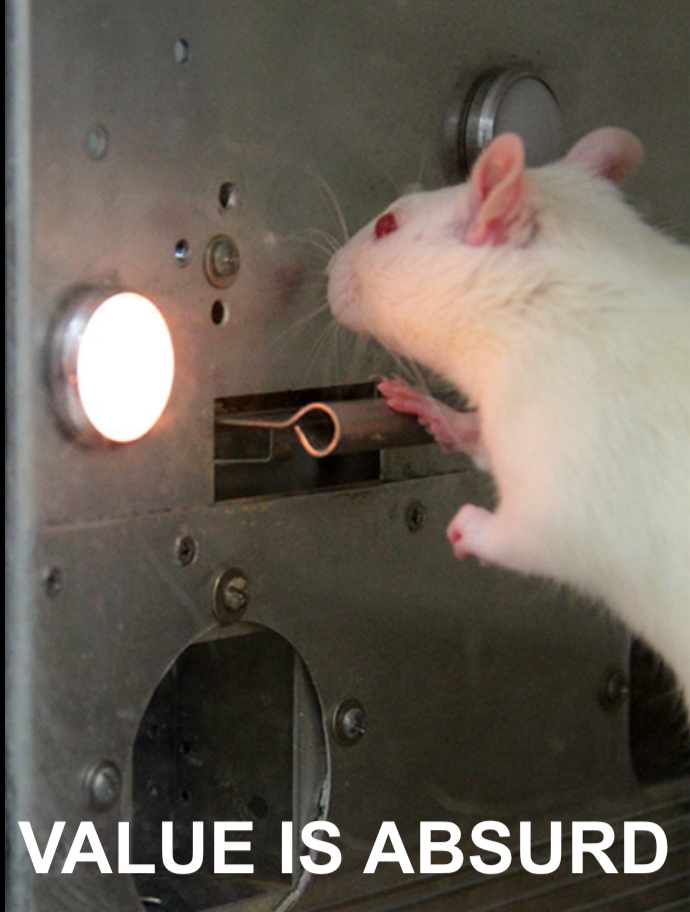
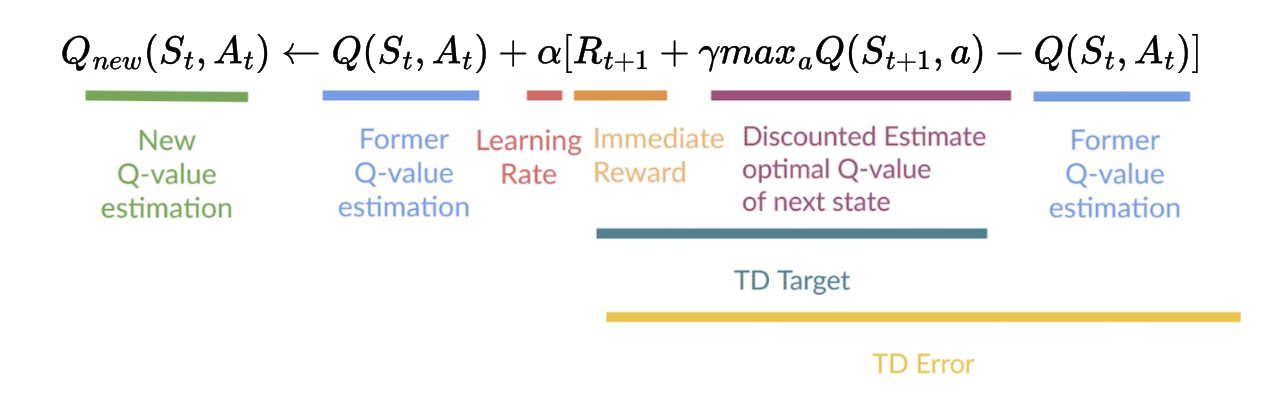


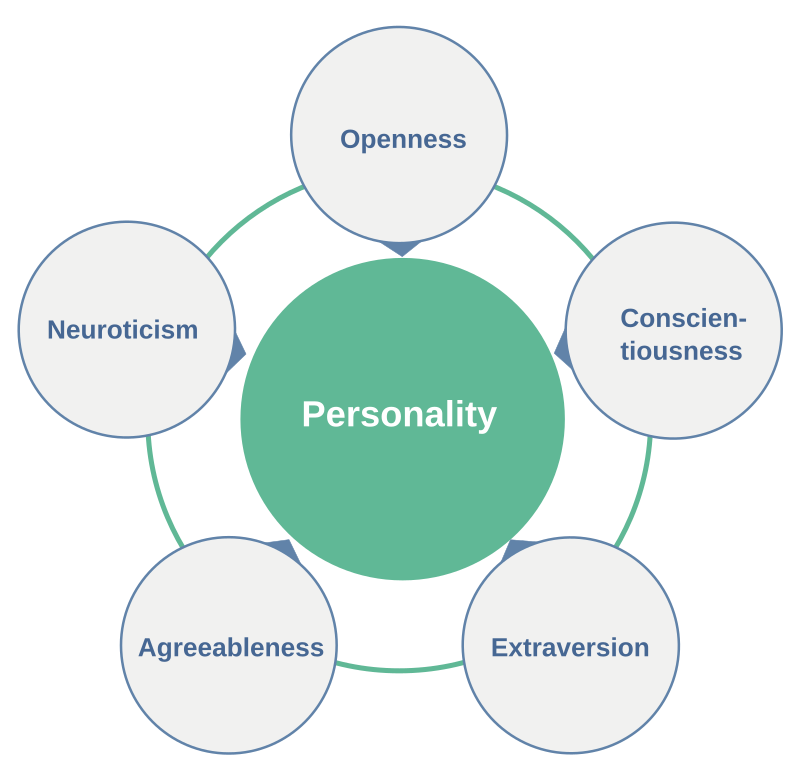


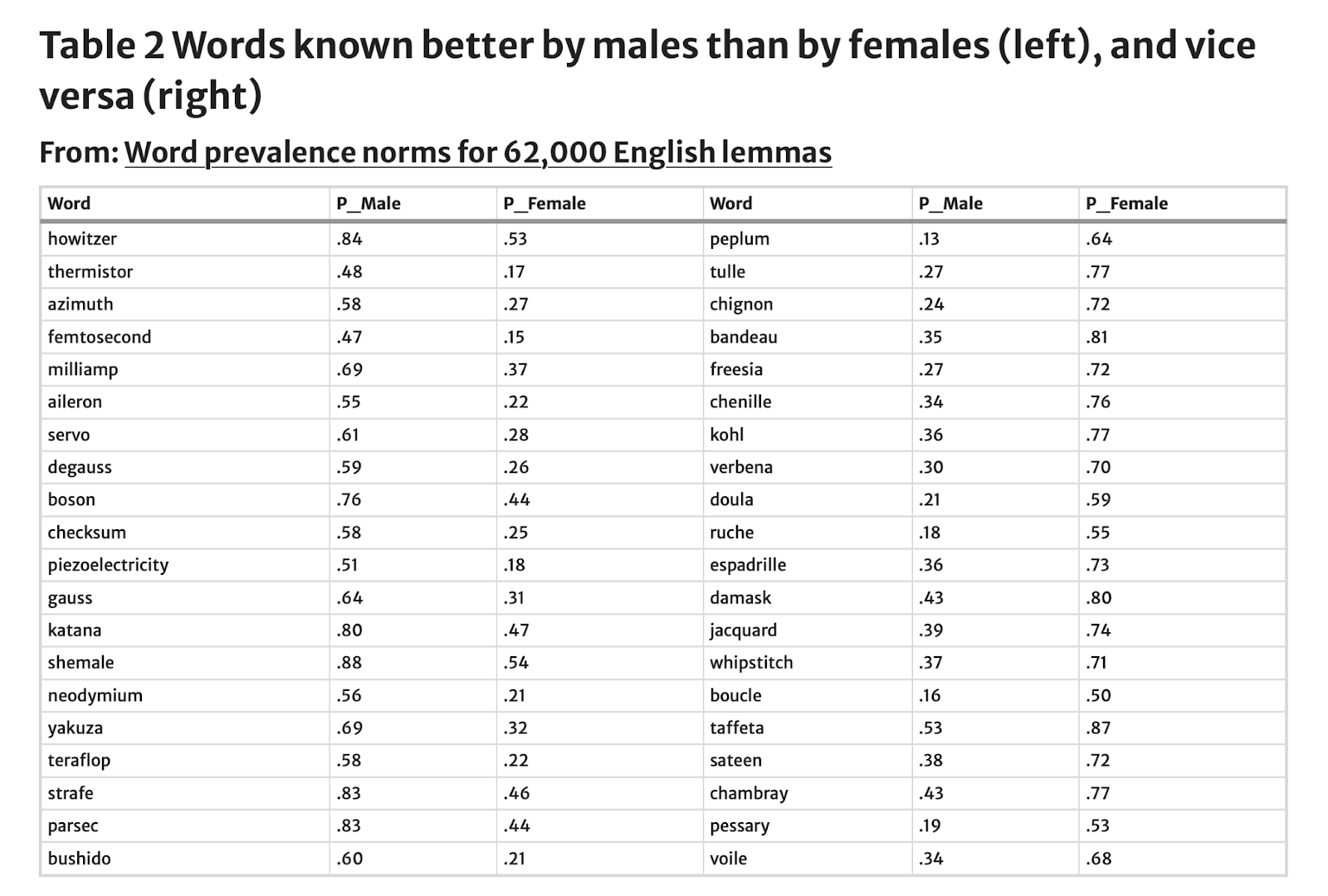
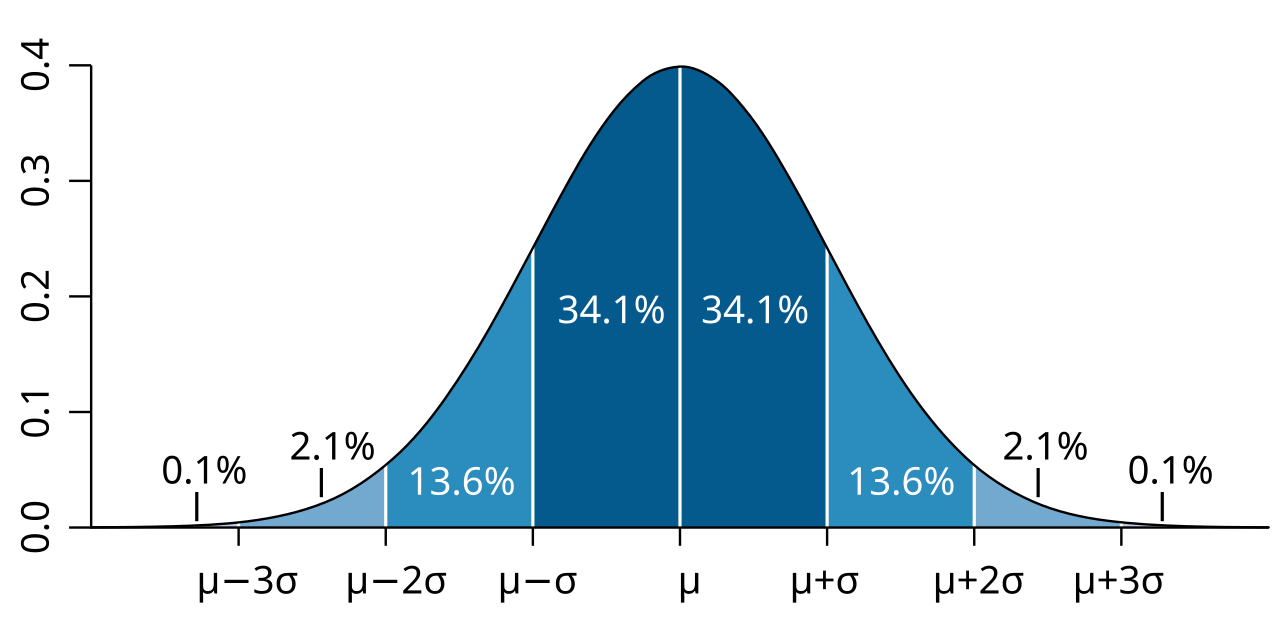
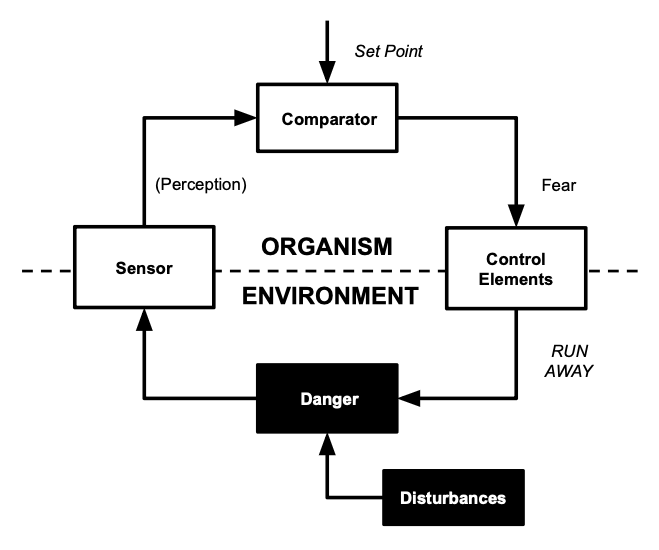
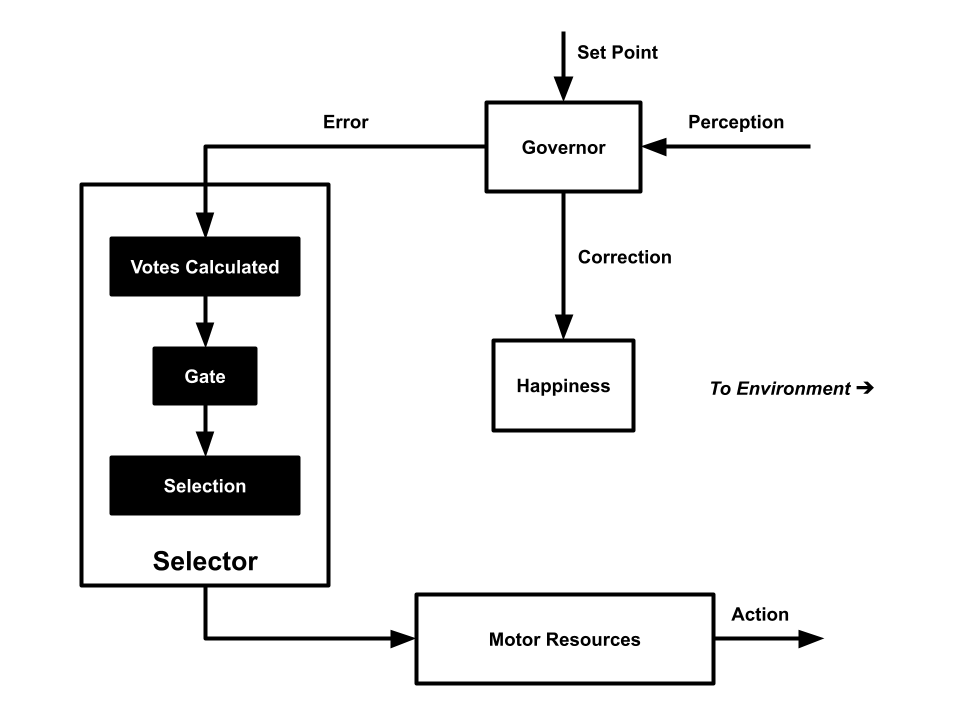
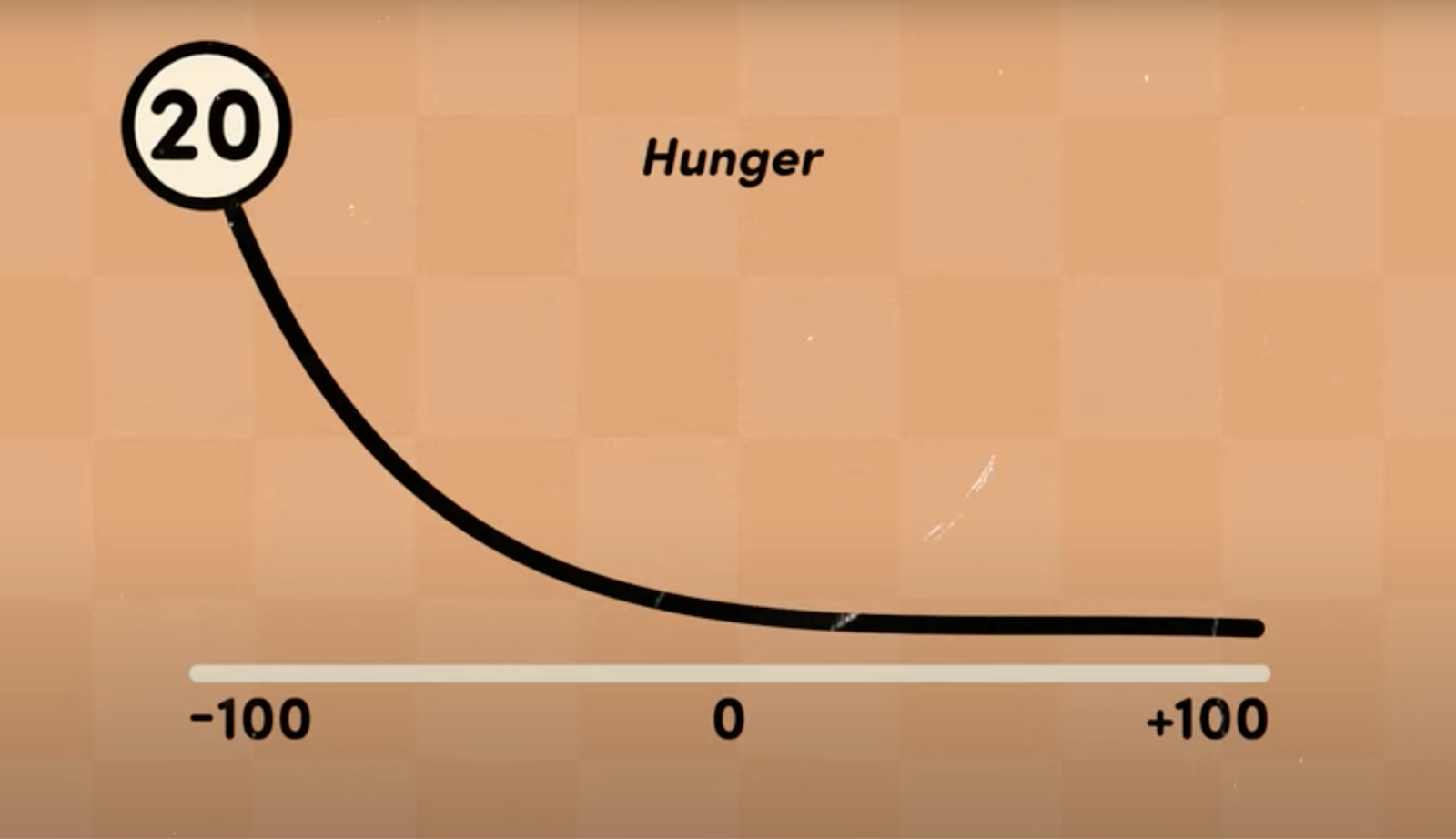



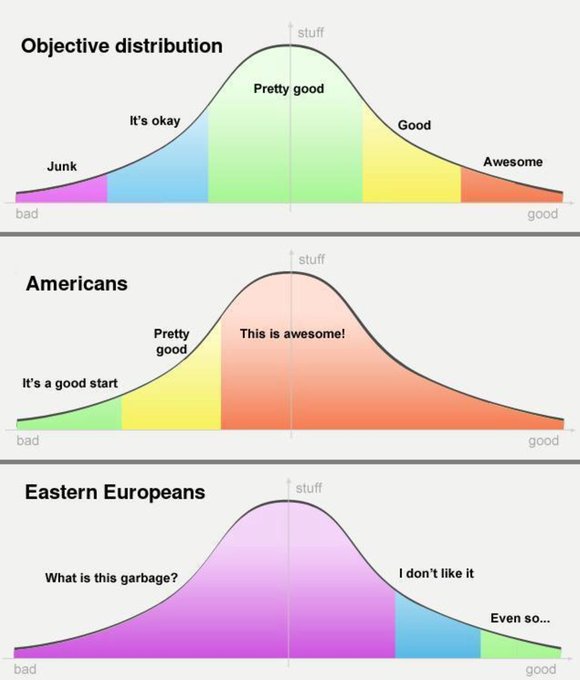
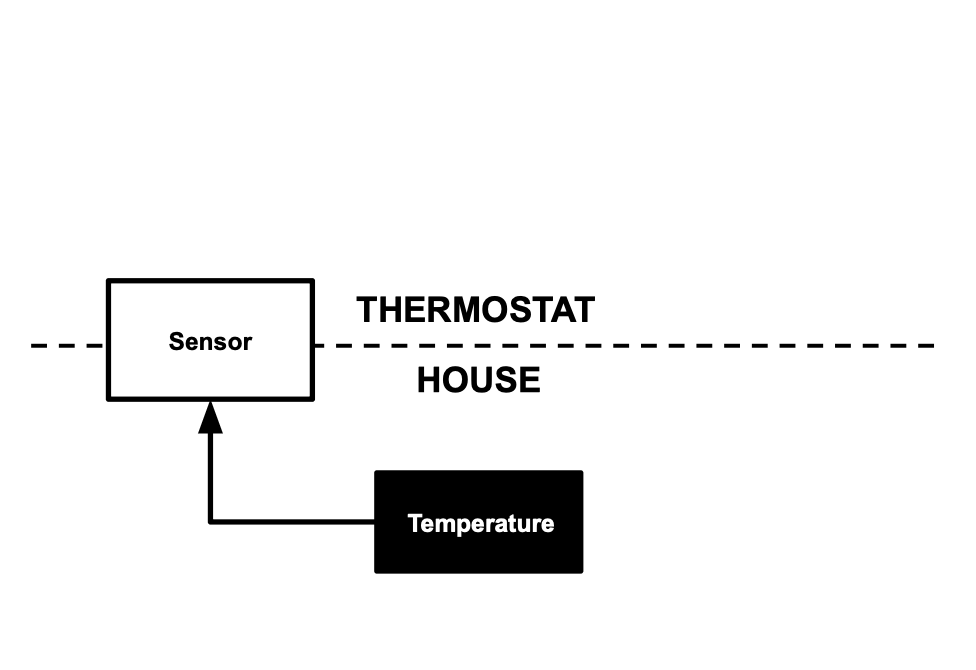
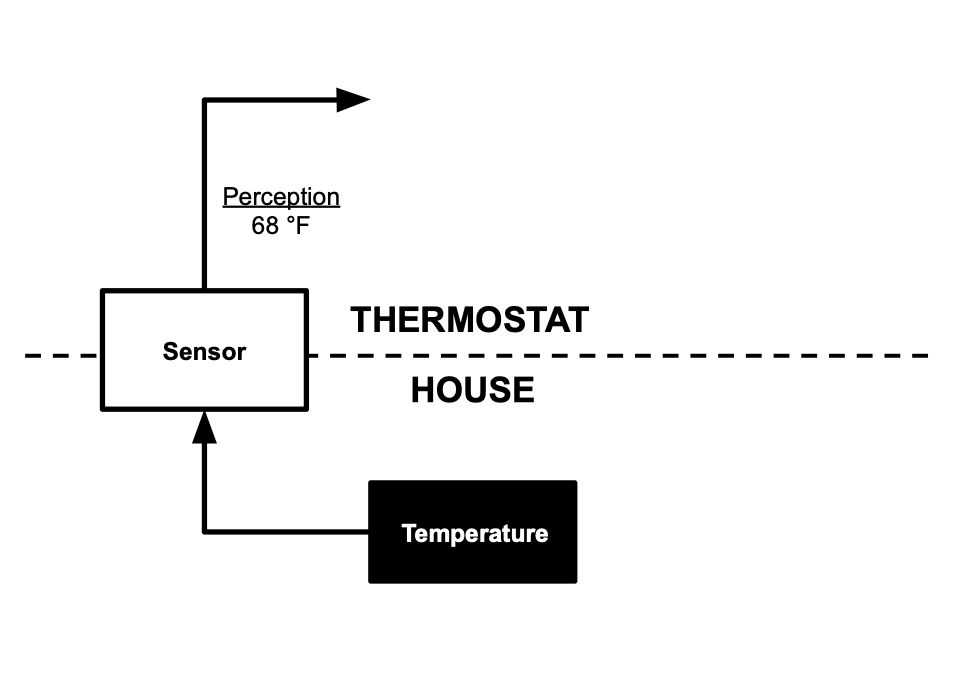
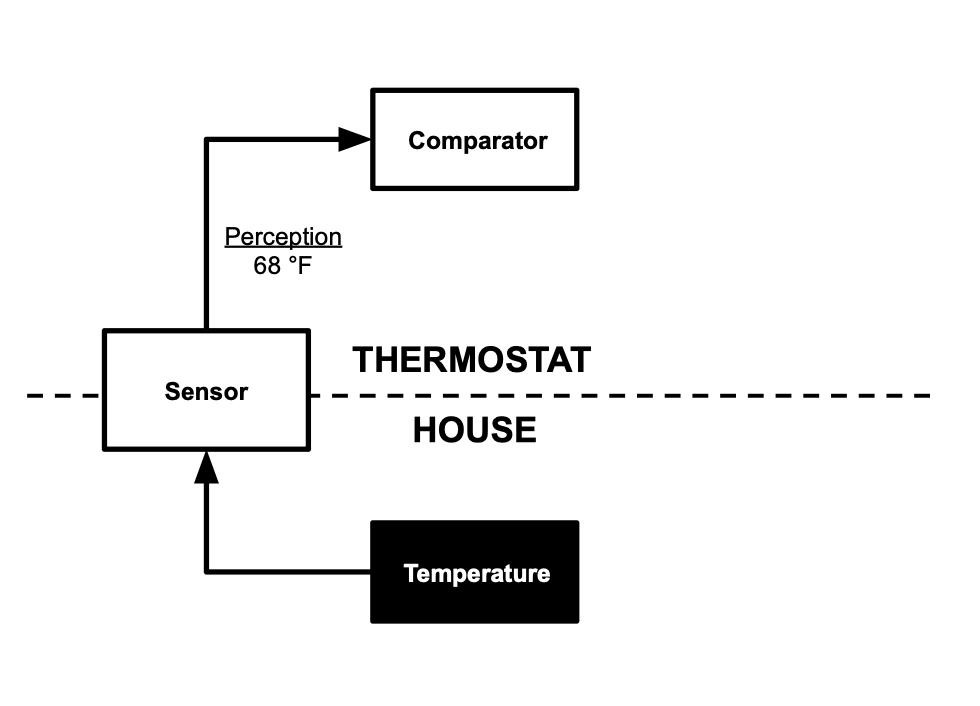
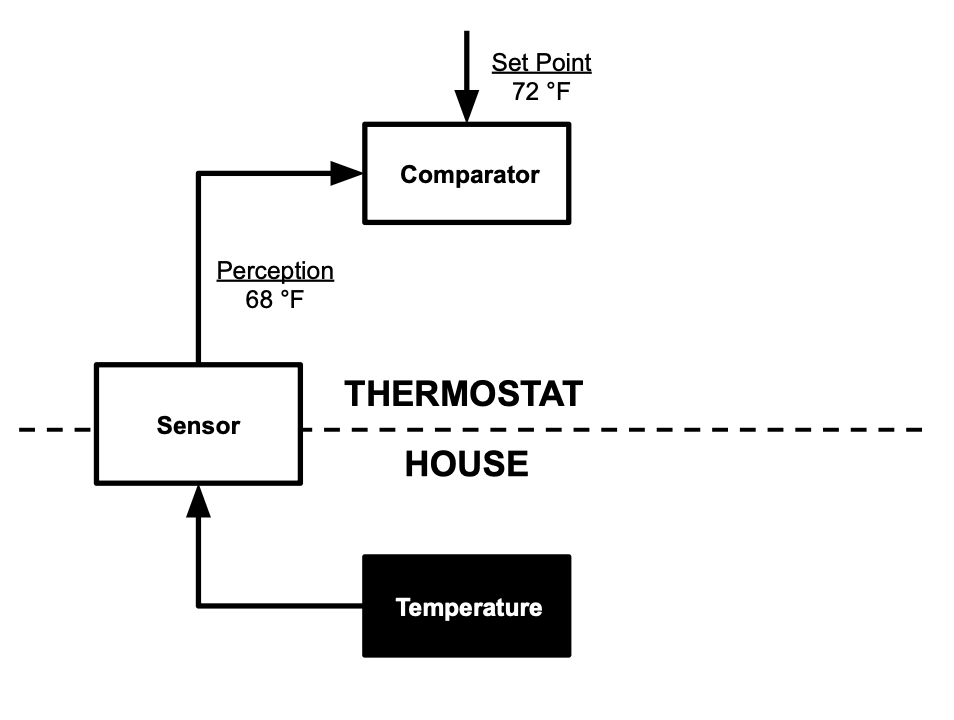
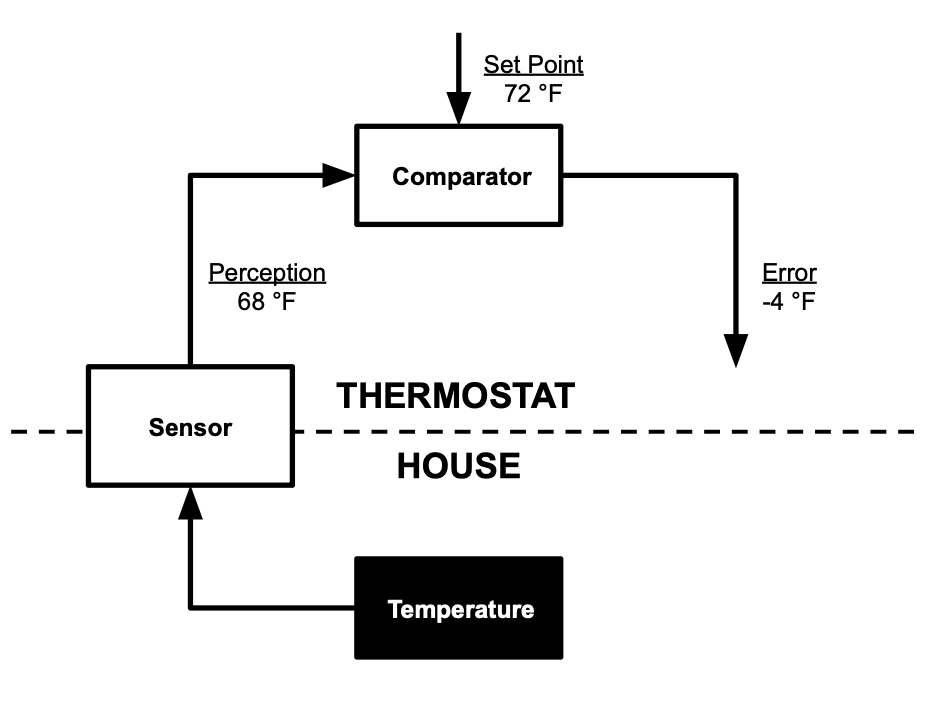
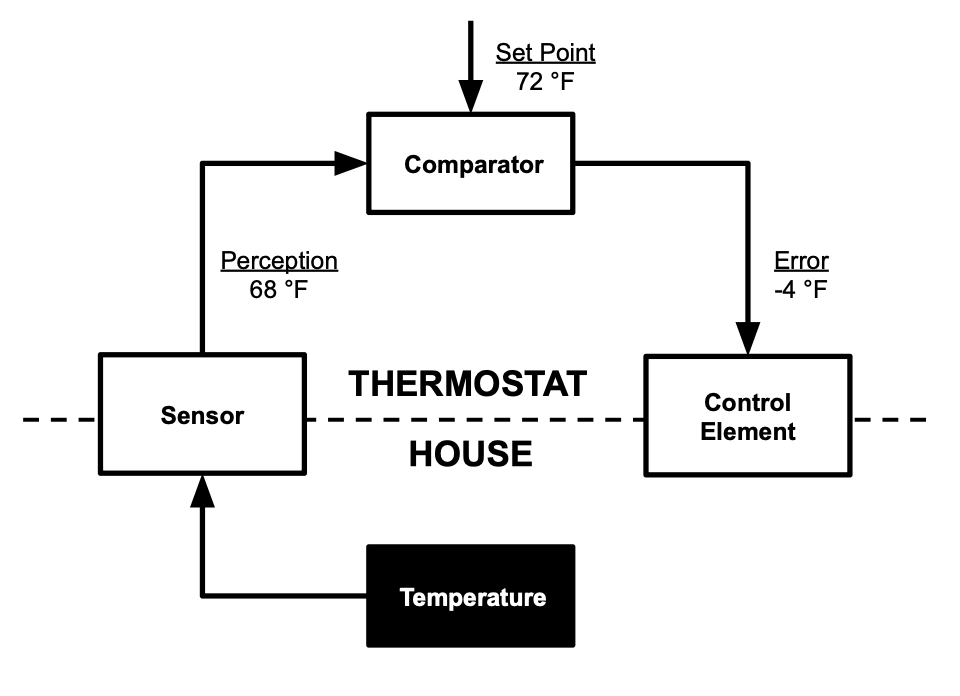
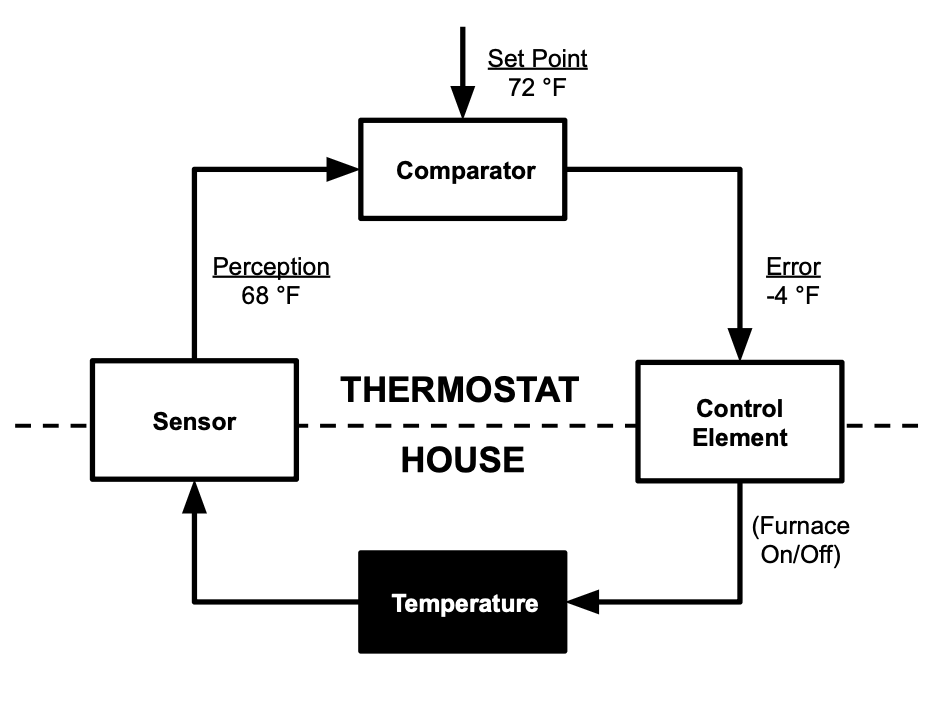
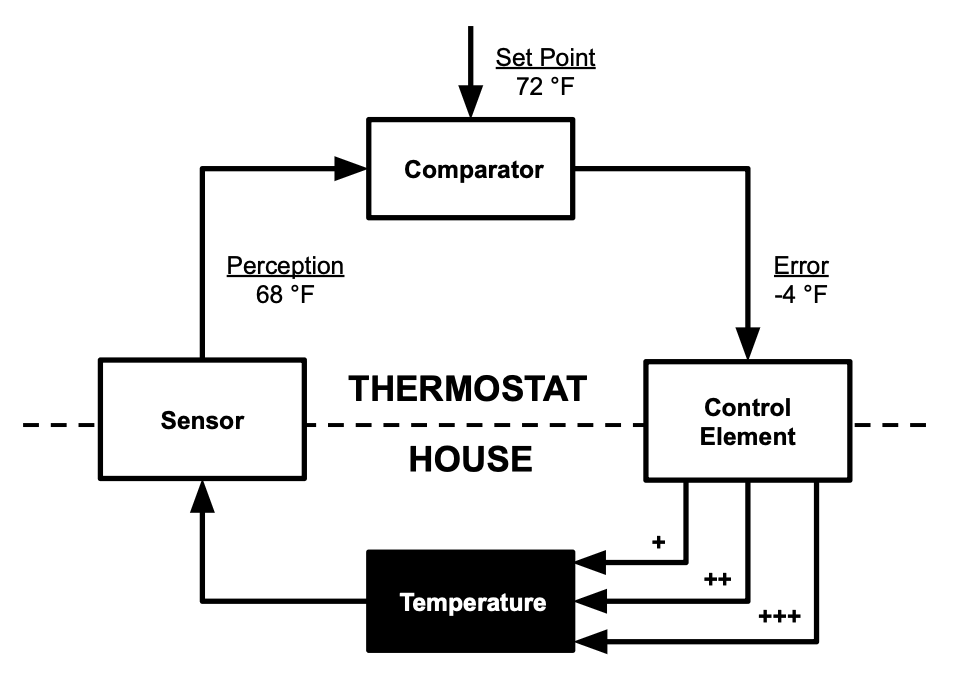
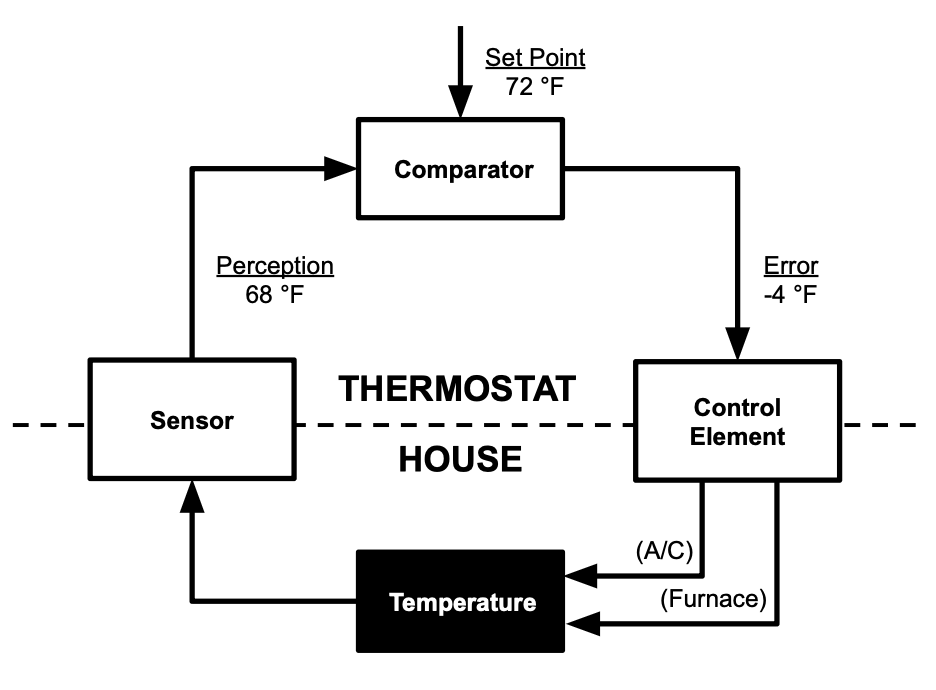
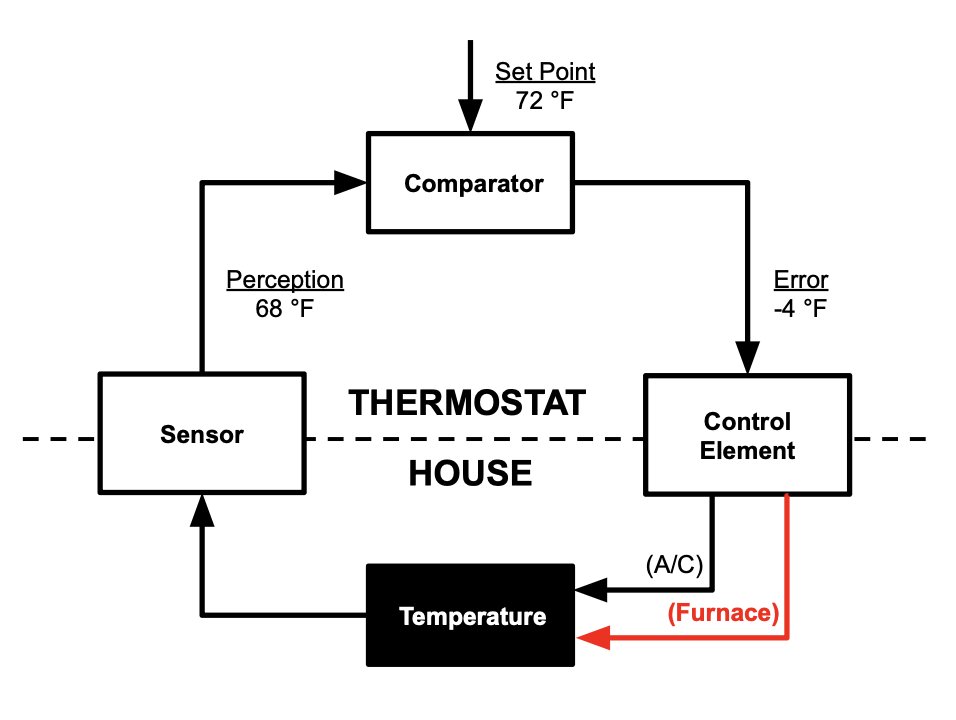
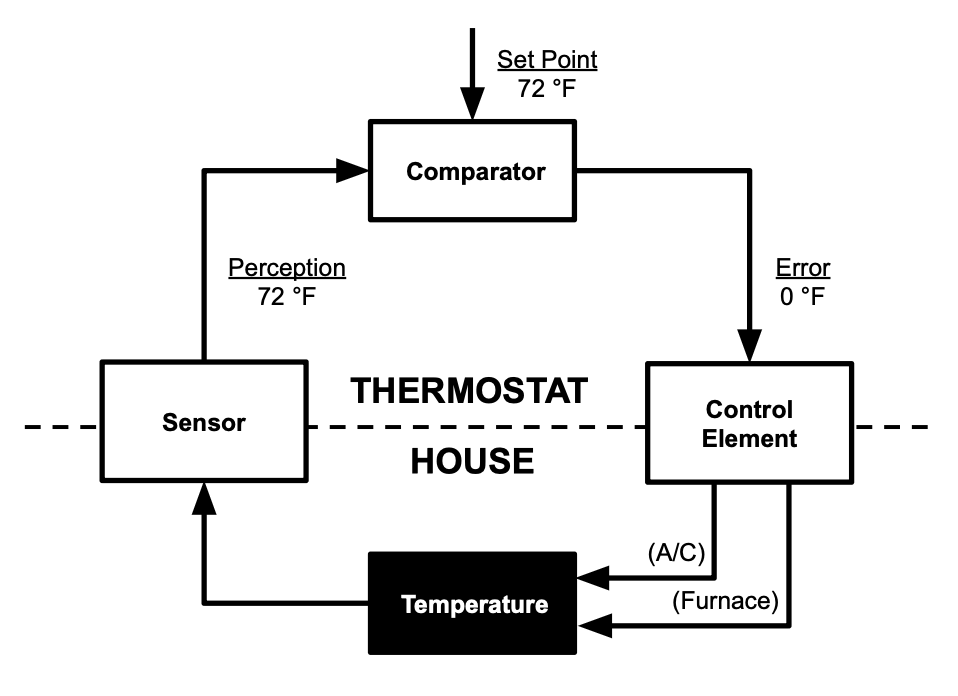
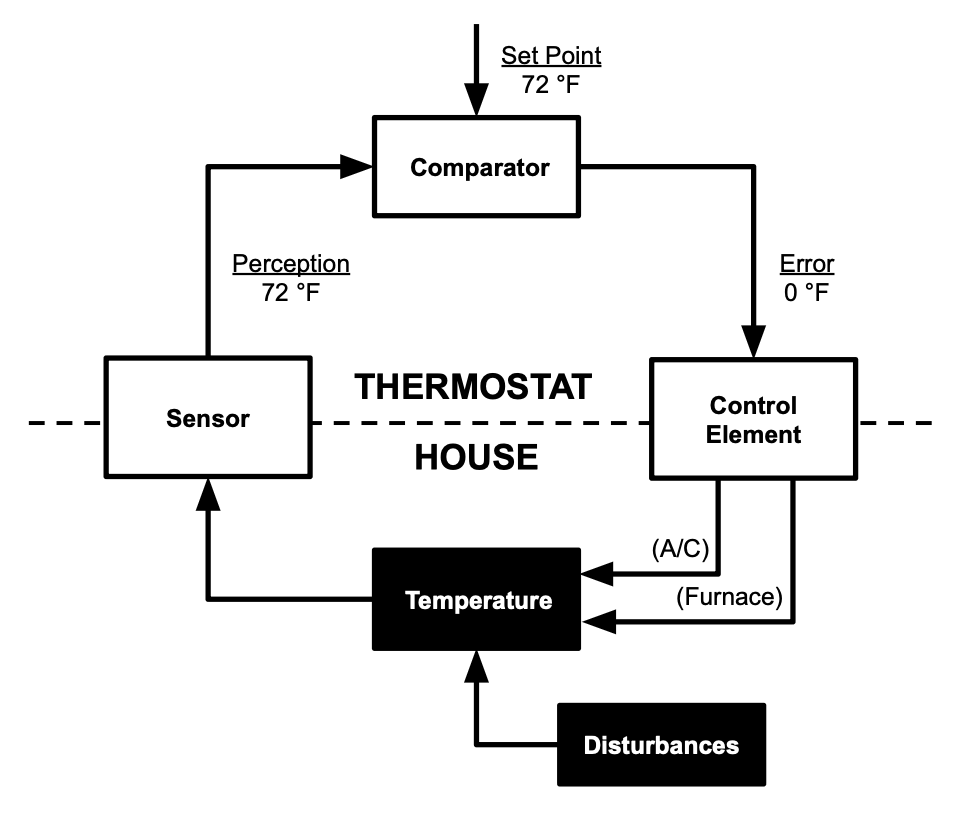
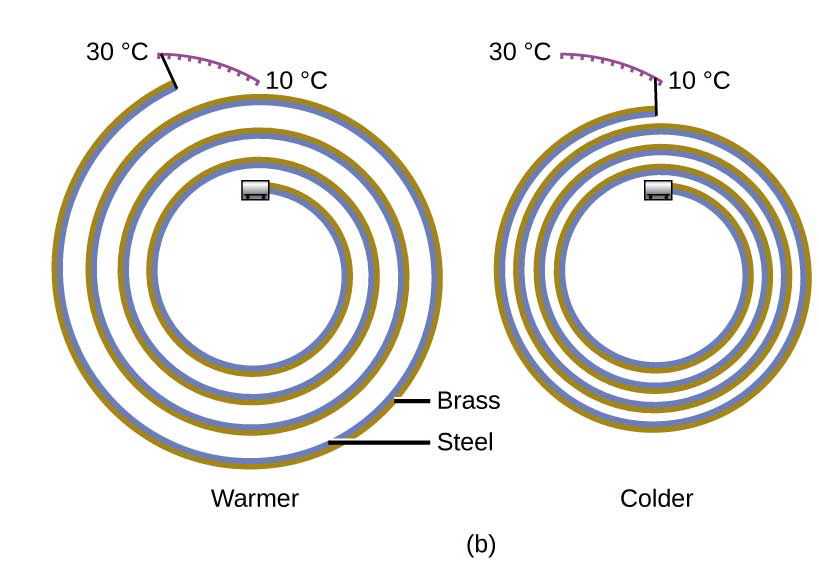
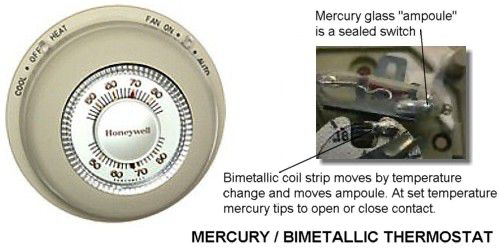
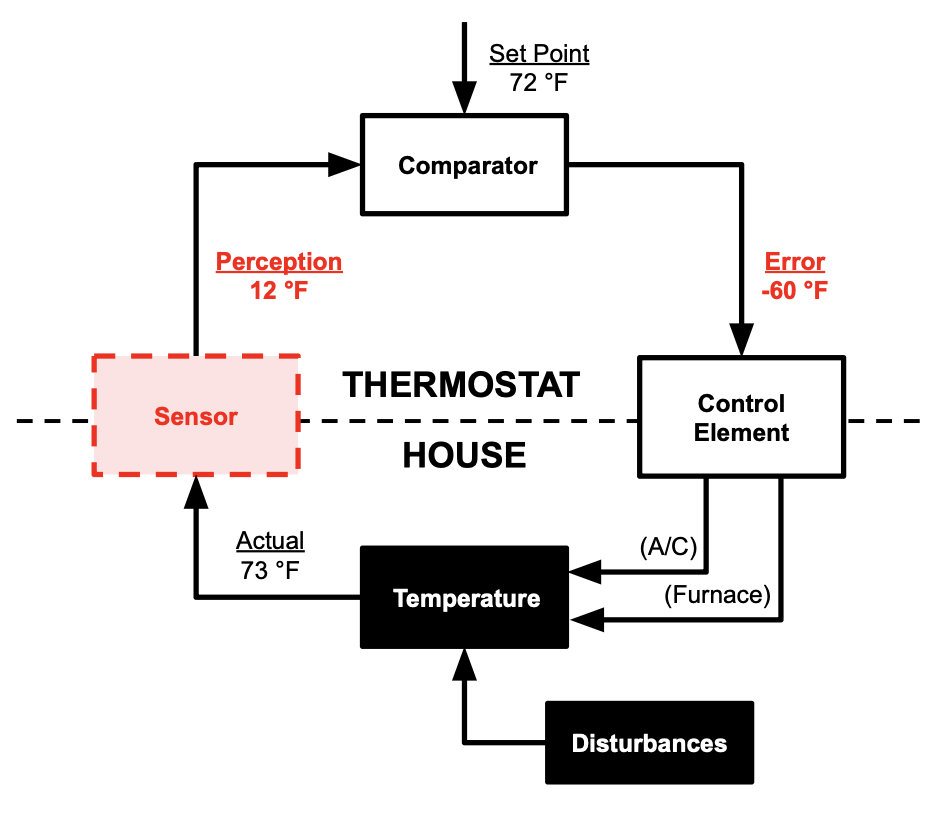
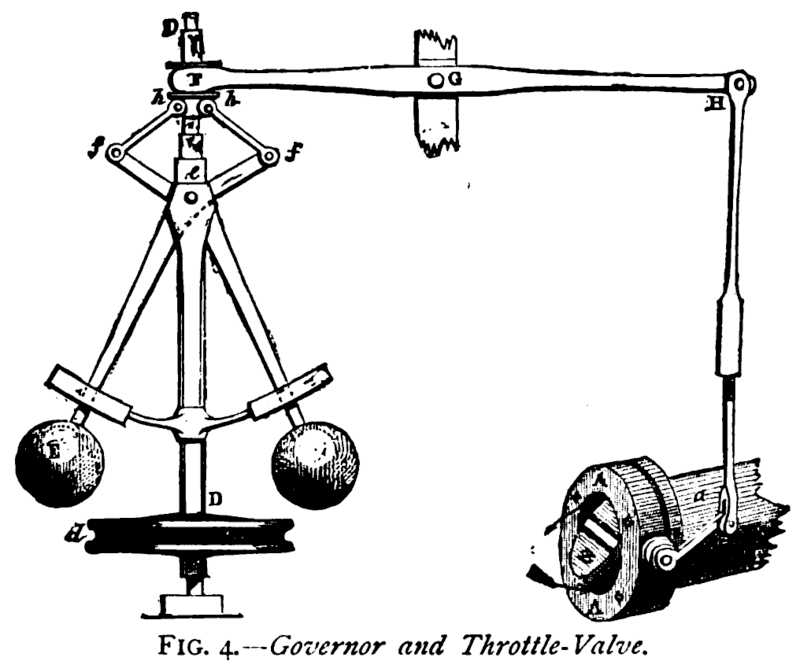
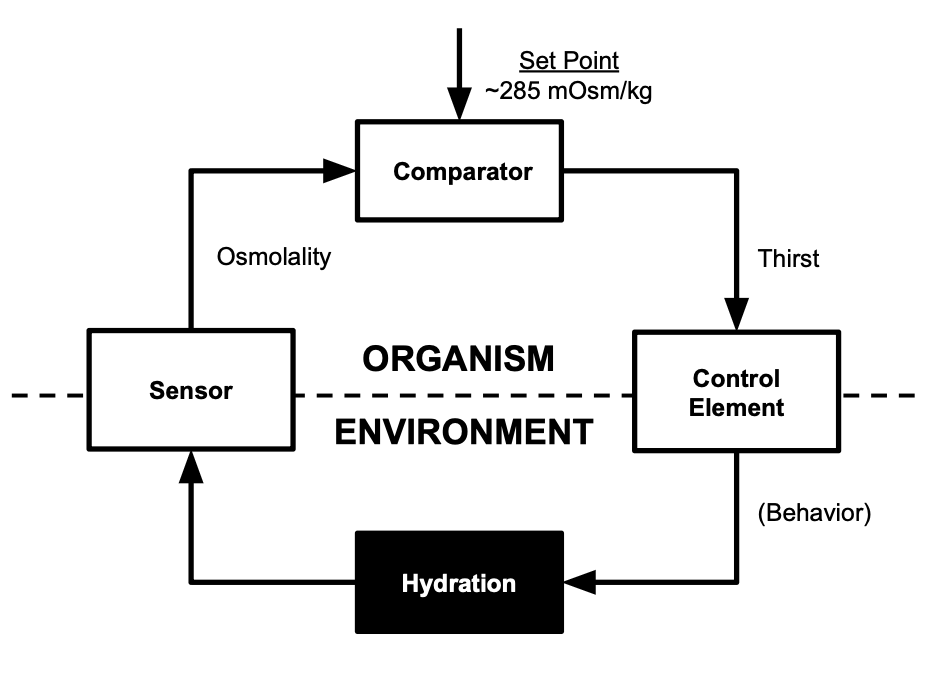
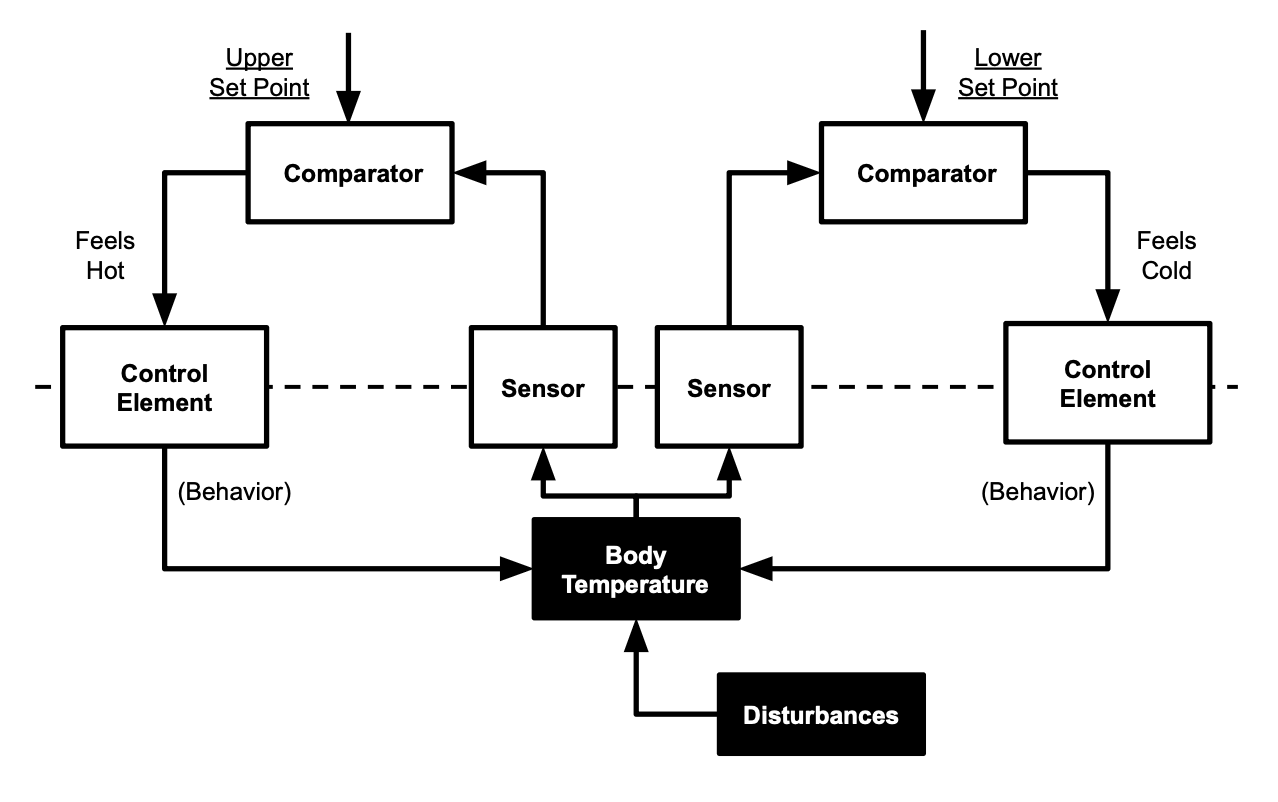
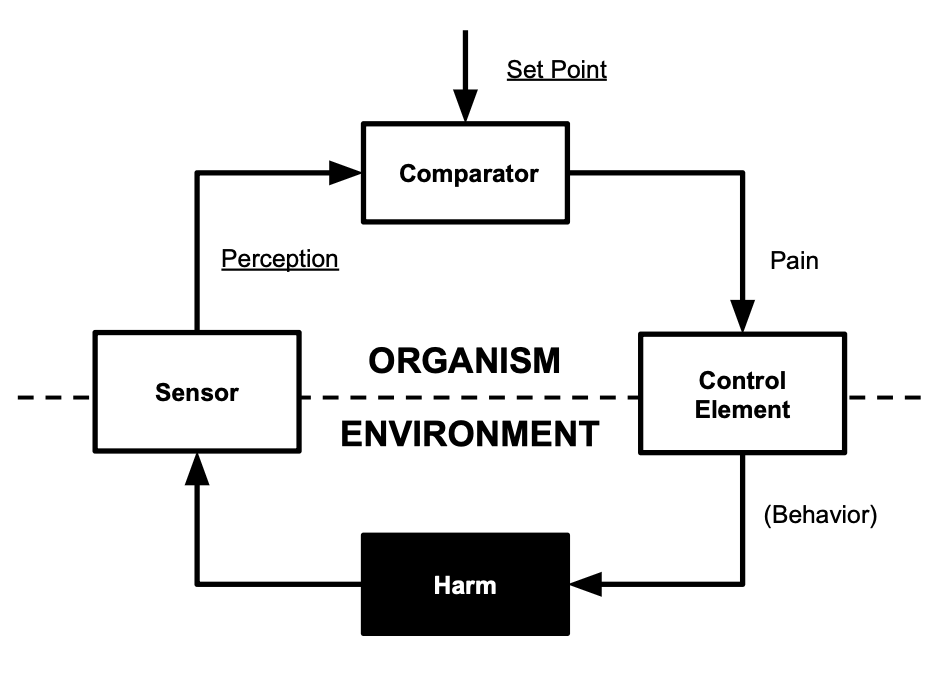
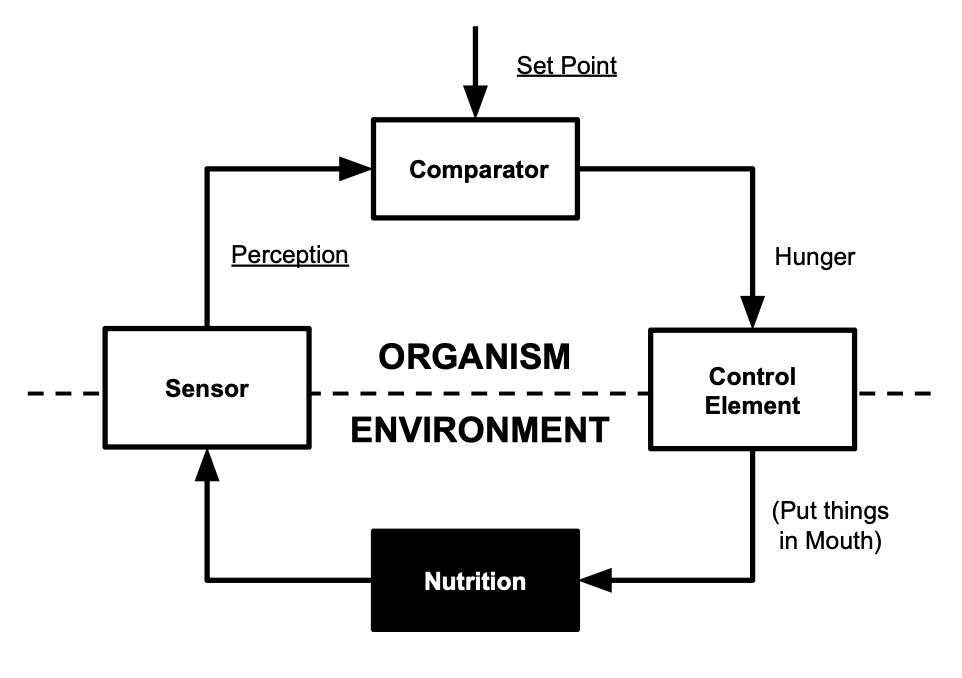
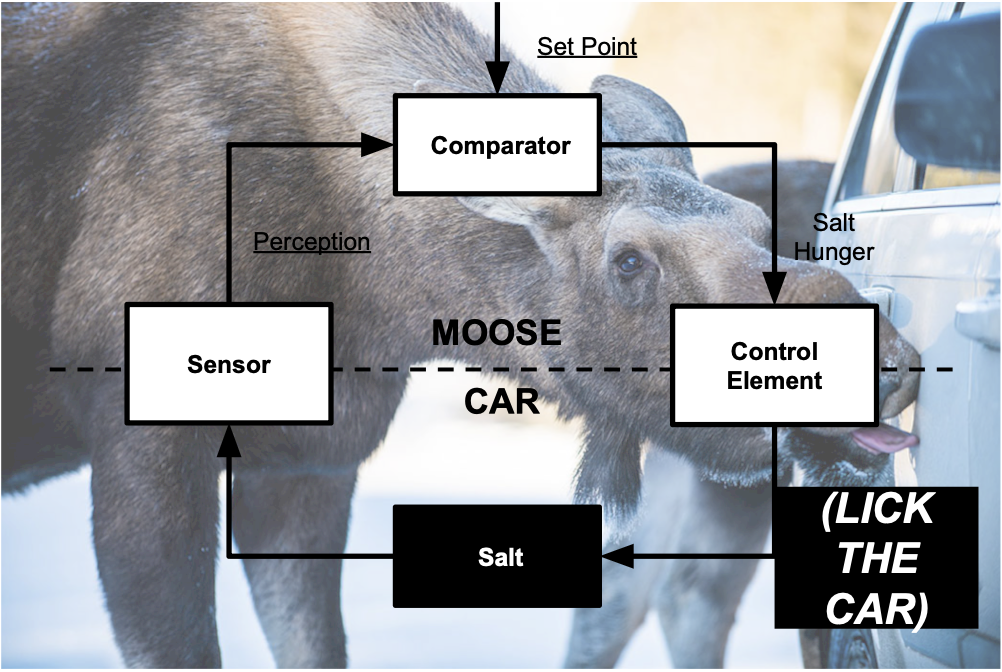

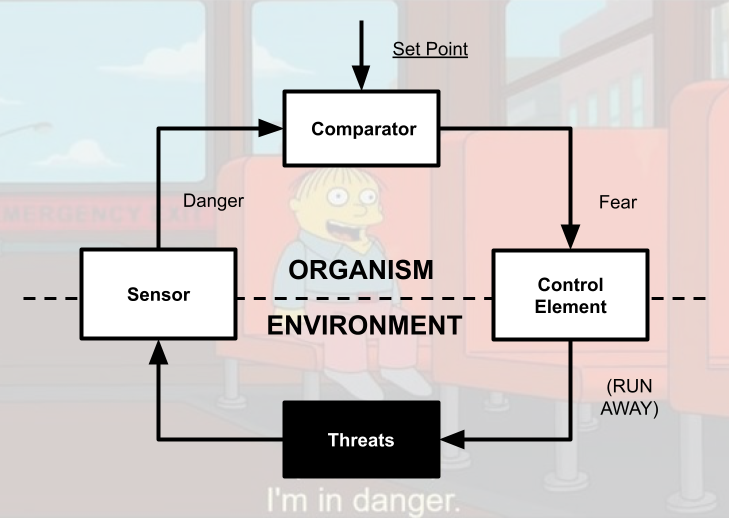
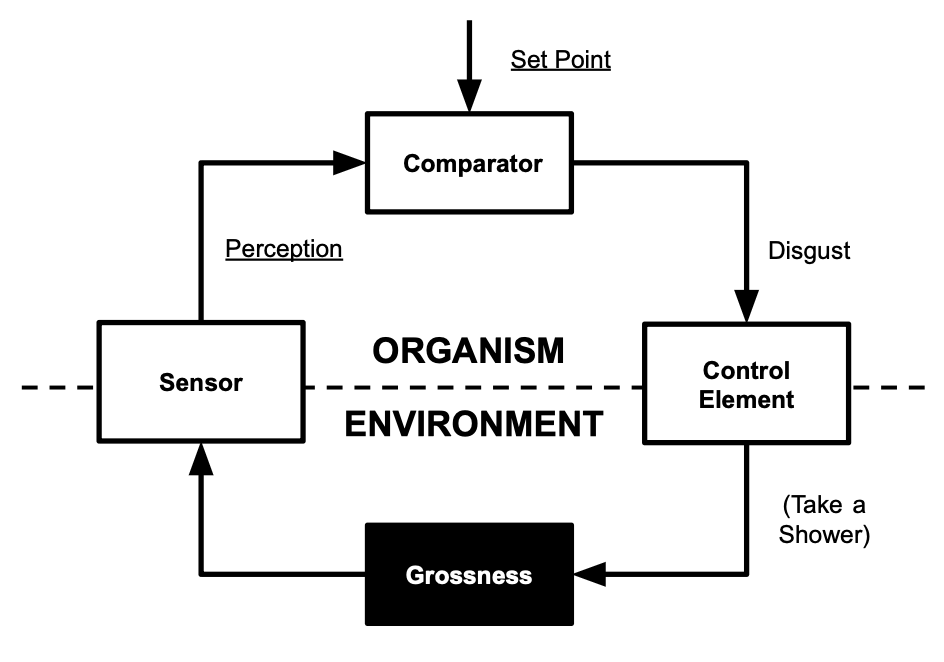
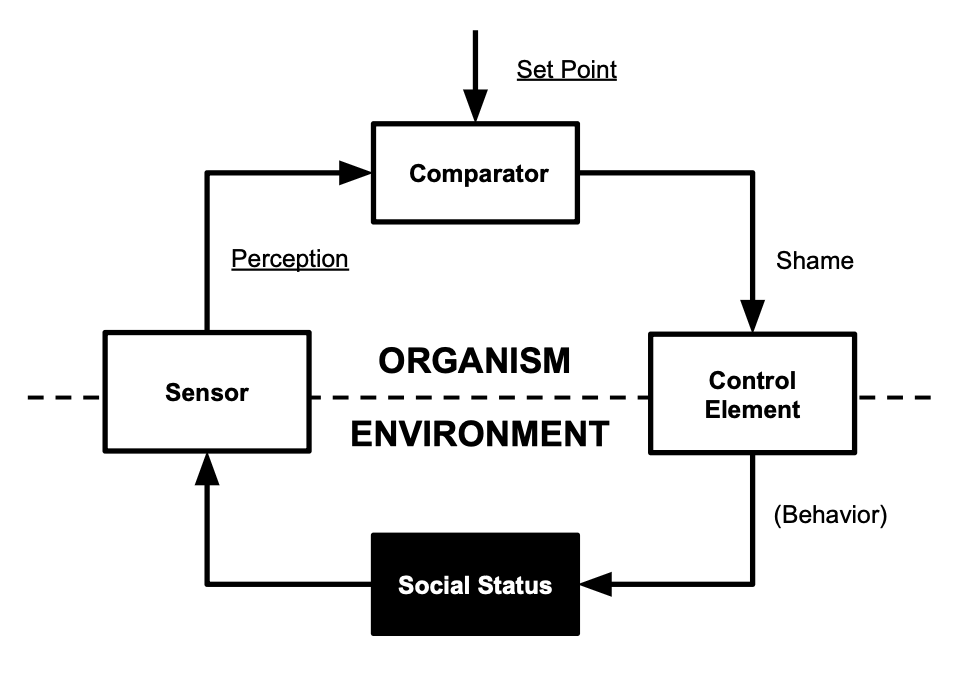
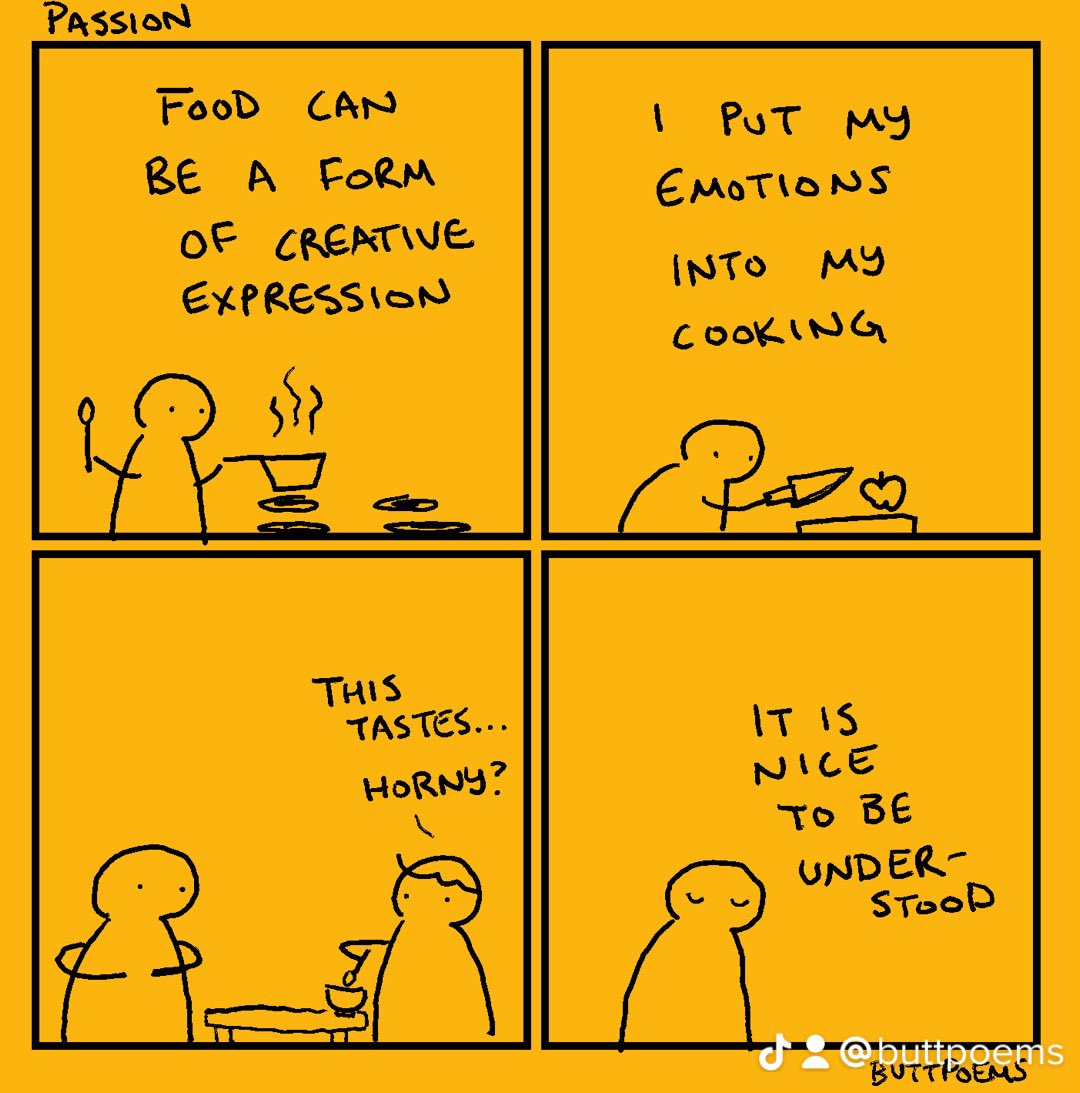
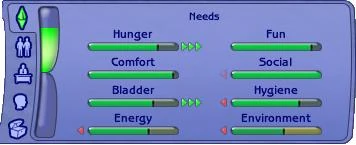

 SLIME MOLD TIME MOLD