The Mind in the Wheel – Prologue: Everybody Wants a Rock

We who have nothing to “wind string around” are lost in the wilderness. But those who deny this need are “burning our playhouse down.” If you put quotes around certain words it sounds more like a metaphor.

— John Linnell, 2009 interview with Rolling Stone

Take almost anything, heat it up, and it gets bigger. Heat it up enough, it melts and becomes a liquid. Heat it up even more, it becomes a gas, and takes up even more space. Or, cool it down, it contracts and becomes smaller again. 

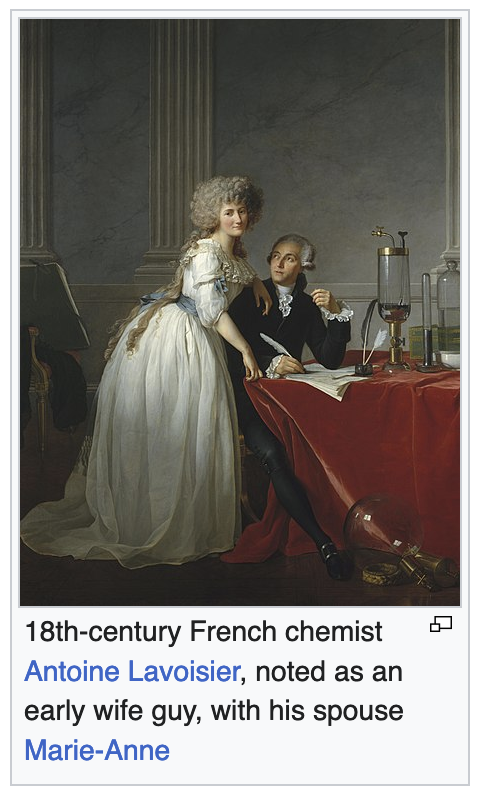
The year is 1789. Antoine Lavoisier has just published his Traité Élémentaire de Chimie. Robert Kerr will soon translate it into English under the title Elements of Chemistry in a New Systematic Order containing All the Modern Discoveries, usually known as just Elements of Chemistry. 

The very first thing Lavoisier talks about in his book is this mystery about heat. “[It] was long ago fully established as a physical axiom, or universal proposition,” he begins, “that every body, whether solid or fluid, is augmented in all its dimensions by any increase of its sensible heat”. When things get hotter, they almost always get bigger. And when things get colder, they almost always shrink. “It is easy to perceive,” he says, “that the separation of particles by heat is a constant and general law of nature.” 
Lavoisier is riding a wave. About two hundred years earlier, Descartes had suggested that we throw out Aristotle’s way of thinking, where each kind of thing is imbued with its own special purpose, and instead bring back a very old idea from Epicurus, that everything is made out of tiny particles. 

The plan is to see if “let’s start by assuming it’s all particles” might be a better angle for learning about the world. So Lavoisier’s goal here is to try to describe heat in terms of some kind of interaction between different particles.

He makes the argument in two steps. First, Lavoisier says that there must be two forces: one force that pushes the particles of the object apart (which we see when the object heats up), and another force that pulls them together (which we see when the object cools down). “The particles of all bodies,” he says, “may be considered as subjected to the action of two opposite powers, the one repulsive, the other attractive, between which they remain in equilibrio.”

The force pushing the particles apart obviously has something to do with heat, but there must also be a force pushing the particles together. Otherwise, the separating power of heat would make the object fly entirely apart, and objects wouldn’t get smaller when heat was removed, things wouldn’t condense or freeze as they got cold. 

“Since the particles of bodies are thus continually impelled by heat to separate from each other,” he says, “they would have no connection between themselves; … there could be no solidity in nature, unless they were held together by some other power which tends to unite them, and, so to speak, to chain them together; which power, whatever be its cause, or manner of operation, we name Attraction.” Therefore, there is also a force pulling them together.

Ok, that was step one. In step two, Lavoisier takes those observations and proposes a model: 

It is difficult to comprehend these phenomena, without admitting them as the effects of a real and material substance, or very subtle fluid, which, insinuating itself between the particles of bodies, separates them from each other; and, even allowing the existence of this fluid to be hypothetical, we shall see in the sequel, that it explains the phenomena of nature in a very satisfactory manner.

Let’s step back and notice a few things about what he’s doing.

First: While he’s happy to speculate about an attractive force, Lavoisier is very careful. He doesn’t claim anything about the attractive force, does not even speculate about “its cause, or manner of operation”. He just notes that there appears to be some kind of force causing the “solidity in nature”, and discusses what we might call it. 

He does the same thing with the force that separates. Since it seems to be closely related to heat, he says we can call this hypothetical fluid “caloric” — “but there remains a more difficult attempt, which is, to give a just conception of the manner in which caloric acts upon other bodies.” 

We don’t know these fluids exist from seeing or touching them — we hypothesize them from making normal observations, and asking, what kind of thing could there be, invisible but out there in the world, that could cause these observations? “Since this subtle matter penetrates through the pores of all known substances,” he says, “since there are no vessels through which it cannot escape, and consequently, as there are none which are capable of retaining it, we can only come at the knowledge of its properties by effects which are fleeting, and difficultly ascertainable.”

And Lavoisier warns us against thinking we are doing anything more than speculating. “It is in these things which we neither see nor feel,” he says, “that it is especially necessary to guard against the extravagance of our imagination, which forever inclines to step beyond the bounds of truth, and is very difficulty restrained within the narrow line of facts.”

Second: In addition to speculating, Lavosier proposes a model.

But not just any model. Lavosier’s theory of heat is a physical model. He proposes that heat is a fluid with particles so small they can get in between the particles of any other body. And he proposes that these particles create a force that separates other particles from each other. The heat particles naturally seep inside the particles of other objects, because they are so small. And this leads to the expansion and contraction that was the observation we started with.

Lavoisier is proposing a model of entities and rules. In this case, the entities are particles. There are rules governing how the particles can interact: Heat particles emit a force that pushes apart other particles. Particles of the same body mutually attract. There may be more entities, and there will certainly be more rules, but that’s a start.

Third: Instead of something obscure, he starts by trying to explain existing, commonplace observations.

People often think that a theory should make new, testable predictions. This thought seems to come from falsificationism: if a theory gives us a prediction that has never been seen before, we can go out and try to falsify the theory. If the prediction stands, then the theory has some legs.

But this is putting the cart before the horse. The first thing you actually want is for a theory to make “testable” predictions about existing observations. If a new proposal cannot even account for the things we already know about, if the entities and rules don’t duplicate a single thing we see from the natural world, it is a poor theory indeed. 

It’s good if your model can do the fancy stuff, but first it should do the basic shit. A theory of weather doesn’t need to do much at first, but it should at least anticipate that water vapor makes clouds and that clouds make rain. It’s nice if your theory of gravity can account for the precession of the perihelion of Mercury, but it should first anticipate that the moon won’t fall into the earth, and that the earth attracts apples rather than repels them.

Fourth: His proposal is wrong! This model is not much like our modern understanding of heat at all. However, Lavoisier is entirely unconcerned. He makes it very clear that he doesn’t care whether or not this model is at all accurate in the entities

…strictly speaking, we are not obliged to suppose [caloric] to be a real substance; it being sufficient … that it be considered as the repulsive cause, whatever that may be, which separates the particles of matter from each other; so that we are still at liberty to investigate its effects in an abstract and mathematical manner.

People are sometimes very anxious about whether their models are right. But this anxiety is pointless. A scientific model doesn’t need to be right. It doesn’t even need to describe a real entity.

Lavoisier doesn’t care about whether the entities he describes are real; he cares about the fact that the entities he proposes 1) would create the phenomenon he’s trying to understand (things generally expand when they get hotter, and contract when they get colder) and 2) are specific enough that they can be investigated.

Lavoisier’s proposal involves entities that operate by simple rules. The rules give rise to phenomena about heat that match existing observations. That is all that is necessary, and Lavoisier is quite aware of this. “Even allowing the existence of this fluid to be hypothetical,” he says, “we shall see … that it explains the phenomena of nature in a very satisfactory manner.”
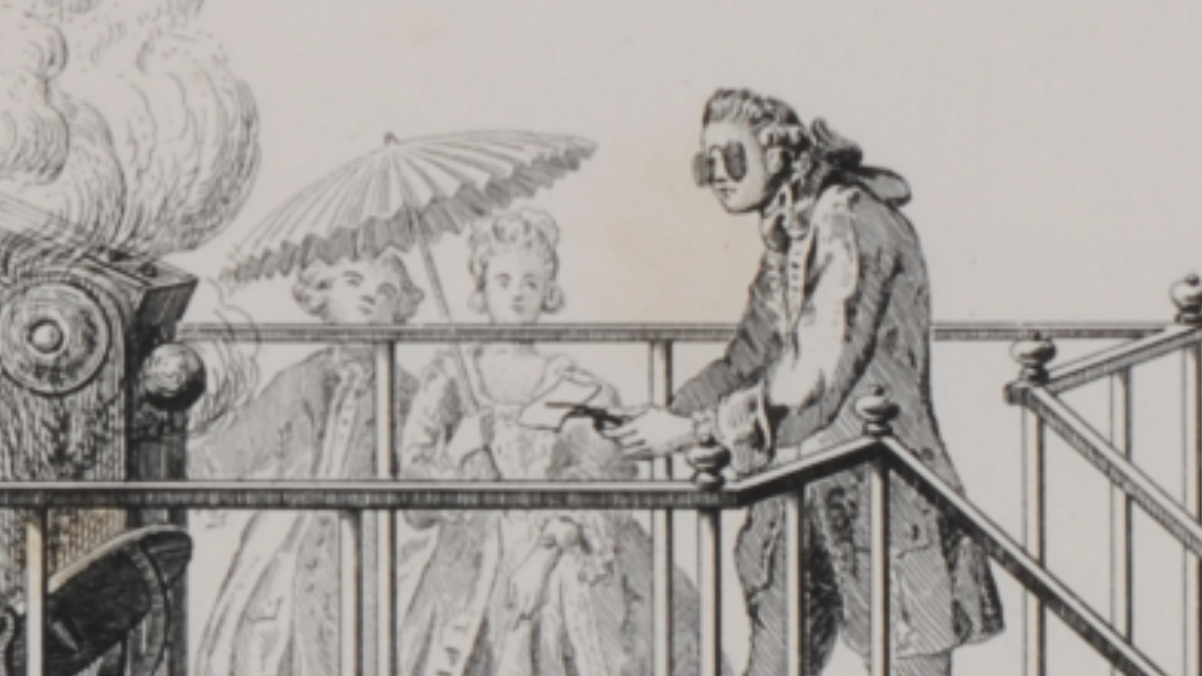
Lavoisier (wearing goggles) operates his solar furnace

This is how scientific progress has always worked: Propose some entities and simple rules that govern them. See if they give rise to the things we see all the time. It’s hard to explain all of the things, so it’s unlikely that you’ll get this right on the first try. But does it explain any of the things?

If so, congratulations! You are on the right track. From here, you can tweak the rules and entities until they fit more and more of the commonly known phenomena. If you can do this, you are making progress. If at some point you can match most of the phenomena you see out in the world, you are golden.

If you can then go on to use the entities as a model to predict phenomena in an unknown set of circumstances, double congratulations. This is the hardest step of all, to make a called shot, to prove your model of rules and entities in unknown circumstances.

But first, you should prove it in known circumstances. If your theory of heat doesn’t even account for why things melt and evaporate, there’s no use in trying to make more exotic predictions. You need to start over. 

Superficial

Much of what passes for knowledge is superficial.

We mean “superficial” in the literal sense. When we call something superficial, we mean that it deals only with the surface appearances of a phenomenon, without making appeal or even speculating about what might be going on beneath the surface. 

There are two kinds of superficial knowledge: predictions and abstractions.

1. Predictions

Predictions are superficial because they only involve anticipating what will happen, and not why. 

If you ask an astronomer, “What is the sun?” and he replies, “I can tell you exactly when the sun will rise and set every day”… that’s cool, but this astronomer does not know what the sun is. That will still be true even if he can name all the stars, even if he can predict eclipses, even if he can prove his calculations are accurate to the sixth decimal point. 

Most forms of statistics suffer from this kind of superficiality. Any time anyone talks about correlations, they are being superficial in this way. “The closer we get to winter, the less time the sun spends in the sky.” Uh huh. And what is the sun, again? 

Sometimes it is ok to talk about things just in terms of their surface appearances. We didn’t say “don’t talk about correlations”. We said, “correlations are superficial”. But often we want to go deeper. When you want to go deeper, accept no substitutes!

Sometimes all you want to do is predict what will happen. If you’re an insurance company, you only care about getting your bets right — you need to have a good idea which homes will be destroyed by the flood, but you don’t need to understand why. You know that your business involves uncertainty, and these predictions are only estimates. If all you want to do is predict, that’s fine.

But in most cases, we want more than just prediction. If you’re a doctor choosing between two surgeries, you certainly would rather conduct the surgery with the 90% survival rate than the surgery with the 70% survival rate. But you’d ideally like to understand what’s actually going on. Even having chosen the surgery with better odds, what can you do to make sure your patient is in the 90% that survive, rather than the 10% that do not? What are the differences between these two groups? We aspire to do more than just rolling the dice.

Consider this for any other prediction. In the Asch conformity experiments, most participants conformed to the group. From this, we can predict that in similar situations, most people will also conform. But some people don’t conform. Why not? Prediction by itself can’t go any deeper.

Or education. Perhaps we can predict which students will do well in school. We predict that certain students will succeed. But some of these students don’t succeed, and some of the students we thought would be failures do succeed. Why? Prediction by itself can’t go any deeper.

I’m able to recall hundreds of important details at the drop of a hat

There’s something a little easy to miss here, which is that having a really good model is one way to make really good predictions. However good your predictions are when you predict the future by benchmarking off the past, having a good model will make them even better. And, you will have some idea of what is actually going on. 

But people often take this lesson in reverse — they think that good predictions are a sign of a good understanding of the processes behind the thing being predicted. It can be easy to just look for good predictions, and think that’s the final measure of a theory. But in reality, you can often make very good predictions despite having no idea of what is actually happening under the hood. 

This is why you can operate a car or dishwasher, despite having no idea how they work. You know what will happen when you turn on your dishwasher, or shift your car into reverse. Your predictions are very good, nearly 100%. But you don’t know in a mechanical sense why your car moves backwards when you shift into reverse, or how your dishwasher knows how to shut off when it’s done.

If you want to fix a dishwasher that’s broken, or god forbid design a better one, you need to understand the inner guts of the beast, the mechanical nature of the machine that creates those superficial features that you know how to operate. You “know” how to operate the superficial nature of a TV, but how much do you understand of this:

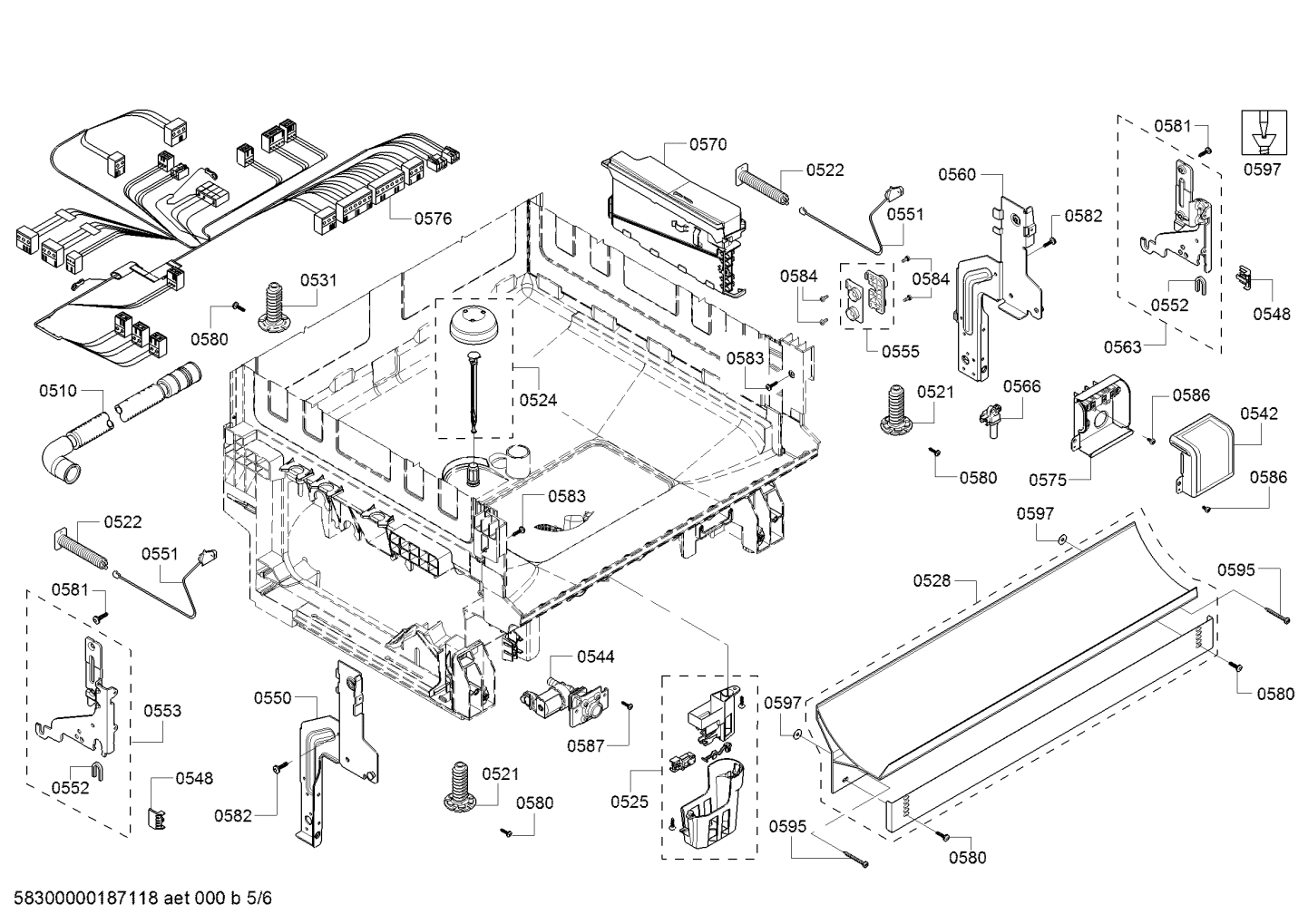
Let’s take another different example. This Bosch dishwasher has only 6 buttons. Look how simple it is for any consumer to operate: 

But look how many parts there are inside. Why are some of the parts such weird shapes? How much of this do you understand? How much of it does the average operator understand: 
2. Abstractions

Successful models will always be expressed in terms of entities and rules. That might seem obvious — if you’re going to describe the world, of course you need to propose the units that populate it, and the rules that govern their behavior! 

But in fact, people almost never do this. Instead, they come up with descriptions that involve neither entities nor rules. These are called abstractions.

Abstractions group similar observations together into the same category. But this is superficial, because the classification is based on the surface-level attributes of the observations, not their nature. All crabs look similar, but as we’ve learned more about their inner nature, what we call DNA, we learned that some of these crabs are only superficially similar, that they came to their crab-like design from entirely different places. The same thing is true of trees.

We certainly cannot do without abstractions like “heat”, “depression”, “democracy”, “airplane”, and so on. Sometimes you do want to group together things based on their outward appearance. But these groups are superficial at best. Airplanes have some things in common abstractly, but open them up, and under the hood you will find that each of them functions in its own way. Democracies have things in common, but each has its own specific and mechanical system of votes, representation, offices, checks and balances, and so on. 

Imagine that your car breaks down and you bring it to a mechanic and he tells you, “Oh, your car has a case of broken-downness.” You’d know right away: this guy has no idea what he’s talking about. “Broken-downness” is an abstraction; it doesn’t refer to anything, and it’s not going to help you fix a car.

Instead, a good mechanic will describe your car’s problem in terms of entities and rules. “Your spark plugs are shot [ENTITIES], so they can’t make the pistons [ENTITIES] go up and down anymore [RULES].” 

It’s easy to see how ridiculous abstractions are when we’re talking about cars, but it can be surprisingly hard to notice them when we’re talking about science.

For instance, if you feel sad all the time, a psychologist will probably tell you that you have “depression.” But depression is an abstraction — it involves no theory of the entities or rules that cause you to feel sad. It’s exactly like saying that your car has “broken-downness.” Abstractions like this are basically useless for solving problems, so it’s not surprising that we aren’t very good at treating “depression.”

Abstractions are often so disassociated from reality that over time they stop existing entirely. We still use words like “heat”, “water”, and “air”, but we mean very different things by these words than the alchemists did. Medieval physicians thought of medicine in terms of four fluids mixing inside your body: blood, phlegm, yellow bile, and black bile. We still use many of those words today, but the “blood” you look at is not the blood of the humorists.

It’s possible that one day we’ll stop using the word “depression” at all. Some people find that idea crazy — depression is so common, so baked into our culture, that surely it’s going to stick around. But stuff like this happens all the time. In the 19th and 20th centuries, “neurasthenia” was a common diagnosis for people who felt sad, tired, and anxious. It used to be included in the big books of mental disorders, the Diagnostic and Statistical Manual (DSM) and the International Statistical Classification of Diseases and Related Health Problems (ICD). 

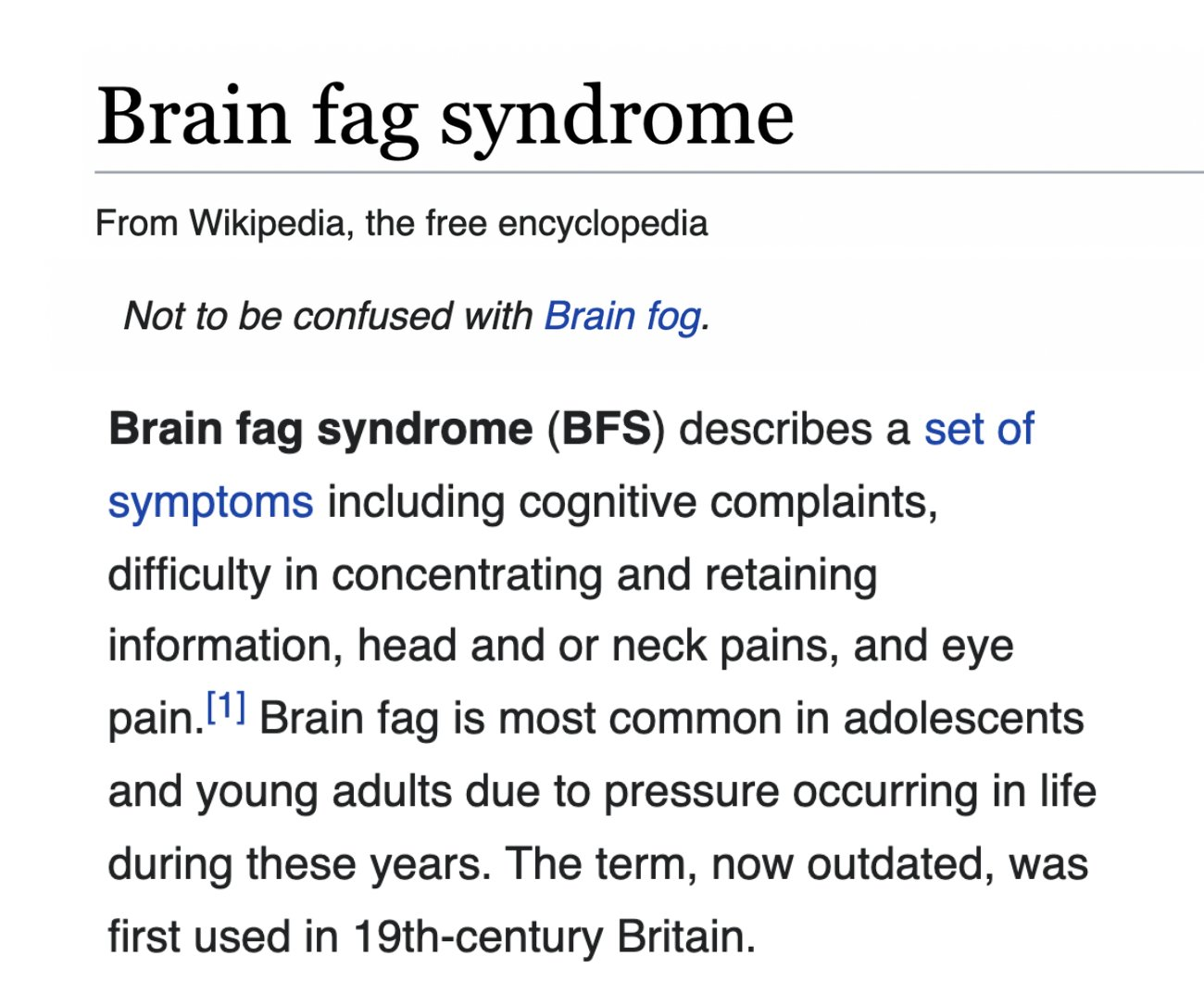
Now it isn’t. But that’s not because people stopped feeling sad, tired, and anxious — it’s because we stopped using “neurasthenia” as an abstraction to describe those experiences. Whatever people learned or wrote about neurasthenia is now useless except for historical study. That’s the thing about abstractions: they can hang around for a hundred years and then disappear, and we can be just as clueless about the true nature of the world as when we began. Don’t even get us started on Brain fag syndrome.
The DSM will never fully succeed because it’s stuck dealing with abstractions. One clue we’re still dealing with geocentric psychology here is that the DSM groups disorders by their symptoms rather than their causes, even though causes can vary widely for the same symptoms (e.g. insomnia can be biological, psychological, or your cat at 3 am).

Imagine doing this for physical diseases instead — if you get really good at measuring coughing, sneezing, aching, wheezing, etc. you may ultimately get pretty good at distinguishing between, say, colds and flus. But you’d have a pretty hard time distinguishing between flu and covid, and you’d have no chance of ever developing vaccines for them, because you have no concept of the systems that produce the symptoms.

Approaches like this, where you administer questionnaires and then try to squeeze statistics out of the responses, will always top out at that level. At best, you successfully group together certain clusters of people or behaviors on the basis of their superficial similarities. This can make us better at treating mental disorders, but not much better. 

If you don’t understand problems, it’s very unlikely you will solve them.

Abstractions are dangerous because they seduce you into thinking you know something. Medicine is especially bad at this. Take an abstraction, give it a Latin name, then say “because”, and it sounds like an explanation. You’ve got bad breath? That’s because you have halitosis, which means “bad breath”. This isn’t an explanation; it’s a tautology.

Will the treatment for one case of halitosis work on another case? Impossible to say. It certainly could. One reason things sometimes have the same surface appearance is because they were caused in the same way. But some people have halitosis because they never brush their teeth, some people have it because they have cancer, and other people have it because they have a rotting piece of fish stuck in their nose. Those causes will require different treatments.

— Molière, The Hypochondriac

Abstractions are certainly useful. But by themselves, abstractions are a dead end, because they don’t make specific claims. This is exemplified by flowchart thinking. You can draw boxes “A” and “B” and draw an arrow between them, but what is the specific claim made by this diagram? At most it seems to be that measures of A will be correlated with measures of B, and if the arrow is in one direction only, that changing measures of A will also change measures of B. 

That’s fine if this is the level of result you’re satisfied with, but it bears very little resemblance to the successes of the mature sciences. Chemistry’s successes don’t come from little flow charts going PROTON –> GOLD <—> MERCURY. If anything, that flowchart looks a lot more like alchemy. 

What you should think of when you see scientific claims using only abstraction

Abstractions can be useful starting points, but they’re bad ending points. For example, people noticed that snow melts in the sunlight and gold melts in a furnace. They noticed that hot water boils and that hot skin burns. It seemed like the same force was at work in all of these cases, so they called it “heat”.

The sensation of warmth, the force of sunlight, the similarities between melting and evaporation, are abstracted: “these go together so well that maybe they are one thing”. 

That’s only a starting point. Next you have to take the hypothesis seriously and try to build a model of the thing. What are the entities and rules behind all this warming, melting, and burning?

That’s what Lavoisier did: he came up with a model to try to account for these superficial similarities. Subsequent chemists proposed updates to the entities and the rules that did an even better job, and now we have a model that accounts for heat very well. We still call it “heat”, but because the model is a proposal about the underlying structure, it’s not superficial, so it’s not an abstraction. 

Game of Life

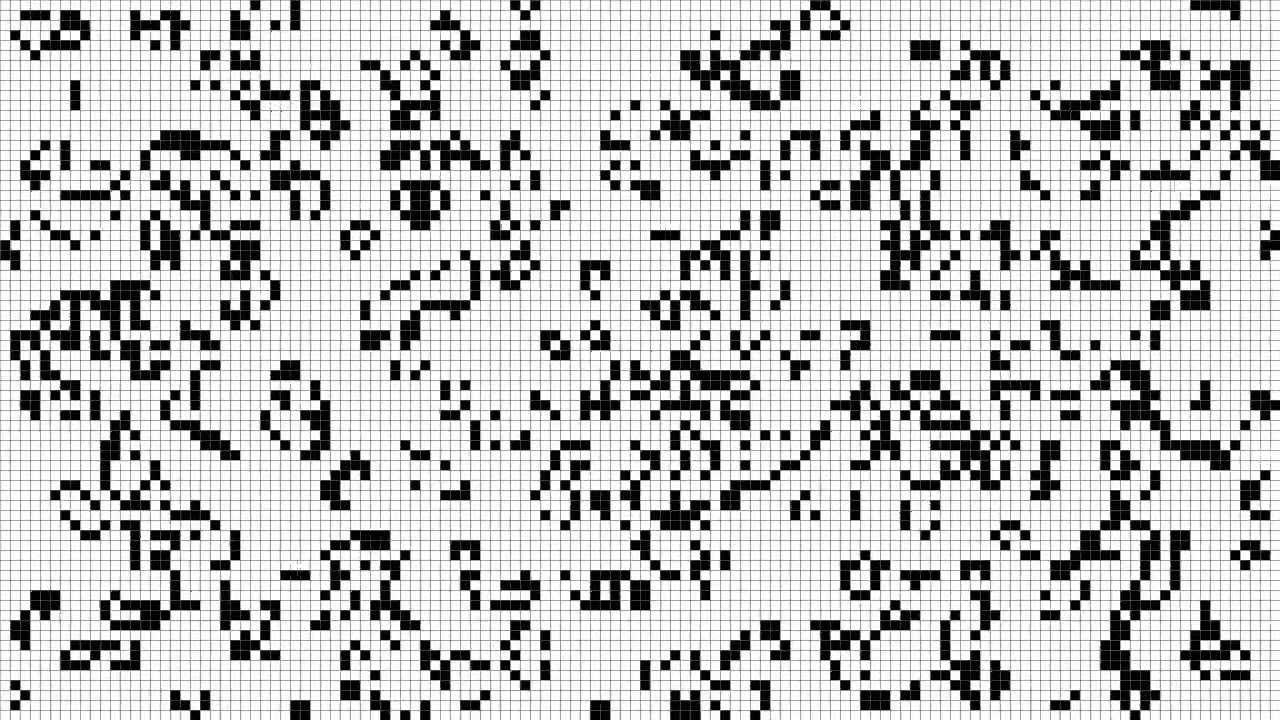
This is Conway’s Game of Life:

The universe of this game is an infinite two-dimensional grid of square cells. This means each cell has eight neighbors, i.e. the cells that are horizontally, vertically, and diagonally adjacent. 

The cells have only two properties — each cell is either alive or dead (indicated as black and white); and each cell has a location in the infinite two-dimensional grid. Time occurs in discrete steps and is also infinite. This is the full list of the entities in this world. 
At each step in time, the following rules are applied:

  1. Any live cell with fewer than two live neighbors becomes dead.
  2. Any live cell with two or three live neighbors stays alive.
  3. Any live cell with more than three live neighbors becomes dead.
  4. Any dead cell with exactly three live neighbors becomes a live cell.

This is the full list of the rules in this world.
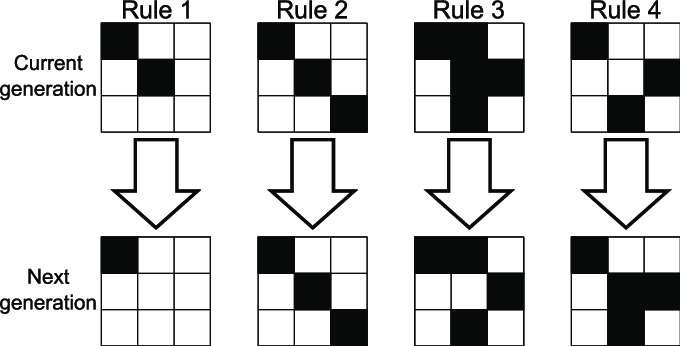
(Remember, black is alive)

All those parts, and no others, come together to create this world. You can try it for yourself here.

Despite being inspired by things like the growth of crystals, Conway’s Game of Life isn’t a model for any particular part of the natural world. However, it is an example of a set of simple entities, and simple rules about how those entities can interact, that gives rise to complex outcomes. 

This is the kind of model that has served as the foundation for our most successful sciences: a proposal for a set of entities, their features, and the rules by which they interact, that gives rise to the phenomena we observe. 

Instead of being a chain of abstractions, a flowchart that operates under vaguely implied rules, Conway’s Game of Life is a set of entities that interact in specific ways. And because it is so precise, it makes specific claims.

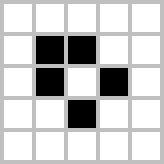
In principle, we can give you any starting state in the Game of Life, and you should be able to apply the rules to figure out what comes next. You can do that for as big of a starting state as you want, or for as many timesteps as you want. The only limit is the resources you are willing to invest. For example, see if you can figure out what happens to this figure in the next timestep:
Or if you want a more challenging example, try this one: 
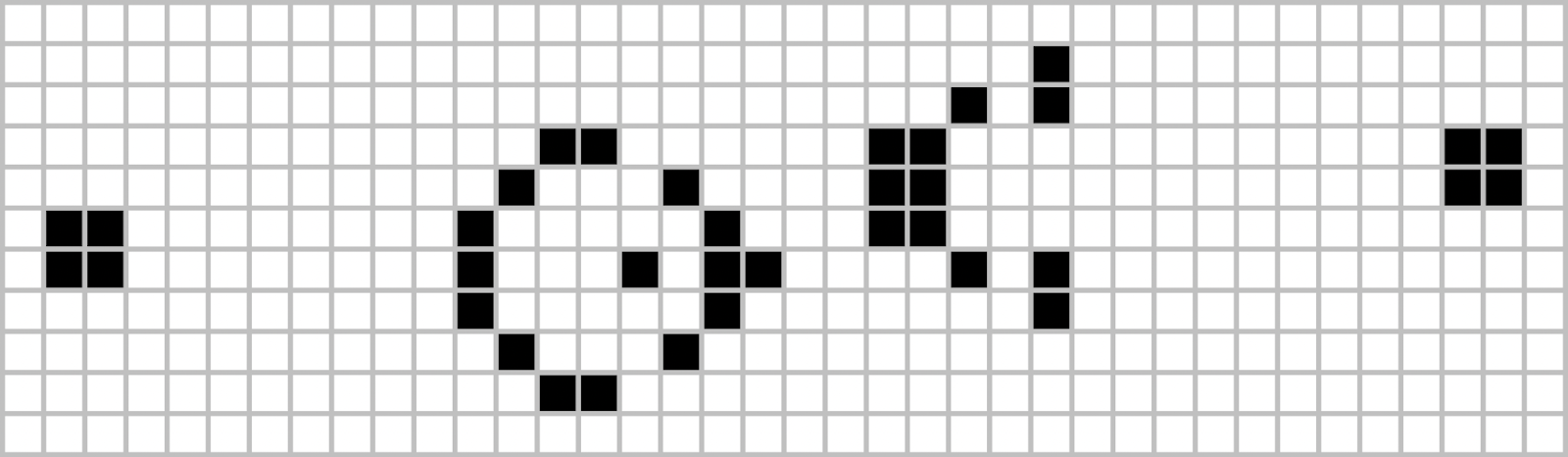
There are, of course, an infinite number of these exercises. Feel free to try it at home. Draw a grid, color in some cells at random, and churn through these rules. Specific claims get made.

In comparison, take a look at this diagram. Wikipedia assures us that the diagram depicts “mental state in terms of challenge level and skill level, according to Csikszentmihalyi’s flow model”:
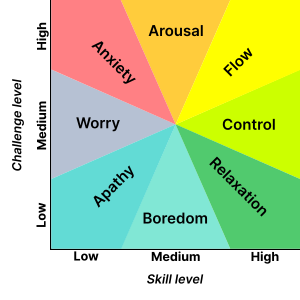
You might wonder what exactly is being claimed here. Yes, if you are medium challenged and low skilled, you are “worried”. But it’s not clear what that means outside of the context of these words.

This diagram is just mapping abstractions to abstractions. There is no proposal about the entities underlying those abstractions. What, specifically, might be going on when a person is medium skilled, or low challenged? LOW SKILL + HIGH CHALLENGE —> ANXIETY sounds like a scientific statement, but it isn’t. It’s like saying LOW CAR ACTIVITY + HIGH AMOUNTS OF WEIRD NOISES —> CAR BROKEN-DOWNNESS. Forget about such questions, what matters is that HIGH SKILL + HIGH CHALLENGE —> FLOW.

The Big Five is considered one of the best theories in psychology, and provides five dimensions for describing personality, dimensions like extraversion and openness. But the dimensions are only abstractions. The theory doesn’t make any claim about what constitutes being “high openness”, literally constitutes in the sense of what that factor is made up of. The claims are totally superficial. At most, the big five is justified by showing that its measures are predictive. This so-called theory is not scientific.

Modern scientists often claim that they are building models. However, these are usually statistical models. They are based on historical data and can be used to guess what the future will look like, assuming the future looks like the past. Statistical models predict relationships between abstract variables, but don’t attempt to model the processes that created the data. A linear regression is a “model” of the data, but no one really thinks that the data entered the world through a linear model like the one being used to estimate it.

This is made even more confusing because there is another totally different kind of “statistical model” found in fields like statistical physics. These are models in the sense that we mean. Despite involving the word “statistical”, they are nothing like a linear regression. Instead of looking backwards at historical data of abstract variables, models in statistical physics take hypothetical particles and step them forward, in an attempt to describe the collective behavior of complex systems from microscopic principles about how each particle behaves. These models are “statistical” only in the sense that they use probability to attempt to describe collective behavior in systems with many particles. 
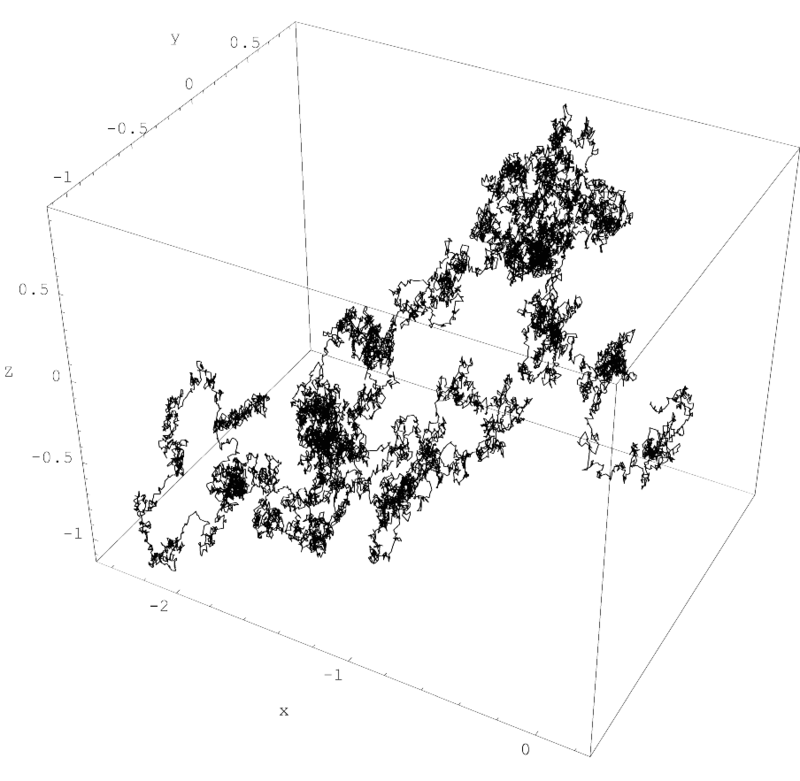
We want a model that is a proposal for simple entities, their properties, and the rules that govern them, that can potentially give rise to the natural phenomena we’re interested in. The difference between the Game of Life and a genuine scientific model is simply that while the Game of Life is an artificial set of entities and rules that are true by fiat, answering to nothing at all about the real world, a scientific model is a proposal for a set of entities and rules that could be behind some natural phenomenon. All we have to do is see if they are a good match.

Particle Man

Physics first got its legs with a model that goes something like this. The world is made up of bodies that exist in three-dimensional space and one-dimensional time. The most important properties of bodies are their mass, velocity, and position. They interact according to Newton’s laws. There are also some forces, like gravity, though the idea of forces was very controversial at first. 

If you read Newton’s laws, you’ll see that these are the only entities he mentions. Bodies that have mass, speed/velocity, and a location in time according to space. Also there is a brief mention of forces.

Since this model was invented, things have gotten much more complicated. We now have electrical forces, Einstein changed the nature of the entities for space/time/mass, and there is all sorts of additional nonsense going on at the subatomic level.

We were able to get to this complicated model by starting with a simpler model that was partially right, a model that made specific claims about the entities and rules underlying the physical world, and therefore made at least somewhat specific predictions. These predictions were wrong enough to be useful, because they could be tested. Claims about the rules and entities could be challenged, and the models could be refined. They did more than simply daisy-chain together a series of abstractions. 
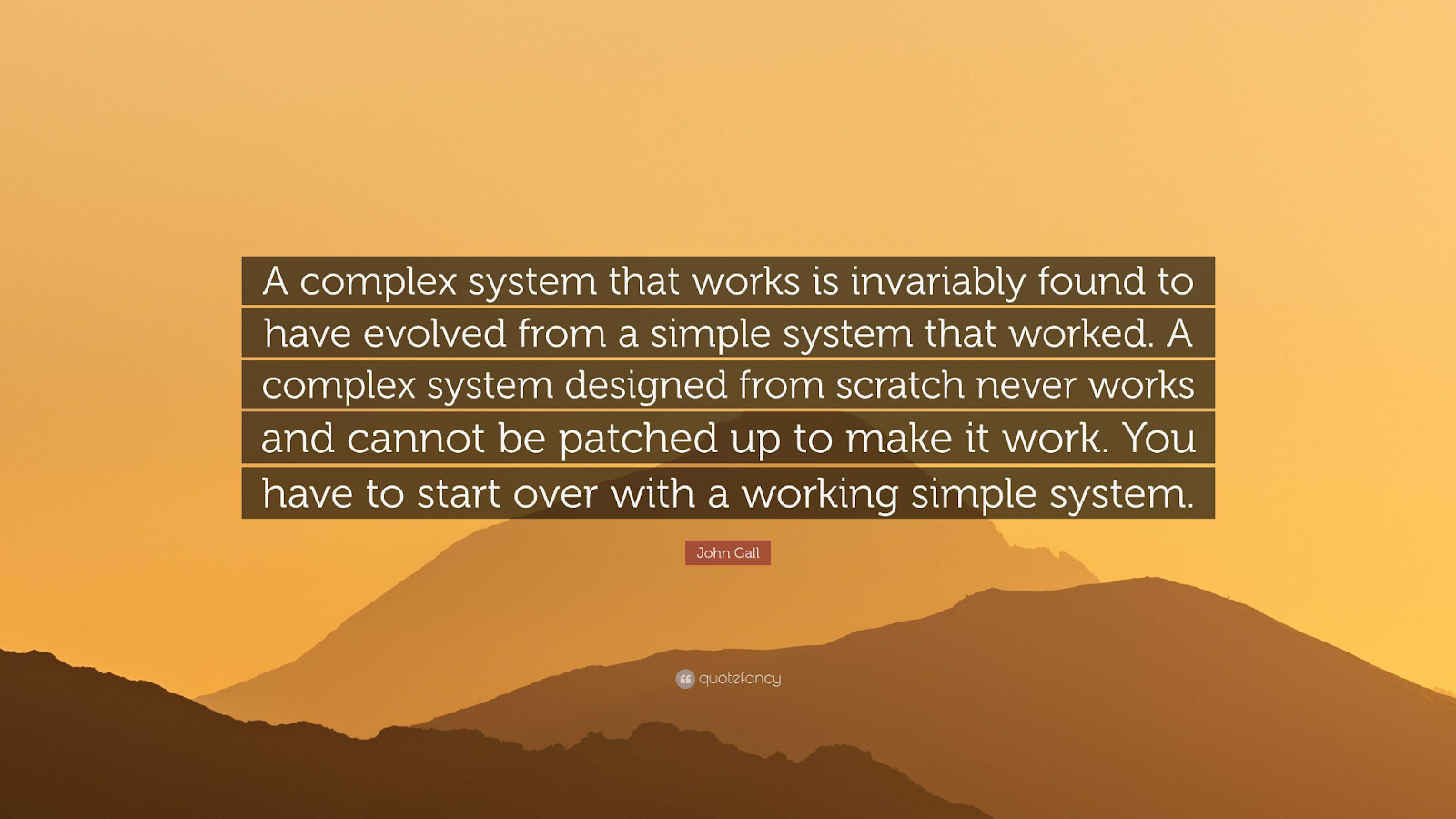
Time for a motivational poster

Coming up with the correct model on the first go is probably impossible. But coming up with a model that is specific enough to be wrong is our responsibility. Specific enough to be wrong means proposals about entities and rules, rather than superficial generalizations and claims about statistical relationships.

Like Lavoisier, we should be largely unconcerned as to whether these models are real or purely hypothetical. We should be more concerned about whether it “explains the phenomena of nature in a very satisfactory manner.” Remember that “we are not obliged to suppose this to be a real substance”!

As another example, consider different models of the atom.
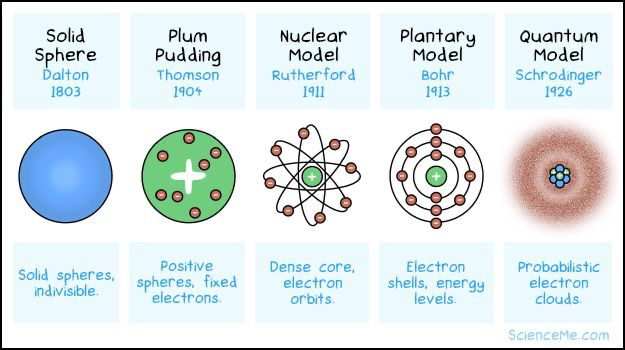
Dalton was raised in a system where elements had been discovered by finding substances that could not be broken down into anything else. Hydrogen and oxygen were considered elements because water could be separated into both gases, but the gases themselves couldn’t be divided. So Dalton thought of atoms as indivisible. 

When electrons were discovered, we got a plum pudding model. When Rutherford found that atoms were mostly empty space, we got a model with a small nucleus and electrons in orbit. Emission spectra and other observations led to electron shells rather than orbits. None of these models were right, but they were mechanical and accounted for many observations.

The Nature of Science

Anyways, what is science?

Most people these days claim that the legitimacy of science comes from the fact that it’s empirical, that you’re going out and collecting data. You see this in phrases like, “ideas are tested by experiment”. As a result, people who do any kind of empirical work often insist they are doing science.

Testing ideas by experiment is essential — what else are you going to rely on, authority figures? But what kind of ideas are tested by experiment? Science can’t answer normative ideas, like “how should I raise my child?” or “what kind of hat is best?” It also can’t answer semantic ideas like “is a hot dog a sandwich?”

Some things are empirical but don’t seem very much like science at all. For example, imagine a study where we ask the question, “are red cars faster than blue cars?” You can definitely go out and get a set of red cars and a set of blue cars, race them under controlled conditions, and get an empirical answer to this question. But something about this seems very wrong — it isn’t the kind of thing we imagine when we think about science, and doesn’t seem likely to be very useful.

Similarly, you could try to get an empirical answer to the question, “who is the most popular musician?” There are many different ways you could try to measure this — record sales, awards, name recognition, etc. — and any approach you chose would be perfectly empirical. But again, this doesn’t really feel like the same thing that Maxwell and Newton and Curie were doing.

You could object to these studies on the grounds that the questions are moving targets. Certain musicians are very popular today, but someday a different musician will be more popular. Even if right now, across all cars, red cars are faster than blue cars, that may not be true in the future, may not always be true in the past. If you go far enough back in time, there weren’t any cars at all. 

You could also object that the results aren’t very stable, they can be easily altered. If we paint some of our red cars blue, if we spend some marketing dollars on one musician over another, the empirical answer to these questions could change. 

Both of these complaints are correct. But they identify symptoms, not causes. They reflect why the questions are nonsensical, but they’re not the source of the nonsense. 

Better to say, these studies are unscientific because they make no claim about the underlying entities.

We say that science is when metaphysical proposals about the nature of the entities that give rise to the world around us are tested empirically. In short, you propose entities and rules that can be tested, and then you test your proposal. Science does have to be empirical. But being empirical is not enough to make something science.

A good way to think of this is that we’re looking for a science that is not merely empirical, but mechanical, in the sense of getting at a mechanism. The ideal study tries to get a handle on proposals about the mechanics of some part of the natural world. And you can only get at the mechanics by making a proposal for entities and rules that might produce parts of the natural world that we observe. 

This isn’t always possible at first. When you hear there’s some hot new mold that cures infections, your first question should be plain and empirical — does it actually cure infections or not? The practical reason to firmly establish empirical results is to avoid dying of infections. But the scientific reason is so that you can come around and say, “now that we have established that this happens, let’s try to figure out why it happens.” Now you are back to mechanism.  

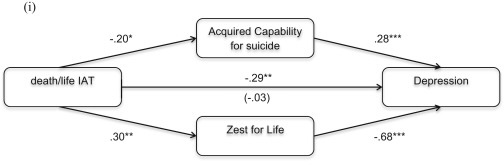
But you still have to be careful, because many things that people think are mechanisms are actually more abstractions. Psychology gets this wrong all the time. Let’s pick on the following diagram, which is theoretically a claim about mechanism, i.e. the mechanism by which your death/life IAT is correlated with some measure of depression. But “zest for life” isn’t a proposal for a mechanism, it’s just another abstraction. You need a specific proposal of what is happening mechanically for something to be a mechanism. 
Incidentally, this suggests that having a background in game design may give you a serious leg up as a theoretical scientist.

Game designers can’t be satisfied with abstractions. Their job is to invent mechanisms, to fill a world with entities and laws that make the gameplay they want to make possible, possible; the gameplay they don’t want impossible; and that help players have the intended experience. 

Compare this story from Richard Feynman: 

[My Father] was happy with me, I believe. Once, though, when I came back from MIT (I’d been there a few years), he said to me, “Now that you’ve become educated about these things, there’s one question I’ve always had that I’ve never understood very well.”

I asked him what it was.

He said, “I understand that when an atom makes a transition from one state to another, it emits a particle of light called a photon.”

“That’s right,” I said.

He says, “Is the photon in the atom ahead of time?”

“No, there’s no photon beforehand.”

“Well,” he says, “where does it come from, then? How does it come out?”

I tried to explain it to him—that photon numbers aren’t conserved; they’re just created by the motion of the electron—but I couldn’t explain it very well. I said, “It’s like the sound that I’m making now: it wasn’t in me before.” (It’s not like my little boy, who suddenly announced one day, when he was very young, that he could no longer say a certain word—the word turned out to be “cat”—because his “word bag” had run out of the word. There’s no word bag that makes you use up words as they come out; in the same sense, there’s no “photon bag” in an atom.)

He was not satisfied with me in that respect. I was never able to explain any of the things that he didn’t understand. So he was unsuccessful: he sent me to all these universities in order to find out those things, and he never did find out.

You can see why Feynman’s father found this frustrating. But to a game designer, nothing could be more trivial than to think that God designed things so that atoms spawn photons whenever the rules call for it. Where were the photons before? The question isn’t meaningful: “photons” is just a number in the video game engine, and when the rules say there should be new photons, that number goes up.

This is also why abstractions don’t work for science. Listening to someone explain a new board game is already one of the most frustrating experiences of all time. But imagine someone explaining the rules to you in abstractions rather than in mechanics.

In Settlers of Catan, the universe is an island consisting of 19 hexagonal tiles. Settlements can be built at the intersections of tiles, and tiles generate resources depending on their type. The game could be described abstractly. But this is not as useful as describing it mechanically:

MR. ABSTRACTIO: You can make a new settlement with resources. Maritime trade creates value. The player with the best economy wins. Okay, let’s play!

MR. MECHANICO: Building a new settlement requires a Brick, Lumber, Wool, and Grain card. A settlement or a city on a harbor can trade the resource type shown at 3:1 or 2:1 as indicated. You win by being the first to reach 10 victory points, and you earn victory points from settlements (1 point each), cities (2 points each), certain development cards (1 point each), having the longest road (2 points), and having the largest army (2 points).

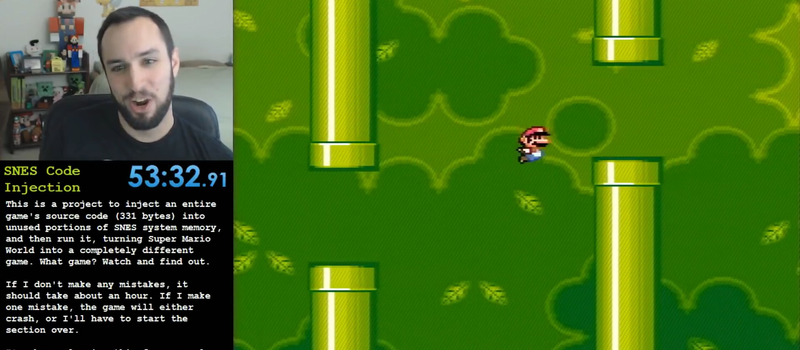
Another source of unappreciated mechanical thinking is video game speedrunners. Game designers have a god’s-eye view of science, as they make the rules of a world from scratch; speedrunners are more like scientists and engineers, using experiments to infer the underlying rules of the world, and then exploiting the hell out of them

With a deep enough understanding of Super Mario World, you can use Mario’s actions to add your own code to the game, and reprogram the world to play Flappy Bird

Many sciences like neuroscience and nutrition pretend to be model-building, but are actually just playing with abstractions. They appear to make claims about specific entities, but on closer inspection, the claims are just abstractions in a flowchart.

This can be hard to spot because many of these entities, like neurotransmitters or vitamins, really are specific entities in the chemical sense. But in neuroscience and nutrition these entities are often invoked only as abstractions, where they interact abstractly (e.g. more of X leads to more of Y) rather than mechanically. They tell you, “X upregulates Y.” How fascinating, what are the rules that lead to this as a consequence? 

As neuroscientist Erik Hoel puts it:

If you ask me how a car works, and I say “well right here is the engine, and there are the wheels, and the steering wheel, that’s inside,” and so on, you’d quickly come to the conclusion that I have no idea how a car actually works.

Explanations are often given in terms of abstractions. “Please doc, why am I depressed?” “Easy, son: Not enough dopamine.” If you’re like us, you’ve always found these “explanations” unsatisfying. This is because abstractions can’t make sense of things. They just push the explanatory burden on an abstract noun, and hope that you don’t look any deeper.

Explanations need to be in terms of something, and scientific explanations need to be in terms of a set of entities and their relationships. Why do sodium and chlorine form a salt? Because one of them has one extra electron in its outer shell, leading to a negative charge, while one has one missing electron in its outer shell, leading to a positive charge, and they form an ionic bond. This is why chlorine also readily forms a salt with potassium, etc. etc. The observed behavior is explainable in terms of the entities and their properties we’ve inferred over several hundred years of chemistry, interacting according to the rules we’ve inferred from the same. 

The fake version of this can be hard to spot. “Why am I depressed? Not enough dopamine” sounds a lot like “Why does my car not start? Not enough gasoline.” But the second one, at least implicitly, leads to a discussion of spark plugs, pistons, and fuel pumps acting according to simple rules, genuine mechanics’ mechanics. The first one promises such an implied mechanism but, in our understanding at least, does not deliver. 

This also dissolves one of our least-favorite discussions about psychology, whether or not there are “real truths in the social sciences”. There may or may not be real truths in the social sciences. But human behavior, and psychology more generally, is definitely the result of some entities under the hood behaving in some way, and we can definitely do more to characterize those entities and how they interact. 

There’s a common misunderstanding. We’ll use an example from our friend Dynomight, who says: 

Would you live longer if you ate less salt? How much longer? We can guess, but we don’t really know. To really be sure, we’d need to take two groups of people, get them to eat different amounts of salt, and then see how long they live.

This way of thinking follows a particular strict standard, namely “randomized controlled experiments are the only way to infer causality”. But this isn’t really how things have ever worked. This is pure extrapolation, not model-building. In contrast to the impressionistic research of inventing abstractions, you might call this brute-force empiricism.

Experiments are useful, but we can’t let them distract from the real goal of science, which is building models that work towards a mechanistic understanding of the natural world. 

To get to the moon, we didn’t build two groups of rockets and see which group made it to orbit. Instead, over centuries we painstakingly developed a mechanical understanding of physics, or at least a decent model of physics, that allowed us to make reasonable guesses about what kind(s) of rockets might work. There was a lot of testing involved, sure, but it didn’t look like a series of trials where we did head-to-head comparisons of hundreds of pairs of rocket designs, one pair at a time.

So to “get to the live longer”, we probably won’t build a low-salt and high-salt diet and fire them both at the moon. Instead we will, slowly, eventually, hopefully, develop a mechanical understanding of what salt does in the body, where things are likely to go well, and where they’re likely to go wrong. Then we will compare these models to observations over time, to confirm that the models are roughly correct and that things are going as anticipated, and we’ll correct the models as we learn more.

It won’t look like two groups of people eating broadly different diets in large groups. That is science done with mittens. There is a better way than losing all articulation and mashing together different conditions.

Astronomy may have forced us to do science the right way because it enforces a “look but don’t touch” approach. Newton didn’t run experiments where he tried the solar system one way and then tried it the other way. Instead he (and everyone else) looked, speculated, came up with models, and saw which models would naturally cause the action they had already seen in the heavens. None of the models were entirely right, but some of them were close, and some of them made interesting predictions. And in time, some of them got us to the moon.

Philosophy Time

These are the insights you need to make sense of the famously confusing but deeply insightful philosopher of science Thomas Kuhn.

One-paragraph background on Kuhn: Thomas Kuhn was a philosopher of science who introduced the concept of “paradigms”. According to Kuhn, each science (biology, chemistry, etc.) is built on a paradigm, and scientific progress is more than the slow accumulation of facts, it involves revolutions, where an old paradigm is tossed out and a new one installed as the new foundation. 

But even though it’s his biggest concept, Kuhn can be kind of vague about what a “paradigm” involves, and this has led to a lot of confusion. So let’s try to pin it down.

A paradigm is not just a shared set of assumptions or tools and techniques. If it were, any tennis club would have a paradigm. 

A paradigm is specifically a proposal (or rather, class of proposals) about the entities, properties, and relationships that give rise to some natural phenomenon.

Kuhn says: 

Effective research scarcely begins before a scientific community thinks it has acquired firm answers to questions like the following: What are the fundamental entities of which the universe is composed? How do these interact with each other and with the senses? What questions may legitimately be asked about such entities and what techniques employed in seeking solutions? At least in the mature sciences, answers (or full substitutes for answers) to questions like these are firmly embedded in the educational initiation that prepares and licenses the student for professional practice.

(The Structure of Scientific Revolutions, Chapter 1)

Why “a class of proposals” and not “a proposal”? Well, because the specifics are always very much up for debate, or at least subject to empirical scrutiny. Any particular proposal, with exact values and all questions pinned down, cannot be a paradigm. A paradigm is a general direction that includes some flexibility. 

For example, we may not know if the mass of a specific particle is 2 or 1 or 156 or 30,532 — but we do agree that things are made up of particles and that one of the things you can say about a particle is that it has some mass. 

There may even be disagreement about the limits of the proposal itself — can the mass of a particle be any real number, say 1.56, or is mass limited to the positive integers, like 2, 4, and 10? Can the mass of a particle be negative? But in general we have a basic agreement on what kind of thing we are looking for, i.e. the types of entities, their features, and their interactions. 

Kuhn gives an example based on Descartes’s corpuscularism. Descartes didn’t give a specific proposal about exactly what kinds of corpuscules there are, or exactly the rules by which they can interact. Instead, it was more of an open-ended suggestion: “hey guys, seems like a good model for physics would be something in the class of proposals where all things are made up of tiny particles”: 

After the appearance of Descartes’s immensely influential scientific writings, most physical scientists assumed that the universe was composed of microscopic corpuscles and that all natural phenomena could be explained in terms of corpuscular shape, size, motion, and interaction. That nest of commitments proved to be both metaphysical and methodological. As metaphysical, it told scientists what sorts of entities the universe did and did not contain: there was only shaped matter in motion. As methodological, it told them what ultimate laws and fundamental explanations must be like: laws must specify corpuscular motion and interaction, and explanation must reduce any given natural phenomenon to corpuscular action under these laws. More important still, the corpuscular conception of the universe told scientists what many of their research problems should be. For example, a chemist who, like Boyle, embraced the new philosophy gave particular attention to reactions that could be viewed as transmutations. 

(The Structure of Scientific Revolutions, Chapter 4)

Kuhn’s arguments definitely line up with one proposal: a book by the cyberneticist William Powers, called Behavior: The Control Of Perception. And the two men must have recognized at least some of this in each other, judging from the blurb that Kuhn wrote for Powers’s book: 

Powers’ manuscript, Behavior: The Control of Perception, is among the most exciting I have read in some time. The problems are of vast importance, and not only to psychologists; the achieved synthesis is thoroughly original; and the presentation is often convincing and almost invariably suggestive. I shall be watching with interest what happens to research in the directions to which Powers points.

And it’s worth considering what Powers says about models:

In physics both extrapolation and abstract generalization are used and misused, but the power of physical theories did not finally develop until physical models became central. A model in the sense I intend is a description of subsystems within the system being studied, each having its own properties and all—interacting together according to their individual properties—being responsible for observed appearances.

As you can see, this is another description of a model based on rules and entities.

The final concept to take away here is that these models are mechanistic. There’s a reason that Descartes was celebrated for his mechanical philosophy. When you assume the universe is akin to a gigantic clock, a real machine where the hands and numbers on the face are driven by the interaction of gears and levers below, your theories will be mechanical too. They will appeal to the interaction of gears and wires, rather than to abstract notions of what is happening on the clock face. (“The minute-hand has minute-force, and that’s why it moves faster than the hour-hand, which only has hour-force.”)

If a model is not mechanical in this way, if it does not speculate about the action of mechanisms beneath what is seen, it will be superficial. And it is not enough to speculate about things beneath. You can layer abstractions on abstractions (e.g. your anxiety is caused by low self-esteem). But you can’t design a watch without talking about individual pieces and how they will interact according to fixed rules.

A Third Direction for the Mind

Psychology is pre-paradigmatic. It’s not simply that we can’t agree on what entities make up the mind — it’s that there have been almost no proposals for these entities in the first place. There are almost no models, or even proposals for models, that could actually give rise to even a small fraction of the behavior we observe. A couple hundred years of psychology, and almost all we have to show for it are abstractions. 

But there are a few exceptions, proposals that really did try to build a model. 

The first major exception is Behaviorism. This was an attempt to explain all human and animal behavior in the terms of reward, punishment, stimulus, and muscle tension, according to the laws of association. If, after some stimulus, some muscle tension was followed by reward, there would be more of that muscle tension in the future following that stimulus; if followed by punishment, there would be less.

This ended up being a terrible way to do psychology, but it was admirable for being an attempt at describing the whole business in terms of a few simple entities and rules. It was precise enough to be wrong, rather than vague to the point of being unassailable, which has been the rule in most of psychology.

A more popular proposal is the idea of neural networks. While models based on this proposal can get pretty elaborate, at the most basic level the proposal is about a very small set of entities (neurons and connections) that function according to simple rules (e.g. backpropagation). And it’s hard to look at modern deep learning and large language models and not see that they create some behavior that resembles behaviors from humans and animals.

That said, it’s not clear how seriously to take neural networks as a model for the mind. Despite the claim of being “neural”, these models don’t resemble actual neurons all that much. And there’s a thornier problem, which is that neural networks are extremely good function approximators. You can train a neural network to approximate any function; which means that seeing a neural network approximate some function (even a human behavior like language) is not great evidence that the thing it is approximating is also the result of a neural network.

Finally, there is a proposal that the main entities of the mind are negative feedback loops, and that much or even all of psychology can be explained in terms of the action of these feedback loops when organized hierarchically. This proposal is known as cybernetics.


[Next: THERMOSTAT]

Potato Riffs Retrospective

Background

Just over a year ago we launched the Potato Diet Riff Trial, the first of its kind.

The riff trial is a new type of study design. In most studies, all participants sign up for the same protocol, or for a small number of similar conditions. But in a riff trial, you start with a base protocol, and every participant follows their own variation. Everyone tests a different version of the original protocol, and you see what happens.

As the first test of this new design, we decided to riff on one of our previous studies: the potato diet. For many people, eating a diet of nothing but potatoes (or almost nothing but potatoes) causes quick, effortless weight loss, 10.6 lbs on average. It’s not a matter of white-knuckling through a boring diet — people eat as much (potato) as they want, and at the end of a month of spuds, they say things like, “I was quite surprised that I didn’t get tired of potatoes. I still love them, maybe even more so than usual?!”

Why the hell does this happen? Well, there are many theories. The hope was that running a riff trial would help get a sense of which theories are plausible, try to find some boundary conditions, or just more randomly explore the diet-space. We thought it might also help us figure out if there are factors that slow, stop, or perhaps even accelerate the rate of weight loss we saw on the full potato diet.

In the first two months after launching the riff trial, we heard back from ten riffs. Those results are described in the First Potato Riffs Report. Generally speaking, we learned that Potatoes + Dairy seems to work just fine, at least for some people, and we saw more evidence against the idea that the potato diet works because you are eating only one thing (people still lost weight eating more than one thing), or because the diet is very bland (it isn’t).

Between January 5th and March 18th, 2024, we heard back from an additional seventeen riffs. Those results are described in the Second Potato Riffs Report. Generally speaking, we learned that Potatoes + Dairy still seems to work just fine. Adding other vegetables may have slowed progress, and the protein results were mixed. However, the Potatoes + Skittles riff was an enormous success. 

Between March 18th and October 9th, 2024, we heard back from an additional eleven riffs. Those results are described in the Third Potato Riffs Report. Generally speaking, we saw continued support for Potatoes + Dairy.

The trial is closed, but since the last report, we’ve heard back from an additional two riffs, which we will report in a moment. This gives us a total of 40 riffs in this riff trial. Note that this is not the same as 40 participants, since some people reported multiple riffs, and a few riffs were pairs of participants.

Raw data are available on the OSF.

Last-Minute Entrants

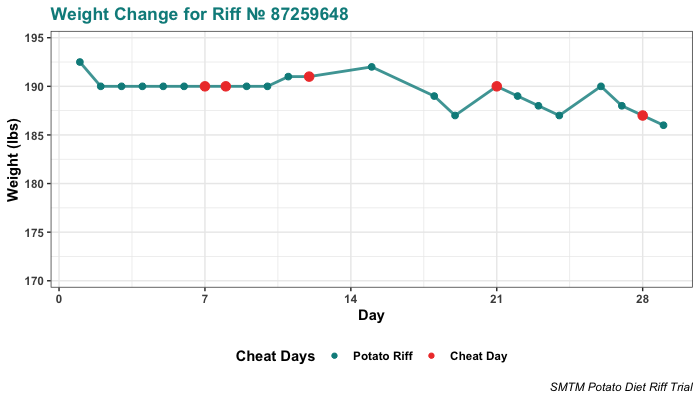
Participant 87259648 did a Fried Potatoes riff, specifically, “mostly fried in a mix of coconut oil and tallow or lard” and continuing her “normal daily coffees with raw whole milk, heavy cream, honey and white sugar.”

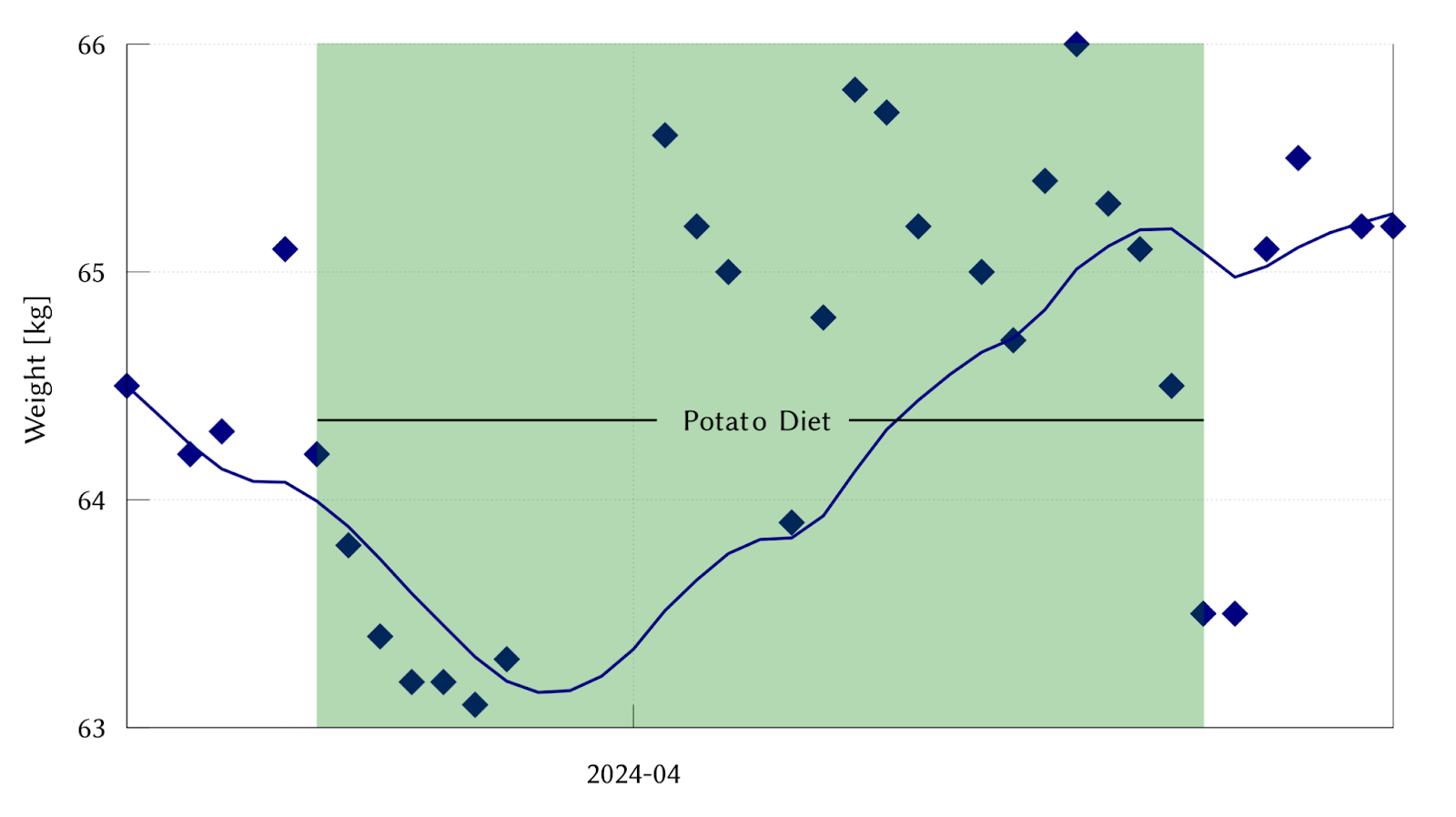
Despite consuming only “around 30 percent potato on average”, she lost a small amount of weight and “found [the] diet to be easy and enjoyable, I never felt sick of potato although I did have a hard time getting myself to eat MORE potato each day.”
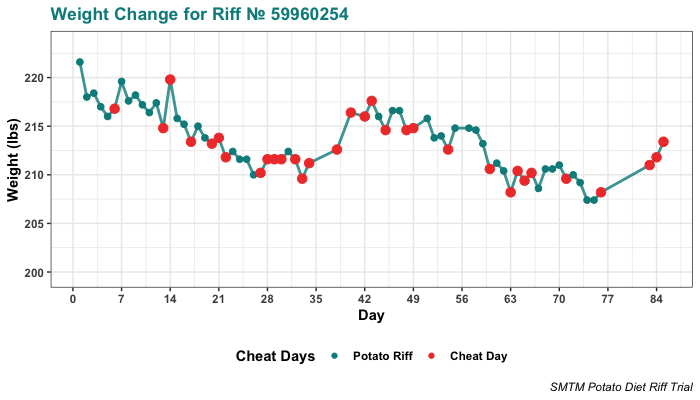
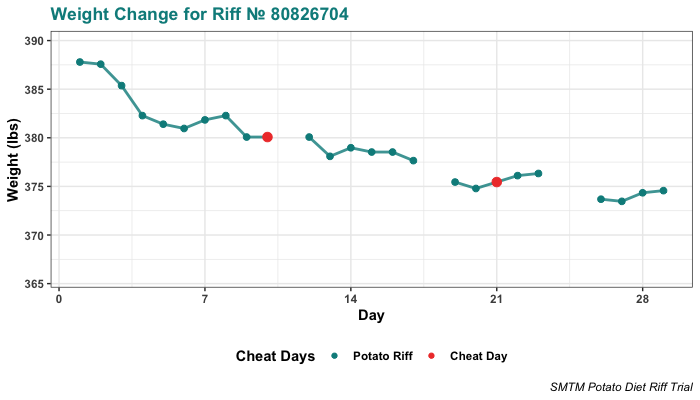
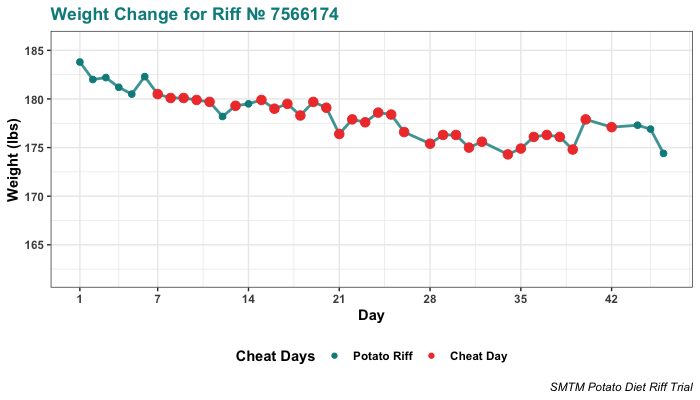
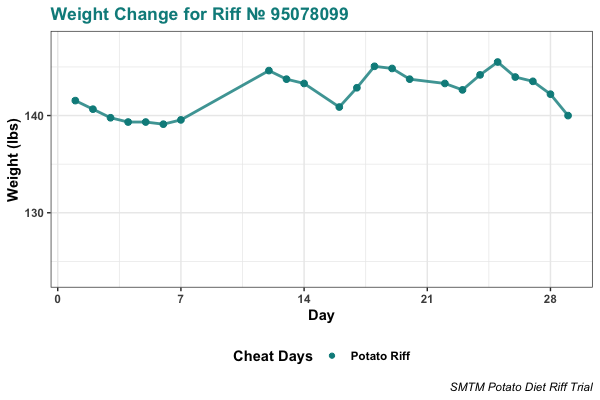
Participant 80826704 was formerly participant 41470698, but asked for a new number to do a new kind of riff. In Riff Trial Report Two, he had done Potatoes + Eggs as participant 41470698 and lost almost no weight. This time, he did a full potato diet and lost a lot of weight, more than 13 lbs: 

This definitely fits with our suspicion that eggs may be related to weight gain, and the observation that eggs often contain high concentrations of lithium.

Summary

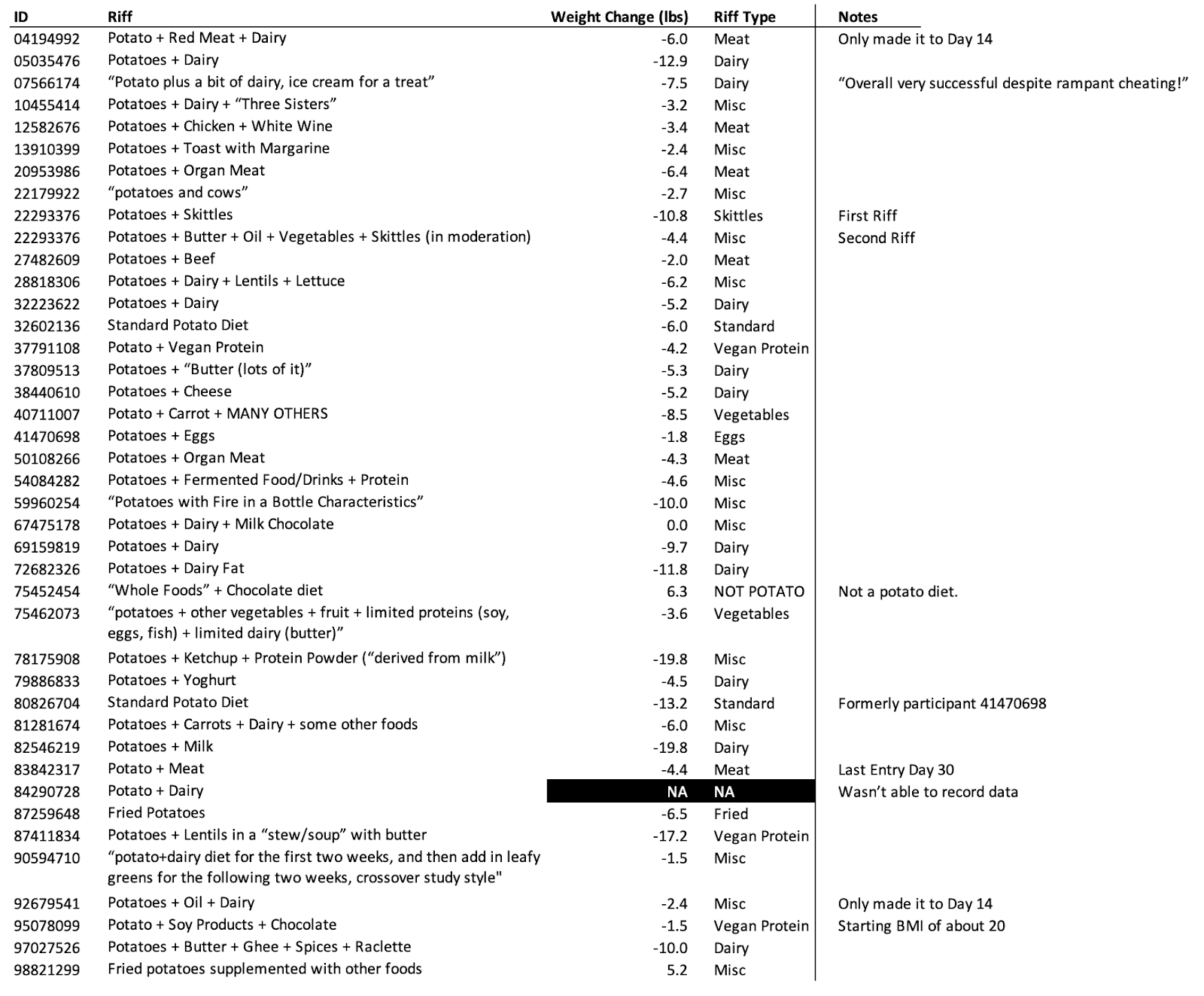
Let’s recap all the riffs. Here’s a handy table:  

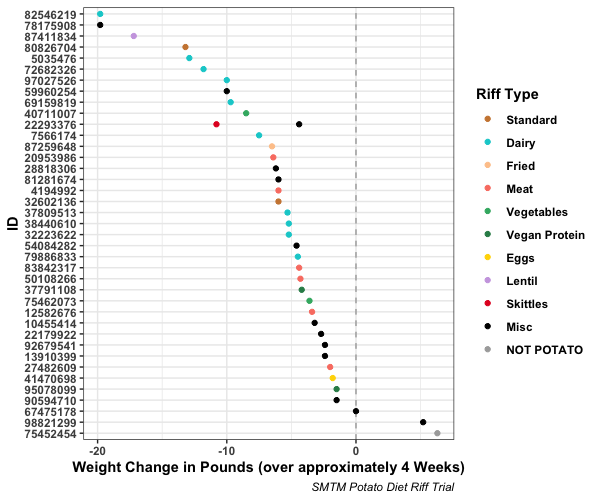
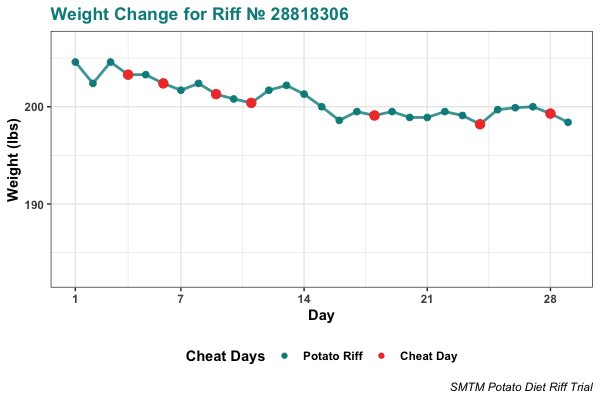
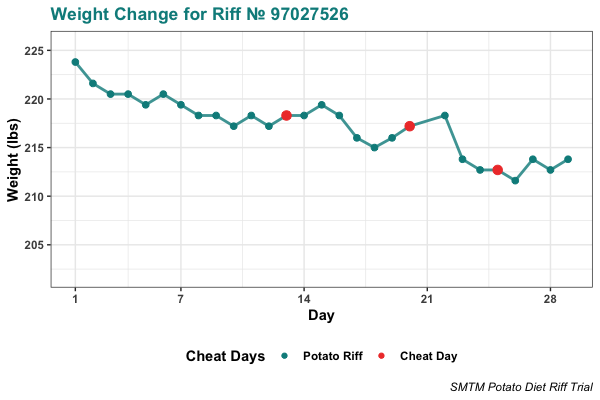
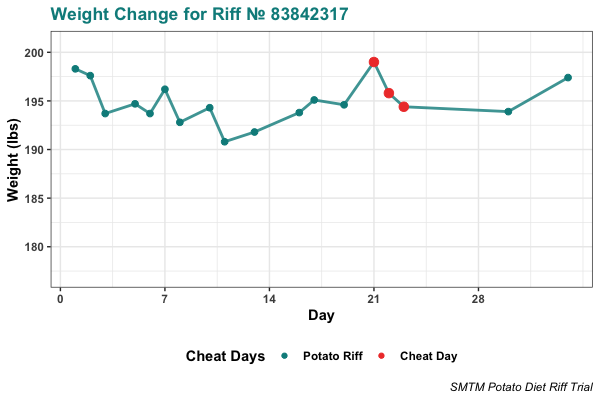
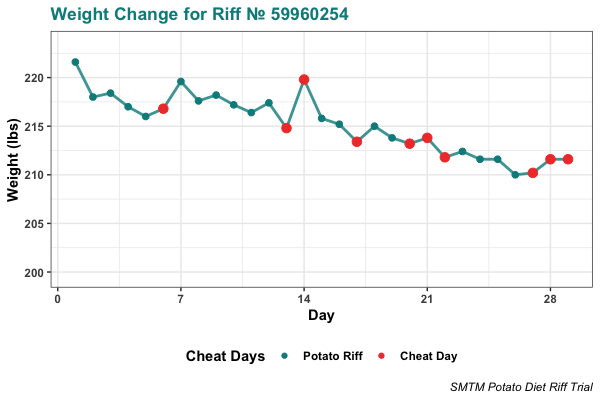
Mean weight change was 6.4 lbs lost, with the most gained being 5.2 lbs and the most lost being two people who both lost 19.8 lbs. One person gained weight, one person saw no change, one person reported no data, and the rest lost weight. One person also gained 6.3 lbs on “Whole Foods” + Chocolate, but this was not a potato diet (only about 10% of her diet was potatoes). 

Here are all the completed riffs, plotted by the amount of weight change and sorted into very rough riff categories: 

There are also a large number of people who signed up, but never reported closing their riff. We’re not going to analyze them at this point, but all signup data is available on the OSF if you want to take a look at the demographics. 

Things we Learned about the Potato Diet

The potato diet continues to be really robust. You can eat potatoes and ketchup, protein powder, or even skittles, and still lose more than 10 lbs in four weeks. 

The main thing we learned is that Potatoes + Dairy works almost as well as the normal potato diet. There were many variations, but looking at the 10 cases that did exclusively potatoes and dairy, the average weight lost on these riffs was 9.2 lbs. This is pretty comparable to the 10.6 lbs lost on the standard potato diet, suggesting that Potatoes + Dairy is almost as good as potatoes by themselves (though probably not better). 

We didn’t see much evidence that there might be a protocol more effective than the potato diet. This is sad, because it would have been really funny if Potatoes + Skittles turned out to be super effective. 

That said, three riffs did do unusually well, and it’s still possible that there is some super-potato-diet that causes more weight loss than potatoes on their own, or that’s better in some other way. 

There’s some evidence that meat, oil, vegetables, and especially eggs make the potato diet less effective. But with such a small sample, it’s hard to know for sure. This could be a productive direction for future research. You could organize it as an RCT, and compare a Just-Potato condition to a Potato + Other Thing condition. Or an individual could test this by first doing a potato diet with one of these extra ingredients for a few weeks, then removing the extra ingredient and doing a standard potato diet for a few weeks as comparison.

The strongest evidence is against eggs, because participant 41470698 / 80826704 did exactly that. First he did a Potatoes + Eggs riff and lost only 1.8 lbs. Then he did a standard potato diet and lost 13.2 lbs. That’s not proof positive, but it’s a pretty stark comparison. If that happens in general, it would be hard not to conclude that eggs stop potatoes from working their weight-loss wonders.  

Current Potato Recommendation

If you want to try the potato diet for weight loss, our current recommendation is this funnel:

  1. Start by getting about 50% of your diet from potatoes and see how well that works.
  2. If you want to be more aggressive, switch to Potatoes + Dairy. Try to get at least 95% of your diet each day from potatoes and dairy products, but don’t worry about small amounts of cheating.
  3. If you want to be more aggressive, switch to the original potato diet. Try to get at least 95% of your diet each day from potatoes, but don’t worry about small amounts of cheating.
  4. If you want to be more aggressive, switch to a strict potato diet. Try to get almost 100% of your calories each day from potatoes, allowing for a small amount of cooking oil or butter, salt, hot sauce, spices, and no-calorie foods like coffee.

If dairy doesn’t work for you for some reason (like you’re a vegan, or you just hate milk), consider replacing Step 2 with a different riff that showed good results, like Potatoes + Lentils or Potatoes + Skittles.

Remember to get vitamin A. Mixing in some sweet potatoes is a good idea for this reason.

Remember to get plenty of water. Thirst can feel different on the potato diet, you will need to drink more water than you expect.

Remember to eat! In potato mode, hunger signals often feel different. But if you don’t eat you will start to feel terrible, even if you don’t feel hungry. If anything, eating a good amount of potatoes each day may make you lose weight faster than you would skipping meals. 

If the potato diet makes you miserable, try the three steps above. If you try those three steps and you’re still miserable, stop the diet. 

Things we Learned about Doing Riff Trials

This is the first-ever riff trial. But it won’t be the last. So for the next time someone does one of these, here’s what we’ve learned about how to do them right.

#1: It Works

We hoped that riff trials would use the power of parallel search to quickly explore the boundary conditions of the base protocol, and discover what might make it work better or worse. 

This works. We had suspected that dairy might stop the potato effect, but we quickly learned that we were wrong. We saw that the potato effect is also sometimes robust to lots of other foods, like skittles. And we saw that other foods, like eggs and meat, seem like they might interfere with the weight-loss effect.

#2: You May Have to Encourage Diversity

That said, there was not as much diversity in the riffs as we might have hoped. 

Most people signed up for some version of Potatoes + Dairy. This was great because it provided a lot of evidence that Potatoes + Dairy works, and works pretty damn well. But it was not great for the riff trial’s ability to explore the greater space of possible riffs. 

In future riff trials, the organizers should think about what they can do to encourage people to sign up for different kinds of riffs. If you don’t, there’s a good chance you’ll find that most of your scouting parties went off in the same direction, and that’s not ideal if you want to really explore the landscape.

One way to do this would be to run a riff trial with multiple rounds. First, you have a small number of people sign up and complete their riffs. Then, you take some of the most interesting riffs from the first round and encourage people to sign up to riff off of those. You could even do three or four rounds. 

In fact, this is kind of what we did. Since we reported the results in waves, and had rolling signups, some people were definitely inspired to try things like Potatoes + Dairy or Potatoes + Lentils because of what they saw from completed riffs. But we could have done this even more explicitly, and that might be a good idea in the future.

#3: Riff Trials Harness Cultural Evolution

There’s no formal skincare riff trial. But it does kind of exist anyway. People get interested in skincare, and go look at other people’s routines. They copy the routines they like, but usually with some modifications. This is all it takes for skincare protocols to mutate, combine, and spread through the population, getting better and better over time.

The same is true of any protocol floating out there in the culture, including the potato diet itself. Even if we hadn’t run the riff trial, people would have experimented with potato diets for the next 10 or 20 years, trying new variations and learning new things about the diet-space. But this process would have been slow, and it would have been hard to tell what we were learning, because the results would have been spread out over time and space.

The fact that we planted our flag and ran this as a riff trial didn’t change the nature of this exploration. But making it one study, clearly marking out its existence, definitely sped things up, and helps make all the riffs easier to compare and interpret. 


87259648 – Fried Potatoes

Riff 

Potatoes, mostly fried in a mix of coconut oil and tallow or lard. I will continue with my normal daily coffees with raw whole milk, heavy cream, honey and white sugar. Maybe occasional fruit on cheat days but mostly just potatoes, dairy, coconut oil, tallow, coffee and honey/sugar. 28 days. My reasoning for choosing this is that fried potatoes are delicious, i really don’t want to give up my coffee routine, or waste the raw milk that i get through a cow share, and anecdotally, coconut oil and stearic acid have both been reported to help with weight loss.

Report

So I didn’t lose a lot of weight, but I definitely lost somewhere between 3 – 6.5 lbs (hard to tell due to fluctuations in water weight) and an inch off my waist despite doing a pretty relaxed version of the diet. 

What I ended up doing was a diet of around 30 percent potato on average (even though I only ate potatoes for dinner and “grazed” on smallish things throughout the rest of the day, it was hard for me to get past around 30 percent potato calorie-wise). The rest of my diet was mostly dairy (raw milk, heavy cream, sour cream, butter, cheese and occasional ice cream), fruit, sugar (and sugary drinks), honey, chocolate and saturated fats (coconut oil and beef tallow).

I rarely boiled the potatoes so the potato portion of the diet was mainly peeled yellow or red potatoes pan-fried in a mixture of tallow and coconut oil, baked russet potatoes with the skins, or roasted red and yellow baby potatoes with the skins.

I occasionally supplemented extra potassium, as well as other supplements. Around day 5 I started drinking coconut water in order to get extra potassium.

I found this diet to be easy and enjoyable, I never felt sick of potato although I did have a hard time getting myself to eat MORE potato each day. The skins didn’t seem to bother me. Something about the diet definitely seemed to have an appetite lowering effect, although my appetite did fluctuate from day to day. I never intentionally cut calories or deprived myself of anything I really wanted. So even on the very low calorie days I ate as much as I felt like eating that day. (i am used to doing extended fasts so this is not super unusual for me, but I DO think that the extra potassium or something DID result in more days than usual where I didn’t feel like eating as much).

I didn’t exercise any more or less than I usually do.

My husband and another male family member did even less strict versions of the diet along with me (potatoes for dinner, whatever else they wanted the rest of the day) and they both seemed to lose more weight than I did, but they didn’t keep track of any data. I’m a 49 year old female, the other two men are 49 and 66. In the last couple years it has gotten much harder for me to lose weight, and I have been pretty fatigued in general. I didn’t notice any extra energy on this diet, but appetite did often seem suppressed.

I didn’t observe any noteworthy reduction in pulse or body temperature over the course of the diet. Three weeks after finishing the diet I have not been able to keep the weight off and am back up to 190.

I kept track of everything in the Cronometer app, so if you have any questions I can access some data that’s even more specific from there, let me know!

80826704 – Only Potatoes

Riff 

Formerly participant 41470698, who asked for a new number: “I would like to try the full potato diet at some point during 2024. Could you prepare a new Google Sheet for me for this purpose?”

Report

I completed the potato only version in August, but neglected to send you a report. Happy to report that I’ve completed it and filled the 4 week sheet.

In terms of feeling it was very similar to my riff experiment. In terms of results this has been completely different. One thing I am now throughly convinced about is the “ad libitum” part. I am hungry, I eat. It’s so simple it’s scandalous, but it’s been buried under years of well meant status quo advice.

From that point it simply matters which food types I eat. Even if the lithium hypothesis turns out wrong, this part I am thoroughly convinced about now.

Difficulty

In a way this was easier than potatoes + eggs. One reason I remember for this was the forced pre-planning. Because I knew I was going to eat only potatoes I generally tried to peel way more potatoes than I was hungry for. Because of this, for the next meal I would have potatoes already lying around. I could then eat those as-is, or more tasty, (re-)baking them in a frying pan.

Somehow I had less inclination to cheat.

I’ve also gone to McDonalds like 6 times, ordering only fries without sauce. And a lot of fries from a Snackbar (https://nl.wikipedia.org/wiki/Snackbar). It’s super convenient when going by train to just order a big portion of fries without sauce.

Fun stuff

Potatoes are fucking delicious by the way. I’ve taken to eating them without sauce, because now it just feels like potatoes with sauce taste like sauce. And then I’m missing the potato flavor. Maillard reaction for the win.

With a group of friends I did a “potato tasting”. I bought 8 breeds of potatoes and cooked them with the oven or boiled. So we tasted 16 different kinds. People were truly surprised by the amount of variation.

My surprise was mostly about how difficult the different breeds were to peel. Some potatoes are truly monsters.

Links for January 2025

An Unconventional Case Study of Neoadjuvant Oncolytic Virotherapy for Recurrent Breast Cancer (h/t Krinn):

Here, we describe the unique case of a 50-year-old self-experimenting female virologist with locally recurrent  muscle-invasive breast cancer who was able to proceed to simple, non-invasive tumour resection after receiving multiple intratumoural injections of research-grade virus preparations, which first included an Edmonston-Zagreb measles vaccine strain (MeV) and then a vesicular stomatitis virus Indiana strain (VSV), both prepared in her own laboratory.

Sound DRAMATICALLY Helps Plants Grow (and why nobody can prove it) — The interpretation here is a little weird, especially his take on the replication crisis, but interesting results.

standardebooks.org — Takes free books and makes them beautiful (and still free).

Lead Poisoning: A Historical Perspective

The Devastating Legacy of Lies in Alzheimer’s Science

Seeds of Science: Bucks for Blogs: Announcing the Subscription Revenue Sharing Program

This Tiny Fish’s Mistaken Identity Halted a Dam’s Construction — Since the boundaries between species aren’t objective, zoologists can say that a small subpopulation of an animal is a “new species”, which then requires conservation because it only lives in one stream/valley/etc. 

SpiRobs: Logarithmic spiral-shaped robots for versatile grasping across scales

First ever (probably) video and audio of a meteorite hitting the ground. 

Water your yard FOR FREE !!! — Not actually (?) illegal, but the right attitude.

Bisphenol A Hormonal Disrupture and Preventive Effect of Rose Water and Clove Oil (h/t Simon Sarris)

The Best Tacit Knowledge Videos on Every Subject

The E.P.A. Promotes Toxic Fertilizer. 3M Told It of Risks Years Ago.

Friend-of-the-blog Lars Doucet on education: Take the pedals off the bike

Association of Prescription H1 Antihistamine Use With Obesity: Results From the National Health and Nutrition Examination Survey – Ratliff – 2010 (h/t Lucent)

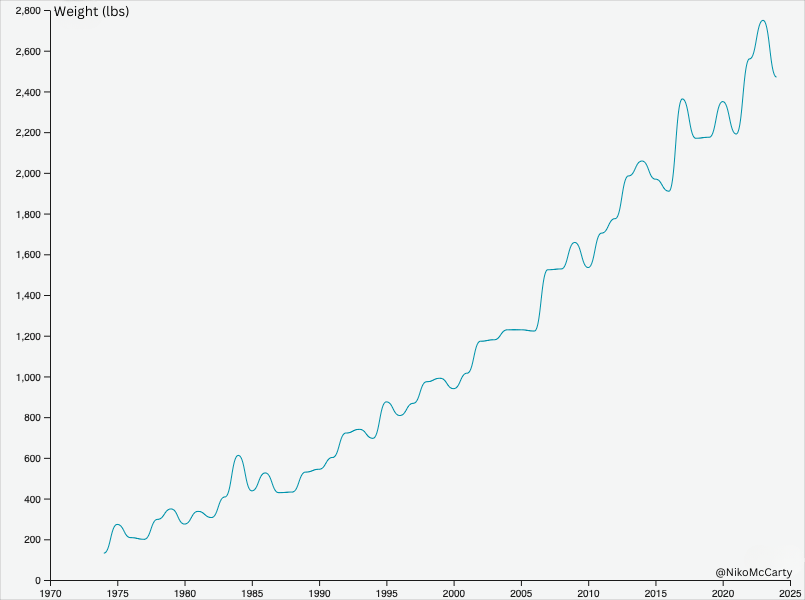
NikoMcCarty: “The weight of giant pumpkins has increased 20-fold in half a century. Humans are ridiculously good at breeding fruits. Data from the ‘Safeway World Championship Pumpkin Weigh-Off.’”

Most Superlative Links of 2024

Link that made us feel the most stoned. December. Shakespearean: When people speak English but with German grammar. Watching this makes us feel stoned. 

Most Scooby-Doo. November. From the annals of superstimuli: Why Are Dogs So Obsessed With Lamb Chop? (The article doesn’t really deliver an answer, but it’s a good mystery.) 

Stinkiest post. October. I can smell “the flu” : r/RandomThoughts h/t Collin Lysford 

Most medieval. October. Medieval Sourcebook: The Trial of Joan of Arc

Asked if she knows she is in God’s grace, she answered: “If I am not, may God put me there; and if I am, may God so keep me. I should be the saddest creature in the world if I knew I were not in His grace.” She added, if she were in a state of sin, she did not think that the voice would come to her; and she wished every one could hear the voice as well as she did. She thought she was about thirteen when the voice came to her for the first time. 

Asked if she had her sword when she was taken, she answered no; but she had one which had been taken from a Burgundian. … from Lagny to Compiègne she had worn the Burgundian’s sword, which was a good weapon for fighting, excellent for giving hard clouts and buffets (in French “de bonnes buffes et de bons torchons”).

Best parody. September. The Batrachomyomachia (“Battle of the Frogs and Mice”) is a comic epic parody of the Iliad and a good source of names for your pet mice. Like Artepibulus, “he who lies in wait for bread”.

Greek etymology rabbithole also led us to troglodyte, which ultimately means, “hole, I get into”:

From Latin trōglodyta (“cave dwelling people”), from Ancient Greek τρωγλοδύτης (trōglodútēs, “one who dwells in holes”), from τρώγλη (trṓglē, “hole”) +‎ δύω (dúō, “I get into”).

Toastiest. August. I Put a Toaster in the Dishwasher (h/t Adam Mastroianni)

These commenters are speaking authoritatively on subjects about which they are completely ignorant, but they are strident in doing so because they are repeating what everybody knows.  They are intellectually secure in the center of a vast mob; their wisdom was received, not crafted.  It doesn’t need to be crafted, because it is already known, established, beyond question (but demonstrably wrong).

Highest cheekbones. July. He secretly changed this freeway sign, helped millions of drivers. Top YouTube comment: 

In 2001, a friend and I had gotten so tired of a massive pot hole in Seattle that we went and got some vests and bags of asphalt and fixed it ourselves. We didn’t live near it, but hung out down there almost daily and hated driving over it. People in the neighborhood asked if we were from the city, and we said no. People clapped, and one brought us iced tea. A city bus came by as we were finishing and was so happy he drove over it, backed up, and drove over it several times to pack it in. I drove by it earlier today for work, and our patch still holds.

Most Bond villain. June. A New Atlantis: “Britain should reclaim an area the size of Wales from Dogger Bank, the area of the North Sea where the sea is only 15-40m deep. We could do it for less than £100bn.” 

Cutest animal. May. Sea Urchins Love Sporting Cowboy and Viking Hats. Also, see here for the original thread on reef2reef.com 

Most hidden desire. May. Brine thoughts: ​​the unspoken, instinctive need for a sweet-tangy-salty beverage in the heat, the combination of sugar, savory, and acid…the American yearns for kala khatta but they do not know it…

Most Constitutional. April. While Lucas M. Miller was serving in Congress, he proposed a Constitutional amendment to change the country’s name to “the United States of the Earth” because “it is possible for this republic to grow through the admission of new states…until every nation on earth has become part of it.”

Best coincidence. March. There is way too much serendipity — “It is therefore a fact of the world that virtually all the popular synthetic sweeteners were discovered accidentally by chemists randomly eating their research topic.”

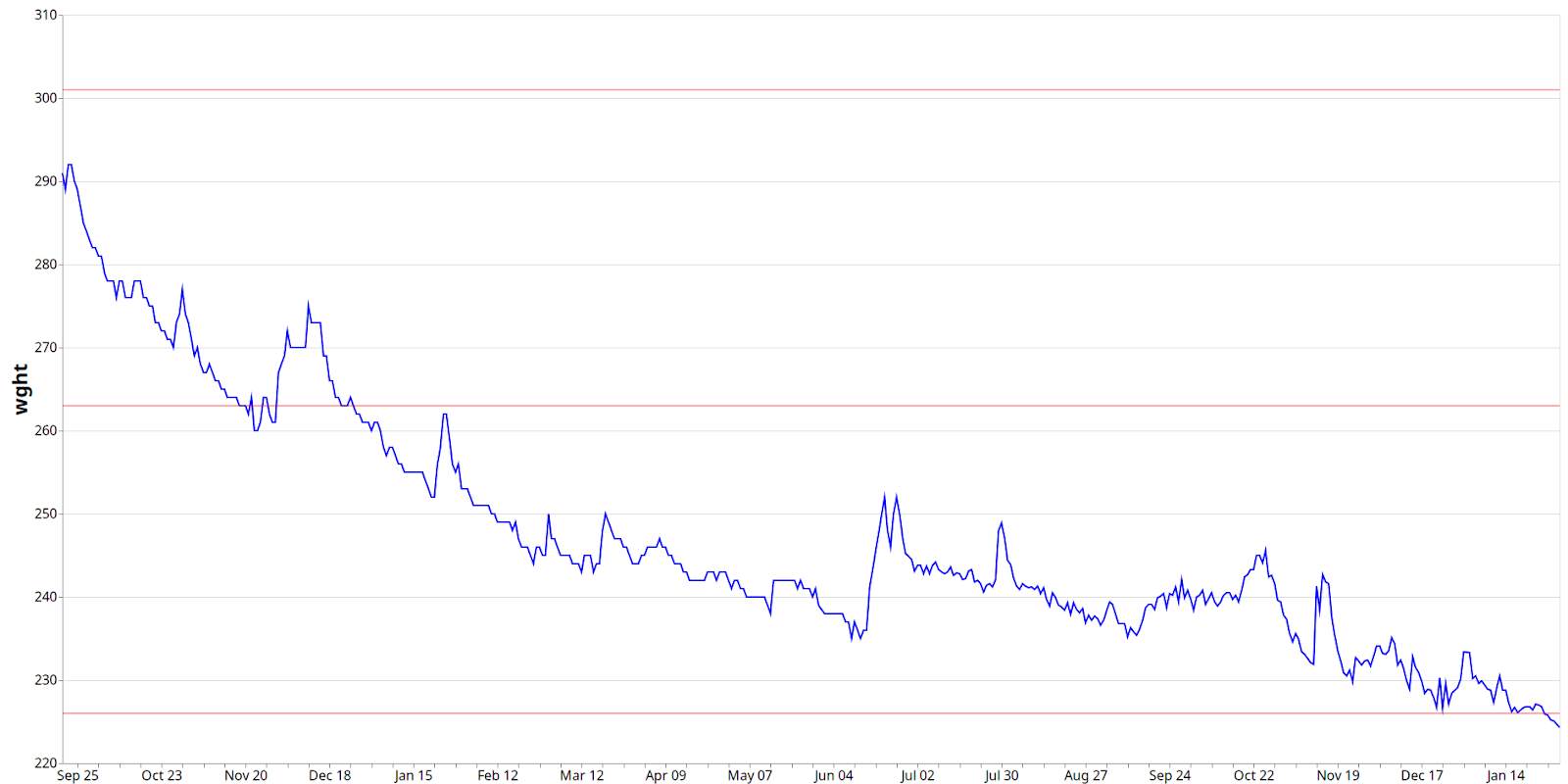
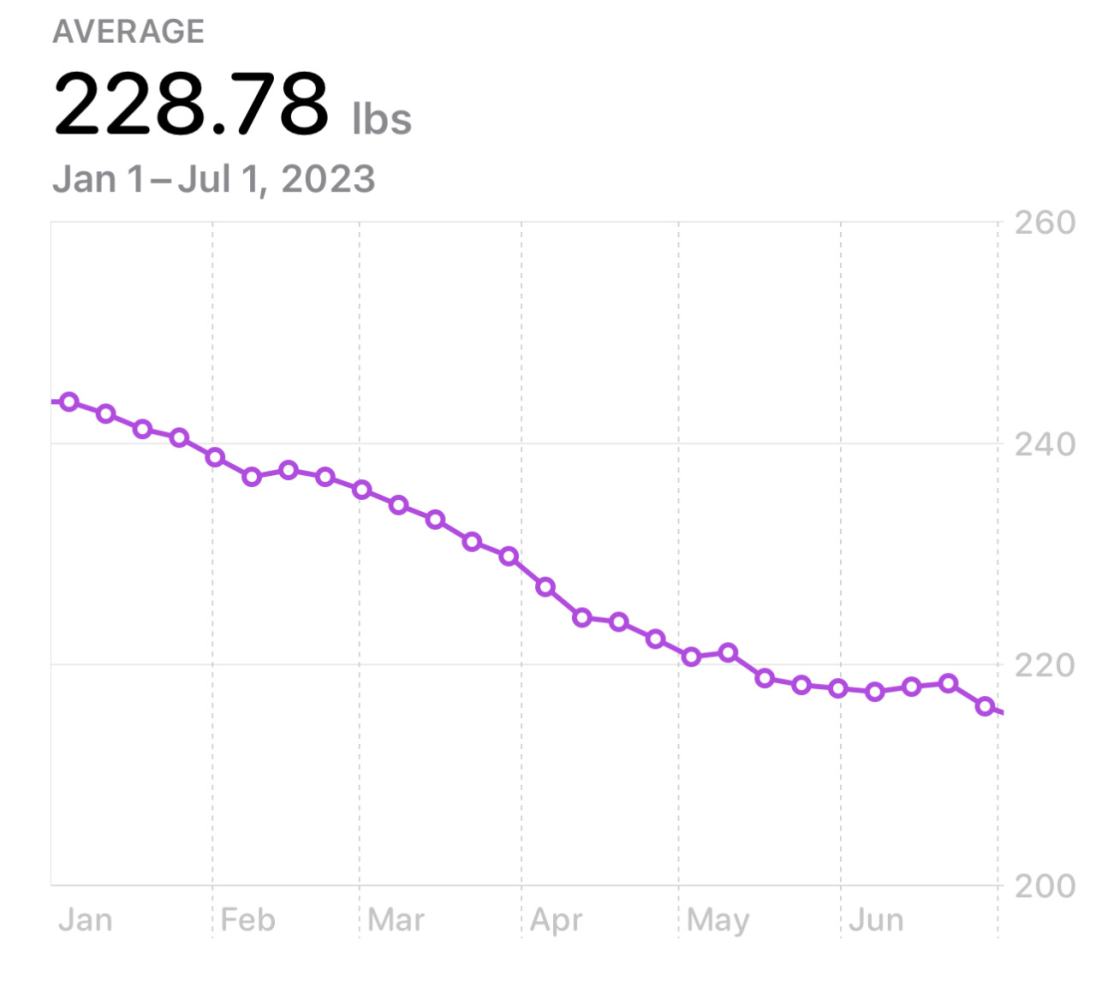
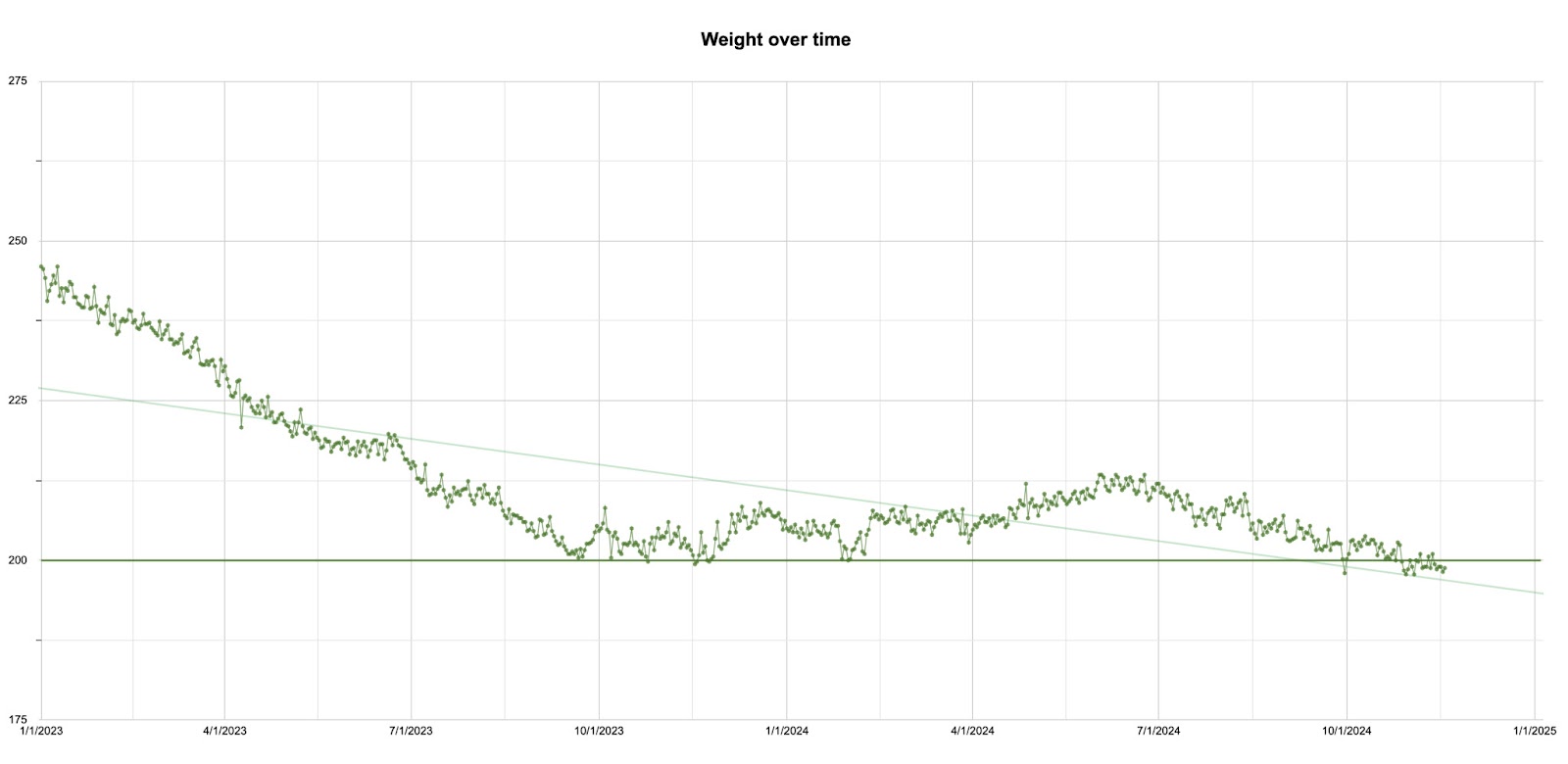
Most empirical. February. Friend of the blog ExFatLoss beats obesity:

Now that’s science

Best near miss. February. AT&T gets a solid B+ on predicting the future: “You Will” Commercials (high quality) YouTube comments have it: “These are absolutely amazing. The only thing they got wrong is ‘The company to bring it to you, AT&T’.”

Most illegalist. January. That’s some good illegalism: Activists vow to keep installing guerrilla benches at East Bay bus stops (h/t ACX)

Most unethical. January. The for-profit system of academic journal publishing was created by Robert Maxwell, who also happens to be Ghislaine Maxwell’s dad. Along with other tidbits, the linked article does a good job highlighting the ways in which scientific publishing is a principal-agent problem:

You have no idea how profitable these journals are once you stop doing anything. When you’re building a journal, you spend time getting good editorial boards, you treat them well, you give them dinners. Then you market the thing and your salespeople go out there to sell subscriptions, which is slow and tough, and you try to make the journal as good as possible. … then we buy it and we stop doing all that stuff and then the cash just pours out and you wouldn’t believe how wonderful it is.

Most unorthodox. January. Ada Palmer: Tools for Thinking About Censorship

If we believe that the purpose of the Inquisition trying Galileo was to silence Galileo, it absolutely failed, it made him much, much more famous, and they knew it would.  If you want to silence Galileo in 1600 you don’t need a trial, you just hire an assassin and you kill him, this is Renaissance Italy, the Church does this all the time. The purpose of the Galileo trial was to scare Descartes into retracting his then-about-to-be-published synthesis, which—on hearing about the trial—he took back from the publisher and revised to be much more orthodox.  Descartes and thousands of other major thinkers of the time wrote differently, spoke differently, chose different projects, and passed different ideas on to the next century because they self-censored after the Galileo trial—an event whose burden in money and manpower for the Inquisition was minute compared to how hard it would have been for them to get at all those scientists.

Best album. January. Soothing Sounds for Baby


Happy New Year! Cheers to the quarter century.

Links for December 2024

ExFatLoss goes back to basics — a great reflection on the fundamentals:

If all of the 1,000,000 chemicals introduced into the food supply since 1850 were at fault, then simply doing a potato diet or heavy cream diet wouldn’t lead people to easily lose a lot of fat.

… Eating potatoes does not remove any microplastics from your body. It doesn’t avoid whatever’s in the soil or water. It doesn’t replenish whatever used to be in the soil and is now missing. It doesn’t turn you into a farmer or manual laborer and it doesn’t change your genetics or epigenetics. It doesn’t remodel your (ruined?) fat cells. It doesn’t reduce air & water pollution and it doesn’t change the makeup of your kitchen & cook ware. It (presumably) doesn’t get you more sleep or reduce stress or EMF or blue light or screen time.

Unless there’s some crazy magic going on, the change is either brought about by something in the potatoes (or cream) or by cutting out something you were previously eating, and replacing it with potatoes (or cream).

Nat Friedman and his collaborators just dropped PlasticList, a project where they tested 300 Bay Area foods for plastic chemicals, mostly phthalates and bisphenols. Really top-notch work here.

A reader sent us this: Los Angeles now tests for lithium, and from this report, it looks like the water from the Los Angeles Aqueduct Filtration Plant contains 25 to 198 ng/mL lithium with an average of 92 ng/mL. That is quite a lot — the Pima had about 100 ng/mL in their water. But LA was, at least as of 2014, the #9 Leanest City in the country, though maybe things have changed since then. The reader also wanted to share this background info: She and her husband had lived in Texas for many years. When they moved to San Francisco, they both abruptly lost “1-2 pant sizes”. This was while “walking about the same amount as we were in Austin”. Then they moved to LA, and gained “+2 pant sizes” above and beyond where they had been in Texas. As before she says, “in general our diet hasn’t changed significantly, our job type hasn’t changed, we haven’t exercised more or less, etc.” This prompted her to look into the LA water quality and she found the new data in this report. 

Here’s the data

Shakespearean: When people speak English but with German grammar. Watching this makes us feel stoned.

Links for November 2024

80/20 Strength Training by friend-of-the-blog Uri Bram — Whether or not you care about strength training, more things should be written like this. 

skeptical thread about honey and bloodletting

Seem like peanut allergies were once rare and now everyone has them?:

The 1990s was the decade of peanut allergy panic. The media covered children who died of a peanut allergy, and doctors began writing more about the issue, speculating on the growing rate of the problem. The American Academy of Pediatrics (AAP) wanted to respond by telling parents what they should do to protect their kids. There was just one problem: They didn’t know what precautions, if any, parents should take.

Rather than admit that, in the year 2000 the AAP issued a recommendation for children zero to three years old and pregnant and lactating mothers to avoid all peanuts if any child was considered to be at high risk for developing an allergy.

How Toxic Is Your Favorite Chocolate? (Ranked) from Bryan Johnson — A good start, but sadly he gives no details on the testing methodology or the breakdown of results. Bryan, please publish your methods and data! 

I fixed my lactose intolerance — by chugging ALL the lactose — A story of a successful self-experiment. 

6 lessons I learned working at an art gallery:

My working model has been that being employed kind of sucks. But this time, since I knew I couldn’t afford to quit anytime soon with the baby and all, I figured I could try treating it like one of my projects. So instead of selling coffee, I figured out how to streamline the café and the cash register so that the volunteers who help out at the gallery felt comfortable doing my job, then I made myself a small office where I sat down to analyze the business and figure out how to improve it. You can imagine how popular this was—I had to backtrack for a few months after the board told me to get back to the café. And this was a good lesson for someone who is used to being self-employed: at an institution, you can’t just do what is best, you also have to build trust and coordinate with others so you are on the same page. This, however, doesn’t mean that you should abdicate your judgment and get in line.

Early Adopter — “conceiving time as a fourth dimension, had been broached in the 18th century, but it had first been treated seriously in a mysterious letter to Nature in 1885”.

From the annals of superstimuli: Why Are Dogs So Obsessed With Lamb Chop? (The article doesn’t really deliver an answer, but it’s a good mystery.)

A Literal Banana: A Case Against the Placebo Effect — A roundup of arguments about the existence of the placebo effect and whether or not it is “meaningful”. Some of the arguments seem to depend on the definition of what counts as a voluntary action, and we’re not sure if that distinction withstands philosophical scrutiny. We feel like there is still more clarity to be found on the topic, but this is a start.

“The Argentine ant global set of supercolonies is one of the largest cooperative societies on earth, it is also one of the most aggressive. World war ant has been raging for over a century, from Japan to South Africa. But where did it all begin?”

We are once again offering “candy and/or a potato” this Halloween, and I’m VERY pleased to report that one mom just asked her kid, “Is this the potato house you were looking for?!”

First Block: Interview with Daniela Amodei, Co-Founder & President of Anthropic (h/t @realityarb). See timestamp around 18:20, where she says: 

At one point, Claude was really convinced that the best way for you to lose weight was to go on an all-potato diet. We have no idea where this came from, it was just really stuck on this idea for a while.

Aer Lingus Flight 164 — “Downey claimed to have been a Trappist monk … He then took a job as a tour guide in central Portugal, at a shrine devoted to Our Lady of Fátima, the reported origin of the Three Secrets of Fátima. At the time of the hijacking, the third secret was known only to the Pope and other senior figures in the Catholic Church; Downey’s statement called on the Vatican to release this secret to the public.” h/t demiurgently, who comments, “‘stole plane to threaten Catholics into revealing heavenly secrets’ feels like a Dan Brown novel”.

Technology will let us taste certain forbidden joys.

When the Nazis Seized Power, This Jewish Actor Took on the Role of His Life:

As a last-gasp effort at professional survival, Reuss resolved to transform himself into an Alpine farmer. Over the spring and into the summer, Reuss grew a beard and perfected the local dialect. He bleached his body hair from head to toe. 

In the evenings, Reuss liked to play tarot cards with Kaspar Altenberger, a local farmer Straub had paid to look after the house. Reuss disclosed his plan, and Altenberger offered to help. He lent Reuss his own identity papers—his passport and baptismal certificate. Reuss had a new official persona.

Lady Baker and the source of the Nile:

Baker was very nervous about discussing the role Florence had played, with him throughout his appalling and dangerous trek across Africa. She had nearly died on more than one occasion, and had saved his life on others with bravery and skilled nursing, and yet she is seldom mentioned in the book. The truth that would have shocked his Victorian readership to the core was that Florence was not his wife at any stage in their African adventures, and they were only married on their return to London in November 1865.

Samuel had found nineteen-year-old Florence, as he called her, in 1859 at an auction of white slaves in a Turkish-administered town in Bulgaria. (There is some date about her exact age: she was certainly less than half Baker’s age when he met her.) Her real name is believed to have been Barbara Maria von Sass, born in Transylvania, then part of Hungary. Her parents had been killed in the 1848 uprising, and she had been raised from her childhood by a wealthy Armenian trader who intended to make a good profit when he sold this beautiful blonde teenager at auction. Baker saw her, bought her, and subsequently fell in love with her. The pair became inseparable, but the longer they were together, the worse Samuel’s problem became: how was he to explain this relationship to his four daughters at home, who he had left with their aunt after his first wife died?

AI prompting challenges: “New AI prompting challenge! Can you get ChatGPT via Dall-E to illustrate a wine glass that is full to the brim? Harder than it looks!” 

A systematic review and meta-analysis of environmental contaminant exposure impacts on weight loss and glucose regulation during calorie-restricted diets in preclinical studies: Persistent organic pollutants may impede glycemic control (in mice and rats)

the divine discontent:

The most fulfilled people I know tend to have two traits. They’re insatiably curious—about new ideas, experiences, information and people. And they seem to exist in a state of perpetual, self-inflicted unhappiness.

Krinn Post 2: A Year and Change

Last time you heard from her, Krinn had just put out a tumblr post titled An Ad-Hoc, Informally-Specified, Bug-Ridden, Single-Subject Study Of Weight Loss Via Potassium Supplementation And Exercise Without Dieting. After losing 6 lbs in our Low-Dose Potassium Community Trial, she decided not to stop as planned but instead to keep going, and in fact go even harder. Eventually she ramped up to around 10,000 mg potassium a day, and lost even more weight. 

Krinn also added an exercise habit that she described as a “naïve just-hit-the-treadmill exercise regimen”. Even with this in mind, her results still seem remarkable, because most people do not lose 50 lbs from starting a moderate treadmill habit: 

We published a short review of that original post on this here blog of ours. That was in July 2023. Now, Krinn is back, and more powerful than ever, with an untitled post we’ll call A Year And Change After The Long Post About The Potassium Experiment (AYACATLPATPE). 

The long and short of it is that Krinn kept taking high doses of potassium and kept losing weight, eventually reaching her goal of 200 lbs. There was a long plateau in the middle after she first brushed up against her goal, but she maintained the original weight loss and eventually lost the remaining weight:

In personal communication (see very bottom of this post), Krinn noted that:

One of the few things the graphs say really, really, really loudly is “Krinn lost 30+ pounds _and stayed that way for at least a year._” … one of the overwhelmingly common failure modes of existing interventions: people lose some weight and then gain some weight and end up fairly close to where they started. Whatever else happened in my experiment, it sure wasn’t that: I lost a significant amount of weight and then _stabilized._ That seems important.

This time we don’t have much to add, but as before we wanted to reproduce her post for posterity. And we do have a few thoughts, mainly: 

This seems like more evidence that high doses of potassium cause weight loss. It suggests that potassium is probably one of the active ingredients, maybe the only active ingredient, in the weight loss caused by the potato diet. Krinn was taking about as much potassium as you would get if you were eating 2000 calories of potatoes per day, and experienced similar weight loss. 

It’s good to be skeptical of single case studies, however rigorous and careful they may be, but here are a few things to keep in mind: 

Remember that participants in the Low-Dose Potassium Community Trial lost a small but statistically significant amount of weight (p = .014) on a dose much lower than what Krinn was taking — only about 2,000 mg of potassium a day on average, compared to Krinn’s ~10,000 mg per day. This can’t confirm the effects of the higher dose, but it is consistent with Krinn’s results, and the final sample size was 104 people.

There’s also at least one successful replication. Inspired by Krinn’s first report, Alex Chernavsky did a shorter potassium self-experiment and lost about 4 pounds over a two-month period, otherwise keeping his diet and exercise constant. He also provided this handy table: 

Finally, we know of two other people who are losing weight on high-potassium brines, at least one of them without any additional exercise. They’re both interested in publishing their results, probably in early 2025. So watch this space. :​) 

As before, we want to conclude by saying that Krinn is a hero and a pioneer. She is worth a hundred of the book-swallowers who can only comment and couldn’t collect a data point to save their life. If you want to do anything remotely like what Krinn did, please feel free to reach out, we’d be happy to help.


Here’s a reproduction of Krinn’s full report as it appears in her tumblr post:

A Year And Change After The Long Post About The Potassium Experiment 

A year and change after the long post about the potassium experiment, I reached my weight-loss goal. This is a quick, minimally-structured thought-dump about it. As before, this is part of a wider conversation that starts with A Chemical Hunger.

Methodology: I mostly kept doing what I’d been doing. Turned up the exercise dial a bit, turned down the potassium dial a bit. Both still, AIUI, quite high compared to American baseline. Some bad news — in addition to whatever confounding factors were present last time, there’s a few extra ones now from my life in general going very poorly. As before, here’s the data, Creative Commons Zero, good luck with whatever you try on it. After making it to one year of being fairly diligent, I decided to let things vary and see what happened — on the one hand, I’d gotten far enough towards my personal goal that I wasn’t too fussed about the last 10%, and on the other hand, if this works in general and even work when you’re kinda half-assing it, that too is great news.

Interpretations: There’s multiple ways this could go. Here are a few that were easy to think of.

  1. Potassium or potassium-plus-exercise caused me to lose weight
  2. Exercise caused me to lose weight and potassium was irrelevant
  3. Something else caused me to lose weight

I would prefer to believe that potassium-plus-exercise caused me to lose weight. The data I have and my experience of gathering/being that data, to some extent support that conclusion. Flipping that around, if I ask “does that data rule out this conclusion?” no it absolutely does not. But it’s important to note that the exercise-only conclusion is only slightly less-well-supported and the none-of-the-above explanation is much-less-well-supported but certainly not ruled out. I have a preferred explanation, but all three of these explanations are live.

My subjective experience of the thing was that there was an easy part and a hard part. In the easy part I lost weight at a pretty rapid and consistent pace. In the hard part, my weight changed less and went back and forth more than it went down. If you buy into SMTM’s “something is screwing up people’s lipostats” theory, this is very consistent with that theory: potassium reduced or removed the something, my weight briskly dropped back to a healthy range (the first 9 months of the graphs) and then stabilized. However, the competing theory of “Krinn was super out of shape and then she started exercising” is also supported by the graphs (not shown on the graphs: my fairly poor 2022 exercise habits — my long-term exercise habits have had some good stretches, but the plague years did not do good things for me there!). I’m not sure whether it matters that I shifted from mostly treadmill time to having a couple of walks around the neighborhood that I can do pretty much on autopilot (shout-out to Mike Duncan’s Revolutions, this show is the first time podcast as a medium has clicked for me and it’s a great show). I do think, though, that exercise is a bit more complicated than I was really grasping. That, in turn, makes me glad that I’m tracking three exercise metrics rather than just one — if I was going to track only one, it’d be exertion, but exertion, exercise minutes, and step count, together make it possible to at least take a guess at what qualities a day’s exercise had.

Regarding my own questions from the first post: 

How safe is this? When I made the first post I was antsy about “adding this much potassium to your diet is probably safe for people in generally good health” but now I’m pretty sure it’s true. Some health problems can take a long time to present themselves, but adding this much of something to your diet for two years and having it be fine, is pretty persuasive evidence that the thing is probably fine. It could still easily turn out to have negative health impacts that are important, but a huge swath of the things you’d be worried about, are vanishingly unlikely once you’ve hit the point of “I’ve been taking this for two years and I’m fine.”

Does this replicate? Well, it’s self-consistent for me, and I don’t want to gain 50 pounds and try again. I did not like the shape of my body at +50 pounds from where I am now! So this is a question for others.

How much do other nutrients matter? I don’t know. Mostly not equipped to rigorously check.

Does HRT matter? I’ll let you know if I can get back on HRT. I would definitely like to investigate this.

Does dieting matter? Probably: my diet changed involuntarily over the course of two years and that certainly matters to some extent, but one of my ground rules is that I’m focusing on controlling exercise and potassium, the things I can control. Diet is far more complex and also in my life particularly, more susceptible to unplanned, involuntary change, so I’m writing it off as a factor.

Does this help with cannabis-induced hunger? I think I was off-base/over-optimistic with this one and it either doesn’t matter or matters a small amount.

Is there a point where I get really hungry/tired or start accidentally starving? I did not reach such a point. I felt basically fine the whole time.

I was cooking with this though:

If you tell someone you want to lose weight and would like their advice, it is overwhelmingly likely that the advice will involve exercising more. Everyone has heard this advice. And yet, as Michael Hobbes observes  in a searing piece for Highline, “many ‘failed’ obesity interventions are successful eat-healthier-and-exercise-more interventions” that simply didn’t result in weight loss. Even if we as a society choose to believe “more exercise always leads to weight loss, most people just fuck up at it,” that immediately confronts us with the important question, why do they fuck up at it? and its equally urgent sibling, what can we learn from those who succeed at it to give a hand up to those who have not yet succeeded?

Conclusion: I’m gonna keep writing things down in my spreadsheet for the same reasons as last time. I’m not sure what exactly I’m going to do as far as twiddling the factors, because now my main goal is somewhere between “don’t gain weight again” and “see what happens,” but I do know that writing down what happens is Good Actually, so I’m going to keep doing that.


Slightly after publication, Krinn sent us these comments, which she agreed we could publish: 

Personal Communication

Dangit now I’m having the first draft effect: writing the first draft and sleeping on it tells me things I should have written. In this case, I think there’s a plausible reading that my experience supports the “potassium does something good at a high enough effect size to care about” line of argument because while the peaks of how much effort I put in were fairly high — the periods of combined high exercise and high potassium intake — the most noticeable effect was when I was ramping up on both of those in the first 9 months, and when I was in just-bumbling-through-like-an-average-human mode, the effect didn’t reverse itself. There were plateau periods and there were slow-reversion periods, but there was definitely no “you slacked off and now there’s rapid weight gain mirroring the rapid weight loss” effect. I think that’s positive? I think it’s plausible to read it as “once I got the majority of the weight loss effect, locking in that benefit was easy.”

In any case one of the questions I was interested in was “if this works, does it work well enough that an average person can successfully implement it?” and I am now convinced that that’s a clear “Yes”.

I wouldn’t say there’s any part of this experiment that I’m actively unhappy about, but I do find it a little frustrating that this is basically just another piece of evidence on the pile of “here’s something that is consistent with the lithium/potassium hypothesis, but that is also consistent with some other stuff, and my main observation is that Something Happened” — intellectually I feel sure that much solid science is built by assembling big enough piles of such evidence and then distilling it into “now we know Why Something Happened,” but putting one single bit of evidence on the pile is still something where I need to make my own satisfaction about it rather than having a well-established cultural narrative rushing to bring me “yes! you did the thing! Woohoo!”

Also thinking more about the potassium experiment I’m having one of those “hold on a minute, this should have been obvious to me” moments — one of the few things the graphs say really, really, really loudly is “Krinn lost 30+ pounds and stayed that way for at least a year.” That’s one of the crucial parts of the whole obesity thing, that second half, right? That’s one of the overwhelmingly common failure modes of existing intervention: people lose some weight and then gain some weight and end up fairly close to where they started. Whatever else happened in my experiment, it sure wasn’t that: I lost a significant amount of weight and then stabilized. That seems important.

Yessssss I get the smug clever-kitty feeling, this is exactly why I have that “ratchet” column in the spreadsheet: the last ratchet-tick day from more than a year ago (i.e. it’s locked in) was July 10th 2023, on which day my week-average weight was 212.4lbs, down 33.6lbs from the start of the year.

So that early period of dramatic weight loss is noteworthy because we can be confident that whatever the cause was — potassium, exercise, or something else — it caused durable weight loss, which is exactly the thing we are looking for.

This is a conclusion we couldn’t have reached in July 2023, with the major writeup I did, because at that point “something else happens and Krinn gains the weight back” was very possible, was one of the likely answers to “what comes next?”

Links for October 2024

“You pant after the garlic and melons of Egypt and have already long suffered from perverted tastes.”

Bembo is a serif typeface created by the British branch of the Monotype Corporation in 1928–1929 and most commonly used for body text. It is a member of the ‘old-style’ of serif fonts, with its regular or roman style based on a design cut around 1495 by Francesco Griffo for Venetian printer Aldus Manutius, sometimes generically called the ‘Aldine roman’. Bembo is named for Manutius’s first publication with it, a small 1496 book by the poet and cleric Pietro Bembo.”

Bop Spotter“I installed a box high up on a pole somewhere in the Mission. Inside is a crappy Android phone, set to Shazam constantly, 24 hours a day, 7 days a week. It’s solar powered, and the mic is pointed down at the street below”

Nightshade allergy thread AKA “HOW I FIXED MY BRAIN FOG. 🧠😶‍🌫”

Packy McCormick: What Do You Do With an Idea?

I’ve noticed a common refrain speaking with founders building physical things: 

“This is an old idea, actually, from the…” 

I interrupt, a shit-eating, Cheshire grin spreading across my face: “1950s or 1960s, right?” 

Right, they say, adding some specific variant like, “It’s from a 1958 paper.”  

But the paper was obscure, or Soviet, or the idea wasn’t technically possible or economically feasible with the tools of the day. So it collected dust, forgotten and waiting to be rediscovered. 

Good ideas aren’t getting harder to find. We just need to use the ones we have. 

Most meteorites traced to three space crackups

It Is Now Legal to Hack McFlurry Machines (and Medical Devices) to Fix Them

ExFatloss TEE & Macro Calculator — For all your macro triangle diagram needs:

Breathing all the Noble Gases

Visakan Veerasamy: straight outta tartarus

The genius of the game to me is that losing is part of the process. … I feel like I learned something about myself and about life from playing Hades. The game encourages you and teaches you persistence. It teaches you to cultivate equanimity in the face of failure. And it teaches you to learn from your experience. 

GRAND THEFT HAMLET

“caterpillars that change color to imitate the background (even when blindfolded)” h/t Stuart Buck

In photo “d”, the two outermost caterpillars are blindfolded. 

Mood Tracking Google Sheet (via nvpkp)

Eli Dourado: Cargo airships are happening

Reddit: Wife’s migraines reduced by 90% and I feel like a jackass via paularambles

First report on quality and purity evaluations of avocado oil sold in the US (h/t ExFatLoss)

Our results showed that the majority of commercial samples were oxidized before reaching the expiration date listed on the bottle. In addition, adulteration with soybean oil at levels near 100% was confirmed in two “extra virgin” and one “refined” sample.

It’s Time to Build the Exoplanet Telescope

Nehaveigur: Ice Cream for Lunch — and in case you didn’t know about earlier ice cream eating adventures, try the 2017 Man Loses 32 Pounds Eating Only Ice Cream for 100 Days

Reddit: r/obscurePDFs

Rose Freistater … was an American schoolteacher who rose to prominence in the 1930s when she was denied a teacher’s license in New York for being overweight.” More detail here, specifically: 

in 1931, Rose stood five feet and two inches and weighed 182 pounds [BMI 33.3]. When she applied for her teaching license that year, she weighed thirty pounds more than the maximum weight allowed by the Board for her height. She was given six months to lose thirty pounds; when she lost only twenty in that time, she was rejected by the Board altogether.

Gassing Satartia: Carbon Dioxide Pipeline Linked To Mass Poisoning

I can smell “the flu” : r/RandomThoughts h/t Collin Lysford

ExFatLoss: Why I stopped Grounding. Good jokes overall but missed a chance to make a “you’re grounded” joke.

Speaking of which, while grounding as a practice may not be real, it is probably less crazy than it sounds:

Over the past decade, Robert has built a body of work that reveals the many ways insects and arachnids use and experience static. Ticks jump, spiders balloon, bees sense the negative charge of a flower recently visited by another positively charged bee. He even found that the charged relationship between air and insects goes both ways: Honeybee swarms shed so many negative charges that they alter the electrical gradient around them. Based on Robert’s estimates, the atmospheric charge resulting from a swarm of desert locusts rivals that of clouds and electrical storms.

James Bailey: Data Heroes

Organizations often do great work collecting data, but then share it in ways that are hard to access or understand, or require all users to repeat hours of cleaning to make the data usable. Sometimes a data hero comes along to share their own improved version that is cleaned and easier to access and understand. Here I share links to some of these “most-improved” datasets.

New preprint from economist Tyler Ransom: Are Vegetable Seed Oils Fueling the Obesity Epidemic?

Thomas Jefferson Snodgrass: The Martians and Their Schooling

Maxwell Tabarrok: Unions are Trusts

The only way to get stably higher union pay is through monopolization. Unions need to get most or all producers of labor in a market to act together and fix their prices at a high level. That way, the consumers of labor have no other option but to accept lower output and pay higher prices. 

This is a monopoly or trust in exactly the same way as when US Steel, Carnegie Steel, and Federal Steel all agree to set their prices high, forcing customers to pay more. If you think that goods sellers colluding to set prices is bad, then you should think that service sellers colluding to set prices is also bad.

Restrictions of commerce are fine when they benefit the needy and punish the greedy. Insofar as this is the case, we can do better to improve the lives of those who need it most than by supporting labor unions.

Venkatesh Rao: The New Systems of Survival

Collin Lysford: The Fractal Ratchet — Many interesting things in this piece, but one that’s unusual and distinctive: it’s often possible to make a strong *ordinal* argument (this thing is hotter/faster/less dangerous than the other thing) even when you can’t provide numerical measurements. This seems important because people often (mistakenly) assume that in the absence of precise numerical measurements, it’s not possible to make ordinal arguments. But in fact you need neither precision nor numbers!

You’ve probably heard this one, but apparently it’s not true. COW vs BEEF: Busting the Biggest Myth in Linguistic History.

Francis Galton was interested in communicating with Mars as early as 1892, when he wrote a letter to the Times suggesting that we try flashing sun signals at the red planet.

METREP: 16lbs of fat loss & 2.5 months later on the potato diet

Medieval Sourcebook: The Trial of Joan of Arc

Asked if she knows she is in God’s grace, she answered: “If I am not, may God put me there; and if I am, may God so keep me. I should be the saddest creature in the world if I knew I were not in His grace.” She added, if she were in a state of sin, she did not think that the voice would come to her; and she wished every one could hear the voice as well as she did. She thought she was about thirteen when the voice came to her for the first time. 

Asked if she had her sword when she was taken, she answered no; but she had one which had been taken from a Burgundian. … from Lagny to Compiègne she had worn the Burgundian’s sword, which was a good weapon for fighting, excellent for giving hard clouts and buffets (in French “de bonnes buffes et de bons torchons”).

Niko McCarty: Estimating the Size of a Single Molecule

I love this story because it shows, at least anecdotally, how deep scientific insights can emerge from the simplest of experiments. It’s a testament to the idea that you don’t always need sophisticated equipment to unlock the secrets of nature — sometimes, all it takes is a drop of oil and a bit of ingenuity.

Richard Ngo: Why I’m not a Bayesian

Where does this leave us? We’ve traded the crisp, mathematically elegant Bayesian formalism for fuzzy truth-values that, while intuitively compelling, we can’t define even in principle. But I’d rather be vaguely right than precisely wrong. Because it focuses on propositions which are each (almost entirely) true or false, Bayesianism is actively misleading in domains where reasoning well requires constructing and evaluating sophisticated models (i.e. most of them).

 Claire L. Evans: What’s a Brain?

Zen & the art of the Macintosh : discoveries on the path to computer enlightenment

The Dukakis Theory of Donnie Darko

Do you remember the opening line of 2001 cult classic Donnie Darko? That’s right, it’s “I’m voting for Dukakis.”

Donnie Darko is set on the eve of the presidential election of 1988, where Texas Republican George H. W. Bush faced off against Massachusetts Democrat Michael Dukakis, eventually winning in a landslide. 

The movie opens on the morning of October 1st, 1988. The first mention of the election is during the dinner scene that night, when Elizabeth Darko drops the opening line. 

That night, Donnie’s father is watching a rerun of the presidential debate. This must be the debate that happened on Sunday, September 25, 1988, because the other presidential debate wouldn’t happen until October 13th. Father Darko is not impressed. “Dukakis,” he mutters, “son of a bitch.”

Around midnight, so now October 2nd, Donnie gets up and wanders downstairs. His father has fallen asleep in the living room. The national anthem is playing through extreme static as Donnie goes outside. 

When Donnie closes the tangent universe and accepts his death, in the main universe the TV is still set on static, but it is not playing the national anthem. 

(If you want the movie to make sense, we strongly recommend the Director’s Cut.)

The next mention of the election comes when Father is driving Donnie to his therapist. Under the Milky Way by The Church is playing on the radio. Donnie’s father turns it to a news station that’s talking about the election. “What people don’t understand about this upcoming election,” says a man on the air, “is that Michael Dukakis does not have the financial infrastructure in place to defe—” Donnie changes it back. 

However, whatever ChatGPT may tell you, there is no Dukakis bumper sticker in this movie. Don’t believe its lies. 

The last explicit mention of Dukakis is when his name appears on the kitchen whiteboard, during a scene where Donnie and the boys are watching a football game. This happens just before Donnie acquires the gun.

Please, Tell Me, Elizabeth, How Exactly Does One Suck A Fuck?

There’s a guy in a Ronald Reagan mask at the Halloween party. He bounces on the trampoline. And H. W. Bush appears briefly in Donnie’s eyes as he leaves the party. 

Also, Actress Drew Barrymore, who plays English teacher Karen Pomeroy (and also financed the film), personally met President Ronald Reagan in October, 1984. Here’s a photo of the two of them together:

How Did You Feel, Being Denied These Hungry Hungry Hippos?

Around midnight on October 2nd, Frank tells Donnie that the world will end in 28 days, 6 hours, 42 minutes, and 12 seconds. This may be a reference to the sidereal month, which is 27 days, 7 hours, 43 minutes, and 11.6 seconds, each value off by exactly one.

This puts the time for the end of the world at around 7 AM on October 30th. 

This does not coincide with two interesting events. First of all, it does not coincide with Halloween, which is on October 31st. The fact that the Darko kids hold a Halloween party confuses many people, but this was probably held on Saturday the 29th. The 31st wouldn’t have worked because it was a Monday, and everyone would have had school. 

Second, it does not coincide with the presidential election. Election day in 1988 was on November 8th. Donnie’s universe ends 9 days before this. 

Still, it’s hard not to conclude that the events of the film spiritually coincide with both events.

Dear Roberta Sparrow, I have reached the end of your book and there are so many things that I need to ask you. Sometimes I’m afraid of what you might tell me. Sometimes I’m afraid that you’ll tell me that this is not a work of fiction. I can only hope that the answers will come to me in my sleep. I hope that when the world comes to an end, I can breathe a sigh of relief, because there will be so much to look forward to.

Third Potato Riffs Report

For many people, eating a diet of nothing but potatoes (or almost nothing but potatoes) causes quick, effortless weight loss. It’s not a matter of white-knuckling through a boring diet — people eat as much (potato) as they want, and at the end of a month of spuds they say things like, “I was quite surprised that I didn’t get tired of potatoes. I still love them, maybe even more so than usual?!” And some people lose a similar amount even when eating only 50% potato.

Why the hell does this happen? Well, there are many theories. To help get a sense of which theories are plausible, try to find some boundary conditions, or just more randomly explore the diet-space, we decided to run a Potato Diet Riff Trial

In this study, people volunteer to try different variations on the potato diet for at least one month and let us know how it goes. For example, they might eat nothing but potatoes and always cook their potatoes in olive oil. Or they might eat nothing but potatoes and leafy greens. Or they might eat nothing but potatoes but always eat their potatoes with ketchup. 

The hope is that this will help us figure out if there are other factors that slow, stop, or perhaps even accelerate the rate of weight loss we saw on the full potato diet. This will get us closer to figuring out why potatoes cause weight loss in the first place, and might get us closer to curing obesity. We might also discover a new version of the diet that is easier to stick to, or causes more weight loss, or both. 

In the first two months after launching the riff trial, we heard back from ten riffs. Those results are described in the First Potato Riffs Report. Generally speaking, we learned that Potatoes + Dairy seems to work just fine, at least for some people, and we saw more evidence against the mono-diet and palatability hypotheses. 

Between January 5th and March 18th, 2024, we heard back from an additional seventeen riffs. Those results are described in the Second Potato Riffs Report. Generally speaking, we learned that Potatoes + Dairy still seems to work just fine. Adding other vegetables may have slowed progress, and the protein results were mixed. However, the Potatoes + Skittles riff was an enormous success. 

Since then, we’ve heard back from 11 new riffs. (Specifically, these are the riffs we heard back from between March 18th and October 9th, 2024.)

A few riffs are ongoing, but signups have slowed to a crawl. So while there may be a few more riff trial results in your future, signups are now closed. We may do more potato diet studies in the future, perhaps even another riff trial, but we are going to wrap this one up for now. Expect a final riffs retrospective around January 2025. 

But let’s see what we’ve learned so far. First we’ll review the overall results, and talk about our interpretation. Then, at the end we’ve included the actual riff proposals and reports from all 11 participants in an appendix, if you want to read about them in more detail.

Unless otherwise indicated, weight loss numbers are over a period of about 28 days, comparable to the original Potato Diet Community Trial. 

Potatoes + Dairy

Participant 07566174 ate “Potato plus a bit of dairy, ice cream for a treat”. At the end they said, “overall very successful despite rampant cheating!” and you know what, that’s entirely right: 

In this case, cheating wasn’t “take a day-long break from eating potatoes”, instead it meant more like “ate less than 100% potato”. For example, one cheat day entry said: “Had some cake, and a couple chocolates. Otherwise, potato. Plus a beer instead of ice cream.”

This participant actually gave us six weeks of data, here is the longer chart: 

Participant 28818306 took to the true spirit of the riffs trials, “trying to combine what looks like working riffs (potatoes + dairy + lentils)” along with adding “some lettuce to the mix to see if it keeps working”. 

This worked ok. “It went well in the first 2 weeks,” 28818306 reported, “the other 2 were kind of slow, and harder to follow.”

Participant 92679541 did a riff of potatoes + oil + dairy (mainly cream and butter), with a more casual protocol and cheating most days, but had to stop the diet early. Despite all this, he lost a couple of pounds:

Participant 97027526 did a riff starting with potatoes plus butter, ghee and spices, and added raclette cheese after a few days. 

Chalk another one up for the potato diet making people fall even deeper in love with potatoes: “I discovered I LOVE baked potatoes (first cooked in the microwave then finished off in the oven to crispen them up) and over 70% of my potatoes were cooked like that. … I am surprised that after four weeks I still really like potatoes! I’m going to continue with the potatoes for a while”. 

She lost exactly 10 pounds over 28 days:

We then later received an update, where she said, “I am almost at the end of 8 weeks and still going strong. … My diet now exclusively consists of baked potatoes, butter, salt (a few pinches once a day), pepper and sometimes garam masala. … I’m not nearly as hungry as I used to be.”

Between Day 1 and Day 53, she lost a total of 15.9 pounds: 

Potatoes + Meats

Several people tried riffs that aimed for the most classic meat & potatoes.

50108266 and 20953986 are a husband and wife team who started with the plain potato diet then added organ-based meat. Their full protocol was a bit complicated, see the appendix for more detail.

The results: Two weeks of just potatoes, “lost weight, but hated it”. Two weeks of potatoes + organ meat, “lost less weight, enjoyed much more. We will keep going.” It’s interesting that such a small change could so strongly affect their perceived enjoyment of the diet, especially while not strongly affecting how quickly they lost weight.

54084282 said, “I feel a diet that I could stick to for 30 days would be potato, bacon, black coffee, and Guinness. The bacon would help supplement fat and protein missing from the potatoes and reduce the need for extra seasonings. The coffee and Guinness are mostly for personal preference.”

Thirty days later, we got this update: “I have modified from my original riff! I’d characterize my current plan as fermented food/drinks + potatoes, along with a serving or two of protein daily. It is resulting in steady weight loss while alleviating the bloating and unpleasant constipation feeling that I experienced initially. I have lost about 5 pounds this month while feeling generally satisfied and still surprisingly not tired of potatoes. Only real remaining issue is eating out. I just cannot bring myself to order only French fries for a meal (especially around the kids). I just cheat in those situations but still manage to steadily drop weight, lol.”

Checking the data now, we see that 54084282 kept recording data up to day 58, and continued the trend of losing weight: 

83842317 says, “potato + meat (chicken, beef, pork, fish)”. Then after the diet, “The convenience of eating tater tots, hash browns, chips, fries, and meat has been very easy and I’ll be sticking to it”.

There was no weight entry for Day 29, so here’s 83842317’s data up to the last weight entry on Day 34:

Participant 22179922 did a riff she came to call “potatoes and cows”, starting with potatoes and ramping up to first include dairy and then include other animal products (see appendix for full details). 

Chocolate-Style Riffs

Two people did riffs that sort of involved chocolate.

59960254 did something like “Potatoes with Fire in a Bottle Characteristics”, meaning potatoes and a small amount of fat from sources like butter, tallow, coconut, cacao, etc. and also including fruit, honey, dates, and dark chocolate. This lead to a weight loss of exactly 10 lbs by Day 29:

We actually have 12 weeks of data from this participant, here is the longer version. The fluctuations in the middle are a sad story that have little to do with the diet itself; his cat got sick around the three week mark.

95078099 followed a riff of “potato + soy products + chocolate”. Note that he started off quite lean, with a BMI of around 20, but that “this is the result of a long, hard calorie restriction. My personal aim is not to lose weight, but to keep the weight down. If I stay at the same weight, and not drift up by a few pounds, I’d consider that a success!” So in this case the question is not really whether 95078099 can lose weight on the potato diet, but whether he can maintain weight on the potato diet without calorie restriction.

Ultimately, 95078099 lost 1.5 lbs between the first and the last measurement over four weeks. But based on the moving average, he concludes, “for myself, and for the purpose of keeping my weight down, I’d consider my potato riff ineffective.” See the appendix for a lot more detail, including additional charts with several years of data.

Skittles Update

Previously, participant 22293376 tried a Potatoes + Skittles riff, and was “astonished at just how well it went.” Here are those original results: 

This was in January 2024. By July, he had started gaining weight and decided to do a second run of the riff, with some minor changes. This time it was potatoes plus: butter, oil, sweet potatoes, “low-calorie vegetables (onions, peppers, broccoli, green chile, etc.)”, and “skittles (in moderation)”. And for this second round, the results look like this: 

The y-axis is fixed to match 22293376’s previous graph.

22293376 says, “I generally didn’t eat more than 20-30 skittles a day, and sometimes none. I don’t really recommend eating skittles-only meals but you do you!” Also check out the appendix for more detail on this riff. 

Interpretation

As before, Potatoes + Dairy seems to work for many people, and it seems quite resistant to cheating. Every Potatoes + Dairy riff in this roundup lost some weight, and some lost as much as 10 lbs.

People lost some weight on different versions of Potatoes + Meats, but this seems to be inconsistent. It’s possible that the kind of meat, or its origin, could make a difference. 

“Potatoes with Fire in a Bottle Characteristics” worked quite well. While the sample size is only one, it’s a nice proof of concept. These various fats and sweets don’t seem to interfere at all with the potato effect, at least not for this participant. 

It’s also wonderful to have a skittles replication. The results are still from the same person, which means we can’t be sure if it will work equally well for other people, but it’s nice to see that this can happen twice. And it’s certainly more evidence against the idea that the potato effect is purely the result of cutting out processed foods and sweets. If sweets were always a potato-effect-killer, they would have stopped the effect here. They didn’t, so they aren’t.  

Of course, we’d love to see replications from other people too. So if you’ve been on the fence, consider trying potatoes + skittles.

If so, please let us know how it goes! But it will have to be your own self-experiment, because as mentioned above, signups for the riff trial are closed. Expect a final report and a retrospective some time around January 2025.


07566174 – Potato + Dairy (ice cream)

Riff 

Potato plus a bit of dairy, ice cream for a treat

Report

Hello,

I’m emailing to share results after 6 ish weeks of potato diet. Overall very successful despite rampant cheating! I’ll be continuing for a few weeks more.

28818306 – Potatoes + Dairy + Lentils + Lettuce

Riff 

I’m trying to combine what looks like working riffs (potatoes + dairy + lentils) and add some lettuce to the mix to see if it keeps working and makes it “healthier” (at least according to my wife :-))

Report

Hi just wanted to let you know that I ended the 4 week of the potato riff trial.

It went well in the first 2 weeks, the other 2 were kind of slow, and harder to follow.

My diet consisted of a lentils burrito for breakfast (lentils flat bread + cooked lentils as filling + cheese). A mix of baked potatoes + cheese during the rest of the day. I tried to keep it mostly potatoes and use cheese for variety or as a snack.

I usually cooked 2 big batches of potatoes every week and I reheated them on a pan with a bit of olive oil.

I happened to take a blood test at the end of the diet and notice a drop in a few markers.

I’ve attached 2 pdfs. One is the most recent and another was 6 months before for comparison.

You can use them in your posts if you anonymize them.

They were translated by AI but look ok

Cheers

92679541 – Potatoes + Oil + Dairy

Riff 

My plan is potatoes + oil + dairy (mainly cream and butter)

Report

I’m stopping the diet early (after two weeks). I ended up doing a *very* loose protocol – basically potatoes + anything that would be fine on Keto (i.e. potatoes intended to be basically my only carb). As you can see from my entries, I cheated most days, typically with sweets, for which I experienced really wild cravings. I am down ~ a couple of pounds from my first weigh in.

97027526 – Potatoes plus butter, ghee, cheese, and spices

Riff 

Not 100% decided yet! Perhaps potato + butter/ghee + spices or potato + butter/ghee + cheese + spices. Planning to do this with another person in my household. We intend to do this just for 4 weeks but if it is going really well and I don’t find it difficult I may continue for another few weeks

Report

Dear Slimemold Timemold team,

August:

I’ve just found the below updates in my drafts from months ago. Not sure if it’s still interesting, but I did eat the potatoes! I ended up going back to my normal diet and I am almost back to my starting weight now. Thinking of giving it another go in September.

February:

I saw your latest potato riffs article today and when I didn’t see my own results there I realised I forgot to send you the following email almost a month ago when I completed the four weeks… So here it is:

Note from the end of the first four weeks

I have completed the four weeks!

I initially planned to do potatoes plus butter, ghee and spices but ended up adding cheese after a few days. This added a bit of interest and I think made me more likely to comply with the diet. I am exclusively eating raclette cheese (a Swiss cheese normally eaten with potatoes). The first two or three days were a bit tough, but after that I had no problems. I discovered I LOVE baked potatoes (first cooked in the microwave then finished off in the oven to crispen them up) and over 70% of my potatoes were cooked like that. After reading about the increased resistant starch in cooled potatoes I decided to cook potatoes the day before. I only managed this sometimes so about 40%-50% of potatoes were pre-cooled. At the start of the diet I ate lots of spices on my potatoes (home ground garam masala and chili flakes) but as time goes on I find myself satisfied with butter and sometimes salt as flavourings.

I am surprised that after four weeks I still really like potatoes! I’m going to continue with the potatoes for a while (probably another 2 weeks maybe another 4) and will keep using the spreadsheet in case that’s useful.

Update from 21/03/2024

I am almost at the end of 8 weeks and still going strong. I have removed the cheese because I suspected it was behind some bowl complaints. No complaints since I stopped the cheese. My diet now exclusively consists of baked potatoes, butter, salt (a few pinches once a day), pepper and sometimes garam masala. Potatoes are about 60% pre-cooled 40% freshly cooked. I’m not nearly as hungry as I used to be. 

Thanks for organising!

50108266 and 20953986 (Potatoes + Organ meat)

Riff 

Hi! 

We are planning to participate in a trial with my husband / wife. So, there will be two very similar applications. [SMTM’s note: as indeed there were!]

We want to start with the plain potato diet and then add organ-based meat to it.

Reasoning includes personal preferences and curiosity about BCAA and PUFA theories. 

Our current diet is 70% “Steak and Salad,” “Fish and Salad,” or “Plain Yogurt, Steak and Salad.” Some days, we binge on processed sugary sweets, then do steak and salad again. Our main dietary sacrifice is starch. And despite most of the time having a “colorful and diverse plate,” straight from the dietary recommendations brochure cover, we both consistently gain weight. So now we want to try to revert our diet.

We both search for dopamine in food and have difficulties fighting cravings, so as a second ingredient, we need something we will be very interested in. We had two main candidates – something sweet or something meaty. 

The results of the Potatoes + Beef riff were not good, and we already know that eating lots of beef doesn’t work for us either. So we had to find meat we like, but don’t eat often. In our case, it’s the organ-based meat. It is common in our home cultures but is absolutely not popular in the country where we live now. So, we did not eat organs and bones for a long time, but we used to eat them when we were thinner. And we really miss it, so it makes us excited. 

Regarding the PUFA theory: to be consistent, we had to decide which type of fat to use for frying the potatoes. We decided to go with butter and leave seed oils aside.

The plan is the following:

1. We start with the 2 weeks plain potato diet

    – We eat potatoes of all available types and in all forms, ad libitum

    – We season the potatoes to make them tasty. It includes adding salt, garlic, different peppers, fresh dill. If the potatoes stop being tasty, we try to add something else in controlled amounts – parsley, soy sauce etc.

    – We fry with butter, preferably ghee. We don’t cook with seed oils during the diet.

   –  We may eat restaurant fries, which probably will be cooked with seed oils, but we don’t make it the main part of our diet

    – We may eat store-bought chips, but we don’t make it the main part of our diet

2. We drink our usual amounts of water, tea, Coke Zero, and coffee, but we don’t add milk to our coffee anymore.

3. We do our cheat meals on weekend breakfasts. Usually, it’s some kind of “balanced European breakfast” – avocado, egg, toast with butter and cheese, smoked salmon, croissant, orange juice

4. We keep taking the supplements we are used to take, which are 

Wife’s case

Lion’s mane – 2500 mg

Vitamin B complex (includes 50 mcg B12)

CoQ10 – 200 mg

Liposomal vitamin C – 500 mg

Saw Palmetto – 500 mg

Myo-inositol – 1000 mg

Husband’s case

Lion’s mane – 2500 mg

Vitamin B complex (includes 50 mcg B12)

CoQ10 – 200 mg

Liposomal vitamin C – 500 mg

5. We stop taking

Omega 369 – 500 mg – Because it’s seed-oil based

Kalium-Magnesium Citraat – 270 mg – Because we increase potassium intake with the potatoes

6. We keep taking prescribed medications 

Wife: I don’t have any

Husband: Fluoxetine

7. We follow the second 2 weeks by adding the protein but trying to keep it on the low-BCAA side. It will be beef and chicken:

   – Bone broth

   – Tongue

   – Liver

   – Heart

   – Stomach

   – Intestine

   – Kidney

   – Other organs we may find in the shop

   – But not the muscle meat

8. We also intend to try to add the third component to the diet or change the component after 4 weeks, depending on the results of the first weeks.

Report

We, 50108266 and 20953986, did it. Here is our report!

TLDR

2 weeks potatoes – lost weight, but hated it

2 weeks potatoes + organs meat – lost less weight, enjoyed much more. We will keep going.

Report

We live in the Netherlands, another country of lean people (16% obesity rate) whose diet contains a significant share of bread and potatoes. The potato part of the diet was easy to organize, as there are tons of potato options in the supermarket, and french fries are available in any restaurant.  For the first week, we bought as many options as possible – different brands of potatoes sliced for fries, more starchy and less starchy potatoes for baking and boiling, and potatoes sliced and mixed with various spices. 

We ended up with a pretty stable diet. For breakfast, we ate air-fried fries. For lunch, we baked potatoes in the oven with their shells and seasoned them with salt, garlic, dill, and butter. For dinner, we baked potatoes again or boiled potatoes with the same seasoning. Usually, after dinner, we had one more snack with store-bought chips.

The first week was especially difficult, as we were constantly bloated, constipated, dehydrated, and hungry. We were eating smaller volumes than we were used to, feeling satiated by the meal’s end but also hungry shortly after. Because of our diet mood, on the first days, we were hesitant to eat more; also, despite our hunger, potatoes were not attractive enough to get up and cook some. Some nights, I was struggling to fall asleep because of growling hunger mixed with a heavy feeling of being bloated. Some nights, we were binge-eating a big pack of chips per person.

We both felt we were not losing enough weight for such a struggle. We both have experienced losing significant amounts of weight with calorie-restricted low-carb diets, and we both felt that “at that time we were losing more weight and faster.” However, I have weight records for myself for those times, and actually, weight-loss speed in absolute amounts was the same. 

The second week was easier as we found preferred options and ate more boiled potatoes. In the middle of the second week, 20953986 started to add a little bit of mayonnaise “for the taste.”  It’s an interesting choice, as he usually is a hot sauce person. Maybe mayonnaise was easier to reach, or perhaps he was attracted to protein in it. For me, 50108266, the smell of eggs in mayonnaise was extremely tempting, and I spent the whole 12th evening thinking about eggs obsessively. On the 13th day, I also accidentally felt sick at night, like I had food poisoning or a stomach bug; both are not common to me. 

On the morning of the 15th day, 20953986 almost cried over his morning potatoes because he was hungry and disgusted at the same time. 

I learned that I could not predict how much weight I was losing. I could not explain my weight fluctuations with bowel movements, water loss, water intake, or menstrual period. I also could not correlate how swollen I was with my weight. However, 20953986 sees the correlation between his bowel movements and weight. I also tried to find a correlation between weight loss and hunger and weight loss and eating processed foods. I was expecting to lose more weight after sleeping hungry, and less weight after eating a full pack of chips, but neither I nor 20953986 found such correlations for ourselves.

In the third week, we started with organs. Organ meat is not typical in Dutch culture but quite common in Turkish and Russian, so we love it and know how to cook it. We added pork liver sausage to our air-fried fries breakfast. For lunch, we usually had boiled beef tongue with boiled or baked potatoes. For dinner, we had either soup with chicken hearts, potatoes, and bone broth or fried beef liver with fries. The grilled liver was also relatively easy to find in Greek and Turkish restaurants, so we had quite a lot of it. We also tried kidneys and thymus, but we did not like them.

In the third week, our weight fluctuated in an unusual way. On the 15th day, the first day of the organ diet, I developed symptoms of an ear infection (even more unusual to me than a stomach bug) that lasted until the 17th day. On the 16th morning, I got +1 kg (2.2 lbs); on the 17th morning, my weight was the same, and after the infection symptoms were gone, my weight rapidly dropped. But the resulting weight loss in the third week was still a pitiful 0,7 kg (1.43 lbs). I assume the reason for the weight gain was an infection, but it could also be a change in the diet or a change in our cheating routine. On that day, we had our planned cheat moment, but because of how depressed 20953986 was, instead of cheat breakfast, we had cheat lunch, which, in my case, contained grilled chicken breast, bread, and yogurt mixed with spices. 

20953986 also did not lose much weight that week, but he gained weight not at the beginning of the week, like me, but on the weekend. He also had a sick moment, but it was a chronic muscular pain problem that most possibly had nothing to do with the diet and weight. 

On his rolling average graph, we see that there is no actual change in the weight loss velocity. 

The fourth week was easy and enjoyable. We never felt too hungry, did not suffer from digestion problems, and got our second-best weight loss results in the four weeks. 

The only thing that we noticed was a craving for vegetables and greens.

At the end of the report, I want to mention the cheat days. We were cheating on weekend breakfasts, as it is an important ritual for both of us. We went (except for one time that I mentioned) to the regular places where we go for breakfast; we always had several latte macchiatos and some kind of an assorted breakfast platter with greens, eggs, savory sandwiches, and pastry (you can imagine continental breakfast or Turkish breakfast). I noticed several things for myself that, however, did not work for 20953986:

  1. I was less attracted to bread and pastry. Last time, I did not touch my bread at all. This also means that I ate less for breakfast than usual. 
  2. We had two breakfasts in a row, and every Sunday, despite the cheating, I had a weight decrease, but after the second breakfast on Monday or one time on Tuesday, I had a weight increase. This pattern included even the first Monday of a diet. We started our diet on Sunday; we ate a cheat breakfast, then ate only potatoes, and my weight increased the next day.
    I wonder whether it is a coincidence, whether something I eat stimulates some weight increase, or whether it is about waking up later on the weekend. When we had a holiday during the third week, I also had a weight decrease followed by an increase, although we did not cheat that day. But the third week was a mess anyway.

Because of this observation, we want to try some experiments around it. Considering that we are limited with our habits and working week, we can’t change much, but our current intention is to keep the same diet and try different times of the day on weekends for the cheat meals, which will also lead to different cheat foods. I am open to suggestions.

54084282 – Potato, Bacon, Black Coffee, and Guinness

Riff 

I’ve recently been experimenting with potato dishes in anticipation of trying a potato diet to lose some weight I’ve gained in the past few years. I feel a diet that I could stick to for 30 days would be potato, bacon, black coffee, and Guinness. The bacon would help supplement fat and protein missing from the potatoes and reduce the need for extra seasonings. The coffee and Guinness are mostly for personal preference but also helps supplement nutrition. I plan to also use a variety of potatoes, including sweet and red with peel on.

Report

It’s now 30 days, just checking in but I plan to continue on my potato riff. I still hope to make it down to 135 lbs 🙂

I have modified from my original riff! I’d characterize my current plan as fermented food/drinks + potatoes, along with a serving or two of protein daily. It is resulting in steady weight loss while alleviating the bloating and unpleasant constipation feeling that I experienced initially.

I have lost about 5 pounds this month while feeling generally satisfied and still surprisingly not tired of potatoes. Only real remaining issue is eating out. I just cannot bring myself to order only French fries for a meal (especially around the kids). I just cheat in those situations but still manage to steadily drop weight, lol. Thanks for bringing this diet to my attention, it’s been good to me!

83842317 – Potato + Meat

Riff 

potato + meat (chicken, beef, pork, fish). I had energy on the last round, but lacked the energy to continue heavy strength training and had to give up lifting the last two weeks. I’d like to see if having meat occasionally can help with recovery and keep my strength and training regimen up while losing weight.

Report

Done.

  • This was much easier. Strength and endurance workouts were fine and I never lacked for energy. I was lifting for maintenance and ramping up endurance for a marathon in October and never had to quit a workout for lack of energy.
  • There was a tracked 38h:32m:25s, 72.53 mi, 18856 kcal of workouts across hiking, walking, running, swimming, and various cardio machines during this period.
  • I had several trips throughout the period, so sticking to it was a challenge. I made do with bags of potato chips and cans of fish from grocery stores, but not always having access to an air fryer was tricky.
  • I took cream or half-and-half when available in my 1-3 coffees per weekday when in an office (maybe maybe 12 of the total days)
  • I caught a nasty cold on the 13th that kept me bedridden and alternating between eating and sleeping for days
  • Between all the travel, it was difficult to get access to a scale, so I wound up weighing myself on five different scales when I could find one.

The convenience of eating tater tots, hash browns, chips, fries, and meat has been very easy and I’ll be sticking to it out of mostly convenience. I’ll add in vegetables for other nutrients, but psychologically I haven’t craved variety in my diet for several years, and the convenience is unbeatable. All I need is a reliable option when traveling.

22179922 – Potatoes and Cows

Riff 

I am primarily interested in learning more about how keto interacts with potatoes.  

History: About a decade ago I lost weight, and kept it off, with keto (note: a sort of meat and veg keto, elements of paleo and Mediterranean, more butter and animal fats than vegetable oils, and lots of intermittent fasting).  I felt great, and it removed the constant hunger that I didn’t even know I had (a commenter on your blog called it the Hunger).  I then gained quite a bit of weight due to a high stress situation in 2020, and for various reasons (pregnancy, breast-feeding, loss of gall-bladder) have been unwilling to go back to that diet until now.  Also my ancestors would have eaten a lot of potatoes and dairy, and it seemed to work for them.

Current situation: I need to lose 10-20 kg.  I am still breastfeeding, and thus need more nutrients (particularly protein) than average.  I also am often low on iron.  There may be another pregnancy in my future, so I would like to lose this weight fast.

Riff: I will start with potatoes, dairy, salt, and spices at libitum for two weeks (to see whether potatoes works for me, and to put the diet most likely to work up front).  I will then add in some animal products (especially fat, stock, and liver from beef, pork, lamb) for another two weeks.

After the four weeks are up, I would like to try alternating two weeks keto (as described above) with two weeks potato (potatoes + dairy + animal products) for as long as I need to (possibly two months).

If I become pregnant again, I would like to try keto + potatoes (at the same time, rather than alternating).  I’m wary of doing any extreme diet during pregnancy in case hormones/epigenetics/etc affect the baby.  However putting these two extreme diets together makes a diet that doesn’t seem extreme at all.  

Reports

First Interim Email

Hello SMTM,

Participant number: 22179922

Riff: potatoes and cows (I think I called it something else when I first

pitched it, but this name is better).

I have finished the first four weeks of my riff.  I intend to keep

going, but I’m sending you my interim report now.  I’m not sure whether

you want to publish it now, or when I finish for good, or both, or

neither, but I’m at least sending you the interim report now since I

intend to keep going for the foreseeable future.  It’s in txt format so

it’s easier for you to turn into whatever format you need, with whatever

formatting is required.

I’ve included some information in the report about my dieting history,

for context.  I’ve also included my conclusions about obesity and weight

loss in general to get a better idea of how I felt over the course of

this diet and how it shaped my opinions. Should you prefer, you may

publish my report without those sections, but I’ve included them for

context; and as a reader I’d like to read similar things from others.

First Interim Report

Participant number: 22179922

Riff: Potatoes and cows

*The Riff*

I like dairy, so wanted to do potatoes + dairy.  Aiming for potatoes garnished with dairy, rather than 50-50.  But I am currently breastfeed and thus may need more protein than usual, as well as other micronutrients, so I decided to add in animal products too.  I’ve heard rumours about too much protein, so I decided to focus on things like stock, fat, liver, and only eat flesh if I felt a craving for it.  I’ve also been reading about seed oils recently, so I decided to focus on beef and lamb (yes, I know lamb is not from a cow) rather than chicken and pork (I rarely eat pork anyway).  Since I’m allowed both butter and animal fat, there’s no point using any other sort of cooking oil.

But I also wanted to see whether potatoes would work for me at all, so I decided to start with two weeks of just potatoes and dairy, followed by two weeks of potatoes and cows.  I did not end up following this to the letter, but I decided to split this diet up into multiple levels and record each day which level I did.

0 – Potatoes only (salt and butter allowed begrudgingly)

1 – Potatoes and dairy

2 – Potatoes and non-flesh animal products (i.e. fat, stock, organ meat)

3 – Potatoes and animal products

4 – Potatoes, animal products, and fruit and vegetables.

I never reached level 4 in the first month (unless you count cheat days), but I put it in because for the next few months I want to experiment with alternating between potatoes, keto, and keto+potatoes in two week blocks.

Some Q&A about this riff:

Why now?  Baby is getting most calories from food rather than breastmilk, and I just came across the potato thing a few days ago, and I want to have another baby soon, so now’s my chance.

Why potatoes?  Preliminary results seem pretty promising.  Also I love potatoes.  Also my ancestors ate lots of potatoes so they might work well with my genome.

Why dairy?  Preliminary results seem pretty promising.  Also I love dairy.  Also my ancestors.  But also, I’ve heard good things about butter in particular as a source of fat, and I love eating potatoes with cheese and/or butter.  

Why add animal products? I need iron.  Also frying potatoes in tallow.  Also other animal nutrients.

Why not meat?  I might add meat if I feel particularly protein hungry, but preliminary results for meat seemed not great, and I mainly wanted to test potatoes, rather than “meat and potatoes”.  But someone (possibly me) should test “meat and potatoes” in the future.  Or even “meat and potatoes and veg”/”meat and 3 veg”.

Why not chicken?  Preliminary results for eggs seem bad, and also their high in lithium.  I’ve heard rumours that chicken fat inherits its omega3/6 etc from its diet, and chicken diets are probably bad, so I think chicken might be a confounder that is worth testing separately.  I’d like to test free-range vs feed lot chicken though.

Doesn’t pork have the same problems as chicken?  Yes, but I rarely eat pork as I don’t particularly like it, and I especially avoid pork fat, so I’m not particularly fussed about it.

What about fish?  I might add some fish as “meat” if I feel particularly protein hungry.  But I don’t really eat fish stock, or want to fry potatoes in fish fat, etc.

*About me*

 – I am female.  Ever since puberty I’ve needed both red meat and iron supplements to stay ahead of deficiency.  

 – I’ve always been a bit on the chubby side, with my BMI hovering at the overweight border of normal all throughout childhood.  I love food.  Food makes me feel better and I stress eat and emotional eat and eat for enjoyment and very rarely forget a meal.  (I suspect genetics makes some people feel this way about food more than others, and therefore people like me will overeat more than undereat, and thus will tend towards the overweight side of the spectrum, and will be more likely to be overweight/obese when there is an environmental issue.  Whereas my husband often forgets to eat, so that probably counteracts whatever is in our environment)

 – I need strict rules.  I don’t do well with moderation.

 – I need extrinsic motivation.  I love food and don’t particularly care about appearance, and don’t really play sport.  Being part of a study is particularly good for this.  

 – Related to the above, I am Catholic and find that I am able to “diet” during Lent in ways that I don’t have the willpower for during the rest of the year.  I’ve recently been experimenting with trying to use this to help with both moderation and motivation, e.g. only having sugar on “Feast days”.

*My weight and dieting history*

Childhood: My normal/starting adult weight is 75kg.  Both my parents have always been overweight.  We would often flip flop between lots of take-away, and a strict wholefoods/mediterranean diet.  My mother tried to be mostly low-carb, and used olive oil rather than canola/vegetable oil.  We rarely ate wheat or junk food due to a coelic in the family.  I never felt true satiety, but could feel physically full, and would also use social cues to determine when to eat or stop.  I noticed a commenter on SMTM refered to “the Hunger”, and that’s exactly what I have. Eating Chinese take-away was an occasion for bingeing.

Anecdote about “the Hunger”: As and adult, I went to the USA with my family.  I felt the Hunger stronger than ever before.  At one point we’d just finished eating lunch and my (stick-thin) sister saw an interesting restaurant and decided to get a second lunch.  I thought “Of course we could all eat a second lunch, but it’s not socially acceptable to admit that, and even less so to actually do it”.  I now understand that not everyone feels this Hunger.

First weight gain: in my third year of uni I looked in the mirror and realised I’d gained a lot of weight.  I was now 85kg.  At the time, I attributed it to following my now-husband’s diet patterns (lots of carbs, we’d often share some hot chips together for lunch, very little meat or protein) rather than my mother’s (too many carbs are bad, eat some protein with every meal).  However, having read “A Chemical Hunger”, I now see it could be due to moving house, moving daytime environment (from school to uni), the preponderance of on campus food options (pfas, seed oils), or even the increase in my wheat (glyphosate) or non-freerange chicken (antibiotics?) intake.

First weight loss (keto): I did a combination of keto and intermittent fasting.  My keto diet was basically meat+veggies, with some dairy, as opposed to what I’ve heard called “Standard American Keto”.  I never measured my ketone levels, but I determined ketosis based on how I felt, and in my opinion this was reasonably accurate.  I would generally eat one meal a day, occasionally with one snack, occasional fast for the whole day, and every two weeks I would reintroduce carbs for two weeks.  I rarely ate take-away, at mostly animal fats.  I lost 20kg in 6 months and got down to my lowest adult weight (65kg).  I very quickly gained those last 10kg back (within two weeks), and was stable at my old set point of 75kg for the next 5 years.  For the first time in my life I no longer felt the Hunger.  And even when I reintroduced carbs, I found the Hunger was still gone for the next week or so.  I felt true satiety!  And when the Hunger returned in force, I was able to kill it off with a week of keto, or stave it off with one day of keto/fasting every one to two weeks.  

But this weight loss also co-incided with another change in environment, both moving house and moving workplace/school/uni.

Second weight gain (2020): I had a combination of a long term stressor, plus some acute stress, plus some physical influences, plus the covid lockdowns, all coalesce at once, and I gained about 15kg that year.  But, having read “A Chemical Hunger”, I notice this weight gain also coincided with moving house, and a change in living arrangements (I got married), and a change in eating behaviour (I was now a short walk away from a supermarket that liked to mark down their products, so I would often go for a morning walk through the supermarket to grab a bargain, and ended up eating a lot of packaged and processed food (pfas? seed oils? glyphosate in wheat? etc).

Pregnancy etc: I was now 93kg and creeping up and up, and I became pregnant.  Suddenly I couldn’t do keto (this is debatable, but I decided to be safe in case of hormones or epigenetics) or fast any more, so I could neither arrest this upward trend nor reverse it.  Also I needed a lot of extra protein and extra nutrients (from what I understand, this is mostly for the mother’s sake, as the baby will generally steal her nutrients regardless).  Morning sickness meant I could eat only carbs, fruit, and some dairy.  I had strong cravings the whole pregnancy for carbs+dairy, and this continued into breastfeeding.  

Gall bladder: a few months after giving birth, I went to hospital and needed my gall bladder removed.  I did some research and realised that I needed the following diet for the rest of my life:

 – high fibre (to slow down digestion and soak up gall that is produced)

 – steady fat intake, so lots of small meals is better than one

 – relatively stable diet.

 – at first I thought I had to eat breakfast, but with some experimentation it seems that I can skip it as long as I’m consistent.

 – I’ve heard rumours that different fats react differently (in particular, that coconut oil isn’t digested by gall, and that olive oil feels better the next day than fish and chips grease)

These rules are at odds with my previous success at keto and one meal a day.  I was pretty scared to try anything slightly away from general medical establishment food recommendations, hesitant to try keto again, and scared to go too long without a meal, even when not hungry.  I then gained another 10kgs, and ended up just over 100kg.  

Second weight loss: I knew something had to be done, so I decided to try keto again.  I kept starting and then cheating a day or two later, so I never made it to ketosis, but it did help me to feel comfortable with keto again, even without a gall bladder.  I finally managed to reasonably consistently do keto during Lent (cheating every Sunday though), and I lost around 5kgs (from 102kg to 97kg).  Then I discovered SMTM and the potato study a few months later.  And if I can make keto+potatoes work, I can continue that through pregnancy and breastfeeding in the future.  I lost about 2kg in a month with this riff.

*The month of potatoes*

I started off with just potatoes and dairy.  I very quickly found myself eating a lot more dairy than envisioned, as a piece of cheese or a glass of milk made a good snack.  I found myself always running out of potatoes at the beginning.  Very excited, as potatoes and dairy are both delicious.  At the beginning I would often find myself too hot, and fidgety, but as time went on I felt it a little less.

I started adding animal products earlier than envisioned, at day 5.  Surprisingly, I didn’t yet have any cravings for them, but my husband wanted to feel included so I made us some sweet potatoes fried in animal fat.  I also added meat earlier than expected, on day 8, due to wanting a bit more variety in my diet rather than a craving.

My typical meals were baked potato (usually microwaved, served with cheese and sour cream), soup (potato boiled in stock with cheese, often with lemon juice and pepper added, and usually with a potassium salt mix added too), fried potatoes (either fried in animal fat or ghee, sometimes steamed or microwaved before), and cepalinai (a lithuanian dish involving grated potato, wrapped around mince, boiled, then served with sour cream, onion, and bacon).  I’d never made cepalinai before, and never did succeed perfectly, but I had a lot of fun this month trying very slight variations in the mixture to try to get them to work.  Note that steaming, rather than boiling, is a great cheat’s way of cooking cepalinai without them falling apart.

I often had a bite of my child’s food when she wanted to share with me, but I didn’t count this as cheating.  On Fridays I would eat a few bites of salmon with my potatoes.  I would generally cheat when going out, which was mainly Saturday evening and Sunday brunch.  Some days I would have a square of dark chocolate after dinner.

Early on, I tried two meals that I knew would have lots of leftovers (roast potatoes – potatoes that had been previously boiled with butter, garlic, lemon juice (I had been given lemons the day before I started this diet), herbs; and scalloped potatoes with a cream and garlic sauce).  I gained 1.3kg, which is technically within uncertainty given how much my weight can vary day to day, but it was quite disheartening and I tried to troubleshoot.  Here’s my diary entry from that day: 

> Why am I gaining weight?  Eating too much?  Do I need less variety?  Am I eating too much cheese?  Does boiling reduce potassium too much?  … I can gain/lose by up to 3kg just because (e.g. bloating, mensturation, etc), so idk.  

From this point onwards I never boiled my potatoes unless I was going to eat the boiling water too.  And I never made large oven tray meals either, or meals with garlic, because I noticed I overate those two meals.  

From my fasting days, I had a jar containing a mix of potassium salt, sodium salt, and lemon-flavoured magnesium.  The label has rubbed off and I no longer remember the quantities.  I decided to try adding this to my food in case potassium made a difference.  But I also hate the metallic taste of potassium and the weird fake lemon flavour of the magnesium, so I could only add this in small quantities, and only if I was also adding lemon juice, and practically this meant I only added it to soup.

On some days, especially day 8, I felt extremely hot and fidgety, and it was an internal heat, as though my metabolism was on fire.  I started recording my daily morning temperature after that, but there was nothing out of the ordinary there.  And on some days I was extremely cold, as though I was eating at a calorie deficit, but it was hard to say how much of that was due to the cold winter weather on those days.

Got sick around halfway through, but kept eating potatoes.  Got very little sleep towards the end and probably overate.

While the Hunger never quite went away on this diet like it did during keto, I did get very attuned to noticing a certain variation on the Hunger, which I’ll call the Addiction.  As far as I could tell, the Addiction cropped up whenever I ate seed oil (usually take-away foods like hot chips and Chinese, or packaged foods), but this could easily be confounded by pfas or some other problem.  And when it cropped up, I felt a compulsion to eat that particular food, and never felt satiated by that food, and furthermore the Addiction seemed to hang around for about 12-24hrs.  

I’ve realised that the Hunger seems to come in at least two parts, and on days when the Addiction wasn’t there I found myself occasionally feeling semi-satiated and happy to put my half-finished food away for later.  If the seed oil blogs are right, I wonder if the Addiction is direct vegetable oil metabolic harm and the non-Addiction part of the Hunger is some sort of indirect metabolic harm from vegetable oil.  Or they could be from at least two different sources of contamination etc.

I never got sick of potatoes, and in fact found a new appreciation for them.  I particularly enjoyed feeling a connection with my european ancestors.  However, towards the end I did feel a strong yearning to include other foods like onions, eggs, or a touch of flour.  This was not a craving, but because I wanted to better emulate some of these ancestral recipes.  In future I may decide to be a little more lax with things like that.  On the other hand, I never managed to eat only potatoes (and salt).  I tried eating only potatoes twice: the first time I caved and added butter at dinner, the second time I had butter with every meal and caved and added cheese and milk at dinner.  I don’t think I could do a straight potatoes diet.

*My current theory*

I read “A Chemical Hunger”, and I generally agree that there is some sort of contamination in the modern world.  Probably multiple.  But I also think some things like seed oils and HFCS may be a problem too.  It seems like certain diets (e.g. keto) may be a bit of a work-around for a broken metabolism, but I love carbs so I’d like to get to the bottom of this so I can eat carbs freely some day.  

Mainly, I think that each of these issues probably causes obesity in some people, but none of them will be the cause of obesity in everyone.  And if we remove one thing (e.g. pfas), some people will get completely better, and others will get a little bit better, and still others (hopefully very few) will have been permanently broken.  For me personally, I think seed oils are one culprit, but I think there’s at least one other that I haven’t identified yet.

The fact that semaglutide has been found to work against addiction makes me wonder if one of it’s main pathways is preventing “the Addiction”, and thus that vegetable oil (or whatever similar thing in processed food (both ultra-processed packaged food and commercial restaurant/fast food)) is a culprit for many people.

*The future*

I’m going to have a few cheat days, maybe up to a week, and then try alternating between keto and potatoes+cow every two weeks.  I may allow a few extra things like onions and eggs during the potatoes+cow phase.  Next time I pregnant, I’d like to try some version of keto+potatoes, i.e. a sort of wholefoods diet that includes milk and excludes rice and wheat, so as to be sufficiently mainstream.  I’d like to avoid vegetable oil, but that’s extremely difficult at the best of times.  I’d also like to avoid packaged and ultra-processed food, and wheat.  

Things I’d like to experiment with in the future (or see someone else try):

 – Rice (I love rice and could eat it all day)

 – Better bread (many variations, e.g. made without soy, without vegetable oil, from european wheat, etc)

 – Free range vs. cage eggs (and chickens)

 – Chicken (esp free range) vs. red meat

 – Animal products vs. animal flesh

 – Meat+veg+potato(+dairy)

 – Alternating keto and potato, or keto and potato+keto

 – Modern Catholic diet: preplan what fast (i.e. some sort of food restriction) and feast days mean, and preplan which days of the year are which (mix of long and short periods), and then follow that

 – Medieval Catholic (or Orthodox) diet: as above, using medieval rules.

 – Medieval peasant diet: as above, but with very little meat except on Sundays and feasts.

Second Report

Hello SMTM,

Here’s my next (probably final) report.  This time there is less to say, so I’ll just say it here instead of attaching it:

————————————

Participant number: 22179922

After I completed 4 weeks of potato+cows, I decided to start alternating between 2 weeks “keto” and two weeks “potato”.  

During my two weeks of keto, I tried to do something similar to ex150 from ExFatLoss.  That is, one meal containing veggies + a limited amount of protein, and as much cream as I like the rest of the time.  But because I don’t have a gall bladder, I require more fibre with my fat so I decided to add veggies or berries to the ad-lib cream.  Overall, I don’t think this worked very well.  When I exclude the initial water loss, I think I even gained weight here.  And it took about a week for my gall-bladder to adjust, so I should have chosen a longer period.  And towards the end I was craving carbs and protein and I had to switch to potatoes early.

I then intended to do a further two weeks of potato+cows, but it turned out I was pregnant.  That probably caused the protein cravings, but I don’t think it caused the weight gain.  Because I was pregnant, I decided to follow potato+cows very loosely, indulging in any cravings that came up ad lib.  However, it turned out that most of my cravings were for meat, potatoes, and dairy anyway, so I actually followed my potato riff reasonably closely.  Three common additions during this time were onions, eggs (free range), and flour (Italian to avoid glyphosate), mostly so I could follow certain potato recipes.

Overall, I didn’t seem to lose much weight in the initial 4 weeks, and to the extent that I did lose it I seemed to gain it all back in the following 4 weeks.  I also felt very tired and hungry towards the end, but it’s unclear how much of that was due to a calorie deficit and how much was due to pregnancy.  I would not attribute the weight gain to pregnancy though.  It felt a lot closer to “weight loss by calorie deficit” rather than “weight loss by not feeling hungry”, both of which I have previous experience with.

I don’t think I’d try potatoes for weight loss in the future, but I did feel pretty good on them, discovered a few new satiety-related feelings, and I now have a new-found appreciation for potatoes.  I’ve also made a big effort to avoid fast food, take-away, and packaged food, along with Australian and American wheat, and obvious sources of PFAS.  And when I do buy pre-prepared food, I do my best to avoid fried food.  I’m sure it’s healthier, but I’m yet to see an effect on my weight yet.

I will continue eating this way for the foreseeable future, but I don’t think I’ll fill in the spreadsheet – I’ve already noticed I’m putting in a lot less information than in the first month.

And I still haven’t managed to properly make cepelinai.

59960254 – Potatoes with Fire in a Bottle Characteristics

Riff 

4 weeks. I am planning on incorporating the general idea/outlook of work like Fire in a bottle. So potatoes and a small amount of fat from sources that are not seed oils. Butter, tallow, coconut, cacao, etc.

Report

So my protocol was potato diet, low fat, low protein in the spirit of Brad Marshall’s “Fire in a Bottle” blog. So that meant the fat was generally saturated, and sources high in stearic acid. Fruit and honey were permissible, as well as dates for an evening sweet treat, or high cacao % dark chocolate. The one corner I cut on this was to frequently use this chili oil ( https://xiankits.com/products/xff-chili-oil-crisps-jar?Size=8oz ) to make the meals more palatable. In the spirit of FiaB this should be off limits because I’m sure the oil they’re using is some sort of seed oil but… can’t win them all.

For potatoes I tried a range of different styles, at first doing separate batches of regular and sweet, so that I had options. Eventually found I really enjoyed the yellow potatoes from Lidl and just make that. For prep/cooking I peel, boil, and mash all of them. At first I was weighing and tracking calories and titrating the amount of fat added to keep it below 10% of calories. After a week or 2 of this I got lazy and just eyeballed it. I experimented with all manner of combinations when eating. I found sweet potatoes often didn’t require the addition of anything beyond salt and pepper. Regular potatoes were eaten with various combinations of: butter, stearic enhanced butter (as Brad describes on his blog), chili oil, beef tallow, cacao butter, beef bone broth, honey, powdered glycine, and maybe something else I’m forgetting. 

I found the diet reasonably easy to stick to, since I wasn’t eating strictly potatoes and could vary what I put in them. One concept that Brad has talked about is the idea that saturated fat causes a feeling of satiety much quicker than PUFA and why, down to a mitochondrial level, that might be. I really buy that argument now after the last several months. The speed and intensity of satiety I get when using tallow or cacao butter is a lot. I found my perception of hunger changed whenver I had a good stretch of following the diet strictly. I wouldn’t really feel actaul hunger, I would just at some point realize I was daydreaming about how good an entire pizza would be, or a steak, or piece of cake, whatever, and know that meant I was hungry. 

Any time I’ve restarted the diet after a cheat day I find it takes at least a day to feel the effects kick in. Between potato diet and not drinking (which is still kinda a new thing for me) I find I wake up early and have good energy throughout the day. I’ve experimented with eating early in the morning to kickstart metabolism, another thing I believe I’ve heard Brad talk about, and at the other end of the spectrum waiting till at least noon or later to actually eat a substantial meal. The second option is more fun mentally because the morning fast allows me to log a lower weight for the day, and I’ll take any psychological trick that works. I found blood pressure improved pretty quickly with some weight loss and a few days into potato diet. Blood glucose was less quick to make changes, but perhaps I need to lose more weight.

I often cheated when going out to dinner with the wife, since in my mind eating fries in a restaurant is also a bad option due to the frying oil, so in those situations I just went with the flow and ordered what I wanted. I found between weight and waistline I could see some sort of progress near daily, however that progress would be quickly and temporarily undone by a cheat day or meal. Every cheat was reversed by getting back on the diet, but conversely, you could say as soon as I stopped the restrictive diet I immediately started reverting to the mean, which for me seems to be over 220. 

I only ended up losing 10# during the month in part because of cheat meals, with a few days of travel, and my favorite cat getting sick at the 3 week mark, which threw everything out of whack for the 2 weeks that he was ill before we had to put him down. Since completing the month I’ve tried to stay on the diet however it’s summer time and there’s tons of plans and it’s hard not to cheat when out and about.

My interpretation of Brad and others work is that the increased PUFA in diet throws off a variety of mechanisms that disable or alter the lipostat and cause weight gain. If Brad is right then this is in part because the body normally sees PUFA as a sign of scarcity and depresses metabolism as part of a survival mechanism. My understanding of all that is that in theory if I could purge the excess PUFA from body fat, which would likely also mean losing quite a bit more weight, that maybe then I wouldn’t so immediately start putting weight back on when I stop eating potato diet.

At time of writing I’m at 213, up from a low of 207 after a week and a few days of being off diet. Will be interesting to see how long it takes to get back to 207 and make a new low. I am having a hard time of breaking and staying under 210, and I have not weighed less than 200 in over a decade. My goal weight is still < 180, and I plan to evaluate how much further to go when I get to that point. And while this has not been as immediate a change as I’d like, I am still 20# lighter than my heaviest weight.

Also today I shared a different version of the potato diet chart/vitals with you. I don’t love the horizontal scroll to fill in the info. Will be continuing on with the V2 I shared. This was a kinda free form rambling recollection of the experience. I should have done it sooner after the completion of 1 month but ya know, was dealing with the cat and life in general. Please hit me up with any followups as needed.

95078099 – Potatoes + Soy + Plain Vegan Chocolate

Riff 

My riff is potato + soy products + chocolate! Sounds delicious, and will give me plenty of protein.

My main hypothesis for why the potato diet works is that it’s relatively bland, leading to less calorie intake. My chosen riff will hopefully not be very bland, though, and if it works, would make my hypothesis seem less likely to me.

Note that my starting weight is quite low, with a BMI of ~20. This is the result of a long, hard calorie restriction. My personal aim is not to lose weight, but to keep the weight down. If I stay at the same weight, and not drift up by a few pounds, I’d consider that a success!

I participated in the half-tato trial last year (participant ID 81471891), with a highly calorie-controlled approach, and I didn’t see a significant difference in weight loss speed between the baseline weeks and the potato weeks. This time, I plan to not count calories or track what I eat, but just to eat what I feel like, within the constraints of my riff.

Report

Hey SNTM 🙂

I finished my “potatos + soy products + plain vegan chocolate” riff! 

Found it pretty enjoyable! I stuck to my riff very consistently, and didn’t break the diet.

– Potatos: Most of the time, I microwaved them, which I found extremely convenient! But I also ate them baked, fried, mashed, and as soup. I also occasionally ate french fries, potato dumplings, and store-bought hash browns. Once, I tried making “potato cookies” from potato starch.

– Soy products: This included soy milk, soy yoghurt, soy-based cream, lots of tofu, fermented tofu, tempeh, some soy-based meat substitutes, soy flakes, and soy flour. I was really happy with the variety here!

– Chocolate: I restricted myself to plain, dark, vegan chocolate, so I wouldn’t over-indulge. But I didn’t hold back here, and ate as much chocolate as I wanted. In the end, I was a bit bored by plain supermarket chocolate. I also put cocoa powder into my soy milk sometimes.

– Oil: This was allowed per the base protocol. I mostly had canola oil, olive oil, coconut oil, and — of course — soybean oil.

– Spices: A per protocol I also added spices to my food: Salt and pepper, herbs, garlic and onion powder, chili and paprika powder.

– Sugar: On two days, I made caramelized potatos, and some of the soy milk and soy yoghurt I ate had sugar in it.

So, what were the outcomes? It is important to mention that, because of my already low starting weight, my goal was not weight loss, bug weight maintenance. Between the first and the last measurement over the course of the four weeks, I lost 0.7 kg (1.5 lbs). However, as weight measurements have a high degree of noise to them, looking at a moving average of the data seems more meaningful.

This becomes especially clear when zooming out. I have *a lot* of data on my weight, and attached some graphs: Of the last two months, of the last 1.5 years, and of all data I have (12 years). As you can see, I did a calorie restriction diet for most of 2023, where I ate 1200-1800 kcal per day. Now, I’m trying to stay inside the 64-67 kg range by resuming that restriction once I hit the upper boundary of that range, until I hit the lower boundary again.

I started the potato diet immediately after such a calorie restriction phase. This way, I could compare how effective it would be in keeping my weight down. Overall, in the moving average, it looks like I gained about 1 kg of weight during the month. This seems typical for a phase where I’m not counting calories. So, for myself, and for the purpose of keeping my weight down, I’d consider my potato riff ineffective.

Finally, here are some suggestions for how I think you could improve your approach:

– Ask people to track their weight for one additional week before and after the potato period, to be able to build better moving averages, and to see how starting/stopping eating potatoes affects the weight.

– Have participants fill out a survey at the end of the four weeks, asking for more data. Questions like “How many meals were deep-fried potatoes?”, “What total volume of oil did you consume?” or “What food did you miss most?”

– Do yearly follow-up surveys with all participants (of all previous trials)! Ask for current weight, their current potato consumption, and other dieting experiences. This would allow you to see the long-term effects of the potato intervention.

Thanks again for organizing!

UPDATE from 22293376 – Potatoes + Skittles

Previously 

Update

I have a followup with results from a second round to share – feel free to post it if you want to.

It’s me, Skittles guy* again. I’m back to report on my second round of the potato diet. After my successful first attempt in January, I decided to give it another go this summer.

Quick Recap of Round One (January):

– Duration: 4 weeks

– Weight loss: 12 pounds (187 to 175 lbs)

– Protocol: Potatoes, fats, and Skittles (consumed in moderation)

The Interim Period:

After the initial success, I maintained my weight without much effort. However, by June-July, I noticed the scale creeping above 175 lbs, accompanied by some compulsive eating behaviors. So, I broke out the potato peeler once again…

Round Two (July 22nd – August 17th):

– Starting weight: 176 lbs

– Ending weight: 166.4 lbs 

Modified Protocol:

This time, I allowed myself the following foods ad libitum:

– Butter and oil

– Sweet Potatoes

– Low-calorie vegetables (onions, peppers, broccoli, green chile, etc.)

– Skittles (in moderation)

Additional Factors:

– I’m in the midst of training for an Ultramarathon and averaged ~30 miles of running per week

– Allowed fresh fruit as a treat after runs of 2 hours or longer (4-5 times during the diet period)

– One cheat meal after a particularly long run

The Experience:

While not quite as enjoyable as the winter edition (hot potatoes are probably just less appealing in the summer?), the diet was still effective and compliance was relatively easy. Hash browns and mashed potatoes were my go-to meals, often with generous helpings of green chile. I had no particular difficulty running, and my estimated VO2Max (per Apple Watch) improved from 43.5 to 45.

Key Takeaways:

1. The potato diet once again proved effective, even at a lower starting weight.

2. Adding other vegetables was not incompatible with weight loss.

2. The diet is compatible with endurance training, supporting both weight loss and performance improvement.

The potato diet has been a game changer for me. It’s a real psychological comfort to know that I can drop weight (or even just reset my eating behaviors) with a simple protocol that doesn’t require a great deal of mental effort.

* I generally didn’t eat more than 20-30 skittles a day, and sometimes none. I don’t really recommend eating skittles-only meals but you do you!