Let us call this past form aristocratic tutoring, to distinguish it from a tutor you meet in a coffeeshop to go over SAT math problems while the clock ticks down. It’s also different than “tiger parenting,” which is specifically focused around the resume padding that’s needed for kids to meet the impossible requirements for high-tier colleges. Aristocratic tutoring was not focused on measurables. Historically, it usually involved a paid adult tutor, who was an expert in the field, spending significant time with a young child or teenager, instructing them but also engaging them in discussions, often in a live-in capacity, fostering both knowledge but also engagement with intellectual subjects and fields.
“Aristocratic tutoring” is not how we would describe it, but otherwise this sounds about right. We think Erik is right that historical tutoring was better than education today. But we don’t think being aristocratic is what made it better. So here are three other angles on the same idea:
I.
It’s no secret that school sux. It’s not that tutoring is good, it’s that mechanized schooling is really bad. If we got rid of formal 20th century K-12 education, and did homeschooling / unschooling / let kids work at the costco, we would get most of the benefits of tutoring without all the overhead and inequality.
Our personal educational philosophy is that, for the most part, the most important thing you can do for your students is expose them to things they wouldn’t have encountered otherwise. Sort of in the spirit of, you can lead a horse to water, but you can’t make him drink. So K-12 education gums up the works by making bad recommendations, having students spend a lot of time on mediocre stuff, and keeping them so busy they can’t follow up on the better recommendations from friends and family.
From this perspective, mechanized schooling is actually a net negative — it is worse than nothing, and if we just let kids run around hitting each other with sticks or whatever, we would get more geniuses.
Future Geniuses
But another possibility is that mechanized schooling is net neutral, and the problem is that we’ve lost some active ingredient that makes tutoring effective.
II.
Education no longer includes moral instruction. Back in the day, a proper education taught you more than “the mitochondria is the powerhouse of the cell” — it taught you to take your character as seriously as your scholarship, to lead and to serve, and to understand your moral responsibilities. Tutoring worked because tutors inspired their pupils. Modern education is a lot of things, but “inspiring” ain’t one of them.
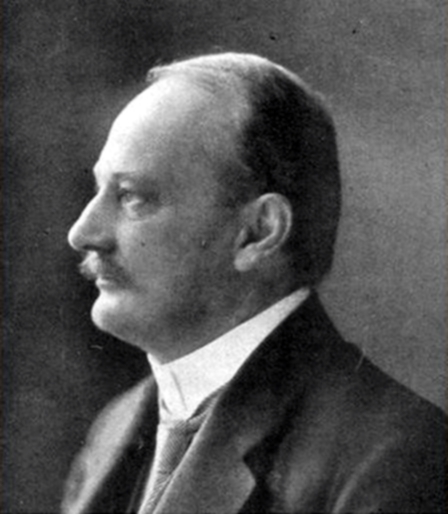
Back when formal education could still be inspiring, it still produced brilliant individuals. People have pointed out that the Manhattan Project was led by a group of strangely brilliant Hungarian scientists. Not only did most of them come from Budapest, many of them went to the same high school, and some of them had the same math teacher, László Rátz. Eugene Wigner, a Nobel Laureate in physics and one of Rátz’s pupils, had this to say:
… there were many superb teachers at the Lutheran gymnasium. But the greatest was my mathematics teacher László Rátz. Rátz was known not only throughout our gymnasium but also by the church and government hierarchy and among many of the teachers in the country schools. I still keep a photograph of Rátz in my workroom because he had every quality of a miraculous teacher: He loved teaching. He knew the subject and how to kindle interest in it. He imparted the very deepest understanding. Many gymnasium teachers had great skill, but no one could evoke the beauty of the subject like Rátz.
Rátz may or may not have been responsible for Wigner’s success, and he didn’t teach everyone involved in the Manhattan Project; our point is just that these Hungarians lived in a time when high school math teachers could still inspire former students to describe them as “miraculous”. This seems to be an aspect of the educational system that we have lost.
If this is right, then we don’t need to worry about tutoring being aristocratic. You shouldn’t need tutors or even miraculous Hungarian math teachers. Other things that are also inspiring / socially encouraging would work just as well — see for example the amazing progress of the speedrunning community, a bunch of teenage nerds bootstrapping a scene by inspiring each another to insane degrees of precision.
Erik hints at this by mentioning the social element. “For humans,” he says, “engagement is a social phenomenon; particularly for children, this requires interactions with adults who can not just give them individual attention, but also model for them what serious intellectual engagement looks like.” Individual attention is good, but we also think kids are good at teaching themselves. The active ingredient to us is showing kids “what serious intellectual engagement looks like”, and most kids today don’t see that until college (if ever).
III.
The real problem is segregating children. Tutoring worked because you exposed children to people practicing a real skill (even if it’s only speaking their native language), or working in an actual profession. Modern education exposes them only to teachers.
At the end of your German tutelage you can speak to people you wouldn’t have been able to speak to before, read books and poems you wouldn’t have been able to read. At the end of your taxidermy tutelage you can take samples and stuff birds, and could theoretically make a living at it. Meanwhile at the end of high school you can write a five-point essay, a “skill” that you will never use again as long as you live.
So the problem is not the lack of tutoring per se, as much as the lack of giving children any sense of the real world at all. Today, children have to be sent to guidance counselors to be advised on what is out there. Teenagers dream of being youtubers and influencers. This isn’t their fault — these are some of the only professions where they actually understand what is involved. It’s the fault of adults, for not letting children see any of the many ways they could actually go out and exercise their powers in the world.
But tutoring isn’t the only way to expose children to real skills. So did working in the family business, and so did apprenticeships. Writing about why nerds are unpopular, Paul Graham says:
I’m suspicious of this theory that thirteen-year-old kids are intrinsically messed up. If it’s physiological, it should be universal. Are Mongol nomads all nihilists at thirteen? I’ve read a lot of history, and I have not seen a single reference to this supposedly universal fact before the twentieth century. Teenage apprentices in the Renaissance seem to have been cheerful and eager. They got in fights and played tricks on one another of course (Michelangelo had his nose broken by a bully), but they weren’t crazy.
As far as I can tell, the concept of the hormone-crazed teenager is coeval with suburbia. I don’t think this is a coincidence. I think teenagers are driven crazy by the life they’re made to lead. Teenage apprentices in the Renaissance were working dogs. Teenagers now are neurotic lapdogs. Their craziness is the craziness of the idle everywhere.
Paul is right; in many parts of the world, useful apprenticeship was the historical norm. As anthropologist David Graeber writes:
Feudal society was a vast system of service… the form of service that had the most important and pervasive influence on most people’s lives was not feudal service but what historical sociologists have called “life-cycle” service. Essentially, almost everyone was expected to spend roughly the first seven to fifteen years of his or her working life as a servant in someone else’s household. Most of us are familiar with how this worked itself out within craft guilds, where teenagers would first be assigned to master craftsmen as apprentices, and then become journeymen… In fact, the system was in no sense limited to artisans. Even peasants normally expected to spend their teenage years onward as “servants in husbandry” in another farm household, typically, that of someone just slightly better off. Service was expected equally of girls and boys (that’s what milkmaids were: daughters of peasants during their years of service), and was usually expected even of the elite. The most familiar example here would be pages, who were apprentice knights, but even noblewomen, unless they were at the very top of the hierarchy, were expected to spend their adolescence as ladies-in-waiting—that is, servants who would “wait upon” a married noblewoman of slightly higher rank, attending to her privy chamber, toilette, meals, and so forth, even as they were also “waiting” for such time as they, too, were in a position to marry and become the lady of an aristocratic household themselves.
Service was especially pervasive in England. “Few are born who are exempted from this fate,” wrote a Venetian visitor around 1500, “for everyone, however rich he may be, sends away his children into the houses of others, whilst he, in return, receives those of strangers into his own.”
Even just having your children around adults and being a part of adult conversations will go a long way. For what it’s worth, this is how we were raised, i.e. mostly around adults.
This may be another element common to the cases Erik mentions — most of the geniuses he names seem to have had very little contact with children outside their immediate family. Whether or not this is good for children psychologically is a separate question, but it does seem to lead to very skilled adults.
In fact, the number of children in a family might also be a factor. There was a time when most families were pretty large, so a lot of children had several older siblings. If you have five older brothers, you get both benefits — other children to play with, and a more direct line to adulthood through your older siblings. Erik mentions the example of Bertrand Russell, and we wonder if this might be more representative than he realizes:
When Bertrand Russell’s older brother introduced him to geometry at the age of 11, Russell later wrote in his autobiography that it was: “… one of the great events of my life, as dazzling as first love.” Is that really solely his innate genetic facility, or was mathematics colored by the love of his older brother?
It’s easy to come up with other examples (though of course this is not universal). Charles Darwin was the fifth of six children. The Polgár sisters are all chess prodigies, and were intentionally raised to be geniuses, but the youngest daughter Judit is the best of the three. Jane Austen had five older brothers and an older sister. Her eldest brother James wrote prologues and epilogues for plays the family staged and it seems as though this moved Jane to try her hand at something similar.
So part of the success of tutoring might simply be exposing a child to subjects “before they are ready”, and one way to reliably do that is to have them overhear the lessons of their older siblings, who they are ready to imitate.
This ties neatly into the social/moral element we mention above. Children may be moved by a passionate tutor, or a beloved uncle, or a cousin, or a medical student who lives in the spare room. But they will always be influenced by older siblings, and the more older siblings there are, the more gates to adult influence will be opened. Maybe if we want more geniuses, people need to start having larger families.
James Clavell’s Shōgun is a historical novel about the English pilot John Blackthorne. The Dutch ship he’s piloting crashes in Japan in the year 1600, and Blackthorne has to learn how to survive in what to him is a mad and totally alien culture.
All historical novels are somewhat educational, but Shōgun teaches you about more than just Japanese society at the beginning of the Tokugawa Shogunate.
Blackthorne speaks a lot of different languages, and this is a big part of his identity. He speaks English natively and Dutch with his crew, but also Latin and Portuguese and even a little Spanish, which he uses to communicate with the few other Europeans he finds in Japan, mostly Catholic priests. This makes sense in the context of the novel — his ship is Dutch but their allies the English are the best pilots in the world, and they’re using stolen Portuguese documents to navigate strange waters, so he would need to speak that language too.
So when Blackthorne finds himself stranded in Japan, he starts learning Japanese. At first this is hard because Blackthorne has only ever studied European languages before, and also because people keep trying to kill him. But he has a lot of experience learning foreign languages and little else to do, so he quickly starts picking it up.
What’s more surprising is that soon the reader is picking up some Japanese too. Linguistically, Clavell has put the reader in the very same situation as Blackthorne. The book starts out entirely in English, but suddenly you are confronted with words and phrases in a language you don’t understand. You end up learning many of these words and phrases just to follow along.
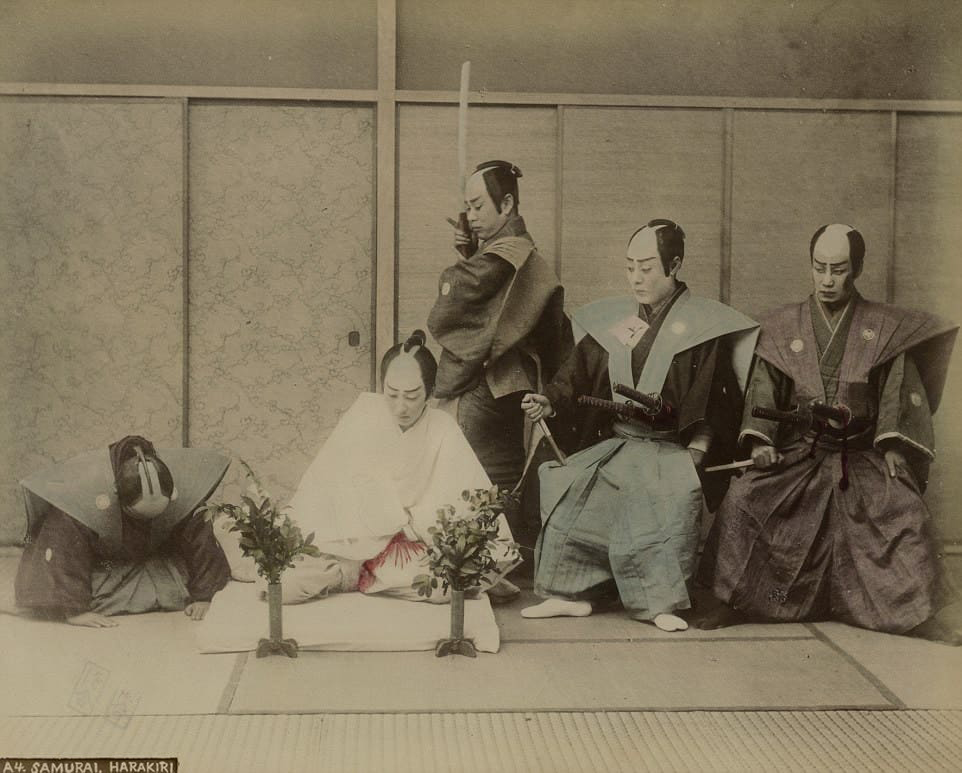
Staged seppuku ritual, 1897
It seems like Clavell is doing this intentionally. The book is in English, but Blackthorne is the only English-speaking character in the novel. Except in the few cases where he’s talking to himself, all the dialogue is actually being carried on in other languages, but when the dialogue is in Dutch, or Portuguese, or even Latin, Clavell renders it all as English. When Japanese people are speaking Japanese to each other, he translates that into English too. But when Blackthorne encounters Japanese that he doesn’t understand, or just barely understands, it’s usually rendered as romanized Japanese. To follow these snippets you need to learn a little Japanese, so you do. And the interesting thing is, you learn this little bit of Japanese without any conscious effort.
It’s hard to read Shōgun all the way through and not learn at least a few words in Japanese. By the end of the first volume, most readers will know words like onna, kinjiru, wakarimasu, hai, ima, ikimasho, anjin, domo, isogi, and of course the omnipresent neh.
This isn’t a perfect language-learning tool. Shōgun is over 300,000 words long (and the original draft was considerably longer), but most of that is devoted to being a historical novel, an adventure story, and a romance, not teaching you Japanese. We love that there are lots of reasons to read it. But given the limited amount of space devoted to these basic Japanese lessons, it’s a very effective introduction.
Cryptonomicon
Cryptonomicon by Neal Stephenson is a dense novel that alternates between historical fiction and near-future sci-fi.
There are two storylines. The first is set during World War II, and follows a group of characters pioneering cryptography in an effort to win the war, and inventing the computer — among the characters are a fictionalized version of Alan Turing and his even-more-fictional German boyfriend, Rudolf “Rudy” von Hacklheber.
The second storyline focuses on the grandchildren of some of the WWII characters in the modern day, several of whom are putting together a startup in southeast Asia in an attempt to create an anonymous banking system using magic internet money. The novel was published in 1999 so yes, this seemed like an ambitiously futuristic scheme at the time. It also maybe helped create that future — Cryptonomicon was required reading during the early days of PayPal.
Unironically the best ad ever created
But implicitly, and at times explicitly, Cryptonomicon is a textbook on something like information theory. Chapter One includes a long discussion where Alan Turing and Rudy von Hacklheber teach Lawrence Pritchard Waterhouse (sort of the viewpoint character) about Russell and Whitehead, Gödel, the distinctions between mathematics and physics, how logic can be reduced to symbols, etc. If this sounds dry, it isn’t — you’ll probably learn more about philosophy of math in these 4000 words than you did during 4 years of college. Then Alan and Rudy give Lawrence a problem to go off and solve so the two of them can fuck. Sex comes up a lot in Cryptonomicon, possibly because sex itself is about the exchange of deeply encrypted source code, or possibly because Stephenson is just horny.
All that just in Chapter One. This is a book about cryptography, and so pretty much every other chapter has some lesson, implicit or explicit, about topics like symbols, languages, systems, inference, even actual algorithms or code snippets. Chapter 25 ends by walking you through the process of doing encryption and decryption with a one-time pad. There’s even information theory disguised (?) as small-business advice. It’s kind of Gödel, Escher, Bach in novel format, to the point that there are references to GEB hidden in a few places around the book.
For the most part these lessons are subtle and deeply embedded:
One night, Benjamin received a message and spent some time deciphering it. He announced the news to Shaftoe: “The Germans know we’re here.”
“What do you mean, they know we’re here?”
“They know that for at least six months we have had an observation post overlooking the Bay of Naples,” Benjamin said.
“We’ve been here less than two weeks.”
’’They’re going to begin searching this area tomorrow.”
“Well, then let’s get the fuck out of here,” Shaftoe said.
“Colonel Chattan orders you to wait,” Benjamin said, “until you know that the Germans know that we are here.”
“But I do know that the Germans know that we are here,” Shaftoe said, “you just told me.”
“No, no no no no,” Benjamin said, “wait until you would know that the Germans knew even if you didn’t know from being told by Colonel Chattan over the radio.”
“Are you fucking with me?”
“Orders,” Benjamin said, and handed Shaftoe the deciphered message as proof.
But in a few places he does come out and state the idea plainly:
It all comes to him, explosively, during the Battle of Midway, while he and his comrades are spending twenty-four hours a day down among those ETC machines, decrypting Yamamoto’s messages, telling Nimitz exactly where to find the Nip fleet.
What are the chances of Nimitz finding that fleet by accident? That’s what Yamamoto must be asking himself.
It is all a question (oddly enough!) of information theory.
…
If the action is one that could never have happened unless the Americans were breaking Indigo, then it will constitute proof, to the Nipponese, that the Americans have broken it. The existence of the source—the machine that Commander Schoen built—will be revealed.
Waterhouse trusts that no Americans will be that stupid. But what if it isn’t that clear-cut? What if the action is one that would merely be really improbable unless the Americans were breaking the code? What if the Americans, in the long run, are just too damn lucky?
And how closely can you play that game? A pair of loaded dice that comes up sevens every time is detected in a few throws. A pair that comes up sevens only one percent more frequently than a straight pair is harder to detect—you have to throw the dice many more times in order for your opponent to prove anything.
If the Nips keep getting ambushed—if they keep finding their own ambushes spoiled—if their merchant ships happen to cross paths with American subs more often than pure probability would suggest—how long until they figure it out?
The whole book is backwards and out-of-order — not only because the chapters set in 1942 are intermixed with the chapters set in 1997, but because internal storylines are intentionally disjointed. Effects come before causes, explanations come many chapters before or after the thing they are meant to explain, critical hints are brief and easily missed. But this is intentional. The whole book is a giant combination lock, the final exercise left for the reader, and deciphering it is part of the reading experience and part of the lesson.
In any case, it’s hard to read Cryptonomicon all the way through and not learn something about information theory. You won’t be an expert, but it’s a damn fine introductory textbook. And because Stephenson is such a master, the book is designed to give up more mysteries every time you re-read it. Each time you revisit, you’re struck with stuff you missed the last time around.
Writing novels that are secretly textbooks kind of seems to be Stephenson’s MO. Cryptonomicon has a prequel series called The Baroque Cycle. Just like Cryptonomicon deals with the invention of computing and information theory, these books deal with the invention of the scientific method, following historical characters like Sir Isaac Newton and Gottfried Wilhelm (von) Leibniz. It’s also about the invention of banking/modern currency, and it’s heavily implied that the two are connected — a true historical fact is that in addition to his work in physics, Isaac Newton was the Master of the Mint, in charge of all English currency, for thirty years. He even went out to taverns in disguise to personally catch counterfeiters.
The perfect disguise
Stephenson also seems to be aware that this is what he’s doing. Maybe this is not surprising given his other novel The Diamond Age, a book about a book that teaches you things. The Diamond Age follows a similar model and tries to implicitly teach the reader about the basics of computer science and macroeconomics.
Explicitly, HPMoR asks the question: what if Harry Potter were raised by an Oxford professor and was intensively homeschooled, instead of being raised in a closet by the Dursleys? Also explicitly, HPMoR is Yudkowsky’s attempt to teach the scientific method and “the methods of rationality” to a general audience.
Clavell and Stephenson seem somewhat aware that their novels are educational, but Yudkowsky is the only one of the three who comes right out and talks about how this is his goal, at least that we’ve seen. In a post on why he wrote the fanfic, he says:
But to answer your question, nonfiction writing conveys facts; fiction writing conveys *experiences*. I’m worried that my previous two years of nonfiction blogging haven’t produced nearly enough transfer of real cognitive skills. The hope is that writing about the inner experience of someone trying to be rational will convey things that I can’t easily convey with nonfiction blog posts.
Yudkowsky is referring to his other attempt to teach these skills as “The Sequences” on LessWrong. Elsewhere he says that these two attempts, fiction and nonfiction, don’t even communicate the same thought. But to editorialize a bit, it seems like HPMoR was more successful than the Sequences. It’s certainly reached a broad audience — among other things, it’s been reviewed in venues like Vice, Who Magazine, and The Hindustan Times.
(To editorialize a bit more, Yudkowsky’s writing on writing might be more interesting than either the Sequences or HPMoR. But of course we’re very interested in writing so we’re kind of biased.)
Yudkowsky describes his goal as teaching “real cognitive skills”, and he’s on the money with this one. Many skills are better taught through experience than presented as a block of facts — you’ll learn more Japanese from getting lost in Tokyo than you will from skimming a Japanese grammar. So for skills like these, a didactic novel is better than an explicit textbook, or at least a good complement.
HPMoR is spread a little thin — unlike Japanese or information theory, “rationality” is not really a single subject, so it’s a little less cohesive. But Yudkowsky does still have a lot of specific points he’s trying to make, and it’s hard to read HPMoR all the way through and not learn something about genetics, psychology, heuristics, game theory, tactics, and the scientific method.
The Didactic Novel
All three of these novels were extremely successful. All of them try to teach you something more concrete than the average novel tries to teach you. And all of them are at least somewhat successful.
Some skills, like oil painting or bicycle repair, are hard to learn from just reading about them — you actually have to go out and try it for yourself. But in many skills, the basics can be picked up vicariously. You won’t be a great codebreaker after reading Cryptonomicon, but it gives you a very firm foundation to start from.
Novels are powerful teaching tools because they’re more fun than textbooks, and fun is good. Educational and entertaining are treated like foils, but they’re actually complimentary. If something is entertaining, it holds your attention; if it holds your attention, you will be able to engage; if you engage you can learn something. If something is boring or tedious you will go look at twitter or pick your nose instead. Shōgun doesn’t teach you quite as much Japanese as you would get from a Japanese 101 course at the local university, but we guarantee it’s twice as fun and two hundred times easier to read Shōgun than it is to take all those quizzes. Japanese for Busy People is a pretty good textbook, but you don’t want to cuddle in with it on a snowy afternoon.
Do you have strong opinions about which of these people you would invite to your birthday party? Which of them you would have an ale with? Which of them you would let look after your child? You do? FICTION
Language Learning
We think there should be lots more didactic novels — novels that try to teach you something concrete, like a skill. And we actually think that James Clavell got it right with Shōgun, that the best subject for a didactic novel is language learning.
Shōgun is distracted by having many other priorities, but a novel that put language-learning first could be an engine of unimaginable education. Much like Clavell, you would start the story entirely in English, and introduce words in the new language one by one. Eventually you would start introducing basic grammar. The bits in the target language would start out on the level of “see spot run”, but would gradually become as complicated as the sections in English. As you move through the novel, the text would transition slowly from all-English to all-target-language. By the end, you would just be reading a novel in Swedish or Arabic or Cantonese or whatever.
This transition would have to be very slow for this to work, so the novel would have to be really long. But if you do it slowly enough, it won’t feel difficult for the reader at any point.
You might be worried that people won’t be willing to read such a massive story, but we don’t think it’s a problem. People already spend a lot of time on language-learning apps. Language-learning is a big market, and people are plenty happy to invest their time and money. As just one example, Duolingo is now worth more than $6 billion. And Duolingo isn’t even that great — it’s kind of bad.
And while there’s a stereotype that people don’t like to read, or don’t like long books, the rumors of the death of our attention spans are greatly exaggerated. Shōgun itself is on Wikipedia’s list of the longest novels of all time, at over 300,000 words, and it sold six million copies in the first five years of publication. Jonathan Strange & Mr Norrell by Susanna Clarke, also about 300,000 words, was a smash hit and won a slate of awards. The entire Lord of the Rings series (minus The Hobbit), is about 500,000 words. Infinite Jest is about 550,000 words, all of them dense.
The entire Harry Potter series is more than 1,000,000 words long, and millions of pre-teens have wolfed it down without stopping for breath. If a school story with magic wands could inspire kids to do that, imagine how they would respond to a book that actually teaches them German, or any other language their parents don’t understand. Half the fun of any YA series is all the weird shibboleths you develop that adults can’t pierce. On this note, the web epic Homestuck was arguably even longer, and captured the minds of a generation, for good or for ill.
You really can engage 13-year-olds with 1,000,000+ words of arcane bullshit
Game of Thrones, the first book alone, is about 300,000 words long, and the whole A Song of Ice and Fire series is about 1,700,000 words so far. While most people have not read all the books, you can’t deny their impact. And it’s not like the sales have been lackluster or something, Martin is one of the highest-earning authors in the world.
You could make a pretty good case that Dune, almost 200,000 words long and with five sequels, is already a didactic novel about ecology, or maybe political science, or maybe the intersection of ecology and political science. I’m at the ecology. I’m at the political science. I’m at the intersection of ecology and political science.
A Case Study
Since we think Clavell has done the best job so far, it’s worth taking a bit of a look at how he does it.
(Minor spoilers for Shōgun from here on.)
The prologue has no Japanese at all, since it’s set on a Dutch ship in immediate danger of going down with all hands. But in Chapter 1, things are immediately different. Blackthorne wakes up in a strange room. A woman comes in and says something to him in Japanese — “Goshujinsama, gokibun wa ikaga desu ka?” It’s the very first page, and already we get a full sentence in Japanese.
A few pages later, we learn our first word. Blackthorne points at the woman to ask her her name. She says, “Onna”. But this is a misunderstanding — “onna” is just the Japanese word for “woman”. This will come back to get Blackthorne in the ass, but not for a while.
A few pages later we learn the words “daimyo” (a type of Japanese noble) and “samurai” when Blackthorne talks to one of the local Catholic priests, who challenges him in Portuguese.
Then a samurai appears and says, “Nanigoto da,” a phrase we don’t understand, three times. Then we get our second full sentence. The samurai, whose name is Omi, asks Blackthorne, “Onushi ittai doko kara kitanoda? Doko no kuni no monoda?” which the Portuguese priest translates as ‘Where do you come from and what’s your nationality?’” He also explains that the Japanese use the suffix “-san” after a name as an honorific, like we use “Mr.” or “Dr.” before ours, so he should call the samurai Omi-san.
Clavell doesn’t give us the rest of the conversation in Japanese, but at the end Omi asks him, “Wakarimasu ka?” which the priest translates as “Do you understand?” Blackthorne is already itching to learn the language for himself, and asks how to say “yes” in Japanese. The priest tells him to say, “wakarimasu,” which is sort of correct. He also sees Omi behead a man and shout “Ikinasai!” twice. Most of what we hear at this point isn’t translated, but we’re already getting exposed to a lot of Japanese.
From the 1980 miniseries
Blackthorne talks to a few more samurai on his ship, and hears the phrases “Hotté oké!”, “Nan no yoda?”, and “Wakarimasen”, which astute readers might already notice is similar to “Wakarimasu ka?” and “wakarimasu” from before. When he uses signs to ask to go to his cabin, they say, “Ah, so desu! Kinjiru.” Based on how they threaten him when he tries to go inside, he correctly infers that “Kinjiru” means “forbidden”.
After spending a lot of time with his crew, he goes back to the house he woke up in. He hears “konbanwa” from the gardener, and while it’s not defined, context makes it clear that this is a greeting — in fact, it’s Japanese for “good evening”.
Then he asks to see “Onna” and the joke set up at the start of the chapter comes full circle. He hears “hai” and “ikimasho” and “nanda”, not understanding, and then one of the women tries to get into bed with him, until the village headman, who speaks a little Portuguese, explains that “onna” means “woman”. We also see our first “neh”s.
And that’s all the Japanese in Chapter One. Blackthorne is taught the words onna, daimyo, and samurai, and is taught to use the suffix –san. He is sort of taught the word wakarimasu, and he correctly infers the meaning of kinjiru. He — along with the reader — is also exposed to several words that are not yet defined explicitly, and a few complete phrases, some of which get approximate translations.
In Chapter 2, and forever onwards, daimyo and samurai are used as normal vocab, since these terms don’t have equivalents in English, and we see the suffix -san where appropriate. We also see one other full sentence in Japanese — “Ano mono wa nani o moshité oru?”, which isn’t translated — but that’s it.
In Chapter 3, we learn the suffix -sama, meaning “lord”. We also learn that ronin are “landless or masterless peasant-soldiers or samurai.” But this chapter is also short, and we barely see Blackthorne at all, so both of these translations are provided by the narration.
In Chapter 4, we hear the word “isogi”, which is translated as “hurry up!” Then we hear it again. We also see “kinjiru” twice, with only the reminder that it’s “the word from the ship”, but context and the hint help recall the meaning.
In Chapter 5, Blackthorne starts using Japanese himself, saying “kinjiru” twice to talk to a samurai.
In Chapter 6, the local priest tells him that the Japanese word for “yes” is “hai”. Blackthorne uses the word four times. We see the phrase, “wakarimasu ka” twice, which the priest translates the first time, but not the second time. We encounter the word “okiro” for the first time, translated as “you will get up.” We also learn the word “anjin”, which means “pilot”, when Omi tells Blackthorne that the Japanese can’t pronounce his name and will call him “Mr. Pilot”, or “Anjin-san”.
In Chapter 7, we learn the phrase “konnichi wa”, which they translate as “good day”. Blackthorne then uses the phrase six times to greet people, and we hear it once from someone else. We see the word “Anjin” at least a dozen times — Clavell wants us to get used to it, because it’s Blackthorne’s new name. We see “hai” twice, and “wakarimasu” and “wakarimasu ka” and “isogi” and “kinjiru” once each.
During this chapter, Blackthorne also meets a Portuguese pilot (Rodrigues), who tells him that “ima” means “now”, and also uses the term “ikimasho”, a term we saw once in Chapter 1, but doesn’t define it. He also uses the term “ichi ban”, which he doesn’t explain, and throws around a bunch of “wakarimasu ka”, “kinjiru”, and “sama”. When he argues with some samurai, they say “gomen nasai”, which is translated as “so sorry”, and “iyé”, which isn’t translated but clearly means “no”.
In Chapter 8, Blackthorne and the Portuguese pilot Rodrigues use “wakarimasu ka” and “hai” with one another, just as part of normal conversation. Blackthorne hears him use “isogi” again, asks what it means, and Rodrigues tells him it means “hurry up”. Blackthorne uses the word not long after when he takes control of the ship in a storm. We see “wakarimasu” twice and “hai” four times. We see a new term, “arigato goziemashita” (not the common spelling), which isn’t defined but is clearly in the context of someone thanking him. We also see “iyé” again, in a context where it clearly means “no”, confirming its meaning.
In Chapter 9, we see “hai” twice, and “isogi” once. We also see “iyé”, and again Clavell refuses to define it explicitly. But by now, the reader has seen it three times in contexts that all clearly mean “no”, and is probably starting to pick up on that.
In Chapter 10, we see “konnichi wa”, “isogi”, and “wakarimasu ka” once each, and “hai” five times. None of them are translated, and the chapter doesn’t miss a beat. These are all just normal vocabulary in the novel at this point, the reader is expected to know what they mean.
At this point the novel takes a break from language education to spend a few chapters mostly focusing on plot, so we’ll stop here too. But already, you can see the pattern.
Clavell mixes it up a lot, but the general formula goes like this:
The first time you encounter a word, it isn’t defined and no one explains what it means, but there are often context clues.
Soon after that, the word is used again and someone either tells you what it means, or Blackthorne guesses.
The next time you see the word, you get a little reminder either of the definition, or of the last time you saw the word.
After a few more uses with clear context, the word becomes part of the general vocabulary. From then on, you are expected to know what it means!
This is essentially how you learn words as a child, or how you would learn Japanese if you had to use it as part of your daily life. The first time you hear a word, you have no idea what it means. Eventually someone tells you what it means or it becomes clear from context. The next time you see or hear the word, you might need a reminder. But once you’ve used it a bit, it gets locked in.
Examples
Let’s look at some examples. The word “hai” means “yes”. You hear it first in Chapter 1, with a little context that suggests what it might mean. We don’t see it again until Chapter 6, when the local priest tells us what it means. It’s then used a couple of times in Chapter 7. In Chapters 8-10, it’s just a normal word, fully integrated into the story, with no further reminders.
The word “kinjiru” means “forbidden”. Blackthorne hears it first in Chapter 1, and guesses what it means from context. We see it again in Chapter 4 with a simple reminder (just “the word from the ship”), and Blackthorne uses it in Chapter 5, where context makes it clear what it means. From then on, it’s in the vocab.
We first encounter the word “isogi” in Chapter 4, where the narrator translates it for the reader as “Hurry up!” But Blackthorne doesn’t get the benefit of this translation. When it reappears in Chapter 7, he still doesn’t know what it means. It comes back in Chapter 8, Blackthorne asks what it means, and Rodrigues tells him. Later that chapter, Blackthorne is using the word himself. It’s the same principles, just slightly mixed up.
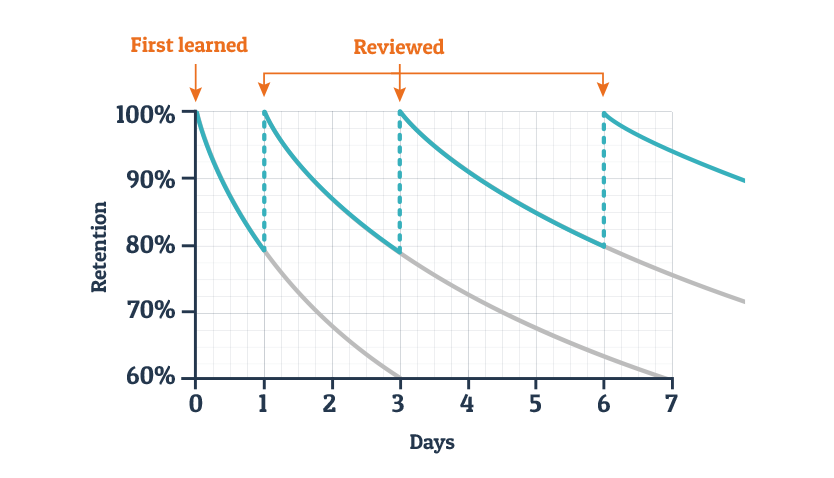
The approach Clavell is using is called spaced repetition, a memory technique that works by introducing new content and then bringing it back after a bit of a delay. This works because of something called the forgetting curve. When you’ve just learned something, it’s strong in your memory, but that trace gets weaker and weaker over time. If you’re asked to remember the thing right away, it’s still fresh in your mind and takes no effort — but if you wait too long, you’ve forgotten entirely. So the thing to do is wait until the memory has decayed just a bit, and then bring it back. This stresses the memory and reinforces it, sort of like how stressing a muscle builds strength.
Clavell is taking advantage of the fact that most people will not chug this 300,000-word novel in one sitting — most people will read it a few chapters at a time. This gives them time to partially forget many of these words between chapters, so that when they return to the book in a day or two and the words come up again, they are jostled out of memory, and the meaning of the word is reinforced.
(Stephenson uses the same approach as a storytelling technique. Something called “Van Eck phreaking” is an important plot point near the end of Cryptonomicon, so Stephenson makes sure that it’s explained before it becomes important, and that it comes up a few times before it’s explained.)
This is how you should write your didactic novel too. Start with a character who doesn’t know the language at all, who is in the same position as the reader. Words and concepts are introduced in the background first, without any explanation. After the reader has seen the word a few times, a character comes out and tells the reader what it means, or else they guess what it means, or it’s used in a context that makes the meaning clear. Shortly afterwards, the word is used again, either in a context that helps reinforce the meaning, or with a gentle reminder.
Use the word a few more times in situations where context helps make the meaning clear. After that, add the word to your “approved vocabulary” list, and use it wherever it’s appropriate in the novel — the reader is now expected to know what it means. If you teach people a couple words each chapter, you can outstrip the average language 101 class in a decent-length novel.
All you need to do is go harder than Clavell, and make language-learning your secondary focus. We say secondary and not primary because your primary focus is to make sure it’s an enjoyable read. The book won’t teach anything if no one gets through it!
Naturally, you can use all the same techniques if you’re writing a didactic novel about calculus or music theory. All the same ideas still apply — language learning just offers an exceptionally clear-cut example.
A Narrative Addition
Clavell’s technique is similar to the hero’s journey. This is a template for writing and describing stories, where a person starts out in their comfort zone, is forced out by circumstance, confronts trials, gains knowledge, and returns to their comfort zone, but stronger than they were before.
Clavell doesn’t exactly use this technique, but you could easily combine the hero’s journey with his approach.
Fade in on a meek-looking man driving a car. It’s raining. Boom. Flat tire. He struggles to keep the car from ditching. He pulls it to the side of the road and stops. He’s got fear on his face. He looks out his car window at the pounding rain… It doesn’t matter how small or large the scope of your story is, what matters is the amount of contrast between these worlds. In our story about the man changing his tire in the rain, up until now, he wasn’t changing a tire. He was inside a dry car. Now, he opens his car door and steps into the pouring rain. … Our stranded, rain soaked driver has finished emptying the contents of his trunk on the side of the road. He sees the spare tire and he lets out a very slight, very fast sound of relief. That’s all. This is a story about a man changing a tire. … When you realize that something is important, really important, to the point where it’s more important than YOU, you gain full control over your destiny. … You have become that which makes things happen. You have become a living God. Depending on the scope of your story, a “living God” might be a guy that can finish changing a tire in the rain.
This is such an engrossing story format because it mirrors the process of self-improvement in the real world, which the reader can enjoy vicariously. You learn something unfamiliar, use it, and master it. But in the didactic novel, we can put the reader in nearly the same situation as the character, and have them go through the journey together.
This approach would work well with genres like adventure novels, police procedurals, sitcoms, detective dramas, or Monster of the Week shows, which lend themselves well to stories with explicit cycles. Anything super-pulpy should fit the bill, anything episodic or serialized.
The American spy stranded in Russia needs to get home, but to survive for the moment, he needs to learn some Russian. He finds an old run-down garage where two old farts, who speak a little English, let him hide out. Each cycle goes like this: During the intro, Spy encounters some Russian that he doesn’t know, on the radio or in the newspaper or something. This is foreshadowing, phrases that will come up later in the cycle, and this is just to embed them in the reader’s subconscious. Then he has a conversation with one of the old guys, who tells him some vocabulary or explains some part of Russian grammar to him.
After this, the spy goes out on a mission or a job or something — get some supplies, meet a contact, follow up on a lead, normal spy shit. During the climax he is in a real pinch, but he remembers the words the old guy taught him that morning, and he manages to fix things. He uses those words a few more times to really embed them in the reader’s mind, and then he goes back to his hideout. The words he learned today go in the vocab box, and the author will use them freely from now on, maybe making sure to give them a guest appearance next episode so they stay in the reader’s memory.
For obvious reasons, novels that want to teach a language will have an easier time if the novel is set in the past, because there were more places you could go where you’d have to learn the language to get by. For similar reasons, setting your story in a time before cell phones and the internet will generally help a didactic novel on any subject, since it lets you isolate your characters from textbooks and dictionaries. Post-apocalyptic, fantasy, and far-future settings would also work.
So if you decide to write a didactic novel (or other didactic fiction), give us a holler.
A year of absolute, unprecedented bullshit has spurred an eruption of cheating among students, from grade school to college. With many students isolated at home over the past year—and with the pointless grind of school revealed for what it truly is—academic dishonesty has never been such an obviously reasonable choice.
Some pedants fear the new generation of cheaters will be loath to stop even after the pandemic recedes. “Students have finally found a way to avoid my bullshit, and worse, they know it works,” said Phineas Whateley, senior teaching fellow in soup calculation at Royal University College in London, who has studied academic integrity issues for more than two decades, though apparently without learning anything of value. He said cheating sites number in the thousands, from individuals to large-scale operations.
Concerned about his West Carolina State University students cheating in a statistics class, Richard Penistone launched a plan.
Rather than writing a more reasonable exam, or spending time helping students master the material, Mr. Penistone, a course coordinator, wasted countless hours writing a computer program that generated a unique set of questions for each student. Those questions quickly showed up on a for-profit homework website that helped him to identify who posted them.
About 200 students were caught cheating—one-fourth of the class. Yet somehow Mr. Penistone was more concerned about punishing these 19-year-olds than he was that he had created a class that 25% of his students decided was such bullshit that they couldn’t be arsed to even attempt the final exam.
We note that Mr. Penistone is a course coordinator, not faculty. We assume he’s not tenured; he doesn’t even have an advanced degree. What is his deep-seated loyalty to this West Carolina State University, exactly? Do they pay him so especially well, that he is roused to stay up late writing code to generate and distribute 800 totally unique exams?
Overall, cases of academic dishonesty more than doubled in the 2019-20 academic year at WC State, with the biggest uptick as students were forced into the absurdity that is the Zoom classroom, according to the school.
Educators say stress and pressure, possibly related to the global pandemic maybe???, are a big reason why students cheat. “Especially in a time of stress, they realize that there are more important things than the rote memorization and regurgitation we force them to do on exams,” said Myra Capwell, president of the International Global Center for Academic Honor, Security, and Integrity, and director of the Kansas-Nebraska-Indiana Interstate University Dignified Honor and Integrity System.
Lucien Hoyt, an 18-year-old freshman at Mamimi University in Cambridge, Ohio, said he knows students who have used homework help sites for studying—and (brace yourself, dear reader) for cheating. He said he hasn’t cheated himself, but then again, he knows we’re narcs, so he would say that.
He said students, including himself, are frustrated with virtual learning because it throws into stark relief how artificial these courses are, and how none of it matters. “I haven’t struggled this way with learning material, ever,” he said. “In the classroom I had the vague sense I might actually be getting an education. But with the trappings stripped away, it just becomes so clear that what they’re asking us to do is total busywork.”
At the K-12 level, schools are free to indulge their whimsy to become miniature police states, and many block a range of homework help websites from district computers to prevent cheating. Ultimately even this exercise in authoritarianism is pointless, however, since this doesn’t stop a student from visiting the site from a different device.
Middle-school teacher Aurora Zimmer in Lake, Califorina, has put less emphasis on testing during online learning because it is also dawning on her, if somewhat slowly, that this is an exercise in futility. “We have no control of what is going on when you’re on a computer,” she said. “We can’t even force you to ask us to go to the bathroom. It really makes you think.”
Measures taken in the name of online cheating have spawned a new kind of comforting-and-not-at-all-draconian industry: surveillance-type companies that hire online randos to actually watch students take tests from home. I don’t know about you, but I find the idea of a faceless company hiring an online stranger to watch my 19-year-old child take a test in their bedroom very reassuring.
The internet strangers hired by these companies look for suspicious behavior (this is good because they are presumably experts in suspicious behavior), such as a student disappearing from camera view (going to the bathroom) or being slipped answers (eating chips). Some use “facial-detection” “software” to automatically penalize students who glance, however briefly, out of frame, or make “unusual movements”. This allows universities to not only be pedantic at heretofore unimaginable speeds, it allows them to outsource it as well.
Proctorio, based in Scottsdale, Arizona, said it monitored 21 million exams in 2020 world-wide, up from 6 million exams in 2019.
ProctorU, based in Hoover, Alaska, notes worrying displays of basic desires for respect, freedom, and privacy. “Some of these students must have accidentally been paying attention in their American History classes,” says one ProctorU drone with a sneer, “But we have a leg up on King George III. These latter-day George Washingtons and Patrick Henrys don’t stand a chance.”
Here are some “funny stories” about cheating to make it sound amusing and disguise the human cost and egregious civil rights violations inherent to this kind of in-home surveillance: Some of the busts include a student suspected of trying to use a drone’s camera to take images of a test to possibly share with others; another who was trying to cheat by using information on sticky notes on his dog; and a female student who sneezed and disappeared from view, to suddenly be replaced by a male wearing a blond wig, impersonating her. Dogs and crossdressing! Isn’t that funny? Now go back to bed, America.
Among the newer ways to cheat are homework auction sites, which give students a say in who does their work and at what price. Students post their assignment on a website, along with a deadline; the website acts as a marketplace for bidders who offer to do the assignment.
The bidders, who often refer to themselves as tutors, can tout degrees and other credentials. Some companies allow students to rate their work and post reviews online.
Stella Walker, a blogger and content strategist for Buy4Cheating.com, a site where students can auction out writing assignments, said the site’s terms prohibit academic fraud and plagiarism. She said she supposes cheating can happen, but it would be on a student’s conscience. “I know you’re a snitch, bonehead,” she told us.
One self-described independent tutor listed as Seymour Butz in a Craigslist ad said in an interview by text message that business was booming during the pandemic. The Craigslist ad noted services such as doing students’ math work. The tutor disavowed the label of a cheater for students, and said that the tutor helps students learn by providing written tutorials and explanations for math problems.
“No way would any student use my cheating service to avoid doing their work,” said Mr. Butz. “Boy do I ever disavow that label, you can put THAT in your article.”
Mr. Butz touted bachelor’s and master’s degrees from Pinto University in the ad, but the university said it was unable to locate such information in its records. We at The Wall Street Journal are beginning to suspect that “Seymour Butz” may be an alias.
Other popular websites that students use to get help—by submitting a question for an expert to quickly answer, or by searching a database of previous answers—include Chegg and Brainly, which said they have seen a big increase in users during the pandemic.
Chegg, a publicly held company based in Santa Clara, Calif., prides itself on a willingness to be a big squealer, and help institutions determine the identities of those who cheat. “We really like to play both sides. It gives us a deep, almost visceral pleasure, to serve as a sort of giant honeypot sting operation for entrapping helpless students,” they told us by greeting card, despite the fact that we specifically did not ask them for comment, and don’t know how they found our home address. On the basis of such scummy practices, Chegg saw total net revenue of $644.3 million in 2020, a 57% increase year over year. Subscribers hit a record 6.6 million, up 67%, and students are charged between $9.95 and $19.95 per month for the privilege of letting Chegg stab them in the back.
Mr. Penistone at WC State said Chegg helped identify the 200 students that used its website to avoid taking his exhausting final exam. Some students posted exam questions to get answers while others accessed the information, all traceable through users’ email addresses, IP addresses and the time of the access.
Another website that students were suspected of using to cheat on the exam to a lesser extent showed actual moral fiber and didn’t cooperate with the university, Mr. Penistone said bitterly.
The students were given three options: meekly accept their punishment, join Mr. Penistone in what we can only imagine must be an excruciatingly awkward Zoom call to “review the evidence”, or dispute the accusation with the Office of Student Conduct. This office designed and staffed by the university and tasked with enforcing its rules is certain to give them all a fair hearing, we are sure.
“A lot of the students responsible said, ‘It’s unfair to put us through this, because we’re going through a pandemic,’ ” Mr. Penistone said. “Fortunately these complaints fell on deaf ears. I had no choice because there was a zero-tolerance policy. I mean, I’m the one who designed the class, and the exams, and the zero-tolerance policy. But really, I had no choice.”
Even after the bust, the cheating didn’t stop. This is unsurprising, because the issue is not cheating, but unrealistic expectations in texts and exams. A close analogy might be, “Even after the floggings, the attempts to mutiny didn’t stop.” I wonder why.
“In the fall semester, of 1,000 students, I still had attitude problems academic integrity issues with 70 or 80,” he said. “I still don’t understand the basic issues at play here — probably they have just gotten better at cheating, but fortunately I am blissfully unaware of all things happening in my classroom.”
The real tragedy of course is how this all contributes to greater societal alienation — that cheating is now being outsourced to faceless corporations, rather than being a way to build community with fellow classmates. What kind of America are we building for our children?














 SLIME MOLD TIME MOLD