
[PROLOGUE – EVERYBODY WANTS A ROCK]
[PART I – THERMOSTAT]
[PART II – MOTIVATION]
Human nature is not a machine to be built after a model, and set to do exactly the work prescribed for it, but a tree, which requires to grow and develop itself on all sides, according to the tendency of the inward forces which make it a living thing.
—John Stuart Mill
The cybernetic paradigm gives you a theory of personality for free.
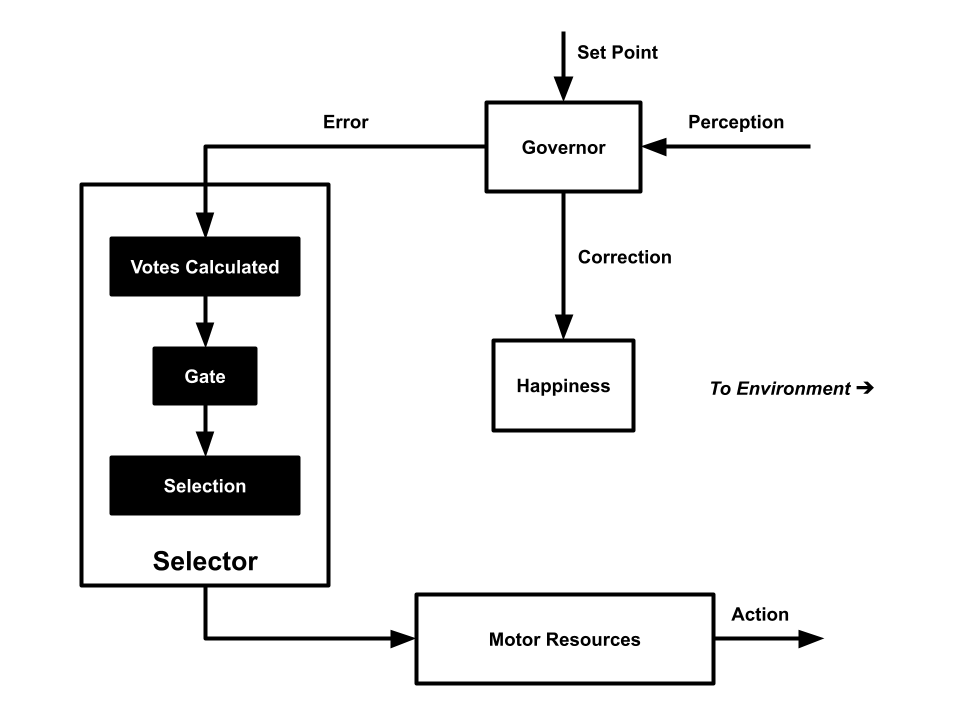
There are lots of governors in your mind, and some governors are stronger than others. Other things being equal, a stronger governor has more influence over your actions than a weaker governor. It gets more votes and has more of a say when it comes time for your governors to decide what to do.
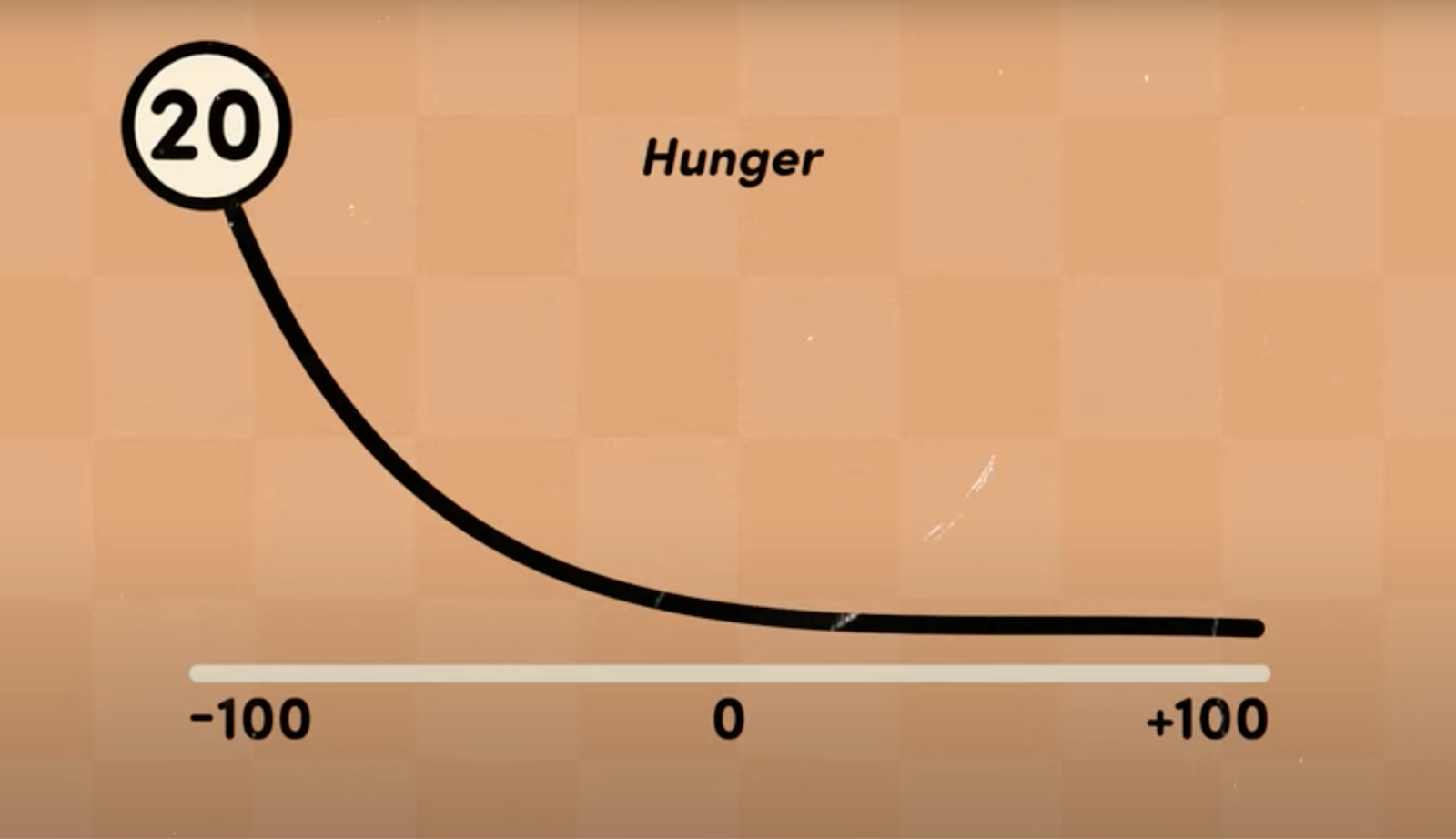
Someone with an unusually strong hunger governor will seek out food sooner and will spend more effort to get it than someone with an especially weak hunger governor.
Someone with an especially strong status governor will be especially sensitive to changes in their status, and will invest lots of time and effort into status games. Someone with an especially weak status governor will appear almost blind to status, and it will hardly ever influence their behavior.
This provides the cybernetic paradigm’s theory of personality. People differ in many ways, but a particularly important way they can differ is in the strength of each of their different governors/emotions. In the cybernetic paradigm, differences between people are differences between parameters like the setpoints, strength, and sensitivity of their different governors.
To say that one person is more extraverted than another is to say either that their setpoint for social interaction is higher, that they defend the setpoint more aggressively, or that they’re more sensitive to disturbances away from that setpoint. To say that someone is brazen is to suggest that their shame governor is weaker than normal. To say that they are humble says something about the governor that pays attention to status.

Let’s break this down a little further.
First: People can have different setpoints for the same governor. We don’t know what units danger is measured in, but if one person has a danger set point of 5 units and another person has a danger set point of 10 units, the first person will keep themselves much safer than the second person. They will avoid situations where they feel that danger is above 5 units, while the other person won’t be sensitive, won’t feel any fear, until the danger is much higher.
That said, we actually don’t think that most personality differences are differences in setpoints, because the setpoints we know about are pretty similar across different people. Most people defend very similar setpoints for body temperature (about 98.6 °F), very similar setpoints for plasma osmolality (about 280 mOsm/L), very similar setpoints for serum potassium (about 4 mmol/L).
But there are certainly some exceptions. People can defend very different body weights, making some people extremely lean and others extremely obese. And set points can change, so they’re sometimes different even within one person. A fever is a short-term change in the body temperature set point(s). Obesity is a long-term change in the body weight set point(s).
Finally, even if people do defend very similar setpoints across the board, there will always be small differences between their setpoints, which will lead to some differences in personality.
Second: People’s governors can be stronger or weaker when it comes time to negotiate with other governors. When two governors disagree, which one wins?
Mark’s anger governor is especially strong, and gets many more votes than the other governors. So when anger goes up against anything else, it almost always wins. Mark has anger-control issues.
Julie’s fatigue governor is especially weak, and gets many fewer votes than the other governors. So when fatigue goes up against anything else, it almost always loses. Julie often stays up until she is very tired, doing all sorts of activities until she practically collapses. She barely seems aware that she’s tired. Even when she lies down, she often has a very hard time falling asleep. If there’s anything else she has in mind, her fatigue is not strong enough to keep her from thinking of it, then getting up and doing it.
You can describe this in terms of each governor having a different weight, with a weight of 1 meaning average strength. If one of your governors has a weight of 1, then that drive is as strong for you as it is for the average person. Weights above 1 mean the governor is stronger than normal; weights below 1 mean it’s weaker.
If you are born with the weight on your fear governor set to 2, your experience of fear is twice as powerful as normal, it has something like twice the influence over your actions. This makes you very cowardly, since your fear becomes overpowering in situations that other people would find mildly concerning. After all, it has twice as many votes as usual!
If you are born with the weight on your fear governor set to 0.5, your experience of fear is half as powerful as normal, it gets half as many votes as it would normally. This makes you very brave. In situations that other people would find terrifying, your fear barely has enough votes to call a motion.
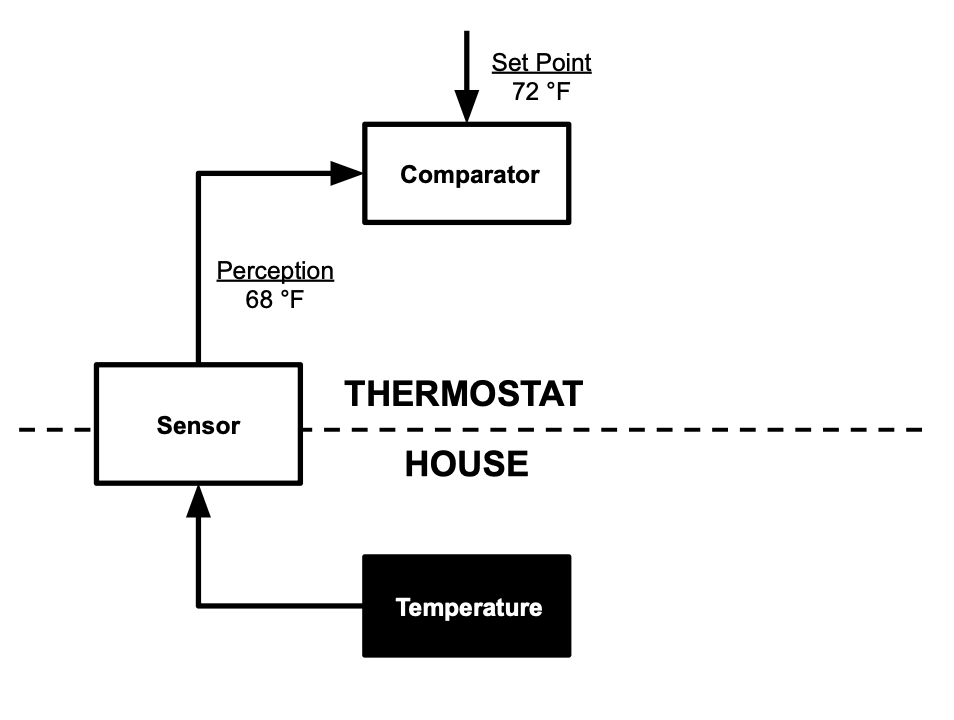
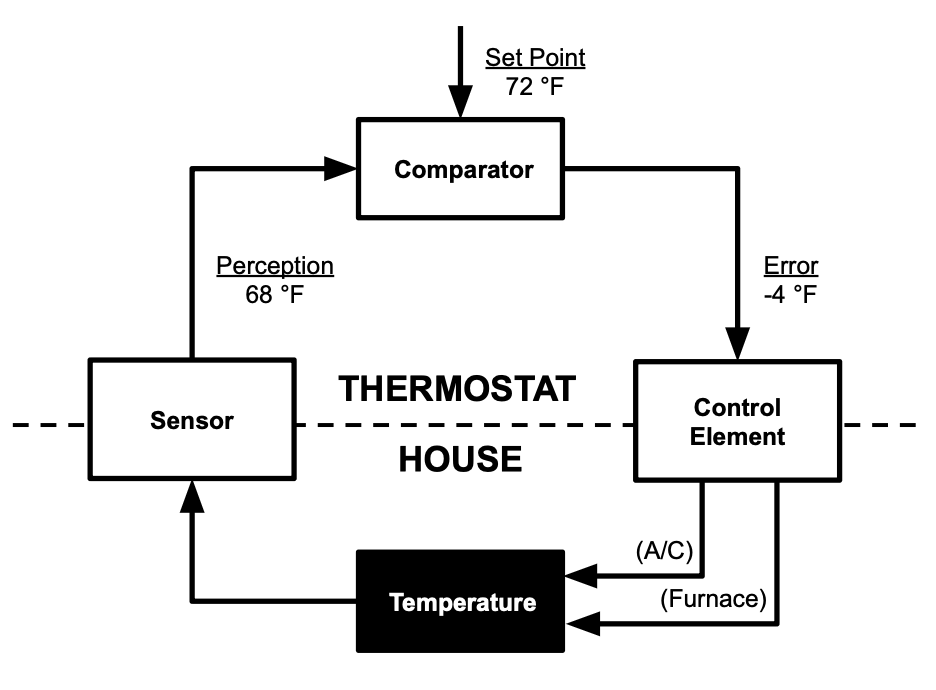
Third: People’s governors can be more or less sensitive to disturbances. By analogy, a thermostat might have a narrow or a wide acceptable range around the target temperature. Strict sensitivity would mean frequent corrections as soon as the temperature drifted even 0.1 °F away from the set point, while a looser control system would allow more drift before it reacts, with control not kicking in until it was 2-3 °F off target.
This is a natural tradeoff. Strict/aggressive control means you spend more energy, reacting even to small changes and adjusting constantly, but it also means you stay very close to the set point. Loose/sluggish control means you spend more time out of alignment but you also save a lot of energy on not making all these neurotic adjustments. Some things really do need to be kept right at the set point, but other things can be allowed to wander a bit.

We think these three kinds of differences are probably important. But just to show that this isn’t an exhaustive list, here are two more ways that people’s governors might be different.
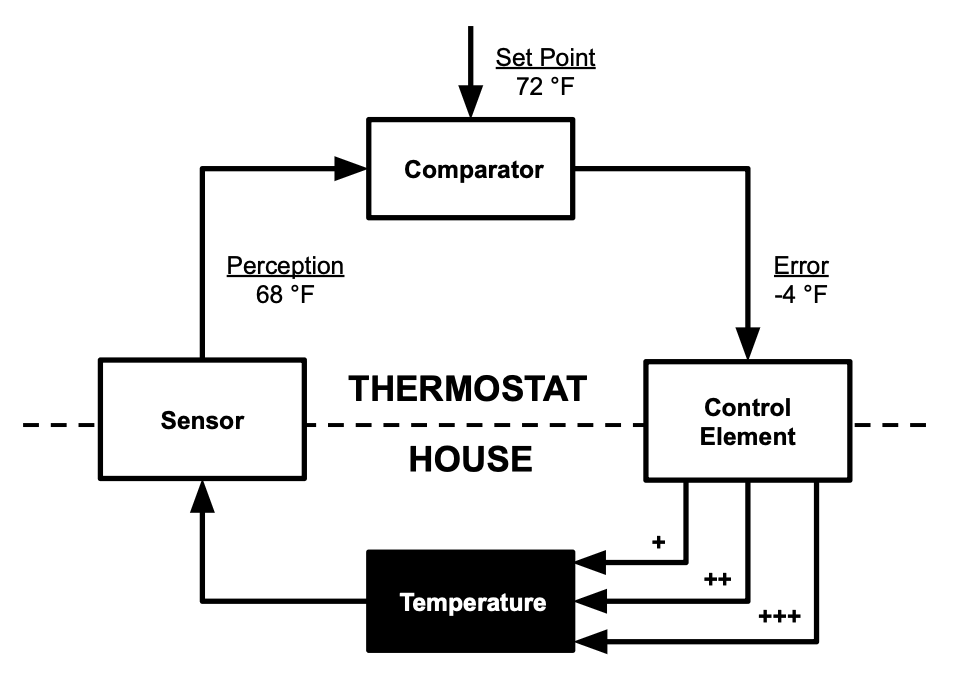
For example, an important parameter in control systems is gain. A sluggish system applies weak corrections (low gain), meaning it takes longer to reach the target. An aggressive system cranks up corrections harder (high gain), leading to faster changes, but possibly overshooting.
So some governors respond to an error with a big correction all at once, while other governors respond to an error of the same size with many small, incremental corrections. This might look like a personality difference of overreacting or underreacting.
This isn’t the same as sensitivity to disturbances. For example, Julie has a cleanliness governor with low sensitivity and high gain. She lets her apartment get pretty dirty (because of the low sensitivity), but once it’s a certain level of mess, she cleans it all at once, back to a high level of cleanliness (high gain).
Mark also has a cleanliness governor with low sensitivity, but his has low gain. He also lets his apartment get pretty dirty (because of the low sensitivity), but once it’s a certain level of mess, he slowly cleans it bit by bit until it doesn’t bother him anymore (low gain).
A related idea is damping. Some thermostats have a built-in “wait time” after making a correction, which helps prevent the temperature from swinging wildly. If our governors have some kind of damping, this might also vary between people.
With a fear governor set to low damping, you would respond very quickly to danger, but might sometimes freak out over nothing. It might even look like an extreme flinch response. With a fear governor set to high damping, you would respond very slowly and deliberately to new threats — good in some situations, but very bad in others!

All these parameters can combine in some interesting ways. Consider two people who have unusual sugar-governors, but unusual in different ways. Alice has a normal sugar setpoint, but her sugar-governor is unusually strong. Bob has a normal weight on his sugar-governor, but an unusually high sugar setpoint.
Alice’s sugar-governor gets more votes than other people’s. Since it tends to have the votes it needs, from the outside this looks like making sweet foods a priority. She always eats her sweets first. But if you kept a close measure of how much sugar she’s eating, you’d see that it’s actually the same amount as the average person, because her set point is the same.
Bob’s sugar-governor gets the normal amount of votes, but aims for a higher setpoint. For a given level of desire, Bob doesn’t prioritize sugar more than other people. But if you keep track over the long term, he does consume more sugar to reach that higher set point.
The upshot is that there are at least as many personality dimensions as there are emotions, and each of these personality dimensions are linked to the “settings” of a particular emotion.
Mere Words
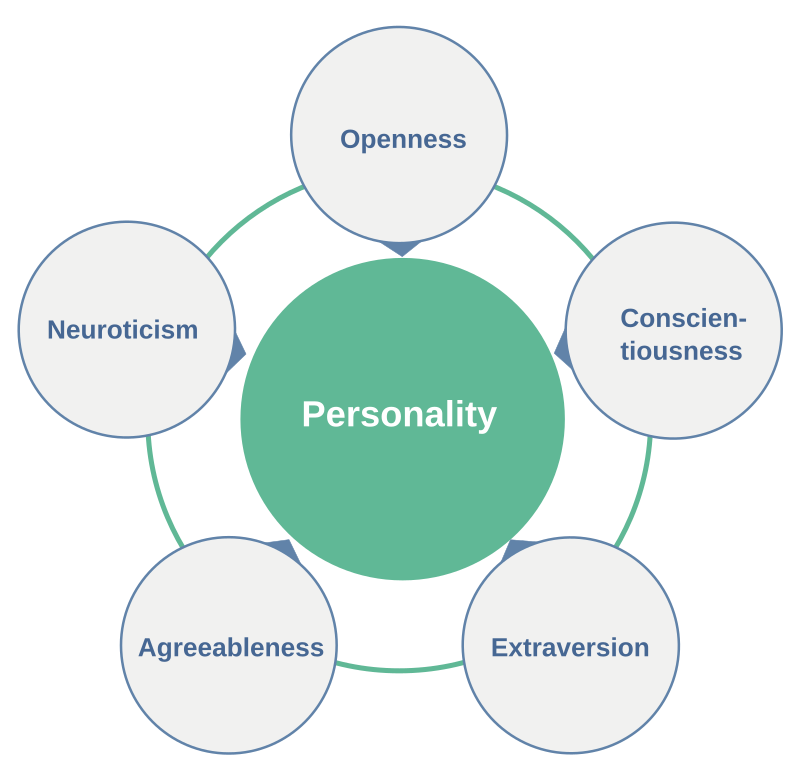
As of this writing, the most widely accepted theory of personality is the “Big Five” personality traits.
This theory comes from statistical analysis. When you have people rate themselves and others on a wide variety of adjectives, and then apply various statistical techniques, you usually end up with five clusters of adjectives. Over time people settled on a set of labels for those clusters: openness, conscientiousness, extraversion, agreeableness, and neuroticism.
It’s not hard to see how these might map on to various emotions. For example, extraversion is probably a rough measure of the strength of various social emotions.
But the Big Five has some problems as a theory. The first one is fundamental — the Big Five are an abstraction, not a model. We all have a casual sense of what it means to be neurotic, we know what kind of superficial behavior to expect from someone described with this word, but the theory doesn’t say anything about the mechanisms that cause someone to behave in a neurotic way. It caps out at being able to record that one measure is correlated with another measure. It can neither explain, nor in any meaningful way can it predict. (For more about these problems, see The Prologue.)
In addition, the method psychologists used to come up with these five factors is limited.
The Big Five were discovered through a method called factor analysis, a statistical approach that searches for clusters of correlated variables and hypothesizes factors that might account for the patterns it finds. Psychologists collected large sets of descriptive adjectives like “friendly” and “bashful” and had people rate how well the adjectives applied to themselves or others. Then they used factor analysis to estimate how these ratings co-occurred. This usually gave a solution of five factors — five clusters of adjectives that tended to be highly correlated within the clusters.
But language doesn’t capture all of the true personality differences, or at least doesn’t capture all of them to the same degree.
There are some terms, like “salt tooth” and “sweet tooth”, which hint at recognition of the fact that in some people the salt-hunger governor is unusually strong, and in other people the sugar-hunger governor is unusually strong. But these terms aren’t as much a part of our language as dimensions like “does this person spend lots of time around other people” or “is this person reliable”, which come out into the factors of “extraversion” and “conscientiousness”.
This is for social-historical reasons — at the moment, our culture cares a lot about communicating whether or not a person is sociable and/or reliable, and cares very little about their preferences for sweet or salty foods. Compare this to how Ancient Greek and Latin both had lots of different words for different kinds of shields. In their culture, the kind of shield you used said a lot about where you fit in society, so they had terms to make these distinctions. But in our culture no one cares what kind of shield you use, so modern English does not.

Different times and cultures will have different priorities, and will want sets of words that help them describe variation in the drives they care about the most. There’s still variation in the drives they don’t care about as much, but since they don’t care about that variation, they won’t talk about it, so they won’t need any words for it.
The fear governor is real, and martial cultures of the past had many ways to talk about differences in how someone responds to fear. How you responded to fear was very relevant in these cultures, it came up a lot. But today we are safe most of the time and these differences rarely matter, so the words we’ve inherited from such times, like brave and cowardly, are too few to pull their own group in a factor analysis. (You could get more by adding archaic terms like dauntless, plucky, valiant, doughty, aweless, and orped, but these probably don’t go in the surveys.)
The Icelandic language, on the other hand, which has changed much less than English over the centuries, still retains several words for these concepts — huglaus, óframur, ragur, blauður, deigur, all these mean something like “fearful” or “cowardly”. And on the opposite side, Icelandic has about a dozen words for “brave”.
But even though English doesn’t give them dozens of adjectives apiece, emotions like cold, tiredness, needing to pee, etc. all have personality dimensions just the same. Some people are driven more by the need to keep warm, and some barely notice the cold. Some people are driven by their bed. For some people, when nature calls, you must answer.
The seven deadly sins are a bit judgy as a personality measure, but they had it a little better. Gluttony and sloth are clearly ways to talk about individual differences in things like hunger and tiredness. And lust is, if anything, one of the most notable personality dimensions. How could you possibly explain Aella’s personality without mentioning that she is much, much hornier than average? On the opposite side, having a weight on this governor near zero would lead to asexuality, so being asexual should also be understood as part of personality.
Individual Differences
There are also some differences that are not linked to the emotions and drives, that don’t reflect the settings on different governors.
For example, people can also be different in the parameters of motivation we described in Part II; like the gate threshold, i.e. the minimum number of votes to make an action happen. If you have a higher gate threshold, you are more likely to just sit there and less likely to do anything, every action needs a larger number of votes just to activate. If you have a lower gate threshold, you are constantly jumping around, every time an action gets any votes, you do it. Similarly, to say that someone is decisive is to imply something about the parameters of their selector, not their governors.
One underrated individual difference is being a night owl versus being a morning lark (sometimes called your chronotype). The dimension is related to sleep, but doesn’t seem like a parameter of the drive for sleep (probably?). Instead it’s a tendency or preference for when sleep will occur.
Some people are certainly more curious than others. But curiosity may not be an emotion, because it doesn’t seem to be satisfying a drive to send a signal to some specific target.
Another difference is taste preference. Certainly some tastes, like those for salt or fat, are nutritive, necessary for survival, and therefore probably controlled by a governor. But some taste preferences may not come from the drives, they may just be variation. Chunky and creamy peanut butter have almost exactly the same nutritional profile, but some people prefer one to the other. The same goes for preferences for smells — there is probably not a lavender-smell governor, but some people still like the smell of lavender more than others.
If these preferences really are preferences, and aren’t attached to drives, we’ll be able to tell because they will not be exhausted like drives are. Even someone who likes salt very much will eventually eat enough salty food and will stop eating it for a while. Their salt drive will send its error signal to zero and then be satisfied. But someone who likes the smell of lavender shouldn’t get satisfied by it in the same way, their preference should be mostly constant.
The reason for these differences is the same as for any kind of differences: diversity. It’s not just random chance; it is by design, because: bees.
How do the bees decide how many of them should be fanning? … There’s no communication, but as the ventilation gets worse in the hive, more and more bees start fanning their wings. How would you design bees to solve this problem? You don’t want every bee fanning their wings 24/7 or they’re wasting time, but a nice ratio of ‘bees fanning’ to ‘bees not fanning’ that adapts in order to hit your ventilation criteria.
When Huber examined the fanning problem, he came up with an elegant theory. He suggested that bees are differentially sensitive to noxious smells. So as the noxious smells get worse, the sensitivity threshold of more and more bees is reached, and more of them begin fanning until ultimately the entire hive is fanning.
If everyone in your village has the same set point for danger, then as danger increases, for a long time no one takes any precautions, and then at some point everyone flips over and starts fortifying the town all at once. This is kind of a nuts way to do things.
It’s better to have some diversity. If there’s only a little danger, a small number of villagers are stockpiling food and reinforcing the town walls. As the danger increases, more and more villagers attend to the safety of the town. This is actually its own form of control system.
The same thing goes for preferences. If everyone in your band of hunter-gatherers falls asleep exactly at dusk and rises at dawn, then you are all defenseless at the same time. But if some of you are morning larks and some of you are night owls, then someone is always awake to tend the fire and watch for saber-toothed tigers.
Now apply the same reasoning to taste and smell. If everyone in your town has identical tastes, then they will all eat pretty much the same food; if that food becomes rotten, everyone gets sick at once. Better to have variation in food preferences so you’re eating different things. Then if some food goes bad, only some of you get sick. Avoid a single point of failure.
To sum up, differences in the strength of different governors are a major part of personality, though not the only part. There are also various other individual differences, including simple preferences.
Sex Differences
Academic psychologists claim they can’t find any clear mental differences between the sexes (mostly; for the nuanced version of things, see here). But here’s one: the huge and obvious differences in the desire to play certain kinds of video games.
About half of gamers are women. But a few genres are overwhelmingly played by men. In particular, men are much more interested in tactical shooters like ARMA 3, and in grand strategy paint-the-map games like Europa Universalis. These games are about violent competition and domination, so this pattern may point to the existence of something like a “need to dominate” emotion.
Looking closer, the experience of shooters and strategy games are quite different, suggesting that there might actually be two separate dominance-related emotions that tend to be much stronger in men than in women. Let’s consider these drives one at a time.
The experience of a tactical shooter is shooting people in the head; it’s about as close as you can get these days to crushing your enemies, seeing them driven before you, and hearing the lamentations of their women. You may be wondering whether people really have a drive for such a thing, especially if you don’t play tactical shooters. But there’s good evidence that many people do. As one example, the subreddit r/CombatFootage (TAKE CARE IN CLICKING, CONTAINS DISTURBING COMBAT FOOTAGE) has 1.7 million members. Top videos on the subreddit get thousands of likes and hundreds of comments. For comparison, r/vegan also has 1.7 million members. Some people really want to see this stuff.
In contrast, grand strategy games are abstract and bloodless, lovingly referred to as spreadsheet simulators. These don’t seem like they could be about personal, physical domination, since they don’t even simulate that. But they’re not pacifistic — they do a very good job simulating the experience of forcing other societies to make concessions, become your vassals, and so on.
Between the two genres, there’s plausibly one dominance emotion about personally thrashing your enemies, and another dominance emotion about being in charge of organizing the logistics of thrashing — something like social domination, or having your group dominate other groups.

We see something similar in the list of words known better by males than by females, and vice versa. Men are much more likely to know words like howitzer, katana, and bushido (not just military terms, but historical military terms) while women are much more likely to know words like peplum, chignon, and damask (fabric and hairdressing terms). The authors of this paper characterize the result as, “gender differences in interests (games, weapons, and technical matters for males; food, clothing, and flowers for females)”.
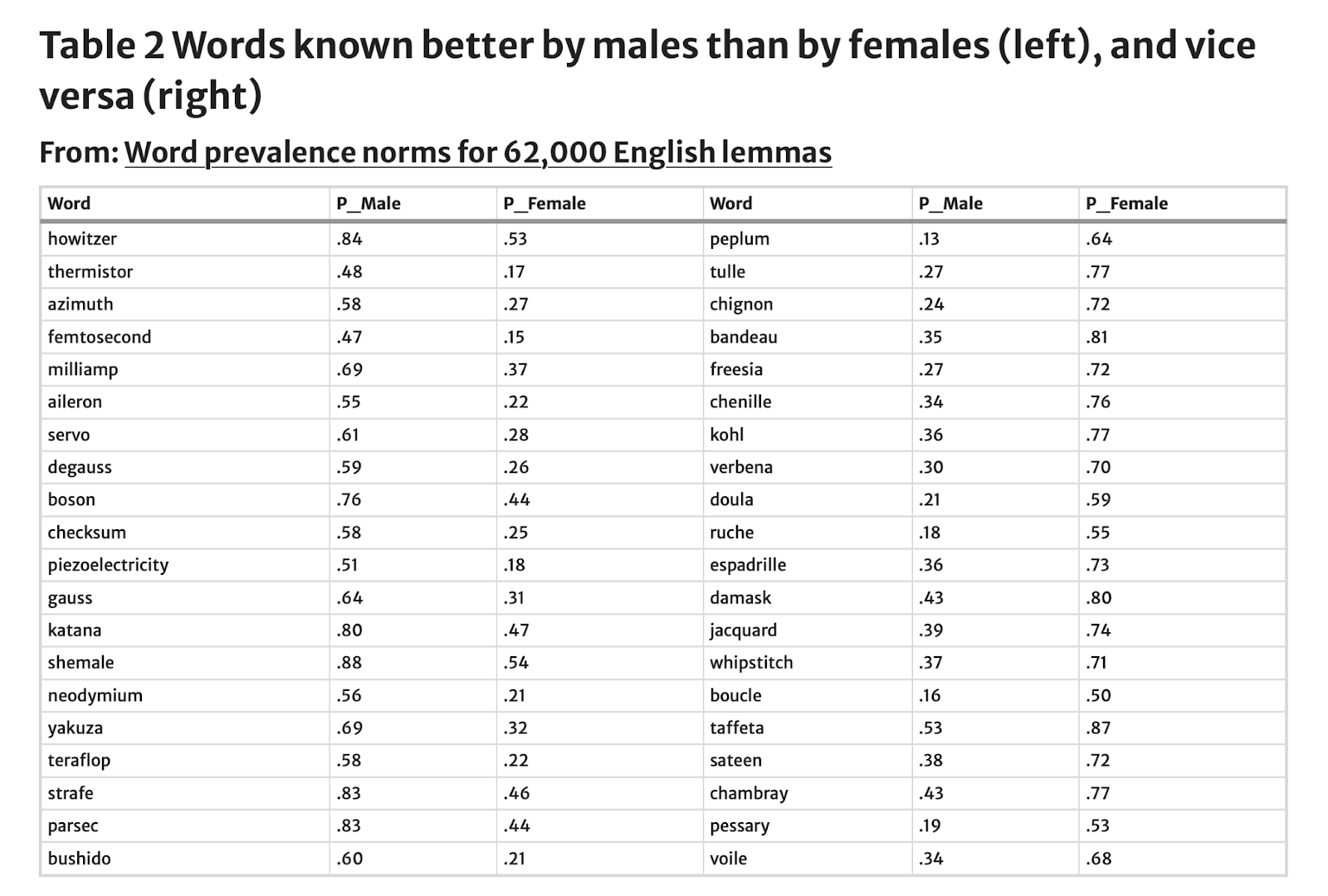
The list suggests that on average men tend to have stronger dominance emotions and women tend to have stronger decorative emotions, or perhaps hygienic emotions (in the sense that being properly dressed is hygiene).
We are of course talking about average differences. There are plenty of women with strong dominance emotions, and plenty of men with strong decorative emotions. (And women may in fact have higher tuning on a different set of dominance emotions.) But on average there seems to be some difference.
We don’t care about the cause — differences could be the result of socialization, of nature, or both. Or something else. But there do seem to be average personality differences between the sexes, which make perfect sense when you think of personality as differences in the strength of different governors.
It’s also worth considering if sex differences we think of as physiological might actually be psychological. Women typically feel colder than men — this might be biological, something to do with their body size or metabolic rate. But it could also be psychological, something to do with the set point or strength of their cold governor.
Psychiatry
Like most biological attributes, the strength of our governors probably falls on a normal distribution. The majority of people will have a fairly usual weight on each governor. But in rare cases, weights will be set incredibly high or incredibly low.
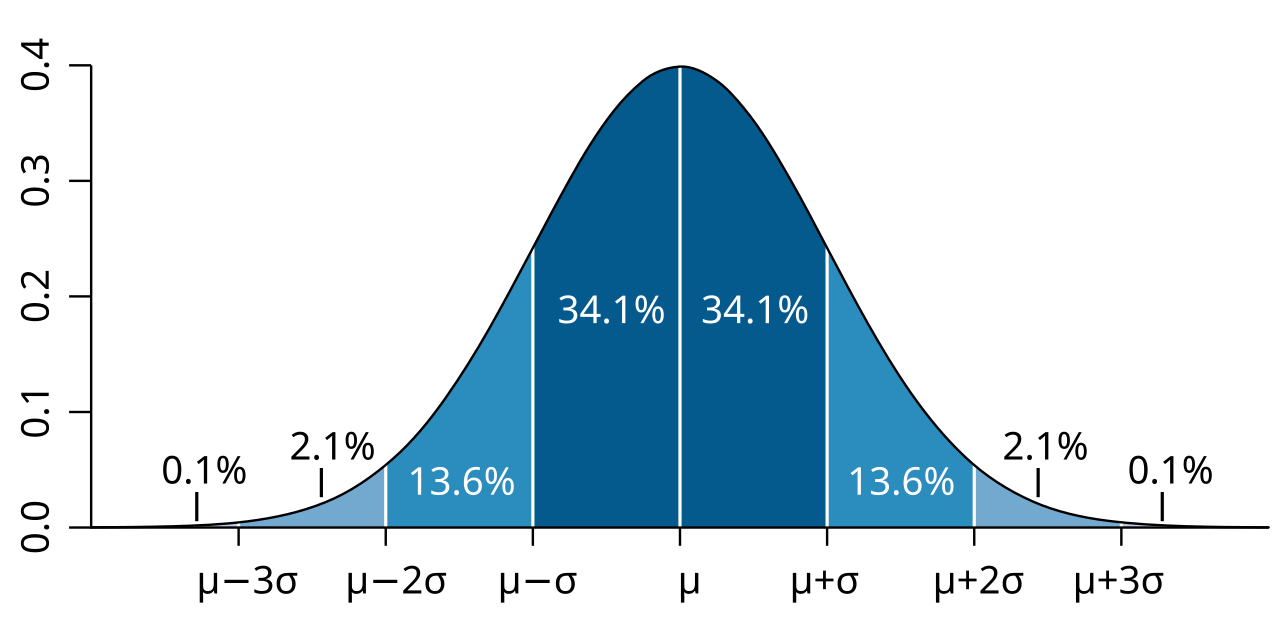
Since we have no idea what the units are for “strength of a governor”, as before we will just say that 1 is the population average. Having a weight of 0.5 on a drive means it is half the strength of the population average, and having a weight of 2 on a drive means it is twice the strength of the population average.
If you set the weight on a governor to 0, we call this a “knockout”. It’s functionally equivalent to not having that drive at all, because when the weight on a governor is 0, the governor gets no votes.
For example, take Alex Honnold, sometimes called “the World’s Greatest Solo Climber”. Alex enjoys climbing sheer cliffs without a rope, an experience so terrifying that many people can’t even stand to watch the videos. When neuroscientists put Honnold through an fMRI and showed him terrifying and gruesome pictures, they found that his brain is intact — he does have an amygdala — but he has almost no fear response.
Whatever the exact biological issue might be — whether he was born that way, or if he’s somehow turned down the fear governor through training and exposure — Honnold appears to be someone with a fear knockout. The weight on his fear governor is set very close to zero.
In cybernetic psychology, a lot of psychiatric conditions look, in a literal sense, like personality disorders. Personality is largely made up of differences in the weights on a person’s various governors. Personality disorders occur when some of those weights are not merely different, but set extremely low or extremely high.
Consider fear. Most people are somewhat concerned about things some of the time. They have a weight on their fear governor around 1. If you set the weight on “fear” to 10, they will instead be very concerned about things lots of the time. That looks a lot like paranoia.
This is a good spot to point out that a cybernetic system has multiple parts and can be broken in many ways. Let’s take the fear governor as an example.
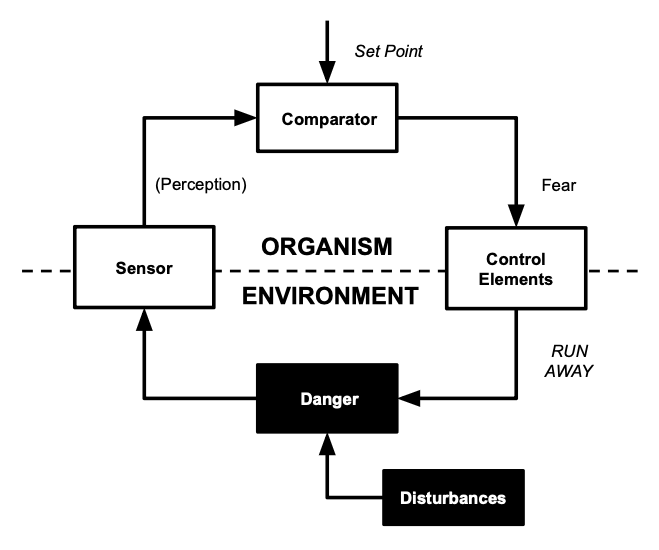
You can break the input function, so it perceives danger as being higher than it otherwise would. This will cause paranoia. You can change the fear governor’s set point to a very low level of danger, so it reacts to even very small amounts of danger. This will cause paranoia. You can damage the output function, so that it thinks that large interventions are appropriate for small amounts of danger. This will cause paranoia. Or you can change how many votes the fear governor gets in the parliament of the mind. Again, this will cause paranoia.
These changes may present slightly differently, but notice how even though these are four different problems with the fear governor, you end up seeing basically the same behavior in every case. Among other things, this makes diagnosis and treatment quite tricky. You have at least four disorders, with categorically different causes, yet nearly identical presentation.
This also offers a plausible model for conditions like autism and psychopathy. Both appear to be congenital abnormalities in various emotions — conditions that happen when you are born with a couple of your emotions unusually strong or weak.
“Autism” seems to be a label that we apply to people who have very low weights, or complete knockouts, on some of their social emotions.
“Psychopathy” seems to be a label that we apply to people who have very low weights or knockouts on a different set of social emotions, especially when combined with high weights on emotions like anger or need for dominance.
As you can tell from our hedging, we suspect these categories are poorly-formed. There probably isn’t “a disorder” that can be identified with autism. It’s just a word, an abstraction that we use to refer to various personality types that are similar in the sense that they have low weights on certain social emotions. (See the Prologue for more on this.)
Autism and psychopathy are often framed as deficiencies, but you can also see them as deficiencies in some things combined with superabundances in other things.
We tend to call people “psychopaths” not when they merely lack in fear or compassion, but when a lack of fear or compassion are combined with unusually strong drives for status and dominance.
People tend to be considered autistic not when they merely lack a drive for status, but when this is combined with unusually strong interest in social rules and an unusually strong drive for compassion. People get confused about this. You often hear things like, “people who are autistic don’t understand social conventions”. But actual people who are autistic seem to believe things like, “if you eat a non-prime number of chicken nuggets you’re breaking the rules”.
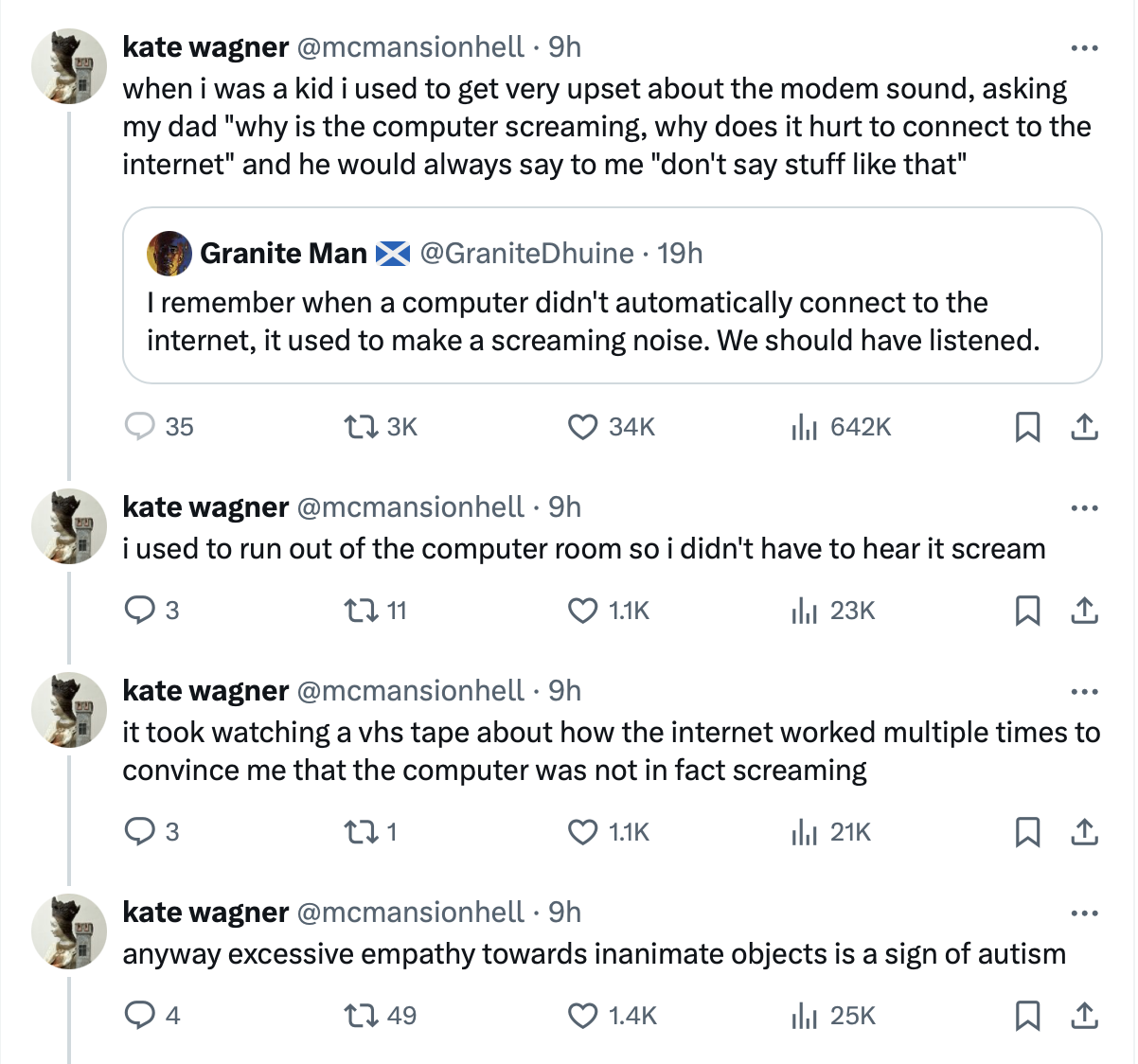
It’s not clear if these are specific “disorders”, or just the extremes of normal personality variation. Some people have stronger social emotions than others. When the weights on your social emotions are 0.7, nobody cares, you just seem kind of introverted. But when some of your weights are 0.5 or lower, maybe they start calling you autistic.
Same thing for psychopathy. The lower your social weights are, and the higher your aggression and dominance weights, the more likely people are to call you a psychopath. But there’s not a bright line. It’s more like height than blood type. Type O and type AB blood are categorically different, but there’s no objective point at which you become “tall” or “short”, those are relative.
Recap
- People differ in many ways, but a particularly important way they can differ is in the strength of each of their different governors/emotions. In the cybernetic paradigm, personality is the result of differences between parameters like the setpoints, strength, and sensitivity of different governors.
- People can have different setpoints for the same governor.
- People’s governors can be stronger or weaker when it comes time to negotiate with other governors. When two governors disagree, which one wins?
- People’s governors can be more or less sensitive to disturbances.
- People’s governors can have different amounts of gain, applying weak corrections or strong corrections.
- People’s governors can have different amounts of damping.
- The Big Five are an abstraction, not a model.
- The Big Five were discovered through a method called factor analysis, a statistical approach that searches for clusters of correlated variables and hypothesizes factors that might account for the patterns it finds.
- Psychologists collected large sets of descriptive adjectives like “friendly” and “bashful” and had people rate how well the adjectives applied to themselves or others. Then they used factor analysis to estimate how these ratings co-occurred. This usually gave a solution of five factors.
- But language doesn’t capture all personality differences, or at least doesn’t capture all of them to the same degree.
- There are also some individual differences that are not linked to the emotions and drives, like your chronotype or your taste preferences.
- The reason to have personality differences is the same as for any kind of differences: diversity.
- It’s better to have diversity. If there’s only a little danger, a small number of villagers are stockpiling food and reinforcing the town walls. As the danger increases, more and more villagers attend to the safety of the town.
- Remember: bees!
- There appear to be large sex differences in the strength of some of the governors.
- Many psychiatric conditions are probably personality disorders, the result of the weights on a person’s various governors being set extremely low or extremely high.
[Next: LEARNING]


 SLIME MOLD TIME MOLD