
[PROLOGUE – EVERYBODY WANTS A ROCK]
[PART I – THERMOSTAT]
Inland Empire: What if *you* only appear as a large singular body, but are actually a congregation of tiny organisms working in unison?
Physical Instrument: Get out of here, dreamer! Don’t you think we’d know about it?
— Disco Elysium
When you’re hungry, you eat a sandwich. When you feel kind of gross, you take a shower. When you’re lonely, you hang out with friends.
But what about when you want to do all these things and more? Well, you have to pick. You have many different drives, but only one body. If you try to eat a hamburger, kiss a pretty girl, and sing a comic opera at the same time, there will be a traffic jam in the mouth. You will suffocate, or at least you will greatly embarrass yourself. Only a true libertine can eat a sandwich in the shower while hanging out with friends.
To handle this, you need some kind of system for motivation.
For starters, consider this passage from Stephan Guyenet’s The Hungry Brain:
How does the lamprey decide what to do? Within the lamprey basal ganglia lies a key structure called the striatum, which is the portion of the basal ganglia that receives most of the incoming signals from other parts of the brain. The striatum receives “bids” from other brain regions, each of which represents a specific action. A little piece of the lamprey’s brain is whispering “mate” to the striatum, while another piece is shouting “flee the predator” and so on. It would be a very bad idea for these movements to occur simultaneously – because a lamprey can’t do all of them at the same time – so to prevent simultaneous activation of many different movements, all these regions are held in check by powerful inhibitory connections from the basal ganglia. This means that the basal ganglia keep all behaviors in “off” mode by default. Only once a specific action’s bid has been selected do the basal ganglia turn off this inhibitory control, allowing the behavior to occur. You can think of the basal ganglia as a bouncer that chooses which behavior gets access to the muscles and turns away the rest. This fulfills the first key property of a selector: it must be able to pick one option and allow it access to the muscles.
The human mind, and the minds of most vertebrates, operates in essentially the same way.
Motivation and action are determined by the collective deliberation of multiple governors. Each governor is one of the control systems described in Part I — some governors for thirst, some for pain, some for fear, and so on. They come together and submit bids for different actions and vote on which action to take next.
Inside Out, Disco Elysium, Internal Family Systems, The Sims, etc. — we have a deep intuition that behavior is the result of a negotiation between inner forces that want different things. This keeps manifesting in pop culture, but academic psychology has mostly missed it.
The technical term for this problem is selection, so we’ll refer to this system as the selector. In a physical sense this process probably happens in the basal ganglia, but we’ll let someone else worry about the neuroscience. For now we just want to talk about the psychology.
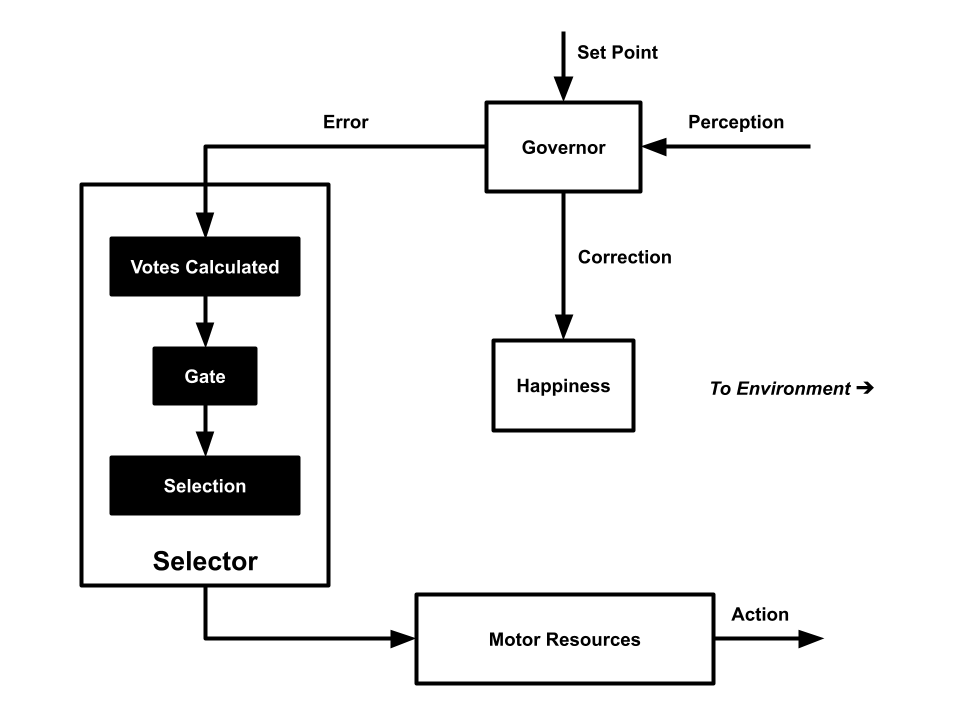
We can’t say exactly how the selector works, there are too many mysteries, lots more work to be done, a lot of possible lines of research. But here’s some speculation about how we think it might work, which will sketch out some of the open questions.
Governors cast votes based on the strength of their error signal. The stronger the error, the more votes it gets. When you’re not at all thirsty, the thirst governor gets basically no votes, because it doesn’t need them. Other priorities are more important. But if you are very thirsty, the thirst governor gets lots of votes (or if you prefer, one very strong vote). If you are starving, your hunger governor gets plenty of votes so it can drive you to eat and become less hungry.
Governors vote for behaviors that they expect will decrease their errors. The thirst governor votes for actions like “find water” and “drink water”. Later, the have-to-pee governor votes for actions like, “find a bathroom”. The pain governor votes for things like “stop picking a fight with the lions, get the hell out of the lion enclosure.”
Governors can also vote against behaviors that would increase their errors. It’s clear that the pain governor can vote against touching a hot stove, even if pain is currently at zero. You don’t have to wait until you burn your hand for your pain governor to realize this will be a bad idea.
This is because governors are predictive. If something is hurting you, the pain governor will vote for you to stop doing that, to avoid the thing that is causing you pain, to withdraw. But you don’t have to be in pain for the pain governor to influence your actions. As behaviors come up for a vote, the pain governor looks at each of them and tries to predict if they will increase its error, that is, if they will cause you pain. If it thinks some behavior will increase its error, the pain governor votes against that behavior.
So we see that governors don’t only get votes based on their current error signals — they also have the power to vote against behaviors they anticipate will increase their error. Maybe governors cast votes not based on the current strength of their error signal, but based on the predicted change in their error if the action were to be carried out. In this way when hunger is high, the hunger governor gets votes for “eat ham sandwich” because this is predicted to correct the error. And even when pain is zero, the pain governor still gets votes against “touch the electric fence” because touching the fence is predicted to increase its error. This would also fit most observed behavior.
Wherever votes come from, the governors need to allocate their votes, so there’s some procedure for this as well. One simple way to do things is for governors to propose behaviors and submit bids on those behaviors to the selector, and the strongest bid wins. If this is how it works, then each governor is supporting only one behavior at a given time.
This seems unlikely. We think it’s more likely that governors support many possible behaviors at once — just like how legislators in a real congress support many possible policies at once.
Actions that happen all the time are so common because they are popular with lots of governors. For example, the “eat a hamburger” action captures the votes of basically the whole hunger voting bloc — salt-hunger, fat-hunger, calorie-hunger, et cetera. Many different hungers will vote for this hamburger. No one dares to vote against the hamburger policy, except maybe the shame governor, if you’ve been taught that hamburgers are sinful or something.
It’s also not clear whether votes are conserved. If the hunger governor has 100 votes and you give it 50 options, can it only give each option 2 votes? Is this why no one can agree what they want for dinner? Or can it put all 100 votes towards every option that it likes?
Functions
Some governors may get more votes than others. You can imagine why the governor in charge of keeping you breathing might get extra votes — it has a very important job and it can’t wait to build a coalition. The same thing goes for governors like fear and pain. When you’re in serious danger, they always have the votes they need.
Our assumption so far is that the relationship between error signal and votes is linear. But certain governors, controlling things that are critical to your survival, may get more votes for the same amount of error signal — there may be different curves. This is how The Sims did it. If this is the case, it should be possible to discover the formula for votes as a function of error for each governor.
On the other hand, maybe the more critical governors just have stronger error signals than less-important governors. In any case, we should notice that things like suffocation and pain tend to get the votes they need, however that works out under the hood.
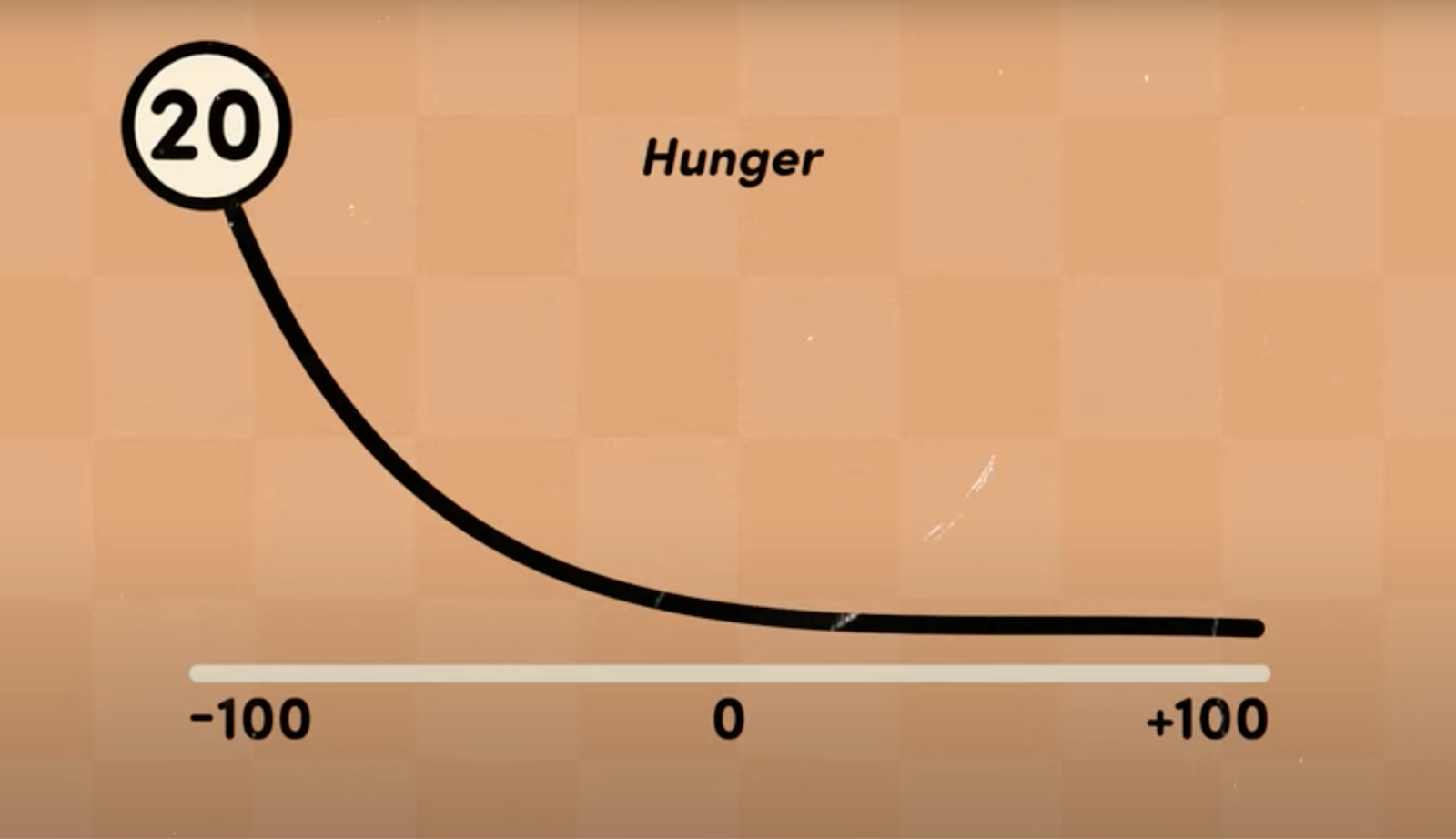
However votes are determined, the outcome is simple. Whatever action gets the most votes is the action you take next, assuming the action wins by a large enough margin.
This is not exactly a winner-take-all system. You can sometimes do more than one thing at once, the selector does try to account for multitasking — you can chew and drive at the same time, since your mouth and hands are not deadlocked. But you cannot e.g. both pee and stay in your clean, dry bed. Someone is going to have to win that vote.
Threshold
An organism that can’t sit still and keeps doing stuff, even when it doesn’t need to, is wasting resources for no reason and putting itself in danger. Sometimes organisms do nothing at all, so our model of the selector needs to account for that.
We think it does that through a mechanism that recognizes votes below a certain threshold and reduces them to zero. In audio engineering, this is called a gate. An audio gate stops sounds below a certain volume from passing through, which is good for cutting out background noise and static. For more information, watch this Vox explainer or listen to some Phil Collins.

In the mental selector, the gate stops votes that are below some minimum threshold. If you are a tiny bit hungry, you shouldn’t bother leaving the house to get a meal, even if there is nothing better to do. Don’t go out and see people if you are only a tiny bit lonely.
An organism without a gate, or with a broken gate, will eat as soon as it is a tiny bit hungry, leave the house as soon as it is even a tiny bit lonely. It will constantly put on and take off its sweater to try to maintain a precise target temperature. But this is clearly not a good use of time or energy. Better to wait until you’re actually some minimum amount of hungry or lonely, before taking steps to correct things.
The gate may act on governors directly, preventing governors with very small error signals from voting at all. When you’re not in any danger, who cares what the fear governor thinks?
Or it could be that the gate acts on behaviors, and behaviors that get below some fixed number of votes are treated like they got zero votes instead. If no action gets a number of votes above the threshold, then no behavior occurs.
Also, it seems like an action only happens as long as it beats the next-highest action by a certain number of votes. It’s not clear whether it needs to win by a certain number of votes (“action with the most votes happens as long as it has more than 20 more votes than the action with the second-most votes”) or by some kind of fraction (“action with the most votes happens as long as the action with the second-most votes has no more than 90% its count”), or if this is even a meaningful question given how our motivation system is designed. The important thing is that if “drink coffee” gets 151 votes and “run to catch the bus” gets 152 votes, you will stand there looking like an idiot and miss your bus. (cf. Buridan’s ass)
We designed this model of motivation without concerning ourselves at all with neuroscience, so one reason for optimism is that it is largely convergent with a model of the function of the basal ganglia developed in 1999, also inspired by cybernetics. This was “The Basal Ganglia: A Vertebrate Solution to the Selection Problem?” by Redgrave, Prescott, and Gurney.
Dark Horse Drives
So far we’ve been assuming that governors are the only things that drive behavior, the only things that ever get votes in the selector. But there may be exceptions.
Curiosity is an unusual case, kind of an enigma. It might be an emotion, but it’s a bit strange. It might be something else, some other kind of signal.
Like an emotion, curiosity seems to be able to drive behavior. We’ve all done things simply because we were curious. This suggests it might, like the other emotions, be the error signal of some kind of governor. And it seems to be able to compete with the other governors, because curiosity often wins out over concerns like sleep or even sex.
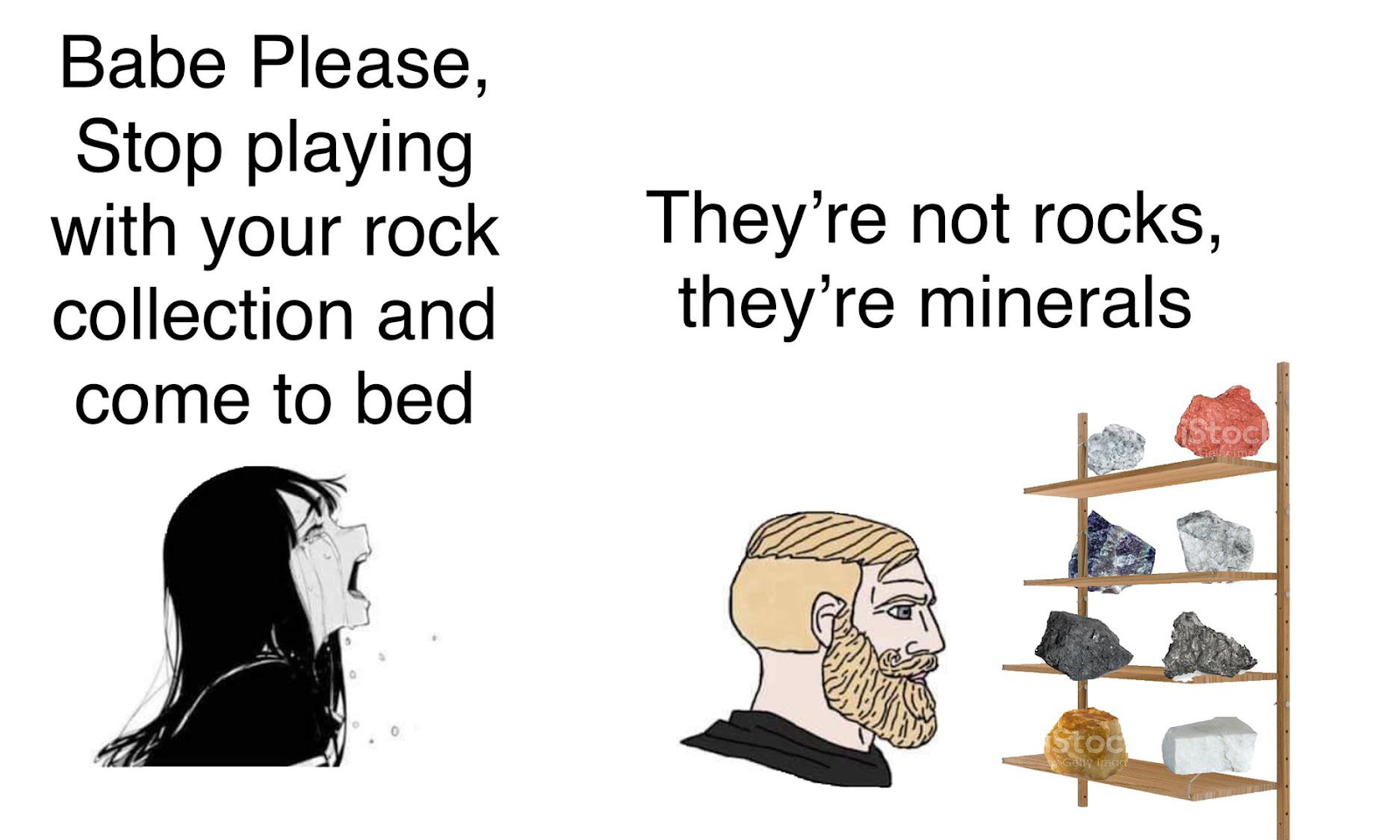
But in other ways, curiosity does not look like the other emotions. Unlike hunger or fear, it’s not obviously an error signal from a drive that keeps us alive. It’s not obviously connected to immediate survival in the way the other emotions are. A person who doesn’t sleep or breathe dies. A person who doesn’t feel shame is ostracized, and (in nature) soon dies. But a person who doesn’t act on their curiosity is just frustrated.
And unlike the other emotions, curiosity doesn’t seem to be easily satisfied. Acting on your fear should make you less afraid, acting on your thirst should make you less thirsty, but acting on your curiosity often seems to make you more curious.
We do have one suggestion of how curiosity might work. Let’s return to the idea that emotions are predictive. The fear governor not only knows that escaping the basement will reduce its error, it can also predict beforehand that entering the basement will increase its error. In general, governors have a model of the world which they use to predict how different behaviors will influence their errors.
Unlike the governors, which vote for behaviors that they predict will correct their errors, curiosity is a special drive that votes for behaviors the emotions have a hard time predicting. Actions can be ranked by how certain the governors are about their consequences. Curiosity, the most perverse, votes for actions that the other governors rate as having the greatest uncertainty.
This helps us learn about actions that the governors might otherwise ignore. It’s another way to encourage exploration. If you only act in response to emotions, then you lose the opportunity to learn about things that might be really important later. It’s a better long-term strategy to use your extra energy to try things that are probably safe, but where you aren’t sure what will happen. (See this paper for more on this kind of model.)
You know who loves doing this? Toddlers. Toddlers love doing this. It may not be that children are more curious than adults, but simply that adults have learned more about the consequences of their actions and have fewer of these very uncertain behaviors to explore.
Self-Control
One of the mysteries of motivation is that sometimes, you want to do something and it’s super easy to do. Why is it sometimes easy to do things?
The answer is simple. When a behavior gets votes from a governor, it’s easy to do. Outside of clinical depression, you don’t have to drag yourself to a delicious meal, or to hear the new hot gossip. Popular emotions are throwing all their votes behind these actions, they are going to become policy.
Behaviors that don’t have a governor behind them are hard to do. Evolution didn’t include a governor for “write your term paper”, so this project tends to go pretty slowly, especially if it’s in competition with behaviors that do have governors voting for them, like “hang out with your friends”. Sometimes the term paper never happens.
The same thing goes for the big-picture aspirations people so often struggle with. Intellectually you might want to become a famous author, or learn Japanese, or memorize pi to 100 digits. But the sad truth is that no governor is willing to support these ideas. You just don’t have the votes.
Things that can’t get votes from a governor only get votes from your executive function. Executive function must not have many votes to spend, because these actions tend to be very difficult.
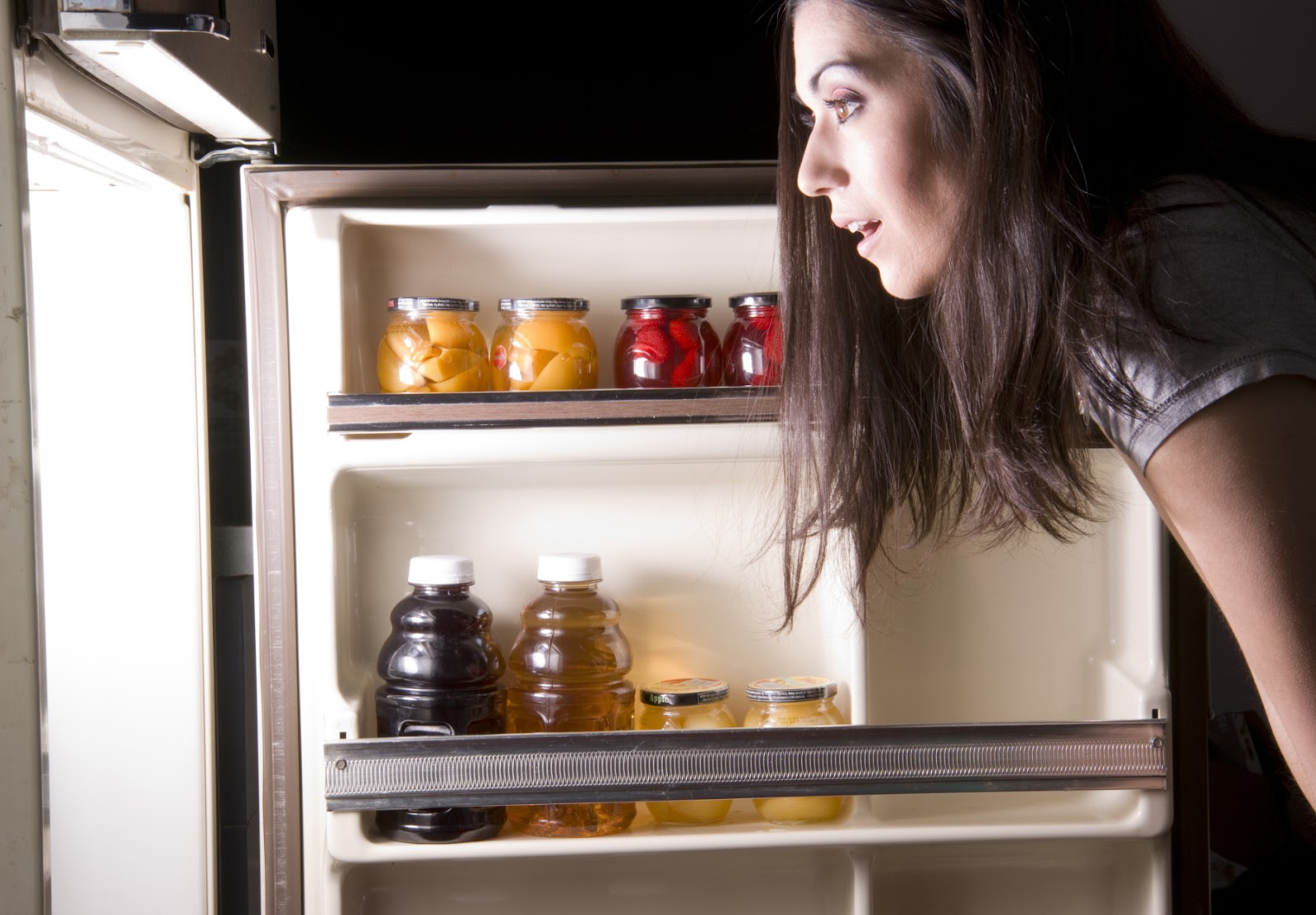
Even if you can temporarily scrape together the votes for one of these actions, you have to hold your coalition together. This usually fails. You will inevitably get distracted once any of the other governors gets a large enough error signal to vote for something else, like getting a snack. This is why you are always looking in the fridge instead of studying.
One workaround is to convince a governor to vote for these actions. If you get a lot of praise and status at school for doing well on your math test, social governors that are concerned with status will be willing to vote for math-related activities in the future, because they realize that it’s good for their bottom line. Or if there’s a pretty girl in your Japanese class, you may find that it becomes easier for you to work on your presentation, in an effort to impress her. No points for guessing which governor is voting for this!
This is probably why people seem to find over and over again that money is not very motivating.
Money is motivating when it can directly address your needs. If you are starving, the connection between $5 and a block of cheese is pretty clear. As a result, the hunger governor will vote for things that get you $5.
But in a modern economy, most people’s remaining needs cannot be easily met by more money. They already have enough money to get all the food, warmth, sleep, and so on that they need. The only drives they have problems satisfying are the drives where, for one reason, there isn’t or can’t be a normal market.
Social factors like friendship or a feeling of importance are often left unsatisfied, but these are hard to trade directly for money. You can’t buy these things for any amount, or at least, there are no effective markets in these “goods”. So money is no longer very motivating for people who need these things. Their active governors, the ones with big errors, the ones that get the votes, understand that more money won’t solve their problems, so they don’t vote for actions that would get you more money.
As we hinted at above, we might assume that there is also an executive function that gets some votes. Executive function is why you can make yourself do dumb things that are in no way related to your survival, why you can plan for the very-long-term, and also why you have self-control in the face of things like cold and pain.
Eventually we may discover that what appears to be “self-control” is actually just the combined action of social emotions like shame. It may be that there is no such thing as an executive function, and what feels like self-control is really the result of different social emotions, the drives to do things like maintain our status or avoid shame, voting for things that are in their interest. But for now let’s keep the assumption that there is someone driving this thing.
Even so, executive function doesn’t have very many votes, which is why most people cannot starve themselves to death or hold their breath until they suffocate. At some point, the suffocation governor ends up with so many votes that it can make you do whatever it wants, and it always votes for the same thing: breathe.
Happiness
Here’s another thing people find surprising: why don’t we maximize happiness?
People often complain about not being as happy as they would like. But their revealed preferences are clear: they don’t always do things that make them happy, even when they know what those things are, even when it’s easy. People often choose to do things that are painful, difficult, even pointless.
This is because there is no governor voting for happiness. Happiness is more like a side-effect, something that happens whenever you successfully correct any governor’s error signal. People who live challenging lives end up happy, assuming they are able to meet those challenges, but there is no force inside you that is voting for you to go and become more happy per se.
Remember that happiness isn’t an emotion. All emotions are error signals generated by a governor dedicated to controlling some signal related to survival. Governors have a simple relationship with the error signals they generate: they vote for behaviors that will drive their error signal towards zero. So if happiness were some kind of emotion, the governor that generated it would vote, whenever possible, to drive happiness towards zero!
Clearly people don’t behave in a way that tries to drive happiness to zero. While we aren’t happiness-maximizers either, many of our actions do make us happier, and when we take an action that makes us less happy, we’re less likely to take that action in the future. This is clear evidence that happiness isn’t an emotion.
The paradoxes of motivation are a lot like the paradoxes of democracy. A democracy does not institute the policies that are the best for its citizens. It doesn’t even institute the policies that are most popular. Democracies institute the policies that get enough votes.
Similarly, a person does not take the actions that make them happiest. They do not take the actions that are best for them, or even the actions that are most likely to lead to their survival. No, people take the actions that get the most votes.
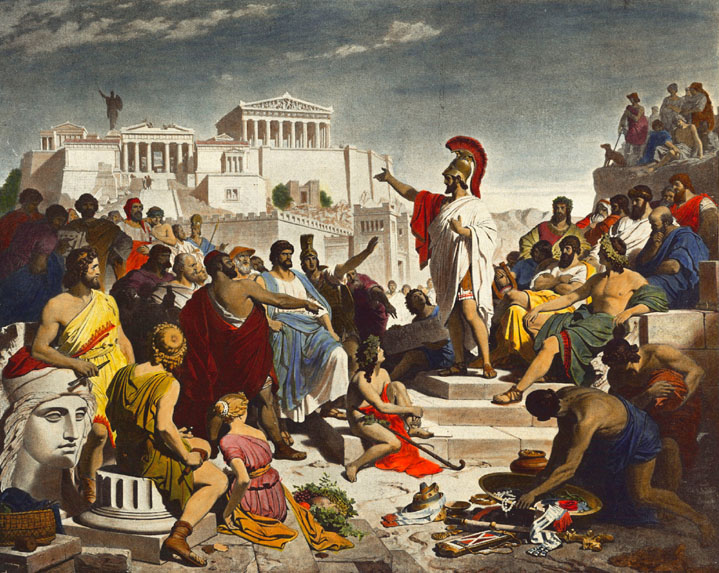
Like with democracy, the system still mostly works, because “what gets the most votes” is close enough to “what’s good for you”, enough of the time. But there are all kinds of situations that lead to behavior that can appear mystifying, until you learn to see things through the lens of parliamentary procedure.
There’s nothing wrong with not being happy. You can not be happy and still be doing perfectly fine. So why do people find this startling, and ruminate about their lack of happiness? Isn’t it strange that people obsess so much over happiness, but don’t actually change their actions to become more happy?
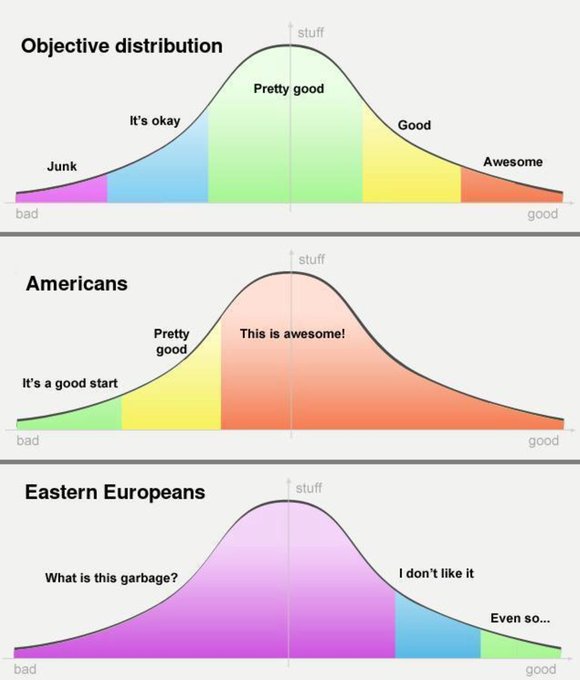
The explanation may be purely social. In modern American culture, we are expected to be happy. Not being happy is seen as a sign of failure and weakness. Being unhappy, or even just feeling neutral, is enough to make us lose status in the eyes of others, it can be the source of ridicule and shame. Being anything less than perfectly happy can be enough to make you a subject of pity. So even though happiness is not directly controlled, if you exist in a culture with these norms, some of your social governors (associated with emotions like shame and drives for status) will vote for you to do things that will make you happy, just so you can get one over on the Joneses.
But our social emotions are not voting to make us happy per se — they are actually concerned with making sure we avoid the social consequences that would come from appearing unhappy. They want to make sure that we don’t lose status for being seen as gloomy, and keep us from feeling shame for our melancholy. One way to do this is to vote for actions that will make you happier. But equally good, better even, is to vote for actions that make you seem happy!
So other things being equal, the social emotions tend to drive us towards the appearance of happiness, rather than actual happiness. Actual happiness may or may not make us appear happy in a way that will increase our status or reduce our shame. But the appearance of happiness always appears happy. So that’s what gets the votes.
This is what makes people neurotic about not being as happy as they should be. When they’re feeling reflective, it makes some people worry that they are fake, since they feel consistently driven towards the appearance of happiness, even at the expense of what would actually make them happy.
This is a well-known problem in contemporary American culture, and for cultures that have borrowed American standards for happiness. But most other cultures don’t expect people to be happy all the time. Without this expectation, people from these cultures don’t have the problem of feeling like they must both seek happiness and perform it, and don’t run into this weird vicious cycle. (Though of course, other cultures have problems of their own.)
For a similar example, consider the problem of self-sabotage. In some cultures and contexts it’s not appropriate to perform better than your peers, or to get too much better too quickly (cf. tall poppy syndrome). In this case, some of the social governors will vote against performing your best, to avoid the social disapproval that might come from performing better than you “should”.
This suggests that the treatment for self-sabotage is to surround yourself with people who think that failure is shameful and success is impressive, rather than the other way around. And it suggests that something you can do for the people around you is to express polite disappointment when they accomplish less than they hope for and genuine enthusiasm when they accomplish more. Even an expression of envy can be a supportive thing to do for your friends, as long as it’s clear that it comes from a place of admiration rather than competition.
Of course, if you go too far in this direction, you can end up with a culture that is neurotic about success rather than about conformity. Decide your own point on the tradeoff, but we’d argue that self-sabotage is worse than pushing yourself too hard.
Suffering
Why do people sometimes seek out extreme experiences? Why do we subject ourselves to things like roller coasters, saunas, horror movies, extreme sports, and even outright suffering?
Psychologist Paul Bloom explains these decisions in terms of chosen suffering versus unchosen suffering. For example, in this interview he says, “You should avoid being assaulted… there’s no bright side to the death of a loved one… there’s no happiness in watching your house burn down… nor is there happiness to be found in getting a horrible disease. Unchosen suffering is awful.”
In contrast he says, “chosen suffering, the sort of suffering we seek-out can be a source of pleasure … You choose to have kids, you choose to run a marathon, you choose to eat spicy food. You choose these things because there’s a payoff later in future pleasure.”
We think this is close. He’s picked the right examples, but getting assaulted, losing a loved one, or getting a horrible disease, are just bad. Choosing them wouldn’t make them any better. So it can’t be the chosen versus unchosen nature of these examples that makes the difference.
A better way to think about this is whether the suffering is under your control. If suffering is under your control, it can be corrected at any time. Since happiness is generated when errors are corrected, then controlled suffering is a neat hack — it’s a free way to generate happiness at no risk to actual life and limb.
Controlled suffering is like a sauna or a horror movie. You’re sweating or you’re scared, but you can stop at any time, and stopping feels pretty great, it’s a relief. The uncontrolled version would be more like being trapped in a sauna, or locked inside a haunted house — not so pleasurable, and not the sort of thing people go looking for. A really uncontrolled version would be the experience of being trapped inside a burning building, or being chased by an actual serial killer, where the stakes are not only real, they have permanent consequences.
When given a choice, people only tend to choose controlled suffering, and tend to suffer uncontrolled suffering only against their choosing. So almost all chosen suffering is controlled, and all uncontrolled suffering is unchosen. This should come as no surprise. But this has led Bloom to mistake the choosing for the active ingredient, rather than the controlled nature of the suffering.
Choosing uncontrolled suffering doesn’t make it good for you. Choosing to get assaulted is about as bad as getting assaulted by accident. Unchosen but controlled suffering isn’t usually that bad. Taking a wrong turn and ending up in the sauna by mistake is not that much of a bummer.
If you do want to become happier, the solution is simple — make yourself hungry, thirsty, cold, hot, tired, lonely, scared, etc. And then correct these errors promptly. It will feel amazing. If it doesn’t feel amazing, you are probably depressed in some more serious way. (See upcoming sections for more speculation about what this means for you.)
Recap
- There is a governor for each drive, as described in Part I.
- Governors vote for behaviors that they expect will decrease their errors.
- Governors are predictive, they will also vote against actions that they anticipate will increase their error.
- The number of votes each governor gets is a function of the size of their error and/or the predicted change in error of the actions available.
- Behavior is determined by the collective negotiation of all governors.
- The technical term for this problem is selection, so this set of systems is called the selector.
- There is a mechanism called a gate that takes votes below a certain threshold and reduces them to zero. In the mental selector, the gate stops votes that are below some minimum threshold. This ensures that actions must get at least some minimum number of votes to be performed.
- Behaviors like “eat cake” that have a governor behind them are easy to do. Behaviors like “study for your math test” that don’t have a governor behind them are hard to do. This resolves most mysteries of self-control.
Discussion Questions
- What behaviors do you find it really easy to do? What behaviors do you find it really challenging to do?
- When was a time you chose to do something that was painful, difficult, or pointless?
- What kinds of extreme experiences do you seek out? Why do you do that?
- Is each governor’s influence conserved? If the hunger governor has 100 votes and you give it 50 options, can it only give each option 2 votes? Or can it put all 100 votes towards every option? Is this why no one can agree what they want for dinner?
[Next: PERSONALITY]
 SLIME MOLD TIME MOLD