The Church FAQ — “A few years ago, we bought a church building. Since then, every time I mention it online and/or on social media, someone always responds, “wait, you bought a church, what” and then asks some standard questions. At this point it makes good sense to offer up a Church FAQ to answer some of those most common questions. Let’s begin!”
Serious Music — “A new paper in Science Robotics reports a device that Schumann would have jumped at the chance to try: a robotic exoskeleton for the hand.”
> Nature paper figures out how to cook eggs evenly by duty-cycling the temperature of water between 30°C and 100°C every 2 mins, derived from a model of heat transfer between yolk and white
> @sdamico implements the paper using his stoves that can hold water steady at 30°C and 100°C
Here, we describe the unique case of a 50-year-old self-experimenting female virologist with locally recurrent muscle-invasive breast cancer who was able to proceed to simple, non-invasive tumour resection after receiving multiple intratumoural injections of research-grade virus preparations, which first included an Edmonston-Zagreb measles vaccine strain (MeV) and then a vesicular stomatitis virus Indiana strain (VSV), both prepared in her own laboratory.
This Tiny Fish’s Mistaken Identity Halted a Dam’s Construction — Since the boundaries between species aren’t objective, zoologists can say that a small subpopulation of an animal is a “new species”, which then requires conservation because it only lives in one stream/valley/etc.
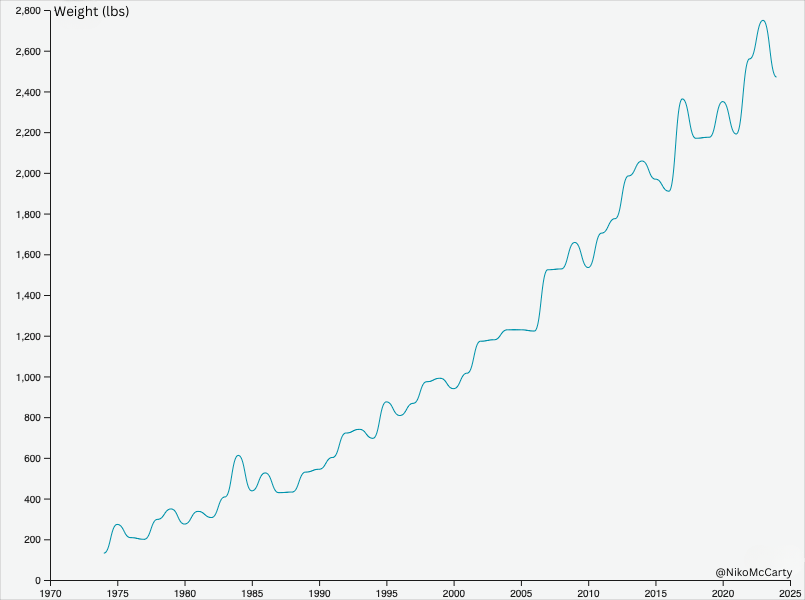
NikoMcCarty: “The weight of giant pumpkins has increased 20-fold in half a century. Humans are ridiculously good at breeding fruits. Data from the ‘Safeway World Championship Pumpkin Weigh-Off.’”
Asked if she knows she is in God’s grace, she answered: “If I am not, may God put me there; and if I am, may God so keep me. I should be the saddest creature in the world if I knew I were not in His grace.” She added, if she were in a state of sin, she did not think that the voice would come to her; and she wished every one could hear the voice as well as she did. She thought she was about thirteen when the voice came to her for the first time.
…
Asked if she had her sword when she was taken, she answered no; but she had one which had been taken from a Burgundian. … from Lagny to Compiègne she had worn the Burgundian’s sword, which was a good weapon for fighting, excellent for giving hard clouts and buffets (in French “de bonnes buffes et de bons torchons”).
Best parody. September.The Batrachomyomachia (“Battle of the Frogs and Mice”) is a comic epic parody of the Iliad and a good source of names for your pet mice. Like Artepibulus, “he who lies in wait for bread”.
Greek etymology rabbithole also led us to troglodyte, which ultimately means, “hole, I get into”:
From Latin trōglodyta (“cave dwelling people”), from Ancient Greek τρωγλοδύτης (trōglodútēs, “one who dwells in holes”), from τρώγλη (trṓglē, “hole”) + δύω (dúō, “I get into”).
These commenters are speaking authoritatively on subjects about which they are completely ignorant, but they are strident in doing so because they are repeating what everybody knows. They are intellectually secure in the center of a vast mob; their wisdom was received, not crafted. It doesn’t need to be crafted, because it is already known, established, beyond question (but demonstrably wrong).
In 2001, a friend and I had gotten so tired of a massive pot hole in Seattle that we went and got some vests and bags of asphalt and fixed it ourselves. We didn’t live near it, but hung out down there almost daily and hated driving over it. People in the neighborhood asked if we were from the city, and we said no. People clapped, and one brought us iced tea. A city bus came by as we were finishing and was so happy he drove over it, backed up, and drove over it several times to pack it in. I drove by it earlier today for work, and our patch still holds.
Most Bond villain. June.A New Atlantis: “Britain should reclaim an area the size of Wales from Dogger Bank, the area of the North Sea where the sea is only 15-40m deep. We could do it for less than £100bn.”
Most Constitutional.April. While Lucas M. Miller was serving in Congress, he proposed a Constitutional amendment to change the country’s name to “the United States of the Earth” because “it is possible for this republic to grow through the admission of new states…until every nation on earth has become part of it.”
Best coincidence. March.There is way too much serendipity — “It is therefore a fact of the world that virtually all the popular synthetic sweeteners were discovered accidentally by chemists randomly eating their research topic.”
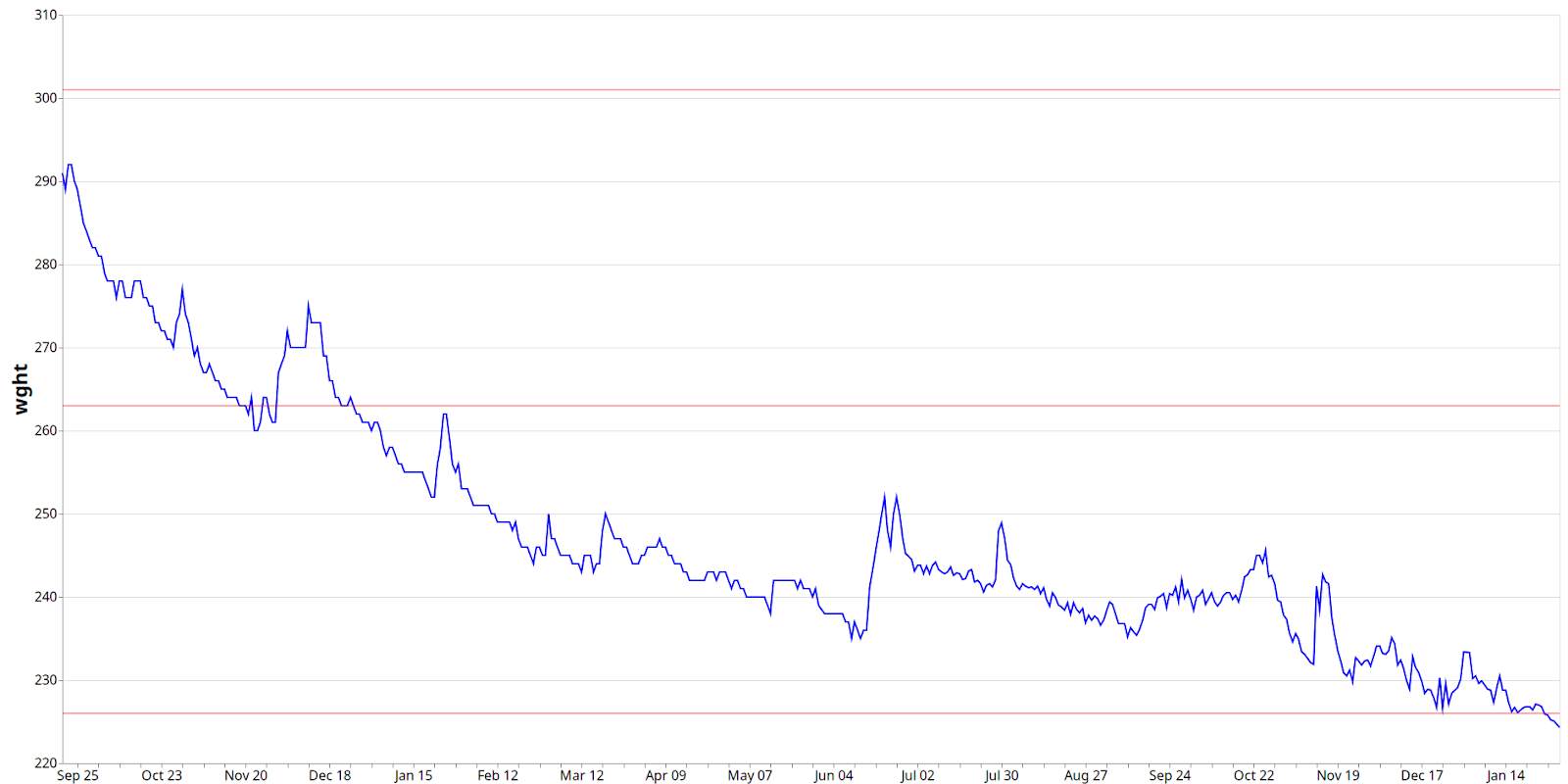
Most empirical. February.Friend of the blog ExFatLoss beats obesity:
Now that’s science
Best near miss.February. AT&T gets a solid B+ on predicting the future: “You Will” Commercials (high quality) YouTube comments have it: “These are absolutely amazing. The only thing they got wrong is ‘The company to bring it to you, AT&T’.”
Most unethical. January. The for-profit system of academic journal publishing was created by Robert Maxwell, who also happens to be Ghislaine Maxwell’s dad. Along with other tidbits, the linked article does a good job highlighting the ways in which scientific publishing is a principal-agent problem:
You have no idea how profitable these journals are once you stop doing anything. When you’re building a journal, you spend time getting good editorial boards, you treat them well, you give them dinners. Then you market the thing and your salespeople go out there to sell subscriptions, which is slow and tough, and you try to make the journal as good as possible. … then we buy it and we stop doing all that stuff and then the cash just pours out and you wouldn’t believe how wonderful it is.
If we believe that the purpose of the Inquisition trying Galileo was to silence Galileo, it absolutely failed, it made him much, much more famous, and they knew it would. If you want to silence Galileo in 1600 you don’t need a trial, you just hire an assassin and you kill him, this is Renaissance Italy, the Church does this all the time. The purpose of the Galileo trial was to scare Descartes into retracting his then-about-to-be-published synthesis, which—on hearing about the trial—he took back from the publisher and revised to be much more orthodox. Descartes and thousands of other major thinkers of the time wrote differently, spoke differently, chose different projects, and passed different ideas on to the next century because they self-censored after the Galileo trial—an event whose burden in money and manpower for the Inquisition was minute compared to how hard it would have been for them to get at all those scientists.
If all of the 1,000,000 chemicals introduced into the food supply since 1850 were at fault, then simply doing a potato diet or heavy cream diet wouldn’t lead people to easily lose a lot of fat.
… Eating potatoes does not remove any microplastics from your body. It doesn’t avoid whatever’s in the soil or water. It doesn’t replenish whatever used to be in the soil and is now missing. It doesn’t turn you into a farmer or manual laborer and it doesn’t change your genetics or epigenetics. It doesn’t remodel your (ruined?) fat cells. It doesn’t reduce air & water pollution and it doesn’t change the makeup of your kitchen & cook ware. It (presumably) doesn’t get you more sleep or reduce stress or EMF or blue light or screen time.
Unless there’s some crazy magic going on, the change is either brought about by something in the potatoes (or cream) or by cutting out something you were previously eating, and replacing it with potatoes (or cream).
Nat Friedman and his collaborators just dropped PlasticList, a project where they tested 300 Bay Area foods for plastic chemicals, mostly phthalates and bisphenols. Really top-notch work here.
A reader sent us this: Los Angeles now tests for lithium, and from this report, it looks like the water from the Los Angeles Aqueduct Filtration Plant contains 25 to 198 ng/mL lithium with an average of 92 ng/mL. That is quite a lot — the Pima had about 100 ng/mL in their water. But LA was, at least as of 2014, the #9 Leanest City in the country, though maybe things have changed since then. The reader also wanted to share this background info: She and her husband had lived in Texas for many years. When they moved to San Francisco, they both abruptly lost “1-2 pant sizes”. This was while “walking about the same amount as we were in Austin”. Then they moved to LA, and gained “+2 pant sizes” above and beyond where they had been in Texas. As before she says, “in general our diet hasn’t changed significantly, our job type hasn’t changed, we haven’t exercised more or less, etc.” This prompted her to look into the LA water quality and she found the new data in this report.
The 1990s was the decade of peanut allergy panic. The media covered children who died of a peanut allergy, and doctors began writing more about the issue, speculating on the growing rate of the problem. The American Academy of Pediatrics (AAP) wanted to respond by telling parents what they should do to protect their kids. There was just one problem: They didn’t know what precautions, if any, parents should take.
Rather than admit that, in the year 2000 the AAP issued a recommendation for children zero to three years old and pregnant and lactating mothers to avoid all peanuts if any child was considered to be at high risk for developing an allergy.
How Toxic Is Your Favorite Chocolate? (Ranked) from Bryan Johnson — A good start, but sadly he gives no details on the testing methodology or the breakdown of results. Bryan, please publish your methods and data!
My working model has been that being employed kind of sucks. But this time, since I knew I couldn’t afford to quit anytime soon with the baby and all, I figured I could try treating it like one of my projects. So instead of selling coffee, I figured out how to streamline the café and the cash register so that the volunteers who help out at the gallery felt comfortable doing my job, then I made myself a small office where I sat down to analyze the business and figure out how to improve it. You can imagine how popular this was—I had to backtrack for a few months after the board told me to get back to the café. And this was a good lesson for someone who is used to being self-employed: at an institution, you can’t just do what is best, you also have to build trust and coordinate with others so you are on the same page. This, however, doesn’t mean that you should abdicate your judgment and get in line.
Early Adopter — “conceiving time as a fourth dimension, had been broached in the 18th century, but it had first been treated seriously in a mysterious letter to Nature in 1885”.
A Literal Banana: A Case Against the Placebo Effect — A roundup of arguments about the existence of the placebo effect and whether or not it is “meaningful”. Some of the arguments seem to depend on the definition of what counts as a voluntary action, and we’re not sure if that distinction withstands philosophical scrutiny. We feel like there is still more clarity to be found on the topic, but this is a start.
At one point, Claude was really convinced that the best way for you to lose weight was to go on an all-potato diet. We have no idea where this came from, it was just really stuck on this idea for a while.
Aer Lingus Flight 164 — “Downey claimed to have been a Trappist monk … He then took a job as a tour guide in central Portugal, at a shrine devoted to Our Lady of Fátima, the reported origin of the Three Secrets of Fátima. At the time of the hijacking, the third secret was known only to the Pope and other senior figures in the Catholic Church; Downey’s statement called on the Vatican to release this secret to the public.” h/t demiurgently, who comments, “‘stole plane to threaten Catholics into revealing heavenly secrets’ feels like a Dan Brown novel”.
As a last-gasp effort at professional survival, Reuss resolved to transform himself into an Alpine farmer. Over the spring and into the summer, Reuss grew a beard and perfected the local dialect. He bleached his body hair from head to toe.
In the evenings, Reuss liked to play tarot cards with Kaspar Altenberger, a local farmer Straub had paid to look after the house. Reuss disclosed his plan, and Altenberger offered to help. He lent Reuss his own identity papers—his passport and baptismal certificate. Reuss had a new official persona.
Baker was very nervous about discussing the role Florence had played, with him throughout his appalling and dangerous trek across Africa. She had nearly died on more than one occasion, and had saved his life on others with bravery and skilled nursing, and yet she is seldom mentioned in the book. The truth that would have shocked his Victorian readership to the core was that Florence was not his wife at any stage in their African adventures, and they were only married on their return to London in November 1865.
Samuel had found nineteen-year-old Florence, as he called her, in 1859 at an auction of white slaves in a Turkish-administered town in Bulgaria. (There is some date about her exact age: she was certainly less than half Baker’s age when he met her.) Her real name is believed to have been Barbara Maria von Sass, born in Transylvania, then part of Hungary. Her parents had been killed in the 1848 uprising, and she had been raised from her childhood by a wealthy Armenian trader who intended to make a good profit when he sold this beautiful blonde teenager at auction. Baker saw her, bought her, and subsequently fell in love with her. The pair became inseparable, but the longer they were together, the worse Samuel’s problem became: how was he to explain this relationship to his four daughters at home, who he had left with their aunt after his first wife died?
The most fulfilled people I know tend to have two traits. They’re insatiably curious—about new ideas, experiences, information and people. And they seem to exist in a state of perpetual, self-inflicted unhappiness.
“Bembo is a serif typeface created by the British branch of the Monotype Corporation in 1928–1929 and most commonly used for body text. It is a member of the ‘old-style’ of serif fonts, with its regular or roman style based on a design cut around 1495 by Francesco Griffo for Venetian printer Aldus Manutius, sometimes generically called the ‘Aldine roman’. Bembo is named for Manutius’s first publication with it, a small 1496 book by the poet and cleric Pietro Bembo.”
I’ve noticed a common refrain speaking with founders building physical things:
“This is an old idea, actually, from the…”
I interrupt, a shit-eating, Cheshire grin spreading across my face: “1950s or 1960s, right?”
Right, they say, adding some specific variant like, “It’s from a 1958 paper.”
But the paper was obscure, or Soviet, or the idea wasn’t technically possible or economically feasible with the tools of the day. So it collected dust, forgotten and waiting to be rediscovered.
Good ideas aren’t getting harder to find. We just need to use the ones we have.
The genius of the game to me is that losing is part of the process. … I feel like I learned something about myself and about life from playing Hades. The game encourages you and teaches you persistence. It teaches you to cultivate equanimity in the face of failure. And it teaches you to learn from your experience.
Our results showed that the majority of commercial samples were oxidized before reaching the expiration date listed on the bottle. In addition, adulteration with soybean oil at levels near 100% was confirmed in two “extra virgin” and one “refined” sample.
“Rose Freistater … was an American schoolteacher who rose to prominence in the 1930s when she was denied a teacher’s license in New York for being overweight.” More detail here, specifically:
in 1931, Rose stood five feet and two inches and weighed 182 pounds [BMI 33.3]. When she applied for her teaching license that year, she weighed thirty pounds more than the maximum weight allowed by the Board for her height. She was given six months to lose thirty pounds; when she lost only twenty in that time, she was rejected by the Board altogether.
ExFatLoss: Why I stopped Grounding. Good jokes overall but missed a chance to make a “you’re grounded” joke.
Speaking of which, while grounding as a practice may not be real, it is probably less crazy than it sounds:
Over the past decade, Robert has built a body of work that reveals the many ways insects and arachnids use and experience static. Ticks jump, spiders balloon, bees sense the negative charge of a flower recently visited by another positively charged bee. He even found that the charged relationship between air and insects goes both ways: Honeybee swarms shed so many negative charges that they alter the electrical gradient around them. Based on Robert’s estimates, the atmospheric charge resulting from a swarm of desert locusts rivals that of clouds and electrical storms.
Organizations often do great work collecting data, but then share it in ways that are hard to access or understand, or require all users to repeat hours of cleaning to make the data usable. Sometimes a data hero comes along to share their own improved version that is cleaned and easier to access and understand. Here I share links to some of these “most-improved” datasets.
The only way to get stably higher union pay is through monopolization. Unions need to get most or all producers of labor in a market to act together and fix their prices at a high level. That way, the consumers of labor have no other option but to accept lower output and pay higher prices.
This is a monopoly or trust in exactly the same way as when US Steel, Carnegie Steel, and Federal Steel all agree to set their prices high, forcing customers to pay more. If you think that goods sellers colluding to set prices is bad, then you should think that service sellers colluding to set prices is also bad.
…
Restrictions of commerce are fine when they benefit the needy and punish the greedy. Insofar as this is the case, we can do better to improve the lives of those who need it most than by supporting labor unions.
Collin Lysford: The Fractal Ratchet — Many interesting things in this piece, but one that’s unusual and distinctive: it’s often possible to make a strong *ordinal* argument (this thing is hotter/faster/less dangerous than the other thing) even when you can’t provide numerical measurements. This seems important because people often (mistakenly) assume that in the absence of precise numerical measurements, it’s not possible to make ordinal arguments. But in fact you need neither precision nor numbers!
Asked if she knows she is in God’s grace, she answered: “If I am not, may God put me there; and if I am, may God so keep me. I should be the saddest creature in the world if I knew I were not in His grace.” She added, if she were in a state of sin, she did not think that the voice would come to her; and she wished every one could hear the voice as well as she did. She thought she was about thirteen when the voice came to her for the first time.
…
Asked if she had her sword when she was taken, she answered no; but she had one which had been taken from a Burgundian. … from Lagny to Compiègne she had worn the Burgundian’s sword, which was a good weapon for fighting, excellent for giving hard clouts and buffets (in French “de bonnes buffes et de bons torchons”).
I love this story because it shows, at least anecdotally, how deep scientific insights can emerge from the simplest of experiments. It’s a testament to the idea that you don’t always need sophisticated equipment to unlock the secrets of nature — sometimes, all it takes is a drop of oil and a bit of ingenuity.
Where does this leave us? We’ve traded the crisp, mathematically elegant Bayesian formalism for fuzzy truth-values that, while intuitively compelling, we can’t define even in principle. But I’d rather be vaguely right than precisely wrong. Because it focuses on propositions which are each (almost entirely) true or false, Bayesianism is actively misleading in domains where reasoning well requires constructing and evaluating sophisticated models (i.e. most of them).
The Batrachomyomachia (“Battle of the Frogs and Mice”) is a comic epic parody of the Iliad and a good source of names for your pet mice. Like Artepibulus, “he who lies in wait for bread”.
Greek etymology rabbithole also led us to troglodyte, which ultimately means, “hole, I get into”:
From Latin trōglodyta (“cave dwelling people”), from Ancient Greek τρωγλοδύτης (trōglodútēs, “one who dwells in holes”), from τρώγλη (trṓglē, “hole”) + δύω (dúō, “I get into”).
You can’t send a person into space too fast, because they will turn to goo. But many other things can be sent to space fast without becoming goo. This is the premise behind Longshot Space, “a hypersonic launch startup” that will use big guns to send things that are not people to space. Longshot please hire us to write your marketing we promise we will use the word “goo” at least once a sentence.
There’s a misconception that good faith discussion only happens in close-knit communities like LessWrong or HackerNews. The reality I’m looking at here is that ~everyone on the internet is rational AND is arguing in good faith. If it doesn’t look that way, it’s because you’re speaking different languages.
It may be fine to put a toaster in a dishwasher, despite everyone with a shred of common sense “knowing” that’s a bad idea. I was skeptical, but I thought I’d try it since my toaster is very cheap, very old and very dirty. As I added the dishwasher tab and chose a cycle, I was praying that I wasn’t about to fall prey to a 12-year-old prank.
When Maslow showed his subjects paintings, people who struggled to self-actualize would typically label what they saw (“It is a Picasso”) whereas the self-actualized would describe the concrete details of the painting they had before them (“There is an interesting tension between the yellows and the blues here”).
Unusual thread about math. Not sure of its accuracy but we’re interested in any argument based on the premise, “you’re a victim of a 2300 year old error in metaphysics”.
DefenderOfBasic: “one of the most popular tools I ever made was this thing to explain how JPEG images are created out of these mathematical patterns … made in a couple hours for a talk, didn’t even bother trying to style it/make it look good.” Despite this, it is good. Try the jpeg-sandbox here.
The idea of feeding minerals “free choice” to livestock came about by a need to decrease over-consumption of a liquid supplement containing phosphoric acid, protein, molasses, and other minerals. Upon investigation, it was found that the liquid supplement was being used heavily by the animal as a source of phosphorous. Consequently, we discovered if animals had access to a phosphorous source on a free choice basis, over-consumption of the liquid ceased. We then extended this concept to other vitamins and minerals: if the animal was able to select phosphorous on a free choice basis, perhaps calcium could be selected in the same manner – success!
The next item tested free choice was sodium (Na+), in the form of sodium bicarbonate (NaHCO3). It was feared that salt (NaCl) was not a satisfactory source of Na+ because it is one-third Na+ and two-thirds chloride (Cl-), and chloride was already in excess in most rations. Again, we found great success in our method. In time, potassium, sulfur, silicon, magnesium, vitamins, and trace minerals were added to the list. Finally, there were 16 separate vitamins and minerals fed free choice.
In his posthumously published book about pseudonyms, The Point of View of My Work as an Author, Kierkegaard makes an interesting argument for pseudonyms. Kierkegaard says that he used pseudonyms because he wanted the reader to be uncertain about how much of what he was saying was something he believed (far from everything). He would add details that make you question the trustworthiness of the authors of his books—as in Fear and Trembling, where Johannes Silencio is talking about how to deal with despair, while, quite obviously, being in despair himself. This unreliability of the authors forces the reader to “stand alone” (staa alene) to use Kierkegaard’s phrase. As a reader, you can’t pretend that you are not responsible for what you believe—you can’t say, “Oh, but Kierkegaard said so.” Or, worse: “Everyone does that.” No. You are left alone with these strange and unreliable authors and you have to come to your own conclusions.
Listen to radio from all over the world on radio.garden
astronaut.io – “youtube videos that have never been seen before, that may never be seen again“ (h/t DefenderOfBasic)
Seeds of Science puts out The SoS Library, including a couple of pieces by your favorite slimes.
These commenters are speaking authoritatively on subjects about which they are completely ignorant, but they are strident in doing so because they are repeating what everybody knows. They are intellectually secure in the center of a vast mob; their wisdom was received, not crafted. It doesn’t need to be crafted, because it is already known, established, beyond question (but demonstrably wrong).
The tests are small plastic pouches holding vials of chemicals. They’re cheap, roughly $2 apiece, and easy to use. Officers open the pouch and add the substance to be tested. The tests are designed to produce specific colors when mixed with drugs like heroin, cocaine or methamphetamine. But dozens of items, including foods and household cleaners, trigger similar reactions.
One of the first places to use the Myers Briggs Type Indicator in the wider world was the Institution for Personality Research and Research (IPAR). It was housed at a fraternity house in Berkeley that had been purchased by a psychologist named Donald MacKinnon, the first person to buy the Myers Briggs Type Indicator from Isabel.
At IPAR, MacKinnon wanted to create what he called a ‘house party approach’ to testing. He’d bring people to live in this fraternity house for long weekends. He’d give them personality tests; he’d have them compete against each other in games; he’d put them in deliberately stressful situations. And he’d have psychology graduate students watching their behavior to see what they could discern about personality from this very strange, immersive testing experience.
Twitter user DREW DANIEL @DDDrewDaniel “had a dream I was at a rave talking to a girl and she told me about a genre called ‘hit em’ that is in 5/4 time at 212 bpm with super crunched out sounds thank you dream girl”. Turns out this formula makes for pretty good tracks (and commentary, and reflections on the nature of twitter), add another entry to Wikipedia’s List of works based on dreams. Here are some favorites:
Humans 1, Chimps 0: Correcting the Record – You may have seen the videos where a chimp does amazingly well on a number task, suggesting that chimps have better working memory than humans. But this is probably not true. The chimp in the video does so well because he has had a huge amount of practice. When you give humans a similar amount of practice, they do about as well. A reminder to in general trust primatology findings less than you might otherwise.
In one study of lithium in urine samples, urine lithium was positively associated with TSH, and high levels of TSH can be a sign of thyroid dysfunction. The authors conclude, “Exposure to lithium via drinking water and other environmental sources may affect thyroid function, consistent with known side effects of medical treatment with lithium.” Jandrade0112 on twitter says,
to my eyeballing this looks like thyroid inhibiting effects don’t really kick in until urinary excretion > 5 mg/L, which is roughly 5 mg daily lithium intake
In 2001, a friend and I had gotten so tired of a massive pot hole in Seattle that we went and got some vests and bags of asphalt and fixed it ourselves. We didn’t live near it, but hung out down there almost daily and hated driving over it. People in the neighborhood asked if we were from the city, and we said no. People clapped, and one brought us iced tea. A city bus came by as we were finishing and was so happy he drove over it, backed up, and drove over it several times to pack it in. I drove by it earlier today for work, and our patch still holds.
The Chinese government says it will investigate allegations that fuel tankers have been used to transport cooking oil after carrying toxic chemicals without being cleaned properly between loads. … Transporting cooking oil in contaminated fuel trucks was said to have been so widespread it was considered an “open secret” in the industry, according to one driver quoted by the newspaper.
The original medication was manufactured in the form of semisolid gel capsules, based on the only known crystal form of the drug (“Form I”). In 1998, however, a second crystal form (“Form Il”) was unexpectedly discovered. It had significantly lower solubility and was not medically effective.
Form Il was of sufficiently lower energy that it became impossible to produce Form I in any laboratory where Form Il was introduced, even indirectly. Scientists who had been exposed to Form Il in the past seemingly contaminated entire manufacturing plants by their presence, probably because they carried over microscopic seed crystals of the new polymorph.
KineStop is an app that draws an artificial horizon on your phone or tablet to keep you from getting motion sick while reading in the car. Zed (@zmkzmkz) on twitter says, “it looks silly but trust me it’s magic”
I burn 4,600kcal/day being sedentary – ExFatLoss finds weird results using doubly-labeled water. Definitely keep this one in mind when you see other claims based on methods using doubly-labeled water (e.g. this one that has been going around recently).
Doubly-labeled water is allegedly the Gold Standard ™ test for energy expenditure. It’s what Herman Pontzer and John Speakman have built careers on. It’s apparently so precise it’s used to calibrate all the other tests, basically gospel. So what gives?
The first, obvious issue [with RCTs] is that external validity is weak: there’s no real way to verify whether a study generalizes besides its application. This comes from a series of issues, primarily that transporting the results is mostly done based on “faith”. Also, the internal validity of the study is usually in question too: basically, the results for the population are too heterogenous to be both precise (i.e. capturing properly the value of the effect) without being unbiased (affected by “noise”, so to say). And even when the average effect of a treatment is correctly identified, it is never guaranteed that the average effect is the most relevant statistic.
A New Atlantis: “Britain should reclaim an area the size of Wales from Dogger Bank, the area of the North Sea where the sea is only 15-40m deep. We could do it for less than £100bn.”
10 technologies that won’t exist in 5 years: “Technological progress is not a mystical force that delivers the most important [technologies] first. Some problems are hard to solve, and won’t make you much money even if you succeed, and don’t get talked about on the news. What people choose to work on determines what new technologies are made. The 10 technologies above are worth working on.” We really love this one!
Thermobolic on twitter reports “total failure” on a Personal Fat Loss / Coconut Oil Maxxing Experiment. We’re glad to see this report, null results are also important!
Friend-of-the-blog Uri Bram writes for the Atlantic: The Cure for Hiccups Exists. Among other things, it’s an interesting account of the interplay between reddit research and mainstream medical science.
Moctezuma III on twitter: “i love wikipedia, because you can have a random thought like ‘when was pocky invented’ and then learn that the companies president was kidnapped in 1984 by a criminal that called themselves ‘The Monster with 21 Faces’ and who was never caught.”
Empirical tubetti: A Better Way To Cook Pasta? Doesn’t quite deliver on the promise of “see how many pasta rules we can break”, but it’s a nice start.
The Time magazine article, “Science: Fudging Data for Fun and Profit” gives an interesting look at the state of science fraud and institutional confidence back in December 1981.
All patients had bilateral hearing restoration. The average auditory brainstem response threshold in the right (left) ear was >95 dB (>95 dB) in all patients at baseline, and the average auditory brainstem response threshold in the right (left) ear was restored to 58 dB (58 dB) in patient 1, 75 dB (85 dB) in patient 2, 55 dB (50 dB) in patient 3 at 26 weeks, and 75 dB (78 dB) in patient 4 and 63 dB (63 dB) in patient 5 at 13 weeks. The speech perception and the capability of sound source localization were restored in all five patients.
Origins of the Lab Mouse — the author says, “My new essay for Asimov Press is ostensibly about the unlikely origin story of the lab mouse. But it’s actually about the role of chance in scientific discovery, and how random contingencies can lead to technological lock-in.” For example, “In one case, a gene that appeared to be toxic to the liver when using one substrain of black 6 as a control seemed to instead protect liver function when a different substrain was used.” If this is true, how can we possibly expect any mouse research to generalize to humans? In fact, how can we expect something true for some humans to be true for any other humans? To be honest, a more likely explanation is that the described result is simply not true, and is actually the result of p-hacking or other research malpractice. In general this is a good background piece on specifically why not to take mouse research too seriously.
The compound bow combines two ancient inventions, the bow and the pulley. But it wasn’t until 1967, “after six years of development in the garage of its inventor in Missouri, a strange looking device, described as a ‘compound’ bow was born.” ZyMazza on twitter expounds, “A brilliant innovation hidden to humanity for like 4000ish years. What two things are waiting to be combined today?”
DefenderOfBasic on twitter, “sick & tired of not being able to share links to my articles on twitter. having to share a screenshot and say ‘link in bio’ like a goddamn porn bot” decided “enough is enough” and “made a little tool to circumvent this stupid censorship”. May be helpful for those of you on both twitter and substack.
Naïve observers fail to report clearly visible stimuli when their attention is otherwise engaged—famously even missing a gorilla parading before their eyes (Simons & Chabris, 1999). This phenomenon and the research programs it has motivated carry tremendous theoretical significance … However, these and other implications critically rest on a notoriously biased measure: asking participants whether they noticed anything unusual (and interpreting negative answers as reflecting a complete lack of visual awareness). Here, in the largest ever set of IB studies, we show that inattentionally blind participants can successfully report the location, color and shape of the stimuli they deny noticing.









 SLIME MOLD TIME MOLD