
Adam Mastroianni announces The Summer 2024 Blog Post Competition, Extravaganza, and Jamboree, complete with cash prizes:
I want to prime the pump, discover some new writers, and hopefully help them reach more people. It can be a grueling slog when you’re just a lil weirdo starting out. Good stuff does tend to spread on the internet, but it has to reach a certain critical mass of attention first. I got a couple key boosts early on that helped me keep going, so I’d like to do the same for the next generation.
Sea Urchins Love Sporting Cowboy and Viking Hats. Also, see here for the original thread on reef2reef.com
Game Boy Camera Gallery: Mystery Show by Scratching Post Studio
Predictions for 2050 are already coming in! First off, our prediction “Assistive Technology Meets in the Middle” is already partially fulfilled by This Next-Gen Hiking Tech. It’s even available for purchase, assuming the Kickstarter goes through. And our prediction “Everything Will be on Video” is once more fulfilled by the recent and stunning meteor in Portugal (video compilation, dashcam video, awesome selfie video).
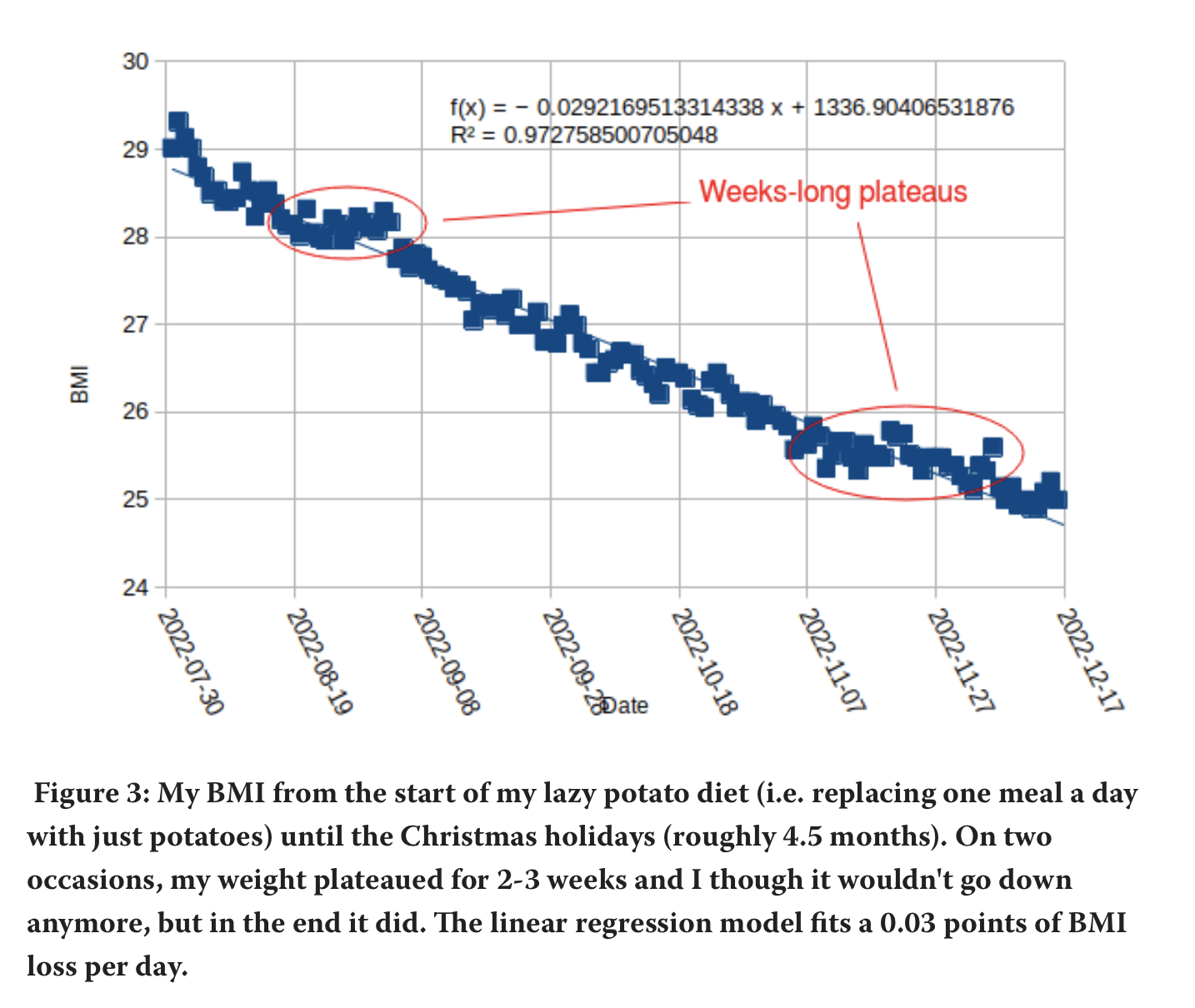
Baryonic Musings: It’s Potato Time Again! – Interesting account of a potato diet case study. The author saw a lot of previous success with the potato diet, saying, “I last tried the potato diet in September 2022 and it worked great, losing ~23 pounds in 21 days. Here I go again.” But this attempt had to be stopped early. Despite losing 0.9 lbs/day, the author had to stop after only 8 days. “Well, it was working, but something’s a bit different this time. I’m constantly hungry.” Post includes some speculation as to why.
How 3M Execs Convinced a Scientist the Forever Chemicals She Found in Human Blood Were Safe

Exposure of U.S. adults to microplastics from commonly-consumed proteins — We’re still skeptical of microplastics causing obesity, but here is this paper just in case. (h/t Krinn)
My hour of memoryless lucidity, and the sequel Some Experiments I’d Like Someone To Try With An Amnestic, all from LessWrong.
‘Shut up and calculate’: how Einstein lost the battle to explain quantum reality
Clearer Thinking’s Astrology Challenge:
A scientific test of astrological skill that any astrologer in the world can take. We developed it by working closely with astrologers who generously volunteered their time to help. It consists of 12 multiple-choice questions. For each, you’ll presented with tons of information about a real person, as well as 5 astrological charts, and your goal is to say which of the 5 natal charts is that person’s real chart (the other 4 charts are random and have nothing to do with that person). If you’re the first to get at least 11 out of 12 multiple choice questions correct (among the first 200 challengers), then you win a $1000 prize! Participation is completely secret, so nobody will know you participated unless you choose to announce it. After the challenge closes, we’ll tell you how many questions you got right on the test, as well as whether you won.
…
We previously ran a test of sun sign astrology (i.e., the idea that whether you’re a Pisces, Aries, etc., impacts your life) and found that sun signs were not able to predict any of the 37 life outcomes that we tested. Although sun sign astrology is extremely popular (about 1 in 3 Americans at least somewhat believe in it), astrologers rightly pointed out that the study was not a test of astrology as most astrologers practice it since they use much more complex methods involving full astrological charts. This inspired the development of this test, which is based on whole charts.
… If astrology works, then that calls for a revolution in our scientific understanding of how the universe operates since modern physics provides no mechanism that could explain astrology. In such an instance, it would also teach us something important about scientific bias and what scientists miss. On the other hand, if astrology doesn’t work at all, I also think that is very important because astrology is extremely widely believed. Literally millions of people use it to guide their understanding of their lives, character, and future. If it doesn’t work, they’d be better off seeking other sources of understanding and insight.
Brine thoughts: the unspoken, instinctive need for a sweet-tangy-salty beverage in the heat, the combination of sugar, savory, and acid…the American yearns for kala khatta but they do not know it…

Wounded orangutan seen using plant as medicine – The coverage is dumb but the observation is fascinating if true.
Photographs of the Los Angeles Alligator Farm (ca. 1907):
Visitors — and their pets — could get alligator carriage rides or watch them rocket down slides; toddlers could have their picture taken with a crowd of hatchlings and even bring one home at the end of the day.
…
The lack of regulations for the safety of captive animals, staff, or visitors allowed for a level of casual proximity with adult alligators that would be unthinkable today. One photo shows a group of young women enjoying a half-submerged picnic in a park enclosure complete with what the caption claims to be a birthday cake for one of the reptiles. A keeper stands to one side, club in hand, to make sure nothing goes awry.
@AndyJScott “Was wondering if the whole ‘sugar causes cavities’ thing has good data behind it and guess what”






 SLIME MOLD TIME MOLD
