ExFatLoss on measurement: a “Regular, Boring Scale” is the best way to measure body weight for weight loss. “All other methods are either less precise, more prone to user error, or too impractical/expensive to do daily. It doesn’t matter which scale you buy. Just get any $20 model from Amazon. No smart/body fat sensing required. All scales are imprecise. Still good enough. Yea, yea, the scale isn’t perfect. Most scales aren’t that accurate. … But everything else I’ve seen is worse. And I’ve tried a lot.”
The Fosbury Flop Changed Athletes’ Bodies – “the coach can impart important principles, but my sense of great coaches is that they also allow — or encourage — some freedom for the learner to experiment and find a personal solution within the bounds of the task. … I think there’s an analogy for coaches or mentors or bosses of any kind: we should all think about how we can use our influence essentially to underwrite smart risk-taking and experimentation, even within the confines of a well-defined goal.”
Most descriptions of sumptuary laws (historical laws that, among other things, limit who can wear what) focus on how these laws keep common people from imitating those of higher status. If we pass a law that only dukes are allowed to wear cloth-of-gold, then rich merchants can’t pretend to be as important as a duke just because they can afford it. But we have this long-standing suspicion that sumptuary laws also kept rich people from pretending to be lower status than they really are. Think of it as a combination of the king wanting to know who is flush enough to tax heavily, and enforcing noblesse oblige, with everyone being able to tell who is fortunate enough to have an especial obligation to the less fortunate. Anyways: You Can’t Even Tell Who’s Rich Anymore
“The spread of cases across the country and the fact it has been predominantly affecting schoolgirls, with fewer boys and adults falling ill, were central to his conclusion, he said. The nature of the symptoms and the fact most patients quickly recovered were also key, he said.”
How to Achieve Long Term Success on the Potato Diet from Critical MAS. We don’t agree with the conclusions, but this is the kind of criticism we’d like to see more of — disagreement on specific theoretical points that we could maybe try to resolve empirically. MAS if you are reading this, we’re curious to know what you think of the half-tato diet.
Declining Sperm Count: Much More Than You Wanted To Know. People ask us all the time about doing a deep dive on sperm count — now Scott at ACX has done it, concludes that the evidence is mixed but maybe favors pesticides as a cause, “I’m pretty split about how concerned to be”. We are glad he did it so we didn’t have to.
Nearly every scientist who has used mice or rats to study depression is familiar with the forced-swim test. The animal is dropped into a tank of water while researchers watch to see how long it tries to stay afloat. In theory, a depressed rodent will give up more quickly than a happy one — an assumption that has guided decades of research on antidepressants and genetic modifications intended to induce depression in lab mice.
But mental-health researchers have become increasingly sceptical in recent years about whether the forced-swim test is a good model for depression in people. It is not clear whether mice stop swimming because they are despondent or because they have learnt that a lab technician will scoop them out of the tank when they stop moving.
Obesity seems like it would be bad for your health and would make you more likely to die from things like heart attacks. But many studies find no effect of BMI on mortality — this is sometimes called the obesity paradox. However, a new paper argues that this can be explained by simple statistical biases. The paper concludes, “the mortality consequences of overweight and obesity have likely been underestimated, especially at older ages.”
Claims about fascia and chronic pain. Some parts seem plausible but also sounds a lot like any miracle cure claim, so, dubious. We’d be interested in hearing points for or against.
Is Everything an MLM? Only tangentially about MLMs, also about e.g. the false lure of graduate school:
But academia … does something different. Like my yoga teacher, it affirms what so many of us wanted to believe about ourselves: that we’re good enough, smart enough, potential-filled enough, to go to grad school. Maybe it started when you wrote a paper you were particularly proud of, and your professor told you, off-handedly, “maybe you should think about grad school.” Maybe someone else in your life — the parent of a friend, someone you nannied for, your parent — told you the same. When my undergrad professor told me as much, it was like someone had unfogged the windshield of my life: oh, yes, there’s the road in front of me! Everyone I met in grad school had some version of this story.
Mike vs ADHD 2023. Interesting prediction-market-based N=1, luck-based medicine self-experiment. Will Mike regret using nicotine gum? You predict, Mike decides.
“Another thing I don’t like, not only about Kabul but broadly about life after the fatha, are the new restrictions. In the group, we had a great degree of freedom about where to go, where to stay, and whether to participate in the war.
However, these days, you have to go to the office before 8 AM and stay there till 4 PM. If you don’t go, you’re considered absent, and [the wage for] that day is cut from your salary.”
I took my new revelation to a friend older than I, a game designer who’s been involved with internet technology since the beginning. He too was amazed by my confession, but from a different angle I’d never considered: one of an internet historian. “I think you made the first true meme,” he told me. We looked through lists of the earliest internet memes, and although several preceded The Dancing Baby (like the Hamster Dance), their popularity had remained contained within the internet. The Dancing Baby was the first meme to truly permeate meatspace.
@MegaDarren on twitter: “Just learned that Dutch scientists left a hamster wheel outside in 2014 and saw that tons of wild mice used it just for fun as well as frogs and slugs? All the creatures of the forest wanted a turn?? Absolutely phenomenal” @EvilCactus comments: “I hear the Rocky theme play in my mind every time I look at that photo of the snail. Might print it out and use it as a motivational poster.” Original paper is here.
Phytomining for lithium: “…the team also studied which plants could accumulate lithium from the soil at high concentrations. Starting with 34 candidates, the scientists eventually whittled the list down to just three: cabbage, rapeseed and sunflower.” The original paper appears to be Induced Plant Accumulation of Lithium. From the abstract: “The question we sought to answer was, can any of the plant species investigated accumulate Li at levels high enough to justify using them to agro-mine Li. Results show maximum accumulated levels of >4000 mg/kg Li in some species.”
The famous “36 questions that lead to love”… don’t. The NYT and everyone else reported a different set of questions from the same authors, modified to be less romantic! The original set of *40* questions wasn’t online, but I emailed the authors and got a copy.
In particular we want to emphasize the moral Ivan draws from this story, which seems to us entirely correct:
I continue to be amazed at the incredibly high returns to “just check the original source”. Thanks to @alexeyguzey, @slatestarcodex, @ArtirKel and the o.g. Noam Chomsky for hammering this lesson over and over again until it stuck with me.
And for those of you not on the rainy isles, you may be as surprised as us to hear of this daring UK jewelry heist from 2015. “It was reported that the burglars had entered the premises through a lift shaft, then drilled through the 50 cm (20 in) thick vault walls with a Hilti DD350 industrial power drill. … video showed people nicknamed by the newspaper as ‘Mr Ginger, Mr Strong, Mr Montana, The Gent, The Tall Man and The Old Man’.”
Stanisław Leszczyński: Wins the throne of Poland in a civil war, loses it, another civil war happens, wins back the throne, yet another civil war, loses it again, ends up as Duke of Lorraine, dies when his silk robe catches fire when he falls asleep by the fireplace. Still somehow the longest-living Polish king.
Before Scooby-Doo there was The Famous Five, a series about four children and their dog Timmy who go on adventures or solve mysteries. Apparently this series was wildly popular at the time, but we’ve never heard of it. The five are led by George, who “gets cross when anyone calls her by her birth name” and “[asks] that her name be prefixed with Master instead of Miss.”
Rodney Brooks makes predictions and scores predictions from past years about three topics: 1) self driving cars, 2) artificial intelligence, machine learning, and robotics, and 3) space travel. His conclusion: “In the last couple of years I have started to think that I too, reacted to all the hype, and was overly optimistic in some of my predictions. My current belief is that things will go, overall, even slower than I thought five years ago.” Only time will tell, but take a look at this updated view from 2018 if you need an antidote to the hype around some of these subjects.
60 Minutes covers semaglutide, gives some mainstream attention to the fact that doctors don’t understand obesity, and to the idea (widely accepted in the research world) that diet and exercise aren’t the end-all be-all of treatment, that willpower isn’t the issue. This is the one you can show to your mom (figuratively or literally).
Michael Nielsen on discovery fiction. We like this idea a lot, someone should write a set of textbooks that are all discovery fiction (there are a few similar books already). We might do this at some point, but in the meantime if you’re interested in writing or funding such a project, let us know, maybe we can put people in touch.
We commented on this in an earlier links post, now Aella goes off on the same point: You don’t need a perfectly random sample for useful data, jfc. She’s right by the way, as is Scott Alexander. See also Eigenrobot on twitter: “the biggest problem in both statistical practice and criticism of statistical practice is braindead insistence on following form rather than consideration of whether adherence to form is sufficient to produce the desired insight or necessary to produce any insight respectively”
@selentelechia on twitter has been trying an “old 4chan iodine theory on fast food salt cravings”, which is about as crazy as it sounds, but she’s experienced some pretty good outcomes: “I’ve been doing this for two days and my hands aren’t cold anymore, nor are they taking half an hour to warm up after coming inside … I don’t feel a constant low level impulse to lie down”. Seems interesting.
“Many cell lines that are widely used for biomedical research have been overgrown by other, more aggressive cells,” begins Wikipedia’s list of contaminated cell lines. “For example, supposed thyroid lines were actually melanoma cells, supposed prostate tissue was actually bladder cancer, and supposed normal uterine cultures were actually breast cancer … Estimates based on screening of leukemia-lymphoma cell lines suggest that about 15% of these cell lines are not representative of what they are usually assumed to be. … Contaminated cell lines have been extensively used in research without knowledge of their true character. For example, most if not all research on the endothelium ECV-304 or the megakaryocyte DAMI cell lines has in reality been conducted on bladder carcinoma and erythroleukemia cells, respectively.” (h/t @MasterTimBlais)
@goblinodds asks twitter, “do both of your eyes see the same colors or is one’s input cooler-toned than the other?”, finds that 20.9% report different temperature input from different eyes. Uh???
“Many researchers have conjectured that the humankind is simulated along with the rest of the physical universe – a Simulation Hypothesis. In this paper, we do not evaluate evidence for or against such claim, but instead ask a computer science question, namely: Can we hack the simulation?” Science Banana draws particular attention to Table 1:
Great bloggers are rare, weird, and not team players. Showing our biases here, but we actually think that this is an argument for teams of bloggers, like yours trulies. For one person to be a great blogger they may indeed need to be obsessed about writing all the time & very widely read & interested in just about everything & willing to work for relatively low wages, but if your blogging team is two people, you only need to have that combination of traits between the two of you. If you can make a blogging collective of four people, you only need one person who has each of those traits! Maybe it’s a crazy scheme but we’re the ones with the hive mind over here.
Jeff Nobbs and Zero Acre Farms released a white paper titled How Vegetable Oil Makes Us Fat, which is partially a response to the questions we raised in response to Nobbs’ previous work in Interlude E: Bad Seeds of A Chemical Hunger. We’ve read the new piece and are going to discuss it with Jeff and the rest of his team, and we’ll put out more posts if the discussion changes our mind about the role of vegetable oils in the obesity epidemic.
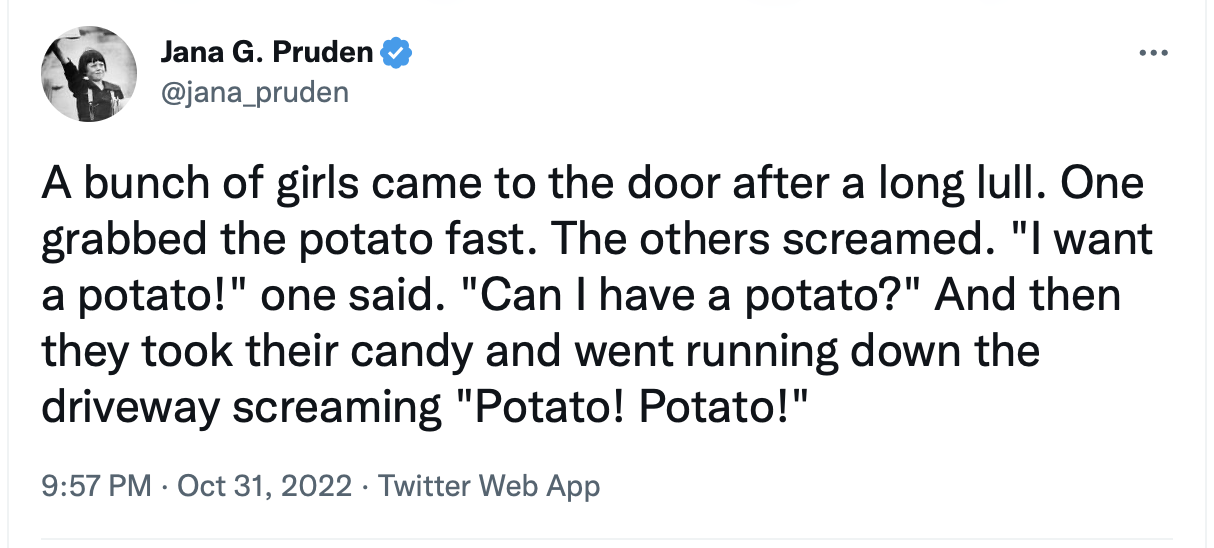
Do children prefer candy or potatoes? It’s not the most rigorous experiment of all time, but this informal halloween study by @jana_pruden suggests that many if not most children prefer the potato (as do 77% of twitter respondents). Someone should do a replication, maybe next halloween?
Hacker News comment claiming that it is 100x brighter outside than inside. “I bring this up because one of the largest factors in myopia development appears to be outdoor light exposure in childhood.”
If you’re worried about the death of twitter, why not move to Twitter 2, a Google form and Google doc maintained by a math professor at the University of Toronto.
Simon Sarris on twitter argues that B12 deficiency is common, and may be the cause of what is often diagnosed as anxiety, executive dysfunction, depression, and even autism. If he’s right, this would be pretty easy to study and would be an amazing finding. We haven’t gotten a chance to take a close look yet, curious to know if people think this theory is plausible.
@CollinLysford shares an interesting test from @qkate that claims to reliably distinguish between chronic fatigue and depression. Ask your patient, “if you felt completely better tomorrow, what would you do?” If they go, “idk”, it’s depression. If they describe a huge list of things they would love to pursue, it’s chronic fatigue. Whether or not this test actually works for depression vs. CFS, Collin is entirely right that this is the kind of “ontological firepower” we need more of.
Command+F to search documents for text strings has changed scholarship. Tools like this OpenAI API from Dwarkesh Patel will change it even more.
Dapplegrim is a Norwegian fairy tale collected by Peter Christen Asbjørnsen and Jørgen Moe in their Norske Folkeeventyr. A man comes home to find that his parents are dead and his elder brothers have split up the family fortune — all he’s inherited are 12 mares, each of which has just had a foal. He praises the most beautiful foal, which tells him he should kill all the other foals and let it drink the milk of all 12 mares for a year. The young man is like “sure sounds reasonable” (“Yes, the lad was ready to do that; so he killed all those twelve foals, and went home again”), kills the other foals, and comes back a year later to find the foal “so fat and sleek, that the sun shone from its coat”. Events escalate to the point where the man and the giant horse go to hell and kidnap the Devil’s horse to win the hand of the princess in marriage.
Nicky Case is doing an unofficial Potato Diet 3-Month Follow-Up Survey, at that link. Nicky is doing this because she’s “too impatient for the 6-month follow-up, and also because a 6-month follow-up wouldn’t be able to tell the difference between ‘weight regained at fast as the original weight loss’, and ‘weight regained at 1/6 the rate as the original weight loss’.” If you participated in the potato diet and you’re interested, consider filling it out!
Paper from 2020: negative association between percentage of obese people and water hardness in water purification plants (in Japan, which may not be all that representative.) The correlation is about r = 0.5, but the sample size is only 9 regions. The paper says this is statistically significant but unless we’re missing something, r = 0.5 shouldn’t be significant with n = 9. So probably don’t take this one too seriously but still, food for thought.
Dana Fischer “is an American Magic: The Gathering player. She is tied for the youngest to make the second day of a Grand Prix tournament (at age eight) and is the youngest to win cash at a Grand Prix (at age nine). … Her father started teaching both daughters Magic when they were very young, before they could read the card text. They learned to play by memorizing the cards. … After they learned to read, the process went faster.” Inevitable comparison to the Polgár Sisters.
Friend of the blog @atroyn is starting a new grant program: “if you sleep on a mattress on the floor anywhere in the bay area, if accepted someone will come to your house and install a bed frame” (actually by this point applications are closed)
Living plant controls a machete through an industrial robot arm. “Plant machete has a control system that reads and utilizes the electrical noises found in a live philodendron. The system uses an open source micro-controller connected to the plant to read varying resistance signals across the plant’s leaves.”
*Poem by One Named Huie from Heungshan Encouraging the Traveler*
Just talk about going to the land of the Flowery Flag and my countenance fills with happiness. Not without hard work were one thousand pieces of gold dug up and gathered together. There were words of farewell to the parents, but the throat choked up first. There were many feelings, many tears flowing face to face, when parting with the wife. Waves big as mountains often astonished this traveler. With laws harsh as tigers, I had a taste of all the barbarities. Do not forget this day when you land ashore. Push yourself ahead and do not be lazy or idle.
What is this cartoon? Tens of thousands of people on twitter looked, and for a long time, no one could identify it. But eventually they managed to track it down — it’s a still from a 1991 TV movie about how “’soulmates’ from another planet” teach Earth people that confidence can help to save Christmas. Sometimes it takes a million eyes to solve a mystery, but on the internet, we HAVE a million eyes.
Aella releases the results of a new study where she “asked trans people how much their preference for various sexual things changed after hormone replacement therapy”. She describes her sample size as “real low”, but 300 is much higher than most psychology studies (which famously often have a mere 20 people per condition). Some criticism from Liminal Warmth on twitter here — Lim says “I don’t think much at all can be drawn in terms of generalizable or solid conclusions from this data set” and points out that there are alternative explanations for Aella’s findings. This is true, but we think it’s the wrong way to look at things. There are always alternative explanations, and the value of a study usually depends on how many explanations it rules out, how much it narrows things down, not how many alternatives are left. Someone might predict, for example, that taking estrogen would make a person much less interested in most sexual preferences, but Aella’s results provide pretty strong evidence against that story. There are limitations to the dataset but there was basically nothing before and now there’s something, so kudos to her. This is what research looks like, and we’re excited to see what Aella does next.
One of the earliest pieces to argue against the use of tobacco is the treatise A Counterblaste to Tobacco, written by King James VI of Scotland / I of England. James blames Native Americans for this public-health scourge, but you have to admit that he writes with some style — he calls smoking “a custome lothsome to the eye, hatefull to the Nose, harmefull to the braine, dangerous to the Lungs, and in the blacke stinking fume thereof, neerest resembling the horrible Stigian smoke of the pit that is bottomelesse.”
Eukaryote Writes Blog reviews the book Barriers to Bioweapons (an old review actually, from 2017). Among many other things: “the book also relays an anecdote from Shoko Ashara, the head of the Aum Shinrikyo cult, who after its bioterrorism project failure ‘speculat[ed] that U.S. assessments of the risk of biological terrorism were designed to mislead terrorist groups into pursuing such weapons.’”
The skill of these once ubiquitous mammals has been recognized by U.S. authorities, who on various occasions in the past parachuted beavers into wilderness areas to restore watersheds.
The U.K. is also conducting controlled trials using the animals to slow water along river systems and prevent flooding, Gies said, but some folks aren’t waiting for official outcomes.
“Some people have been releasing wild beavers illegally. Guerrilla beavering, if you will, because of their ability to heal ecosystems.”
The comment from user left_the_center on this NY Mag piece — “‘Quiet quitting’, ‘cancel culture’, ‘identity politics’ – these are all press-ready phrases designed to stir up disingenuous debates that center responsibility for bad systems on the people subject to those systems.” Whether or not you agree with the conclusion, it highlights how so much culture war is based around attempts to reframe things without drawing attention to the reframing.
Rambling essay on don’t read the news / talk about risk in order to act, don’t just complain / Pets.com was good, actually / “modern especially western societies is multiple generations of people not asking themselves if things are good or bad and instead asking if things are legal or illegal.” Roundabout in places but a good attempt to point at some pretty common brainworms.
Étienne Fortier-Dubois on Prompt Engineering for Humans. A really nice roundup of some great old writing techniques.
Rachel B. (@Procraftinate) on twitter pointed us to this psychiatrist claiming that moderately high doses of zinc (“15 mg twice per day for adolescents, and up to 30 mg twice per day for adults”) is an effective treatment for anorexia. We suspect that anorexia is a paradoxical reaction to whatever contaminant(s) cause obesity, so we’ve been looking into it more. We found some studiessuggesting that zinc can protect against the negative side-effects of lithium exposure, with hints of some other relationships (all in rats, naturally). Curious to know what people think or if this suggests any more connections. FWIW, we asked a physician we know who said, “this article has a bit of a fishy vibe imo. Specifically, I find it really irritating to read because it’s awfully sloppy.”
Vampire Survivors Success: An opportunity in the Steam marketplace. The essay is theoretically about games, but the design lessons are good in general – “Ryanair has figured out that the only thing people really, truly, care about is getting from one spot to the next safely and cheaply. People complain about the lack of amenities but in reality, passengers actually care more about the price. That is why Ryanair focuses EVERYTHING they have on those things: getting people to where they need to go safely, cheaply, and on time. To hell with everything else. “
Learn piano in AR. Piano Hero. Honestly surprised that it’s taken this long.
We haven’t confirmed any of these claims, but check out this thread on the history of the atomic bomb. “The timing of the bombs was not due to any strategic or political calculus. It came down to the weather — an operational choice. The people on Tinian dropped a second bomb because they had a second bomb ready to go, and because their strike order was open-ended. … many of the military-operational types didn’t think one or two bombs would cause Japan to surrender anyway … General Marshall was having his people think about how to use the bombs in conjunction with an invasion — imagining a world in which they might have an atomic bomb to use every 10 days or so … they had a pipeline that they thought could make 3.5 atomic bombs per month, and the military wanted to use them.”
The US Air Force built a fake town in the middle of the Arizona desert to practice bombing, and they named it “Yodaville”. Surprisingly this town does not seem to have been named after the Star Wars character — it was named after the call sign of the guy who had the idea of making a fake bombing-target town in the first place, though his call sign presumably came from the Star Wars character.
Large pieces of space junk land in a field in Australia. “I think it’s a concern it’s just fallen out of the sky,” says a local. “If it landed on your house it would make a hell of a mess.” Also: “I’m a farmer from Dalgety, what am I going to say to NASA?”
Gods of Salt — Uh, claims? About what you would expect from a theory of history posted on DeviantArt, but a pretty good read nonetheless.
Some translation stories are more interesting than others — this one, about one woman’s quest to translate The Egyptian Book of the Dead, is more interesting than most.
pokemon cellular automata — “we quickly see areas of fire > water > grass > fire, electric sweeping over, ground frontiers taking over etc etc … Bug is always obliterated almost immediately”
When an essay begins “Should you eat boogers practice automucophagy?”, you know it’s going to be good about eating boogers. Seriously, it’s an interesting post, and ends with two proposed experiment designs.
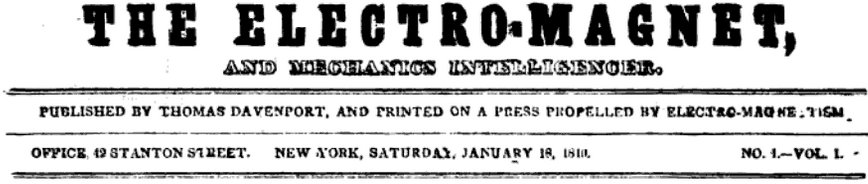
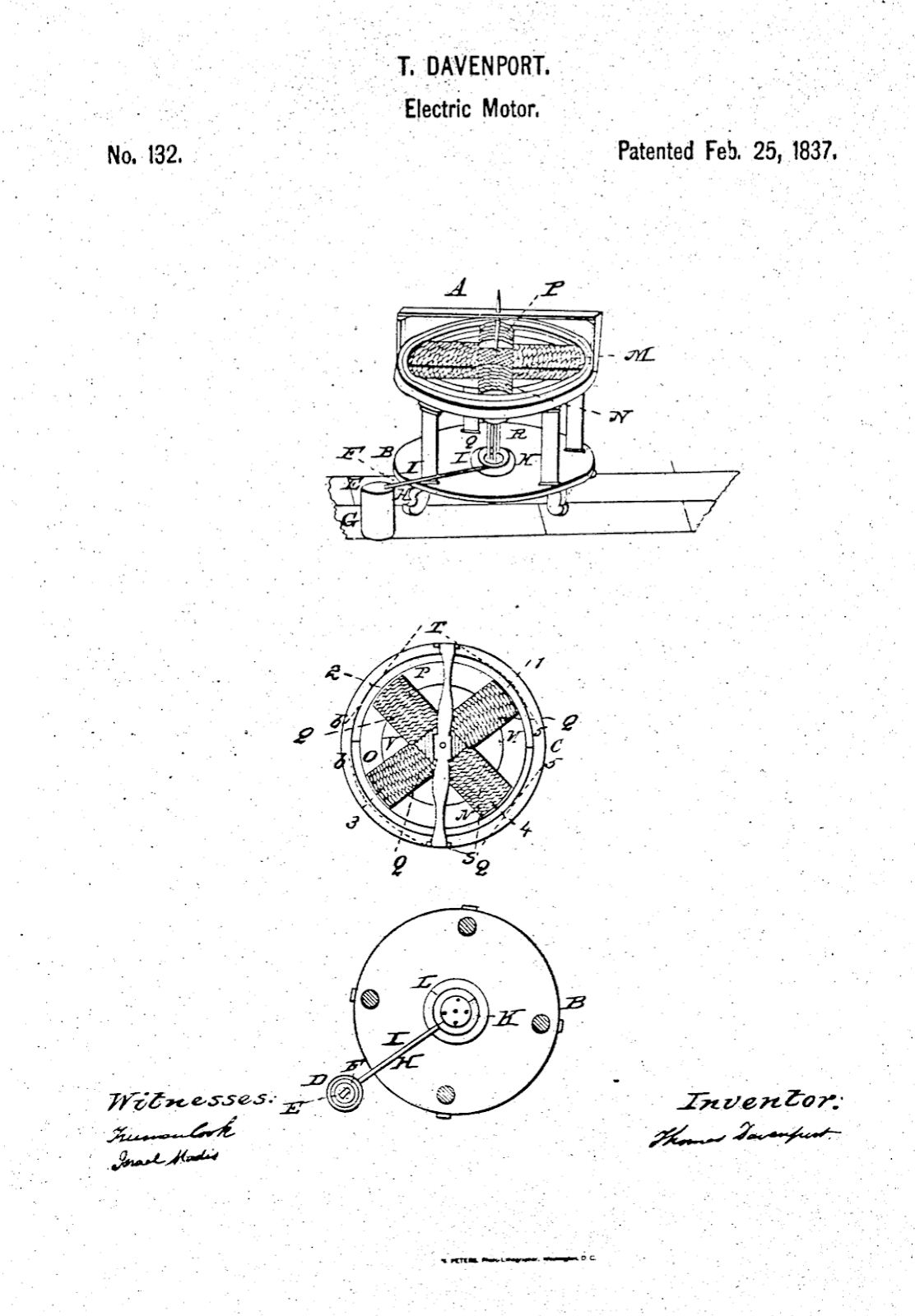
Thomas Davenport was a Vermont blacksmith who worked with his wife Emily Davenport to construct the first American DC electric motor in 1834. They first used it to operate a small car, and in 1837, received the first American patent on an electric machine. The Davenports went on to use their electric motor to print a newspaper called The Electro-Magnetic and Mechanics Intelligencer, the first newspaper printed using electricity. Based on the eccentric character of the publishers and the name of the newspaper, we’d like to culturally claim this as the first blog as well. Like most good blogs, it lasted only a few issues.
The Atlantic recently released its full archive dating back to the 1850s, and people have discovered such gems as “I Married a Jew” by Anonymous (h/t this tweet, looks like the account got suspended…). It is uh, it is a lot. Literally every paragraph. It makes it hard to know what paragraph to quote for you, but well, here’s one: “I try to tell Ben,” the anonymous author says of her husband, “that Hitler is merely writing another page in a history that will continue so long as the status quo between Jews and Gentiles remains—a status that only the willing shoulders of both protagonists can remove. But it is hard for Ben to take the long view. He looks upon Hitler as something malignantly unique, and it is no use trying to tell him that a hundred years hence the world will no more call Hitler a swine for expelling the Jews than it does Edward I of England, who did the same thing in the thirteenth century.” In this and other stories from the archives of The Atlantic, there’s a definite air of “haha oh why are the Jews so worried about antisemitism? (THE YEAR IS 1939).” Presumably The Atlantic regrets this error.
Ok, ok, here’s the actual rickrolling paper. “Based on a careful manual assessment, we confirm that there are 24 academic documents for which the intention is clearly to rickroll the reader, with no relationship between the topic of the document and the link. This means that rickrolling is significantly more practiced (33x) than studied (10x) in the academic literature.” Seriously, click on it. Go ahead. We would never let you down.
The ACX book review of Haidt’s The Righteous Mind this month was particularly interesting. We had two thoughts we wanted to share. First, we loved the political analysis, but we’re surprised that still no one has pointed out that if the purity foundation is conservative, and purity is about avoiding disease, it seems like Haidt’s model would have predicted that conservatives would freak out majorly about COVID and liberals, who lack the purity foundation, would blow it off. Clearly this was not what happened, and it seems like a strike against the theory. Second, the author of the book review expresses concern that Haidt “doesn’t show his work” and “there’s no explanation of how he got from his data to his moral foundations”. In defense of Haidt’s data, if you feed responses to Haidt’s MFQ survey items into a factor analysis, the factors really do come out into those five foundations like he says they do. Whether those items are a good selection is a thornier issue.
Claims: Queen Elizabeth II is a distant descendant of Muhammed
Air pollution in China is associated with weight gain; “Specifically, a 1 μg/m3 (1.59%) increase in average PM2.5 concentrations in the past 12 months increases BMI by 0.31%, and further increases the overweight and obesity rates by 0.89 and 0.19 percentage points, respectively.” (h/t arpitrage)
A research project has been culturing 12 populations of E. coli since 1988 and tracking their evolution. “My bias going into the experiment was that all the strains would go off in very different directions. I was thinking that the roles of chance and contingency in evolution would have been larger than they were. And over the years, we’ve actually seen just striking amounts of reproducibility. So although a typical line has improved its relative fitness compared with the ancestor by maybe 70% or 80%, the variance in competitive fitness between most lines is more like just a few per cent. So they’ve all tremendously increased, but very similarly to one another.”
Slime Mold Time Mold endorses Becca Balint for US Congress. One part of her platform jumped out to us in particular — she hopes to make rent, the largest cost-of-living expense for most people, tax deductible.
“Pentagon guru” Edward Luttwak, 79 years old, spills the beans on geopolitics, Xi Jinping’s obsession with Goethe (and Faust in particular), and what it’s like to grow up with the Mafia bosses’ children in Sicily.
Scott Alexander is running another book review contest. As former ACX Book Review bronze medalists, here are our favorites so far: The Future Of Fusion Energy for an engaging technical overview and optimistic take on fusion power in the next few decades, The Dawn Of Everything for a critical take on a provocative book and a surprisingly strong argument that prehistory was socially very much like high school, The Castrato for lots of weird facts about Castrati and speculation “that sometime this century a new landscape of biological and psychological possibilities will open up before us”, and Making Nature on how the journal Nature went from a pop science venue to a prestige publication in a surprisingly brief window. Excellent work, chaps.
New in Interactive Instruction: Mark Brown has a new platformer toolkit interactive which “drops you in to a crummy-feeling platformer – and then gives you all the tools to make it better.”