Science education usually starts with teaching students different tools and techniques, methods for conducting research.
This is wrong. Science education should begin with the scientific virtues.
Teaching someone painting techniques without teaching them composition will lead to lifeless paintings. Giving business advice to someone who lacks civic duty will lead to parasitic companies. Teaching generals strategy without teaching them honor gets you warlords. So teaching someone the methods of science without teaching them the virtues will lead to dull, pointless projects. Virtue is the key to happy, creative, important, meaningful research.
The scientific virtues are:
- Stupidity
- Arrogance
- Laziness
- Carefreeness
- Beauty
- Rebellion
- Humor
These virtues are often the opposite of the popular image of what a scientist should look like. People think scientists should be intelligent. But while it’s helpful to be clever, it’s more important to be stupid. People think scientists are authority figures. Really, scientists have to defy authority — the best scientists are one step (or sometimes zero steps) away from being anarchists. People think scientists are arrogant, and this is true, but we worry that scientists are not arrogant enough.
Anyone who practices these virtues is a scientist, even if they work night shifts at the 7-11 and learned everything they know about statistics from twitter. Anyone who betrays these virtues is no scientist at all, even if they’ve got tenure at Princeton and have a list of publications long enough to run from Cambridge to New Haven.
Cultivating virtue is the most important way to become a better scientist. Many people want to be scientists but are worried that they are not smart enough, or not talented enough. It’s true that there is not much you can do to become smarter, and you are mostly stuck with the talents you were born with. But virtues can be cultivated infinitely — there is no limit to how good you can get at practicing them. Anyone can become a better scientist by practicing these virtues — maybe even a great scientist.
Stupidity
The great obstacle to discovering the shape of the earth, the continents, and the oceans was not ignorance, but the illusion of knowledge.
— Daniel Boorstin
To a large extent, your skill as a researcher comes down to how well you understand how dumb you are, which is always “very”. Once you realize how stupid you are, you can start to make progress.
A different writer might say “humility” here rather than stupidity. But calling this virtue humility might make you feel smug and self-satisfied, which is not the right feeling at all. Instead, you should feel dumb. The virtue of stupidity is all about feeling like a tiny mote in a vast universe that you don’t understand even a little bit, and calling it humility doesn’t strike that note.
Great scientists are not especially humble, as we shall see in just a minute. But they are stupid — they are practiced in practicing ignorance. They have cultivated the virtue of saying and doing things that are just entirely boneheaded, because this is vital to the process of discovery, and more important, it is relaxing and fun.
It seems necessary to me, then, that all people at a session be willing to sound foolish and listen to others sound foolish.
— Isaac Asimov
Stupidity is all about preparing you to admit when you’re facing a problem where you don’t know what is going on, which is always. This allows you to ask incredibly dumb questions at any time.
People who don’t have experience asking stupid questions don’t understand how important they can be. Try asking more and dumber questions — lean in on how stupid you are. You will find the world opening up to you. Ignorant questions are revealing!
I took mechanical drawing when I was in school, but I am not good at reading blueprints. So they unroll the stack of blueprints and start to explain it to me, thinking I am a genius. …
I’m completely dazed. Worse, I don’t know what the symbols on the blueprint mean! There is some kind of a thing that at first I think is a window. It’s a square with a little cross in the middle, all over the damn place. I think it’s a window, but no, it can’t be a window, because it isn’t always at the edge. I want to ask them what it is.
You must have been in a situation like this when you didn’t ask them right away. Right away it would have been OK. But now they’ve been talking a little bit too long. You hesitated too long. If you ask them now they’ll say, “What are you wasting my time all this time for?”
What am I going to do? I get an idea. Maybe it’s a valve. I take my finger and I put it down on one of the mysterious little crosses in the middle of one of the blueprints on page three, and I say, “What happens if this valve gets stuck?” — figuring they’re going to say, “That’s not a valve, sir, that’s a window.”
So one looks at the other and says, “Well, if that valve gets stuck –” and he goes up and down on the blueprint, up and down, the other guy goes up and down, back and forth, back and forth, and they both look at each other. They turn around to me and they open their mouths like astonished fish and say, “You’re absolutely right, sir.”
So they rolled up the blueprints and away they went and we walked out. And Mr. Zumwalt, who had been following me all the way through, said, “You’re a genius. I got the idea you were a genius when you went through the plant once and you could tell them about evaporator C-21 in building 90-207 the next morning,” he says, “but what you have just done is so fantastic I want to know how, how do you do that?”
I told him you try to find out whether it’s a valve or not.
― Richard Feynman
Asking dumb questions was a particular favorite of Richard Feynman, who really cannot recommend it strongly enough:
That was for me: I can’t understand anything in general unless I’m carrying along in my mind a specific example and watching it go. Some people think in the beginning that I’m kind of slow and I don’t understand the problem, because I ask a lot of these “dumb” questions: “Is a cathode plus or minus? Is an anion this way, or that way?”
But later, when the guy’s in the middle of a bunch of equations, he’ll say something and I’ll say, “Wait a minute! There’s an error! That can’t be right!”
The guy looks at his equations, and sure enough, after a while, he finds the mistake and wonders, “How the hell did this guy, who hardly understood at the beginning, find that mistake in the mess of all these equations?”
— Richard Feynman
Reading about the lives of talented researchers, ones who have been praised by their peers and made stunning discoveries, you pretty quickly notice that they are not afraid at all of seeming or being very dumb, or very ignorant. For example, we can consider Niels Bohr, who won the Nobel Prize in Physics in 1922 for his pioneering work in quantum mechanics:
It is practically impossible to describe Niels Bohr to a person who has never worked with him. Probably his most characteristic property was the slowness of his thinking and comprehension. … In the evening, when a handful of Bohr’s students were “working” in the Paa Blegdamsvejen Institute, discussing the latest problems of the quantum theory, or playing ping-pong on the library table with coffee cups placed on it to make the game more difficult, Bohr would appear, complaining that he was very tired, and would like to “do something.” To “do something” inevitably meant to go to the movies, and the only movies Bohr liked were those called The Gun Fight at the Lazy Gee Ranch or The Lone Ranger and a Sioux Girl. But it was hard to go with Bohr to the movies. He could not follow the plot, and was constantly asking us, to the great annoyance of the rest of the audience, questions like this: “Is that the sister of that cowboy who shot the Indian who tried to steal a herd of cattle belonging to her brother-in-law?” The same slowness of reaction was apparent at scientific meetings. Many a time, a visiting young physicist (most physicists visiting Copenhagen were young) would deliver a brilliant talk about his recent calculations on some intricate problem of the quantum theory. Everybody in the audience would understand the argument quite clearly, but Bohr wouldn’t. So everybody would start to explain to Bohr the simple point he had missed, and in the resulting turmoil everybody would stop understanding anything. Finally, after a considerable period of time, Bohr would begin to understand, and it would turn out that what he understood about the problem presented by the visitor was quite different from what the visitor meant, and was correct, while the visitor’s interpretation was wrong.
— George Gamow on Niels Bohr
Great scientists were generally quite stupid, though we admit that some of them may have been stupider than others. More notably, most of them seem to have known it!
The first thing Bohr said to me was that it would only then be profitable to work with him if I understood that he was a dilettante. The only way I knew to react to this unexpected statement was with a polite smile of disbelief. But evidently Bohr was serious. He explained how he had to approach every new question from a starting point of total ignorance. It is perhaps better to say that Bohr’s strength lay in his formidable intuition and insight rather than erudition.
— Abraham Pais
Some of this is about fear. If you accept your ignorance, you will be aware of how stupid you are. Being afraid of being stupid, or seeming stupid, will lead you to make lots of mistakes. You will be afraid to look for mistakes; you will not double-check your work with the same level of care; you will be afraid that if people find out about your mistakes, they will laugh and think you are an idiot. Once you have accepted in full confidence that you, along with all other scientists, are in fact idiots, you will no longer be worried about this. You will notice your own mistakes, or others will notice them for you, and you will laugh it off. “I’m so glad someone caught this!” you will say.
You see, one thing is, I can live with doubt and uncertainty and not knowing. I think it’s much more interesting to live not knowing than to have answers which might be wrong. I have approximate answers and possible beliefs and different degrees of certainty about different things, but I’m not absolutely sure of anything and there are many things I don’t know anything about, such as whether it means anything to ask why we’re here, and what the question might mean. I might think about it a little bit and if I can’t figure it out, then I go on to something else, but I don’t have to know an answer, I don’t feel frightened by not knowing things, by being lost in a mysterious universe without having any purpose, which is the way it really is so far as I can tell, possibly. It doesn’t frighten me.
― Richard Feynman
Mistakes are inevitable! You are a dummy; you will sometimes be wrong. It is ok to be wrong. If you’re not willing to accept that sometimes you’re wrong, you will have a hard time ever being right. Be wrong with confidence.
Don’t worry too much about your intellectual gifts. Despite popular misconceptions, a lack of IQ won’t hold you back. If you are really dumb and know it, you have a leg up on the smart people who, on a cosmic scale, are still stupid, but haven’t realized it yet.
Brains are nice to have, but many people who seem not to have great IQs have done great things. At Bell Telephone Laboratories Bill Pfann walked into my office one day with a problem in zone melting. He did not seem to me, then, to know much mathematics, to be articulate, or to have a lot of clever brains, but I had already learned brains come in many forms and flavors, and to beware of ignoring any chance I got to work with a good man. I first did a little analytical work on his equations, and soon realized what he needed was computing. I checked up on him by asking around in his department, and I found they had a low opinion of him and his idea for zone melting. But that is not the first time a person has not been appreciated locally, and I was not about to lose my chance of working with a great idea—which is what zone melting seemed to me, though not to his own department!
— Richard Hamming
Stupidity can also be part of the inspiration behind the virtue of rebellion, a scientist’s ability to defy authority figures. If you’re stupid, you don’t realize when you should keep your mouth shut, so you say what you really think. Feynman again:
The last time he was there, Bohr said to his son, “Remember the name of that little fellow in the back over there? He’s the only guy who’s not afraid of me, and will say when I’ve got a crazy idea. So next time when we want to discuss ideas, we’re not going to be able to do it with these guys who say everything is yes, yes, Dr. Bohr. Get that guy and we’ll talk with him first.” I was always dumb in that way. I never knew who I was talking to.
Maybe more important is that accepting your stupidity helps you cultivate the virtue of being carefree. If you think you have a great mind, you will feel a lot of pressure to work on things that are “challenging” and “important”. But you will never get anything done if you stress out about this kind of thing, and more seriously, you will never have any fun.
Perhaps one of the most interesting things that I ever heard him say was when, after describing to me an experiment in which he had placed under a bell-jar some pollen from a male flower, together with an unfertilized female flower, in order to see whether, when kept at a distance but under the same jar, the one would act in any way on the other, he remarked: — “That’s a fool’s experiment. But I love fools’ experiments. I am always making them.”
— E. Ray Lankester, recalling Charles Darwin
Arrogance
My goal is simple. It is a complete understanding of the universe, why it is as it is and why it exists at all.
— Stephen Hawking
Arrogance is the complement of stupidity, the yang to stupidity’s yin. Being stupid is all about recognizing that you know nothing about everything, and in fact you have little chance of ever understanding much about anything. Having accepted such complete ignorance, you must then be extraordinarily arrogant to think that you could ever make an original discovery, let alone solve a problem that has baffled people for generations. But this is exactly what we aim to do. To complement their stupidity, a scientist must also be arrogant beyond all measure.
No one else knows anything either, so when it comes to figuring something out for the first time, you have as good a shot at it as anyone else does! Why not go for it, after all?
The condition of matter I have dignified by the term Electronic, THE ELECTRONIC STATE. What do you think of that? Am I not a bold man, ignorant as I am, to coin words?
— Michael Faraday
Most people have the good sense to know what is realistic and practical, and to laugh at people who think they can do the impossible. So you have to be very dumb indeed, to be arrogant enough to think that you can change the world!
Who would not have been laughed at if he had said in 1800 that metals could be extracted from their ores by electricity or that portraits could be drawn by chemistry.
— Michael Faraday
A great gap in research is between people who try things and people who sit around thinking about whether to try things. Truly, aiming low is a dead end. Aiming low is boring.
Confidence in yourself, then, is an essential property. Or, if you want to, you can call it “courage.” Shannon had courage. Who else but a man with almost infinite courage would ever think of averaging over all random codes and expect the average code would be good? He knew what he was doing was important and pursued it intensely. Courage, or confidence, is a property to develop in yourself. Look at your successes, and pay less attention to failures than you are usually advised to do in the expression, “Learn from your mistakes.” While playing chess Shannon would often advance his queen boldly into the fray and say, “I ain’t scared of nothing.”
— Richard Hamming
You will not always be right. Often you will be wrong. This is why stupidity comes before arrogance, because you have to be prepared to make lots of dumb mistakes. If you are prepared to make dumb mistakes, you can act with confidence. You will put ideas out there that you think might be wrong. But sometimes you will surprise yourself.
Is it dangerous to claim that parents have no power at all (other than genetic) to shape their child’s personality, intelligence, or the way he or she behaves outside the family home? … A confession: When I first made this proposal ten years ago, I didn’t fully believe it myself. I took an extreme position, the null hypothesis of zero parental influence, for the sake of scientific clarity. Making myself an easy target, I invited the establishment — research psychologists in the academic world — to shoot me down. I didn’t think it would be all that difficult for them to do so. … The establishment’s failure to shoot me down has been nothing short of astonishing.
— Judith Rich Harris for Edge
Like stupidity, arrogance is linked to the virtue of rebellion. If you think you are hot shit, you will not be afraid to go against the opinions of famous writers, ivy-league professors, public officials, or other great minds.
The idea that smashed the old orthodoxy got its start on Christmas 1910, as Wegener (the W is pronounced like a V) browsed through a friend’s new atlas. Others before him had noticed that the Atlantic coast of Brazil looked as if it might once have been tucked up against West Africa, like a couple spooning in bed. But no one had made much of it, and Wegener was hardly the logical choice to show what they had been missing. He was a lecturer at Marburg University, not merely untenured but unsalaried, and his specialties were meteorology and astronomy, not geology.
But Wegener was not timid about disciplinary boundaries, or much else. He was an Arctic explorer and a record-setting balloonist, and when his scientific mentor and future father-in-law advised him to be cautious in his theorizing, Wegener replied, “Why should we hesitate to toss the old views overboard?”
— Richard Conniff for Smithsonian Magazine
You shouldn’t cultivate arrogance in a way that makes you an asshole, though some scientists have made this mistake. This virtue is not about thinking that you are better than other people. Forget about other people. It is about thinking that you have the potential to be really good — to be damn good. It is about moving with extreme confidence. You cultivate arrogance so that if someone says, “that’s very arrogant of you!” you respond, “so what?”
Laziness
Study hard what interests you the most in the most undisciplined, irreverent and original manner possible.
— Richard Feynman
Everyone knows that research requires hard work. This is true, but your hard work has to be matched by a commitment to relaxation, slacking off, and fucking around when you “should” be working — that is, laziness.
Laziness is not optional — it is essential. Great work cannot be done without it. And it must be cultivated as a virtue, because a sinful world is always trying to push back against it.
Leonardo, knowing that the intellect of that Prince was acute and discerning, was pleased to discourse at large with the Duke on the subject… and he reasoned much with him about art, and made him understand that men of lofty genius sometimes accomplish the most when they work the least, seeking out inventions with the mind, and forming those perfect ideas which the hands afterwards express and reproduce from the images already conceived in the brain.
— Giorgio Vasari
Hard work needs to happen to bring an idea to fruition, but you cannot work hard all the time any more than a piston can be firing all the time, or every piston in an engine can fire at once. Pistons are always moving up and down. A piston moves up; it fires; but that action is matched by the piston moving down, and spending some time not firing. It would be foolish to complain that the piston is not firing all the time, but this is what some people do in trying to work hard all the time. They are trying to keep the piston in the down position the whole time, not recognizing that this will stop the piston from firing again, and will damage the whole engine.
They would do better to cultivate the virtue of laziness, and go take a nap or stare at the clouds or play fetch with their dog or something. Taking a nap is just turning your brain off and then on again, which solves 90% of my computer problems.
Albert Einstein once asked a friend of mine in Princeton, “Why is it I get my best ideas in the morning while I’m shaving?” My friend answered, as I have been trying to say here, that often the mind needs the relaxation of inner controls — needs to be freed in reveries or day dreaming — for the unaccustomed ideas to emerge.
— Rollo May
Mathematicians are not exactly scientists, but they certainly have one of the best claims on pure idea work. So you might expect that for mathematicians, more time spent working would lead to more results. But apparently not. G.H. Hardy, one of the great British mathematicians of the 20th century, started his mornings by reading the cricket scores (or when cricket was not in season, the Australian cricket scores). He would work only from 9 to 1, after which he would eat lunch, play tennis, or (surprise) watch a game of cricket. His collaborator John Edensor Littlewood said:
You must also acquire the art of ‘thinking vaguely,’ an elusive idea I can’t elaborate in short form. After what I have said earlier, it is inevitable that I should stress the importance of giving the subconscious every chance. There should be relaxed periods during the working day, profitably, I say, spent in walking. … On days free from research, and apart from regular holidays, I recommend four hours [of work] a day or at most five, with breaks about every hour (for walks perhaps). If you don’t have breaks you unconsciously acquire the habit of slowing down.
— John Edensor Littlewood
Henri Poincaré is perhaps the best example. He was something of a mathematician but also worked in physics and engineering, and he worked around four hours a day. Poincaré happened to have several experiences where hard work failed to crack a problem, but laziness or relaxation did the trick; for example, drinking coffee too late and messing up his sleep schedule:
For fifteen days I strove to prove that there could not be any functions like those I have since called Fuchsian functions. I was then very ignorant; every day I seated myself at my work table, stayed an hour or two, tried a great number of combinations and reached no results. One evening, contrary to my custom, I drank black coffee and could not sleep. Ideas rose in crowds; I felt them collide until pairs interlocked, so to speak, making a stable combination. By the next morning I had established the existence of a class of Fuchsian functions, those which come from the hypergeometric series; I had only to write out the results, which took but a few hours.
— Henri Poincaré
Or, even more effortless, getting onto a bus:
I left Caen, where I was living, to go on a geological excursion under the auspices of the School of Mines. The incidents of the travel made me forget my mathematical work. Having reached Coutances, we entered an omnibus to go some place or other. At the moment when I put my foot on the step the idea came to me, without anything in my former thoughts seeming to have paved the way for it, that the transformations I had used to define the Fuchsian functions were identical with those of non-Euclidean geometry. I did not verify the idea; I should not have had time, as, upon taking my seat in the omnibus, I went on with a conversation already commenced, but I felt a perfect certainty. On my return to Caen, for conscience’s sake I verified the result at my leisure.
…
Then I turned my attention to the study of some arithmetical questions apparently without much success and without a suspicion of any connection with my preceding researches. Disgusted with my failure, I went to spend a few days at the seaside and thought of something else. One morning, while walking on the bluff, the idea came to me, with just the same characteristics of brevity, suddenness and immediate certainty, that the arithmetic transformations of indefinite ternary quadratic forms were identical with those of non-Euclidean geometry.
— Henri Poincaré
(In fact there seems to be something about buses. If you are working on a problem you just can’t crack, maybe take a bus ride?)
In 1865, Kekulé himself came up with the answer. He related some years later that the vision of the benzene molecule came to him while he was riding on a bus and sunk in a reverie, half asleep. In his dream, chains of carbon atoms seemed to come alive and dance before his eyes, and then suddenly one coiled on itself like a snake. Kekulé awoke from his reverie with a start.
— Isaac Asimov
Poincaré and Kekulé aren’t the only ones. For Linus Pauling, a head cold and pulpy detective novels seems to have done the trick:
In Oxford, it was April, I believe, I caught cold. I went to bed, and read detective stories for a day, and got bored, and thought why don’t I have a crack at that problem of alpha keratin.
— Linus Pauling
This was one of the one of the many achievements that led to his Nobel Prize in Chemistry in 1954. So next time you think, “I shouldn’t read detective stories until I get bored, I should be working,” please reconsider.
Insight comes suddenly and without warning, but rarely when you have your nose to the grindstone. So spend some time staring out your dormitory window. If you don’t learn to be lazy, you might miss it.
Carefreeness
I lie on the beach like a crocodile and let myself be roasted by the sun. I never see a newspaper and don’t give a damn for what is called the world.
— Albert Einstein, letter to Max Born
The hardest of the scientific virtues to cultivate may be the virtue of carefreeness. This is the virtue of not taking your work too seriously. If you try too hard, you get serious, you get worried, you’re not carefree anymore — you see, it’s a problem.
So I got this new attitude. Now that I am burned out and I’ll never accomplish anything, I’ve got this nice position at the university teaching classes which I rather enjoy, and just like I read the Arabian Nights for pleasure, I’m going to play with physics, whenever I want to, without worrying about any importance whatsoever.
Within a week I was in the cafeteria and some guy, fooling around, throws a plate in the air. As the plate went up in the air I saw it wobble, and I noticed the red medallion of Cornell on the plate going around. It was pretty obvious to me that the medallion went around faster than the wobbling.
I had nothing to do, so I start to figure out the motion of the rotating plate. I discover that when the angle is very slight, the medallion rotates twice as fast as the wobble rate — two to one. It came out of a complicated equation! Then I thought, “Is there some way I can see in a more fundamental way, by looking at the forces or the dynamics, why it’s two to one?”
I don’t remember how I did it, but I ultimately worked out what the motion of the mass particles is, and how all the accelerations balance to make it come out two to one.
I still remember going to Hans Bethe and saying, “Hey, Hans! I noticed something interesting. Here the plate goes around so, and the reason it’s two to one is…” and I showed him the accelerations.
He says, “Feynman, that’s pretty interesting, but what’s the importance of it? Why are you doing it?”
“Hah!” I say. “There’s no importance whatsoever. I’m just doing it for the fun of it.” His reaction didn’t discourage me; I had made up my mind I was going to enjoy physics and do whatever I liked.
I went on to work out equations of wobbles. Then I thought about how electron orbits start to move in relativity. Then there’s the Dirac Equation in electrodynamics. And then quantum electrodynamics. And before I knew it (it was a very short time) I was “playing” — working, really — with the same old problem that I loved so much, that I had stopped working on when I went to Los Alamos: my thesis-type problems; all those old-fashioned, wonderful things.
It was effortless. It was easy to play with these things. It was like uncorking a bottle: Everything flowed out effortlessly. I almost tried to resist it! There was no importance to what I was doing, but ultimately there was. The diagrams and the whole business that I got the Nobel Prize for came from that piddling around with the wobbling plate.
— Richard Feynman
This is related to the scientific virtue of laziness — a carefree person will find it easier to take time off from their work, to relax, go sailing, play ping-pong, etc. But carefreeness is a higher virtue than even laziness is. Being carefree means not worrying and relaxing even when you are working very hard.
If you do not cultivate the sense of carefreeness, you will get all tangled up about not working on “important” problems. You will get all tangled up about working on the things you think you “should be” working on, instead of the things you want to be working on, the things you find fun and interesting.
If research starts to be a drag, it won’t matter how talented you are. Nothing will kill your spark faster than finding research dull. Nothing will wring you out more than working on things you hate but you think are “important”.
This is tricky because there are many different ways you can lose your sense of carefreeness. There are a lot of things that can throw off your groove. The first is becoming attached to worldly rewards — cash, titles, fancy hats, etc.
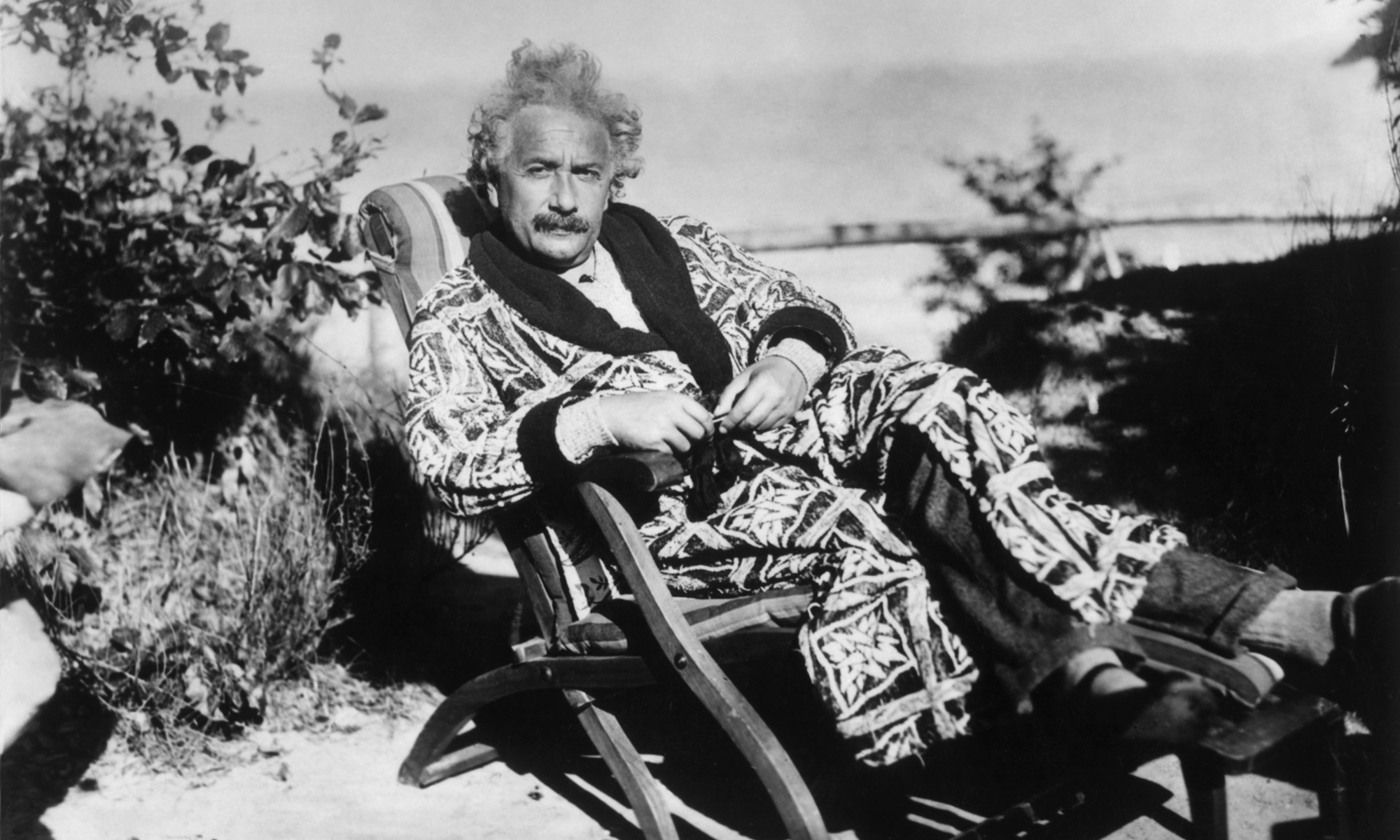
I am happy because I want nothing from anyone. I do not care about money. Decorations, titles or distinctions mean nothing to me. I do not crave praise. The only thing that gives me pleasure, apart from my work, my violin, and my sailboat, is the appreciation of my fellow workers.
— Albert Einstein
When you start seeking these rewards, or even thinking about them too much, the whole research enterprise falls apart. Sometimes this can happen overnight.
You might say, “well surely someone has to think about these practical problems.” It’s true that some people should think about worldly things, but we don’t exactly see a shortage of that. What cannot be forced, and can only be cultivated, are free minds pursuing things that no one else thinks are interesting problems, for no good reason at all.
We must not forget that when radium was discovered no one knew that it would prove useful in hospitals. The work was one of pure science. And this is a proof that scientific work must not be considered from the point of view of the direct usefulness of it. It must be done for itself, for the beauty of science, and then there is always the chance that a scientific discovery may become like the radium a benefit for humanity.
— Marie Curie
The best ideas are almost certainly going to be ones that seem insane or stupid — if they seemed like good ideas, someone would have tried them already. How can there possibly be a market for such ideas? They are left to people who are carefree enough in their spirit to pursue these dumb ideas anyways. Most great advances are preceded by announcements that they are impossible, and you need to be ready and willing to ignore that stuff:
The whole procedure [of shooting rockets into space]… presents difficulties of so fundamental a nature, that we are forced to dismiss the notion as essentially impracticable, in spite of the author’s insistent appeal to put aside prejudice and to recollect the supposed impossibility of heavier-than-air flight before it was actually accomplished.
— Sir Richard van der Riet Woolley, British astronomer, reviewing P.E. Cleator’s “Rockets in Space”, Nature, March 14, 1936
Some people are ok at resisting money and fame. But people find it harder to avoid being swayed by praise. It is easy to want to impress people, and want them to like you. But if you start worrying about praise, two things will happen. First of all, you will be worrying, which will cloud your head. Second, if you are trying to get praise, you will work on problems that are popular. Popular problems are fine, but you have to know that they will be seductive. You should pay more attention to topics you like that aren’t popular.
Focusing on unpopular problems you find fascinating is a good sign that you’re making use of your particular talents. Following praise is a sign you are being led away from your gifts! Taste is really important — follow what you find interesting.
…my work, which I’ve done for a long time, was not pursued in order to gain the praise I now enjoy, but chiefly from a craving after knowledge, which I notice resides in me more than in most other men. And therewithal, whenever I found out anything remarkable, I have thought it my duty to put down my discovery on paper, so that all ingenious people might be informed thereof.
— Antonie van Leeuwenhoek, Letter of June 12, 1716
Another is worrying about being an “expert”, keeping up with the field, staying aware of the latest publications, et cetera. Staying carefree means being happy to ignore these things (if you feel like it).
You can tell really good science because it stays carefree even when the stakes are very high:
I remember a friend of mine who worked with me, Paul Olum, a mathematician, came up to me afterwards and said, “When they make a moving picture about this, they’ll have the guy coming back from Chicago to make his report to the Princeton men about the bomb. He’ll be wearing a suit and carrying a briefcase and so on — and here you’re in dirty shirtsleeves and just telling us all about it, in spite of its being such a serious and dramatic thing.”
— Richard Feynman
Staying carefree is how you keep in touch with what really interests you. It is how you practice going with your gut. It is how you make sure you are still having fun.
No one is doing great work when they are bent over their lab bench thinking, “gee I wish I were doing something else!” Great work doesn’t come from banging your head against your keyboard a little harder.
Alan Turing’s celebrated paper of 1935, which was to provide the foundation of modern computer theory, was originally written as a speculative exploration for mathematical logicians. The war gave him and others the occasion to translate theory into the beginnings of practice for the purpose of code-breaking, but when it appeared nobody except a handful of mathematicians even read, let alone took notice of Turing’s paper.
— Eric Hobsbawm on Alan Turing
We cannot emphasize enough that great work almost always comes from things that at the time seemed like pointless nonsense. Those scientists did it anyway, because it interested them. But to do that you will have to be ready to stand against the world, people telling you that you should be using your gifts on something more productive, that you are wasting your talents! Cultivating this carefreeness will help you ignore them.
A large part of mathematics which becomes useful developed with absolutely no desire to be useful, and in a situation where nobody could possibly know in what area it would become useful; and there were no general indications that it ever would be so. By and large it is uniformly true in mathematics that there is a time lapse between a mathematical discovery and the moment when it is useful; and that this lapse of time can be anything from 30 to 100 years, in some cases even more; and that the whole system seems to function without any direction, without any reference to usefulness, and without any desire to do things which are useful.
— John von Neumann
Not every pointless idea ends up being a great discovery — most of them do not. But a feature you will see over and over again in great scientists is a complete lack of fear when it comes to pursuing ideas that seem like (or truly are) nonsense. You might have to look into 100 dumb ideas before you find one that is any good — in fact, maybe you should start right now.
I’ve noticed that my dog can correctly tell which way I’ve gone in the house, especially if I’m barefoot, by smelling my footprints. So I tried to do that: I crawled around the rug on my hands and knees, sniffing, to see if I could tell the difference between where I walked and where I didn’t, and I found it impossible. So the dog is much better than I am.
— Richard Feynman
Most people find it hard to stay carefree all the time. When you choke, and start worrying about things — are you working on the right stuff, are you wasting your life, etc. — cultivating the virtue of carefreeness is the way to get back on top.
Beauty
I am among those who think that science has great beauty. A scientist in his laboratory is not only a technician: he is also a child placed before natural phenomena which impress him like a fairy tale. We should not allow it to be believed that all scientific progress can be reduced to mechanisms, machines, gearings, even though such machinery also has its beauty.
Neither do I believe that the spirit of adventure runs any risk of disappearing in our world. If I see anything vital around me, it is precisely that spirit of adventure, which seems indestructible and is akin to curiosity.
— Marie Curie
The fifth virtue that a scientist must cultivate is an appreciation for beauty. There are practical reasons to do science, but in the moment, great research is done just to do something because it’s beautiful and exemplifies enjoying that beauty.
This eye for beauty is not optional! It is, like all the scientific virtues, essential for doing any kind of original research.
The scientist does not study nature because it is useful; he studies it because it pleases him, and it pleases him because it is beautiful. Were nature not beautiful, it would not be worth knowing, life would not be worth living.
— Henri Poincaré
Every scientist is limited by their appreciation for beauty. If you have developed an eye for it, your work will benefit. Without a sense for it, your work will suffer. It does not matter if your taste is for poetry, pinwheels, or cricket plays. You can have an obsession with video game soundtracks, or be an ameteur baker. You must be able to see the beauty in something — it is practice for seeing the beauty and the harmony of nature. The more kinds of beauty you learn to appreciate, the better your work will become.
The mathematician’s patterns, like the painter’s or the poet’s must be beautiful; the ideas, like the colours or the words must fit together in a harmonious way. Beauty is the first test: there is no permanent place in this world for ugly mathematics.
— G. H. Hardy
To many people, a scientist will seem obsessive. This is true, but obsession is not by itself a virtue. The obsession you see in many researchers comes from their sense of beauty — they know what it should look like. They have an intense need to get it right. They cannot let it alone when they know it is wrong — it keeps calling them back. Only when it is right will it be beautiful.
Copernicus’ aesthetic objections to [equants] provided one essential motive for his rejection of the Ptolemaic system.
— Thomas Kuhn, The Copernican Revolution
This is why we cultivate an appreciation for aesthetics, rather than cultivating obsession itself. Pure obsession will lead you to pursue any project anywhere, even if it leads you up a tree. Cultivating aesthetics, you will only follow projects if they lead you up the trunks of particularly beautiful trees.
This builds on itself. Building an aesthetic sense leads you to become a better researcher. Practicing this sense in your work becomes another way to develop this virtue. Having developed the virtue, you can now appreciate the beauty in more things. This develops your aesthetic sense further, your work improves, the virtue reaches a higher stage of refinement, etc.
I have a friend who’s an artist, and he sometimes takes a view which I don’t agree with. He’ll hold up a flower and say, “Look how beautiful it is,” and I’ll agree. But then he’ll say, “I, as an artist, can see how beautiful a flower is. But you, as a scientist, take it all apart and it becomes dull.” I think he’s kind of nutty. … There are all kinds of interesting questions that come from a knowledge of science, which only adds to the excitement and mystery and awe of a flower. It only adds. I don’t understand how it subtracts.
— Richard Feynman
Part of what is called beauty could simply be called fun. If you don’t know how to have fun, you will not be able to appreciate the beauty around you — you will not have a good time.
McClintock was motivated by the intrinsic rewards that she experienced from the work itself. She was rewarded every day by the joy she felt in the endeavor. She loved posing questions, finding answers, solving problems. She loved working in her garden and in her laboratory. She recalled later, “I was doing what I wanted to do, and there was absolutely no thought of a career. I was just having a marvelous time.”
Upon hearing that she had been named for the Nobel Prize, McClintock told reporters, “The prize is such an extraordinary honor. It might seem unfair, however, to reward a person for having so much pleasure, over the years, asking the maize to solve specific problems and then watching its response.” When asked if she was bitter about the lateness of the recognition, she said simply, “If you know you’re right, you don’t care. You know that sooner or later, it will come out in the wash.”
— Abigail Lipson on Barbara McClintock
Given all this, perhaps it’s not surprising that many scientists are also talented artists and musicians.
If I was not a physicist, I would probably be a musician. I often think in music. I live my daydreams in music. I see my life in terms of music. … I cannot tell if I would have done any creative work of importance in music, but I do know that I get most joy in life out of my violin.
— Albert Einstein
Just how good a violinist was Einstein? One time, a confused music critic in Berlin thought Einstein was a famous violinist rather than a famous physicist, and said, “Einstein’s playing is excellent, but he does not deserve world fame; there are many others just as good.”
Leonardo da Vinci is famous for his painting and drawing, of course, but what you may not know is that he was also something like the 15th century equivalent of a heavy metal virtuoso:
In the year 1494, Leonardo was summoned to Milan in great repute to the Duke, who took much delight in the sound of the lyre, to the end that he might play it: and Leonardo took with him that instrument which he had made with his own hands, in great part of silver, in the form of a horse’s skull—a thing bizarre and new—in order that the harmony might be of greater volume and more sonorous in tone; with which he surpassed all the musicians who had come together there to play. Besides this, he was the best improviser in verse of his day.
— Giorgio Vasari
Richard Feynman (Nobel Prize in Physics, 1965) was famous for playing bongos, and briefly played the frigideira in a Brazilian samba band. He also made some progress as a portrait artist, to the point where he sold several pieces and even had a small exhibit.
Barbara McClintock (Nobel Prize in Physiology or Medicine, 1983) played tenor banjo in a jazz combo for years, but in the end she had to give it up because it kept her up too late at night.
Santiago Ramón y Cajal (Nobel Prize in Physiology or Medicine, 1906) ranks up there almost with Da Vinci in terms of the incredible breadth of his artistic pursuits:
Santiago Ramón y Cajal (1852–1934) is one of the more fascinating personalities in science. Above all he was the most important neuroanatomist since Andreas Vesalius, the Renaissance founder of modern biology. However, Cajal was also a thoughtful and inspired teacher, he made several lasting contributions to Spanish literature (his autobiography, a popular book of aphorisms, and reflections on old age), and he wrote one of the early books on the theory and practice of color photography. Furthermore, he was an exceptional artist, perhaps the best ever to draw the circuits of the brain, which he could never photograph to his satisfaction.
— Larry W. Swanson, foreword to Cajal’s book Advice for a Young Investigator
We can add to this list that Cajal also wrote a number of science-fiction stories that were considered too scandalous for publication. Five were eventually published under the pseudonym “Dr. Bacteria” (yes, really), but the rest were considered too offensive to be published even at this remove, and they have since been lost.
This was also true for many of the old masters. James Clerk Maxwell was fascinated by color, and helped invent color photography. Robert Hooke was apprenticed to a painter as a young man, and proved pretty good at it. He did all his own illustrations for his book Micrographia, which to this day remain impressive. Sir Isaac Newton also seemed to have quite the knack for illustration:
Mr. Clark, aforementioned now apothecary, & surgeon in Grantham, tells me, that he himself likewise lodg’d, whilst a youth, in that same garret in the old house where Sr. Isaac had done. he says, the walls, & ceelings were full of drawings, which he had made with charcole. there were birds, beasts, men, ships, plants, mathematical figures, circles, & triangles. that the drawings were very well done. & scarce a board in the partitions about the room, without Isaac Newton cut upon it. … Sr Isaac when a lad here at School, was not only expert at his mechanical tools, but equally so with his pen. for he busyed himself very much in drawing, which he took from his own inclination; & as in every thing else, improv’d it by a careful observation of nature.
— William Stukeley on Isaac Newton
This is only an incomplete list — not every talented scientist is also a musician or artist. But a scientist’s success depends on the cultivation of their aesthetic sense, and this sense of beauty is essential to every researcher.
I am no poet, but if you think for yourselves, as I proceed, the facts will form a poem in your minds.
— Michael Faraday
Rebellion
… a reaction I learned from my father: Have no respect whatsoever for authority; forget who said it and instead look what he starts with, where he ends up, and ask yourself, “Is it reasonable?”
— Richard Feynman
To do research you must be free. Free to question. Free to doubt. Free to come up with new perspectives and new approaches. Free to challenge the old ways of doing things, or worse, ignore them. Free to try to solve problems where everyone thinks they know the answer. Free to not spend all your time hunched over your workbench and let your mind wander. Free to tinker with pointless ideas. Free to turn over rocks and look at the bugs underneath.
The world must be free and open as well. You need to be free to meet and discuss things with anyone you want. You must have free access to books, libraries, journals, the internet. You must be free to try things and build things for yourself.
But not everyone shares these values. And, because we are social creatures and we were brought up in societies that are less than totally free, we carry around an inner authoritarian in our heads. We cultivate the virtue of rebellion to free us from inner and outer attempts to suppress our freedom of thought and expression.
There must be no barriers to freedom of inquiry … There is no place for dogma in science. The scientist is free, and must be free to ask any question, to doubt any assertion, to seek for any evidence, to correct any errors. Our political life is also predicated on openness. We know that the only way to avoid error is to detect it and that the only way to detect it is to be free to inquire. And we know that as long as men are free to ask what they must, free to say what they think, free to think what they will, freedom can never be lost, and science can never regress.
— J. Robert Oppenheimer
Spitting in the eye of authority isn’t easy — it doesn’t come naturally to most people. So rebellion must be cultivated in small ways every day. You may not have to actively rebel very often, but the material for raising hell should always be kept in readiness.
To do science you have to be ready to pick at the idea that something might be wrong. The most important new ideas are going to be most at odds with what we believe right now. Having a mind free enough to think thoughts that have never been thought before is absolutely necessary.
The vibe of rebellion is, “the prevailing order is wrong — but some other order might be right.” Things could be fundamentally different than they are now; everything you take for granted could be ungranted.
It’s not that this is true 100% of the time — sometimes the usual way of thinking is right — just that it won’t be obvious unless you’re questioning what you “know”. To some degree, rebellion is basically just acknowledging that the status quo can lead you astray.
Not everyone likes the idea of turning the current order upside down, so you may have to fight for it, or even for the right to speculate about it. But it’s important because making the world a better place is worth it.
Research depends on cultivating the skill of looking at something and thinking — gee, this could be better. This instrument could be better. This theory could be better. Our understanding of this question could be better. This leads to the cultivation of the virtue of rebellion, where you look at how things are today, and think, you know what, they could be better.
I won’t stop at being Robin Hood. I feel more like a revolutionary because the final goal is not only to download all the articles and books and give open access to them, but to change legislation in such a way that free distribution of research papers will not face any legal obstacles.
— Alexandra Elbakyan
Rebellion is one of the highest scientific virtues. It is supported by stupidity — because you have to be pretty dumb to bet against the status quo and think you can win. It is supported by arrogance — in that you must be pretty arrogant to think you know better than the experts. It is supported by aesthetics — because seeing the possibility for a more beautiful experiment, a more beautiful theory, a more beautiful world is needed to inspire your rebellion. It is supported by carefreeness — not worrying about whether you win or lose makes the struggle against authority that much easier. Whenever possible, rebellion should be fun.
Rebellion is also egalitarian — it means focusing on people’s arguments, not their credentials. If their arguments are solid, then it doesn’t matter if they are, in fact, a soccer mom. If their arguments are so full of holes you can see them from a mile away, then it doesn’t matter where their PhD is from, or what university gave them tenure.
If it disagrees with experiment it is wrong. In that simple statement is the key to science. It does not make any difference how beautiful your guess is. It does not make any difference how smart you are, who made the guess, or what his name is – if it disagrees with experiment it is wrong. That is all there is to it.
— Richard Feynman
The virtue of rebellion means cultivating in yourself the ability to stand up to anyone on the planet, to question them as an equal, and to not take anything they say on authority alone. But rebellion is not about getting in fights for no reason — be strategic.
John Tukey almost always dressed very casually. He would go into an important office and it would take a long time before the other fellow realized that this is a first-class man and he had better listen. For a long time John has had to overcome this kind of hostility. It’s wasted effort! I didn’t say you should conform; I said “The appearance of conforming gets you a long way.” If you choose to assert your ego in any number of ways, “I am going to do it my way,” you pay a small steady price throughout the whole of your professional career. And this, over a whole lifetime, adds up to an enormous amount of needless trouble.
— Richard Hamming
This virtue extends outside of the research world, because nature does not stop at the laboratory door! Practicing rebellion has to extend to every part of your life.
It’s easy to parrot experts. Even just saying “I don’t understand” is an act of rebellion. If you want to be free to be confused, to doubt, to ask dumb questions, you need to be prepared to be a rebel.
Every valuable human being must be a radical and a rebel, for what he must aim at is to make things better than they are.
— Niels Bohr
You need to cultivate rebellion because people won’t always understand the value of that weird thing you are doing. You have to be ready to do it anyways. One reviewer of Charles Darwin’s book On The Origin of Species suggested that “Mr. D” re-write the book to focus on his observations of pigeons. “Every body is interested in pigeons,” they said. “The book would be reviewed in every journal in the kingdom, & would soon be on every table. … The book on pigeons would be at any rate a delightful commencement.” Barbara McClintock’s parents were against her research because they didn’t think there was any value in genetics!
The world in general disapproves of creativity, and to be creative in public is particularly bad. Even to speculate in public is rather worrisome.
— Isaac Asimov
Similarly, if you have cultivated this virtue, you will also be ok with other people doing research that you don’t understand. Anyone doing really first-rate work must be doing something you don’t get — because if you understood it, it couldn’t possibly be all that original. So when you see a project that makes you scratch your head, think — it might be nothing, but let’s see where it goes, it could be a big deal.
In addition, exercising your rebellious thinking on social issues is good practice for rebellious thinking on scientific issues.
Unthinking respect for authority is the greatest enemy of truth.
— Albert Einstein
Many people are open-minded. But some people have a hard time imagining society changing in any way, even for the better. It makes some people uncomfortable. So you need to be ready to try anyways, even in the face of this discouragement.
I used to cut vegetables in the kitchen. String beans had to be cut into one-inch pieces. The way you were supposed to do it was: You hold two beans in one hand, the knife in the other, and you press the knife against the beans and your thumb, almost cutting yourself. It was a slow process. So I put my mind to it, and I got a pretty good idea. I sat down at the wooden table outside the kitchen, put a bowl in my lap, and stuck a very sharp knife into the table at a forty-five-degree angle away from me. Then I put a pile of the string beans on each side, and I’d pick out a bean, one in each hand, and bring it towards me with enough speed that it would slice, and the pieces would slide into the bowl that was in my lap.
So I’m slicing beans one after the other — chig, chig, chig, chig, chig — and everybody’s giving me the beans, and I’m going like sixty when the boss comes by and says, “What are you doing?”
I say, “Look at the way I have of cutting beans!” — and just at that moment I put a finger through instead of a bean. Blood came out and went on the beans, and there was a big excitement: “Look at how many beans you spoiled! What a stupid way to do things!” and so on. So I was never able to make any improvement, which would have been easy — with a guard, or something — but no, there was no chance for improvement.
— Richard Feynman
This puts you at odds with authority. Kings, princes, and network executives do not want revolutionary new ideas. They generally like the current system, because they are used to it, and this system has given them positions of respect and power. They are going to do what they can to encourage people to accept how things are, or at least accept that for any problems that do exist, qualified people are taking care of it.
The scientist has a lot of experience with ignorance and doubt and uncertainty, and this experience is of very great importance, I think. When a scientist doesn’t know the answer to a problem, he is ignorant. When he has a hunch as to what the result is, he is uncertain. And when he is pretty darn sure of what the result is going to be, he is still in some doubt. We have found it of paramount importance that in order to progress we must recognize our ignorance and leave room for doubt. Scientific knowledge is a body of statements of varying degrees of certainty – some most unsure, some nearly sure, but none absolutely certain. Now, we scientists are used to this, and we take it for granted that it is perfectly consistent to be unsure, that it is possible to live and not know. But I don’t know whether everyone realizes this is true. Our freedom to doubt was born out of a struggle against authority in the early days of science. It was a very deep and strong struggle: permit us to question – to doubt – to not be sure. I think that it is important that we do not forget this struggle and thus perhaps lose what we have gained.
— Richard Feynman
It is not enough to simply question the wisdom of experts, or to not listen to authority yourself. You have to cultivate ACTIVE REBELLION. Authority will constantly be telling you that things are understood, that they cannot be improved, that you cannot run in the halls. You need to actively undermine this — by finding ways that the world is not understood, by trying to improve things, by organizing go-kart races during lunch period.
Authority will tell you to wait until the time is right, or wait for other people who are more qualified to have a go at it. But if you wait you will never get anywhere. You need to try small things right away, to try and fail and learn, to experiment and have a go at it.
Science as subversion has a long history. … Davis and Sakharov belong to an old tradition in science that goes all the way back to the rebels Benjamin Franklin and Joseph Priestley in the eighteenth century, to Galileo and Giordano Bruno in the seventeenth and sixteenth. If science ceases to be a rebellion against authority, then it does not deserve the talents of our brightest children. … We should try to introduce our children to science today as a rebellion against poverty and ugliness and militarism and economic injustice.
— Freeman Dyson
This even puts you at odds with other scientists. Like other entrenched authorities, any change to the status quo threatens the position of scientists who have come before you. In fact it’s somewhat worse with other scientists, because the more famous they are, the bigger a target there is on their back. A good way to do great work is to tear down famous work by the previous generation, and you can imagine why the previous generation has a hard time feeling excited about this idea.
When an old and distinguished person speaks to you, listen to him carefully and with respect — but do not believe him. Never put your trust into anything but your own intellect. Your elder, no matter whether he has gray hair or has lost his hair, no matter whether he is a Nobel laureate — may be wrong.
— Linus Pauling
Ideas can also have authority. A good idea in science tends to stick around until you barely notice it anymore. It’s not just that you see them as necessary, it’s that they start to seem like part of the background, a totally reasonable assumption. You take them for granted. But questioning old ideas is even more important than questioning old people, and a high exercise of rebellion is trying to tear down old ways of thinking, ways of thinking so old that you didn’t even realize you thought that way.
Concepts that have proven useful in ordering things easily achieve such authority over us that we forget their earthly origins and accept them as unalterable givens. Thus they might come to be stamped as “necessities of thought,” “a priori givens,” etc. The path of scientific progress is often made impassable for a long time by such errors. Therefore it is by no means an idle game if we become practiced in analysing long-held commonplace concepts and showing the circumstances on which their justification and usefulness depend, and how they have grown up, individually, out of the givens of experience. Thus their excessive authority will be broken. They will be removed if they cannot be properly legitimated, corrected if their correlation with given things be far too superfluous, or replaced if a new system can be established that we prefer for whatever reason.
— Albert Einstein, Obituary for physicist and philosopher Ernst Mach (Nachruf auf Ernst Mach)
This is the great curse of success in science — it turns you into an authority figure. All of a sudden you, the little fringe weirdo that you are, are regarded as an expert. People start taking you seriously. People stop questioning your work, and start defending it! What’s worse, they defend your work on its reputation, rather than on how good it is.
To punish me for my contempt of authority, Fate has made me an authority myself.
— Albert Einstein
If you are so unlucky as to live to see this tragedy, you should try to see your status as an authority figure as a big joke. When it comes to these things, you need to have a sense of…
Humor
Good design is often slightly funny. … Godel’s incompleteness theorem seems like a practical joke.
The final and — perhaps most important — virtue is humor. We see over and over again that individual scientists had wonderful, strange senses of humor.
Einstein in real life was not only a great politician and a great philosopher. He was also a great observer of the human comedy, with a robust sense of humor. … Lindemann took him to the school to meet one of the boys who was a family friend. The boy was living in Second Chamber, in an ancient building where the walls are ornamented with marble memorials to boys who occupied the rooms in past centuries. Einstein and Lindemann wandered by mistake into the adjoining First Chamber, which had been converted from a living room to a bathroom. In First Chamber, the marble memorials were preserved, but underneath them on the walls were hooks where boys had hung their smelly football clothes. Einstein surveyed the scene for a while in silence, and then said: “Now I understand: the spirits of the departed pass over into the trousers of the living.”
— Freeman Dyson, “Einstein as a Jew and a Philosopher”, The New York Review of Books
A good sense of humor comes in many forms — wordplay, slapstick, poking fun at annoying colleagues…
It is said that the Prior of that place kept pressing Leonardo, in a most importunate manner, to finish the work … he complained of it to the Duke, and that so warmly, that he was constrained to send for Leonardo … [Leonardo explained] that two heads were still wanting for him to paint; that of Christ, which he did not wish to seek on earth; … Next, there was wanting that of Judas, which was also troubling him, not thinking himself capable of imagining features that should represent the countenance of him who, after so many benefits received, had a mind so cruel as to resolve to betray his Lord, the Creator of the world. However, he would seek out a model for the latter; but if in the end he could not find a better, he should not want that of the importunate and tactless Prior. This thing moved the Duke wondrously to laughter.
— Giorgio Vasari
In On the Origin of Species, Darwin wrote that bumblebees are the only species that pollinates red clover. He discovered in 1862 that honeybees also pollinate red clover. Prompted by this discovery, he wrote to his friend John Lubbock, saying, “I hate myself, I hate clover, and I hate bees.” In his correspondence to W. D. Fox in October of 1852, he writes of his work on Cirripedia, “of which creatures I am wonderfully tired: I hate a Barnacle as no man ever did before, not even a Sailor in a slow-sailing ship.” Another time he wrote, “I am very poorly today and very stupid and hate everybody and everything.”
Many things conspire to make humor so important. One aspect of humor is noticing a pattern that almost everyone has missed, but which is undeniable once it’s been pointed out. Really good research does the same thing — you notice something that has always been there, and which is apparent in retrospect, but that no one has ever noticed before.
Once the cross-connection is made, it becomes obvious. Thomas H. Huxley is supposed to have exclaimed after reading On the Origin of Species, “How stupid of me not to have thought of this.”
— Isaac Asimov
Making these little connections is an essential part of humor. If you train yourself to see and appreciate these little jokes in your everyday life, with friends, at the movies, etc., you will get better at seeing them in your work.
In spite of twenty-five years in Southern California, [Aldous Huxley] remains an English gentleman. The scientist’s habit of examining everything from every side and of turning everything upside down and inside out is also characteristic of Aldous. I remember him leafing through a copy of Transition, reading a poem in it, looking again at the title of the magazine, reflecting for a moment, then saying, “Backwards it spells NO IT ISN(T) ART.”
— Igor Stravinsky, Dialogues
David Ogilvy wasn’t a scientist, but he was right when he said, “The best ideas come as jokes. Make your thinking as funny as possible.”
One of economist Tyler Cowen’s favorite questions to bug people with is, “‘What is it you do to train that is comparable to a pianist practicing scales?’ If you don’t know the answer to that one, maybe you are doing something wrong or not doing enough.” For scientists, the perfect practice is telling jokes.
László Polgár believed that geniuses are made, not born, and set out to prove it. He kept his daughters on a strict educational schedule that included studying chess for up to six hours a day. There was also a twenty-minute period dedicated to telling jokes.
— Louisa Thomas on László Polgár
Having a sense of humor also helps keep things in perspective.
When I gave a lecture in Japan, I was asked not to mention the possible re-collapse of the universe, because it might affect the stock market. However, I can re-assure anyone who is nervous about their investments that it is a bit early to sell: even if the universe does come to an end, it won’t be for at least twenty billion years. By that time, maybe the GATT trade agreement will have come into effect.
— Stephen Hawking
Humor keeps you from taking yourself too seriously.
The downside of my celebrity is that I cannot go anywhere in the world without being recognized. It is not enough for me to wear dark sunglasses and a wig. The wheelchair gives me away.
— Stephen Hawking
Life is hard — sometimes the world is very dark. Research can be challenging. Pursuing an interest that few people understand, that sets you up against the authorities of your day, is often isolating. Scientists may discover things they would rather not have known. A sense of humor lessens the burden.
Schopenhauer’s saying, that “a man can do as he will, but not will as he will,” has been an inspiration to me since my youth up, and a continual consolation and unfailing well-spring of patience in the face of the hardships of life, my own and others’. This feeling mercifully mitigates the sense of responsibility which so easily becomes paralyzing, and it prevents us from taking ourselves and other people too seriously; it conduces to a view of life in which humor, above all, has its due place.
— Albert Einstein
Another reason to cultivate humor is that nature is really weird. It will always be stranger and more amusing than you expect. The only way to keep up is to try to think in jokes. If you have a good sense of humor, you will end up closer to the truth. “Wouldn’t it be absurd if X were true?” you think, only to discover the next day that X is indeed true.
The most exciting phrase to hear in science, the one that heralds new discoveries, is not “Eureka” but “That’s funny…”
— Isaac Asimov
Finally, science is very social. If you have a good sense of humor, people will like you. You will get along with them better; you will have more fun; probably you will do better work together! Humor is worth cultivating for this reason too.
Humor is generative. It attracts unusual people and ideas, the sort that wouldn’t otherwise end up in the same place together.
A deep sense of humor and an unusual ability for telling stories and jokes endeared Johnny even to casual acquaintances.
— Eugene Wigner, in “John von Neumann (1903 – 1957)”
Science is too important to be taken seriously. In the end, if you cannot have some fun out of your research, if you cannot see in some way how ridiculous the whole thing is — then what’s the point?
When I was younger I was anti-culture, but my father had some good books around. One was a book with the old Greek play The Frogs in it, and I glanced at it one time and I saw in there that a frog talks. It was written as “brek, kek, kek.” I thought, “No frog ever made a sound like that; that’s a crazy way to describe it!” so I tried it, and after practicing it awhile, I realized that it’s very accurately what a frog says.
So my chance glance into a book by Aristophanes turned out to be useful, later on: I could make a good frog noise at the students’ ceremony for the Nobel-Prize-winners! And jumping backwards fit right in, too. So I liked that part of it; that ceremony went well.
— Richard Feynman