
So we did this half-tato diet community trial. People signed up for a minimum of six weeks — two weeks of baseline, so we could see how their weight changed when they were eating as normal, and then four weeks where they got around 50% of their calories from potatoes every day.
This was inspired by our original Potato Diet Community Trial, which worked pretty well. In that study, people lost an average of 10.6 lbs over four weeks eating almost nothing but potatoes.
We say “almost nothing but potatoes” because most people took multiple cheat days, and it didn’t seem to make much of a difference. Combined with a couple of case studies, who reported enormous success on a half-tato diet (in particular, M with his potatoes-by-default), this made us wonder if a half-tato diet could be made to work almost as well as a full-tato diet.
Anyways, let’s look at some results.
Today’s analysis is based on a snapshot of the data taken on June 1, 2023 (about 10 weeks after the study was launched). This means we have up to 10 weeks of data, specifically 2 weeks of baseline and 8 weeks of half-tato. A few people are still going with the half-tato diet, but we will look at their data later.
The dataset is mostly straightforward, but here’s one note: One or two important measurements were missing for a small number of people. For example, they might have entered a weight for Day 28 and Day 30, but not Day 29 (which is important because Day 29 is the end of the first four weeks).
When an important measurement like this was found to be missing, we filled it in by making the missing measurement the average of the two values around it. For example, if the weight measurement for Day 29 was missing, we filled it in with the average of the weights on Day 28 and Day 30.
We did all these replacements before doing the analysis, and only a few measurements were interpolated like this.
As usual: raw data, the analysis script, and study materials are available on the OSF.
Participants
A total of 123 people filled out the signup form.
Of those, 8 people filled out the form incorrectly in such a way that we couldn’t sign them up (they didn’t enter an email, didn’t enter critical data such as height, etc.). We enrolled the remaining 115 people in the study.
Of the 115 people who were enrolled, 92 entered at least one day of weight data.
For people who entered any data, the most common outcome was to make it the full 2 weeks baseline + 4 weeks half-tato, though people dropped out at various points along the way, and a few people didn’t finish the baseline two weeks.
Here you can see how many days people completed. In this figure, the vertical line at 0 divides the baseline span (Days -14 to -1) from the half-tato span of up to 8 weeks (Days 1 to 57).
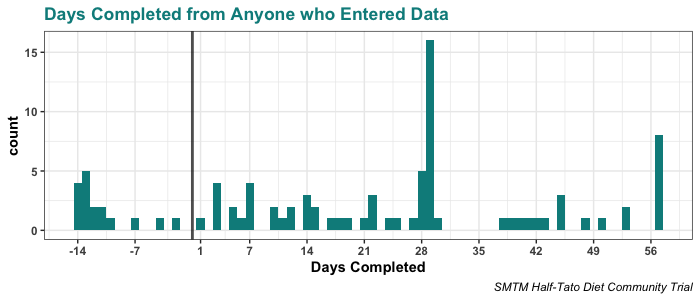
Let’s summarize that plot. As of the snapshot on June 1st:
- 92 people entered at least one day of weight data
- 75 people made it to Day 1, past the baseline period of two weeks
- 38 people made it to Day 29, the end of the first 4 weeks of half-tato
- 8 people made it to 8 weeks or further, and some are still going
For this analysis, we will mostly be focusing on weight change up to Day 29, since there’s not much data past that point.
Weight Change over Baseline
First let’s look at the baseline. Similar to a crossover design, this baseline serves as a kind of control group.
There was very little average weight change in the baseline period, and it was not statistically distinguishable from zero. Here’s the histogram of weight change over baseline, with a black vertical line at 0 lbs (i.e. no weight change over baseline) and a red dashed vertical line at the mean weight change:
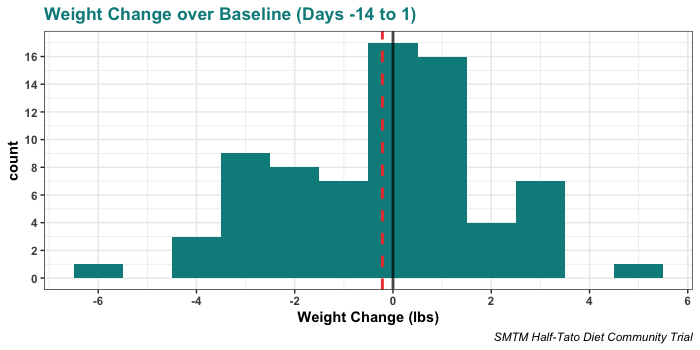
The mean weight change over this period was -0.22 lbs, with a 95% CI of -0.70 lbs to 0.27 lbs. This is not statistically distinct from zero.
The mean suggests an average loss of 0.11 lbs per week on average, or 0.35 per week if we take the lower bound of the confidence interval.
Of course, it’s also consistent with an average weight GAIN of 0.14 lbs per week if we take the upper bound of the confidence interval.
In previous studies, people have expressed concern about the Hawthorne effect — that when we ask people to measure their weight, they might start losing weight simply because they are aware that their weight is being observed. Looking at the baseline period, we find very little support for this idea, even with a sample size of 75 people.
Observing your weight for two weeks just doesn’t change it much, and likely doesn’t change it at all. Going forward, we will continue to not worry about the so-called Hawthorne effect.
(Also, it’s amusing to see that Wikipedia kind of drags this whole idea: “some scholars feel the descriptions are fictitious” and “J. G. Adair warned of gross factual inaccuracy in most secondary publications on the Hawthorne effect and that many studies failed to find it.”)
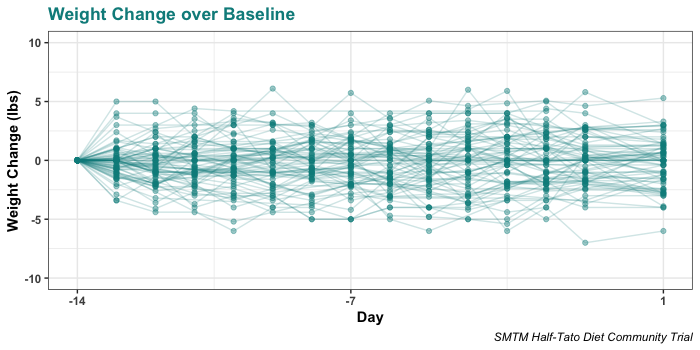
Here’s a plot of weight change over baseline, including only people who finished the two-week span. As you can see, these look like a bunch of random walks around zero.
Weight Change at Four Weeks
Our main interest is weight change on the half-tato diet, specifically people’s weight change between the morning of Day 1 and the morning of Day 29. Here’s the histogram of that variable, with a black vertical line at 0 lbs (i.e. no weight change over 29 days) and a red dashed vertical line at the mean weight change:

People lost 1.7 lbs on average over these four weeks, and that loss is significantly different from zero, t(37) = 2.70, p = .010. Another way of putting this is that 27 out of 38 people (71%) lost at least some weight.
By now we’re sure you’ve noticed the extreme outlier, the person who reported losing 17 lbs over four weeks (participant 25348806). This outlier is impressive, and we’ll look at her results in more detail later, but excluding that person doesn’t change the overall results. Without the outlier, average weight loss is 1.3 lbs over four weeks, and that loss remains significantly different from zero, t(36) = 2.66, p = .012.
We see that weight loss is significantly different from zero. People do seem to lose weight on the half-tato diet.
But we should also emphasize that they don’t lose much — the effect size here is a disappointment. We had hoped that the half-tato diet might have around half the effect of the full potato diet, but that just didn’t happen.
Overall, the effect is less than half the effect of the original potato diet. Average weight loss on the potato diet was 10.6 lbs, so half of that would be 5.3 lbs. Instead we see only around 15% of the effect of the full-tato diet.
We should note that there are some mitigating factors here. In particular, about 30% of participants in the half-tato diet started out as “normal weight” (BMI < 25), compared to only about 15% in the original potato diet. (In the original study, people who were obese or overweight tended to lose more weight, so this means the average weight loss will look smaller when there are fewer obese or overweight participants.)
But weight loss on half-tato is still quite minor, even if you limit the analysis just to overweight (BMI > 25) participants, who lost 1.8 lbs on average, or obese (BMI > 30) participants, who lost 3.1 lbs on average. This is still much less weight loss than on the original potato diet.
Another way to put it is like so: On the original potato diet, 64 people made it 4 weeks. One of those people lost no weight. Everyone else lost more than the AVERAGE weight loss on the half-tato diet. It’s really no contest; full-tato is overwhelmingly more reliable and causes overwhelmingly more weight loss, at least among the people who can make it four weeks on mostly potatoes.
Frankly, this just emphasizes how successful the original potato diet study was. In fact, on reflection the Potato Diet Community Trial was probably the most successful weight loss study of all time. Are there any other studies that caused weight loss in 98% of people who finished the study, and caused an average of 10.6 lbs of weight loss over just four weeks? Not that we know of.
Trajectory
As we mentioned, there’s one extreme outlier who lost 17 lbs over four weeks. You may also have noticed a less-extreme outlier who lost 9 lbs, who happens to be someone who participated in the original Potato Diet Community Trial and saw a lot of weight loss there as well, losing 19 lbs. Both of them stand out quite clearly in a plot of people’s weight loss trajectories:
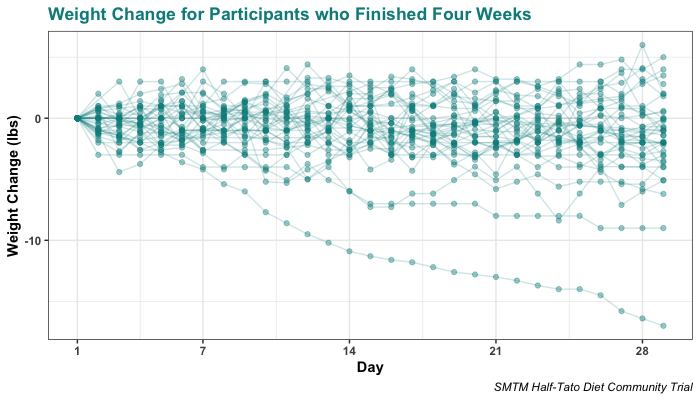
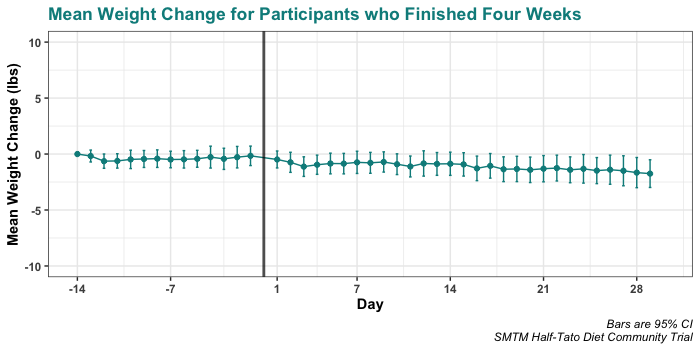
Having seen some reports like this one, we wondered if there might be a yo-yo effect on the half-tato diet, where in the beginning people lose weight no problem, but at some point the potato effect stops working and their weight heads back to baseline. That seems like a reasonable way to interpret this plot:
But overall, this doesn’t seem to be the case. In general, half-tato weight loss over four weeks seems small but constant:
Weight Change at Eight Weeks
We also have a tiny bit of data on people’s weight loss taking the half-tato diet out to eight weeks. Here’s the plot:
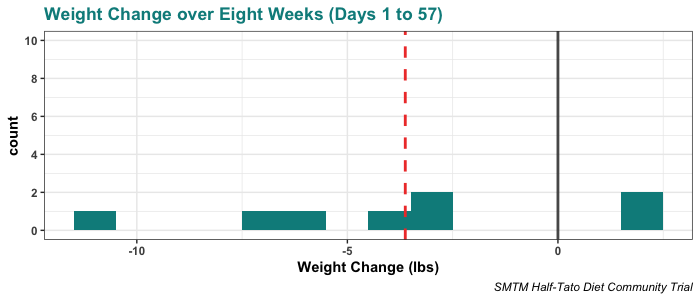
The average weight loss at eight weeks is 3.6 lbs, though you can see that one person has lost more than 10 lbs. With only eight individuals, this is too few people to do a statistical analysis. But it does suggest that longer spans on the half-tato diet may be effective.
Note that the extreme outlier does not appear in this group — that person only sent us data up to Day 29.
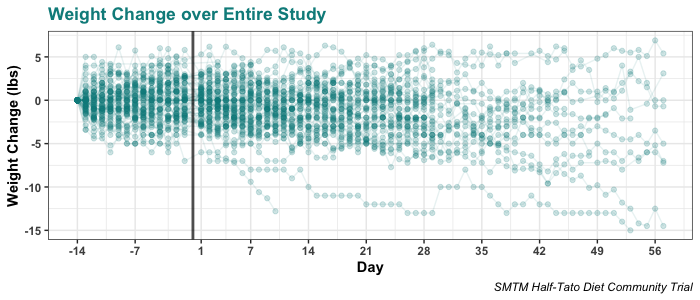
Here’s the whole span from everyone who finished baseline (minus our main outlier), showing all data points from the start of baseline to the end of eight weeks:
What Things Correlate with Weight Loss
There’s not much variation in people’s weight loss over these four weeks, but some people did lose more weight than others. This makes us wonder if there are any variables that might be correlated with weight loss.
Take the analyses below with a grain of salt. They’re very exploratory. The sample size is small. We’re not correcting for multiple comparisons. And of course, all these correlations are correlational.
As you well know, correlation does not imply causation — but as XKCD reminds us, “it does waggle its eyebrows suggestively and gesture furtively while mouthing ‘look over there’.” Correlations can still be suggestive, and if any of the correlations we find are real, we should eventually be able to demonstrate the same relationships experimentally. So let’s take a look and see if anything stands out.
BMI
Our first surprise is that BMI doesn’t seem to have much to do with weight loss.

The correlation between weight loss and starting BMI is relatively small, and is not statistically significant, r(36) = -0.29, p = .078.
Protocol
We let people sign up for three different protocols for the half-tato diet, three different ways you could try to get about 50% of your calories from potatoes. People ended up about evenly split between the three approaches:

Here is a plot of weight loss by each of the protocols:

As you can see, there are no huge differences in weight loss between the three protocols, though Potatoes-By-Default includes the outlier who lost the most weight.
Percent Potato
We asked people to estimate what percent of their total calories they were getting from potatoes each day, and some people reported getting a much higher percent potato than others. Since some people were doing about 50% potato, and others were doing only about 10%, you might suspect that the diet caused more weight loss for people getting more potato.
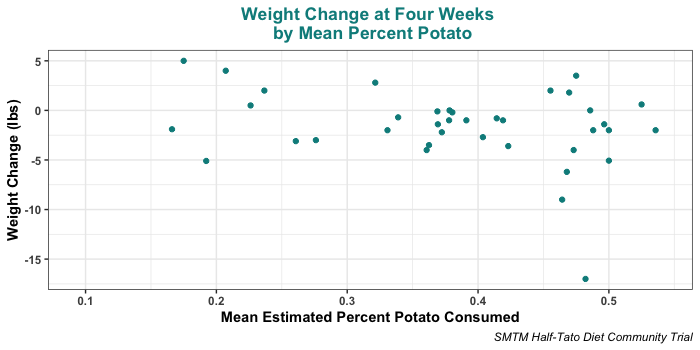
This is much more muddy than we expected. Getting closer to 50% of your calories from potatoes does seem to maybe cause more weight loss, but if so, it’s not super clear. The correlation is quite small and not significant, r(36) = -0.28, p = .084, and weaker if you exclude the major outlier, r(35) = -0.24, p = 0.147.
It’s hard to imagine that percent potato doesn’t matter at all, and we do see that the three people who lost the most weight were all getting close to 50% potato. This suggests that for best results, you should try to get around 50% potato on average. But there isn’t a clear correlation overall.
Dairy
In the original Potato Diet Community Trial, we asked people to avoid dairy entirely. This time around, we decided to just ask people to track how many servings of dairy they got each day. This lets us look for any correlation between dairy consumption and weight loss on half-tato.
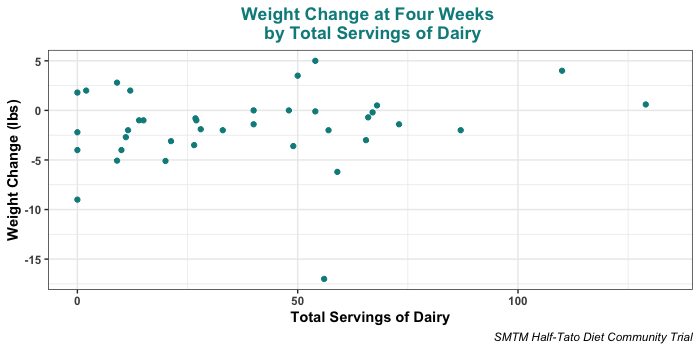
There may be a bit of a trend where more dairy is related to less weight loss, but the person who lost the most weight ate plenty of dairy, and the overall correlation is not significant, r(36) = 0.15, p = .355.
That said, the relationship is slightly stronger if we exclude the outlier, though still not significant, r(35) = 0.29, p = .078.
Tomato
We were also concerned that tomato products might interfere with potato-based weight loss. So just like dairy, we asked people to track how many servings of tomato products they had each day. Here’s the scatterplot:

Surprisingly, this relationship is significant, even with such a small sample. The overall correlation is r(36) = 0.37, p = .021, and it remains significant if you remove the extreme outlier, r(35) = 0.36, p = .031.
You can see that the two outliers, people who lost the most weight, almost entirely avoided tomato products on the diet. Also interesting is that the person who gained the most on the diet happens to be the person who ate the most servings of tomato products.
This is correlational, not corrected for multiple comparisons, etc., but it does provide more support for our suspicion that tomatoes interfere with the potato weight loss effect. This would be great to experimentally confirm at some point, and it should be relatively easy to test — just assign some people on a potato diet to use ketchup, and others to eat their potatoes bareback, i.e. no ketchup. In the meantime if you are trying to lose weight using potatoes, we certainly encourage you to avoid ketchup.
Cooking Method
We’ve previously mentioned that boiling or soaking potatoes removes a lot of their potassium. So we’re curious to see if people who boiled their potatoes lost less weight than people who baked, roasted, fried, or otherwise kept their potatoes for the most part whole and un-leached.
Most people didn’t leave detailed notes on how they prepared their taters, but the people who did leave notes often mentioned either boiling them or using frozen potato products, which are generally pre-boiled / blanched / parboiled.
This might explain why the half-tato diet did not cause much weight loss on average — if we’re right, and the weight loss is caused by potassium (or anything else in the potatoes that is leached out on boiling/blanching/soaking; who knows, maybe iodine), then many people were consuming less effective potatoes.
There aren’t enough reports to bother hand-coding preparation method or doing an analysis, but here are some examples:
(42475044) Most of my potato meals were a 50/50 mix of roasted yellow potatoes (partially peel 1 inch cubes, lightly oil, 375 convection for 45 minutes), and store-bought frozen french fries (whatever seemed to have the least oil) cooked in the air fryer with no additional oil.
(63062664) My protocol was mostly whole boiled potatoes pan-fried in ~15g of butter or a small glug of rapeseed or olive oil. Usually ~1kg for breakfast + lunch.
(78152385) I ate mainly russet or golden potatoes, baked or roasted, and I didn’t eat the skins of the russet because last time I did that it gave me the worst stomach cramps I’ve ever had. I also ate a lot of Alexia french fries with sea salt, and some sweet potatoes.
(80975703) I always ate potatoes I had boiled in batches and kept in the fridge. My favourites were red potatoes, half peeled, but I also had yellow or white potatoes, fully peeled. Always with a bit of olive oil and salt and spices, chopped up and reheated in a pan on the stove.
(28228309) I had visions of making home-made latkes or really fine hash browns. I just didn’t make time. While I know we are supposed to start with whole potatoes, I’m sure glad I found frozen potato patties at the store, or there’s no way I could’ve even approximated the quantity of potato I needed. I put my toaster to 6 (nearly the highest setting) and toast them twice, and they’re great, and I could do it for breakfast on work days.
(30834698) I do not like skin on the potatoes; I can eat it, but I do not like the taste or how it makes me feel; I prefer them without skin, so I mostly eat them like that; usually just boiled with a pinch of salt, sometimes in the oven, sometimes with a drop of olive oil; sometimes with some harissa; the easiest and tastiest for me was boiled with salt, then peel the skin and eat them
(72618178) In general I was making homemade oven-baked ‘fries’ (thinly sliced par-boiled potato). I would often give in and allow myself ketchup or spicy mayo. I also went through some phases of doing homemade gnocchi, mashed potato, and faux-dauphinoise (thinly sliced, stacked, oven-baked potatoes with veg stock and a bit of butter).
As you can see, many people boiled their potatoes or used frozen potato products that were likely boiled in some way before freezing. But to be fair, this does not describe everyone. Some people did report mostly baking or roasting:
(58681391) I usually baked an entire 5 lb. bag of gold potatoes at 350 for 1.5 hours, for roughly three servings. I didn’t use oil when baking but would sometimes refry the baked potatoes into hash browns with about 1 tsp of avocado oil.
(70030447) My main method for eating potatoes, as I work from home, was to chuck a few russets in the oven for an hour after coating them in salt and pepper, then once they’re done I would cut them into two halves and eat those entirely. I found olive oil a hassle, and putting salt and pepper on the insides after they’re done was also too much hassle for me to want to bother doing everyday. Maybe I’d do that if I cooked them some other way.
Despite eating baked or roasted potatoes, neither of these people lost weight. The first saw no change at all, and the second gained 4 lbs. This is enough to show that baking or roasting is not enough to ensure weight loss.
But there may be other reasons these two didn’t lose any weight. 58681391 ate a lot of tomato and dairy, and got only about 38% of their calories from potatoes. 70030447 ate an unusually large amount of dairy (third most out of everyone) and got only about 20% calories from potatoes.
In any case, we still suspect that starting with whole, raw potatoes, and not boiling, soaking, or blanching them, might be important for causing potato weight loss. We didn’t make people roast or bake their potatoes in the original potato diet study, but maybe with +90% potato, it doesn’t matter.
It might have been an oversight not to ask people to roast or bake their potatoes for the half-tato protocol. If you’re trying it for yourself, probably don’t boil them or live off of frozen french fries.
Regression Analysis
To wrap up these correlational analyses, we fit some regression models to try to predict weight change from multiple factors at once. In all these models, we excluded the outlier who lost 17 lbs, participant 25348806, because we wanted to try to understand things that might have impacted weight change for the average participant, who did not lose so much weight.
One especially strong model included total dairy consumption (p = .007), total tomato consumption (p = .003), and their interaction (dairy * tomato; p = .035). This interaction had a negative sign, suggesting that tomatoes and dairy are slightly less than the sum of their effects. All three terms were significant predictors of weight change, and the model explained 23.7% of the adjusted variance in people’s weight change.
This was a much better fit than we expected, especially given the small sample size, and it provides more support for the idea that tomato and dairy consumption for some reason inhibit the potato weight loss effect. Note that this is TOTAL dairy and tomato consumption over four weeks, not average daily consumption, which provided a weaker fit.
This was not the best model we found, however. When you dummy-code the three potato protocols, and put them in a model with total tomato consumption and the two-way interactions, many terms are significant (for example, True Half-Tato condition * tomato sum is significant, p = .0004) and the model explains 37% of the variance in weight loss. We literally are not sure what to think of that, and are not sure how to interpret this result.
In any case, these are very simple models. It will be hard to squeeze more information out of just 37 observations, but if you have experience with more complex forms of statistical modeling, we encourage you to download the data and see if you can make more sense of it than we can.
Potatosis
Some people liked getting half of their daily calories from potatoes:
(23555212) This was cool! I have a newfound appreciation for potatoes.
Other people did not:
(28228309) Oh happy day. No more forcing myself to eat bland potatoes.
(81471891) Not super happy with my mindset about this diet. It’s currently “I *have* to eat 1 kg of potatoes per day!”, and feels a bit forced.
This is kind of striking compared to the absolutely rave reviews we got about the 100% potato diet, where most people said that they loved it. You’d think that eating 100% potatoes would be a bigger ask and a bigger pain than eating just 50% potatoes, but apparently not.
This makes us wonder if most people in this study never went into “potato mode”. In the original potato diet study, we found that after a day or two of eating potatoes, most people’s appetites waned, they didn’t want anything aside from potatoes, and they began to steadily lose weight. This seemed like a separate “mode” the body can be in, that both caused weight loss and made it easy to eat nothing but potatoes without major discomfort.
If something about the half-tato diet keeps people from going potato mode — the percent potato wasn’t high enough, the potatoes were prepared wrong, ketchup is a potato inhibitor, etc. — that would explain why people didn’t lose much weight, and why many people found it difficult to stick with even a mere 50% potatoes.
This is corroborated by a comment from one person who was also a participant in the original potato diet study, and says that they found half-tato very different:
(42475044) Overall this didn’t work anywhere near as well for me as the full potato. My weight over the last 8 weeks has largely stayed the same, whereas on the full-tato I lost 9 pounds in 3 weeks. I could definitely feel that the potatoes were helping me not gain weight, but I think my non-potato calorie intake was just too high for the potatoes to compensate for. On the full-tato diet I was able to eat as much as I wanted and still lose weight, but that doesn’t seem feasible for me on half-tato.
That said, at least one person on the half-tato diet did report signs that sound a lot like potato mode:
(21268204) Sweating at night, which I never do otherwise. Appetite low… Get full really fast even when eating non-potatoes … 2nd day in a row that it didn’t occur to me to eat until 4pm … Have not been hungry at all the last few days. The calories I did get were because I forced myself to sit down, mostly, with some potatoes
This participant lost only one pound over the first four weeks, but kept going and lost 3.5 lbs over eight weeks.
All this suggests that there might be a right and a wrong way to do half-tato. If you do it wrong, basically nothing happens, maybe you lose a little weight on average. But if you do it right, you go into potato mode, much like on the full-tato diet, and you start losing weight very quickly.
Let’s assume for the moment that there is such a secret magic switch (or set of switches) that can make half-tato cause rapid weight loss, and try to figure out what it is. If there is such a switch, then almost everyone on the full potato diet tripped it. All the case studies (like M) managed to trip it. The major weight-loss outlier in this study, and maybe some of the less major outliers, seem to have tripped it. Maybe they were doing something right that puts you in potato mode — so what would that be?
The extreme outlier (25348806) in this study give us a fairly detailed report of how she approached half-tato, saying:
I signed up for a spreadsheet for 52 weeks. I’m doing the diet and have had great success … Am female with 100 or so lbs to lose (now 30 down).
I first lost about 15 lbs doing a very loose version of potato by default after first reading your blog pre half tato experiment and have since lost another 15 beginning April 22 with starting half tato in earnest. I steam peeled yukon gold in batches in the Instant pot for 12-15 minutes at high/manual (depends on size, I try to get bigger but often its just medium available). Right out of the instant pot I add white vinegar which helps preserve color and appearance and tastes great later (more subtle than adding vinegar at mealtime) before cooling and fridge. I started eating a mix of cold and hot depending on if microwave is available (sometimes with mustard) but now I’ve settled into just hot (2 min microwave) with mainly salt. I try to have this 2-3 meals out of the day (2 medium or 1 big 1 smallish per meal). One of the 2 potato meals I may add one of: poached egg yolks; calf liver lightly sauted in butter (plus lingonberries and/or honey); or cooked ground beef (with 21 gun salute seasoning from trader joes and sometimes full fat sour cream), and possibly pepper or cholula sauce (rare), occasional oysters (fresh or canned). I don’t add ketchup (except once – when I went out and had beef fat fries at a steakhouse bar which did not seem to stall). I really enjoy the potatoes and look forward to them. I am not hungry but feel satisfied. I also have dairy – at least one glass of milk a day (either raw whole milk or 2% or whole conventional) – and a small amount of juice or lemonade. Some mornings I may have full fat yogurt with collagen and stearic acid (see fireinabottle.net) but not all mornings. I have some extra potassium as well as other supplements.
We love the level of detail, but it’s hard to know which of these elements are required to enter potato mode, if any of them are. But there are some features that this outlier and all the half-tato case studies (M, Nicky, and Joey “No Floors” Freshwater) share:
- Nicky had a bit of ketchup, but everyone else either never or almost never had ketchup with their potatoes.
- None of them avoided dairy
- All of them mention eating meat and eggs
- All of them used butter and/or oil
- None of them ate boiled potatoes; their potatoes were generally steamed, air fried, microwaved, or baked

To us, this further supports the idea that at least part of the secret switch is eating not-boiled whole potatoes and mostly avoiding ketchup and tomato products. Dairy doesn’t seem to matter much, or at least it didn’t stop these people, and neither do various fats, meat, or eggs. Of course, it’s difficult to tell if there might be some ADDITIONAL element that they are all getting right. Are they all getting lots of magnesium or something? Hard to say.
Just in case it helps, here’s a closer look at the other people who lost relatively large amounts of weight on the half-tato diet:
Participant 26130773 lost the second-most over four weeks on half-tato, a total of 9 lbs. Overall he ate a good potato percentage, reporting 40%-60% most days, though on some days he only got 20%.
This participant left almost no notes and didn’t report his dairy or tomato intake, which makes it hard to figure out what he might have been doing right. But one thing that jumps out is that it’s clear he was eating lots of eggs. Here are his notes from the first three days of the diet:
5 eggs, potatoes for lunch (350 cal eggs. If I do 2 yokes 3 whites, 190 cal) Protein shake (120) for snack Turkey b patty, salad (600?)
5 eggs w 2 yolks, few bites turkey (225) Protein shake (120) Soup w meatballs (500)
5 eggs w 2 yolks (190) Protein shake (120) Normal dinner cheat (900) 2 drinks
Participant 56896462 lost the third-most over four weeks on half-tato, a total of 6 lbs. He had a very good potato percentage, 40% or 50% almost every day. He ate some dairy and some tomato, about 2 servings of dairy a day and 1 of tomato, on average. He also left very few notes, though we notice that he is in Italy.
Conclusions
The half-tato diet causes some weight loss in most people, but for most people, it is much less than half as effective as the full potato diet. If you really want to lose weight, probably go for the full potato diet instead, and try to get as close to 100% of your calories from potatoes as you can.
However, a small number of people do lose a lot of weight on the half-tato diet. This suggests that there might be some way to go into “potato mode” while on half-tato, if you do it right. If we could find out how to make this happen reliably, that would be pretty neat.
Our guess is that it involves some combination of:
- Baking, steaming, microwaving, or roasting whole potatoes instead of boiling them or using pre-boiled frozen potato products
- Avoiding tomato products, especially ketchup
- Getting enough of something else, possibly something found in eggs, meat, or dairy.
We should note that this list is largely based on circumstantial and/or correlational evidence. We do worry that ketchup might be a potato-blocker, but the evidence is not yet all that strong. That makes all of these guesses good subjects for future experiments.
You could design a large trial to answer these questions — randomly assign 100 people to do half-tato with ketchup and 100 people to do half-tato without — but you might need a very large sample size to be able to detect a difference. And while we’d love to see more community trials, it may not be practical to do multiple trials of several hundred people each, one after the other, to try to chase down whether each of these things makes a difference. That seems like it would take forever and be a lot of work.
So instead, another option would be for individuals to test these guesses as a self-experiment, which could provide very strong evidence, and might be able to provide it quickly.
For example, let’s say that Gary is a fellow who is happily losing 2 lbs a week on the full-tato or half-tato diet. Whatever makes potato mode happen, Gary has found it, even if he doesn’t know what he’s doing right.
Now Gary can test individual switches to see if they turn potato mode off. For example, he can randomly assign some weeks to be ketchup weeks, where he always has ketchup with his potatoes, and other weeks to be no-ketchup weeks, where he religiously avoids ketchup and all other tomato-based foods.
If Gary’s weight loss always stalls on ketchup weeks, but continues humming along on no-ketchup weeks, that’s a pretty clear sign that avoiding ketchup is one of the switches to make the half-tato diet work. If the randomization makes no difference, that’s a pretty clear sign that ketchup doesn’t matter, at least not for him.
You can imagine a similar design for anything else. Gary could randomly assign some weeks to try only boiled potatoes, and other weeks to try only baked potatoes, and see if it makes any difference.
We doubt things will be this simple — it’s quite possible that one brand of ketchup kills the potato effect, while another brand has no impact — but we won’t know until someone has tried. It might take several weeks to pick up a clear signal, but anyone who is able to get a potato diet working for them can test any of these switches out for themselves.
All we ask is that if you try something like this, please publish your results online, regardless of how it turns out. We’re very curious to know what will happen!
Closing Notes
Some people have gone for more than eight weeks on half-tato, and we plan to analyze their results at some point in the future. It will be a small sample size, but we are excited to have some more case studies. So stay tuned.
If you are interested in doing an N=1 experiment about these ideas and want our help designing a protocol, please feel free to contact us.
If you would like to be notified of future stupid studies, or if you want to keep up with our work in general, you can subscribe to the blog by email (below), or follow us on twitter.
And if you feel like reading this post has added a couple of dollars’ worth of value to your life, or if you have lost weight as the result of our research and you think it improves the quality of your life by more than one dollar a month, consider donating $1 a month on Patreon.
Thanks for going on this journey with us.
Sincerely,
Your friendly neighborhood mad scientists,
SLIME MOLD TIME MOLD
 SLIME MOLD TIME MOLD
Unless I am disqualified for some reason, I am one of the people who signed up for 52 weeks and am continuing.
I unofficially did full potato last year for 2 months and lost about 20 lbs. I have never felt consistent satiety like I did then. I experienced potato mode.
I have been struggling with 50% potato. I will do fine for most of the day then become ravenous in the evenings. This evening snacking often brings me down from 50% potato to between 30-45%. The intense evening hunger is something pretty common in my dieting experience outside of full tato diet.
I feel like the sweet spot for me might be between 75-90% potato. I need more protein in my diet than 100% potato. I recently had some bloodwork done and even with only 50% potato, my protein was a little low. So I have increased my intake from 1 nondairy protein shake per day to 2. It is a bit of a chore.
I also take a comprehensive multivitamin every day and have for years. In addition I supplement B vitamins, D vitamins, and iron.
I have lowered my normal amount of tomato but have done it by replacing ketchup or salsa with tomatillo salsa. It is unclear to me if tomatillos would have the same effect as tomatos. I have not been logging tomatillo consumption. I estimate I eat tomatillo 3-5 servings per week.
I would say my current diet is a pretty even mix between boiled and roasted. I like the convenience of frozen french fries in the air fryer and it makes the diet much easier. I will typically do this once per day and a baked potato once per day. Potato salad or nondairy au gratin style potatos for third meal. I substitute sweet potato for potato several times per week.
I think I might try a diet of 75% potato, 15% nondairy protein shake later on this year. I will theoretically still be logging at that point unless circumstances significantly change.
LikeLike
Great, we look forward to seeing the results of your self-experimentation!
LikeLike
I think it might really just be the blandness of the diet that does it. There is the well know “twinkie diet”, where someone lost weight eating nothing but twinkies and vitamins. Could it be if you limit your diet to *any* singular food, you’d lose weight? Rice, beans, and veggies supply you with all the nutrients you need, and I’d bet a diet restriction of just those 3 foods would result in weight loss too.
LikeLike
People keep saying this about mono diets but so far no one has run a community trial. If that’s true, it would be good to know — show us the data!
LikeLike
When I did full tato I did not do it bland and I still lost weight. I used hot sauce, seasoning mixes, onions, peppers, salsa, sugar free ketchup and bbq sauce. Some light oil sometimes – margarine or olive oil. Stuff that had negligible calories but still added flavor.
LikeLike
[…] 详情参考 […]
LikeLike
I genuinely admire the guerrilla science but cmon man:
“ketchup is a potato inhibitor”
Ketchup is more high fructose corn syrup than it is a ‘tomato food product’.
The vegetable, tomato, a ‘potato inhibitor’??? Facepalm…
Ketchup is concentrated tomato paste (shitloads of fructose) plus HFCS (GM fructose) plus shitloads of salt and vinegar. Preservatives and other junk too no doubt…
So if you’ve got a bunch of dudes eating platefuls of potato doused in ketchup like 8 year olds to make it palatable… then sure… it ain’t healthy or gonna inspire any weight loss….
Try making a tomato passata and salt homemade patatas bravas…
Look out of HFCS…. 🇺🇸
Leave tomatoes alone bro, tomatoes have feelings too…
LikeLike
I don’t know what the hypothesized mechanism of interference would be but it seems like it might be more likely to happen with a plant more taxonomically distant than a fellow nightshade.
Then again I suppose other nightshades would interfere with weight loss through cessation of the dieter’s metabolic processes altogether, so who knows.
LikeLike
I know you guys don’t put much stock in the seed oil theory of obesity but I would like to point out that the one outlier participant who lost a ton of weight mentions reading Fire in a Bottle, taking stearic acid supplements, and eating “beef fat fries.” Fire in a Bottle is a blog about how PUFAs may cause obesity and a lot of its followers avoid them religiously while also increasing their saturated fat intake as much as possible by supplementing with stearic acid and cooking everything in butter and tallow. The inclusion of organ meats and canned oysters in her diet makes me think she’s also a follower of Cate Shanahan, who once again puts a huge emphasis on avoiding seed oils. Other participants in the trial who relied heavily on frozen potato products were likely eating quite a lot of polyunsaturated fats along with their potatoes as almost all frozen potato products contain sunflower, soybean or canola oil. I think this outlier warrants another look at the seed oil/PUFA theory from you guys!
Personally I’ve lost a bunch of weight with zero effort or calorie restriction simply by avoiding PUFAs as much as possible. I’m not surprised at all to see that your outlier was doing something similar. The effect has been dramatic enough that I wouldn’t believe it if I hadn’t experienced it for myself so I understand your skepticism. PUFA avoidance might make for an interesting trial when you’re done with potatoes and potassium!
LikeLike
We’re open to it, we just don’t think there’s particularly strong evidence for it at the moment. A few good case studies, N=1s, or a community trial could change that, depending on what they found of course. You should write up your experience as a case study!
We probably won’t run a seed oil community trial (in part because we don’t expect a seed oil effect), but if someone does think there would be a clear effect, they should see what they can put together! We’d be happy to help discuss the design.
LikeLike
Your extreme outlier (25348806) steamed her potatoes, added vinegar then chilled them. This would have increased the resistant starch, but also halved their glycemic index. This will have reduced blood sugar spikes and increased satiety. This is a link to a nutritionfacts video (with links to scientific citations) which expands on this https://nutritionfacts.org/video/how-to-reduce-the-glycemic-impact-of-potatoes/
LikeLike
It might be interesting to look at half tato, with some potassium supplementation, and eating some of the taters first at each mealtime. Perhaps with a brief delay before the rest of the meal to let satiety signals kick in, possibly reducing consumption of the other items.
LikeLike
Dear SMTM, Hi! First of all, thank you for all of your excellent and interesting work. I wanted to share with you all an effect of the partial-tato diet I’ve been doing for that last couple months that kind of took me by surprise – in a nice way. My approach to the partial-tato diet was inspired by your half-tato trial, which I wanted to be a part of but lacked the discipline to track my numbers and commit to a certain ratio of potatoes for 4 weeks. With that said, based on your research and other articles I’ve read, I decided to introduce more potatoes into my diet. How much more? I wasn’t sure. I decided to make potatoes my go-to snack food, for starters, and the way it’s worked out is that now I’m getting about 20 – 30% of my daily calories from potatoes about 5 days a week. I’m still enjoying dairy, eggs and yes, tomatoes (raw), along with plenty of fresh veggies, some fruit and fish – no meat or poultry and I am specifically avoiding ketchup. To let you know a little bit about me, I’m a 45yo F with a BMI of about 19. As suggested above, I’m pescatarian, and I exercise 4 – 5 days a week. For context, I introduced the snack-tato eating protocol in an effort to lose those pesky 5 pounds that seem to come and go for pretty much everyone! So far, I’ve lost 2 of them and and working on the 3rd. I find this way of eating very sustainable.
But here’s the surprising part. I know potatoes have resistant starch, and even more resistant starch if they are cooked and cooled. [I’m a big fan of roasting the potatoes dry (no oil), cooling, and eating cold/room temp with various seasonings. I realize this may not appeal to everyone but I love the taste, convenience and versatility.] I learned along the way that resistant starch may have some benefit to our gut microbiome, but never really paid much attention to that because I’m more interested in the effects of resistant starch on appetite and blood sugar. Well. I have been a chronic sufferer of all sorts of (thankfully mild) digestive issues, from IBS to gas to bloating and everything in between, but since I’ve introduced more cooked-and-cooled potatoes, these issues have subsided. Like, majorly subsided. It’s like when you have a headache and don’t notice that it goes away until one minute you realize you’re not in pain anymore. I am no longer uncomfortable all the time from digestive issues. I don’t know if it’s from the snack-tatoes or not, but I suspect that it is and I’m absolutely going to keep it up. Tl;dr – Snack-tato protocol could relieve minor digestive issues such as gas and bloating, possibly due to the effects of resistant starch on the gut microbiome. This is a huge deal for me – enough to keep it up with the potatoes – and thought I’d share. While never medically serious, the gas/bloating and general poor digestion was just a constant nuisance that probiotics never seemed to resolve. If you’d care to share this info with your followers/subscribers, please do – I would only ask that you please avoid using my name.
Oh, I also made a potato soup recipe the other day that was really delicious and I’ll send the recipe separately.
Thank you, again and Happy Thanksgiving! Sarah
LikeLike