
CuoreDiVitro tries a version of the potato diet and writes about it on Lesswrong — My Effortless Weightloss Story: A Quick Runthrough:
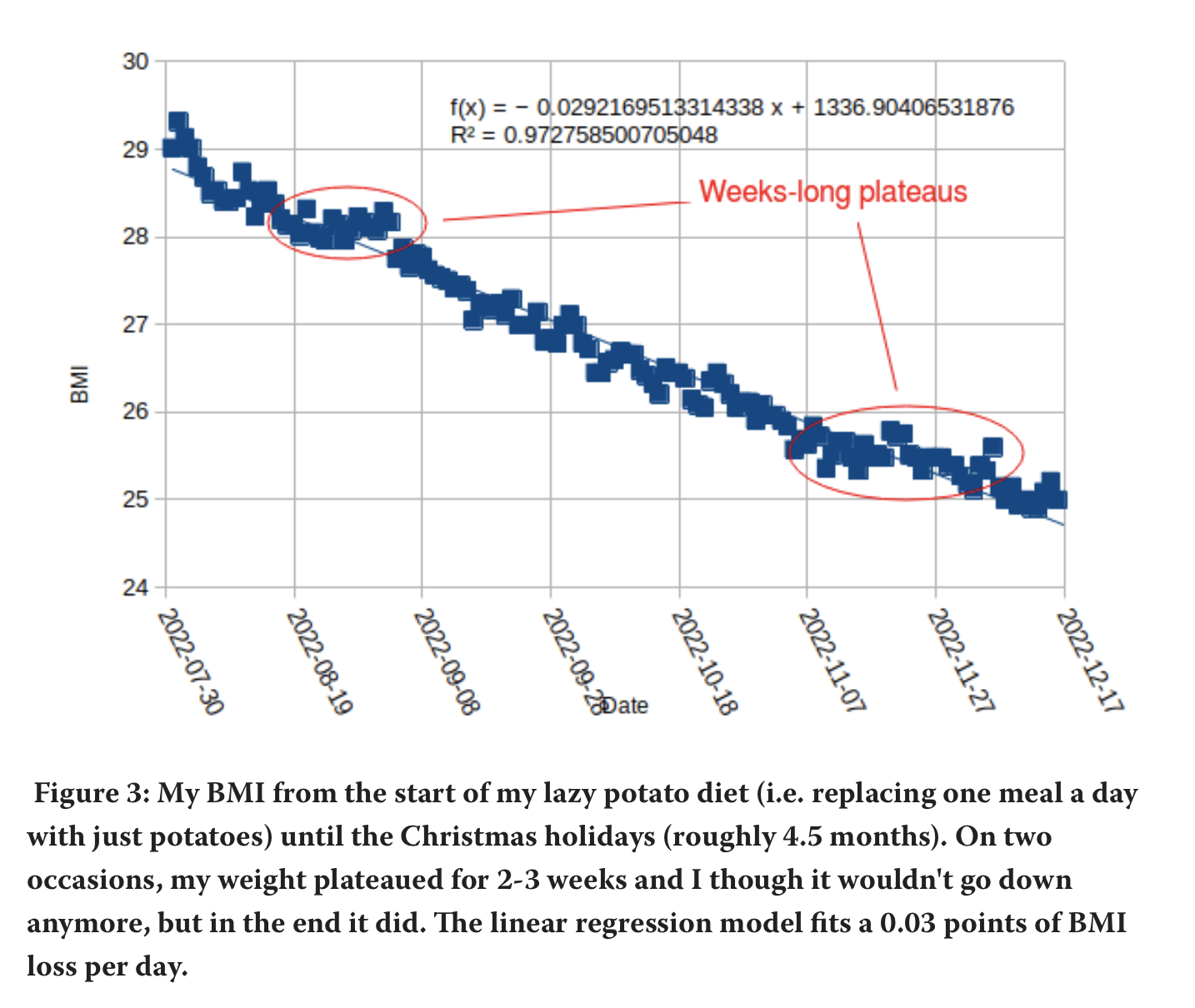
Figure 3 is the plot of my BMI for the first 4 months or so. The rising trend at the end is the Christmas holiday season. As you can see, there are a few plateaus (circled) but generally speaking, my weight just kept decreasing almost linearly until I fell below a BMI of 25.
This was extremely surprising for me. I had always thought that losing weight was supposed to be very difficult and require a lot of willpower and effort. This was nothing of the sort, it was the easiest thing ever. It only required me eating exactly as I used to before but replacing one meal per day with a meal of “just” potatoes (on average, I only did it when it was convenient for me, some days I took two meals of potatoes if it was convenient, others none if it didn’t fit my plans, I still ate three meals a day, the other two meals being exactly the same type of meals I used to eat before the start of this experiment) which I salted with, on average, 2 mL of KCl (I took on average 2mL of KCl per day, sometimes with potatoes, sometimes with something else, some days I took no potatoes but still had KCl some days I had potatoes but no KCl). I also allowed myself to put butter, and spices, and hot sauce, and anything else I wished to add flavour. The only thing I tried not to add to my potatoes is NaCl (normal table salt).
When it comes to rats winning your heart, let me not hold back: rats can learn to play hide-and-seek with humans. They will do so for no other reward than tickles and fun. And they will laugh.
Mindblowing dissertations (h/t Krinn)
We’ve often wondered if it’s legal for state and local governments to issue their own currency. (In part because if Jane Jacobs is right, city regions might benefit from controlling their own fiscal policy.) We still wonder, and this project may help us find out: “The Current, an alternative currency recognized by the IRS that can only be used within the Hudson Valley at member businesses. By using the Current, we ensure that our money stays local and is used to strengthen businesses in our community.” Does this work? Is it backed by something, or is this a fiat currency? Is it actually legal? We don’t know, but we’re curious to hear more.
Although migraine symptoms have been described since antiquity, doctors still struggle to understand their cause. For much of the early 20th century, migraine was thought to be a vascular condition, something that could be treated by restricting blood vessels. Now, most neurologists argue that migraine is a disorder of the trigeminal nerve system, where overactive cells in the face and head respond to benign input (light, sound, smell) by releasing chemicals that transmit pain. But doctors still can’t offer reliable relief.
The best treatment available is prevention, so my doctor tells me about possible triggers—stress, menstruation, sleeping too much, sleeping too little—so that I can do my best to change my behavior. Beyond that, treatment is a process of trial and error.
First word discovered in unopened Herculaneum scroll by 21yo computer science student. “Casey found the pattern by staring at the segmented CT scans for hours on end. This was a major and surprising discovery.” The word is ΠΟΡΦΥΡΑϹ (Porphyras) and means “purple”. Also see this related twitter thread.
You may have heard that Katalin Karikó won the Nobel Prize in Physiology and Medicine this month (along with Drew Weissman) for the development of mRNA technology leading to the recent COVID vaccines. There’s lots to read about her, but we particularly liked this 2021 profile from Glamour Magazine.
Gatorade is good. But there may be a secret, even better Gatorade, kept from us by the Quaker Oats Company:
Gatorade’s inventors went on to develop new sports drinks. Gatorade’s owners sued to acquire rights to these new products, but they never made them available publicly.
First, Shires and Cade developed Go!, a drink that, unlike Gatorade, contained protein to stimulate muscular recovery. Stokley-Van Camp paid “a fee to have the exclusive rights for some period of time, but they never did develop it”.
In 1989, Dr. Cade created a new sports drink that he claimed was more effective than Gatorade. The new product was called TQ2, shorthand for Thirst Quencher 2. The patent application read:
“The invention described here is a novel fluid composition which surprisingly and advantageously maintains blood volume at levels well above those observed in the absence of fluids or even with Gatorade.”
In an experiment with cyclists, Cade found that TQ2 allowed athletes to endure for 30% longer than Gatorade.
Cade pitched the TQ2 product to Pepsi and other beverage companies. Meanwhile, Gatorade’s owner Quaker sued Cade. After years of legal proceedings, Cade was forced to sell TQ2 to Quaker in 1993. Quaker “bagged” TQ2, never releasing it to the public. Gatorade claimed that its research found that TQ2 was not an improvement over the original Gatorade formula. Cade, on the other hand, continued to stand by his product. He accused Quaker and Gatorade of stifling the publication of the research behind TQ2.
The Truth about College Costs — College sticker prices keep going up. But this analysis argues that in practice, colleges give out so many “scholarships” (not real money, just discounts) that students are paying less for college today than they did in 2004. Most private colleges “discount their published tuition by 60% or more for virtually every student.”
 SLIME MOLD TIME MOLD
Thanks for the interesting links. Good to see the potato stuff still coming in, and rats are, indeed, clever, wonderful animals, and humans should be tried for crimes against nature for their mistreatment of rats. The “superior” Gatorade story is a cheap joke, however.
Concerning local currencies, I assure you that they are quite real and quite legitimate. For more research, I highly recommend investigating the utterly shocking story of the town of Wörgl in Austria during the 1930s. Be sure not to miss out on the conclusion, in which (spoiler alert) Raffeisen Bank, still around today, steps in and crushes everyone’s hopes and dreams.
LikeLike
The FAQ for the Hudson Valley Current is pretty confusing. On the one hand, they say that the USD and the Current have the same value. On the other, they say that “Unlike the USD ($), Currents are not backed by investments or interest, so they do not ‘crash’ or ‘fluctuate’ in value.”
So it kind of sounds like they’re anticipating that the peg could break at some future point, but that there’s no mechanism for exchange between the Current and the USD.
Thanks for the link. It sent me down a whole rabbit hole of learning about the dynamics of local currencies.
LikeLike