
Unless you’re stuck in an airport like Tom Hanks in that movie, you’re a citizen of somewhere. So pointing out that someone is a citizen is kind of a non-starter. Yes, they are also made of molecules, they are a mammal, what of it?
But for some reason, we keep finding ourselves in conversations where people pull out the term “citizen science”. What is that adjective doing there, Timmy? What is it doing?
In most cases, adjectives are looped in on a noun to add some information. A car may be red, but we call it a red car when we want to distinguish it from other cars. A red car is not green, blue, white, etc. What information does “citizen” add, what other scientists are we distinguishing them from? If “blue” is a non-red car, what is a non-citizen scientist?

We’re tired of having conversations about “citizen science”. First of all, “citizen science” is incoherent. Pointing out that science was done by “a citizen” is like pointing out that it was done by someone with a nose; except more vapid than that, since some scientists don’t have noses, while almost all scientists have citizenship. Tenured professors at Princeton and Oxford are citizens; so are research professionals at Pfizer and ThermoFisher. So why point out that a particular project involved citizens?
Because the term is so incoherent, the only reason to use it is to be condescending. The implication is that the citizens involved are not scientists, and that “citizen science” is a process of the general public (after all, almost everyone qualifies as a citizen, so this is the lowest possible bar) helping “real” scientists with their work.
This is not even a very subtle condescension — when people go on to define citizen science, they usually say it outright. Wikipedia describes “citizen science” as “research conducted with the participation of the general public”, and other definitions are even more blunt: “the practice of public participation and collaboration in scientific research, where everyday people help professional scientists gather, analyze, or report data.”
But we already have a term for people who do research: we call them scientists, and William Whewell didn’t coin the term “scientist” to describe local mom Mary Somerville in his anonymous 1834 review of her On the Connexion of the Physical Sciences for us to abuse it with vapid adjectives like “citizen”. Mary Somerville was a translator, experimentalist, astronomer, and mathematician. She was also a citizen of Great Britain, but you would never think to call her a “citizen scientist”, it would be an insult to a great woman. She was a scientist.
Amateur Hour in the House of Science
If we insist on making a distinction, we should be clear about it. How about professional science vs. amateur science?
While “amateur” has become a bit of an insult, it originally referred to someone who loved what they did. It comes from French amateur, via Latin amātor (“lover”), from amāre (“to love”). An amateur is someone who’s in it for the love of the game — in contrast to a professional, who does it for pay.
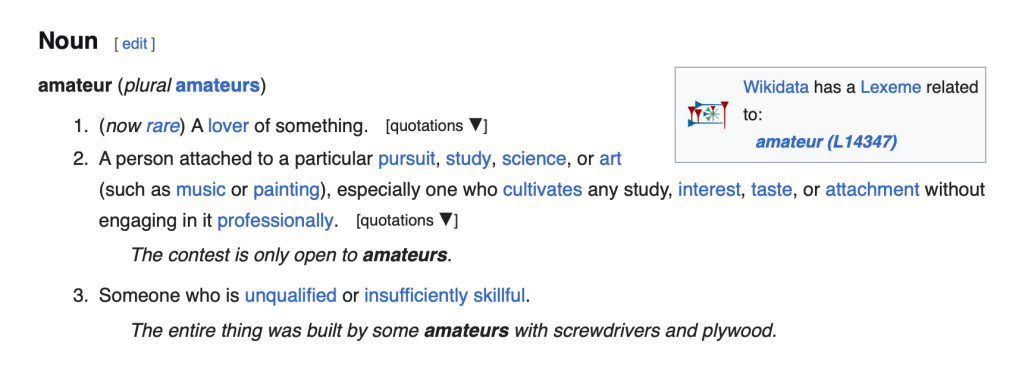
Historically, most scientists were amateurs, in the sense that they were not paid to do science. They mostly had day jobs or were independently wealthy. Charles Darwin? Independently wealthy. Gregor Mendel? Day job. Robert Boyle? Fabulously wealthy. Albert Einstein? Famously, day job as a patent clerk. Caroline Herschel was granted an annual salary of £50 by King George III for her work as her brother William’s assistant, but this was the exception, rather than the rule.
Because they are paid to do science, and often paid, implicitly or explicitly, to get certain kinds of results, pros have the most incentive to manipulate their data, the most incentive to outright lie. Professional research is always at least a little suspect. Amateurs didn’t give us the replication crisis. Pros did.
That said, we do support scientists getting paid for their work. We think amateur scientists are real scientists, as real or sometimes more real than the professionals, but we don’t think that all scientists should remain amateurs. It’s natural for the very talented to go pro, we want that.
So if “amateur” rubs you the wrong way, maybe academic science vs. indie science.
Keep Science Indie
We love the term “indie science”, and not just because of the implied street cred. If indie music is “a broad style of music characterized by creative freedom, low budgets, and a do-it-yourself approach to music creation”, that’s a phenomenal target to aim at for science.
The only thing that captures our ideal ethos better is the slogan, “Tony Stark did this in a cave with a box of scraps”. Galileo, Newton, and Einstein revolutionized physics, and the biggest line item on their budgets was for thought experiments. Big telescopes are great, but science doesn’t benefit from having a particle accelerator fetish. We like Paramore, but we also like mewithoutYou.

(While we’re on music genre metaphors, is it too much to ask for punk rock science? Blunt and confrontational, fun and liveliness, designed to outrage and shock the mainstream? Honestly, that might be a return to tradition. In The Scientific Virtues, we named Rebellion as one of the seven virtues, because thumbing your nose at common sense and conventional wisdom is not optional.)
Indies are independent. Independence of thought, judgment, and outcome. The opposite of “indie music” is “selling out to the man”. You cannot serve both God and Elsevier.

Calling things “citizen science” has a chilling effect on broad and general participation in the scientific enterprise, which is the common heritage of humanity. Discouraging that is contemptible — which is why we hate to hear it!
If you have noticed something strange or wonderful or mysterious in the world around you and you want to understand it better, you should go for it. Discoveries made by people without PhDs, or people without jobs for that matter, are still discoveries. Anyone with a good idea should do it — even if they happen to have citizenship.
 SLIME MOLD TIME MOLD
A similar term I dislike is “civilian graffiti” (i.e. graffiti done by some random guy off the street)
LikeLike
Speaking of which, you guys should organize more of those crowd-sourced experiments, like the “half-tato” community trial. Those are fun and very interesting. It’s been a while since you did one.
LikeLike
Hear, hear! Amen!
I agree that there’s an implicit condescension inherent to the phrase “citizen” science, and I like some of the favorable inferences drawn with “amateur” or “indie” science.
Other adjectives used in nearby meanings: “democratized,” “decentralized,” and “crowd-sourced” science. All seem less pejorative – though most also seem to have a specificity that takes them away from your intended meaning.
To add some layers to your onion:
There’s another class of science that I don’t think you directly addressed that gets the “citizen” moniker: “leaderless” science.
Traditional research has a clear leader – a PI, who finds funding, organizes a team, protocols, interpretations, publications, etc. Most “citizen” science has leaders: potato diets, bird-watching efforts, asteroid tracking, etc.
But some science is leaderless. Ex: a reddit chatroom suddenly dominated by 100 different people chiming in about what their favorite supplement did for their chronic sleep/inflammation/etc. problem. To refer to work done by a level-group of people without a leader as citizen-ish seems a reasonable use of the term.
That specific example is both amateur and indie, and so already would fit “citizen” science, but it also is interestingly leaderless. (I leave it to the reader for the exercise to come up with an example that is “leaderless” but is neither amateur nor indie…)
For that example’s leaderless-ness alone I would have liked a moniker like “citizen” science, but instead could have seen “flat” or “leaderless” or “participant-driven” or somehow “organic?”.
Aside: There’s a branch of U.S. research funding dedicated to “patient-centered” research (Patient-Centered Outcomes Research Institute) that also is a thrust in this direction – though not at all citizen-science in the nature of how that research is structured/led.
I’m on board with the idea that everyone can and should be a scientist.
“Citizen” science is dead, long live “indie,” “amateur,” “democratized,” “decentralized,” “
crowd-sourced” and “leaderless” science!
(And, because I lack vision, courage, and discipline, I’ll still probably use the phrase citizen science despite the completely legitimate points you raise here. Sigh.)
LikeLike
While she is, in fact, very much a professional, it seems only right to give a nod here to Laura Albert’s Punk Rock Operations Research.
LikeLike
Absolutely. The whole ethos of science as I was taught, is that it’s a method, and anybody can do it if you follow best practices and anybody can also make mistakes (hence peer review and publishing methodology).
The term reeks of credentialism at a time when academia is known to be riddled with conflicts-of-interest.
LikeLike
I love the term “indie science”! 😀
LikeLike
While I agree with y’all’s discontempt with the phrase citizen science, I am glad for the field’s existence in HCI and beyond as it’s helped to encourage scientists to make their research legible to those without formal training. What comes to mind are “games” like Foldit and Terry Tao’s Equational Theories project, Gardner’s “Mathematical Games” column and similar writing projects in the combinatorics and number theory communities, and many “working groups” I’ve participated in both in-person and online. While we should change the name, we should not definitely look to ditch the great practices I’ve seen in the “recreational” mathematics (there goes another condescension) and programming communities. More than just making sure we use the right words, we should demonstrate that indie science is science by enabling existing communities, creating new ones, and putting them all in conversation with one another, which ties in nicely to y’all’s last post.
LikeLike
I did a little amateur science myself the other day, on a public dataset.
Addressing the epidemiology of ME/CFS:
View at Medium.com
Be interested to hear if you guys have any views on the absurdity or otherwise of this approach!!
cheers,
Jason
LikeLike