Links for December 2020

There are 37 official editions of Scrabble, each of which has its own distribution of letter tiles. There are also many unofficial versions, including Anglo-Saxon, Bambara, Klingon, and L33tspeak.

During a series of diplomatic talks in 1958, Mao invited Kruschev to his private pool. Kruschev couldn’t swim and was forced to use a flotation device (which Henry Kissinger described as “water wings”) in order to accept his host’s invitation to join him in the water.

Basketball is back, which means an unending stream of bickering about who is the GOAT. Only one man, however, has performed the double-double to end all double doubles. In 1921 William Howard Taft became the Chief Justice of the United States after serving as the President from 1909-1913. Take that, LeBron. 

According to nature, crabs are the most perfect form. You may not like it, but 🦀 is what peak performance looks like. This sacred knowledge inspired us so much, we even made a meme. We think this is the first step in the process of memes themselves evolving to be more crab-like. 

We’re still thinking about the Lieutenant Governor of Pennsylvania, his wife, and their rad house. They have my vote. 

Looking to spice things up in the bedroom? Why not try history’s most mysterious sex position, first described in Aristophanes’ classic comedy Lysistrata in 411 B.C. “The women are very reluctant, but the deal is sealed with a solemn oath around a wine bowl, Lysistrata choosing the words and Calonice repeating them on behalf of the other women. It is a long and detailed oath, in which the women abjure all their sexual pleasures, including the Lioness on the Cheese Grater (a sexual position).”

It May Surprise You to Learn the Senate is a Beacon of Liberal Politics

The Senate gets a lot of grief these days. Vox wants you to know that the Senate is a much bigger problem than the Electoral College. GQ makes the case for abolishing the Senate. Someone at the New Yorker tries to answer the question “how broken is the Senate?“, but in our opinion spends far more time than is necessary comparing the senators to various zoo animals. We can accept that Senator John Thune bears a certain resemblance to a gazelle, but Senator Jim Bunning really doesn’t look anything like a “maddened grizzly”.

The basic argument against the Senate is that it’s undemocratic. Senators aren’t elected proportionally, and so some senators represent more people than others. If democracy is all about giving a voice to the people, it seems pretty perverse to give more of a voice to some people than to others. 

But it turns out that disproportionate representation isn’t just compatible with democracy, it’s one of the most important safeguards of a liberal society.

It’s not just that every person deserves a vote. Liberalism also says that every way of life deserves to exist, as long as it doesn’t infringe on someone else’s way of life (e.g. no cannibals). After all, America isn’t a melting pot, it’s more of a patchwork quilt. I’m not into Lutheranism, extreme body modification, or small yappy dogs, but I think that people who are into these things deserve to be able to live how they want and celebrate these aspects of their lifestyle.

The basic argument against Democracy is the old saying that democracy is two wolves and a sheep voting on what’s for dinner (no, it wasn’t Benjamin Franklin). With 1/3 of the vote, the sheep always gets eaten. In a country with 49 sheep and 51 wolves, as long as we have strict proportional representation, all the sheep still get eaten. If the vice president is a wolf, even a 50/50 split isn’t safe.

If the sheep all live in Sheepsylvania, however, they have a better chance to stand up for themselves. They may be outnumbered, but they still get two votes in the Senate. If they also have friends in Elkowa, Beavermont, and Llamassouri, that provides even more protection. It may not be enough to save them, but they will still do a lot better than they would with proportional representation. Disproportionate representation allows them to protect themselves even when they are enormously outnumbered.

States don’t correspond perfectly to different ways of life, and this is a fair criticism of the system. Disproportionate representation might work even better if we explicitly tied representation to specific minority groups. But states do have some correspondence to different ways of life. 

Most people these days think about disproportionate representation in terms of liberal versus conservative. But really, the differences in disproportionate representation today are urban versus rural. It happens to be that most rural states are also conservative, but population density comes with being a rural area, not from voting Republican. There are plenty of rural voters who are very liberal but still prefer to live in the woods. 

It’s not hard to imagine that urban voters — who are already more privileged in terms of wealth and education — might accidentally or even intentionally pass laws that would destroy a rural way of life for millions of people. For just one example, consider how decisions made in major cities can impact rural schooling. It’s important to have a political system that allows minorities to protect themselves.

Your state doesn’t even have to be all that rural to begin with. The Senate benefits the interests of pretty much anyone not living in California (11.9% of the population), Texas (8.7%), Florida (6.5%), or New York (5.8%). If you’re from Virginia, Hawaii, Iowa, Louisiana, Maryland, etc., and you don’t want California and Texas telling you how to live your life, then the Senate is acting in your favor.

We’d like to take this opportunity to remind you of Bernie Sanders. 

The state of Vermont has a very unusual but, we think, excellent way of life. Anarcho-socialist-libertarian-progressivism isn’t a way of life shared by most Americans, but it has a lot going for it. If representation were proportionate, we could maybe send Bernie, as an independent, to the house of representatives, where he would be just one voice among 435. But with disproportionate representation, we’ve sent Bernie to the US Senate, where we can punch above our weight. Bernie can work to protect our way of life, and he can help to bring our values (flannel, maple syrup, and Ben & Jerry’s) to the rest of the country. You’re welcome, America.

Film Concept: Gangsters, Thugs, and Local Government

I. 

People who are decently well-off usually don’t appreciate how thin the line between “organized crime” and “local government” can be for the very poor.

In the Great Depression, notorious mobster Al Capone organized soup kitchens in Chicago. More recently, Brazilian gangs, in response to government failure to take action against the pandemic, declared a unilateral quarantine order in Rio de Janeiro, saying “If the government won’t do the right thing, organized crime will”. In some parts of Japan, the yakuza really are the de facto local government, and in the wake of natural disasters like earthquakes, they’re often faster to provide aid than the Japanese government is.

When you’re poor, the sad truth is that the de jure government probably doesn’t care about you much. There probably aren’t a lot of legitimate jobs in your area; you can’t afford to move away; even if you’re very talented, someone with better connections or a fancier-sounding degree will probably beat you out when competing for the few good jobs available.

This is especially true for marginalized groups, in particular when they’re targeted by law enforcement. In a legal system like ours, there are so many pointless and mutually contradictory laws that everyone is guilty of something. If the police watch you for long enough, they will eventually find something that they can arrest you for. (Obviously it’s even worse if they’re willing to lie or plant evidence, but the point is that it can happen even without this.) 

Even if they only put you away for a few weeks, a criminal record will probably kill your chances of getting a legitimate job in the future. If you want to serve your community, or even just put food on the table, your only choice may be an illegal job. 

But “criminal” doesn’t mean “evil”. Modern governments criminalize lots of things they really shouldn’t. If I couldn’t get a legal job, I would be pretty happy selling weed. I don’t think weed should be illegal, and there would be plenty of satisfied customers, so I would be open to sticking my thumb in the government’s eye over this issue if I didn’t have any other option. A similar argument can be made for other drugs, prescription medications, etc. — even giving medical care without a license. If none of these work for you, then remember that during prohibition, the government criminalized alcohol. Ask yourself how guilty you would feel selling booze in the 1920’s, if you had no other job prospects.

Since criminal activity is often the only way for the very poor to make their way in the world, criminal organizations are often the only local institutions around. And because the official government doesn’t really care about these neighborhoods (they may even be actively antagonistic), criminal organizations often end up being the only thing protecting the poor.

The affluent have a hard time understanding all of this, and for many people, a reasoned argument can’t shake the scary image of the criminal or gang member as an uncultured, unreasoning thug.

The good news is that this is what art is for. Fiction can give us, even if only distantly, the sense of what life is like for people who are different from us.

II.

So let’s imagine what a movie to flip this script would look like. Our hero is a young black man who grew up in a poor but respectable suburb of a major American city. He’s talented, but there aren’t many opportunities in his hometown. Like many young men with few options, he joins the Army. He’s quickly recognized as a crack shot and natural leader, gets recruited to the Green Berets, and receives multiple commendations. He also makes some very close friends. Once he returns to civilian life, one of his best friends from the Army runs for mayor, wins, and the protagonist spends the next few years helping his friend try to make things better in their city. He makes some money, starts dating a woman from a well-respected family, and begins thinking of settling down.

But when war is declared in the Middle East, his friend the mayor returns to military service to serve his country, and our hero joins him. They’re shipped overseas, and see a few years of intense combat. His friend the mayor goes missing in battle, presumed captured; our hero is injured and, after recuperating, is honorably discharged from service.

He’s sent home, only to find that things are worse than ever. The new mayor neglects social services in favor of pursuing a “tough on crime” agenda popular with the middle class. The police are encouraged to make lots of high-profile arrests, and they quickly grow fat on civil forfeiture. Constant harassment by the police leads anyone with the means to try to leave the poor parts of town. As money flows out of the neighborhood, so do most businesses, taking with them the last few legitimate jobs.

Soon, almost no one can make a living without turning to some kind of crime. Often this is only opening a hairdresser’s without a license, or running a restaurant in your living room, but the cops crack down on these businesses just the same — and legally, they’re in the right.

The first thing our hero sees when he gets home is the police arresting a kid who tried to steal food from a gas station. He steps in to try to help, but the cops pull their guns on him. With his Special Forces training, he’s able to disarm the cops, free the kid, and make his escape, all without hurting anyone. What he doesn’t know is that he’s made a powerful enemy. One of the cops he embarrassed was the new sheriff, a close ally of the corrupt mayor, who recognizes him. The sheriff puts out an APB, and soon our hero finds that cops are crawling all over the city looking for him, and no one will take him in.

He eventually finds shelter with a preacher at a local church, who has seen enough of police brutality. He had shut down the church and begun to turn to drinking, but seeing someone stand up to the cops and get away with it has given him new hope for the future. 

It’s not just the preacher who takes note. Our hero starts attracting followers. First it’s his young cousin, a flashy dresser and accomplished boxer, hot-headed but idealistic. Next it’s a real beast of a man, a former bouncer who’s out of work and goes by “Lil’ Jon” or something, who impresses our hero by first beating him in a fight, and then throwing him off a bridge and into the river. Soon, more than a dozen people are hanging out in the basement of the abandoned church. 

Our hero can’t get legal work — in the eyes of the law, he’s a wanted criminal, who assisted the escape of a thief, resisted arrest, and assaulted officers. For one reason or another, neither can any of his followers. Even if he turned himself in, now that he knows he personally embarrassed the sheriff, he’s not confident he would survive to make it to trial.

But just because he can’t get legal work doesn’t mean he can’t make a difference for his community. The cops have been stealing property, cars, even cash from anyone they want, so he decides to steal it back. Under cover of night, the new band of friends break into the impound lot and take as many cars as they can drive away, leaving the guards hogtied but otherwise unharmed. 

With this success under their belt, the group grows bolder. They find the location of a multi-millionaire CEO’s summer home up in the hills, break in, and take everything of value. Next they knock over an armored car on its way to a bank, taking everything and even recruiting the driver to join their cause. With so much money on hand, the preacher helps them launder it, distributing the money to those in need and making it appear to come from the church.

Their fame, or maybe infamy, grows. When the cops try to arrest people on trumped-up charges, our hero intervenes, and many of the people he saves (now considered criminals, whether they like it or not) decide to join him. His fiancée escapes from her controlling parents and finds him hiding in the urban jungle. When bounty hunters are sent to track him down, more often than not, they end up being convinced by his cause and joining him instead. Even some of the cops on the force throw away their badges and turn outlaw. The sheriff and the mayor stop calling him a “violent wanted criminal” and start calling him a “notorious gang leader”.

The rest of the movie is dedicated to all of the tricks they pull. They place a call on an anonymous tip line, “revealing” that the gang headquarters is in an abandoned mall. Half of the cop cars in the city converge on the mall, leaving the gang to heist a shipment of insulin, which they distribute for free to the needy. Our hero disguises himself and poses as a bounty hunter, joining the hunt for his own gang. He crashes a fundraiser at the mayor’s house and tells the rich what he really thinks of them. He gets captured and the rest of the gang has to break him out of jail. Eventually, his friend the mayor is released in a prisoner-of-war exchange, comes back, wins election once again, and pardons them all. The wicked mayor and the sheriff are exposed for their crimes and held accountable, and our hero finally marries his sweetheart. And of course, you’d call it Hood Robin.

(This idea isn’t even quite as out there as it sounds.)

You Make My Head Hurt

“Catastrophic failure [of the unhelmeted skull] during testing…experiencing a maximum load of 520 pounds of force,” says the Journal of Neurosurgery: Pediatrics.

According to NASA, the average push strength of an adult male is about 220 lbs of force, with a standard deviation of 68 lbs. If Gregor Clegane were three standard deviations from the mean (the top 0.1%), he would be able to produce about 424 lbs of force, which is not quite enough. He would need to be about 4.5 standard deviations above average to crush a skull with his bare hands.

This is pretty extreme, but if strength is normally distributed in Westeros, Gregor would only be about 1 in 147,160. Another way of saying this is that if one baby were born every day, a man as strong as this would come around about every 403 years. Since birth rates are much higher than that, it’s not impossible.

This is also consistent with what we know about Gregor in general. He’s described as being nearly eight feet tall, or 96 inches. The average height of men in the United States is about 70 inches, with a standard deviation of 4 inches. This means that Gregor is about 6.5 standard deviations taller than average. It seems likely that he would be similarly above average in terms of his strength.

Verdict – it is statistically possible that someone strong enough to crush a skull with their hands exists in Westeros, and Ser Gregor is a good candidate for the role.

Mulch Ado About Nothing

See part one here

Well, it’s been more than a month, and still the fabled glories of slime mold cultivation evade me. The first serious snow of the season fell this week. Despite daily drenchings of the prescribed amount, nothing has grown. None has been spotted casually growing on rotting wood around the forest either. It may just be a bad year for slime molds, due to the exceptionally dry summer. 

Either we will try again next year or we will cave and buy a culture kit.

Links for October

Looking for a new cocktail to juice up your fall? Why not try Torpedo Juice–a mixture of pineapple juice and the 180-proof grain alcohol used as fuel in Navy torpedo motors. On second thought, this sounds more like a summer beverage. 

During the first year of his presidency, George H.W. Bush’s love of pork rinds drove a 31% increase in sales of this non-kosher snack. 

Lithium’s psychiatric effects were originally “discovered” by taking urine from patients at the Bundoora Repatriation Mental Hospital (near Melbourne, Australia) and injecting it into the abdominal cavities of guinea pigs. Early pregnancy tests involved injecting women’s pee into mice, rabbits, or frogs (note: Piss Prophets is an amazing name for a feminist punk rock band if you’re looking to start the next Pussy Riot). Maybe if we want faster biomedical research, we need to try injecting more kinds of pee into more kinds of animals.

The Department of Defense represents 77% of the federal government’s energy consumption. In Fiscal Year 2017, the DoD consumed over 82 times more BTUs than NASA. The federal agency with the second largest energy consumption is the Postal Service. 

Trump is famous for giving his political opponents cheeky nicknames, but his zingers pale in comparison to those of classical Chinese philosophers. Case in point: “Mozi criticized Confucians by saying they ‘behave like beggars; grasp food like hamsters, stare like he-goats, and walk around like castrated pigs. 是若人氣,鼸鼠藏,而羝羊視,賁彘起。(墨子·非儒下)’”

In his eulogy at Graham Chapman’s memorial service, John Cleese said, “I guess that we’re all thinking how sad it is that a man of such talent, of such capability and kindness, of such unusual intelligence, should now, so suddenly, be spirited away at the age of only forty-eight, before he’d achieved many of the things of which he was capable, and before he’d had enough fun. Well, I feel that I should say, Nonsense. Good riddance to him, the freeloading bastard, I hope he fries!” Amazingly, we have this on video.

Agent Orange was just one of a family of colorful chemicals put to use by the United States Military. During the Vietnam War, Project AGILE deployed 9 types of Rainbow Herbicides (Agent Pink, Agent Green, Agent Purple, Agent Blue, Agent White, and 4 types of Agent Orange) across Southeast Asia between 1961 and 1971. I feel like I should lighten the mood but all of the rainbow jokes I can think of are extremely offensive and/or distasteful.

Slime Mold Part I

It’s late September, which for me means seasonal hankerings for autumnal coffee beverages and questionable slime mold studies. I finally got a Pumpkin Cream Cold Brew at Starbucks yesterday. Unfortunately, no plasmodiums have presented themselves as willing partners to help me solve mazes or design efficient transit systems

I emailed a local expert (someone who wrote an article about slime molds and has a doctorate in a relevant field) a few weeks ago. They advised me to wait until cooler temps and rain naturally induce the spores that lay dormant through the summer. We’ve now had several nights below freezing, but very little fall rain, and I worry my ideal cultivation window is rapidly closing. 

It’s time to take fate into my own hands. 

I’ve located six locations near to my house with slightly different elevations, exposures, and soil types to serve as cultivation grounds. At each I have placed two piles of brown mulch. I am using this type of mulch because it is what I had at the house. One pile will serve as the site control, while the second will be watered daily. I used a 32 oz. can to scoop the mulch to ensure approximately similar amounts in each condition.

Figure 1: Freshly strewn mulch piles at sites 1-6.

Watered piles will get two scoops of water from a little red plastic scoop that was originally used for protein powder. I chose this because its vibrant hue will make it easier to find when I inevitably misplace it. Also, it was the first thing I found.

Figure 2: A 32 oz. can for creating mulch piles and carrying water and red scoop for dosage. 

I’m using tap water because I really don’t think using distilled water will make a difference — the water at our house comes from a well and is probably more similar to rainwater than treated water would be. The budget for this project is also $0. 

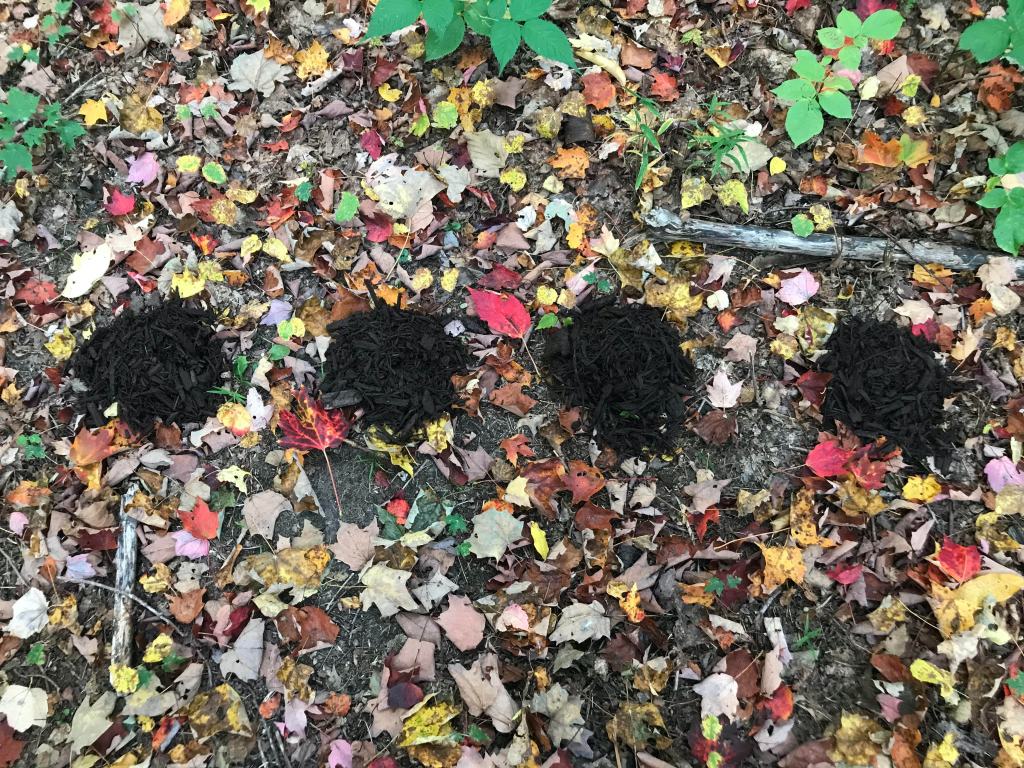
A seventh location with 4 mulch piles will examine a wider range of watering conditions–1 scoop, 2 scoops, 4 scoops, and 6+ scoops are the treatment conditions.

Figure 3: Mulch piles at site 7.

The 1 scoop pile isn’t a real control, but there are already a bunch of no-water piles around at the other sites, so having another one here seemed boring. I was going to have the highest value be 8 scoops but I’m saying 6+ because the can I use only really holds a total of 14 scoops so to do all of them in one go it would end up being 7 scoops for the final pile, which just doesn’t follow as nicely from the previous numbers as 6 or 8 does. Still, I want to have this one to be pretty wet so on some days I might go and fill up the can a second time so I can give it 8 (or more) scoops. I fully expect this to degenerate into a “just drench it” scenario within the week.