
Reference Reading
- A Chemical Hunger, Part VII and Interludes C, G, and H
- U.S. Geological Survey, Public Water Supplies of the 100 Largest Cities in the United States, 1962
- U.S. Geological Survey, Lithium in U.S. Groundwater, 2021
- Ferensztajn-Rochowiak, E., & Rybakowski, J. K. (2023). Long-term lithium therapy: side effects and interactions. Pharmaceuticals, 16(1), 74.
Background Information
In clinical settings, lithium is usually prescribed as lithium carbonate, and doses are given in milligrams (mg) of the compound. But lithium carbonate is only 18.8% elemental lithium (the rest is carbonate), so the dose of elemental lithium is much lower than the face amount. For example, if you are prescribed “600 mg 2 times a day”, that’s 1200 mg of lithium carbonate, which works out to about 225 mg of elemental lithium.
Remember that most numbers in this problem set are expressed as elemental lithium. Be careful to distinguish between elemental lithium and lithium carbonate when interpreting doses.
Part 1: Dose-Response Estimation
1. People often take several hundred milligrams of elemental lithium per day as a medication. Drawing on official lists of drug effects from sources such as MedlinePlus (U.S. National Library of Medicine), the FDA, the Mayo Clinic, the NIH, and the NHS (and any other sources you deem appropriate), and using your judgment, pick five effects you think are commonly observed at therapeutic doses, and briefly explain the evidence basis for classifying each effect as common at clinical doses rather than rare.
Keep in mind that accounts may seriously differ — for example, this paper says that “the prevalence of hypothyroidism during lithium treatment varies from 6% to 50%”, an extremely wide range.
2. Take the five effects you named in Question 1. To the best of your ability, which of these effects would you expect to occur in a reasonable number of patients (say, more than ~5%) at 300 mg/day elemental lithium? 100 mg/day? 50 mg/day? 20 mg/day? 1 mg/day? For each dose, explain your reasoning.
3. If an individual were exposed to 300 mg/day elemental lithium through food, would you expect them to experience the same effects as someone taking 300 mg/day elemental lithium as a clinical dose of lithium carbonate (approximately equivalent to 600 mg of lithium carbonate 3 times a day)? Why or why not?
Part 2: Analytical Comparison
4. Different studies report widely varying, even contradictory, lithium concentrations in food (see these literature reviews). One potential explanation is that some analytical techniques are more accurate than others. Studies that use HNO₃ digestion with ICP-MS generally find only trace levels (~0.1 mg/kg in most foods, with no foods above 0.5 mg/kg), while studies that use other analytical techniques like ICP-OES or AAS, sometimes with H₂SO₄ or HCl digestion, report higher concentrations (often >1 mg/kg, with some foods exceeding 10 mg/kg).
As part of an effort to test whether differences in analytical precision might explain these conflicting results, a recent head-to-head comparison of different analytical techniques on identical samples of food found that when samples were digested in HNO₃, both ICP-MS and ICP-OES registered very low concentrations of lithium, often below the limit of detection. In contrast, when samples were dry ashed, both ICP-MS and ICP-OES analysis detected lithium in all samples, up to 14.8 mg/kg in goji berries and 15.8 mg/kg in eggs. A follow-up study on eggs using dry ashing and ICP-OES found similar results.
Question: Which results (HNO₃ digestion or dry ashing) are more likely to reflect the true lithium content of these foods? Read the reports carefully to fully understand the methods used. Explain your reasoning, considering the possible effects of digestion method, analytical technique, and potential sources of error.
5. In the results mentioned in Question 4, there are two analytical protocols — HNO₃ digestion followed by ICP-MS / ICP-OES and dry ashing followed by ICP-MS / ICP-OES — giving two very different sets of results. They cannot both be correct. It’s possible that one is accurate and the other is not. But it’s also possible that both are wrong.
Considering the limitations and biases of each method, how likely is it that both analytical protocols are overestimating the true concentrations? (i.e. The real concentrations are lower.) How likely is it that both analytical protocols are underestimating the true concentrations? (i.e. The real concentrations are higher.) Explain your reasoning, taking into account the digestion methods, analytical techniques, and possible sources of error.
6. For the sake of argument, assume the higher concentrations from the dry ashing analysis are correct. In eggs, the dry ashing analysis found concentrations of up to 15.8 mg/kg lithium. Based on these data, estimate how common eggs with 20 mg/kg, 50 mg/kg, or 100 mg/kg lithium would be in the American food supply. Consider both the data from the original study and the followup study focusing on eggs alone. Try estimating the distribution, and compare results under the assumption of normal versus lognormal distributions. Show all calculations and reasoning.
7. Overall, what is your best estimate for the daily amount of lithium an average American gets from their food and water? For water concentrations, consider referring to these USGS sources from 1962 and 2021, but you are encouraged to consult additional sources as well.
Do you think Americans are exposed to appreciable amounts of lithium from any sources other than their food and water? If so, estimate the amount and explain your reasoning.
For each part, clearly justify your estimates, and cite the data or assumptions you use.
Part 3: Advanced Questions
8. The authors of the blog SLIME MOLD TIME MOLD think that chronic exposure to lithium contamination may cause weight gain, and think it’s plausible that lithium contamination may be responsible for some or all of the obesity epidemic. Correctness of the hypothesis aside, why do they think that? What pieces of evidence do they find most convincing? You can use their most recent summary as a starting point, but explain your understanding of their reasoning in your own words.
9. For the sake of argument, assume that lithium does not cause weight gain at less than clinical doses. Given this assumption, are there other reasons why lithium exposure might be a public health concern? Would lithium be a public health concern if people were exposed to 1 mg/day of elemental lithium? 5 mg/day? 10 mg/day? 50 mg/day? 100 mg/day? 300 mg/day? Again assuming no weight gain, at what point would lithium exposure become a public health concern, and for what reasons?
10. Some plants appear to concentrate lithium from their soil and/or water. For example, in the early 1970s, Sievers and Cannon found that in the Gila River Indian Reservation, where the average concentration of lithium in the water was only about 0.1 mg/L (0.1 ppm), the local wolfberries contained “an extraordinary 1,120 ppm lithium in the dry weight”.
Oilfield brines rich in lithium are sometimes used for irrigation of crops intended for human or livestock consumption. Based on available evidence, should the use of lithium-containing irrigation water be limited or avoided? Are there common plant- or animal-derived food products that appear especially likely to accumulate lithium? Explain your reasoning, considering potential public health implications and exposure pathways.
11. Drug effects often vary depending on factors like formulation, delivery method, interactions, and duration of exposure. Drugs can have interactions with other drugs, minerals, or even grapefruit juice. Acute exposure can produce different effects than chronic exposure. And some populations (e.g., children, the elderly, or people with kidney disease) may respond differently than others to an otherwise identical dose.
To the best of your ability, what factors make lithium more effective (stronger effects, lower effective doses, etc.)? What factors make lithium less effective? Answer however you like, but consider starting with: differences by formulation (e.g. lithium carbonate vs. lithium orotate), the influence of dietary sodium, or interactions with common medications (e.g., diuretics, NSAIDs).
Question 12 refers to the early-twenty-first-century tweet below by journalist Matthew Yglesias.
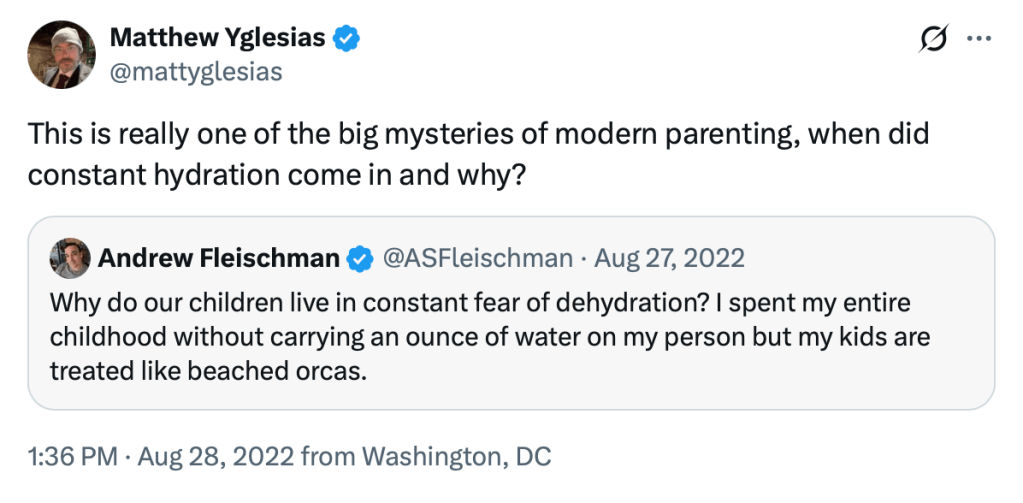
12. Given that increased thirst is a known side-effect of lithium, how much more would people drink and/or pee if they were exposed to 1 mg/day of elemental lithium? 5 mg/day? 10 mg/day? 50 mg/day? 100 mg/day? 300 mg/day? Could this explain modern American habits of hydration and urination? Why or why not? Justify your reasoning with reference to lithium’s known pharmacology, and typical dose-response relationships.
13. Given that “loss in sexual ability, desire, drive, and/or performance” is a known side-effect of lithium, estimate how much it would impact the birthrate if people were exposed to 1 mg/day of elemental lithium? 5 mg/day? 10 mg/day? 50 mg/day? 100 mg/day? 300 mg/day? Could lithium exposure plausibly contribute, in whole or in part, to the modern fertility crisis? If so, approximately what level of exposure would be needed to meaningfully affect the birthrate? Justify your reasoning using known dose-response effects, chronic-accumulation pharmacokinetics, and relevant demographic considerations.
14. For the sake of argument, assume that the obesity epidemic is entirely caused by one or more environmental contaminants. Conditional on this assumption, which contaminant(s) are the most likely contributors? How does lithium stack up compared to other candidates?
Please email completed answers to slimemoldtimemold@gmail.com or submit them on twitter at @mold_time. Or better yet, post them on your blog and let us know. 😛
 SLIME MOLD TIME MOLD