The riff trial is a new type of study design. In most studies, all participants sign up for the same protocol, or for a small number of similar conditions. But in a riff trial, you start with a base protocol, and every participant follows their own variation. Everyone tests a different version of the original protocol, and you see what happens.
As the first test of this new design, we decided to riff on one of our previous studies: the potato diet. For many people, eating a diet of nothing but potatoes (or almost nothing but potatoes) causes quick, effortless weight loss, 10.6 lbs on average. It’s not a matter of white-knuckling through a boring diet — people eat as much (potato) as they want, and at the end of a month of spuds, they say things like, “I was quite surprised that I didn’t get tired of potatoes. I still love them, maybe even more so than usual?!”
Why the hell does this happen? Well, there are many theories. The hope was that running a riff trial would help get a sense of which theories are plausible, try to find some boundary conditions, or just more randomly explore the diet-space. We thought it might also help us figure out if there are factors that slow, stop, or perhaps even accelerate the rate of weight loss we saw on the full potato diet.
In the first two months after launching the riff trial, we heard back from ten riffs. Those results are described in the First Potato Riffs Report. Generally speaking, we learned that Potatoes + Dairy seems to work just fine, at least for some people, and we saw more evidence against the idea that the potato diet works because you are eating only one thing (people still lost weight eating more than one thing), or because the diet is very bland (it isn’t).
Between January 5th and March 18th, 2024, we heard back from an additional seventeen riffs. Those results are described in the Second Potato Riffs Report. Generally speaking, we learned that Potatoes + Dairy still seems to work just fine. Adding other vegetables may have slowed progress, and the protein results were mixed. However, the Potatoes + Skittles riff was an enormous success.
Between March 18th and October 9th, 2024, we heard back from an additional eleven riffs. Those results are described in the Third Potato Riffs Report. Generally speaking, we saw continued support for Potatoes + Dairy.
The trial is closed, but since the last report, we’ve heard back from an additional two riffs, which we will report in a moment. This gives us a total of 40 riffs in this riff trial. Note that this is not the same as 40 participants, since some people reported multiple riffs, and a few riffs were pairs of participants.
Participant 87259648 did a Fried Potatoes riff, specifically, “mostly fried in a mix of coconut oil and tallow or lard” and continuing her “normal daily coffees with raw whole milk, heavy cream, honey and white sugar.”
Despite consuming only “around 30 percent potato on average”, she lost a small amount of weight and “found [the] diet to be easy and enjoyable, I never felt sick of potato although I did have a hard time getting myself to eat MORE potato each day.”
Participant 80826704 was formerly participant 41470698, but asked for a new number to do a new kind of riff. In Riff Trial Report Two, he had done Potatoes + Eggs as participant 41470698 and lost almost no weight. This time, he did a full potato diet and lost a lot of weight, more than 13 lbs:
Mean weight change was 6.4 lbs lost, with the most gained being 5.2 lbs and the most lost being two people who both lost 19.8 lbs. One person gained weight, one person saw no change, one person reported no data, and the rest lost weight. One person also gained 6.3 lbs on “Whole Foods” + Chocolate, but this was not a potato diet (only about 10% of her diet was potatoes).
Here are all the completed riffs, plotted by the amount of weight change and sorted into very rough riff categories:
There are also a large number of people who signed up, but never reported closing their riff. We’re not going to analyze them at this point, but all signup data is available on the OSF if you want to take a look at the demographics.
Things we Learned about the Potato Diet
The potato diet continues to be really robust. You can eat potatoes and ketchup, protein powder, or even skittles, and still lose more than 10 lbs in four weeks.
The main thing we learned is that Potatoes + Dairy works almost as well as the normal potato diet. There were many variations, but looking at the 10 cases that did exclusively potatoes and dairy, the average weight lost on these riffs was 9.2 lbs. This is pretty comparable to the 10.6 lbs lost on the standard potato diet, suggesting that Potatoes + Dairy is almost as good as potatoes by themselves (though probably not better).
We didn’t see much evidence that there might be a protocol more effective than the potato diet. This is sad, because it would have been really funny if Potatoes + Skittles turned out to be super effective.
That said, three riffs did do unusually well, and it’s still possible that there is some super-potato-diet that causes more weight loss than potatoes on their own, or that’s better in some other way.
There’s some evidence that meat, oil, vegetables, and especially eggs make the potato diet less effective. But with such a small sample, it’s hard to know for sure. This could be a productive direction for future research. You could organize it as an RCT, and compare a Just-Potato condition to a Potato + Other Thing condition. Or an individual could test this by first doing a potato diet with one of these extra ingredients for a few weeks, then removing the extra ingredient and doing a standard potato diet for a few weeks as comparison.
The strongest evidence is against eggs, because participant 41470698 / 80826704 did exactly that. First he did a Potatoes + Eggs riff and lost only 1.8 lbs. Then he did a standard potato diet and lost 13.2 lbs. That’s not proof positive, but it’s a pretty stark comparison. If that happens in general, it would be hard not to conclude that eggs stop potatoes from working their weight-loss wonders.
Current Potato Recommendation
If you want to try the potato diet for weight loss, our current recommendation is this funnel:
Start by getting about 50% of your diet from potatoes and see how well that works.
If you want to be more aggressive, switch to Potatoes + Dairy. Try to get at least 95% of your diet each day from potatoes and dairy products, but don’t worry about small amounts of cheating.
If you want to be more aggressive, switch to the original potato diet. Try to get at least 95% of your diet each day from potatoes, but don’t worry about small amounts of cheating.
If you want to be more aggressive, switch to a strict potato diet. Try to get almost 100% of your calories each day from potatoes, allowing for a small amount of cooking oil or butter, salt, hot sauce, spices, and no-calorie foods like coffee.
If dairy doesn’t work for you for some reason (like you’re a vegan, or you just hate milk), consider replacing Step 2 with a different riff that showed good results, like Potatoes + Lentils or Potatoes + Skittles.
Remember to get vitamin A. Mixing in some sweet potatoes is a good idea for this reason.
Remember to get plenty of water. Thirst can feel different on the potato diet, you will need to drink more water than you expect.
Remember to eat! In potato mode, hunger signals often feel different. But if you don’t eat you will start to feel terrible, even if you don’t feel hungry. If anything, eating a good amount of potatoes each day may make you lose weight faster than you would skipping meals.
If the potato diet makes you miserable, try the three steps above. If you try those three steps and you’re still miserable, stop the diet.
Things we Learned about Doing Riff Trials
This is the first-ever riff trial. But it won’t be the last. So for the next time someone does one of these, here’s what we’ve learned about how to do them right.
#1: It Works
We hoped that riff trials would use the power of parallel search to quickly explore the boundary conditions of the base protocol, and discover what might make it work better or worse.
This works. We had suspected that dairy might stop the potato effect, but we quickly learned that we were wrong. We saw that the potato effect is also sometimes robust to lots of other foods, like skittles. And we saw that other foods, like eggs and meat, seem like they might interfere with the weight-loss effect.
#2: You May Have to Encourage Diversity
That said, there was not as much diversity in the riffs as we might have hoped.
Most people signed up for some version of Potatoes + Dairy. This was great because it provided a lot of evidence that Potatoes + Dairy works, and works pretty damn well. But it was not great for the riff trial’s ability to explore the greater space of possible riffs.
In future riff trials, the organizers should think about what they can do to encourage people to sign up for different kinds of riffs. If you don’t, there’s a good chance you’ll find that most of your scouting parties went off in the same direction, and that’s not ideal if you want to really explore the landscape.
One way to do this would be to run a riff trial with multiple rounds. First, you have a small number of people sign up and complete their riffs. Then, you take some of the most interesting riffs from the first round and encourage people to sign up to riff off of those. You could even do three or four rounds.
In fact, this is kind of what we did. Since we reported the results in waves, and had rolling signups, some people were definitely inspired to try things like Potatoes + Dairy or Potatoes + Lentils because of what they saw from completed riffs. But we could have done this even more explicitly, and that might be a good idea in the future.
#3: Riff Trials Harness Cultural Evolution
There’s no formal skincare riff trial. But it does kind of exist anyway. People get interested in skincare, and go look at other people’s routines. They copy the routines they like, but usually with some modifications. This is all it takes for skincare protocols to mutate, combine, and spread through the population, getting better and better over time.
The same is true of any protocol floating out there in the culture, including the potato diet itself. Even if we hadn’t run the riff trial, people would have experimented with potato diets for the next 10 or 20 years, trying new variations and learning new things about the diet-space. But this process would have been slow, and it would have been hard to tell what we were learning, because the results would have been spread out over time and space.
The fact that we planted our flag and ran this as a riff trial didn’t change the nature of this exploration. But making it one study, clearly marking out its existence, definitely sped things up, and helps make all the riffs easier to compare and interpret.
87259648 – Fried Potatoes
Riff
Potatoes, mostly fried in a mix of coconut oil and tallow or lard. I will continue with my normal daily coffees with raw whole milk, heavy cream, honey and white sugar. Maybe occasional fruit on cheat days but mostly just potatoes, dairy, coconut oil, tallow, coffee and honey/sugar. 28 days. My reasoning for choosing this is that fried potatoes are delicious, i really don’t want to give up my coffee routine, or waste the raw milk that i get through a cow share, and anecdotally, coconut oil and stearic acid have both been reported to help with weight loss.
Report
So I didn’t lose a lot of weight, but I definitely lost somewhere between 3 – 6.5 lbs (hard to tell due to fluctuations in water weight) and an inch off my waist despite doing a pretty relaxed version of the diet.
What I ended up doing was a diet of around 30 percent potato on average (even though I only ate potatoes for dinner and “grazed” on smallish things throughout the rest of the day, it was hard for me to get past around 30 percent potato calorie-wise). The rest of my diet was mostly dairy (raw milk, heavy cream, sour cream, butter, cheese and occasional ice cream), fruit, sugar (and sugary drinks), honey, chocolate and saturated fats (coconut oil and beef tallow).
I rarely boiled the potatoes so the potato portion of the diet was mainly peeled yellow or red potatoes pan-fried in a mixture of tallow and coconut oil, baked russet potatoes with the skins, or roasted red and yellow baby potatoes with the skins.
I occasionally supplemented extra potassium, as well as other supplements. Around day 5 I started drinking coconut water in order to get extra potassium.
I found this diet to be easy and enjoyable, I never felt sick of potato although I did have a hard time getting myself to eat MORE potato each day. The skins didn’t seem to bother me. Something about the diet definitely seemed to have an appetite lowering effect, although my appetite did fluctuate from day to day. I never intentionally cut calories or deprived myself of anything I really wanted. So even on the very low calorie days I ate as much as I felt like eating that day. (i am used to doing extended fasts so this is not super unusual for me, but I DO think that the extra potassium or something DID result in more days than usual where I didn’t feel like eating as much).
I didn’t exercise any more or less than I usually do.
My husband and another male family member did even less strict versions of the diet along with me (potatoes for dinner, whatever else they wanted the rest of the day) and they both seemed to lose more weight than I did, but they didn’t keep track of any data. I’m a 49 year old female, the other two men are 49 and 66. In the last couple years it has gotten much harder for me to lose weight, and I have been pretty fatigued in general. I didn’t notice any extra energy on this diet, but appetite did often seem suppressed.
I didn’t observe any noteworthy reduction in pulse or body temperature over the course of the diet. Three weeks after finishing the diet I have not been able to keep the weight off and am back up to 190.
I kept track of everything in the Cronometer app, so if you have any questions I can access some data that’s even more specific from there, let me know!
80826704 – Only Potatoes
Riff
Formerly participant 41470698, who asked for a new number: “I would like to try the full potato diet at some point during 2024. Could you prepare a new Google Sheet for me for this purpose?”
Report
I completed the potato only version in August, but neglected to send you a report. Happy to report that I’ve completed it and filled the 4 week sheet.
In terms of feeling it was very similar to my riff experiment. In terms of results this has been completely different. One thing I am now throughly convinced about is the “ad libitum” part. I am hungry, I eat. It’s so simple it’s scandalous, but it’s been buried under years of well meant status quo advice.
From that point it simply matters which food types I eat. Even if the lithium hypothesis turns out wrong, this part I am thoroughly convinced about now.
Difficulty
In a way this was easier than potatoes + eggs. One reason I remember for this was the forced pre-planning. Because I knew I was going to eat only potatoes I generally tried to peel way more potatoes than I was hungry for. Because of this, for the next meal I would have potatoes already lying around. I could then eat those as-is, or more tasty, (re-)baking them in a frying pan.
Somehow I had less inclination to cheat.
I’ve also gone to McDonalds like 6 times, ordering only fries without sauce. And a lot of fries from a Snackbar (https://nl.wikipedia.org/wiki/Snackbar). It’s super convenient when going by train to just order a big portion of fries without sauce.
Fun stuff
Potatoes are fucking delicious by the way. I’ve taken to eating them without sauce, because now it just feels like potatoes with sauce taste like sauce. And then I’m missing the potato flavor. Maillard reaction for the win.
With a group of friends I did a “potato tasting”. I bought 8 breeds of potatoes and cooked them with the oven or boiled. So we tasted 16 different kinds. People were truly surprised by the amount of variation.
My surprise was mostly about how difficult the different breeds were to peel. Some potatoes are truly monsters.
For many people, eating a diet of nothing but potatoes (or almost nothing but potatoes) causes quick, effortless weight loss. It’s not a matter of white-knuckling through a boring diet — people eat as much (potato) as they want, and at the end of a month of spuds they say things like, “I was quite surprised that I didn’t get tired of potatoes. I still love them, maybe even more so than usual?!” And some people lose a similar amount even when eating only 50% potato.
Why the hell does this happen? Well, there are many theories. To help get a sense of which theories are plausible, try to find some boundary conditions, or just more randomly explore the diet-space, we decided to run a Potato Diet Riff Trial.
In this study, people volunteer to try different variations on the potato diet for at least one month and let us know how it goes. For example, they might eat nothing but potatoes and always cook their potatoes in olive oil. Or they might eat nothing but potatoes and leafy greens. Or they might eat nothing but potatoes but always eat their potatoes with ketchup.
The hope is that this will help us figure out if there are other factors that slow, stop, or perhaps even accelerate the rate of weight loss we saw on the full potato diet. This will get us closer to figuring out why potatoes cause weight loss in the first place, and might get us closer to curing obesity. We might also discover a new version of the diet that is easier to stick to, or causes more weight loss, or both.
In the first two months after launching the riff trial, we heard back from ten riffs. Those results are described in the First Potato Riffs Report. Generally speaking, we learned that Potatoes + Dairy seems to work just fine, at least for some people, and we saw more evidence against the mono-diet and palatability hypotheses.
Between January 5th and March 18th, 2024, we heard back from an additional seventeen riffs. Those results are described in the Second Potato Riffs Report. Generally speaking, we learned that Potatoes + Dairy still seems to work just fine. Adding other vegetables may have slowed progress, and the protein results were mixed. However, the Potatoes + Skittles riff was an enormous success.
Since then, we’ve heard back from 11 new riffs. (Specifically, these are the riffs we heard back from between March 18th and October 9th, 2024.)
A few riffs are ongoing, but signups have slowed to a crawl. So while there may be a few more riff trial results in your future, signups are now closed. We may do more potato diet studies in the future, perhaps even another riff trial, but we are going to wrap this one up for now. Expect a final riffs retrospective around January 2025.
But let’s see what we’ve learned so far. First we’ll review the overall results, and talk about our interpretation. Then, at the end we’ve included the actual riff proposals and reports from all 11 participants in an appendix, if you want to read about them in more detail.
Unless otherwise indicated, weight loss numbers are over a period of about 28 days, comparable to the original Potato Diet Community Trial.
Potatoes + Dairy
Participant 07566174 ate “Potato plus a bit of dairy, ice cream for a treat”. At the end they said, “overall very successful despite rampant cheating!” and you know what, that’s entirely right:
In this case, cheating wasn’t “take a day-long break from eating potatoes”, instead it meant more like “ate less than 100% potato”. For example, one cheat day entry said: “Had some cake, and a couple chocolates. Otherwise, potato. Plus a beer instead of ice cream.”
This participant actually gave us six weeks of data, here is the longer chart:
Participant 28818306 took to the true spirit of the riffs trials, “trying to combine what looks like working riffs (potatoes + dairy + lentils)” along with adding “some lettuce to the mix to see if it keeps working”.
This worked ok. “It went well in the first 2 weeks,” 28818306 reported, “the other 2 were kind of slow, and harder to follow.”
Participant 92679541 did a riff of potatoes + oil + dairy (mainly cream and butter), with a more casual protocol and cheating most days, but had to stop the diet early. Despite all this, he lost a couple of pounds:
Participant 97027526 did a riff starting with potatoes plus butter, ghee and spices, and added raclette cheese after a few days.
Chalk another one up for the potato diet making people fall even deeper in love with potatoes: “I discovered I LOVE baked potatoes (first cooked in the microwave then finished off in the oven to crispen them up) and over 70% of my potatoes were cooked like that. … I am surprised that after four weeks I still really like potatoes! I’m going to continue with the potatoes for a while”.
She lost exactly 10 pounds over 28 days:
We then later received an update, where she said, “I am almost at the end of 8 weeks and still going strong. … My diet now exclusively consists of baked potatoes, butter, salt (a few pinches once a day), pepper and sometimes garam masala. … I’m not nearly as hungry as I used to be.”
Between Day 1 and Day 53, she lost a total of 15.9 pounds:
Potatoes + Meats
Several people tried riffs that aimed for the most classic meat & potatoes.
50108266 and 20953986 are a husband and wife team who started with the plain potato diet then added organ-based meat. Their full protocol was a bit complicated, see the appendix for more detail.
The results: Two weeks of just potatoes, “lost weight, but hated it”. Two weeks of potatoes + organ meat, “lost less weight, enjoyed much more. We will keep going.” It’s interesting that such a small change could so strongly affect their perceived enjoyment of the diet, especially while not strongly affecting how quickly they lost weight.
54084282 said, “I feel a diet that I could stick to for 30 days would be potato, bacon, black coffee, and Guinness. The bacon would help supplement fat and protein missing from the potatoes and reduce the need for extra seasonings. The coffee and Guinness are mostly for personal preference.”
Thirty days later, we got this update: “I have modified from my original riff! I’d characterize my current plan as fermented food/drinks + potatoes, along with a serving or two of protein daily. It is resulting in steady weight loss while alleviating the bloating and unpleasant constipation feeling that I experienced initially. I have lost about 5 pounds this month while feeling generally satisfied and still surprisingly not tired of potatoes. Only real remaining issue is eating out. I just cannot bring myself to order only French fries for a meal (especially around the kids). I just cheat in those situations but still manage to steadily drop weight, lol.”
Checking the data now, we see that 54084282 kept recording data up to day 58, and continued the trend of losing weight:
83842317 says, “potato + meat (chicken, beef, pork, fish)”. Then after the diet, “The convenience of eating tater tots, hash browns, chips, fries, and meat has been very easy and I’ll be sticking to it”.
There was no weight entry for Day 29, so here’s 83842317’s data up to the last weight entry on Day 34:
Participant 22179922 did a riff she came to call “potatoes and cows”, starting with potatoes and ramping up to first include dairy and then include other animal products (see appendix for full details).
Chocolate-Style Riffs
Two people did riffs that sort of involved chocolate.
59960254 did something like “Potatoes with Fire in a Bottle Characteristics”, meaning potatoes and a small amount of fat from sources like butter, tallow, coconut, cacao, etc. and also including fruit, honey, dates, and dark chocolate. This lead to a weight loss of exactly 10 lbs by Day 29:
We actually have 12 weeks of data from this participant, here is the longer version. The fluctuations in the middle are a sad story that have little to do with the diet itself; his cat got sick around the three week mark.
95078099 followed a riff of “potato + soy products + chocolate”. Note that he started off quite lean, with a BMI of around 20, but that “this is the result of a long, hard calorie restriction. My personal aim is not to lose weight, but to keep the weight down. If I stay at the same weight, and not drift up by a few pounds, I’d consider that a success!” So in this case the question is not really whether 95078099 can lose weight on the potato diet, but whether he can maintain weight on the potato diet without calorie restriction.
Ultimately, 95078099 lost 1.5 lbs between the first and the last measurement over four weeks. But based on the moving average, he concludes, “for myself, and for the purpose of keeping my weight down, I’d consider my potato riff ineffective.” See the appendix for a lot more detail, including additional charts with several years of data.
Skittles Update
Previously, participant 22293376 tried a Potatoes + Skittles riff, and was “astonished at just how well it went.” Here are those original results:
This was in January 2024. By July, he had started gaining weight and decided to do a second run of the riff, with some minor changes. This time it was potatoes plus: butter, oil, sweet potatoes, “low-calorie vegetables (onions, peppers, broccoli, green chile, etc.)”, and “skittles (in moderation)”. And for this second round, the results look like this:
The y-axis is fixed to match 22293376’s previous graph.
22293376 says, “I generally didn’t eat more than 20-30 skittles a day, and sometimes none. I don’t really recommend eating skittles-only meals but you do you!” Also check out the appendix for more detail on this riff.
Interpretation
As before, Potatoes + Dairy seems to work for many people, and it seems quite resistant to cheating. Every Potatoes + Dairy riff in this roundup lost some weight, and some lost as much as 10 lbs.
People lost some weight on different versions of Potatoes + Meats, but this seems to be inconsistent. It’s possible that the kind of meat, or its origin, could make a difference.
“Potatoes with Fire in a Bottle Characteristics” worked quite well. While the sample size is only one, it’s a nice proof of concept. These various fats and sweets don’t seem to interfere at all with the potato effect, at least not for this participant.
It’s also wonderful to have a skittles replication. The results are still from the same person, which means we can’t be sure if it will work equally well for other people, but it’s nice to see that this can happen twice. And it’s certainly more evidence against the idea that the potato effect is purely the result of cutting out processed foods and sweets. If sweets were always a potato-effect-killer, they would have stopped the effect here. They didn’t, so they aren’t.
Of course, we’d love to see replications from other people too. So if you’ve been on the fence, consider trying potatoes + skittles.
If so, please let us know how it goes! But it will have to be your own self-experiment, because as mentioned above, signups for the riff trial are closed. Expect a final report and a retrospective some time around January 2025.
07566174 – Potato + Dairy (ice cream)
Riff
Potato plus a bit of dairy, ice cream for a treat
Report
Hello,
I’m emailing to share results after 6 ish weeks of potato diet. Overall very successful despite rampant cheating! I’ll be continuing for a few weeks more.
28818306 – Potatoes + Dairy + Lentils + Lettuce
Riff
I’m trying to combine what looks like working riffs (potatoes + dairy + lentils) and add some lettuce to the mix to see if it keeps working and makes it “healthier” (at least according to my wife :-))
Report
Hi just wanted to let you know that I ended the 4 week of the potato riff trial.
It went well in the first 2 weeks, the other 2 were kind of slow, and harder to follow.
My diet consisted of a lentils burrito for breakfast (lentils flat bread + cooked lentils as filling + cheese). A mix of baked potatoes + cheese during the rest of the day. I tried to keep it mostly potatoes and use cheese for variety or as a snack.
I usually cooked 2 big batches of potatoes every week and I reheated them on a pan with a bit of olive oil.
I happened to take a blood test at the end of the diet and notice a drop in a few markers.
I’ve attached 2 pdfs. One is the most recent and another was 6 months before for comparison.
You can use them in your posts if you anonymize them.
They were translated by AI but look ok
Cheers
92679541 – Potatoes + Oil + Dairy
Riff
My plan is potatoes + oil + dairy (mainly cream and butter)
Report
I’m stopping the diet early (after two weeks). I ended up doing a *very* loose protocol – basically potatoes + anything that would be fine on Keto (i.e. potatoes intended to be basically my only carb). As you can see from my entries, I cheated most days, typically with sweets, for which I experienced really wild cravings. I am down ~ a couple of pounds from my first weigh in.
97027526 – Potatoes plus butter, ghee, cheese, and spices
Riff
Not 100% decided yet! Perhaps potato + butter/ghee + spices or potato + butter/ghee + cheese + spices. Planning to do this with another person in my household. We intend to do this just for 4 weeks but if it is going really well and I don’t find it difficult I may continue for another few weeks
Report
Dear Slimemold Timemold team,
August:
I’ve just found the below updates in my drafts from months ago. Not sure if it’s still interesting, but I did eat the potatoes! I ended up going back to my normal diet and I am almost back to my starting weight now. Thinking of giving it another go in September.
February:
I saw your latest potato riffs article today and when I didn’t see my own results there I realised I forgot to send you the following email almost a month ago when I completed the four weeks… So here it is:
Note from the end of the first four weeks
I have completed the four weeks!
I initially planned to do potatoes plus butter, ghee and spices but ended up adding cheese after a few days. This added a bit of interest and I think made me more likely to comply with the diet. I am exclusively eating raclette cheese (a Swiss cheese normally eaten with potatoes). The first two or three days were a bit tough, but after that I had no problems. I discovered I LOVE baked potatoes (first cooked in the microwave then finished off in the oven to crispen them up) and over 70% of my potatoes were cooked like that. After reading about the increased resistant starch in cooled potatoes I decided to cook potatoes the day before. I only managed this sometimes so about 40%-50% of potatoes were pre-cooled. At the start of the diet I ate lots of spices on my potatoes (home ground garam masala and chili flakes) but as time goes on I find myself satisfied with butter and sometimes salt as flavourings.
I am surprised that after four weeks I still really like potatoes! I’m going to continue with the potatoes for a while (probably another 2 weeks maybe another 4) and will keep using the spreadsheet in case that’s useful.
Update from 21/03/2024
I am almost at the end of 8 weeks and still going strong. I have removed the cheese because I suspected it was behind some bowl complaints. No complaints since I stopped the cheese. My diet now exclusively consists of baked potatoes, butter, salt (a few pinches once a day), pepper and sometimes garam masala. Potatoes are about 60% pre-cooled 40% freshly cooked. I’m not nearly as hungry as I used to be.
Thanks for organising!
50108266 and 20953986 (Potatoes + Organ meat)
Riff
Hi!
We are planning to participate in a trial with my husband / wife. So, there will be two very similar applications. [SMTM’s note: as indeed there were!]
We want to start with the plain potato diet and then add organ-based meat to it.
Reasoning includes personal preferences and curiosity about BCAA and PUFA theories.
Our current diet is 70% “Steak and Salad,” “Fish and Salad,” or “Plain Yogurt, Steak and Salad.” Some days, we binge on processed sugary sweets, then do steak and salad again. Our main dietary sacrifice is starch. And despite most of the time having a “colorful and diverse plate,” straight from the dietary recommendations brochure cover, we both consistently gain weight. So now we want to try to revert our diet.
We both search for dopamine in food and have difficulties fighting cravings, so as a second ingredient, we need something we will be very interested in. We had two main candidates – something sweet or something meaty.
The results of the Potatoes + Beef riff were not good, and we already know that eating lots of beef doesn’t work for us either. So we had to find meat we like, but don’t eat often. In our case, it’s the organ-based meat. It is common in our home cultures but is absolutely not popular in the country where we live now. So, we did not eat organs and bones for a long time, but we used to eat them when we were thinner. And we really miss it, so it makes us excited.
Regarding the PUFA theory: to be consistent, we had to decide which type of fat to use for frying the potatoes. We decided to go with butter and leave seed oils aside.
The plan is the following:
1. We start with the 2 weeks plain potato diet
– We eat potatoes of all available types and in all forms, ad libitum
– We season the potatoes to make them tasty. It includes adding salt, garlic, different peppers, fresh dill. If the potatoes stop being tasty, we try to add something else in controlled amounts – parsley, soy sauce etc.
– We fry with butter, preferably ghee. We don’t cook with seed oils during the diet.
– We may eat restaurant fries, which probably will be cooked with seed oils, but we don’t make it the main part of our diet
– We may eat store-bought chips, but we don’t make it the main part of our diet
2. We drink our usual amounts of water, tea, Coke Zero, and coffee, but we don’t add milk to our coffee anymore.
3. We do our cheat meals on weekend breakfasts. Usually, it’s some kind of “balanced European breakfast” – avocado, egg, toast with butter and cheese, smoked salmon, croissant, orange juice
4. We keep taking the supplements we are used to take, which are
Wife’s case
Lion’s mane – 2500 mg
Vitamin B complex (includes 50 mcg B12)
CoQ10 – 200 mg
Liposomal vitamin C – 500 mg
Saw Palmetto – 500 mg
Myo-inositol – 1000 mg
Husband’s case
Lion’s mane – 2500 mg
Vitamin B complex (includes 50 mcg B12)
CoQ10 – 200 mg
Liposomal vitamin C – 500 mg
5. We stop taking
Omega 369 – 500 mg – Because it’s seed-oil based
Kalium-Magnesium Citraat – 270 mg – Because we increase potassium intake with the potatoes
6. We keep taking prescribed medications
Wife: I don’t have any
Husband: Fluoxetine
7. We follow the second 2 weeks by adding the protein but trying to keep it on the low-BCAA side. It will be beef and chicken:
– Bone broth
– Tongue
– Liver
– Heart
– Stomach
– Intestine
– Kidney
– Other organs we may find in the shop
– But not the muscle meat
8. We also intend to try to add the third component to the diet or change the component after 4 weeks, depending on the results of the first weeks.
Report
We, 50108266 and 20953986, did it. Here is our report!
TLDR
2 weeks potatoes – lost weight, but hated it
2 weeks potatoes + organs meat – lost less weight, enjoyed much more. We will keep going.
Report
We live in the Netherlands, another country of lean people (16% obesity rate) whose diet contains a significant share of bread and potatoes. The potato part of the diet was easy to organize, as there are tons of potato options in the supermarket, and french fries are available in any restaurant. For the first week, we bought as many options as possible – different brands of potatoes sliced for fries, more starchy and less starchy potatoes for baking and boiling, and potatoes sliced and mixed with various spices.
We ended up with a pretty stable diet. For breakfast, we ate air-fried fries. For lunch, we baked potatoes in the oven with their shells and seasoned them with salt, garlic, dill, and butter. For dinner, we baked potatoes again or boiled potatoes with the same seasoning. Usually, after dinner, we had one more snack with store-bought chips.
The first week was especially difficult, as we were constantly bloated, constipated, dehydrated, and hungry. We were eating smaller volumes than we were used to, feeling satiated by the meal’s end but also hungry shortly after. Because of our diet mood, on the first days, we were hesitant to eat more; also, despite our hunger, potatoes were not attractive enough to get up and cook some. Some nights, I was struggling to fall asleep because of growling hunger mixed with a heavy feeling of being bloated. Some nights, we were binge-eating a big pack of chips per person.
We both felt we were not losing enough weight for such a struggle. We both have experienced losing significant amounts of weight with calorie-restricted low-carb diets, and we both felt that “at that time we were losing more weight and faster.” However, I have weight records for myself for those times, and actually, weight-loss speed in absolute amounts was the same.
The second week was easier as we found preferred options and ate more boiled potatoes. In the middle of the second week, 20953986 started to add a little bit of mayonnaise “for the taste.” It’s an interesting choice, as he usually is a hot sauce person. Maybe mayonnaise was easier to reach, or perhaps he was attracted to protein in it. For me, 50108266, the smell of eggs in mayonnaise was extremely tempting, and I spent the whole 12th evening thinking about eggs obsessively. On the 13th day, I also accidentally felt sick at night, like I had food poisoning or a stomach bug; both are not common to me.
On the morning of the 15th day, 20953986 almost cried over his morning potatoes because he was hungry and disgusted at the same time.
I learned that I could not predict how much weight I was losing. I could not explain my weight fluctuations with bowel movements, water loss, water intake, or menstrual period. I also could not correlate how swollen I was with my weight. However, 20953986 sees the correlation between his bowel movements and weight. I also tried to find a correlation between weight loss and hunger and weight loss and eating processed foods. I was expecting to lose more weight after sleeping hungry, and less weight after eating a full pack of chips, but neither I nor 20953986 found such correlations for ourselves.
In the third week, we started with organs. Organ meat is not typical in Dutch culture but quite common in Turkish and Russian, so we love it and know how to cook it. We added pork liver sausage to our air-fried fries breakfast. For lunch, we usually had boiled beef tongue with boiled or baked potatoes. For dinner, we had either soup with chicken hearts, potatoes, and bone broth or fried beef liver with fries. The grilled liver was also relatively easy to find in Greek and Turkish restaurants, so we had quite a lot of it. We also tried kidneys and thymus, but we did not like them.
In the third week, our weight fluctuated in an unusual way. On the 15th day, the first day of the organ diet, I developed symptoms of an ear infection (even more unusual to me than a stomach bug) that lasted until the 17th day. On the 16th morning, I got +1 kg (2.2 lbs); on the 17th morning, my weight was the same, and after the infection symptoms were gone, my weight rapidly dropped. But the resulting weight loss in the third week was still a pitiful 0,7 kg (1.43 lbs). I assume the reason for the weight gain was an infection, but it could also be a change in the diet or a change in our cheating routine. On that day, we had our planned cheat moment, but because of how depressed 20953986 was, instead of cheat breakfast, we had cheat lunch, which, in my case, contained grilled chicken breast, bread, and yogurt mixed with spices.
20953986 also did not lose much weight that week, but he gained weight not at the beginning of the week, like me, but on the weekend. He also had a sick moment, but it was a chronic muscular pain problem that most possibly had nothing to do with the diet and weight.
On his rolling average graph, we see that there is no actual change in the weight loss velocity.
The fourth week was easy and enjoyable. We never felt too hungry, did not suffer from digestion problems, and got our second-best weight loss results in the four weeks.
The only thing that we noticed was a craving for vegetables and greens.
At the end of the report, I want to mention the cheat days. We were cheating on weekend breakfasts, as it is an important ritual for both of us. We went (except for one time that I mentioned) to the regular places where we go for breakfast; we always had several latte macchiatos and some kind of an assorted breakfast platter with greens, eggs, savory sandwiches, and pastry (you can imagine continental breakfast or Turkish breakfast). I noticed several things for myself that, however, did not work for 20953986:
I was less attracted to bread and pastry. Last time, I did not touch my bread at all. This also means that I ate less for breakfast than usual.
We had two breakfasts in a row, and every Sunday, despite the cheating, I had a weight decrease, but after the second breakfast on Monday or one time on Tuesday, I had a weight increase. This pattern included even the first Monday of a diet. We started our diet on Sunday; we ate a cheat breakfast, then ate only potatoes, and my weight increased the next day. I wonder whether it is a coincidence, whether something I eat stimulates some weight increase, or whether it is about waking up later on the weekend. When we had a holiday during the third week, I also had a weight decrease followed by an increase, although we did not cheat that day. But the third week was a mess anyway.
Because of this observation, we want to try some experiments around it. Considering that we are limited with our habits and working week, we can’t change much, but our current intention is to keep the same diet and try different times of the day on weekends for the cheat meals, which will also lead to different cheat foods. I am open to suggestions.
54084282 – Potato, Bacon, Black Coffee, and Guinness
Riff
I’ve recently been experimenting with potato dishes in anticipation of trying a potato diet to lose some weight I’ve gained in the past few years. I feel a diet that I could stick to for 30 days would be potato, bacon, black coffee, and Guinness. The bacon would help supplement fat and protein missing from the potatoes and reduce the need for extra seasonings. The coffee and Guinness are mostly for personal preference but also helps supplement nutrition. I plan to also use a variety of potatoes, including sweet and red with peel on.
Report
It’s now 30 days, just checking in but I plan to continue on my potato riff. I still hope to make it down to 135 lbs 🙂
I have modified from my original riff! I’d characterize my current plan as fermented food/drinks + potatoes, along with a serving or two of protein daily. It is resulting in steady weight loss while alleviating the bloating and unpleasant constipation feeling that I experienced initially.
I have lost about 5 pounds this month while feeling generally satisfied and still surprisingly not tired of potatoes. Only real remaining issue is eating out. I just cannot bring myself to order only French fries for a meal (especially around the kids). I just cheat in those situations but still manage to steadily drop weight, lol. Thanks for bringing this diet to my attention, it’s been good to me!
83842317 – Potato + Meat
Riff
potato + meat (chicken, beef, pork, fish). I had energy on the last round, but lacked the energy to continue heavy strength training and had to give up lifting the last two weeks. I’d like to see if having meat occasionally can help with recovery and keep my strength and training regimen up while losing weight.
Report
Done.
This was much easier. Strength and endurance workouts were fine and I never lacked for energy. I was lifting for maintenance and ramping up endurance for a marathon in October and never had to quit a workout for lack of energy.
There was a tracked 38h:32m:25s, 72.53 mi, 18856 kcal of workouts across hiking, walking, running, swimming, and various cardio machines during this period.
I had several trips throughout the period, so sticking to it was a challenge. I made do with bags of potato chips and cans of fish from grocery stores, but not always having access to an air fryer was tricky.
I took cream or half-and-half when available in my 1-3 coffees per weekday when in an office (maybe maybe 12 of the total days)
I caught a nasty cold on the 13th that kept me bedridden and alternating between eating and sleeping for days
Between all the travel, it was difficult to get access to a scale, so I wound up weighing myself on five different scales when I could find one.
The convenience of eating tater tots, hash browns, chips, fries, and meat has been very easy and I’ll be sticking to it out of mostly convenience. I’ll add in vegetables for other nutrients, but psychologically I haven’t craved variety in my diet for several years, and the convenience is unbeatable. All I need is a reliable option when traveling.
22179922 – Potatoes and Cows
Riff
I am primarily interested in learning more about how keto interacts with potatoes.
History: About a decade ago I lost weight, and kept it off, with keto (note: a sort of meat and veg keto, elements of paleo and Mediterranean, more butter and animal fats than vegetable oils, and lots of intermittent fasting). I felt great, and it removed the constant hunger that I didn’t even know I had (a commenter on your blog called it the Hunger). I then gained quite a bit of weight due to a high stress situation in 2020, and for various reasons (pregnancy, breast-feeding, loss of gall-bladder) have been unwilling to go back to that diet until now. Also my ancestors would have eaten a lot of potatoes and dairy, and it seemed to work for them.
Current situation: I need to lose 10-20 kg. I am still breastfeeding, and thus need more nutrients (particularly protein) than average. I also am often low on iron. There may be another pregnancy in my future, so I would like to lose this weight fast.
Riff: I will start with potatoes, dairy, salt, and spices at libitum for two weeks (to see whether potatoes works for me, and to put the diet most likely to work up front). I will then add in some animal products (especially fat, stock, and liver from beef, pork, lamb) for another two weeks.
After the four weeks are up, I would like to try alternating two weeks keto (as described above) with two weeks potato (potatoes + dairy + animal products) for as long as I need to (possibly two months).
If I become pregnant again, I would like to try keto + potatoes (at the same time, rather than alternating). I’m wary of doing any extreme diet during pregnancy in case hormones/epigenetics/etc affect the baby. However putting these two extreme diets together makes a diet that doesn’t seem extreme at all.
Reports
First Interim Email
Hello SMTM,
Participant number: 22179922
Riff: potatoes and cows (I think I called it something else when I first
pitched it, but this name is better).
I have finished the first four weeks of my riff. I intend to keep
going, but I’m sending you my interim report now. I’m not sure whether
you want to publish it now, or when I finish for good, or both, or
neither, but I’m at least sending you the interim report now since I
intend to keep going for the foreseeable future. It’s in txt format so
it’s easier for you to turn into whatever format you need, with whatever
formatting is required.
I’ve included some information in the report about my dieting history,
for context. I’ve also included my conclusions about obesity and weight
loss in general to get a better idea of how I felt over the course of
this diet and how it shaped my opinions. Should you prefer, you may
publish my report without those sections, but I’ve included them for
context; and as a reader I’d like to read similar things from others.
First Interim Report
Participant number: 22179922
Riff: Potatoes and cows
*The Riff*
I like dairy, so wanted to do potatoes + dairy. Aiming for potatoes garnished with dairy, rather than 50-50. But I am currently breastfeed and thus may need more protein than usual, as well as other micronutrients, so I decided to add in animal products too. I’ve heard rumours about too much protein, so I decided to focus on things like stock, fat, liver, and only eat flesh if I felt a craving for it. I’ve also been reading about seed oils recently, so I decided to focus on beef and lamb (yes, I know lamb is not from a cow) rather than chicken and pork (I rarely eat pork anyway). Since I’m allowed both butter and animal fat, there’s no point using any other sort of cooking oil.
But I also wanted to see whether potatoes would work for me at all, so I decided to start with two weeks of just potatoes and dairy, followed by two weeks of potatoes and cows. I did not end up following this to the letter, but I decided to split this diet up into multiple levels and record each day which level I did.
0 – Potatoes only (salt and butter allowed begrudgingly)
1 – Potatoes and dairy
2 – Potatoes and non-flesh animal products (i.e. fat, stock, organ meat)
3 – Potatoes and animal products
4 – Potatoes, animal products, and fruit and vegetables.
I never reached level 4 in the first month (unless you count cheat days), but I put it in because for the next few months I want to experiment with alternating between potatoes, keto, and keto+potatoes in two week blocks.
Some Q&A about this riff:
Why now? Baby is getting most calories from food rather than breastmilk, and I just came across the potato thing a few days ago, and I want to have another baby soon, so now’s my chance.
Why potatoes? Preliminary results seem pretty promising. Also I love potatoes. Also my ancestors ate lots of potatoes so they might work well with my genome.
Why dairy? Preliminary results seem pretty promising. Also I love dairy. Also my ancestors. But also, I’ve heard good things about butter in particular as a source of fat, and I love eating potatoes with cheese and/or butter.
Why add animal products? I need iron. Also frying potatoes in tallow. Also other animal nutrients.
Why not meat? I might add meat if I feel particularly protein hungry, but preliminary results for meat seemed not great, and I mainly wanted to test potatoes, rather than “meat and potatoes”. But someone (possibly me) should test “meat and potatoes” in the future. Or even “meat and potatoes and veg”/”meat and 3 veg”.
Why not chicken? Preliminary results for eggs seem bad, and also their high in lithium. I’ve heard rumours that chicken fat inherits its omega3/6 etc from its diet, and chicken diets are probably bad, so I think chicken might be a confounder that is worth testing separately. I’d like to test free-range vs feed lot chicken though.
Doesn’t pork have the same problems as chicken? Yes, but I rarely eat pork as I don’t particularly like it, and I especially avoid pork fat, so I’m not particularly fussed about it.
What about fish? I might add some fish as “meat” if I feel particularly protein hungry. But I don’t really eat fish stock, or want to fry potatoes in fish fat, etc.
*About me*
– I am female. Ever since puberty I’ve needed both red meat and iron supplements to stay ahead of deficiency.
– I’ve always been a bit on the chubby side, with my BMI hovering at the overweight border of normal all throughout childhood. I love food. Food makes me feel better and I stress eat and emotional eat and eat for enjoyment and very rarely forget a meal. (I suspect genetics makes some people feel this way about food more than others, and therefore people like me will overeat more than undereat, and thus will tend towards the overweight side of the spectrum, and will be more likely to be overweight/obese when there is an environmental issue. Whereas my husband often forgets to eat, so that probably counteracts whatever is in our environment)
– I need strict rules. I don’t do well with moderation.
– I need extrinsic motivation. I love food and don’t particularly care about appearance, and don’t really play sport. Being part of a study is particularly good for this.
– Related to the above, I am Catholic and find that I am able to “diet” during Lent in ways that I don’t have the willpower for during the rest of the year. I’ve recently been experimenting with trying to use this to help with both moderation and motivation, e.g. only having sugar on “Feast days”.
*My weight and dieting history*
Childhood: My normal/starting adult weight is 75kg. Both my parents have always been overweight. We would often flip flop between lots of take-away, and a strict wholefoods/mediterranean diet. My mother tried to be mostly low-carb, and used olive oil rather than canola/vegetable oil. We rarely ate wheat or junk food due to a coelic in the family. I never felt true satiety, but could feel physically full, and would also use social cues to determine when to eat or stop. I noticed a commenter on SMTM refered to “the Hunger”, and that’s exactly what I have. Eating Chinese take-away was an occasion for bingeing.
Anecdote about “the Hunger”: As and adult, I went to the USA with my family. I felt the Hunger stronger than ever before. At one point we’d just finished eating lunch and my (stick-thin) sister saw an interesting restaurant and decided to get a second lunch. I thought “Of course we could all eat a second lunch, but it’s not socially acceptable to admit that, and even less so to actually do it”. I now understand that not everyone feels this Hunger.
First weight gain: in my third year of uni I looked in the mirror and realised I’d gained a lot of weight. I was now 85kg. At the time, I attributed it to following my now-husband’s diet patterns (lots of carbs, we’d often share some hot chips together for lunch, very little meat or protein) rather than my mother’s (too many carbs are bad, eat some protein with every meal). However, having read “A Chemical Hunger”, I now see it could be due to moving house, moving daytime environment (from school to uni), the preponderance of on campus food options (pfas, seed oils), or even the increase in my wheat (glyphosate) or non-freerange chicken (antibiotics?) intake.
First weight loss (keto): I did a combination of keto and intermittent fasting. My keto diet was basically meat+veggies, with some dairy, as opposed to what I’ve heard called “Standard American Keto”. I never measured my ketone levels, but I determined ketosis based on how I felt, and in my opinion this was reasonably accurate. I would generally eat one meal a day, occasionally with one snack, occasional fast for the whole day, and every two weeks I would reintroduce carbs for two weeks. I rarely ate take-away, at mostly animal fats. I lost 20kg in 6 months and got down to my lowest adult weight (65kg). I very quickly gained those last 10kg back (within two weeks), and was stable at my old set point of 75kg for the next 5 years. For the first time in my life I no longer felt the Hunger. And even when I reintroduced carbs, I found the Hunger was still gone for the next week or so. I felt true satiety! And when the Hunger returned in force, I was able to kill it off with a week of keto, or stave it off with one day of keto/fasting every one to two weeks.
But this weight loss also co-incided with another change in environment, both moving house and moving workplace/school/uni.
Second weight gain (2020): I had a combination of a long term stressor, plus some acute stress, plus some physical influences, plus the covid lockdowns, all coalesce at once, and I gained about 15kg that year. But, having read “A Chemical Hunger”, I notice this weight gain also coincided with moving house, and a change in living arrangements (I got married), and a change in eating behaviour (I was now a short walk away from a supermarket that liked to mark down their products, so I would often go for a morning walk through the supermarket to grab a bargain, and ended up eating a lot of packaged and processed food (pfas? seed oils? glyphosate in wheat? etc).
Pregnancy etc: I was now 93kg and creeping up and up, and I became pregnant. Suddenly I couldn’t do keto (this is debatable, but I decided to be safe in case of hormones or epigenetics) or fast any more, so I could neither arrest this upward trend nor reverse it. Also I needed a lot of extra protein and extra nutrients (from what I understand, this is mostly for the mother’s sake, as the baby will generally steal her nutrients regardless). Morning sickness meant I could eat only carbs, fruit, and some dairy. I had strong cravings the whole pregnancy for carbs+dairy, and this continued into breastfeeding.
Gall bladder: a few months after giving birth, I went to hospital and needed my gall bladder removed. I did some research and realised that I needed the following diet for the rest of my life:
– high fibre (to slow down digestion and soak up gall that is produced)
– steady fat intake, so lots of small meals is better than one
– relatively stable diet.
– at first I thought I had to eat breakfast, but with some experimentation it seems that I can skip it as long as I’m consistent.
– I’ve heard rumours that different fats react differently (in particular, that coconut oil isn’t digested by gall, and that olive oil feels better the next day than fish and chips grease)
These rules are at odds with my previous success at keto and one meal a day. I was pretty scared to try anything slightly away from general medical establishment food recommendations, hesitant to try keto again, and scared to go too long without a meal, even when not hungry. I then gained another 10kgs, and ended up just over 100kg.
Second weight loss: I knew something had to be done, so I decided to try keto again. I kept starting and then cheating a day or two later, so I never made it to ketosis, but it did help me to feel comfortable with keto again, even without a gall bladder. I finally managed to reasonably consistently do keto during Lent (cheating every Sunday though), and I lost around 5kgs (from 102kg to 97kg). Then I discovered SMTM and the potato study a few months later. And if I can make keto+potatoes work, I can continue that through pregnancy and breastfeeding in the future. I lost about 2kg in a month with this riff.
*The month of potatoes*
I started off with just potatoes and dairy. I very quickly found myself eating a lot more dairy than envisioned, as a piece of cheese or a glass of milk made a good snack. I found myself always running out of potatoes at the beginning. Very excited, as potatoes and dairy are both delicious. At the beginning I would often find myself too hot, and fidgety, but as time went on I felt it a little less.
I started adding animal products earlier than envisioned, at day 5. Surprisingly, I didn’t yet have any cravings for them, but my husband wanted to feel included so I made us some sweet potatoes fried in animal fat. I also added meat earlier than expected, on day 8, due to wanting a bit more variety in my diet rather than a craving.
My typical meals were baked potato (usually microwaved, served with cheese and sour cream), soup (potato boiled in stock with cheese, often with lemon juice and pepper added, and usually with a potassium salt mix added too), fried potatoes (either fried in animal fat or ghee, sometimes steamed or microwaved before), and cepalinai (a lithuanian dish involving grated potato, wrapped around mince, boiled, then served with sour cream, onion, and bacon). I’d never made cepalinai before, and never did succeed perfectly, but I had a lot of fun this month trying very slight variations in the mixture to try to get them to work. Note that steaming, rather than boiling, is a great cheat’s way of cooking cepalinai without them falling apart.
I often had a bite of my child’s food when she wanted to share with me, but I didn’t count this as cheating. On Fridays I would eat a few bites of salmon with my potatoes. I would generally cheat when going out, which was mainly Saturday evening and Sunday brunch. Some days I would have a square of dark chocolate after dinner.
Early on, I tried two meals that I knew would have lots of leftovers (roast potatoes – potatoes that had been previously boiled with butter, garlic, lemon juice (I had been given lemons the day before I started this diet), herbs; and scalloped potatoes with a cream and garlic sauce). I gained 1.3kg, which is technically within uncertainty given how much my weight can vary day to day, but it was quite disheartening and I tried to troubleshoot. Here’s my diary entry from that day:
> Why am I gaining weight? Eating too much? Do I need less variety? Am I eating too much cheese? Does boiling reduce potassium too much? … I can gain/lose by up to 3kg just because (e.g. bloating, mensturation, etc), so idk.
From this point onwards I never boiled my potatoes unless I was going to eat the boiling water too. And I never made large oven tray meals either, or meals with garlic, because I noticed I overate those two meals.
From my fasting days, I had a jar containing a mix of potassium salt, sodium salt, and lemon-flavoured magnesium. The label has rubbed off and I no longer remember the quantities. I decided to try adding this to my food in case potassium made a difference. But I also hate the metallic taste of potassium and the weird fake lemon flavour of the magnesium, so I could only add this in small quantities, and only if I was also adding lemon juice, and practically this meant I only added it to soup.
On some days, especially day 8, I felt extremely hot and fidgety, and it was an internal heat, as though my metabolism was on fire. I started recording my daily morning temperature after that, but there was nothing out of the ordinary there. And on some days I was extremely cold, as though I was eating at a calorie deficit, but it was hard to say how much of that was due to the cold winter weather on those days.
Got sick around halfway through, but kept eating potatoes. Got very little sleep towards the end and probably overate.
While the Hunger never quite went away on this diet like it did during keto, I did get very attuned to noticing a certain variation on the Hunger, which I’ll call the Addiction. As far as I could tell, the Addiction cropped up whenever I ate seed oil (usually take-away foods like hot chips and Chinese, or packaged foods), but this could easily be confounded by pfas or some other problem. And when it cropped up, I felt a compulsion to eat that particular food, and never felt satiated by that food, and furthermore the Addiction seemed to hang around for about 12-24hrs.
I’ve realised that the Hunger seems to come in at least two parts, and on days when the Addiction wasn’t there I found myself occasionally feeling semi-satiated and happy to put my half-finished food away for later. If the seed oil blogs are right, I wonder if the Addiction is direct vegetable oil metabolic harm and the non-Addiction part of the Hunger is some sort of indirect metabolic harm from vegetable oil. Or they could be from at least two different sources of contamination etc.
I never got sick of potatoes, and in fact found a new appreciation for them. I particularly enjoyed feeling a connection with my european ancestors. However, towards the end I did feel a strong yearning to include other foods like onions, eggs, or a touch of flour. This was not a craving, but because I wanted to better emulate some of these ancestral recipes. In future I may decide to be a little more lax with things like that. On the other hand, I never managed to eat only potatoes (and salt). I tried eating only potatoes twice: the first time I caved and added butter at dinner, the second time I had butter with every meal and caved and added cheese and milk at dinner. I don’t think I could do a straight potatoes diet.
*My current theory*
I read “A Chemical Hunger”, and I generally agree that there is some sort of contamination in the modern world. Probably multiple. But I also think some things like seed oils and HFCS may be a problem too. It seems like certain diets (e.g. keto) may be a bit of a work-around for a broken metabolism, but I love carbs so I’d like to get to the bottom of this so I can eat carbs freely some day.
Mainly, I think that each of these issues probably causes obesity in some people, but none of them will be the cause of obesity in everyone. And if we remove one thing (e.g. pfas), some people will get completely better, and others will get a little bit better, and still others (hopefully very few) will have been permanently broken. For me personally, I think seed oils are one culprit, but I think there’s at least one other that I haven’t identified yet.
The fact that semaglutide has been found to work against addiction makes me wonder if one of it’s main pathways is preventing “the Addiction”, and thus that vegetable oil (or whatever similar thing in processed food (both ultra-processed packaged food and commercial restaurant/fast food)) is a culprit for many people.
*The future*
I’m going to have a few cheat days, maybe up to a week, and then try alternating between keto and potatoes+cow every two weeks. I may allow a few extra things like onions and eggs during the potatoes+cow phase. Next time I pregnant, I’d like to try some version of keto+potatoes, i.e. a sort of wholefoods diet that includes milk and excludes rice and wheat, so as to be sufficiently mainstream. I’d like to avoid vegetable oil, but that’s extremely difficult at the best of times. I’d also like to avoid packaged and ultra-processed food, and wheat.
Things I’d like to experiment with in the future (or see someone else try):
– Rice (I love rice and could eat it all day)
– Better bread (many variations, e.g. made without soy, without vegetable oil, from european wheat, etc)
– Free range vs. cage eggs (and chickens)
– Chicken (esp free range) vs. red meat
– Animal products vs. animal flesh
– Meat+veg+potato(+dairy)
– Alternating keto and potato, or keto and potato+keto
– Modern Catholic diet: preplan what fast (i.e. some sort of food restriction) and feast days mean, and preplan which days of the year are which (mix of long and short periods), and then follow that
– Medieval Catholic (or Orthodox) diet: as above, using medieval rules.
– Medieval peasant diet: as above, but with very little meat except on Sundays and feasts.
Second Report
Hello SMTM,
Here’s my next (probably final) report. This time there is less to say, so I’ll just say it here instead of attaching it:
————————————
Participant number: 22179922
After I completed 4 weeks of potato+cows, I decided to start alternating between 2 weeks “keto” and two weeks “potato”.
During my two weeks of keto, I tried to do something similar to ex150 from ExFatLoss. That is, one meal containing veggies + a limited amount of protein, and as much cream as I like the rest of the time. But because I don’t have a gall bladder, I require more fibre with my fat so I decided to add veggies or berries to the ad-lib cream. Overall, I don’t think this worked very well. When I exclude the initial water loss, I think I even gained weight here. And it took about a week for my gall-bladder to adjust, so I should have chosen a longer period. And towards the end I was craving carbs and protein and I had to switch to potatoes early.
I then intended to do a further two weeks of potato+cows, but it turned out I was pregnant. That probably caused the protein cravings, but I don’t think it caused the weight gain. Because I was pregnant, I decided to follow potato+cows very loosely, indulging in any cravings that came up ad lib. However, it turned out that most of my cravings were for meat, potatoes, and dairy anyway, so I actually followed my potato riff reasonably closely. Three common additions during this time were onions, eggs (free range), and flour (Italian to avoid glyphosate), mostly so I could follow certain potato recipes.
Overall, I didn’t seem to lose much weight in the initial 4 weeks, and to the extent that I did lose it I seemed to gain it all back in the following 4 weeks. I also felt very tired and hungry towards the end, but it’s unclear how much of that was due to a calorie deficit and how much was due to pregnancy. I would not attribute the weight gain to pregnancy though. It felt a lot closer to “weight loss by calorie deficit” rather than “weight loss by not feeling hungry”, both of which I have previous experience with.
I don’t think I’d try potatoes for weight loss in the future, but I did feel pretty good on them, discovered a few new satiety-related feelings, and I now have a new-found appreciation for potatoes. I’ve also made a big effort to avoid fast food, take-away, and packaged food, along with Australian and American wheat, and obvious sources of PFAS. And when I do buy pre-prepared food, I do my best to avoid fried food. I’m sure it’s healthier, but I’m yet to see an effect on my weight yet.
I will continue eating this way for the foreseeable future, but I don’t think I’ll fill in the spreadsheet – I’ve already noticed I’m putting in a lot less information than in the first month.
And I still haven’t managed to properly make cepelinai.
59960254 – Potatoes with Fire in a Bottle Characteristics
Riff
4 weeks. I am planning on incorporating the general idea/outlook of work like Fire in a bottle. So potatoes and a small amount of fat from sources that are not seed oils. Butter, tallow, coconut, cacao, etc.
Report
So my protocol was potato diet, low fat, low protein in the spirit of Brad Marshall’s “Fire in a Bottle” blog. So that meant the fat was generally saturated, and sources high in stearic acid. Fruit and honey were permissible, as well as dates for an evening sweet treat, or high cacao % dark chocolate. The one corner I cut on this was to frequently use this chili oil ( https://xiankits.com/products/xff-chili-oil-crisps-jar?Size=8oz ) to make the meals more palatable. In the spirit of FiaB this should be off limits because I’m sure the oil they’re using is some sort of seed oil but… can’t win them all.
For potatoes I tried a range of different styles, at first doing separate batches of regular and sweet, so that I had options. Eventually found I really enjoyed the yellow potatoes from Lidl and just make that. For prep/cooking I peel, boil, and mash all of them. At first I was weighing and tracking calories and titrating the amount of fat added to keep it below 10% of calories. After a week or 2 of this I got lazy and just eyeballed it. I experimented with all manner of combinations when eating. I found sweet potatoes often didn’t require the addition of anything beyond salt and pepper. Regular potatoes were eaten with various combinations of: butter, stearic enhanced butter (as Brad describes on his blog), chili oil, beef tallow, cacao butter, beef bone broth, honey, powdered glycine, and maybe something else I’m forgetting.
I found the diet reasonably easy to stick to, since I wasn’t eating strictly potatoes and could vary what I put in them. One concept that Brad has talked about is the idea that saturated fat causes a feeling of satiety much quicker than PUFA and why, down to a mitochondrial level, that might be. I really buy that argument now after the last several months. The speed and intensity of satiety I get when using tallow or cacao butter is a lot. I found my perception of hunger changed whenver I had a good stretch of following the diet strictly. I wouldn’t really feel actaul hunger, I would just at some point realize I was daydreaming about how good an entire pizza would be, or a steak, or piece of cake, whatever, and know that meant I was hungry.
Any time I’ve restarted the diet after a cheat day I find it takes at least a day to feel the effects kick in. Between potato diet and not drinking (which is still kinda a new thing for me) I find I wake up early and have good energy throughout the day. I’ve experimented with eating early in the morning to kickstart metabolism, another thing I believe I’ve heard Brad talk about, and at the other end of the spectrum waiting till at least noon or later to actually eat a substantial meal. The second option is more fun mentally because the morning fast allows me to log a lower weight for the day, and I’ll take any psychological trick that works. I found blood pressure improved pretty quickly with some weight loss and a few days into potato diet. Blood glucose was less quick to make changes, but perhaps I need to lose more weight.
I often cheated when going out to dinner with the wife, since in my mind eating fries in a restaurant is also a bad option due to the frying oil, so in those situations I just went with the flow and ordered what I wanted. I found between weight and waistline I could see some sort of progress near daily, however that progress would be quickly and temporarily undone by a cheat day or meal. Every cheat was reversed by getting back on the diet, but conversely, you could say as soon as I stopped the restrictive diet I immediately started reverting to the mean, which for me seems to be over 220.
I only ended up losing 10# during the month in part because of cheat meals, with a few days of travel, and my favorite cat getting sick at the 3 week mark, which threw everything out of whack for the 2 weeks that he was ill before we had to put him down. Since completing the month I’ve tried to stay on the diet however it’s summer time and there’s tons of plans and it’s hard not to cheat when out and about.
My interpretation of Brad and others work is that the increased PUFA in diet throws off a variety of mechanisms that disable or alter the lipostat and cause weight gain. If Brad is right then this is in part because the body normally sees PUFA as a sign of scarcity and depresses metabolism as part of a survival mechanism. My understanding of all that is that in theory if I could purge the excess PUFA from body fat, which would likely also mean losing quite a bit more weight, that maybe then I wouldn’t so immediately start putting weight back on when I stop eating potato diet.
At time of writing I’m at 213, up from a low of 207 after a week and a few days of being off diet. Will be interesting to see how long it takes to get back to 207 and make a new low. I am having a hard time of breaking and staying under 210, and I have not weighed less than 200 in over a decade. My goal weight is still < 180, and I plan to evaluate how much further to go when I get to that point. And while this has not been as immediate a change as I’d like, I am still 20# lighter than my heaviest weight.
Also today I shared a different version of the potato diet chart/vitals with you. I don’t love the horizontal scroll to fill in the info. Will be continuing on with the V2 I shared. This was a kinda free form rambling recollection of the experience. I should have done it sooner after the completion of 1 month but ya know, was dealing with the cat and life in general. Please hit me up with any followups as needed.
95078099 – Potatoes + Soy + Plain Vegan Chocolate
Riff
My riff is potato + soy products + chocolate! Sounds delicious, and will give me plenty of protein.
My main hypothesis for why the potato diet works is that it’s relatively bland, leading to less calorie intake. My chosen riff will hopefully not be very bland, though, and if it works, would make my hypothesis seem less likely to me.
Note that my starting weight is quite low, with a BMI of ~20. This is the result of a long, hard calorie restriction. My personal aim is not to lose weight, but to keep the weight down. If I stay at the same weight, and not drift up by a few pounds, I’d consider that a success!
I participated in the half-tato trial last year (participant ID 81471891), with a highly calorie-controlled approach, and I didn’t see a significant difference in weight loss speed between the baseline weeks and the potato weeks. This time, I plan to not count calories or track what I eat, but just to eat what I feel like, within the constraints of my riff.
Report
Hey SNTM 🙂
I finished my “potatos + soy products + plain vegan chocolate” riff!
Found it pretty enjoyable! I stuck to my riff very consistently, and didn’t break the diet.
– Potatos: Most of the time, I microwaved them, which I found extremely convenient! But I also ate them baked, fried, mashed, and as soup. I also occasionally ate french fries, potato dumplings, and store-bought hash browns. Once, I tried making “potato cookies” from potato starch.
– Soy products: This included soy milk, soy yoghurt, soy-based cream, lots of tofu, fermented tofu, tempeh, some soy-based meat substitutes, soy flakes, and soy flour. I was really happy with the variety here!
– Chocolate: I restricted myself to plain, dark, vegan chocolate, so I wouldn’t over-indulge. But I didn’t hold back here, and ate as much chocolate as I wanted. In the end, I was a bit bored by plain supermarket chocolate. I also put cocoa powder into my soy milk sometimes.
– Oil: This was allowed per the base protocol. I mostly had canola oil, olive oil, coconut oil, and — of course — soybean oil.
– Spices: A per protocol I also added spices to my food: Salt and pepper, herbs, garlic and onion powder, chili and paprika powder.
– Sugar: On two days, I made caramelized potatos, and some of the soy milk and soy yoghurt I ate had sugar in it.
So, what were the outcomes? It is important to mention that, because of my already low starting weight, my goal was not weight loss, bug weight maintenance. Between the first and the last measurement over the course of the four weeks, I lost 0.7 kg (1.5 lbs). However, as weight measurements have a high degree of noise to them, looking at a moving average of the data seems more meaningful.
This becomes especially clear when zooming out. I have *a lot* of data on my weight, and attached some graphs: Of the last two months, of the last 1.5 years, and of all data I have (12 years). As you can see, I did a calorie restriction diet for most of 2023, where I ate 1200-1800 kcal per day. Now, I’m trying to stay inside the 64-67 kg range by resuming that restriction once I hit the upper boundary of that range, until I hit the lower boundary again.
I started the potato diet immediately after such a calorie restriction phase. This way, I could compare how effective it would be in keeping my weight down. Overall, in the moving average, it looks like I gained about 1 kg of weight during the month. This seems typical for a phase where I’m not counting calories. So, for myself, and for the purpose of keeping my weight down, I’d consider my potato riff ineffective.
Finally, here are some suggestions for how I think you could improve your approach:
– Ask people to track their weight for one additional week before and after the potato period, to be able to build better moving averages, and to see how starting/stopping eating potatoes affects the weight.
– Have participants fill out a survey at the end of the four weeks, asking for more data. Questions like “How many meals were deep-fried potatoes?”, “What total volume of oil did you consume?” or “What food did you miss most?”
– Do yearly follow-up surveys with all participants (of all previous trials)! Ask for current weight, their current potato consumption, and other dieting experiences. This would allow you to see the long-term effects of the potato intervention.
I have a followup with results from a second round to share – feel free to post it if you want to.
It’s me, Skittles guy* again. I’m back to report on my second round of the potato diet. After my successful first attempt in January, I decided to give it another go this summer.
Quick Recap of Round One (January):
– Duration: 4 weeks
– Weight loss: 12 pounds (187 to 175 lbs)
– Protocol: Potatoes, fats, and Skittles (consumed in moderation)
The Interim Period:
After the initial success, I maintained my weight without much effort. However, by June-July, I noticed the scale creeping above 175 lbs, accompanied by some compulsive eating behaviors. So, I broke out the potato peeler once again…
Round Two (July 22nd – August 17th):
– Starting weight: 176 lbs
– Ending weight: 166.4 lbs
Modified Protocol:
This time, I allowed myself the following foods ad libitum:
– Butter and oil
– Sweet Potatoes
– Low-calorie vegetables (onions, peppers, broccoli, green chile, etc.)
– Skittles (in moderation)
Additional Factors:
– I’m in the midst of training for an Ultramarathon and averaged ~30 miles of running per week
– Allowed fresh fruit as a treat after runs of 2 hours or longer (4-5 times during the diet period)
– One cheat meal after a particularly long run
The Experience:
While not quite as enjoyable as the winter edition (hot potatoes are probably just less appealing in the summer?), the diet was still effective and compliance was relatively easy. Hash browns and mashed potatoes were my go-to meals, often with generous helpings of green chile. I had no particular difficulty running, and my estimated VO2Max (per Apple Watch) improved from 43.5 to 45.
Key Takeaways:
1. The potato diet once again proved effective, even at a lower starting weight.
2. Adding other vegetables was not incompatible with weight loss.
2. The diet is compatible with endurance training, supporting both weight loss and performance improvement.
The potato diet has been a game changer for me. It’s a real psychological comfort to know that I can drop weight (or even just reset my eating behaviors) with a simple protocol that doesn’t require a great deal of mental effort.
* I generally didn’t eat more than 20-30 skittles a day, and sometimes none. I don’t really recommend eating skittles-only meals but you do you!
Eating a diet of nothing but potatoes (or almost nothing but potatoes) causes quick, effortless weight loss for many people. It’s not a matter of white-knuckling through a boring diet — people eat as much (potato) as they want, and at the end of a month of spuds they say things like, “I was quite surprised that I didn’t get tired of potatoes. I still love them, maybe even more so than usual?!” (Actual quote from a participant!) And some people lose a similar amount even when eating only 50% potato.
Why the hell does this happen? Well, there are many theories. To help get a sense of which theories are plausible, try to find some boundary conditions, or just more randomly explore the diet-space, we decided to run a Potato Diet Riff Trial. In this study, people volunteer to try different variations on the potato diet for at least one month and let us know how it goes. For example, they might eat nothing but potatoes and always cook their potatoes in olive oil. Or they might eat nothing but potatoes and leafy greens. Or they might eat nothing but potatoes and always eat their potatoes with ketchup.
The hope is that this will help us figure out if there are other factors that slow, stop, or perhaps accelerate the rate of weight loss we saw on the full potato diet. This will get us closer to figuring out why potatoes cause weight loss in the first place, and might get us closer to curing obesity. We might also discover a new version of the diet that is easier to stick to or causes even more weight loss, or both.
In the first two months after launching the riff trial, we heard back from ten riffs. Those results are described in the First Potato Riffs Report. Generally speaking, we learned that Potatoes + Dairy seems to work just fine, at least for some people, and we saw more evidence against the mono-diet and palatability hypotheses.
Since then, we’ve heard back from seventeen new riffs. (Specifically, these are the riffs we heard back from between January 5th and March 18th, 2024.) We will describe these findings in a minute.
More people have their riffs underway or are planning to start soon, so there are more riff trial results in your future. And signups are still open if you want to get involved. But let’s see what we’ve learned so far.
First we’ll review the overall results, and talk about our interpretation. Then, at the end we’ve included the actual riff proposals and reports from all seventeen participants in an appendix, if you want to read about them in more detail.
Unless otherwise indicated, weight loss numbers are over a period of about 28 days, comparable to the original Potato Diet Community Trial.
Potatoes + Dairy
Potatoes + Dairy continues to be the most popular riff. Let’s get right to it.
82546219 ate Potatoes + Milk, specifically “because I wanted to prove whoever said ‘no dairy’ wrong”, and lost 19.8 lbs.
(As before, all these plots have a span of 24 lbs on the y-axis so they can be compared directly.)
32223622 ate Potatoes + Dairy, always potatoes but “dairy … perhaps not every meal but when the mood strikes me!” Results: “Though I struggled to keep a long stretch without cheat days I do not attribute this to the diet itself, rather my work-life balance went to crap and I hardly had the wherewithal to prepare food. This is not typical and was just unfortunate timing for it to happen during this study. In any case, I am happy with the resulting ~5 lbs lost.” This person’s partner also tried the riff and while she did not feel comfortable recording her data, experienced a somewhat stronger effect (see the many interesting details in appendix).
84290728 ate Potato + Dairy, “mainly butter, soured cream, cream; some yoghurt, milk) + ocassional wine”. However, they felt very ill and had to stop after a couple of weeks, and they were not able to record any data. This is an important reminder that some people can’t stand eating this many potatoes, and naturally the potato diet does not work at all for them, even with dairy.
79886833 ate Potatoes + Yoghurt. The verdict? “I really enjoyed it.” See plot:
37809513 ate Potatoes + “Butter (lots of it)”. A few interesting details here. This participant had previously tried an all-potato diet and wasn’t able to stick with it, but was able to make it through on this riff, though still found it a bit unpleasant. He mostly ate his potatoes steamed, which is notable. In the end he lost 5.3 lbs.
Potatoes + Dairy + Others
Some people also tried versions of Potatoes + Dairy plus some other stuff, usually vegetables.
90594710 said, “I’m planning to do the (understandably popular) potato+dairy diet for the first two weeks, and then add in leafy greens for the following two weeks, crossover study style.” This participant had previous success on the potato diet, and notes that while they did lose weight, there was “clearly lost less weight in this riff trial than in my original trial.”
81281674 ate Potatoes + Carrots + Dairy + some other foods, see the appendix for full detail. But safe to say, it was mostly potatoes. They lost 6 lbs in total.
10455414 was an interesting one: Potatoes + Dairy + “Three Sisters”. This participant explains, “I’d like to do the pure potato+dairy for two weeks to see what happens. One cheat day per week. Then add in corn. If that seems to work, I’ll add in the other two of the three sisters: squash and beans. I’m a member of the Cherokee Nation and think that ‘New World’ grains and veggies are better for you, and that the European additions like beef, chicken, wheat, etc. have screwed up our digestive systems.” He did lose some weight, but he had to deviate from his plan (“I never added the corn. I had some digestive issues so added broccoli, carrots, green beans, and cauliflower.”) and overall this protocol didn’t seem to cause much weight loss:
Potatoes + Protein(s)
Many people have been interested in getting more protein, or concerned about its absence, so we were happy to see several riffs testing the inclusion of various kinds of protein.
12582676 ate Potatoes + Chicken + White Wine according to a defined protocol (see appendix). He experienced some swings in overall weight but no consistent weight loss, and had problems with energy. “As much as I tried to like this approach, I felt pretty low energy and this is probably not sustainable for me long-term … I need to have energy during the day, and somehow I didn’t end up feeling like I could sustain the required energy level.”
04194992 ate Potato + Red Meat + Dairy. Unfortunately they had to stop after only two weeks, from running out of willpower. This may not reflect on the riff, as this participant is unusually hungry. “I haven’t felt satiety since puberty, e.g. I always want to eat more (I had normal satiety reaction as a child, but this was suddenly lost). … To be honest, I don’t think I would’ve done better with just potato and dairy, I’m too hungry by nature. The amounts of potato and dairy I could consume if allowed to do so ad libitum, are large.”
37791108 ate Potato + Vegan Protein, “either a protein shake or a protein bar with each potato meal… My preferred protein powder is pea protein.” She reports: “I would consider the potato + plant protein a success. I lost 10 lbs/month on full tato but I suspect that I lost muscle during this as well. On potato riff I lost 6 lbs at day 24 but I did not feel like I lost muscle.” She says she might continue this riff so maybe we will hear from her again in a few months! :)
41470698 ate Potatoes + Eggs, though he says, “in hindsight I believe it’s more fair to say I ate three things: Potatoes, Eggs and Olive Oil.” While there was some movement, he generally maintained his starting weight.
Esoteric Riffs / Other
Finally, there were a few riffs that are hard to categorize or are on a theme all their own.
If the whole food hypothesis is correct, eating these processed foods should make the potato diet much less effective. But if you lose weight on potatoes + gummy worms, that’s evidence against the whole foods hypothesis.
22293376 took us up on this with the Potatoes + Skittles riff. “I intend to follow this for a month and see what happens,” he said at the start. “My reasoning is that I believe adherence will be easier when allowing occasional treats, and because I don’t think that refined sugar has a moral valence.” He was right. In fact, “I was astonished at just how well it went.” The last few cheat days here were simply a poorly-timed vacation, but as you can see it didn’t really matter. Check it out:
32602136 went back to that standard potato diet, “plain potato diet, salt, black pepper, nothing else.” As you can see, there were some breaks, but there was also mostly steady weight loss while on the diet:
75452454 tried a “Whole Foods” + Chocolate diet. This is not really a potato diet, though she did say about 10% of her diet each day was potatoes. In her report she says, “To be honest that was pretty bad, I couldn’t stick to the diet I’d planned for the life of me and definitely gained some weight. If it’s all good I’m going to try a different tact and see how that goes.”
She then did another riff, under the ID 75462073. This was a complex riff, “potatoes + other vegetables + fruit + limited proteins (soy, eggs, fish) + limited dairy (butter)”. She did lose some weight but overall describes the experience as “middling results!”
98821299 ate a diet of fried potatoes supplemented with other foods (e.g. breadrolls, pasta, rice, gingerbread, mayo, soy skyr, toast, etc.). This was more like a half-tato diet as far as we can tell. On this protocol they gained weight pretty consistently:
Interpretation
Potatoes + Dairy continues to work for many people. However, it doesn’t work for everyone. Adding other ingredients, even fruits and vegetables, seems like it may be enough to interfere, though this is based on just a few cases.
So far we don’t see a big winner on adding protein, though vegan protein does seem to do better. The egg riff and the meat riffs didn’t work, at least not for these people. This is pretty interesting given that meat and eggs are probably both high in lithium, though in such a small sample size there are many complicating factors. It would be good to see more protein riffs, especially riffs where someone starts off on the all-potato diet (to show that it works for them) and then adds a protein halfway through. We’d also like to see someone else try lentils, since they are high in protein and there was a big Potatoes + Lentils success in the first round of riffs.
Potatoes + Skittles has a proof of concept. It works just fine, at least for this one participant. More evidence against “mono” and “palatability” as well as “potatoes are a whole food” explanations. We’d love to see more processed sweets riffs, maybe even a Potatoes + 1 Cup Sugar/Day riff!
We’re not entirely sure what to make of the other riffs.
So far it looks like dairy is compatible with the potato diet, or at least some forms of dairy. Vegan protein and sweets, or at least skittles, may be compatible as well.
Going forward, we are most interested in the following kinds of riffs.
The first is a riff where you add just one thing to the potato diet, and show that you still lose weight. This shows that the new ingredient can be compatible with the potato diet, and if we get a couple of riffs like that, like we have with dairy, it suggests that the new ingredient is broadly compatible. We’d love to do a random walk towards the efficient frontier of fat loss, and maybe there is some super version of the potato diet that has yet to be discovered. (Perhaps Potatoes + 1 Cup Sugar/Day 👀)
The second is a riff that clearly shows that some ingredient stops the potato diet. To do this convincingly, you need to first show that you lose weight on the potato diet (since some people simply don’t), and that you stop losing weight when you add this new ingredient. The most interesting riffs going forward might start with 1 or 2 weeks of the classic potato diet as baseline, so it’s clear that the original version works for you. Then you can add one or two ingredients and see if they stop the effect.
However, ruling foods in or out isn’t our main interest. What we really want is to make theoretical progress towards the question, why does the potato diet work (and sometimes not work)? Similarly, we would love to know why the half-tato diet works great for a few people but has a tiny effect on average. Maybe it has to do with what you’re eating in the other half?
We feel that the riffs so far have ruled out explanations like “the potato diet is a mono diet (and those work for some reason)”, “the potato diet is low-palatability, ignore the people who say how delicious it is”, and “on the potato diet you are eating nothing but whole foods.” However, if you disagree and feel that you can make a coherent case for why, we’d love to hear from you. Same if you have other explanations that might be tested by some new riff(s).
Sign Up Now
Signups for the potato riff trial are still open, and will probably stay open for all of 2024. You can read the original blog post here and sign up at the bottom. Feel free to replicate one of the riffs described above, try an extension, or invent your own riff. It’s up to you!
We’ll be back in a couple months when we have a new batch of riff trials big enough to report. For now, enjoy the full riff reports below. :)
82546219 – Potatoes + Milk
Riff
I plan to eat only potatoes and drink one cup of milk per day. CuoreDiVetro mixed dark chocolate with 250ml of milk in their trial. While it’s highly possible the dark chocolate is the active ingredient, I want to isolate the milk as a variable. Milk also contains Stearic Acid so it will be interesting to see whether it’s enough on its own. Europeans have been drinking milk far longer than they’ve been eating chocolate so I’m also curious about that component. Also by drinking milk I won’t have to supplement as much b12.
Report
Thanks for this! I’ve been following you from the very early days. I watched the original potato diet with much fascination and so it was great fun to be involved in this round.
Here’s my report as such, it’s more just a rambling account on how I went rather than anything resembling scientific rigour. I’m quite interested in the science of it all but content to be a data point this time around.
I’m a pretty stubborn person. These kinds of extreme diets seem to suit me as I’m largely incapable of moderation or calorie restriction but very good and really firm rules. I’m also the designated waste disposal unit at any dinner table. A feature which is used by every friend group I’m in. I’m always the residual consumer who finishes all the food at the table. Partly because I hate to see anything go to waste, partly because I like it, and partly because that is the role I’ve come to assume in these friendship groups.
I chose potato and milk because I wanted to prove whoever said “no dairy” wrong. It just didn’t make sense to me why dairy would negate any effect the potatoes had. I liked the various theories about stearic acid and given milk is a good source of it thought that would put it to the test. I didn’t know that pretty much all your other participants were going to try something similar. I also very much thought the Riff trials were about isolating a single particular item. So when the first batch of Riff trials were released a few days into my experiment I was shocked to see others had done dairy as an entire category, what I would have done for a little cheese.
In saying that the first few weeks of the potato and milk diet were enjoyable. In a weird way there was a freedom in knowing I couldn’t eat anything else. I actually love both milk and potatoes and eating them exclusively almost wasn’t a challenge. At least not for the first few weeks. Experimenting with different ways of doing potatoes was fun and knowing I could eat as much as I wanted didn’t make it a chore. I’m a reasonably active person and my biggest worry was that this would effect my energy levels or performance in training, fears that were largely misguided. Towards the end I had one day where I felt incredibly faint after exercise but this may be more likely down to dehydration. I definitely had a bit of trouble with dehydration early in the diet, my urine was incredibly dark, I assume that’s from a drop in water content from what I was eating. I just doubled the amount of water I was drinking until I felt I was back to my baseline level of hydration.
I got many incredulous looks when telling people I was only eating potatoes. Most people were excited to see how it would pan out, many however didn’t believe it was “possible”. I deliberately kept it from my immediate family because they would think it was stupid. This was borne out when they did find out at the end of the 4th week and told me as much. Once I got known as the potato guy things also got easier because people stopped pushing me to eat other things or putting me through the Spanish Inquisition.
Probably the hardest part of the diet was prepping enough potatoes to take to work and for after work events. I play trivia several times a week, go to a weekly dinner at a friend’s place, and do a couple of group exercise things at night. Not having anything prepped meant it would be fries or packets of chips for dinner, both I grew quite sick of. In saying that I treated myself to some KFC chips on 3 different occasions. Something I normally reserve for when the State of Origin and NRL Grand Final are on.
The routine I came up with was to roast about 8kg of potatoes on the Sunday evening and box them up to be reheated through the week. I also boiled some potatoes on Sunday and boxed them, they could then be cut into discs and fried (my favourite format) or just eaten whole in a pinch. On top of this I tried hasselbacks, mash, baked, chips, and rosti’s. You’d think I would have eaten a lot of mash given my milk allowance but I actually wanted to drink the milk separately. Partly because it was often the highlight of my day, partly because I wanted to keep the variables as low as possible, and partly because I only actually felt like mash a couple of times. I originally planned to drink exactly 250ml of milk but that proved too difficult to measure when not in my own kitchen. So some days I was having about a litre and some days a small cup. All the milk I drank was full cream, I find skim too watery.
In terms of how many potatoes I ended up eating I wish I’d been able to count each one and weigh them all. I’d say my biggest day I had around 5kg of potatoes and my smallest around 200g. One thing I definitely think happened for me is I actually just ate less calories. As I could no longer provide clean-up service at dinners with other people, particularly my partner, that was a massive drop in consumption. I also have a big sweet tooth and the removal of refined sugars probably could have made me lose weight on its own. I definitely felt full more easily from straight potatoes. I guess I was also in diet mode and therefore was watching my consumption quite closely.
Towards the end of the diet I was quite keen for it to end. Mainly because I was really starting to crave fresh fruit and vegetables. I couldn’t stop thinking about fresh granny smith apples. I was also craving citrus. My partner started joking I had scurvy given how much I was talking about grapefruit, limes, and lemons. I did notice in the last two weeks I started to develop mouth ulcers, something that I don’t normally experience. By the end they were quite bad. I was taking a B multivitamin and as one of my friend’s loved to say the potato is nearly nutritionally complete so I’m not completely sure what the cause of that could have been. I wondered if it was a change in the bacteria in my mouth. I often thought about my gut biome and the starving little guys who feasted on my usually very diverse diet having only potatoes to eat.
Overall I lost 19.8 Pounds or 9kg. The first 10 pounds were easy and I knew I’d plateau for a bit and then I tend to have a few weeks lag before my body realises it’s a new regime and then it starts responding. So I wasn’t surprised when I lost the rest of the weight in that final week. I’m really happy with that and it’s a great start to the year. I should mention that going into this I’d had a huge Christmas. Every year I put on around 5kg over the Christmas holidays. That weight always seems to come off quite rapidly regardless of the approach because it’s just freshly put on and my sort of resting bitch weight seems to be 110kg. I also decided to do the potato diet about two weeks out and basically gave myself a hall pass to eat however poorly I wanted to in the lead-in. My main task was trying to chop through all the chocolate I got for Christmas so it wasn’t in the house come potato time. This meant I rolled up to the start line at 115kg and I lost that 5kg in the first week alone.
It was tempting on day 29 to keep going but I need at least a week to reset. It’s certainly nice to poop properly again. The social component of it was actually the hardest part, going out to dinner or to friend’s places and only being able to eat potatoes is not easy after the novelty wears off. It is however a good diet trick to have up my sleeve given I’m getting married at the end of the year and I’ve still got a bit to lose before I get to a weight I’d be comfortable waiting at the end of the aisle with.
Regards,
82546219
32223622 – Potatoes + Dairy
Riff
I will be having dairy with my potatoes. Perhaps not every meal but when the mood strikes me! I am open to suggestions however. I want to do potatoes for 28 days regardless, figure I could collect some data along the way :)
I would like to start as soon as possible so please let me know!
Report
Hello,
I am writing to inform you that I have completed 28 days of the potato diet (and a final weigh-in on day 29). Overall, this diet was a great experience and while I don’t think I will be as strict going forward, I will definitely continue to eat more potatoes than I used to. Though I struggled to keep a long stretch without cheat days I do not attribute this to the diet itself, rather my work-life balance went to crap and I hardly had the wherewithal to prepare food. This is not typical and was just unfortunate timing for it to happen during this study. In any case, I am happy with the resulting ~5 lbs lost.
As for going “potato mode” like previous subjects have described, I do think I experienced it a little bit. Days where I was not hungry at all but had to remind myself to eat were common, especially in the beginning. As much as I love(d) cheese and sour cream, these honestly weren’t that enticing on this diet, so personally the added dairy component of this riff didn’t do much for me. Aside from butter, still love butter! And I am so happy living in Canada where I can get poutine just about anywhere. Feels more like a “meal” than just a large order of fries.
My partner, who decided to tag along for this diet (but absolutely hates data collection and diets so did not want to record anything for this study haha), definitely experienced more of the “potato mode” than I did. Any comfort foods she ate, she says the flavour was enhanced by a thousand. Despite that, she still had trouble finishing these cheat meals. Interestingly, she does not like her favourite chocolates that much anymore, as now the chocolate tastes off, and the fillings are too heavy (O’ Henry’s with reese’s peanut butter). I had the same thought, and I enjoyed these chocolates previously as well! Note that she didn’t know about this “effect” of the diet until she experienced it and I told her about it. She is 5’0″ and started at 156 lbs and ended at 149.
What’s most shocking to me in all this is how my perception of food has changed. I would actively avoid potatoes at most fast food places, instead opting to get, for example a chicken sandwich and nuggets. Because “common sense” was that potatoes have too many carbs and carbs = bad and protein = good.
84290728 – Potato + Dairy
Riff
30 days, potato + diary (any – but mainly butter, soured cream, cream; some yoghurt, milk)+ocassional wine.
Thinking: satiety effect due to proteinase inhibitors, v high in potatoes. I have previously noticed high satiety when eating significant amounts of whole wheat (also high in proteinase inhibitors) + soured cream. Expect normal protein levels to moderate the effect – hence low protein. High fat diary is in there to make the carbs palatable. Wine to maintain social life whilst doing it.
Would like to run 30 days, whole wheat + diary and 30 days oats + diary, on same principle.
Report
Just an update – I am afraid after trying various things over the past two weeks or so I have given up on eating potato + diary .
Reason is feeling ill on it – eating anywhere over half kg potato per day would make me nauseous, extremely thirsty, mildly dizzy, within 2/3 hrs of eating. My digestion also went from perfect to diarrhea every couple of days and cramps. Looks like potatoes do not agree with me if eaten every day in substantial amounts. I don’t have any explanations for this – maybe my ancestors did not evolve to eat potato?
I have tried having salty water & eating pickles as I thought electrolite imbalance may be the problem – this resulted in a slight improvement, but not substantial enough to make it manageable. Peeling the potatoes did not help much either.
Have not put anything on spreadsheet as I basically ‘cheated’ every day due to potato ‘side effects’. On average I ate about 400-500g potato / day with some days of no potato due to feeling unwell. More than one meal of potato per day was not manageable for me. When not eating potato, I have reverted to eating wholewheat. I have lost 2.6kg over 2 weeks, mostly within the first few days presumably water weight? My appetite was relatively low throughout, eating around 1600-1700kcal on average.
What’s next? Probably doing this with wholewheat + diary instead of potato, as I know I can tolerate it?
79886833 – Potatoes + Yoghurt
Riff
Potatos + cream/yoghurt / I think that’s a marvelous combination and I know I may not have enough of it thus it will help me to keep it up to the very end of the experiment.
Report
Hi!
I have finished my four weeks. My riff was only yoghurt eventually. I really enjoyed it. My sheet is ready for you.
I hope it will help you!
37809513 – Potatoes + Butter (lots of it)
Riff
I’ll be doing potatoes + butter, for 4 weeks.
I’ve tried a potato diet before, and lasted about a week as I found pure potatoes too unpalatable, and too much work to peel all that everyday.
My rationale is that I’m pretty sold on the low PUFA + low BCAA idea, even though I didn’t lose weight on a rice-based high-carb low-fat low-protein supplemented with bone broth diet and all kind of pills before.
I wanted to do another trial, without supplement this time, just in case one of them sabotaged my weight loss, but I don’t feel comfortable doing that on mostly nutrient-devoid white rice. I also wanted to try high fat instead of low fat, as I experienced some increased inflammation during the low-fat diet, which I blame on the PUFA released from my body fat (the symptoms I experienced went away when I went PUFA-free, and made a come back on a low-fat diet).
Also, potatoes cooked in butter are delicious!
Report
Hi!
Just updating you about my potato riff trial! It went well! I lost 5.3 lbs, which isn’t as much as many others, but I’m still pretty happy with it given that I’ve tried and fail to lose weight with keto, the emergence diet and intermittent fasting this last year, without success.
So what did I do? My riff was potatoes + butter (lots of it).
My typical meal would be steamed potatoes, slathered with butter, seasoned with salt, pepper, and either dijon’s mustard or apple cider vinegar.
I tried other ways to cook potatoes for variety (over roasted, sauteed, …), but in the end the steamed ones were the ones that felt the most satisfying. I didn’t grow tired of them, and still found this meal delicious at the end of the trial. Mid-trial I started to add 15g of fire in a bottle’s stearic a day, melted in the butter, which I replaced with a couple squares of dark chocolate a day for the few last days. I also had some alcohol throughout the trial, mostly bailey’s and vodka mixers (technically, it’s dairyfat and potatoes, right?).
How did I feel? Honestly, not too great. I was a bit bloated at the beginning, but that faded quickly. I tried eating baby potatoes with the skin once, which is a mistake I never did again as it gave me horrible bloating all night, and a bad aftertaste that’d come back anytime I thought about them. Mid-trial, I started to have some mild feeling of nausea and distaste for potatoes between meals, which weirdly disappeared completely once I started eating (potatoes…). I went from feeling like I was sick of potatoes while I had an empty stomach to loving them once the first bite was in my mouth. During the last week, I had a headache pretty much every day, and the thought of any protein-rich meal would be extremely appetizing, even things I don’t particularly like (like lentils). So when the 4 weeks were over, I broke the diet immediately.
In conclusion? There is definitely something magic about the potato diet, which isn’t impaired by butter. But based on my symptoms, and cravings on the last week, I think this version was too low in protein for me (after all, the butter is diluting the potatoes’ protein). Maybe in some other nutrients too. I might also be reactive to the solanine or other nightshade compound. I tried a full-potato diet before, and I lasted less than a week. The butter allowed me to do this one for the full 4 weeks.
I’m a bit tired of weird restrictive diets at this point, so I’m back on my usual one, but I’ll probably try other riffs in the future, this time focused on trying to reap the weight loss benefit while still feeling good.
Thanks a lot for organizing this, this was a lot of fun to do, and I love reading about people’s various attempts at solving the puzzle that is metabolic disease!
I’m planning to do the (understandably popular) potato+dairy diet for the first two weeks, and then add in leafy greens for the following two weeks, crossover study style.
Report
My 4 weeks of data are in! Was, of course, fun as always. … I didn’t do any precise measurement for the leafy greens, but can weigh a sample of spinach and then back-estimate how much of that I ate during a given day with spinach indicated. I also have weight data for the 12 days before I started if that would be of any use. (Interesting note: I dropped more weight in this period, Jan 1st to Jan 13th, than I did during my actual trial, without doing anything special. Just holiday weight going away? Unsure.)
For context, I did the original potato diet (though I allowed myself dairy during that time) and went from ~165lbs to ~158lbs–in other words, it worked pretty alright for me. (I’m on the taller side, so reminder, lower starting BMI -> lower expected % weight loss.) I’ve mostly fluctuated around the midpoint of that range since then. My starting weight for this riff trial was near the lower end of that, at ~159lbs.
Ok, with that out of the way, my riff was that dairy was once again fair game, but this time, I would also allow green leafy vegetables for the last two weeks. No particular reason for this, beyond that I had started craving them during my original trial–a bit of an odd craving, as I’m usually not as good about getting my greens as I should be, though I do also get that craving sometimes even when I’m not thinking about what I eat. Well, that and that leafy greens are “healthy”, so… something something, should make the diet work better, maybe? Turns out my answer to that is “Ehh, looks inconclusive to me.” I did lose weight overall during both the (potato+dairy) and the (potato+dairy+greens) periods: 1.1lbs and 0.4lbs, respectively. Losing less weight while eating greens doesn’t score a ton of points for that approach. However, those numbers can be a bit misleading, as they’re sensitive to local noise at the endpoints of the time periods. The slope of the trendline was more negative when I did have greens: -.0146 without greens vs -.0538 with them.
So I clearly lost less weight in this riff trial than in my original trial. Why? Well, it wasn’t the greens; even if I had lost 1.1lbs in the second half of my riff trial like I did in the first half, that still only gets me to about a third of what I lost in my original trial. One answer might lie in the types of potato preparation I did. In my original trial, my usual diet was hash browns for breakfast, and baked potatoes with a bit of cheese and/or sour cream for lunch and dinner. During my riff trial, I had way more of what people usually consider unhealthy potatoes: hash browns for breakfast, frozen -> oven-baked fries for lunch, and often milk-and-butter-heavy mashed potatoes for dinner; also, about one bowl (like, cereal bowl sized, not popcorn bowl sized) of potato chips a day. I also had way more dairy than in my original trial, snacking on cheese, putting cheese in my hash browns, putting whole milk in my coffee (which I always drank black during my original trial), and so forth. My deviations from these typical meals in the original diet were also fewer and less drastic; I’d occasionally have fries for dinner, but then be back to 2 meals a day of baked potato, whereas during my riff, the exceptions were more along the lines of “cook some potatoes and spinach in a boatload of heavy cream” and then that would be what I ate for the next couple days. Lastly, my vegetables when I had them were–while I did stick entirely to leafy greens–underwhelming from an “eating healthy veggies” perspective. I went through about a pound of spinach, a little over 4lbs of Brussels sprouts (some steamed, but mostly roasted with oil), and one 12oz bag of romaine lettuce. Not too terribly much healthy greenery for a 2-week span where greenery is one of the 3 types of food I can eat. I don’t think exercise was a factor; the only real exercise I did during either trial was go for the occasional walk, and I strongly suspect I got more walking in during my riff than my first trial.
Anyway, first and foremost, this was delicious and fun (and very easy). If you’re still thinking about doing a riff trial and don’t feel strongly about which one to do, I endorse this one as being enjoyable. (Probably less so than potatoes and chocolate, but hey.) If I were to do it again, the changes I would make are:
– Measure more stuff. In my original trial I tracked about a dozen variables and eventually found it a bit tedious. I overcorrected in my riff trial though, only really tracking my weight and a freeform notes field. I definitely wish I’d done more quantitative measurements, such as precise amounts of dairy and greens.
– Lean harder into the greens as a source of fresh, leafy joy rather than just yet another thing to be fried (I often threw spinach in the pan with my hash browns) or cooked with oil. I think I’d’ve had a more enjoyable time and gotten more interesting data if I’d cut out most of my roasted sprouts and instead gone through like 10 bags of romaine.
– Higher starting weight? Is that a thing I’m allowed to say I’d change? I don’t exactly have full control over it (I’ve never tried to gain weight and don’t know if I could intentionally do so–nor have I really tried to lose it outside of mad potato science) and it feels sort of dishonest to try to juice up your weight–either artificially or by waiting for a natural high point in your fluctuation–before starting a diet, even if you have a maybe-somewhat-valid reason to think it makes scientific sense to do so.
81281674 – Potatoes + Carrots + Dairy + Misc.
Riff
Nearly all potatoes, carrots, some dairy. Allow ketchup, seasoning, and oil without restriction. However, I work somewhere that provides free lunch, so if they happen not to have potatoes, I’m going to just eat a light vegetarian+chicken lunch of whatever’s available. This time around my primary goal is to lose weight, so I’m going to be conservative and stick mostly to potatoes apart from the convenience of free lunches. After I reach my goal of -15 lbs, I may try adding bread to get more data into the hypothesis that bread halts weight loss from the potato diet.
Report
Hey, I finally got around to filling in the spreadsheet (I had been tracking in a weight app and personal notes until then) and noticed I’m already four weeks in, so here’s that email.
Things seem to be going well, and I’m going to continue until I get to my goal of 155 lb, then add bread and keep going, as planned.
Eyeballing my data, it looks like I was stagnant Feb 7-12, though I can’t think of a reason for that.
FYI I’ve been subtracting the weight of my poop every morning to reduce variance. Hope that doesn’t mess you up.
Let me know if you have any questions.
10455414 – Potatoes + Dairy + “Three Sisters”
Riff
I’d like to do the pure potato+dairy for two weeks to see what happens. One cheat day per week. Then add in corn. If that seems to work, I’ll add in the other two of the three sisters: squash and beans. I’m a member of the Cherokee Nation and think that “New World” grains and veggies are better for you, and that the European additions like beef, chicken, wheat, etc. have screwed up our digestive systems.
Report
I was initially planning on doing the potato diet for a few weeks, then adding corn, squash and beans. This is a Native diet – it uses nothing from the “old world” but only what Native Americans ate before the Europeans arrived.
I never added the corn. I had some digestive issues so added broccoli, carrots, green beans, and cauliflower. I had a glass of wine most nights, and a cheat night every Friday.
Here’s what went wrong: I REALLY like potatoes. I wolfed down bag after bag of Cape Cod Kettle Cooked chips for two weeks, along with a few visits to Five Guys. I was in heaven. But I didn’t lose weight for the first two weeks. What’s amazing is that I didn’t gain any!
When I cut back on the chips and fries, and substituted more baked potatoes, my weight started dropping. I also started lifting weights, so my fat loss is probably greater than my weight loss.
The net is that I lost about 5 pounds in five weeks.
Quitting now. May go back on it later.
12582676 – Potatoes + Chicken + White Wine
Riff
My riff (description I sent in the beginning):
unlimited whole potato, maximum source of calories possible
measured doses of chicken meat (probably 20-40g of extra protein/day) in addition to potatoes because i worry that potatoes don’t give me enough protein -> muscle loss (i need ~70g pure protein according to online calculators) – might substitute for ~30g of protein from canned sardines when out of chicken (easier)
3 bottles of white wine on the weekends (fri sat sun)
likely to completely fast on Monday because it makes me feel better
Cooking:
* simply pan-fried with a bit of olive oil, OR baked in oven, OR boiled in a chicken soup (for soup will eat all of it so no minerals/nutrients are wasted)
* when eating out with friends, may eat fries to keep company but nothing else. Also may eat frozen hash browns when in super-hurry at home, but still potatoes.
* will do my best to take the potato skins off because you told me that lots of skins lead to indigestion, but that’s a lot of work, so sometimes just cut up whole
* no dairy, tomatoes, etc. – just maximum potatoes, supplemented with 20-40g of chicken protein, with measured wine on the weekends.
Report
just wanted to share some notes on my recently completed riff (12582676):
* I stuck to the rules as described in that doc pretty well, cheated only for two days or so during the holidays, as marked in there.
* There are pretty big day-to-day variations, at first because I weighed at different times, later not entirely sure why, but I diligently weighed multiple times each time and recorded everything as is.
* I can think of a few factors: some days I was too lazy to cook enough potatoes so didn’t get nearly enough calories, a few other days ate too much junk potatoes like frozen tater tots or french fries when eating out, maybe that contributed to ups/downs in the numbers
* Overall, as much as I tried to like this approach, I felt pretty low energy and this is probably not sustainable for me long-term. That’s probably the biggest problem for me, I can deal with routine and cooking, but I need to have energy during the day, and somehow I didn’t end up feeling like I could sustain the required energy level.
Fun experiment and I’m looking forward to more experiments in the future!
04194992 – Potato + Red Meat + Dairy
Riff
Potato+fatty dairy+red meat. I have chronically lowish ferritin levels so I don’t want to skip meat; I like my coffee with milk/creme, so I won’t skip dairy. Therefore, this seems to be the only potato riff diet available to me.
I’ve kept myself at normal weight my whole life with great effort; I haven’t felt satiety since puberty, e.g. I always want to eat more (I had normal satiety reaction as a child, but this was suddenly lost). When eating moderately so that I keep stable normal weight my homeostasis mechanism figures there’s a famine and downregulates heat production and immune response etc, which is not healthy. A month ago I went through a 6-week “keto-diet” (in quotation marks because I ate so much keto-food that I never really reached ketosis) and slowly lost some weight without going into famine mode. However, keto diet is awfully expensive, especially when cooking for a family of four, and also I was badly craving for starchy foods. Yet the high amount of fat may have allowed me to lose weight without physiologically starving, for the first time in my life. So I’ll try potatoes (cheap) with fat (prevents starvation), maybe this works.
I’ll try to eat meat regularly but not too much (in case high protein makes people fat*). I’ll use heavy cream in coffee, butter in food, and sometimes maybe eat peaces of pure butter from the fridge, in case I get too hungry. Potatoes either mushed, baked or fried. I’ll supplement iron, B12 (and some other Bs), C and D vitamin, that’s my usual.
Will start on 8th January, I’ll try to stay on the diet for 4 weeks, but there’s a high chance that I’ll stop earlier if it turns out to be unbearable.
___
* It looks like the human diet science has made an almost full circle, starting with blaming fat intake, then sugar and starch, and now it has reached proteins at last. I’m waiting for the blame to fall on fats again, just to be sure it goes in circles.
Report
Dear SMTM,
I’m reporting the results of my diet trial (number 04194992, potato+redmeat+dairy).
I quit my trial after two weeks, sorry. Mainly I just ran out of willpower and also I didn’t see any difference from a garden-variety calorie-counting diet. Which may be expected, as potatoes, red meat plus fatty dairy together are a diverse kind of diet, with all the usual macronutrients nicely present.
General information: I decided to keep meat consumption at around 100g a day, which is quite moderate, I thought. I also restricted dairy to reasonable amounts and ate potatoes by far the most. I started out counting calories every day just to know how much I eat and always stopped eating at around 2000 kcal. For context, online calculators tell me to consume 1800 kcal per day to stay at a constant weight. I wanted to eat much more, of course. So I never ate potatoes ad libitum. Should I eat potatoes ad libitum, I’d get very fat very soon. (I once tried to start the potato-only diet, but couldn’t last more than a week, cravings for other foods got too strong.)
This diet started with a nice clear water loss in 2-4 days, then a plateau, some more weight loss after I further reduced the intake of calories a week in (deliberately but against my will as usual). Then another plateau, an inevitable cheat day at my child’s birthday followed by weight gain, and soon after that I gave in. Started with BMI at 24.6 and ended up at 23.7.
I wasn’t horribly hungry or horribly cold, but I thought about food all the time and wanted to eat much more than I did. Also craved for fresh fruits.
So I would call this diet not working. That supports the conclusions of previous trials by other people who combined potatoes with red meat. Maybe fatty dairy and any other fat would be okay but the protein in even a small amount of meat ruins everything? To be honest, I don’t think I would’ve done better with just potato and dairy, I’m too hungry by nature. The amounts of potato and dairy I could consume if allowed to do so ad libitum, are large.
I don’t know if this is any use but it’s still a non-zero amount of information.
Cheers,
T
37791108 – Potato + Vegan Protein
Riff
I want to do potato with vegan protein. So either a protein shake or a protein bar with each potato meal. I estimate the breakdown would be 25% calories from protein, 5-10% oil or seasoning for potatoes and 65-70% potato. No restrictions on preparation of potato. My preferred protein powder is is pea protein. I also eat protein bars with peanut and soy and wheat gluten. My plan is to try it for January then re-assess.
Report
Hello Slime Molds,
I would consider the potato + plant protein a success. I lost 10 lbs/month on full tato but I suspect that I lost muscle during this as well. On potato riff I lost 6 lbs at day 24 but I did not feel like I lost muscle.
I actually screwed up the protocol on day 25 and 26 because I went on a vacation and ate like a pig. This was a really bad month for me to do this experiment. Earlier, I had 3 days where I was trapped at work and had to eat their non-potato catering. I had several social events where I ate things like birthday cake to be a part of the group. However, I did not find myself craving these “forbidden” foods so much as I wanted to participate in the gatherings.
Overall I am very happy and am going to continue the protocol, with breaks for social situations. I think even more than the weight loss, it is a huge quality of life boost to feel satiety. It sucks being hungry all the time. Even if I am not dieting, there is a constant gnawing hunger.
With bread, pasta, rice, and even salad I can go from completely full to starving in 45-60 min. With potatoes I have a more lasting satiety that can go for 2-4 hours depending on various factors.
I seasoned my potatoes so boringness was not really a factor in my diet. Eating beans or tofu for protein did not really seem to effect my results vs a straight protein bar or shake. Ketchup did not seem to effect my results but I also use a no sugar added ketchup. I used some oils and margarine to cook with but tried to use them sparingly and keep it under 5% of my total daily caloric intake.
Also I found out that I have anemia and have probably had it for years. And that I have had shitty doctors who ignored my bloodwork that whole time. I started IV iron treatments for malabsorption in the middle of the potato riff diet. But the doctor said it would take 21-28 days for new blood cells to grow, so I wouldn’t see the results of the iron treatments yet.
41470698 – Potatoes + Eggs
Riff
I want to try potato + eggs, both ad libitum.
Reasoning: I’ve previously had great success with the slow carb diet from the book the “four hour body”. Eggs were a staple breakfast item there. Because I had success I believe potato plus eggs should also work. Furthermore eggs are super tasty and contain a ton of nutrients which seems good.
Report
Hello SMTM,
I have completed the potato riff trial 4 weeks. You can publish this text anonymously in any way you see fit.
I was planning to make a detailed description of my experience, but I’m unsure how to make coherent thoughts about this experience. So I have just written down some tidbits. Make of them what you will.
This was truly novel and weird. I have never done an experiment like this.
Beforehand I set myself to only eat Potatoes and Eggs. In hindsight I believe it’s more fair to say I ate three things: Potatoes, Eggs and Olive Oil. I’m a huge olive oil enjoyer and that’s also how I like my eggs. Adding to that the oven fried potatoes to that results in a good quantity of olive oil. So I think it would be fair to say I ate a lot of olive oil. I have stayed tot the protocol almost every day of the 4 weeks.
I think I marked 3 cheat days. Probably it’s like 4, as one evening I just wanted something different.
I probably ate more eggs than my bodies was telling me to eat. At certain points during the 4 weeks I didn’t really want to eat eggs, but I also didn’t want to peel & prepare potatoes. Sometimes I then did indeed make potatoes, but sometimes I still ate some eggs instead. I should probably have eaten potatoes instead, but I didn’t have the willpower.
That was one thing that I was surprised by. The sheer amount of potatoes I had to peel. Finding the time in my schedule to do that was interesting. After a while I just started peeling 3 kilos of potatoes in one sitting. I feel like meal prep is very important for following any of these experiments.
I started trying to mark different things on the sheet, but the effort of even doing the experiment won in the end.
Recipe discovery: Spanish omelets, It’s basically eggs, potato and olive oil, perfect! Hard to make well though, I had mixed results keeping the kitchen and the floor clean.
Tidbit about eggs: In “4 Hour Body” Tim Ferriss recommends eating eggs without yolks or organic eggs. Not sure if this matters, but perhaps there is some substantial difference between organic and non-organic eggs. I stuck to organic eggs for the whole experiment. For the Netherlands, this article lists the different between our “Scharreleieren”, “Vrije uitloopeieren” and “Biologische eieren”: https://www.bnnvara.nl/kassa/artikelen/scharrel-biologisch-of-vrije-uitloopei-wat-is-nou-het-verschil. I only ate “Biologische eieren”.
Bowel movements were truly weird for the first 4-5 days. I had some weird diarrhea, that’s different from the diarrhea I regularly get with heavily processed food. I usually have it the day after when I ordered a pizza for example. With this experiment it was weird though. After eating the sweet potatoes it seems like they just passed through me with no ‘processing’ by my body. It seems that my body adjusted afterward though, because I had no issues the rest of the time. Even though I also tried sweet potatoes again later, those were completely fine.
I felt fine other than the diarrhea. I find these things hard to compare over time, because my remembering self seems so different from my experiencing self. But it seems that I wasn’t feeling much better or worse during the trial.
As for conclusions, the only one I am drawing from this experience is: When I eat only potatoes and eggs ad libitum, I will generally maintain my current weight.
Which is a little disappointing because I was hoping to lose a little. But also it’s different from the status quo, because before the trial I was eating anything a libitum and was gaining weight. So it’s a change from the mean.
22293376 – Potatoes + Skittles
Riff
Potatoes (fat and salt allowed) + skittles candies. I intend to follow this for a month and see what happens. My reasoning is that I believe adherence will be easier when allowing occasional treats, and because I don’t think that refined sugar has a moral valence.
Report
Hi there,
My riff is now complete. I was astonished at just how well it went, thanks for doing all this work!
32602136 – Standard Potato Diet
Riff
Plain potato diet, salt, black pepper, nothing else. I have already prepared an assload of potatoes for the fridge (russet, salad, baby, baking)
Report
Hi, I have some weeks of data complete, but took a break over Christmas period and taking another break now. I hope it is useful.
UPDATE
Hi, I think I will take a semi-break and cease recording data for now – overall I’ve been really pleased with the results. Added some thoughts below:
I read about Penn Jillette’s potato diet and then found SMTM and thought it sounded too good to be true, so I figured it would be worth a shot to lose some excess weight. My potato riff was to include some pepperoni, salami, chorizo and other cured meats to see if they would help with any anticipated cravings for other food and to break up the monotony of only eating potatoes. This turned out to be unnecessary, to my surprise at no point did I become bored of or frustrated with potatoes. They were delicious to start with and remained satisfying the entire time.
I chose a mix of baking, baby, sweet, and red potatoes, always with the skin left on, mostly boiled or baked. I did not use oil or butter, and usually only salt and pepper as seasonings.
I enjoyed knowing that once I had prepared the next batch of potatoes there was no meal prep left to do and nothing to fuss about. The cost of preparing weekly meals was incredibly cheap. If I wanted a snack, the potatoes were ready, if I wanted a larger meal, I would just take more potatoes. I experienced no cravings for any other type of food the entire time and would’ve been just as content with solely potatoes.
The main downside I experienced throughout the last few weeks was taking the time to prepare all the potatoes – baking especially. It often felt like a chore. Storing the cooked potatoes in suitable containers meant that I only had around 2 days worth ready to eat at any time, and I felt a slight resentment that I had to prepare more when they were running low.
I chose to pause the diet over the Christmas period as it wouldn’t be feasible with family meals and such, though after it had ended my weight had not shot back up which was a pleasant surprise.
I saw an immediate drop in weight that leveled off but has stayed off (around 6 lbs) and seemed to fluctuate at random. My lowest weight was reached on the 19th of January despite not doing anything differently, not noticeably eating less or exercising more, and taking several breaks from the diet. Going forward I think I will incorporate far more potatoes into my daily diet, knowing that I can snack on something filling and pleasant that doesn’t seem to have any negative effect on my weight is great. I think if I had solely stuck to potatoes and had no breaks I would’ve lost maybe double the amount of weight, but even though it isn’t a huge amount I am still really impressed with the whole idea. I’ve recommended it to one of my friends and he has begun his own potato diet after reading the blog, so it is pretty convincing.
75452454 – “Whole Foods” + Chocolate
Riff
I’m gonna stick to whole foods and chocolate. I originally lost a lot of weight years ago eating basically cabbage and brussels sprouts every day but during covid I gained some of that back due to stress. I want to commit to a diet of primarily roasted or raw vegetables. I’ll allow mustard, hot sauce, almost no dairy, and only chocolate when necessary.
I should’ve tracked [potatoes] independently but looking back [they] worked out to about 10% of my diet each day.
Report
Technically completed back in December but then the holidays happened and I forgot to finish the last days of the diary.
To be honest that was pretty bad, I couldn’t stick to the diet I’d planned for the life of me and definitely gained some weight. If it’s all good I’m going to try a different tact and see how that goes.
75462073 – Potatoes + Other Vegetables + Fruit + Limited Proteins (Soy, Eggs, Fish) + Limited Dairy (Butter)
Riff
I had done one before focusing on “whole foods and chocolate” but I want to narrow that down. I’m doing potatoes + other vegetables + fruit + limited proteins (soy, eggs, fish) + limited dairy (butter). I’m also going to focus on incorporating exercise since I think that helps not with hitting specific caloric goals but creating a widen margin of error for hitting caloric goals. I also think exercise’s affect on mood helps with making better food choices and sticking to a stricter diet. I’m really angling to recreate previous success I’d had losing weight with a more varied diet than just potatoes and that had involved a lot of cole crops, tofu, and avoiding grains and sweets. I intend to submit results at 4 weeks and then continue if I’m having success.
Report
Hey besties,
I just wrapped week 4 of my potato riff to some, spoiler alert, middling results!
I’ll probably keep tracking for a week or two longer but we’ll see! I don’t think at any point did I feel like I was in the potato zone. I did make a little progress, I’m 7 lbs down from when I initially filled out the form but that’s still less than the 2/week industry standard and came with a lot of ups and downs.
98821299 – Fried Potatoes
Riff
I want to try a Fried potato riff. I think fries and such are delicious. As I’ve been eating rice and pasta for the last few weeks, it’s time for a change.
I would also like to know if the amount of PUFA is more important than the amount of BCAA.
This time last year I had lost about 10kg using a table that calculates real calorie consumption based on intake and weight loss. I’ve since gained it back again, but it was stable for quite a long time. It was only when I doubled my BCAA intake from around 10g to 20g that I became heavier. However, this could also be due to strength training or an increase in my vegan butter consumption. I wasn’t aware of the concept of BCAA restriction at the time and I didn’t have much success with PUFA avoidance before.
I took part in the potassium experiment back then but didn’t stick with it. This stuff is pretty disgusting and after 1-2 weeks I lost all motivation.
I hope I can hold out this time!
I want to know i the amount of PUFA or BCAA has a bigger impact on bodyweight.
There will be some Potatoes, but also other low BCAA foods like Rice.
“However, for now it wont limit the amount of PUFA. I will use a reasonabel amount of it to cook my food. Not drink oil straigt from the jug.”
Calories aren´t counted to keep the data somewhat unbiased.
If there is something, it should work ad lib.
If BCAA´s are such important signal molecules it will be refelctet in the data.
If its neither BCAA or PUFA it shoud also show.
A multivitamin suplement is taken every day.
I´m Vegan, so if i write things like “Butter” or “Cheese” its always a Vegan version of it
Report
Hey There, i fucked around and found (something, maybe) out!
My goal with this messy riff was to find data on the relationship between BCAA, PUFA and body weight.
I recorded protein, BCAAs, fat, PUFAs, carbohydrates and fiber in addition to food eaten for 30 days. Unfortunately, it only occurred to me in the last few days that carbohydrates might also be important. I have therefore only been able to collect 2 data points from them so far. So I will continue my riff for another 30 days to get meaningful data.
I have started to analyze all the data. I may have damaged your summary. I am sorry.
Let’s start with calculated correlations of the individual macros and body data for my weight.
Protein – 0.009195770085
The amount of protein does not seem to be particularly important in my quantities. The trend line is also almost horizontal.
BCAA – 0.0171401008
The amount of BCAA per kg body weight seems to be a bit more important. In the diagram, however, the trend line is completely horizontal.
Fat – -0.5219424632
More fat made me quite reliably heavier the next day.
PUFA – -0.3515048417
The same goes for PUFA. Interestingly, the less fat and the higher the PUFA content, the less weight gain.
Steps – 0.4659220545
More weight = more energy = more exercise.
Calories – 0.3381898136
I’m not surprised either. I have to get rid of the energy somehow.
In the next step I compared the macros I ate the day before with the change in weight overnight.
As already mentioned, the amount of protein seems to have little or no relevance. Both trend lines are almost horizontal. Fats on the other hand seem to make me heavier. However, data on carbohydrates is missing for the comparison.
So what happens next?
I will also record carbohydrates and keep the amount of fat down. I may increase the amount of protein when I see results. I have put on 4 kg for science and I don’t like that.
Eating a diet of nothing but potatoes (or almost nothing but potatoes) causes quick, effortless weight loss for many people. It’s not a matter of white-knuckling through a boring diet — people eat as much (potato) as they want, and at the end of a month of spuds they say things like, “I was quite surprised that I didn’t get tired of potatoes. I still love them, maybe even more so than usual?!” And some people lose a similar amount even when eating only 50% potato.
Why the hell does this happen? Well, there are many theories. To help get a sense of which theories are plausible, try to find some boundary conditions, or just more randomly explore the diet-space, we decided to run a Potato Diet Riff Trial. In this study, people volunteer to try different variations on the potato diet for at least one month and let us know how it goes. For example, they might eat nothing but potatoes and always cook their potatoes in olive oil. Or they might eat nothing but potatoes and leafy greens. Or they might eat nothing but potatoes and always eat their potatoes with ketchup.
The hope is that this will help us figure out if there are other factors that slow, stop, or perhaps accelerate the rate of weight loss we saw on the full potato diet. This will get us closer to figuring out why potatoes cause weight loss in the first place, and might get us closer to curing obesity. We might also discover a new version of the diet that is easier to stick to or causes even more weight loss, or both.
In the two months since launching the riff trial we’ve heard back from ten riffs. More people have their riffs underway or are planning to start soon, so there are more riff trial results in your future. But let’s see what we’ve learned so far.
First we’ll review the overall results, and talk about our interpretation. Then, at the end we’ve included the actual riff proposals and reports from all ten participants, if you want to read about them in more detail.
Unless otherwise indicated, weight loss numbers are over a period of about 28 days, comparable to the original Potato Diet Community Trial.
Potatoes + Dairy
The most common riff to date has been one version or another of Potatoes + Dairy, five out of the ten reports so far. Let’s take a look!
72682326 ate Potatoes + Dairy Fat (butter, heavy cream, sour cream), plus a little chocolate, and lost 11.8 lbs. “This is a new low weight for me,” she adds, “I’d say going back 15 years.”
(All these plots have a span of 24 lbs on the y-axis so they can be compared directly.)
05035476 ate Potatoes + Dairy and lost 12.9 lbs.
69159819 ate Potatoes + Dairy, mostly as mashed potatoes (prepared as “5 pounds of potatoes with 1-2 sticks of butter, plenty of milk and cream mixed in, and cheese on top”) or potatoes roasted in butter, and had coffee with lots of cream. He lost 9.7 lbs, and described the experience as “truly decadent”. This report is interesting because this participant had the lowest starting BMI (just 26.6) of all the reports so far, and because previous attempts at the full-potato diet didn’t work for him.
38440610 ate Potatoes + Cheese. “My reasoning is that I thought it would be very funny if cheesy potato would work,” he explained in the signup form, “so I wanted to try.” He ate a wide variety of cheeses (feta, cheddar, parmesan, emmental, maasdamer, etc.) and lost 5.2 lbs.
67475178 ate Potatoes + Dairy + Milk Chocolate, and lost no weight. Despite this, she reports being amazed that the scale didn’t move, given how much potatoes, butter, cheese, and chocolate she was eating. “I have lost an inch of my waist (maybe less bloated?),” she says, “despite eating copious amounts of milk chocolate daily.”
Obviously this is a small sample size, but so far it looks like Potatoes + Dairy works about as well as the original potato diet, where people lost an average of 10.6 lbs over a similar span of time. So tell your friends, “I need to eat more gratin de pommes à la dauphinoise, I’m trying to lose weight!”
78175908 ate Potatoes + Ketchup + Protein Powder (“derived from milk”) and lost 9 kg (about 19.8 lbs) in the process. He does mention that he doesn’t like potatoes, but says that satiety and energy levels were good overall.
87411834 ate Potatoes + Lentils in a “stew/soup” with butter, along with a few other minor interventions, like “two Gatorade Zeros each with an additional 1 teaspoon of Potassium Chloride per day” as inspired by Krinn. He lost 17.2 lbs over 29 days.
In addition, here are two plots he provided of the same data:
40711007 did a riff that can only be quoted: “Potato + Carrot (for vitamin A) + Fish (for B12 & protein) + Marmite (for B12) + salt (I hear it can be lacking if you just eat potato) + olive oil (…honestly it’s the fat source that I had lying around when I decided to commit to the bit) + various seasonings (it’s how I make soup taste of things) + Apples (I’m only about 90% that I’d be getting enough C from potatoes) + sugar-free fizzy drinks.” Despite this list of modifications, he lost 8.5 lbs, “and that was with four explicit cheat days, as well as at least two days with an unwise amount of deep frying even by the measure of ‘amounts of deep frying’.”
None of these riffs seemed to stop the potato effect. In fact, the first two might have accelerated it. Both of them outperformed the average weight loss in the original Potato Diet Community Trial (though they didn’t outperform the extremes; the greatest amount lost in the original study was 24.0 lbs).
It’s irresponsible to speculate too much from just two examples, but both of them do include more protein. It’s possible that more protein improves the potato diet. It’s also possible that this is just noise.
Flopped
13910399 ate Potatoes + Toast with Margarine, the toast being for breakfast and an afternoon snack. He lost only 2.4 lbs. It may be that this riff doesn’t work, but there are complicating factors — he had a cold at one point during the study, took a lot of cheat days, and all the potatoes he had were boiled.
27482609 ate Potatoes + Beef, mostly grass-fed, and using butter as cooking oil. He lost only 2.0 lbs.
Both of these participants lost weight, but neither of them lost very much. Again, we should be careful about speculating from just two examples, but this definitely makes us curious whether toast, margarine, or beef blocks the potato effect in general.
If you are interested in trying a potato riff (instructions to sign up are below), we’d be very interested to see riffs of Potato + Bread/Toast, Potato + Margarine, or Potato + Beef.
Even better would be for someone to try 100% potato for 2-4 weeks, to confirm that they lose weight on the normal potato diet. Then they would add toast, margarine, or beef for another 2-4 weeks and see if they stop losing weight. If they do, they can do another 2-4 weeks of just potato and see if they start losing weight again. This could provide strong evidence that the added food somehow stops the potato diet from causing weight loss as normal.
Interpretation
We’re interested in potatoes because we want to try to figure out the cause and cure for obesity. But you may be reading this because you’re looking for a way to lose weight. In a practical sense, if you’re trying to lose weight, you might want to start by trying Potatoes + Dairy. It seems to work about as well as the normal potato diet, and it’s probably easier to stick to. If it doesn’t work for you, you can always switch to original potato diet.
Some people think the potato diet causes weight loss because it is a mono diet, a diet where you eat mostly or entirely one food. We already found this interpretation unlikely, and the riff trials provide even more data against it. Potatoes + Cheese isn’t a mono diet. Neither are Potatoes + Dairy, Potatoes + Lentils, Potatoes + Ketchup + Protein Powder, or Potatoes + Carrots + Fish + … + Sugar-Free Fizzy Drinks. Yet all of these diets caused weight loss, for at least one person who has tried them. If you still think another mono diet would work just as well, then please do a riff of your own and send us the results.
Some people think the potato diet causes weight loss because it is boring. This is often linked to Stephan Guyenet’s perspective that very palatable (read: delicious) foods lead to overeating and weight gain. From this perspective, the potato causes weight loss because it is high-satiety and low-palatability, i.e. filling yet bland. If this were true, adding delicious foods like butter and cheese to potatoes should stop or at least slow their weight-loss powers. Right? Fuckin’ wrong!
Participant 72682326 ate potatoes, various dairy fats, and sometimes chocolate. She described the experience as “I feel like I’m stuffing myself with delicious carby potatoes”, and lost 11.8 lbs over 28 days. Participant 69159819 ate potatoes and dairy, lost 9.7 lbs, and described the experience as “truly decadent”. Participant 78175908 specifically added ketchup “for enhanced palatability” and still lost 19.8 lbs. Read the rest of the reports below to see similar details. Any kind of blandness/deliciousness/palatability hypothesis predicts the opposite: adding tasty foods to the potato diet should make it much less effective, and anyone who is having a decadent time shouldn’t lose weight. Busted.
Given this evidence, we find it hard to take the mono diet or palatability explanations very seriously. If there’s anyone out there who still defends either of these interpretations, we’d love to hear what you’re thinking.
Sign Up Now
Signups for the potato riff trial are still open! And they will probably stay open all year. If you want to help out, or just try it for yourself, you can read the original blog post here and sign up at the bottom. Feel free to replicate one of the riffs described above, try an extension, or invent your own riff. It’s up to you.
We’ll be back in a couple months when we have a new batch of riff trials big enough to report. For now, chill out and enjoy the full riff reports below. :)
72682326 – Potato + Dairy Fat
Riff
Potato + dairy fat
Report
Hi there –
I almost can’t believe that 4 weeks have gone by already but here we are. I started at 216 and today I’m at 204.2… I had 6 substantial deviation days, 2 of which were in the past week (family funerals are rough on diet experiments!)
Before I comment on the last for week, I’ll offer a little history about me. I’ve been obese pretty much my whole adult life. I’m 48F, 5’5”, hourglass-ish (ie low-ish WHR), and with one exception when I was in my early 30s, never was able to get my weight reliably below 250. By early 2022, I was up to 270 and had been in that vicinity for at least a couple of years. Before the pandemic I had gotten down just below 250 but the pandemic showed up and I gained back everything I’d lost and maybe a little more. On Feb 22, 2022 (2/22/22, I’m a fan of palindromes) I decided to get serious and lose weight, no matter what. Over the course of 2022, I lost about 50 pounds using what I refer to as my change-up diet(when I get bored, I change it up, so I cycled through CICO, low fat, high fiber, keto, vegetarian, a very brief carni stint, etc etc.) Early in 2023, I came across r/SaturatedFat and r/StopEatingSeedOils on reddit and then was kind of off to the races on that whole thing. I was having a hard time losing (and even maintaining) at that point and had some luck maintaining the weight loss on TCD. But I wanted to lose more. It was in April/May 2023 that I came across Exfatloss’s stuff and his ex150 experiment so I did that in May/June 2023, starting at 220 and ending at 206. I then had a ton of work travel and various other life events (aka summer in Wisconsin) that made it difficult to keep losing. I stayed under 210 for the most part until some work and personal stress in September/October when things started trending up again, leading to a bit of a freak out and my plan to do a potato spin off (saw someone comment somewhere on Reddit that potatoes + fat was working for them, so I figured what the heck, because I love potatoes and it’s one of the foods I’ve missed the most while doing a fair amount of low carb eating.) About a week in I told Exfatloss what I was up to and he told me about your potato riff and that’s when I messaged you.
Sorry that was a lot but I just wanted to kind of lay that all out. Here are my thoughts on the last 4 weeks.
My starting weight. The scale said 216, yes, but average wise my weight going in to this was more like 214, and it was a recent 214 from a previously lower average weight of 210ish. But I was definitely in a gaining trend that I wanted desperately to reverse.
My ending weight. This is a new low weight for me, I’d say going back 15 years. Back then the low weight that I hit was a brief victory, I got there via keto and I probably stayed that weight for a couple of weeks, if that, then lost the keto battle and put the weight back on and then some.
The food I ate: basically, I’d have coffee with heavy cream for breakfast and then potatoes and dairy fat (butter, heavy cream, sour cream) for lunch and dinner. I’d usually target eating about 200-250g of potatoes per meal depending on how hungry I was. I’d add enough fat to make it taste good. I’d also be liberal with salt and other seasonings. I would eat slowly so that if I started to feel full, I’d stop before I felt sick (I had a day where I was in a rush and ate too fast/too much and felt terrible the rest of the day.) If I felt like I needed something sweet, I’d have a square of dark chocolate or a Lindt 70% cacao truffle.
The weight I lost. As I mentioned above, I previously got down to 206 on ex150 back in May/June. My weight loss efforts always take a couple of times to stick so I’m super excited about this weight loss, it makes me think that I can keep losing. I loved the food on ex150 but that way of eating was pretty difficult to incorporate into my life. I’d say that I love this way of eating about as much and it’s easier to make work for me. Easier to make work -> easier to stick with it.
Speaking of keto. I mentioned it in my notes on the spreadsheet but there were days that I was in ketosis (my wife has a finely tuned nose for keto breath, for better and for worse.) I was really surprised by this. I know I’m not in major keto because I haven’t dropped all the water weight like I did on ex150. I feel like I’m stuffing myself with delicious carby potatoes, so how is that happening? I have a couple of thoughts on that.
1) the lion’s share of the potatoes I’m eating are yellow or red potatoes that have been cooked/cooled/reheated, so are the carbs lower than I think because of resistant starch, and/or does resistant starch have some magical quality that we haven’t quite sussed out yet
2) is the high quantity of saturated fat and/or low quantity of protein making it easier to get in to ketosis.
3) something else I’m not thinking of
Couple of last thoughts: I’m so excited about these results and my plan is to continue to eat like this for the foreseeable future (holidays might be tricky, crossing that bridge when I get there, one meal at a time). A goal I had for this year was to get to onederland, but it was not happening and I decided not to make myself crazy over the holidays by trying to lose weight. I was just going to ride it out in that average 210-215 weight zone and then attack it again in 2024. Now I’m feeling like I could maybe get to that point yet this year. I’m elated at this prospect.
That was a lot, hopefully not TMI. Is there anything else you’d like to know?
Thanks for doing this! I’m looking forward to seeing other people’s riffs.
05035476 – Potatoes + Dairy
Riff
potato plus dairy b/c i like those things and I read the ice cream hypothesis…would be very interesting if the combo helped wait loss b/c of all the negative pub on dairy in diets
Report
Hi There!
Finished my potato diet! Very happy with the results, some cheat days at the end that kept my weight a little bit up. Think I have Stockholm Syndrome now and am keeping up with the taters. Best diet ever.
Hope my data can help. Kept to potatoes plus dairy, didn’t go hard on the dairy, just supplemented my potato intake. Tried to keep it low in BCAA, but some seed oil hash browns and fries included in there.
Mood and digestion was all great during the diet. Only cranky one was my wife having to cook for herself :)
69159819 – Potatoes + Dairy
Riff
My intent is to try potatoes + dairy. This riff is particularly interesting for a few reasons. From a lifestyle perspective, this seems like a relatively accessible way to do the potato diet. I love mashed potatoes (the most delicious way to eat potatoes), most of the toppings I put on baked potatoes are dairy foods, and I don’t see any reason I couldn’t roast potatoes with butter instead of oil. Additionally, the last time I tried the potato diet (as an unregistered personal experiment), I think the olive oil I relied on to roast my potatoes upset my stomach, so I’m interested if this approach eliminates that issue.
Potatoes + dairy is also interesting to me from an ancestral health perspective. My family comes almost exclusively from the British Isles, and I recently read a book (“Highland Folk Ways”) that provided a detailed description of the diet the Highland side of my family would have followed. The historic Highland diet was ridiculously high in both dairy and potatoes! If anyone is able to thrive on just potatoes and dairy, it should be me. If I don’t lose weight/feel good (especially if a future riff without dairy does work for me), that would be particularly valuable information for my personal health.
Beyond those more personal factors, dairy seems pretty controversial in health/fitness/nutrition circles, which makes it interesting. More than I decade ago, when I was first learning about nutrition, I remember reading the strength coach Mark Rippetoe talk about putting scrawny high school boys on the Gallon of Milk a Day (GOMAD) diet, and he proposed that milk was uniquely anabolic. (I seem to recall that the proposed mechanism was Insulin-Like Growth Factor (IGF-1), but further details elude me now.) When you’re trying to put muscles on a high school kid, anabolism is good, but not so much if you’re trying to lose weight. At the same time, dairy is a staple of plenty of non-obese cultures (most of Northern Europe, for example, which is where I am genetically from). Anyway, I’ve noticed that I’m confused about dairy, and that makes it exciting.
I intend to start the day after American Thanksgiving (November 24). Thanksgiving is a big potato holiday in my family, so I’ll have plenty of leftovers to get started with. I will continue up to December 24, the next major date that has food traditions associated with it. I intend to use a mixture of russet, gold, and red potatoes. My major foods will be mashed potatoes (made with lots of milk and butter), potatoes roasted in butter, and baked potatoes with dairy toppings (butter, sour cream, cheese, etc.). I will not restrict incidental dairy in my coffee (I often put a small amount of cream or milk, or have the occasional latte), but I do not intend to eat tons of supplementary dairy (e.g., no ExFatLoss-style whipped cream desserts).
Report
I just took my 4 week weight measurement for the potatoes + dairy riff.
Overall results were surprisingly good – almost 10 pounds of weight loss despite eating massive amounts of both potatoes and dairy. Even assuming that some of the initial weight loss was water, it was impressive. I’ve included some implementation details below to add some context, or in case others want to try to replicate the riff.
Mashed potatoes were the MVP meal – 5 pounds of potatoes with 1-2 sticks of butter, plenty of milk and cream mixed in, and cheese on top, generally lasting 4-5 meals. It was truly decadent. I suspect that I ate that for something like 35-40 total meals, with potatoes roasted in butter making up another 10-15 meals. I generally did coffee with lots of cream (2-4 mugs/day) for breakfast, then had potatoes for lunch and dinner at normal times (roughly 12 and 6, but I made no effort to manipulate the times I ate, I just ate when I was hungry). Rarely (something like 5 meals, each indicated on the sheet) I would eat french fries from a restaurant, mostly for social reasons.
Compared to my previous personal experiment with the potato diet, the dairy makes this so much more accessible for me. First of all, it means fewer overall potatoes, since I was getting quite a bit of satisfaction from the hefty amounts of dairy. While I’m very excited to eat non-potato food (my wife commented last night that I have begun to stare longingly at other people’s food), I’m actually not tired of potatoes. (I actually ate leftover potatoes for lunch, despite technically ending my diet yesterday.) Second, having the dairy also pushed me to prepare almost all of my potatoes from an unprocessed state, rather than trying to justify frozen potatoes, potato chips, and various forms of fried potatoes.
The original potato diet did not seem to work for me. Besides the presence of dairy, the other major confounding factor is the preparation method – in my previous attempt, I mostly ate roasted potatoes (probably 50% peeled, 50% unpeeled, roasted with olive oil). In the dairy riff, a majority of my meals were mashed potatoes, which started with peeling and boiling. During this iteration, I noticed that when I ate roasted potatoes, my weight plateaued or went up the next day (I actually started recording that in my notes part way through). I assumed that was just water retention (maybe I just salt roasted potatoes more heavily?), but it was a very consistent pattern. I’ll also note that this argues against the “boiling potatoes removes the potassium, so boiled potatoes won’t work as well” theory from the original riff intro post!
Let me know if you have any other questions, and thanks for organizing this whole thing! I’m excited to see the results of other riffs.
38440610 – Potatoes + Cheese
Riff
My riff is potatoes and cheese. My reasoning is that I thought it would be very funny if cheesy potato would work, so I wanted to try. My plan is to do the 4 weeks, I have no idea how I will feel afterwards so it’s hard for me to say if I will continue. I know from the past two years, in which I recorded my weight to track weight-loss, that I have a much harder time loosing weight in spring time (or even just holding my weight). If this works now, I will repeat it in the spring to see if it still works then.
Side note: I just did a quick google search if it’s common to gain weight in spring and a quick search suggest the polar opposite. Might just be because I am lazy and not very social, while others are especially active during spring.
Anyhow there is one caveat for me in this: My goal is to loose weight so if this riff turns out horribly (I feel like a good cut-off point is if I gain 10 lbs total at any point relative to my starting weight) my plan is to abort this riff and transition to the traditional potato (pure-tato?) diet. I plan to document everything so hopefully it will still be useful fore someone. If the pure-tato diet also does not work for me, at least I will have suffered for science T^T
Report
thanks for organizing this riff trial. It was a great experience and a lot of fun.
I think generally potatoes + cheese works. I wasn’t very strict to begin with and when I cheated it reset my progress quite a bit.
After week two I started to get fed up with potatoes and also was pretty stressed in general. I think for me the resulting mental state was the biggest hurdle.
Even though I tended to get satiated more easily on the potato + cheese diet in general, in that time I ate more than ever and still felt hungry.
I’m stopping for now because it will be a pain during the holidays and I’m also planning to move flats in January which would make it increasingly difficult to adhere to the diet.
But I like the idea of continuing N=1 experiments after things settled down a bit.
Yours, participant 38440610
67475178 – Potatoes + Dairy + Milk Chocolate
Riff
Potatoes + dairy + milk chocolate for at least four weeks. I have chosen dairy as I would enjoy the potatoes more with butter and cheese and I’m curious as to the weight loss effects if any. Chocolate because I’m curious about that as well.
Report
Hi I have completed the four weeks off my riff! I have lost no weight, but I have lost an inch of my waist ( maybe less bloated?). Despite eating copious amounts of milk chocolate daily. My blood pressure has also gone down a bit from 138/95 to 137/87 I’m not sure if that’s of any significance.
I was amazed I didn’t put any weight on! I ate a variation of potatoes for every meal with either butter and cheese or both. Followed by some milk chocolate or a yogurt mixed with cream. Usually the potatoes were microwaved in the skin.
78175908 – Potatoes + Ketchup + Protein Powder
Riff
+Ketchup +100g protein per day (150g powder, made from milk)
Personal Experience with the Potato Diet Riff (November 1st to 28th)
Introduction
Diet Overview: Engaged in a modified version of the Potato Diet from November 1st to 28th, adding ketchup and protein powder.
Purpose: To explore the effectiveness and adaptability of the Potato Diet while maintaining muscle mass and energy levels.
Riff Details
Ketchup Addition: Included ketchup for enhanced palatability.
Protein Supplementation: Consumed 150 grams of protein powder daily, providing an additional 100 grams of protein from 563 kcal. This was to prevent muscle loss, given the low protein content in potatoes.
Results
Weight Loss: Achieved a significant reduction in weight, from 87 kg to 78 kg over 28 days, with a more rapid loss observed initially.
Hunger and Convenience: Generally, hunger was not an issue; however, the diet’s convenience was sometimes challenging, particularly during busy periods.
Potato Preparation: Utilized jarred potatoes (425 grams per jar), rinsed and microwaved for a minute, served with ketchup.
Energy Levels: Maintained stable energy throughout the diet, contrasting previous diet experiences that involved reduced eating.
Observations
Non-Palatability as a Factor: Personal dislike for potatoes and the unpleasant taste of the protein powder negatively impacted the diet experience.
Beverage Consumption: Primarily drank water, with occasional sugar-free pop.
Conclusions
Efficacy: The diet was effective for weight loss, even with the modifications.
Muscle Maintenance: The high protein intake likely contributed to preserving muscle mass during the diet. No measurements were made.
Satiety and Energy: Satiety was generally good, and energy levels remained stable.
Private factor: For privacy reasons, I’ve omitted a factor that may be important. Please don’t update too strongly on my results.
Palatability Challenges: The diet’s success might be hindered by the non-enjoyable nature of the foods consumed, suggesting a potential trade-off between effectiveness and enjoyment.
87411834 – Potatoes + Lentils
Riff
“Potato Stoop” – basically a stew/soup of potatoes, onions, celery, red lentils and butter cooked in an Instant Pot (so I’m retaining the broth and hopefully the potassium). I’ll likely add in some supplementing with potassium chloride later when I receive it from Amazon. I’m hoping to stick with it for several weeks.
Rationale: lentils will add some protein and fiber (maybe a good thing?), and the rest is to help make it tasty and “not just potatoes”. I’ll also add salt, pepper, and various hot sauces to keep it from becoming too same-y and bland.
Report
Hey,
I’ve reached the four week mark and wanted to give an update on how things have been going and why I’ll continue with this for a while longer! It doesn’t feel like it’s been four weeks…
Background
I’m a 47 year old cishet white male with a sedentary lifestyle (IT consultant) living in Canada. Over the last few years I’ve gained “The Covid 19” and then some, so this was a good opportunity to try and lose weight for myself and For Science!
Protocol
First up, some details on what I’ve been eating. My eventual-standard recipe has been:
Approx. 5 lbs yellow potatoes (i.e., eyeball half a 10 lb bag from the supermarket)
3 cups water
1 cup dry lentils – more on this shortly
1/4 cup butter
I cut the potatoes into pieces with a maximum dimension of around an inch; half go into an instant pot, then the water, then the lentils sprinkled on top, the other half of the potatoes (so now we have a half-submerged raw potato sandwich with dry lentil filling) and the butter on top. This cooks in the Instant Pot at high pressure for 11 minutes, preferably with natural release. I then “finish” things by using a wooden spoon to roughly mash the potatoes and combine in the lentils. Serve with hot sauce of choice. Do it all over again in a couple of days.
Aside Number One: Laziness aka “recipe optimization”
Originally I was also sauteing a finely diced onion and chopped celery first before doing the above steps – this added significantly to the prep time and didn’t add enough value to the experience, so I dropped it. I’ve also tried adding some herbs to the recipe but they didn’t do much for it either. Sometimes simpler truly is better. This recipe’s prep time is about five minutes.
Aside Number Two: Lentil options
At first I was using red lentils – they are a better aesthetic option as they dissolve into the cooking water and have little effect on the colour of the end product, maybe even brightening it a little. When I ran out of those I switched to green lentils – they also taste good but the colour of the result is not as inviting. Opinions will likely differ though, and it’s something I’ve adjusted to.
Aside Number Three: Potassium
I read Krinn’s experiences with Potassium supplements with great interest and decided to include this in my protocol. Starting in the middle of week two, I’ve been drinking two Gatorade Zeros each with an additional 1 teaspoon of Potassium Chloride per day. Sadly, the Costco multipack here in Canada doesn’t include “blue”.
Adherence
There have been two days when I’ve been “off” the diet. The first was an all-day industry conference, so I was eating the delicious catered food at the event. The second was after a very long day, I had an alcoholic beverage and then pigged out on the leftovers from my youngest (bagel, chicken fingers, etc…).
I’m allowing myself a “small” quantity of potato chips as part of the diet, as the meals don’t have any crunch to them and I miss that texture. I also will have things like fresh berries. All that said, I’m staying conscious of what I’m eating and staying away from what I would consider my “typical” diet.
In terms of mealtimes, I’ve sort of fallen into a 16-hour fasting period with an 8-hour feeding window. I typically have my first meal at around 11:30 in the morning, and the food day is over by 7:30PM. My potassium supplementation is generally aligned to these times as well.
This hasn’t been a hardship to adhere to because I’m giving myself some grace from being completely strict. Does that make this “riff-ish”? Perhaps, but I also feel that, outside a medical context, people are typically going to be mostly-good at sticking to a strict eating program. I would say I’m achieving the main goal, that the majority of my calories are coming from my riff. Maybe I’d have a different perspective if I was doing a more fun riff like “potatoes and Snickers bars” :)
Results
I’ve been extremely pleased with how this has gone. This first graph shows progress so far (in kilograms, the native measure of my scales) – on the first day I lost almost 3kg, which I assume is water weight. The three bars are the daily weigh-in (blue), a three-day average (orange) and a seven-day average (gray). The smoothed curves show a pretty consistent weight reduction over time after the first day’s outlier reading.
I find the sawtooth peak/drop pattern intriguing in the raw data, but prefer the smoothed data for looking at overall progress.
I also found it useful / inspirational to pull a seven-day rate of change graph for these readings:
It’s a bit of a mess because the lines all overlap, but you can see from the smoothed curves that I’m typically down between 1 and 1.5 kg (i.e. two to three pounds) compared to the reading from a week before. There hasn’t yet been a sign of a decline in the rate of change.
Next Steps
As the graphs indicate, I plan on continuing this for a couple more weeks – at that point it’ll be the holiday season and I will be fully participating in seasonally appropriate food consumption! After that I will resume the diet; it’s working, I feel good doing it, and I don’t feel like I’m missing out.
Thanks for inspiring me to give this a shot!
40711007 – Misc.
Riff
Potato + Carrot (for vitamin A) + Fish (for B12 & protein) + Marmite (for B12) + salt (I hear it can be lacking if you just eat potato) + olive oil (…honestly it’s the fat source that I had lying around when I decided to commit to the bit) + various seasonings (it’s how I make soup taste of things) + Apples (I’m only about 90% that I’d be getting enough C from potatoes) + sugar-free fizzy drinks (realistically if I try to fully abstain from Treats(TM) I might indulge further than planned on other days).
Report
Hello Slime Mold Time Mold,
This morning was the 28th measurement. As I believe you can see from the data (I suppose I’m assuming you have at least read-access to the spreadsheet that you made and then gave me a copy of), in that time I shed a net total of about 8.5lb from my body mass, and that was with four explicit cheat days, as well as at least two days with an unwise amount of deep frying even by the measure of “amounts of deep frying”.
Among other things this is enough evidence for me that on the order of 2 litres a day of aspartame juice sugar free fizzy drinks is not enough on its own to thwart the potato diet. While I would by no means recommend that anyone, ever, rely on crisps (known as “chips” in America) as a main source of any nutrient, even salt – they were close to a logistical necessity during office days, and even with far more packs a day than I’d normally have used, they weren’t a consistent factor in weight gain days.
Going forwards, obviously I’m not going to be able to stick to the exact riff rigorously over Christmas, however “getting most of the calories from taters” seems to have worked pretty well as a medium to long term stratagem – at least until the trend line stops going down. Of course, I’m most certainly adding onions and swede to the list of explicitly allowed foods (can’t really make soup without onions; can’t make tatties and neeps without the neeps), and probably chicken too as it’s a cheaper protein source compared to even the cheapest tinned fish (certainly if you measure by just grams of protein per unit legal tender). Which is to say, I’ll still be taking data, but “had chicken” is no longer going to get a tick of “majorly broke diet”.
Looking forward to analysis of the data – here’s hoping something more useful was got at this stage, beyond “you can add dietary sources of A and B12 with different macro profiles to the potatoes without totally wrecking the diet” and “in a shock not seen since the Pope was confirmed to be Catholic, excessive consumption of deep fried food is correlated with weight gain”.
Kind regards Mr Cavern
13910399 – Potatoes + Margarined Toast
Riff
My plan is to follow the potato diet but have toast with margarine for breakfast and afternoon snack. When I tried the potato diet for the first time, I had a lot of bread cravings, so it would be great if I could have it and still lose weight. I’m trying out the margarine to see if consuming seed oils hinders weight loss.
Additionally, I’ll also have mandarins and soy milk in small quantities, which are not part of the main plan, but I had them during my first attempt at the potato diet and still lost weight without any issues.
I will follow the diet for 4 weeks (unless I feel unwell or start gaining weight rapidly), and if I see that it works well, I will continue it for a longer period.
Report
I was very motivated at the start, but at the end I was cheating a lot. Also, I got a cold or something last week and I lost some weight due to that. The days I was sick have a note on the “Observations” row. And maybe relevant, all the potatoes I ate were boiled.
27482609 – Potatoes + Beef
Riff
Potato + Beef. My plan is to make potatoes the majority of my food intake, since my normal diet is very high in meat. It wouldn’t be much of a trial for me if I allowed no potato and unlimited beef. I’m not exactly sure how exactly what the restriction will be; perhaps a pound of steak and then as much potato as I want.
I will be using butter as a cooking oil, writing down how much I use per day, and I may also have beef liver on occasion.
I’d like to get back into my gym routine during the trial, and I’m not very much in the mood to experiment with a low protein diet. I also have a freezer full of grass-fed beef and I’d like to actually eat it.
Report
I’ve put my four weeks in, so I’m done. I’m sorry to say this will not be the most insightful or interesting trial you receive, but here it is. I’ve left my few thoughts and comments in the spreadsheet itself.
General notes from the spreadsheet:
I had intended to record mass of potato and steak, but I ended up messing that up enough that it wasn’t worth recording. As you can see, I was not perfect at measuring myself in the morning, either. Sorry about that.
I generally ended up eating equal parts beef and potato, sometimes large majority potato, very rarely large majority beef.
Common recipes include diced potatoes with beef, mashed potatoes with beef, sliced and fried potatoes with steak.
When we finished the Potato Diet Community Trial, we found ourselves in a pickle. The diet worked — people lost 10.6 lbs on average over only four weeks — and we had basically no idea why. No idea what parts of the protocol were essential, and what parts were optional.
We had no idea what would make it work better. We had no idea what might make it work worse. And we had no idea of the boundary conditions. We told everyone to avoid dairy, but was that really necessary? Is the potato diet very strict, and you need to stick closely to the original protocol? Or is it very lax? When does it stop working, and why?
We could keep going like this, running one study at a time. But honestly, that would take forever. The problem is that you can easily come up with 100 different hypotheses for what’s going on. Ok, so you run 100 different studies to test each one. But studies take a long time to run — let’s say 6 months per study. Congratulations, you’ve just locked yourself into 50 years of studying nothing but iterations on the potato diet. There has to be a better way.
So today we’re introducing a new kind of study we call the riff trial. Let’s see how it works!
Variations on a Meme
In a normal study, everyone follows pretty much the same protocol. In some kinds of studies, like randomized controlled trials, participants are randomly assigned to a small number of very similar protocols.
Instead of making protocols standard, the riff trial makes protocols different. In a riff trial, you start with a base protocol, and every participant follows a different variation. Everyone tests their own riff on the original protocol, and you see what happens.
To give credit where credit is due, the blogger known as ExFatLoss did something like this first. He ran a study where 10 people signed up to try his ex150 protocol. In practice, however, most people tried minor riffs on the original protocol, like adding an “illegal” carrot salad, and they still generally lost weight. This is a better test of the robustness of his protocol, and it’s a more efficient way to explore the design space.
Now it’s our turn. Today we are starting a Potato Riffs Trial, and we’re looking for people who want to try their own riff on the potato diet.
A riff trial takes advantage of the power of parallel search. Some riffs will work better than others (or at least differently), and parallel search helps you find these differences faster, especially if the differences are big.
Or if you prefer, it uses the power of evolution. The original protocol goes out with mutations and we see how they do in the face of natural selection. If you want, you can even run a second riff trial on the most successful riff(s), to explore the space even further. In this way, the riff trial is the atomic gardening of study design.
Some riffs will be more compelling than others. If you do a riff and lose weight on that version of the potato diet, this suggests the potato diet is robust to that difference. If you do a riff and don’t lose weight, that’s tricker, because we know the potato diet doesn’t work for some people — maybe you are just one of those people.
But even when individual riffs don’t prove much, together they can be suggestive. If ten people try potatoes + bacon and they all gain weight, that’s pretty strong evidence that bacon is the anti-potato. You could also account for this by doing a few weeks of the original potato diet to demonstrate that it works for you under normal conditions, and then starting the riff to see if anything changes.
A riff trial is scientific fun for friends and family. If a husband and wife living in the same house try different potato riffs, and have different results, we know the differences aren’t a result of their environment, since they live in the same house and sleep in the same bed and so on. If adult siblings living in different cities try the same potato riff and have different results, the differences are probably due to differences in their cities, since the siblings are closely related and are doing the same protocol.
This is also a way to put your money where your mouth is, so to speak. We love all y’all people on the internet, but some of you talk a lot and experiment very little. Science needs to be more competitive — not in the sense of arguing (bleh!) but in the sense of people actually doing studies to go after their disagreements rather than just theorizing about them. This is your chance to get your hands dirty.
And as always, this is a chance to PLAY with your ideas, to PLAY WITH SCIENCE, to JOIN the INTERNET HIVE MIND and MESS AROUND WITH YOUR FRIENDS. This can be your way to help welcome the 21st century scientific revolution you so desperately crave.
Science is a freaking blast!
Tl;dr, we’re looking for people to volunteer to eat almost nothing but potatoes (depending on your riff) for at least four weeks, and to share their results. You can sign up below. For more detail, read on!
Potato Riffs
As a reminder, here is our version of THE POTATO DIET (more detail can be found in the original post):
Drink mostly water. You can also have other beverages like tea or coffee. Just don’t take them with cream or sugar and try not to get too many calories from your drinks.
Eat potatoes. Start with whole potatoes and cook them yourself when you can, but in a pinch you can eat potato chips or fries if you need to. You can calculate how many potatoes to eat (a potato is about 100 calories, so if you need 2000 kcal/day, eat about 20), but we think it’s better to eat the potatoes ad libitum — make a lot of potatoes and just eat as much as you want.
Perfect adherence isn’t necessary. If you can’t get potatoes, eat something else rather than go hungry, and pick up the potatoes again when you can.
Seasonings are ok. Do what you can to keep yourself from getting bored.
Oil is ok.
Take a daily B12 supplement, since potatoes don’t contain any. We like this version but use whatever you like. Take vitamin A if you’re not eating sweet potatoes. A multivitamin would also be fine as long as it contains B12.
Your mission, should you choose to accept it, is to try the potato diet plus some kind of variation of your choice for at least four weeks. You can try any riff you like, but for inspiration, here is a list of ideas:
Before you sign up, let’s highlight some riffs we might be especially interested in:
Mono-Diet
Some people think the potato diet causes weight loss because it is a mono diet, a diet where you eat mostly one food. We think this is wrong! If it were true, 1) any other mono diet would also work, and 2) the half-tato diet wouldn’t work because you eat more than one thing. But the half-tato diet does seem to work, at least for some people. Also there was so much cheating in the original potato diet (by design!) that we’re not sure even most of those would could as a mono diet really:
So one very simple riff you can do is the potato diet plus some other food of your choice. Potatoes and apples. Potatoes and lettuce. Potatoes and carrots. If the mono-diet hypothesis is true, adding these other foods should stop the potato diet from working. If it keeps working, that’s a major problem for the mono-ness hypothesis.
Deliciousness
Some people think the potato diet causes weight loss because it is bland. We think this is wrong too. First of all, potatoes are delicious. Second of all, this doesn’t make any sense. Why would that happen.
However, one riff you could do is potatoes plus one or two foods you think are especially delicious. This seems like a good deal. You get to eat potatoes and one or more of your favorite foods, as much as you want for a whole month, and you might lose weight for your trouble. If you do lose weight eating potatoes and a favorite food, that’s a major problem for the blandness hypothesis. Also it makes sense.
Potatoes + Whole Foods or Unwhole Foods
Some people think the potato diet causes weight loss because potatoes are whole foods — they are totally unprocessed, unadulterated, torn directly from the bosom of Mother Earth. This might be part of it, though it makes us wonder what it might be about “whole foods” that would make them cause weight loss.
Anyways, one way to test this would be to try eating potatoes plus some other whole food, like almonds or bananas. If the whole food hypothesis is correct, this should cause as much weight loss as the normal potato diet, maybe more.
Or you could do the opposite, and try eating potatoes plus some highly-processed food, like snickers bars or Big Macs. If the whole food hypothesis is correct, eating these processed foods should make the potato diet much less effective. But if you lose weight on potatoes + gummy worms, that’s evidence against the whole foods hypothesis.
...yes
Potatoes + Cream
ExFatLoss has lost a lot of weight on a diet that is mostly heavy cream. When he recruited ten other people to try the same thing, most of them lost weight too. If potatoes cause weight loss, and cream causes weight loss, maybe potatoes and cream together will cause even more weight loss?
Worth trying, at least, especially since in the original Potato Diet Community Trial, we asked people to avoid dairy. Maybe that was the wrong move. You could also do potatoes + light cream or potatoes + milk, to see if milkfat matters. Or just a general potatoes + dairy, where you eat both potatoes and any dairy products ad libitum.
Potatoes + Various Fats
Some people think that seed oils are the cause of the obesity epidemic, and/or are bad for you in general. From this perspective, the reason the potato diet works is that it cuts all the seed oils out of your diet — you’re too busy eating potatoes. As we’ve previouslyargued, we don’t find this theory very convincing. But it’s easy enough to test. We wrote:
It would be easy to run a variation of the potato diet where half the participants are randomly assigned to eat their potatoes with butter, and the other half are randomly assigned to eat their potatoes with sunflower oil. (Or substitute these for whatever fats the seed oil theorists think are best and worst.) If the seed oil theory is correct, then the participants eating potatoes + butter should lose weight much faster than the participants eating potatoes + sunflower oil. If the seed oil theory is wrong, there should be basically no difference.
This would be a good subject for riff trials. If they want to, some people can sign up to eat olive oil with all their potatoes, some can sign up to eat butter with all their potatoes, some can sign up to eat canola oil, etc. Then we can see if there are big differences between people who choose different fats.
If seed oil theorists are really confident in their theory, they should sign up and demonstrate that seed oils kill the potato weight loss effect, and other fats don’t.
Potatoes and Suspected Blockers
The potato diet may work by adding things to your diet, like huge doses of potassium. But it may also work by removing things from your diet. (It might also do both.) This suggests that there may be some foods that “block” the potato weight loss effect. You can test this in a riff by trying the potato diet plus one of these foods, to see if it keeps working or not.
One prime suspect is tomato and tomato products like ketchup. Ketchup came to our attention as a result of some anecdotes from the original Potato Diet Community Trial, stories where people felt that eating ketchup kept them from losing weight. As Jack Peterson noted, tomatoes blocking the effect “would explain why no one ever noticed [the weight loss properties of potatoes] prior to Chris Voigt’s stunt: because potatoes are usually eaten with ketchup”. And we were surprised to see that in the Half-Tato Diet Community Trial, weight loss was correlated with tomato consumption, r(36) = 0.37, p = .021 (also significant when removing the extreme outlier, r(35) = 0.36, p = .031). Plot here:
So you could try a potato diet with ketchup in particular, or with tomato products in general. If you still lose weight, that would show that tomato isn’t necessarily a blocker. If you don’t lose weight, that’s pretty interesting. You could also try alternating weeks with and without tomatoes, to see if you can make the effect turn on and off at whim. Whee!
Tomatoes are our top bet, but other possible blockers might be: wheat, bread, grains more generally, maybe meat. Carbs stand out because on the potato diet you are getting a lot of carbs. So even if you do take a cheat day, you probably won’t be cheating with bread, because you probably won’t crave that. Some people think sugar might be a blocker, so you could try potatoes + white sugar (but maybe not together, ew). Eggs or goji berries might also be blockers because they seem to be high in lithium. So one kind of riff would be trying potatoes and one of these foods and seeing how it goes.
Potatoes + Chocolate
CuoreDiVetro recently published a self-experiment where they followed a very simple form of the potato diet, replacing one meal per day with a meal of just potatoes, supplemented by additional doses of potassium chloride (based off of a potassium:sodium ratio hypothesis that has been floating around). This worked very well for them at first — then they discovered that it appeared to work even better when they included chocolate, like so:
I bought dark baking chocolate (100% cacao) with a high concentration of potassium (just in case it was the potassium). I made my hot cacao by melting ~36g of dark chocolate (containing roughly 750 mg of K) in roughly one cup (250ml) of milk (containing roughly 350 mg of K) and sweetening it to taste.
According to CuoreDiVetro, they lost weight four times faster when they were eating one hot chocolate per day in addition to their meal of potatoes.
This could be something about chocolate in particular. But it might also be yet another pointer to stearic acid, a waxy fat common in foods like tallow, lard, butterfat, and cocoa butter, which for some reason keeps showing up in weight loss research. If you’ve heard of this fat before, it’s likely from Fire in a Bottle (FIAB), a website/program/theory which argues that a diet high in stearic acid can cause weight loss. This is sometimes called The Croissant Diet (TCD), presumably in the hopes of confusing readers — you do not actually eat nothing but croissants. In fact, you don’t have to eat any croissants at all. But you do ideally eat lots of foods high in stearic acid, sometimes supplementing with additional stearic acid, and some people seem to lose weight when they do this.
There are other reasons to think that stearic acid might be involved. ExFatLoss and co must be getting a lot of stearic acid from the huge quantities of milkfat they’re consuming. And Outlier 17 from our Half-Tato Diet Community Trial, who lost way more weight than anyone else in the trial, often took straight stearic acid as a supplement.
So you could supplement stearic acid on top of your potatoes and see what that does. Or you could try potato + chocolate, which seems more delicious. But to each their own.
You could also try CuoreDiVetro’s riff exactly, or riff further off that riff. It appears to be 1) one meal per day as a meal of just potatoes, 2) potatoes are salted with 3.2 g KCl, 3) avoid adding NaCl (normal table salt) to potatoes, 4) at least one hot cacao per day, per the recipe above, and 5) otherwise eat as normal. This is really several riffs away from the main protocol and might not be as illuminating, but would give another similar data point for comparison.
Preparation
We think the potato diet might cause weight loss because of the super high doses of potassium you get when you eat tons of potatoes. We also hear that boiling potatoes removes a lot of their potassium, because it drains out of the potato and into the boiling water. If this is the case, then eating nothing but boiled potatoes would probably cause much less weight loss than eating nothing but baked or roasted potatoes, which should still have all their potassium. Unless you boiled your potatoes as a soup and then drank all the broth.
Doing a riff where you only ate one kind of preparation, whether those be boiled, baked, fried, steamed, roasted, mashed, or souped potatoes, might illuminate this question. But it might be kind of boring.
Half-Tato Accelerator
Many people lose weight on the half-tato diet, like M, Nicky Case, Outlier 17, and CuoreDiVetro. We say “half-tato”, even though many of these people were getting less than 50% of their food from potatoes. But when we ran a community trial of the half-tato diet, most people barely lost any weight.
What gives? Maybe there’s some extra step required to make half-tato work. If we could figure out that extra step, people could lose weight with much less hassle. So if your riff seems to be working on full-tato, you could switch to half-tato and see if it keeps working just as well. Or you could try various riffs on half-tato and see if any of them serve as the switch.
Get Confused
They say that the most exciting phrase to hear in science is not “Eureka!” but “That’s funny…” So the best thing that could happen would be if you find something really weird. For example, it would be very weird if people found that taking iron supplements makes the potato diet totally ineffective… unless you take iron supplements AND magnesium supplements, in which case it starts working again (we have no reason to think this would happen, just a wild hypothetical). If that happened and it were robust, it would be very surprising, and trying to puzzle it out would get us closer to an answer.
So if you have some other weird potato diet riff you want to try for some reason — we say, go for it!
Sign Up
Ok researchers, time to sign up.
The only prerequisites for signing up are:
You must be 18 or older;
In generally good health, and specifically with no kidney problems;
Willing to do some version of the potato diet, as described above, for at least four weeks, and;
Willing to share your data with us — you can publish it as a philosophical transactions post on our blog if you like, or publish it somewhere else on your own.
As usual, you can sign up to lose weight, lower your blood pressure, get more energy, or see one of the other potential effects. But you can also sign up to help advance the state of medical science. This study will hopefully get us much closer to understanding why the potato diet causes weight loss. It might lead to a practical weight-loss intervention that’s much easier than the 100% potato diet, and it might lead to curing obesity for good.
And beyond that, running a study like this through volunteers on the internet is a small step towards making science faster, smarter, and more democratic. Imagine a future where every time we’re like, “why is no one doing this?”, every time we’re like, “dietary scientists, what the hell?”, we get together and WE do it, and we get an answer. And if we get a half-answer, we iterate on the design and get closer and closer every time. That seems like a future worth dreaming of. If you sign up, you get us closer to that future.
Eating this much potato may sound a little daunting, but people who have tried it say that it is much easier than they expected, and delicious to boot. Here’s our suggestion: If you are at all interested in trying a potato diet riff, go ahead and sign up and start collecting your data. Collect your baseline measurements for two weeks, then try the first day or two of the potato diet and see how it feels. If you hate it and have to stop, we would still love to have that data.
If at any point you get sick or begin having side-effects, stop the diet immediately. We can still use your data up to that point, and we don’t want anything to happen to you.
We are mostly interested in weight loss effects for people who are overweight (BMI 25+) or obese (BMI 30+), but if you are “normal weight” (BMI 20-25) you can also sign up.
And for everyone, please consult with your doctor before trying this or any other weight loss regimen.
We realize that anyone who starts a potato riff soon will overlap with Thanksgiving and/or Christmas. So you’re welcome to wait and sign up later, we will keep signups open at least through January, maybe longer. But also, it’s not a problem if you overlap with the holidays, and it might be a good way to see how robust your riff is. Someone doing an “I ate potatoes and whatever holiday treats I wanted” would honestly be an amazing study.
In general, signups will be open for a while, and it’s all rolling signups. Pick out a riff and join whenever.
If you were part of previous SMTM studies, please feel free to sign up for this study as well! Just mention it, and provide any previous subject numbers, when you’re signing up.
How do you decide what riff to choose? Here are three approaches to consider:
Put your money where your mouth is. This is a chance to test your theoretical bone to pick, whatever that might be. If you think the potato diet works because it is low sugar, then potatoes + sugar shouldn’t work. You can try that and test your idea. If you think the potato diet works because it is a seed oil elimination diet, then potatoes + sunflower oil shouldn’t work, while potatoes + coconut oil should work as normal. You can recruit three friends and test it. You might be surprised.
You can choose “randomly”. What sounds funny? What is no one else doing? Go with that.
Anyways, to sign up:
Fill out this google form, where you give us your basic demographics and contact info. You will assign yourself a subject number, which will keep your data anonymous in the future. You will also tell us what riff(s) you’re interested in.
We will clone a version of this google sheet and share the clone with you. This will be your personal spreadsheet for recording your data over the course of the diet.
On the first day, weigh yourself in the morning. If you’re a “morning pooper”, measure yourself “after your first void”; if not, don’t worry about it. We don’t care if you wear pajamas or whatever, just keep it consistent. Note down your weight and the other measures (mood, energy, etc.) on the google sheet.
Do your version of the potato diet for at least four weeks.
When you reach the end of the diet (whether you’re ending the diet early, reaching the end of 4 weeks, or reaching the end of a longer span), send us an email. Let us know if you want to publish your results yourself (in which case send us a link to your post) or if you want to publish your results on SMTM as a philosophical transactions post (in which case send us a detailed email about your protocol, results, and thoughts).
Remember that it is ok to end the study early if you need to, for example if you get sick. It’s also fine to reach the end of 4 weeks and keep going if you’re having a good time. Just make your intentions clear in the comments on your data sheet and send us an email whenever you decide to finish, we’d love to hear from you.
We plan for this to be somewhat more relaxed and more casual than our previous studies, so please understand if we take a few days to sign you up or get back to you about anything.
As always, if you think this is an interesting idea, please tell your friends!
So we did this half-tato diet community trial. People signed up for a minimum of six weeks — two weeks of baseline, so we could see how their weight changed when they were eating as normal, and then four weeks where they got around 50% of their calories from potatoes every day.
This was inspired by our original Potato Diet Community Trial, which worked pretty well. In that study, people lost an average of 10.6 lbs over four weeks eating almost nothing but potatoes.
We say “almost nothing but potatoes” because most people took multiple cheat days, and it didn’t seem to make much of a difference. Combined with a couple of case studies, who reported enormous success on a half-tato diet (in particular, M with his potatoes-by-default), this made us wonder if a half-tato diet could be made to work almost as well as a full-tato diet.
Anyways, let’s look at some results.
Today’s analysis is based on a snapshot of the data taken on June 1, 2023 (about 10 weeks after the study was launched). This means we have up to 10 weeks of data, specifically 2 weeks of baseline and 8 weeks of half-tato. A few people are still going with the half-tato diet, but we will look at their data later.
The dataset is mostly straightforward, but here’s one note: One or two important measurements were missing for a small number of people. For example, they might have entered a weight for Day 28 and Day 30, but not Day 29 (which is important because Day 29 is the end of the first four weeks).
When an important measurement like this was found to be missing, we filled it in by making the missing measurement the average of the two values around it. For example, if the weight measurement for Day 29 was missing, we filled it in with the average of the weights on Day 28 and Day 30.
We did all these replacements before doing the analysis, and only a few measurements were interpolated like this.
As usual: raw data, the analysis script, and study materials are available on the OSF.
Participants
A total of 123 people filled out the signup form.
Of those, 8 people filled out the form incorrectly in such a way that we couldn’t sign them up (they didn’t enter an email, didn’t enter critical data such as height, etc.). We enrolled the remaining 115 people in the study.
Of the 115 people who were enrolled, 92 entered at least one day of weight data.
For people who entered any data, the most common outcome was to make it the full 2 weeks baseline + 4 weeks half-tato, though people dropped out at various points along the way, and a few people didn’t finish the baseline two weeks.
Here you can see how many days people completed. In this figure, the vertical line at 0 divides the baseline span (Days -14 to -1) from the half-tato span of up to 8 weeks (Days 1 to 57).
Let’s summarize that plot. As of the snapshot on June 1st:
92 people entered at least one day of weight data
75 people made it to Day 1, past the baseline period of two weeks
38 people made it to Day 29, the end of the first 4 weeks of half-tato
8 people made it to 8 weeks or further, and some are still going
For this analysis, we will mostly be focusing on weight change up to Day 29, since there’s not much data past that point.
Weight Change over Baseline
First let’s look at the baseline. Similar to a crossover design, this baseline serves as a kind of control group.
There was very little average weight change in the baseline period, and it was not statistically distinguishable from zero. Here’s the histogram of weight change over baseline, with a black vertical line at 0 lbs (i.e. no weight change over baseline) and a red dashed vertical line at the mean weight change:
The mean weight change over this period was -0.22 lbs, with a 95% CI of -0.70 lbs to 0.27 lbs. This is not statistically distinct from zero.
The mean suggests an average loss of 0.11 lbs per week on average, or 0.35 per week if we take the lower bound of the confidence interval.
Of course, it’s also consistent with an average weight GAIN of 0.14 lbs per week if we take the upper bound of the confidence interval.
In previous studies, people have expressed concern about the Hawthorne effect— that when we ask people to measure their weight, they might start losing weight simply because they are aware that their weight is being observed. Looking at the baseline period, we find very little support for this idea, even with a sample size of 75 people.
Observing your weight for two weeks just doesn’t change it much, and likely doesn’t change it at all. Going forward, we will continue to not worry about the so-called Hawthorne effect.
(Also, it’s amusing to see that Wikipedia kind of drags this whole idea: “some scholars feel the descriptions are fictitious” and “J. G. Adair warned of gross factual inaccuracy in most secondary publications on the Hawthorne effect and that many studies failed to find it.”)
Here’s a plot of weight change over baseline, including only people who finished the two-week span. As you can see, these look like a bunch of random walks around zero.
Weight Change at Four Weeks
Our main interest is weight change on the half-tato diet, specifically people’s weight change between the morning of Day 1 and the morning of Day 29. Here’s the histogram of that variable, with a black vertical line at 0 lbs (i.e. no weight change over 29 days) and a red dashed vertical line at the mean weight change:
People lost 1.7 lbs on average over these four weeks, and that loss is significantly different from zero, t(37) = 2.70, p = .010. Another way of putting this is that 27 out of 38 people (71%) lost at least some weight.
By now we’re sure you’ve noticed the extreme outlier, the person who reported losing 17 lbs over four weeks (participant 25348806). This outlier is impressive, and we’ll look at her results in more detail later, but excluding that person doesn’t change the overall results. Without the outlier, average weight loss is 1.3 lbs over four weeks, and that loss remains significantly different from zero, t(36) = 2.66, p = .012.
We see that weight loss is significantly different from zero. People do seem to lose weight on the half-tato diet.
But we should also emphasize that they don’t lose much — the effect size here is a disappointment. We had hoped that the half-tato diet might have around half the effect of the full potato diet, but that just didn’t happen.
Overall, the effect is less than half the effect of the original potato diet. Average weight loss on the potato diet was 10.6 lbs, so half of that would be 5.3 lbs. Instead we see only around 15% of the effect of the full-tato diet.
We should note that there are some mitigating factors here. In particular, about 30% of participants in the half-tato diet started out as “normal weight” (BMI < 25), compared to only about 15% in the original potato diet. (In the original study, people who were obese or overweight tended to lose more weight, so this means the average weight loss will look smaller when there are fewer obese or overweight participants.)
But weight loss on half-tato is still quite minor, even if you limit the analysis just to overweight (BMI > 25) participants, who lost 1.8 lbs on average, or obese (BMI > 30) participants, who lost 3.1 lbs on average. This is still much less weight loss than on the original potato diet.
Another way to put it is like so: On the original potato diet, 64 people made it 4 weeks. One of those people lost no weight. Everyone else lost more than the AVERAGE weight loss on the half-tato diet. It’s really no contest; full-tato is overwhelmingly more reliable and causes overwhelmingly more weight loss, at least among the people who can make it four weeks on mostly potatoes.
Frankly, this just emphasizes how successful the original potato diet study was. In fact, on reflection the Potato Diet Community Trial was probably the most successful weight loss study of all time. Are there any other studies that caused weight loss in 98% of people who finished the study, and caused an average of 10.6 lbs of weight loss over just four weeks? Not that we know of.
Trajectory
As we mentioned, there’s one extreme outlier who lost 17 lbs over four weeks. You may also have noticed a less-extreme outlier who lost 9 lbs, who happens to be someone who participated in the original Potato Diet Community Trial and saw a lot of weight loss there as well, losing 19 lbs. Both of them stand out quite clearly in a plot of people’s weight loss trajectories:
Having seen some reports like this one, we wondered if there might be a yo-yo effect on the half-tato diet, where in the beginning people lose weight no problem, but at some point the potato effect stops working and their weight heads back to baseline. That seems like a reasonable way to interpret this plot:
But overall, this doesn’t seem to be the case. In general, half-tato weight loss over four weeks seems small but constant:
Weight Change at Eight Weeks
We also have a tiny bit of data on people’s weight loss taking the half-tato diet out to eight weeks. Here’s the plot:
The average weight loss at eight weeks is 3.6 lbs, though you can see that one person has lost more than 10 lbs. With only eight individuals, this is too few people to do a statistical analysis. But it does suggest that longer spans on the half-tato diet may be effective.
Note that the extreme outlier does not appear in this group — that person only sent us data up to Day 29.
Here’s the whole span from everyone who finished baseline (minus our main outlier), showing all data points from the start of baseline to the end of eight weeks:
What Things Correlate with Weight Loss
There’s not much variation in people’s weight loss over these four weeks, but some people did lose more weight than others. This makes us wonder if there are any variables that might be correlated with weight loss.
Take the analyses below with a grain of salt. They’re very exploratory. The sample size is small. We’re not correcting for multiple comparisons. And of course, all these correlations are correlational.
As you well know, correlation does not imply causation — but as XKCD reminds us, “it does waggle its eyebrows suggestively and gesture furtively while mouthing ‘look over there’.” Correlations can still be suggestive, and if any of the correlations we find are real, we should eventually be able to demonstrate the same relationships experimentally. So let’s take a look and see if anything stands out.
BMI
Our first surprise is that BMI doesn’t seem to have much to do with weight loss.
The correlation between weight loss and starting BMI is relatively small, and is not statistically significant, r(36) = -0.29, p = .078.
Protocol
We let people sign up for three different protocols for the half-tato diet, three different ways you could try to get about 50% of your calories from potatoes. People ended up about evenly split between the three approaches:
Here is a plot of weight loss by each of the protocols:
As you can see, there are no huge differences in weight loss between the three protocols, though Potatoes-By-Default includes the outlier who lost the most weight.
Percent Potato
We asked people to estimate what percent of their total calories they were getting from potatoes each day, and some people reported getting a much higher percent potato than others. Since some people were doing about 50% potato, and others were doing only about 10%, you might suspect that the diet caused more weight loss for people getting more potato.
This is much more muddy than we expected. Getting closer to 50% of your calories from potatoes does seem to maybe cause more weight loss, but if so, it’s not super clear. The correlation is quite small and not significant, r(36) = -0.28, p = .084, and weaker if you exclude the major outlier, r(35) = -0.24, p = 0.147.
It’s hard to imagine that percent potato doesn’t matter at all, and we do see that the three people who lost the most weight were all getting close to 50% potato. This suggests that for best results, you should try to get around 50% potato on average. But there isn’t a clear correlation overall.
Dairy
In the original Potato Diet Community Trial, we asked people to avoid dairy entirely. This time around, we decided to just ask people to track how many servings of dairy they got each day. This lets us look for any correlation between dairy consumption and weight loss on half-tato.
There may be a bit of a trend where more dairy is related to less weight loss, but the person who lost the most weight ate plenty of dairy, and the overall correlation is not significant, r(36) = 0.15, p = .355.
That said, the relationship is slightly stronger if we exclude the outlier, though still not significant, r(35) = 0.29, p = .078.
Tomato
We were also concerned that tomato products might interfere with potato-based weight loss. So just like dairy, we asked people to track how many servings of tomato products they had each day. Here’s the scatterplot:
Surprisingly, this relationship is significant, even with such a small sample. The overall correlation is r(36) = 0.37, p = .021, and it remains significant if you remove the extreme outlier, r(35) = 0.36, p = .031.
You can see that the two outliers, people who lost the most weight, almost entirely avoided tomato products on the diet. Also interesting is that the person who gained the most on the diet happens to be the person who ate the most servings of tomato products.
This is correlational, not corrected for multiple comparisons, etc., but it does provide more support for our suspicion that tomatoes interfere with the potato weight loss effect. This would be great to experimentally confirm at some point, and it should be relatively easy to test — just assign some people on a potato diet to use ketchup, and others to eat their potatoes bareback, i.e. no ketchup. In the meantime if you are trying to lose weight using potatoes, we certainly encourage you to avoid ketchup.
Cooking Method
We’ve previously mentioned that boiling or soaking potatoes removes a lot of their potassium. So we’re curious to see if people who boiled their potatoes lost less weight than people who baked, roasted, fried, or otherwise kept their potatoes for the most part whole and un-leached.
Most people didn’t leave detailed notes on how they prepared their taters, but the people who did leave notes often mentioned either boiling them or using frozen potato products, which are generally pre-boiled / blanched / parboiled.
This might explain why the half-tato diet did not cause much weight loss on average — if we’re right, and the weight loss is caused by potassium (or anything else in the potatoes that is leached out on boiling/blanching/soaking; who knows, maybe iodine), then many people were consuming less effective potatoes.
There aren’t enough reports to bother hand-coding preparation method or doing an analysis, but here are some examples:
(42475044) Most of my potato meals were a 50/50 mix of roasted yellow potatoes (partially peel 1 inch cubes, lightly oil, 375 convection for 45 minutes), and store-bought frozen french fries (whatever seemed to have the least oil) cooked in the air fryer with no additional oil.
(63062664) My protocol was mostly whole boiled potatoes pan-fried in ~15g of butter or a small glug of rapeseed or olive oil. Usually ~1kg for breakfast + lunch.
(78152385) I ate mainly russet or golden potatoes, baked or roasted, and I didn’t eat the skins of the russet because last time I did that it gave me the worst stomach cramps I’ve ever had. I also ate a lot of Alexia french fries with sea salt, and some sweet potatoes.
(80975703) I always ate potatoes I had boiled in batches and kept in the fridge. My favourites were red potatoes, half peeled, but I also had yellow or white potatoes, fully peeled. Always with a bit of olive oil and salt and spices, chopped up and reheated in a pan on the stove.
(28228309) I had visions of making home-made latkes or really fine hash browns. I just didn’t make time. While I know we are supposed to start with whole potatoes, I’m sure glad I found frozen potato patties at the store, or there’s no way I could’ve even approximated the quantity of potato I needed. I put my toaster to 6 (nearly the highest setting) and toast them twice, and they’re great, and I could do it for breakfast on work days.
(30834698) I do not like skin on the potatoes; I can eat it, but I do not like the taste or how it makes me feel; I prefer them without skin, so I mostly eat them like that; usually just boiled with a pinch of salt, sometimes in the oven, sometimes with a drop of olive oil; sometimes with some harissa; the easiest and tastiest for me was boiled with salt, then peel the skin and eat them
(72618178) In general I was making homemade oven-baked ‘fries’ (thinly sliced par-boiled potato). I would often give in and allow myself ketchup or spicy mayo. I also went through some phases of doing homemade gnocchi, mashed potato, and faux-dauphinoise (thinly sliced, stacked, oven-baked potatoes with veg stock and a bit of butter).
As you can see, many people boiled their potatoes or used frozen potato products that were likely boiled in some way before freezing. But to be fair, this does not describe everyone. Some people did report mostly baking or roasting:
(58681391) I usually baked an entire 5 lb. bag of gold potatoes at 350 for 1.5 hours, for roughly three servings. I didn’t use oil when baking but would sometimes refry the baked potatoes into hash browns with about 1 tsp of avocado oil.
(70030447) My main method for eating potatoes, as I work from home, was to chuck a few russets in the oven for an hour after coating them in salt and pepper, then once they’re done I would cut them into two halves and eat those entirely. I found olive oil a hassle, and putting salt and pepper on the insides after they’re done was also too much hassle for me to want to bother doing everyday. Maybe I’d do that if I cooked them some other way.
Despite eating baked or roasted potatoes, neither of these people lost weight. The first saw no change at all, and the second gained 4 lbs. This is enough to show that baking or roasting is not enough to ensure weight loss.
But there may be other reasons these two didn’t lose any weight. 58681391 ate a lot of tomato and dairy, and got only about 38% of their calories from potatoes. 70030447 ate an unusually large amount of dairy (third most out of everyone) and got only about 20% calories from potatoes.
In any case, we still suspect that starting with whole, raw potatoes, and not boiling, soaking, or blanching them, might be important for causing potato weight loss. We didn’t make people roast or bake their potatoes in the original potato diet study, but maybe with +90% potato, it doesn’t matter.
It might have been an oversight not to ask people to roast or bake their potatoes for the half-tato protocol. If you’re trying it for yourself, probably don’t boil them or live off of frozen french fries.
Regression Analysis
To wrap up these correlational analyses, we fit some regression models to try to predict weight change from multiple factors at once. In all these models, we excluded the outlier who lost 17 lbs, participant 25348806, because we wanted to try to understand things that might have impacted weight change for the average participant, who did not lose so much weight.
One especially strong model included total dairy consumption (p = .007), total tomato consumption (p = .003), and their interaction (dairy * tomato; p = .035). This interaction had a negative sign, suggesting that tomatoes and dairy are slightly less than the sum of their effects. All three terms were significant predictors of weight change, and the model explained 23.7% of the adjusted variance in people’s weight change.
This was a much better fit than we expected, especially given the small sample size, and it provides more support for the idea that tomato and dairy consumption for some reason inhibit the potato weight loss effect. Note that this is TOTAL dairy and tomato consumption over four weeks, not average daily consumption, which provided a weaker fit.
This was not the best model we found, however. When you dummy-code the three potato protocols, and put them in a model with total tomato consumption and the two-way interactions, many terms are significant (for example, True Half-Tato condition * tomato sum is significant, p = .0004) and the model explains 37% of the variance in weight loss. We literally are not sure what to think of that, and are not sure how to interpret this result.
In any case, these are very simple models. It will be hard to squeeze more information out of just 37 observations, but if you have experience with more complex forms of statistical modeling, we encourage you to download the data and see if you can make more sense of it than we can.
Potatosis
Some people liked getting half of their daily calories from potatoes:
(23555212) This was cool! I have a newfound appreciation for potatoes.
Other people did not:
(28228309) Oh happy day. No more forcing myself to eat bland potatoes.
(81471891) Not super happy with my mindset about this diet. It’s currently “I *have* to eat 1 kg of potatoes per day!”, and feels a bit forced.
This is kind of striking compared to the absolutely rave reviews we got about the 100% potato diet, where most people said that they loved it. You’d think that eating 100% potatoes would be a bigger ask and a bigger pain than eating just 50% potatoes, but apparently not.
This makes us wonder if most people in this study never went into “potato mode”. In the original potato diet study, we found that after a day or two of eating potatoes, most people’s appetites waned, they didn’t want anything aside from potatoes, and they began to steadily lose weight. This seemed like a separate “mode” the body can be in, that both caused weight loss and made it easy to eat nothing but potatoes without major discomfort.
If something about the half-tato diet keeps people from going potato mode — the percent potato wasn’t high enough, the potatoes were prepared wrong, ketchup is a potato inhibitor, etc. — that would explain why people didn’t lose much weight, and why many people found it difficult to stick with even a mere 50% potatoes.
This is corroborated by a comment from one person who was also a participant in the original potato diet study, and says that they found half-tato very different:
(42475044) Overall this didn’t work anywhere near as well for me as the full potato. My weight over the last 8 weeks has largely stayed the same, whereas on the full-tato I lost 9 pounds in 3 weeks. I could definitely feel that the potatoes were helping me not gain weight, but I think my non-potato calorie intake was just too high for the potatoes to compensate for. On the full-tato diet I was able to eat as much as I wanted and still lose weight, but that doesn’t seem feasible for me on half-tato.
That said, at least one person on the half-tato diet did report signs that sound a lot like potato mode:
(21268204) Sweating at night, which I never do otherwise. Appetite low… Get full really fast even when eating non-potatoes … 2nd day in a row that it didn’t occur to me to eat until 4pm … Have not been hungry at all the last few days. The calories I did get were because I forced myself to sit down, mostly, with some potatoes
This participant lost only one pound over the first four weeks, but kept going and lost 3.5 lbs over eight weeks.
All this suggests that there might be a right and a wrong way to do half-tato. If you do it wrong, basically nothing happens, maybe you lose a little weight on average. But if you do it right, you go into potato mode, much like on the full-tato diet, and you start losing weight very quickly.
Let’s assume for the moment that there is such a secret magic switch (or set of switches) that can make half-tato cause rapid weight loss, and try to figure out what it is. If there is such a switch, then almost everyone on the full potato diet tripped it. All the case studies (like M) managed to trip it. The major weight-loss outlier in this study, and maybe some of the less major outliers, seem to have tripped it. Maybe they were doing something right that puts you in potato mode — so what would that be?
The extreme outlier (25348806) in this study give us a fairly detailed report of how she approached half-tato, saying:
I signed up for a spreadsheet for 52 weeks. I’m doing the diet and have had great success … Am female with 100 or so lbs to lose (now 30 down).
I first lost about 15 lbs doing a very loose version of potato by default after first reading your blog pre half tato experiment and have since lost another 15 beginning April 22 with starting half tato in earnest. I steam peeled yukon gold in batches in the Instant pot for 12-15 minutes at high/manual (depends on size, I try to get bigger but often its just medium available). Right out of the instant pot I add white vinegar which helps preserve color and appearance and tastes great later (more subtle than adding vinegar at mealtime) before cooling and fridge. I started eating a mix of cold and hot depending on if microwave is available (sometimes with mustard) but now I’ve settled into just hot (2 min microwave) with mainly salt. I try to have this 2-3 meals out of the day (2 medium or 1 big 1 smallish per meal). One of the 2 potato meals I may add one of: poached egg yolks; calf liver lightly sauted in butter (plus lingonberries and/or honey); or cooked ground beef (with 21 gun salute seasoning from trader joes and sometimes full fat sour cream), and possibly pepper or cholula sauce (rare), occasional oysters (fresh or canned). I don’t add ketchup (except once – when I went out and had beef fat fries at a steakhouse bar which did not seem to stall). I really enjoy the potatoes and look forward to them. I am not hungry but feel satisfied. I also have dairy – at least one glass of milk a day (either raw whole milk or 2% or whole conventional) – and a small amount of juice or lemonade. Some mornings I may have full fat yogurt with collagen and stearic acid (see fireinabottle.net) but not all mornings. I have some extra potassium as well as other supplements.
We love the level of detail, but it’s hard to know which of these elements are required to enter potato mode, if any of them are. But there are some features that this outlier and all the half-tato case studies (M, Nicky, and Joey “No Floors” Freshwater) share:
Nicky had a bit of ketchup, but everyone else either never or almost never had ketchup with their potatoes.
None of them avoided dairy
All of them mention eating meat and eggs
All of them used butter and/or oil
None of them ate boiled potatoes; their potatoes were generally steamed, air fried, microwaved, or baked
To us, this further supports the idea that at least part of the secret switch is eating not-boiled whole potatoes and mostly avoiding ketchup and tomato products. Dairy doesn’t seem to matter much, or at least it didn’t stop these people, and neither do various fats, meat, or eggs. Of course, it’s difficult to tell if there might be some ADDITIONAL element that they are all getting right. Are they all getting lots of magnesium or something? Hard to say.
Just in case it helps, here’s a closer look at the other people who lost relatively large amounts of weight on the half-tato diet:
Participant 26130773 lost the second-most over four weeks on half-tato, a total of 9 lbs. Overall he ate a good potato percentage, reporting 40%-60% most days, though on some days he only got 20%.
This participant left almost no notes and didn’t report his dairy or tomato intake, which makes it hard to figure out what he might have been doing right. But one thing that jumps out is that it’s clear he was eating lots of eggs. Here are his notes from the first three days of the diet:
5 eggs, potatoes for lunch (350 cal eggs. If I do 2 yokes 3 whites, 190 cal) Protein shake (120) for snack Turkey b patty, salad (600?)
5 eggs w 2 yolks, few bites turkey (225) Protein shake (120) Soup w meatballs (500)
5 eggs w 2 yolks (190) Protein shake (120) Normal dinner cheat (900) 2 drinks
Participant 56896462 lost the third-most over four weeks on half-tato, a total of 6 lbs. He had a very good potato percentage, 40% or 50% almost every day. He ate some dairy and some tomato, about 2 servings of dairy a day and 1 of tomato, on average. He also left very few notes, though we notice that he is in Italy.
Conclusions
The half-tato diet causes some weight loss in most people, but for most people, it is much less than half as effective as the full potato diet. If you really want to lose weight, probably go for the full potato diet instead, and try to get as close to 100% of your calories from potatoes as you can.
However, a small number of people do lose a lot of weight on the half-tato diet. This suggests that there might be some way to go into “potato mode” while on half-tato, if you do it right. If we could find out how to make this happen reliably, that would be pretty neat.
Our guess is that it involves some combination of:
Baking, steaming, microwaving, or roasting whole potatoes instead of boiling them or using pre-boiled frozen potato products
Avoiding tomato products, especially ketchup
Getting enough of something else, possibly something found in eggs, meat, or dairy.
We should note that this list is largely based on circumstantial and/or correlational evidence. We do worry that ketchup might be a potato-blocker, but the evidence is not yet all that strong. That makes all of these guesses good subjects for future experiments.
You could design a large trial to answer these questions — randomly assign 100 people to do half-tato with ketchup and 100 people to do half-tato without — but you might need a very large sample size to be able to detect a difference. And while we’d love to see more community trials, it may not be practical to do multiple trials of several hundred people each, one after the other, to try to chase down whether each of these things makes a difference. That seems like it would take forever and be a lot of work.
So instead, another option would be for individuals to test these guesses as a self-experiment, which could provide very strong evidence, and might be able to provide it quickly.
For example, let’s say that Gary is a fellow who is happily losing 2 lbs a week on the full-tato or half-tato diet. Whatever makes potato mode happen, Gary has found it, even if he doesn’t know what he’s doing right.
Now Gary can test individual switches to see if they turn potato mode off. For example, he can randomly assign some weeks to be ketchup weeks, where he always has ketchup with his potatoes, and other weeks to be no-ketchup weeks, where he religiously avoids ketchup and all other tomato-based foods.
If Gary’s weight loss always stalls on ketchup weeks, but continues humming along on no-ketchup weeks, that’s a pretty clear sign that avoiding ketchup is one of the switches to make the half-tato diet work. If the randomization makes no difference, that’s a pretty clear sign that ketchup doesn’t matter, at least not for him.
You can imagine a similar design for anything else. Gary could randomly assign some weeks to try only boiled potatoes, and other weeks to try only baked potatoes, and see if it makes any difference.
We doubt things will be this simple — it’s quite possible that one brand of ketchup kills the potato effect, while another brand has no impact — but we won’t know until someone has tried. It might take several weeks to pick up a clear signal, but anyone who is able to get a potato diet working for them can test any of these switches out for themselves.
All we ask is that if you try something like this, please publish your results online, regardless of how it turns out. We’re very curious to know what will happen!
Closing Notes
Some people have gone for more than eight weeks on half-tato, and we plan to analyze their results at some point in the future. It will be a small sample size, but we are excited to have some more case studies. So stay tuned.
If you are interested in doing an N=1 experiment about these ideas and want our help designing a protocol, please feel free to contact us.
If you would like to be notified of future stupid studies, or if you want to keep up with our work in general, you can subscribe to the blog by email (below), or follow us on twitter.
And if you feel like reading this post has added a couple of dollars’ worth of value to your life, or if you have lost weight as the result of our research and you think it improves the quality of your life by more than one dollar a month, consider donating $1 a month on Patreon.
Thanks for going on this journey with us.
Sincerely, Your friendly neighborhood mad scientists, SLIME MOLD TIME MOLD
In the original potato diet study, we asked people to try to eat nothing but potatoes. This worked pretty well — people lost 10.6 lbs on average over just four weeks.
But we also told them, “perfect adherence isn’t necessary. If you can’t get potatoes, eat something else rather than go hungry, and pick up the potatoes again when you can.”
People took this to heart. We asked people to track how often they broke the diet, and almost everyone took at least one cheat day.
Five people said they stuck to the diet 100%, but everyone else said they broke the diet at least once. Most people cheated only a few times, but as you can see from this histogram, a substantial minority cheated more than half the time:
Taking these cheat days didn’t seem to matter much. Almost everyone lost weight, even if they cheated a lot:
In general, the more often people cheated, the less weight they lost. But even the people who cheated the most still lost around 5 lbs.
Realistically, our original potato diet study was really more like a 90% potato diet. People took quite a few cheat days, and it mostly didn’t seem to matter. Makes you wonder how low we can push that percent and still have it work — after all, the original weight loss effect was ginormous.
This is one reason why today we are announcing a 50% potato diet study. We’re looking for people to volunteer to get about 50% of their calories per day from potatoes for at least four weeks, and to share their data so we can do an analysis. You can sign up below.
Case Studies
The other reason we’re doing this study is a number of extremely interesting case studies.
Case Study: Joey No Floors Freshwater
The earliest case study comes from Joey “No Floors” Freshwater, who shared his story on twitter. He did a version of the potato diet consisting of “1-1.5lbs of potatoes a day when I could”. This comes out to about a 20% potato diet, and it turns out the 20% potato diet works quite well, at least for Joey.
Sadly Joey is no longer on twitter, but we do still have the screenshots:
Nicky Case Study: Nicky Case
The second case study comes from Nicky Case. Nicky participated in the original potato diet study and lost more than 10 lbs over four weeks, without much difficulty. This is kind of striking because Nicky was pretty lean to begin with.
After the potato diet ended, her weight slowly climbed back up. So 50 days after the end of the potato diet, she started a half-tato diet (“at least ONE meal per day is potato”). On the half-tato diet, she lost weight at about half the rate she did on the potato diet, and described it as “TRIVIALLY EASY to do”. Here’s the figure:
This is very encouraging. Nicky tried both the potato diet and the half-tato diet for more than 40 days each, and the direct comparison makes it pretty clear that the half-tato diet caused about half as much weight loss, at least for her.
M tried a version of the potato diet he calls “potatoes by default”. He describes this approach like so:
If I didn’t have anything better to eat, I’d eat potatoes. This meant that if I had plans for lunch or dinner, I would eat whatever it was I would’ve normally eaten ad libitum, and I tried actively to prevent the diet from materially interfering with my lifestyle (I drank alcohol socially as I normally would’ve, I participated in all the meals I normally would’ve participated in with friends, I tried arbitrary new dishes at restaurants, etc.). … In practice, “potatoes by default” meant I was eating potatoes for roughly 1/3 of my meals, mostly for lunch when I was working from home during the week or on weekends, since I usually had dinner plans of some kind.
This relatively potato-light approach caused surprisingly rapid weight loss. M describes it like so: “I think my main reaction to the data was that it was kind of insane? I was eating potatoes a third of the time and literally whatever else I wanted the rest of the time, and losing weight almost as quickly as the full potato diet.”
Here’s the figure. The chart on the right is just a zoomed-in version of the chart on the left, the vertical red line is when he began the potato diet, and the gray bars are when he was traveling and ate no potatoes:
The orange dots in this plot follow the daily averages for the full-tato diet we did. You can see that they are very similar to the blue dots, which are M’s data. When M says that he was losing weight almost as quickly as the full potato diet, he wasn’t joking. While the half-tato diet worked about 50% as well for Nicky, “potatoes by default” seemed to work much better than 50% for M.
You’ll also notice that M kept on “potatoes by default” for much longer than 30 days, and while the weight loss seems to slow a bit near the end, he keeps losing weight for basically the whole period covered in the plot. He loses more than 10% of his body weight over about three months! And he wasn’t even getting that many calories from potatoes — only like 30%!
Design
That’s why we are running a half-tato diet community trial. Let’s take a look at the design!
Half-Tato Diet Protocol
The half-tato diet is very flexible. As long as you are getting around 50% of your calories each day from potatoes, you’re on target.
Here are three ways of doing half-tato:
❖ True Half-Tato: Try to get 50% of your calories from potatoes each day, however you want.
❖ Potatoes-by-Default: This is M’s plan, and it worked well for him. Basically, if you don’t have any other plans for a meal, eat only potatoes (a little cooking oil and spices/hot sauce are ok, but nothing substantial). Otherwise, if you are seeing friends or going on a date or anything else, eat as you normally would. If you choose this plan, consider taking a close look at M’s email to us where he describes his protocol in more detail.
❖ Potato Meal: Have one meal a day be nothing but potatoes (with basic spices, etc.). For other meals, eat as normal. This is basically what Nicky Case tried for her half-tato diet. She describes it as “½ the weight-loss effect, but it was *much* easier than Full-Tato. Trivially easy, even.”
On the signup sheet (linked below), we will ask you to indicate which approach you are planning to follow. You don’t have to stick with the approach you choose, but it will be good to know which approaches are most popular, and if there happens to be a big difference between these approaches for some reason, maybe we’ll be able to pick up on it.
When you’re not eating potatoes, please eat as you normally would. The goal is to see how the diet works when you otherwise eat, exercise, and live as normal, so try not to change too much.
We do, however, have two small suggestions.
In the original potato diet study, we asked people to try to avoid dairy. But now we are not so worried about it. For the half-tato diet, please feel free to continue eating dairy if you want. We will just ask you to track the number of servings of dairy you eat each day on your data sheet. That way, on the off chance that dairy does make a huge difference, we may be able to detect it.
The second has to do with tomato products, especially ketchup. We reached out to the case studies we mentioned above, and most of them told us that they didn’t have ketchup with their potatoes, or didn’t have it very often, so “no ketchup” may be important for the half-tato diet to work. You may want to avoid tomato products and not have ketchup with your potatoes, but it’s really up to you.
Like with dairy, we will just ask you to track the number of servings of tomato products you eat each day on your data sheet. That way, if tomatoes stop the potato effect for some reason, we may be able to detect it.
To sum this up:
Get around 50% of your calories from potatoes each day, using whatever method (one potato-only meal a day, potatoes-by-default, etc.) you like.
Start with whole, raw potatoes when you can, consider cooking them in a way that keeps them as whole as possible.
Otherwise, eat as you normally would. Don’t consciously eat better, but also don’t consciously eat worse.
On the spreadsheet we share with you (below), track your weight, approximate percent potato for each day, your energy, mood, and the ease of the study, as described on the sheet.
Track servings of dairy just in case, don’t bother avoiding it if you don’t want to.
Track servings of tomato products, just so we can see if there’s a difference. Maybe consider avoiding them, especially if you’re not losing weight.
Track any bonus variables you’re willing/interested to track.
On the first day of half-tato, start eating potatoes as per the approach you chose above (e.g. potatoes-by-default). As long as you are feeling ok, keep trying to stick with it. The effect sometimes takes a couple days to become clear; there’s lots of variation between different people; you may lose a little weight one day and gain weight the next; don’t worry if the effect takes a little while to show up.
If you start feeling bad or weird, try one of these helpful hints:
Eating a potato (or something else). Hunger feels different on the potato diet and you may not realize that you are hungry. Yes, really.
Drinking water.
Eating a different kind of potato. Different varieties of potatoes may seem like they’re all pretty much the same, but they can really be quite different, and if you’re eating a lot of potatoes, these differences become much easier to notice. You will almost certainly want to eat more than one kind of potato.
Peeling your potatoes. Eating less peel / no peel seems to help some people with digestive and energy issues, especially after a few days on the diet.
Eating more salt. Potatoes are naturally low in sodium and you may not be getting enough. They’re also high in potassium, which can throw off your electrolyte balance if you don’t get enough sodium to match it.
If you try these things and still feel bad or weird, take a day or two off the half-tato diet and just mark down on your sheet that 0% of your food (or whatever) for those days was from potatoes.
If you start feeling really bad, or you otherwise can’t make the half-tato work for you, just stop the trial early. We don’t want anything bad to happen to you. Just send us an email to close out the trial as normal (see below).
Two-Week Baseline
In our previous community trials, we didn’t include a control group. This is because we expected the effect sizes to be ginormous. People don’t, generally speaking, spontaneously drop 10 lbs in four weeks, so it’s clear the weight loss on the potato diet is “real” without the need for a control group.
This worked less well for the potassium trial, but we wanted to get the biggest sample size we could for that study, and we weren’t sure how many signups we would get beforehand. We stand behind the idea that when you’re trying to estimate an effect size, it’s good to get as many people in the experimental condition as possible.
We’re still not going to include a control group, because we don’t think it would be very interesting to recruit half of you to sit around and do nothing for several weeks, and it wouldn’t teach us very much.
But we will do the next-best thing, and that’s to ask you to take a baseline of your weight change without the half-tato diet. For the first two weeks of the study, eat as you normally would, and track your weight over time. Then on the fifteenth day, start the half-tato protocol and get on to eating lots of potatoes. It’s simple.
This lets us use everyone as a control group for themselves, sort of like a crossover design. While this design wouldn’t work for everything, we think it works pretty well for the half-tato diet.
Variable-Span Signup
We’d like you to try the half-tato diet for at least four weeks. With the two-week baseline, this is a total commitment of six weeks.
But if you’re willing to go further, we would be really interested to have that data. So for the half-tato diet community trial, we are opening things up and letting people enroll for however long they want.
Credit where credit is due, this part of the design was Nicky Case’s idea. She describes it as a “hey this trial runs for however long you want, and we’ll just report data every month for whoever hasn’t dropped out yet” design, and we think it makes a lot of sense.
This is a bit like what we did with the potassium trial — we asked people to keep going to 60 days if they were willing, some did, and we reported on their data in a second analysis post. We want to do the same thing in this study, except that we’d like to ask you to sign up for longer spans up front, if you’re willing.
We won’t hold you to this. It’s not a commitment. We’d just like to know up front how long you’re planning to sign up for. If you can’t make it that long, that’s fine. Just tell us how long you’re thinking you might try.
(Obviously you can also keep going for longer if you want, don’t let us stop you.)
For example, you can sign up for:
2-week baseline + 4-week half-tato
2-week baseline + 8-week half-tato
2-week baseline + 12-week half-tato
And so on and so forth, all the way up to 2-week baseline + 68-week half-tato. We will take snapshots of the data at relevant intervals and analyze the data up to that point.
Sure, “report every month on whoever hasn’t dropped out yet” has a selection bias. The people who sign up for 52 weeks will not be your average ordinary citizens. In fact, they will be paragons, heroes. But that doesn’t concern us. We still want to see those data.
And if you sign up for 52 weeks but it turns out no one can actually be bothered to do half-tato that long, that’s still useful data. Just think about it. 😉
Sign Up
Ok researchers, time to sign up.
The only prerequisites for signing up are:
You must be 18 or older;
In generally good health, and specifically with no kidney problems;
Willing to do a two-week period of baseline measurements;
Willing to get about 50% of your calories every day from potatoes, as described above, for at least four weeks, and;
Willing to share your data with us.
As usual, you can sign up to lose weight, lower your blood pressure, get more energy, or see one of the other potential effects. But you can also sign up to help advance the state of medical science. This study will tell us something about nutrition, weight loss, and obesity. If the half-tato diet works for most people, it will give us a practical weight-loss intervention that’s much easier than the 100% potato diet.
And beyond that, running a study like this through volunteers on the internet is a small step towards making science faster, smarter, and more democratic. Imagine a future where every time we’re like, “why is no one doing this?”, every time we’re like, “dietary scientists, what the hell?”, we get together and WE do it, and we get an answer. And if we get a half-answer, we iterate on the design and get closer and closer every time.
That seems like a future worth dreaming of. If you sign up, you get us closer to that future. We hope that this is only the beginning of what will be a century full of community-run scientific trials on the internet. Maybe by 2030, the redditors will have found a way to triple your lifespan. But for now we are doing potato.
Eating this much potato may sound a little daunting, but people who have tried it say that it is much easier than they expected, and delicious to boot. Here’s our suggestion: If you are at all interested in trying the half-tato diet, go ahead and sign up and start collecting your data. Collect your baseline measurements for two weeks, then try the first day or two of half-tato and see how it feels. If you hate it and have to stop, we would still love to have that data.
If at any point you get sick or begin having side-effects, stop the diet immediately. We can still use your data up to that point, and we don’t want anything to happen to you.
We are mostly interested in weight loss effects for people who are overweight (BMI 25+) or obese (BMI 30+), but if you are “normal weight” (BMI 20-25) you can also sign up. The original full-tato diet caused weight loss in people of normal weight, and it would be interesting to see if the same thing happens for the half-tato.
And for everyone, please consult with your doctor before trying this or any other weight loss regimen.
If you were part of the original SMTM Potato Diet Community Trial, or the SMTM Low-Dose Potassium Community Trial, please feel free to sign up for this study as well! We know that most people who were part of the Potato Diet Community Trial have returned to their baseline weight in the last 6 months, so the original results shouldn’t interfere. And it will be very interesting to compare your weight loss on the half-tato diet to your weight loss on the full-tato diet. Since we can make direct within-person comparisons, this will give us a much better sense of if the half-tato diet works half as well (or better; or worse) as the full-tato diet.
Anyways, to sign up:
Fill out this google form, where you give us your basic demographics and contact info. You will assign yourself a subject number, which will keep your data anonymous in the future.
We will clone a version of this google sheet and share the clone with you. This will be your personal spreadsheet for recording your data over the course of the diet.
On the first day, weigh yourself in the morning. If you’re a “morning pooper”, measure yourself “after your first void”; if not, don’t worry about it. We don’t care if you wear pajamas or whatever, just keep it consistent. Note down your weight and the other measures (mood, energy, etc.) on the google sheet.
For the first two weeks, eat as normal and continue to track your weight and other variables to provide the baseline. Then when the two weeks of baseline are complete (clearly marked on the data sheet), start eating about 50% potatoes, and continue with the half-tato diet for however long you signed up for (4 weeks or longer).
We prefer that you try to get around 50% of your calories from potatoes for at least four weeks. But imperfect adherence is ok. If you only get 30% of your calories from potatoes one day, or you have to skip a day entirely, that’s all right. Just note it down on your sheet. We’re interested in how the diet works for normal people at home, with all the complications that entails.
When you reach the end of the diet (whether you’re ending the diet early, reaching the span you signed up for, or going beyond it), send us an email with the subject line “[SUBJECT ID] Half-Tato Diet Complete”. This will give us a sense of how the study is proceeding in general and is your opportunity to tell us all about how the study went for you. Please tell us any information that doesn’t easily fit into the spreadsheet — how you felt, what kind of potatoes you used, how you prepared them, before and after pictures (if you want), advice to other people trying this, etc. There’s a chance that the half-tato approach will work for some people and not for others, and if that happens, we’ll dig into these accounts to see if we can figure out why.
Remember that it is ok to end the study early if you need to, for example if you get sick, or if you decide that 12 weeks or whatever is too long of a commitment. It’s also fine to reach 12 weeks and keep going if you’re having a good time. Just make your intentions clear in the comments on your data sheet and send us an email whenever you decide to finish, we’d love to hear from you.
Assuming we get 20 or so people, we will write up our results and publish them on the blog. We would really like to get a couple hundred people, though, since at that point it becomes possible to do more complex statistical analyses. So if you think this is an interesting idea, please tell your friends!
Most diets are not nearly this effective. The potato diet seems unusually good at causing weight loss. Could it also be unusually good at maintaining weight loss after people stop eating potatoes?
There are some signs that it might. The potato diet was partially inspired by several case studies, and the case studies suggest that the weight you lose on the potato diet stays off, at least for a while. We focus on three case studies in particular:
Chris Voigt lost 21 lbs on a 60-day potato diet back in 2010. It’s not clear if he gained that back or not — this article from 2018 doesn’t mention it either way. He looks pretty lean in photos, but then again, he was pretty lean to begin with.
Andrew Taylor did an all-potato diet for a full year and lost 117 pounds. This was 7 years ago and he seems to have kept most of the weight off since then. Of course, Andrew did the potato diet for a full year, and was pretty strict about it, so his experience might not generalize to people who did the potato diet for only four weeks.
And of course, Penn Jillette, of Penn & Teller fame, lost over 100 lbs on a diet that started with a two-week period of nothing but potatoes. This was way back in 2014, and despite only doing potatoes for two weeks, he seems to have kept most of the weight off as well.
In these cases, especially the last two, it seems like the potatoes have somehow reset these people’s lipostats, the system in the brain that keeps you at a particular weight. Their lipostats used to be really high for some reason; then they did a potato diet; now their lipostat seems to be defending a set point about 100 pounds lower.
The good news is that we now have a larger sample to work with, so maybe we can finally get at some of these questions. It has been about 6 months since the close of the SMTM Potato Diet Community Trial, and this is the 6-month followup analysis.
Method
We sent an email on January 1st, 2023 to everyone who had participated in the Potato Diet Community Trial, asking people to fill out a short 6-month followup survey.
In this survey, we asked them for:
Their potato diet participant ID, so we could connect their responses to the original results
We gave people approximately two weeks to fill out this survey. Then on January 14th, we downloaded the data.
There were a total of 53 responses by this point.
The majority (51 of them) were people who we analyzed in the original trial.
Of these, 32 were people who made it the full 4 weeks in the original trial. This happens to be exactly half of the 64 who originally made it to 4 weeks.
When we did the original analysis of the potato diet, there were still a few people who were in the middle of their four weeks of the diet, so we didn’t analyze their data at the time. Two of those people responded to this followup survey. They were not in the original analysis, but they did both complete four weeks, so we are going to include them in this analysis.
So in total we have 34 people who completed 4 weeks on the potato diet and then reported back at the 6-month check-in. This is our main group of interest.
One person (participant 24235303) reported being 136.4 lbs at the 6-month followup, but he was 222.2 lbs at the end of the potato diet, so this would mean he had lost 85.8 more pounds over the intervening 6 months. Because this seems unlikely, and because his comment was, “my weight drifted back up over a few months”, we assumed this was a typo. We followed up by email and he confirmed that he meant to type 236.4 lbs, so we corrected this number for the analysis.
Participant 63746180 reported being pregnant (congratulations!) so we are excluding her data from this analysis as her weight may not be representative.
Participant 65402765 mentioned that they “started semaglutide around the same time as potato diet”. Semaglutide (sold under brand names like Ozempic and Wegovy) is an anti-obesity medication, so while this participant did lose 13.4 lbs in this 6-month period, we also excluded their data from the analysis.
Because of these exclusions, the final sample size for the rest of the post is 32 people.
All new data and materials are available on the OSF.
Results
On average, people gained back most of the weight they lost. This subset of people lost an average of 11.1 pounds from Day 1 to Day 28, and from Day 28 to the 6-month followup there was on average 10.3 lbs of weight re-gain.
People are on average down 0.71 lbs from their starting weight on Day 1 of the original study, but this is not significantly different from zero. On average, people are pretty much back to baseline.
In aggregate, it looks like a pretty strict reversion to the mean — people lost a little more than 10 lbs over 4 weeks on the potato diet, and gained back almost all of that weight over the next 6 months.
This is still a relatively successful weight loss intervention — you do a diet for just one month and it takes about 6 months to gain back the weight you lost. This suggests that if you were willing to do a week or two of potato diet every 3 months, you could probably keep your weight down indefinitely.
But just looking at the averages conceals a pretty drastic spread. When we plot the results, we can see that 6 months later, most people are back near baseline, maybe slightly under baseline on average. But some people are down almost 20 or 30 lbs, some people are up more than 10 lbs, and one person is up almost 30 lbs!
That central cluster is what gives us the average. Most people gained weight in the 6 months after the end of the potato diet, and ended up on average slightly under baseline.
Four people kept losing weight (one of them isn’t obvious in the plot, they were near the top of the pack at Day 28 and are near the bottom of the pack at the 6-month check-in), and three of those people ended up down more than 15 lbs over 6 months. Those three are the clear outliers below the main group at 6 months.
Five people gained back way more (10+ lbs) than they lost. These are the five dots way above the main group at 6 months, including that one dot that is up at nearly 30+ lbs.
It may be hopeless to try to figure out what is different about these eight or so people, given the small sample size, but let’s try.
Outliers
Since there are so few outliers, let’s start by looking at them one-by-one.
Participants 99065049, 82575860, 66459072, 10157137, and 77742719 all ended up more than 10 lbs heavier than their baseline on Day 1 of the potato diet.
Participant 99065049 is the outlier, having lost 6.3 lbs in the trial and gained back 34.5 lbs since then, for a total gain of 28.2 lbs since Day 1. We wanted to double-check this result, so we reached out to this participant over email and he confirmed that it was not a typo.
This group didn’t say much about themselves in the comments. Only two of them left responses at all. Participant 10157137 said:
After the potato diet my cholesterol had improved, but post diet it shot back up again 😔
Participant 82575860 said:
Would appreciate a follow up post on the best potato-based recipes that were sent in
Participants 20943794, 19289471, and 35182564 lost the most weight. All of them lost more than 5 lbs on the potato diet, and kept losing weight after that. Their total weight loss by 6 months was 19.3 lbs, 23.2 lbs, and 28.7 lbs, respectively.
Participant 35182564, who lost the most weight, said:
Weight is incredibly stable, although I eat normal, just like before the potato diet. This was a great success.
Participant 20943794 offered the most detail, saying:
After the potato diet ended, I started a pretty traditional CICO diet using the Noom app. Roughly speaking, I lost 10 lbs on the potato diet, and another 10 on the CICO diet.
Before the potato diet, I tried calorie counting and various high-protein, low carbohydrate diets, and have never had this kind of sustained success. (E.g., I’ve lost 20 – 30 lbs before, but I didn’t maintain that weight for more than a month or so).
In addition to the potato diet, there are some other confounding factors:
1. Whey protein has figured heavily in all my previous diet regimens, but I obviously didn’t take any during the potato diet, and even after it ended, I drastically cut back how much protein powder I consumed (because of the lithium hypothesis)
2. Because of covid and it’s after-effects, I eat out far less frequently than I ever did before. Since January 2020, I’ve eaten restaurant food (whether dine-in or take-out) only about a dozen times (most of that was on a business trip in October 2022). Before that, I’d say I ate restaurant food on average once per week
Moving on from the comments, we can see if any of the other variables offer us insight.
The potato diet included people from all weight brackets, and maybe that’s what is causing this confusing pattern. For example, maybe all the outliers who gained weight over baseline are people who were slightly underweight when they started the potato diet, and who have gone up to a healthy weight 6 months later. Maybe all the outliers who lost extra weight were very heavy people whose lipostats were easier to reset.
But when we plot the results by BMI bracket, we see basically no pattern:
Another possibility is that this reflects whether or not people kept eating potatoes after the trial was over. After all, you can eat potatoes without being on the potato diet, and many people do. Perhaps the people who kept losing weight are the people who stuck with the potato diet, even if only casually, for the long-term. And maybe the people who gained extra weight grew disgusted with potatoes and stopped eating them entirely.
The good news is that we collected this very variable. But again, when we plot it, we see no such thing:
The person who lost the most weight ate “way less potatoes than [they] used to”. The people who gained the most weight are all in the middle. No clear pattern here.
That said, if you plot this variable WITHOUT the outliers, you see basically what we would expect — people who kept eating more potatoes are mostly still below their original weight, people who didn’t change their potato intake are back to baseline, and people who are eating way less potato than they used to are slightly above baseline.
Finally, here’s a breakdown by country. Most participants are Americans but take a look:
American Holidays
Most of our participants are Americans, and in the span between the start of July and the end of December there’s a major American holiday period that famously involves a lot of eating: the period from Thanksgiving to New Year’s.
Obligatory Rockwell
As a result, at the 6-month followup our participants were asked to weigh themselves just after a period of especially serious and far-ranging eating. Quite possibly they were being asked to weigh themselves at the heaviest they would be all year.
So in some ways, the particular timing of how this all worked out is a rather conservative test of the potato diet. The weight loss from the potato diet does not seem to survive the holiday period, but it might last somewhat better across any other 6-month span.
A number of our participants commented on this as well. Let’s take a look:
(57875769) For about the first month after doing the trial my weight continued to trend downward although much more slowly. Then it slowly started creeping back up. Most of the weight came back during the holidays (it’s a little unfortunate that the six month follow up landed right after Thanksgiving, Christmas, and New Years!).
(89852176) After ending the full potato diet about 10 pounds below my typical weight, I returned rather quickly to my baseline (spurred on by eating at family vacation) and stayed there for several months. I ended the year roughly 5 pounds higher than baseline, all of which were gained in the second half of December with “typical” USA holiday (over-)eating.
(63187175) Gained about 5 pounds over the holidays, I was closer to 235 at the beginning of December
(50913144) I stayed at the lower weight for a few months, it only started creeping back up at pre-potato-trial rates in the last 6 weeks or so. I am probably going to do another round of potato intervention, i don’t like the potassium and it doesn’t seem to help me much.
(15106191) This measurement is being taken just after the holidays. This is higher than my pre-potato weight but I don’t blame the potatoes, its normal for me to weigh about this much more in January than I did in June
If we expand our plot using her data, we can see that some people were down quite a bit more in late October / early November than they were at our 6-month check in.
Some people, however, mentioned gaining the weight back more quickly:
(25547207) It took about a two months to gain all my weight back. My strength training had to cease 2 weeks in for the remainder of the study, and my large lifts dropped about 10%. It took about 1 month to recover my original strength and I was making gains before fully recovering my weight.
(72706884) I gained back all the weight within 3 months
Conclusions
The potato diet causes very consistent weight loss. But whatever makes the potato diet work doesn’t permanently change your set point. The first thing we see is that most people gain back the weight they lost over time, and on average, it looks like they are back close to their original weight about six months later.
Unless it did permanently change the lipostat for those three people for some reason. Because the second thing we see is striking individual differences. A small number of people ended up weighing 10+ pounds more or less than they did when they signed up for the trial, and it’s not clear why.
Maybe they had unusual life circumstances that happened to make them lose or gain more weight over those six months. Maybe they are just random outliers. Or maybe they are more/less sensitive to potatoes for some reason, more sensitive to whatever the active ingredients are. Something something cybernetic attractor states.
There’s a chance that the outliers who kept losing weight are just noise, or that they would have lost weight anyways for some other reason and just happened to sign up for the potato diet at the right time. But there’s also the chance that there is something different about these four participants. If we could figure out what that difference is, maybe we could create lasting weight loss for everyone. For example, are these four people the only four vegans in this sample? We didn’t think to ask this question, but if they were, that would be very interesting. A potential extension then would be to do a much larger potato diet study (1000+ participants) and keep special track of the people who kept losing weight after the trial ended.
Still, the potato diet is a relatively successful weight loss intervention, since one month of dieting gives consistent results that tend to stick around for about six months. And given the significant individual differences we see, it seems that for some people the effects are more lasting. While we don’t know why this happens for some people and not for others, there’s a small chance that you’ll end up being one of these outliers, and you’ll keep losing weight after the potato diet is over.
We will probably still do the 1-year followup to keep up with these outlier participants, and to see if overall average weight remains below the original baseline or not. But in general, it seems like the conclusion is that 4 weeks of potato diet will make you lose weight, and six months later most people will be back around baseline.
That’s not much weight loss, but it’s also not a very big supplemental dose of potassium, and the weight loss is significantly different from zero. People who took higher doses of potassium lost more weight, as did people who weighed more to begin with.
But what about past that first span of 29 days? Some people kept going with the protocol, taking potassium up to 60 days. Today we report their data.
30+ Days Results
We took a snapshot of all participants’ data on January 5, 2023. This was more than a month after we collected the data from the first 29 days, so everyone had the opportunity to reach 60 days by this point if they wanted to. This new snapshot is available on the OSF.
All the sample sizes in this case are too small to be statistically significant with the potential effect sizes involved, so we don’t report any statistical tests in this post.
We cleaned these raw data and are going to look at the data from Day 1 on the protocol to Day 60. Some people may have kept going past Day 60, but we aren’t going to look at that right now.
Here are the overall trajectories for the people who reported at least one day’s weight beyond day 29. The vertical red line indicates day 29, so all data points beyond that are past the span of the original trial.
Overall the trend seems to continue. One person ended up down more than 15 lbs, but that’s not at all representative.
People lost weight on average, but we already knew that. In this case we are most interested in whether they kept losing weight past the official end of the trial, so here are those same data zeroed from their weight on Day 29:
We see that in this span, people also lost weight on average, though the average weight loss was not very large. The average weight change past day 29 is negative, -0.37 lbs with all data.
See that spike up to more than 10 lbs? As you may have guessed, those are the days immediately following Thanksgiving. The participant reported that this was their “heaviest weight in 9 years”, but as you can see they lost all that excess weight very quickly.
These plots can make it hard to see what has happened for each individual, so let’s now break things down and just show their last reported weights, again relative to their weight on Day 29.
Here’s a plot of each person’s last reported day, and their reported weight change as of that day.
You can see that there are roughly two groups — most people either made it just a few days past Day 29, or made it up to very close to day 60.
We can take a special look at that second group, people who made it to Day 60 or nearly did so. Here’s everyone who made it past 50 days, broken out by just the landmark measurements — their weight on Day 1, on Day 29 at the official end of the trial, and on the last day they reported.
And here are those same data as a table:
On average, these people lost a decent bit (2.7 lbs) in the first span of the trial, and less in the second span (1.0 lbs). But this obscures a lot of individual stories that are more extreme in one way or another, like participant 42293886, who gained 3 lbs in the first leg but lost 4.6 lbs going to day 60, for a total change of 1.6 lbs. (This participant told us, “Not going to go off potassium any time soon I suspect. Making a little effort to lose weight, and it’s showing a small amount of success.”)
Also notable is that the only two people who had net weight gain by 50+ days are people who had already gained weight by day 29.
Summary
Probably the people who kept going past Day 29 were the ones who were most motivated, or who had seen the best results up to that point, so there may be some selection bias.
While none of this is super compelling, people who kept going did on average keep losing weight. They didn’t stick right where they were on Day 29 and they didn’t regress back to the mean. It’s a small amount more evidence in favor of the idea that supplemental potassium might cause weight loss, another tiny pebble on the scale.
In a practical sense, we still recommend that anyone who wants to lose weight should go on the potato or half-tato diet. It’s much more reliable, and more delicious.
In November 2021, we finished our series A Chemical Hunger, where we argue that the obesity epidemic is the result of environmental contaminants, and that one of those contaminants might be lithium. We hadn’t really expected anyone to read it. But we were wrong — tens of thousands of people have now read the series, and to date the twitter thread giving an overview of the series has more than 2 million views.
In April 2022, we announced the Potato Diet Community Trial. We expected that the potato diet would be really hard to stick to and people would only lose a little weight, if any. But we were wrong — people said the potato diet was easy, enjoyable, and on average, people lost 10.6 lbs over 4 weeks.
Potatoes are really high in potassium, so we wondered if potassium could be the active ingredient causing the weight loss in the potato diet. We decided to try a self-experiment where we took small amounts of potassium salt every day, but it seemed unlikely that such tiny doses could have any effect. But we were wrong — we each lost about 5 pounds over four weeks. One of us kept going and lost 12 lbs over 60 days.
The goal of this study is to see if the large doses of potassium found in potatoes could plausibly be the reason why people lose weight on the potato diet.
The doses of potassium in this study are small in comparison to the potato diet, only a few thousand milligrams per day. This is much less potassium than people got on the potato diet, so we don’t expect the effect to be large in any practical sense. In fact, we expect that if there is an effect at these doses, it will be quite small, probably a loss of only a few pounds on average. We are just looking to try to see if there is any effect at all.
Potato diet estimate per the USDA’s estimate for potassium in 2000 calories of potatoes
We are studying potassium because it is a major variable from the potato diet that we can easily look at in isolation, not because we think potassium will be a great or a practical treatment for obesity on its own.
We don’t expect everyone to lose weight on this protocol, or for it to be sustainable in the long term. We just want to know if potassium could be the reason why people lose weight on the potato diet, something that we currently have almost no information about. If it looks plausible, that tells us something about why the potato diet works; and then we can consider, ok wait a minute, why would potassium cause weight loss at all? But more speculation on these points after we look at the results.
Raw data, the analysis script, and study materials are available on the OSF. The dataset is very rich and there’s a good chance that we haven’t found everything there is to find. So if you are statistically inclined, after you’ve finished reading this post we encourage you to download the data and have a look for yourself. If you find anything interesting, or even if you’re just able to confirm our findings, you should write up your analysis on your own blog and let us know about it! Science is a game, please play!
If you recreate these analyses at home, your results may be slightly different than ours because three participants asked that their data not be shared publicly.
Whether or not you like what we’ve done here, we encourage you not to take our word for it. Download the data and materials, perform your own analysis, share your criticisms, run your own study. If you think you can do a better job, maybe you are right! Show us how it’s done.
2. Variables
We collected variables at three points.
First, we collected demographic variables at signup. The variables we collected at this point were:
chromosomal sex
reported hormone profile (so we can distinguish trans participants with less ambiguity)
age in years
profession
race/ethnicity (from a limited number of options)
local postal code
current country of residence
whether they had done any sort of potato diet in the last year
In response to this last question, the majority told us they had not done any potato diet in the last year, but 40 told us they had done some kind of potato diet on their own, and 7 said they took part in our Potato Diet Community Trial.
After signup, we had people track a number of variables about their health and their diet (and how much potassium they were taking) over the course of the study, on a spreadsheet we provided. You can view a version of that spreadsheet here.
The main variables collected on this sheet were:
weight (in the morning)
potassium doses (up to four doses a day)
variables for whether or not participants consumed meat, eggs, dairy, leafy greens, and tomato products each day (just a 1 for “ate it today” and a 0 for “didn’t eat it today”), because we suspect these foods may be high in lithium (though we’re not sure)
We also included fields for several bonus variables, which were optional but encouraged. These variables were:
calorie intake
waist circumference (which a couple people asked for after the potato diet)
sodium intake
energy, mood, and ease of study (all on 7-point scales)
systolic and diastolic blood pressure
total Cholesterol, as well as LDL and HDL cholesterol
triglycerides
resting heart rate
fasting blood glucose
body temperature
estimated hours of sleep the night prior
sleep quality the night prior
fidgeting (on a 1-7 scale)
estimated minutes of exercise
(and several fields for notes)
After we took a look at the data, we realized we had a few questions about aspects of the study that we hadn’t really measured. For example, some people mentioned that they hated the potassium while other people mentioned finding it delicious. But most people didn’t mention this aspect at all, so it would be hard to conduct any analysis related to how much people enjoyed the potassium.
So finally, on December 3rd, we sent a followup survey asking about some of these remaining questions. Five days later, there were 105 responses. We downloaded these responses and added them to the dataset.
The variables we collected at this point were:
what potassium compound they had primarily consumed
what form they had taken it in (e.g. salt vs. capsule vs. tablet)
what brand of potassium they had primarily consumed
what delivery methods they had used (e.g. in food vs. in a drink)
change in their appetite
how much they enjoyed the potassium at the beginning of the trial
how much they enjoyed the potassium at the end of the trial
whether they felt leaner or chubbier subjectively
whether they were intentionally exercising or eating more or less during the trial
whether they were on some other diet or routine when they started the potassium trial
and a free-response question asking if there was anything else we should know
For more detail, see the copies of the materials available on the OSF.
3. Protocol
As a reminder, the main study protocol was:
Start with two doses of 330 mg potassium (1/8 tsp Nu-Salt) on the first day.
If you feel fine, try three or four doses of 330 mg potassium (1/8 tsp Nu-Salt) on subsequent days.
If you’re feeling fine after 4-7 days, try one dose of 660 mg potassium (1/4 tsp Nu-Salt).
If you still feel good, keep increasing your dose by small increments. For example, if you are on two doses of 660 mg (1/4 tsp Nu-Salt) a day, you might increase that to three doses of 660 mg, or one dose of 660 mg and one dose of 1300 mg (1/2 tsp Nu-Salt). If a higher dose makes you feel bad, try returning to the dose you were on before and maintain that.
Try slowly increasing to two doses of 1300 mg (1/2 tsp Nu-Salt) a day. Only go beyond that if you are feeling totally fine.
You should calibrate based on your own experience — different people will have different needs and different limits. For example, we’d expect someone who weighs 300 pounds would be able to tolerate higher doses than someone who weighs 150 pounds.
If you feel weird / bad / tired / brainfog and you can’t tell why, try:
eating something;
drinking some water;
getting some sodium;
and see if any of those help. It may be easy to end up needing food / water / salt and not notice.
If you still feel weird, try dropping to a lower dose or taking 1-2 days off.
If at any point you feel sick or have symptoms of hyperkalemia, stop immediately and seek medical attention.
Participants were asked to record their weight every morning, and they were asked to record data up to the weight measurement on the morning of day 29 regardless of whether they stuck to the protocol. That way even if someone found the potassium intolerable, we could still use their data.
4. Participants
A total of 305 people submitted the initial form.
Of those, 15 people filled out the signup form incorrectly in such a way that we couldn’t sign them up (they didn’t enter an email, didn’t enter critical data such as height, etc.). We enrolled the remaining 290 people in the study.
Of the 290 people who were enrolled, 57 never entered any data on their spreadsheet, leaving 233 people who entered at least one day of weight data.
The most common outcome in this group was to make it the full 29 days, but the majority of the 233 people who entered data on day 1 stopped entering weight data before day 29. Here’s the distribution of days completed (as measured by last weight entry) from that group:
As shown above, 104 people entered weights on both the first day and on day 29. This was the criteria we specified in advance for the group we would focus on for the main analysis. Specifically, we said:
Anyone who records data for 29 days is clearly taking the study seriously, even if they weren’t able to stick to the potassium supplements the whole time. … Based on this, our main analysis will focus on participants who provide 4 weeks of data. If you provide a weight measurement for the morning of day 1 and the morning of day 29, so we can calculate your weight before and after, and you took at least one dose of potassium, we will do our best to include you in the analysis.
5. Weight Loss
The main outcome of interest is weight change by the morning of day 29. Here’s the histogram of that variable, with a black vertical line at 0 lbs (i.e. no weight change over 29 days) and a red dashed vertical line at the mean weight change:
On average, people lost weight. The mean is -0.89 lbs, or an average loss of 0.89 pounds over 29 days. With a sample size of 104, this is significantly different from zero in a one-sample t-test, p = .014, and the 95% confidence interval for average weight change is [-1.59, -0.19] pounds.
However, this obscures the data of several people who made it to the end of the study, but who mistakenly didn’t report a measurement on day 29. If we look at the data of everyone who reported a weight on day 28, this is the histogram:
This has a mean of -0.85 lbs and a larger sample size, and is also significant, p = .016.
The same thing is true if we look at everyone’s weight at day 27 — the average weight loss is 0.86 lbs and this is significant, p = .016. The exact cutoff doesn’t matter, which indicates that the result is robust.
People who dropped out before reaching the end of the four weeks also seem to have lost weight on average. You can see that the majority of people who stopped before day 21 are below zero (the horizontal line), indicating they lost some weight over the time they spent on the trial:
In fact, if you look at the weight change from EVERYONE who reported at least two weight measurements (i.e. not including those people who only reported weight for day 1, who literally could not have seen weight change), people still lost 0.79 lbs on average. Here’s the histogram:
Because of the much larger sample size, this is still significant. In fact the p-value is quite a bit lower (p = .0002) and the 95% CI is noticeably narrower, [-1.20, -0.38] pounds.
The average weight loss here is smaller, but remember that about half of these people did not make it the full four weeks! In fact, this analysis includes 26 people who didn’t even make it 7 days.
Looking over the course of the study as a whole, it appears that people slowly lose weight over time, with no apparent changes in the trend:
Of interest here is that the 95% CI excludes zero for the first time on day 7, and that day 25 is the point of greatest average weight change.
Looking at individual trajectories is a right mess, but here’s the plot anyways:
Causes
On average it looks like people lose about 0.8 lbs over four weeks on this protocol. This isn’t much weight loss, but it’s statistically distinguishable from nothing.
But obviously some people do lose more weight, sometimes a lot more. Three people lost more than 10 lbs. It’s clear that there is a lot of variation around the small average weight loss. Can we figure out what caused any of this variation?
Well for one thing, some people did not have much weight to lose to begin with. Here’s weight change on day 29 compared to starting BMI:
As you can see, people who started with higher BMIs lost more weight. This correlation is significant, r = -0.269, p = .006, and is exactly what we would expect. People who have a BMI of 22 don’t have much weight to lose, so we should expect to see very little weight loss from them, perhaps no weight loss at all. Meanwhile people with higher starting BMIs have more to lose. It’s interesting to see that the person with the highest starting BMI also lost the most weight.
Many lean people participated in this study, and most seem to have signed up because they wanted to contribute to the research even if they were unlikely to lose weight. This isn’t an experiment, but some of them do provide a sort of baseline response. “I am happy with both weights,” said one participant, “and wasn’t expecting or hoping for a big weight loss number. I thought of myself as somewhat of a ‘control group.’”
If this were a “normal” study, and we were “normal” researchers, we probably would have restricted signups so that only people with a starting BMI of 30 or higher (technically obese) could sign up for the study.
If we had done that, here’s what the analysis would look like. Unsurprisingly, this group lost more weight on average:
The average weight loss for participants who started the trial with a BMI of 30 or above was 1.83 lbs, and again this is significant, p = .031.
Another thing that might matter is what country people are from. This is especially interesting from the perspective of the contamination hypothesis, because we suspect some countries have more contaminants than others. We tried doing a “USA vs. all other countries” analysis, but that was not significant, p = .341. There also doesn’t seem to be a clear effect of what continent people are on, but we can still plot these data:
Nothing groundbreaking here, but we do want to note that we see much less variation in Europe than in North America.
But of course, the main thing we should expect to make a difference in the results of the potassium trial is the amount of potassium!
In this study, everyone was on the same protocol, but some people took much more potassium than others. People were asked to start with two doses of 330 mg on the first day and slowly work up to two doses of 1300 mg a day, but they were asked to drop to a lower dose if a higher dose made them feel bad, and to only go beyond two doses of 1300 mg per day if they were feeling totally fine. We also asked people never to go above 1300 mg in a single dose or 5200 mg in a day.
Given this protocol, it’s natural that some people ended up on higher doses than others. Here’s the distribution of average daily doses for people who made it the full four weeks:
As you can see, there is considerable variation.
With this information, we can compare the amount of potassium people were taking to the amount of weight they lost. When we do, we see a clear relationship, where people who took more potassium lost more weight on average:
This relationship is statistically significant, r = -0.276, p = .005. This is not an experimental result, since we didn’t assign people to different doses, so we shouldn’t assume it’s causal. There are certainly alternative explanations. For example, there may be weird selection issues. People who chose to take more potassium could have been the people who were like “I feel fine, I’ll take more” or people who were like “It’s not working, I’ll take more” or people who were like “I’m losing a little bit of weight, so I’ll take more and lose more”. But this result is also consistent with what we would expect if potassium supplementation was causing the weight loss.
Let’s stop a minute and take a closer look. The regression line here is y = -0.0011x + 1.3110. Essentially what this means is that the model says that on average you would gain 1.3110 lbs if you supplemented no potassium at all for 29 days, but you lose 0.0011 lbs for every mg per day you supplement above that baseline.
For example, someone consuming 2000 mg per day would lose 2.2 lbs more than baseline; since baseline is 1.3 lbs gained, we would expect them to lose about 0.9 lbs on average over 29 days.
The potato diet gives exceptionally high doses of potassium. Sources differ on exact numbers, but the USDA says that a medium potato has about 900 mg of potassium and about 160 calories, so 2000 calories of potatoes a day would give a daily dose of about 11,000 mg potassium.
Plugging that dose into the linear equation above, the predicted weight loss on the potato diet (i.e. on a dose of 11,000 mg/day) would be:
Realistically, the fact that the linear equation in this case lines up with the potato diet so well is just an amusing coincidence. The 95% confidence interval on the slope is [-0.0019 to -0.0003], so model fits for 11,000 mg/day include anything from 19.6 lbs to 2.0 lbs lost.
But you have to agree, it is amusing.
This is in fact moderate support for the idea that potassium is the only active ingredient in the potato diet. We say moderate because it’s certainly not conclusive, but it would be hard for the data to be any more consistent with that interpretation.
Another interesting comparison can be found in the relationship between weight loss and total potassium taken over the course of 29 days:
This relationship is also significant (r = -0.209, p = .033), though it’s somewhat smaller than the relationship between weight loss and daily average potassium. This may mean that taking a consistent dose is more important than the amount of potassium you take overall, though the confidence intervals of the two correlations clearly overlap, so don’t conclude too much from this difference.
Other than starting BMI and potassium dosage, we can’t really tell why some people lost more weight than others. Sex, reported hormone profile, age, ethnicity, previous experience with the potato diet — none of them seem to matter.
We asked people to report how often they ate meat, eggs, dairy, leafy greens, and tomato products, and while there are sometimes vague trends, none of these variables are ever significantly associated with weight loss. On the other hand, we should note that these were measured in a very rough fashion (just “did you eat it or didn’t you” for each day), so the variables aren’t sensitive enough to detect anything less than a very strong effect.
We also tried looking at all these variables while controlling for starting BMI and daily average dose, but there still don’t seem to be any associations with these variables and weight loss (though it’s possible we’re missing something.)
Similarly, we looked at the variables from the followup survey, but with the exception of one appetite result we will report below, we didn’t find any associations with these variables and weight loss. Even if there were relationships, we probably wouldn’t find them in these data, because there wasn’t much variation in these variables — most participants took potassium in about the same ways and (per our request) didn’t change their diet or exercise during the trial.
So much for absolute weight loss. But what about relative weight loss? Were there signs that the potassium made it easier to lose weight?
Indeed there were, at least in the self-report data. Some people mentioned being surprised at how easy it was to lose weight, and some people mentioned that they were surprised they didn’t gain weight given how poorly they were eating:
(77174810) First of all – holy shit! It’s amazing how well this worked and it’s also surprising that it’s never really been studied before! Thank you for the analysis and thought that you put into this. For this trial, I basically just ate whatever I felt like, went to a football tailgate party nearly every weekend with lots of beer and foods you would not associate with dieting… and still lost nearly 10 lbs! I plan to continue on for at least another couple months so feel free to follow up later if you want to.
…
I have tried every diet/exercise and variation of CICO, atkins, keto, IF, etc., etc., etc. to try and lose weight. To no one’s surprise, nothing really worked for long and the weight always came back. At the end of 2020 I was over 275. It took me three months of busting my ass to lose 20 pounds and as soon as I started eating “normally” again, I slowly started putting weight back on.
(23881640) I started a quick calorie-restricted diet before the holidays (got to fit into those festive pants!), and I’m combining counting macros, counting calories, AND adding 1 tsp of potassium chloride a day to my water, and the weight is coming off. It’s making the calorie restriction much more bearable. I can tell I’m technically hungry, but adherence is so much easier doing it this way. (I lost 20 pounds before by counting macros, and that was hard.)
(60114890) Trial was very easy. Lost 5.5 lbs.
…
I definitely attempted to run a calorie deficit. So, this was a deliberate weight loss attempt. I’ve lost the same 5-15 lbs. maybe six times over the last 30 years. This was the first time it wasn’t really painful and didn’t require a lot of discipline. It’s also the fastest rate of weight loss I’ve experienced (1.5-2 lbs/week as opposed to 0.75-1.0 lbs/week). Very very easy. Why? Mostly appetite suppression. Historically I have been able to run 500 kcal deficits with a lot of effort. I was able to run 750-1000 kcal deficits with almost no effort. Real appetite suppression kicked in after second week, at levels of about 1800mg additional potassium. It was ridiculous—yesterday I ate 1300 kcal and burned 2600 kcal and wasn’t really hungry.
…for my purposes, I don’t really care if its placebo. My appetite was substantially suppressed. It was easy to run a 750kcal deficit. I’m going to stay on the diet until I’m at target weight of 185lbs, which would be total loss of 13.6 lbs. Feels very doable.
This wasn’t a universal experience, but we think these reports were interesting.
It seems possible that for most people, small doses of potassium aren’t enough to cause weight loss by themselves, even if they affect your appetite (see below). But they might still be helpful because they enhance other weight-loss approaches.
At this point we would like to draw your attention to the beverages known as “ketoade” and “snake juice”.
It’s possible that the keto diet works but is hard to stick to, and that ketoade has become popular because it makes weight loss on a restrictive diet much faster and easier. It’s also possible that the keto diet doesn’t cause weight loss at all, and that most successes on the keto diet actually come from people who are taking large amounts of potassium “on the side” as ketoade.
Snake juice is a term for (you guessed it) home-made electrolyte drinks people sometimes take as part of various weight loss strategies, including intermittent fasting, keto, and something called the… snake diet. As far as we can tell, no snakes were harmed in the making of this diet — it appears to refer to how snakes go a long time between meals, since it’s a weight loss strategy about going a long time between meals.
Anyways, snake juice involves drinking a concoction that gives you several thousand milligrams of potassium every day. See this helpful instructional video to learn more. It opens with a man yelling “hey FATTY, behold!” at you, so you just know it is a trustworthy and authoritative source.
In any case, most participants in the potassium trial were essentially drinking ketoade / snake juice / whatever you want to call it: potassium salt and sodium salt mixed in some beverage, often with a little bit of flavoring. And while the effect size was small, on average it seemed to cause weight loss, even without keto or fasting or anything else.
The results of this study suggest that the ketogenic diet community, and this community of “snake people”, have correctly developed a folk wisdom tradition of taking large doses of potassium to amplify their weight loss routines. If so, that is pretty wild, and it speaks well of the value of folk wisdom in solving people’s real problems.
It’s especially interesting that their theories of obesity don’t seem to point at potassium at all. These people don’t think that potassium is the active ingredient here, and they don’t have any idea why potassium might help them lose weight, but they have figured out that they should take it. That’s pretty impressive.
The inverse is true as well. The fact that internet people have settled on potassium salt as part of their folk weight loss routines supports our finding that straight potassium causes weight loss.
6. Effects Other Than Weight Loss
People mentioned a wide variety of effects, but most effects were only mentioned once or twice. One person said that the potassium made their tinnitus worse, but there doesn’t seem to be any sign of this generalizing to other participants.
We did let people report some bonus variables, but most of these variables didn’t get many responses, so we often didn’t end up with a big enough sample size to analyze. For example, only one person reported their total cholesterol on day 29, and no one reported HDL cholesterol, LDL cholesterol, or triglycerides on day 29. So we won’t be taking a closer look at any of those.
Even so, a few things did come through. Here are the effects that people mentioned more than a couple times in the self-report data, or where there were enough measurements to make taking a look worthwhile:
Appetite
The most commonly mentioned effect of potassium was reduced appetite.
(36100230) I found that my appetite was dulled a bit — My mind focused on food a bit less, I snacked less between meals, and ate slightly smaller servings. I found this started to wane a little bit towards the end of the month — not entirely, but I found myself more likely to feel hungry between meals.
(58007117) Taking the potassium was very easy (with the exception of the few times I put nu-salt into pill casings and took it that way – this caused stomach pain, which I did not experience when just taking it dissolved in liquid). My overall impression is that potassium acts as a mild appetite suppressant.
(11538897) I didn’t think of food while doing the trial. At the lower doses, my hunger was affected but my appetite was not. At the higher doses, both were affected. … There was a huge difference in my general desire for food if I took the supplement in the morning before eating. If I took my first dose with food, I would be thinking about food sooner (though I wouldn’t say it was even hunger, just craving). When I took only the supplement and then went to work, it was almost always that I wouldn’t think of food until after work.
(77174810) I settled on 3 doses of ~990mg (3/8 teaspoon) a day at 0730, 1130, 1600. I felt like this kept hunger at the lowest level overall and was easy to stick with. I found that if I took the supplement when I was already hungry, I’d eat more overall. So I take the dose an hour or so before I’d normally eat a meal.
(19620767) Finished the trial. It was weird, I lost a pound the first day, then nothing for a week, then 4 more pounds, then nothing. My appetite was pretty suppressed the whole time, but due to injury and illness I wasn’t really able to exercise beyond going on walks and doing my PT, I also ate an unusually large amount of junk food for life reasons (depression, birthday cake, etc) without gaining any weight.
(18556224) The potassium didn’t magically decrease the calories I took in — I had to consciously restrict them, or have circumstances dictate that — but it did suppress my hunger, i.e. four weeks I was as hungry during the day (mostly not at all) no matter how much food I had eaten.
I haven’t decided whether the weird feeling that potassium gives me is better or worse than the hunger I’d otherwise experience, since I’ve gotten fairly good at handling that.
I haven’t noticed any cravings during the trial, which is good because that is often a problem for me — not craving things carby things, but craving certain foods I eat anyway (butter, cheese) so that I eat more calories than needed, even though I’m not really hungry for anything, just seeking pleasure.
(49045265) I did notice an reduced appetite. There was only one day during the study I was hungry.
(60114890) I definitely attempted to run a calorie deficit. So, this was a deliberate weight loss attempt. I’ve lost the same 5-15 lbs. maybe six times over the last 30 years. This was the first time it wasn’t really painful and didn’t require a lot of discipline. It’s also the fastest rate of weight loss I’ve experienced (1.5-2 lbs/week as opposed to 0.75-1.0 lbs/week). Very very easy. Why? Mostly appetite suppression. Historically I have been able to run 500 kcal deficits with a lot of effort. I was able to run 750-1000 kcal deficits with almost no effort. Real appetite suppression kicked in after second week, at levels of about 1800mg additional potassium. It was ridiculous—yesterday I ate 1300 kcal and burned 2600 kcal and wasn’t really hungry. …for my purposes, I don’t really care if its placebo. My appetite was substantially suppressed. It was easy to run a 750kcal deficit.
(06769604) My appetite was clearly suppressed, especially in the morning. The issue seemed to be that it would come roaring back in the afternoon and I’d be quite hungry.
This was true even for many people who didn’t lose weight, or who lost only negligible amounts. But it wasn’t universal, and some people explicitly mentioned that there was no change in their appetite.
We found this interesting, so we included a question about appetite changes in the followup survey. In these data, the majority of people reported no change to their appetite, but about a third reported decreased appetite, and six people reported greatly decreased appetite. Only one person reported any amount of increased appetite.
And you probably won’t be surprised to see that reduction in appetite was associated with weight loss:
When we treated this self-report measure as a continuous variable on a 1-5 scale, the relationship was significant, r = 0.295, p = .011. But you’ll also notice that many people who did not lose any weight still reported a reduced appetite, suggesting the potassium had some effect for them, just not enough to cause weight loss.
You might think that potassium caused weight loss because it reduced appetite, which caused people to eat less, which caused weight loss. That may be the case, and several people did mention that they were running a calorie deficit. But we also included a field for people to track their calories if they wanted to, and while only 22 people provided complete data, the correlation in that data is nonsignificant and pretty flat, r = -0.100, p = .659.
You’ll also notice that it’s trending in the “wrong direction”, where people who reported eating more also lost more weight.
We don’t think it’s helpful to conclude that potassium is “just an appetite suppressant”. Clearly it is an appetite suppressant, but like, um, why? Why would it do this? Everything has a mechanism. What is the mechanism for this?
We think potassium reduces appetite because it turns down your lipostat. As we said with the potato diet,
[Reduced appetite] is NOT an explanation any more than “the bullet” is a good explanation for “who killed the mayor?” Something about the potato diet lowered people’s lipostat set point, which reduced their appetite, which yes made them eat fewer calories, which was part of what led them to lose weight. Yes, “fewer kcal/day” is somewhere in the causal chain. No, it is not an explanation.
Also not shown: increased body temperature, reduced fat storage, etc.
But even if we accept that potassium turns down your lipostat, you still have to ask, why does it do THAT? What is the mechanism that makes potassium turn down your lipostat’s set point? Well, more discussion in a minute.
Sleep
Some people mentioned noticeable improvements to their sleep.
(24646801) Regarding sleep, in the month or two prior to the study, I had started to wake semi-regularly (5-6 nights/week & 1-2 times per night) to use the toilet. This tapered off rather quickly during the trial and with few exceptions has not returned. I don’t know enough medically to explain why this would be, but it’s definitely an improvement to my sleep, and I would continue the trial indefinitely to retain this result.
(81847724) Sleep is highly subjective but overall I think my sleep quality improved during the experiment, generally sleeping longer without waking up in the middle of the night.
(87352273) Sleep was the most pleasant surprise. I have issues with insomnia, so I tend to stay awake until 2-3 am when I get really sleepy so I don’t end up just lying awake in bed getting frustrated. With ~2000 mg of potassium as well as magnesium before bed, I found myself naturally getting sleepy and falling asleep around midnight every night without much effort or thinking about it.
We included some bonus variables about sleep in the spreadsheet, but the results are inconclusive.
Sleep quality did go up by 0.2 points, but that was not significant (p = .480).
Hours slept went down somewhat, which is interesting, but that change also was not significant (p = .296).
We should note that most people did not report either sleep variable, so the sample size in both of these cases is less than 40. It looks like potassium may improve your sleep a little and/or may help you sleep less, but this isn’t well-supported and even if there is an effect, the effect is probably small.
This is interesting given that Gwern, who is notorious for his attention to detail, did a self-experiment with potassium citrate and “confirmed large negative effects on my sleep”, with a large apparent effect (d = 1.1). Possible differences may come from the fact that Gwern was originally taking potassium in the evening rather than in the morning, and when he tested this he found a difference; was taking about 4000 mg a day, much higher than most people in this trial; and that he was taking potassium citrate, while most people on this trial were taking potassium chloride. (Also Gwern may just be built different.)
Energy
We didn’t find any effect of fidgeting (if anything, people fidgeted less over time), but there were a few self-reports of intense or manic energy.
(87352273) I had really noticeably elevated energy at first, and pretty regularly had the urge to walk or exercise just to burn off some of the nervous energy. The intensity leveled off after the first week or so, but energy overall stayed higher than usual.
(84130320) I had a huge rush of energy, like borderline hypomanic, and I ended up pulling a chest muscle doing pushups because I felt like I was 10 years younger (note to others: you are not actually 10 years younger, do not suddenly do a bunch of pushups). So that sucked.
(93059017) I had so much energy after work that I just needed to walk and I walked an extra mile home.
The participant who lost the most weight (81847724) was also notable for this report:
My mood and energy have been nothing short of fantastic. On a normal day pre-trial, I’d rate my average mood and energy levels in the 4/5 area on the 1-7 scale. Somewhere during week 2 of the trial, I really noticed how elevated I felt in my mood all day long and generally my energy levels were high regardless of the amount of sleep.
However, this increased energy did not seem to be widespread, and some people specifically mentioned not feeling any more energetic.
Looking at the self-report question we included about energy (though FWIW, a sample size of only 29), people’s energy improved by 0.54 points on a 7-point scale, but this was not significant (p = .126).
Surprisingly, Stimulants
A couple people noted stimulant-like effects, and strangely, some also mentioned a kind of stimulant reduction or substitution effect.
(36100230) I felt a little more focused after taking the potassium. A few times I wanted to get some caffeine, and took potassium instead, and no longer needed the caffeine.
(72706884) My caffeine intake decreased substantially during the early part of the diet. I typically intake 100-250mg of caffeine daily. This was reduced to 30-60mg every other day during the first 2 weeks. I found supplementing with a 200mg caffeine pill helpful and used one daily during weeks 3 and 4.
(64983306) While taking potassium, I also experienced heightened concentration abilities, as if I was taking ritalin/adderall. This feeling would last for 2-3 hours after taking a dose of potassium.
We can corroborate this with our own experience. Caffeine seemed to have less of an effect for us while on the potassium, and weirdly, seems to have less of an effect still! Not sure what’s up with that.
Blood Pressure
Only seven people reported their blood pressure readings on day 29, so there wasn’t enough data to do a proper analysis.
However, most of them saw their blood pressure go down, so we figured we should go into some detail anyways.
In the seven cases that reported their BP on both day 1 and day 29, people saw their blood pressure go from:
120/81 to 113/77
114/64 to 116/63
121/91 to 114/78.5
123/90 to 123/80
131/78 to 130/85
111/75 to 99/82
121/78 to 126/81
On average, systolic BP went down by 2.9 points, with a maximum of 12 points down; and diastolic BP went down by 1.5 points, with a maximum of 12.5 points down.
Again, these differences are not significant. But with the very small number of people reporting BP, the sample size isn’t large enough to reach statistical significance. Most of these people also had relatively low blood pressure to begin with, so it’s not clear what kind of change you might see if you had hypertension.
Enjoyment
People were split on the potassium. Many people found it distasteful, and some people hated it.
(50612600) this is way too disgusting to drink
unbelievable it’s sold as a food product
(79606462) it truly does taste horrible, even dissolved in 12 oz water
Unsurprisingly, many of these people chose to end the trial early, and we can’t blame them.
(02689028) does liking kcl salt too much count as anything important
(84130320) My experience overall was actually very pleasant. I didn’t think the taste of the KCl was nearly as bad as advertised. To me, it tasted like salt, if salt were perishable and had spent a little bit too long in the refrigerator. Putting it in sparkling water was fairly good, I could tell it was weirdly salty (especially once I got up to 1300mg/dose) but if I just chugged a little, like half a glass, and then topped it back up it was legitimately delicious. If I did a schorle (fruit juice mixed with sparkling water) instead I could barely taste it. … when I felt really bad and backed off of the potassium per the instructions, I craved potassium. Like I really wanted to eat bananas and was like “boy I could really go for some sparkling water with KCl in it.” It was super strange.
(23578149) I went from finding Nu-Sal revolting (even mixed 2:1 with salt) to finding it pleasant.
But one thing is for sure: it really makes you pee.
(7619655) Have you ever eaten a really salty meal, like pizza or Chinese food, and then felt really thirsty afterwards? That’s how the potassium made me feel a lot of the time. It was drink, pee, drink, pee, drink, pee all day. If I didn’t keep up on the drinking, I would get parched lips and a headache. It was hard to keep this up, so I skipped a bunch of days towards the end.
(74537321) I found I had to pee a lot more often depending on how much water I was drinking. I tried to drink a lot of water throughout the day so I could get the most out of my bowel movements, but one issue was I just had to go pee a lot more. It felt like I would drink a cup of water, and then 20 mins later have to pee like I hadn’t gone all day. 🙂 I would say I had 1 to 2 liters of water per day in addition to meal time drinks (milk, juice, diet soda).
We found these self-reports interesting (also hilarious) so in the followup survey, we explicitly asked people how much they enjoyed the potassium. Because some people mentioned that their opinion of the potassium changed over time, we asked them how they felt about it at both the beginning and at the end of the trial:
In the beginning, most people found it unpleasant or disgusting (though you will notice there is still one “very delicious” rating!), but:
By the end, a majority found it either neutral or pleasant, though many people still found it super gross.
You might expect that potassium enjoyment would be related to weight loss, but we didn’t find much evidence for that. We didn’t notice any statistically significant relationships with weight loss, though looking at the plots does seem suggestive:
So it’s possible that people who enjoy potassium salts are more likely to lose weight by eating them, but if so, the effect is probably too small to detect in this study.
7. Interpretation
The lithium hypothesis is the only theory of obesity that predicts that straight potassium might help people lose weight. It’s not a very strong prediction, we simply noticed that lithium and potassium are both monovalent cations, and that they appear to have some interaction in the brain, where the lipostat is located. But other theories wouldn’t predict a relationship between potassium and weight loss at all.
We first introduced the lithium hypothesis in Part VII of our series A Chemical Hunger, expanding on the idea in Interlude G, Interlude H, and Interlude I. In Part X, the conclusion to the series, we speculated that if obesity is caused by lithium exposure, potassium might be an effective treatment:
Lithium … is an alkali metal ion that appears to affect the brain. Other alkali metal ions like sodium and potassium also play an important role in the brain, and there’s evidence that these ions may compete with each other, or at least interact, in interesting ways (see also here, here, and here). If lithium causes obesity, it may do so by messing with sodium or potassium signaling (or maybe calcium) in the brain, so changing the amount of these ions you consume, or their ratios, might help stop it.
However, the results of this study are not conclusive evidence in favor of the lithium hypothesis, and it benefits us to explore some alternative explanations.
Prosaic explanations like “potassium caused people to lose water weight” would seem to be ruled out by the fact that many people’s appetites got noticeably weaker, and the fact that some people mentioned that they had never lost weight so quickly or easily before. Same thing for placebo.
So the two classes of likely alternatives are that either it’s something confounded with the potassium dose (i.e. when you take more potassium, you also do more X), or that potassium causes weight loss for some other reason than its relationship to lithium.
Deficiency
A natural starting point is to consider whether obesity could be just another disease of deficiency, one you develop if you don’t get enough potassium. Scurvy is the disease that happens when you don’t get enough vitamin C, beriberi is the disease that happens when you don’t get enough vitamin B1, could obesity be as simple as a potassium deficiency?
Unfortunately we think that is not the case. Diseases of deficiency are easy to identify because they regularly crop up in situations where people eat a limited diet for a long time. Both beriberi and scurvy, for example, were common among sailors on long voyages.
Obesity does not really fit this profile. People today may not be getting enough potassium, but if obesity were a disease of deficiency, you would expect to see it showing up in historical records of cities under long sieges, sailors on long voyages, explorers in the Antarctic, and so on.
We see two distant ways to reconcile this idea, however. The first would be if potassium deficiency causes obesity, but only over the very long term. For example, maybe you only develop obesity if you eat a low-potassium diet for 10 years. This would be unusual and we think it is unlikely, but it’s consistent with the data.
The other is if obesity occurs in the rare cases when people both have a potassium deficiency AND have lots of access to calories. Sailors, explorers, and other people who tend to get diseases of deficiency usually are not eating that well in general. Maybe obesity is only triggered when you’re not getting enough potassium, but you can otherwise eat as much as you want. We think this also seems unlikely, but again, we can’t rule it out.
Hydration / Clearance
People drank a lot more water on the potassium trial because the potassium salt made them thirsty, and they had to pee a lot. People also drank a lot of water on the potato diet, for similar reasons. Is it possible that both diets cause weight loss because they encourage you to drink huge amounts of water, and that water flushes your system (or something)?
This seems pretty unlikely to us, though it is consistent with all the evidence. If someone wants to try the super-hydration community trial, where you try to drink 5 liters a day or something (don’t use that number we made it up, figure out what is actually safe), that would be fairly interesting. We don’t expect it would cause comparable weight loss, in part because we think someone would have noticed by now if staying hydrated was enough to cure obesity. But it sure would be interesting if it did!
Sodium
Potassium and sodium balance each other in biological functions. To regulate the increased amount of potassium they were consuming, we encouraged people to consume more sodium as well, and they may also have naturally craved more sodium as they ate more potassium.
As a result, people on the potassium trial may have been getting more sodium than normal. For similar reasons, people on the potato diet may have been getting more sodium than normal. So one kind of weird possibility is that sodium is what’s causing the weight loss here, not potassium.
We did have this in mind from the start, so one of the bonus variables for the study was estimated daily sodium intake.
Unfortunately, out of the 233 people who entered data, only 20 people tracked their sodium, so we don’t have much evidence. But what evidence we do have doesn’t support this interpretation. People who consumed more sodium actually ended up with higher weights at the end (r = 0.101), though the relationship is not significant (p = .670).
In general we do not expect that sodium is responsible for the weight loss observed in this study, nor would we encourage anyone to try a high-sodium diet. But again, we can’t really rule it out.
Other Biology
Is it possible that potassium increases the clearance of something other than lithium? Just making more urine will increase the clearance of some things! Or could it treat obesity in some other way?
It seems likely, but we can’t really be much more specific than that. Potassium has approximately one zillion roles in biology, so for example if obesity is caused by anything to do with “hormone secretion and action”, which seems like a pretty broad category, potassium could potentially be a treatment. This seems like a question for someone who knows more about biochemistry than we do.
8. Future Studies
There are a number of studies that could be run to get more information. We might run some of them ourselves in the future. For now, here they are as brief sketches.
Experimental Extensions
We know that one of the biggest criticisms we’re going to get on this study is about the lack of blinding and lack of a control group. Everyone in this study took potassium, and everyone knew exactly what they were taking.
Let’s imagine what a control group might look like. It’s well-established that people get heavier as they get older, so over the course of 29 days, people who do nothing should on average end up weighing slightly more by the end. We’re pretty sure that a straight control group would have lost about 0 lbs and maybe would have gained some small fraction of a pound over the course of the study — if you gain 2 lbs a year, that’s about 0.17 lbs a month.
But it’s true that people in this study were paying more attention to their weight and to their diet, and it’s possible if they were taking packets of some other white powder that wasn’t potassium, they would lose weight for some other reason. It’s possible that there’s some level of placebo.
That’s fine, because this study was never intended to be the final word. It’s the first study, not the last.
While the hierarchy of evidence is very important, a meta-analysis of multiple randomized controlled trials doesn’t just happen overnight. With this study, we’ve shown that it’s plausible that potassium by itself could lead to weight loss. There wasn’t evidence for that before.
For example, this comment from the extremely measured thread by Agaricus
But now that we have this evidence, it might be worth investing more time and energy in a more controlled or more complex study.
We wouldn’t want to do a straight control group where people do nothing, because that would reduce our effective sample size and it would be boring for participants. Fortunately, there are designs that can help with both problems. Here are two ideas:
First of all, we could run a crossover trial. In this case, the study would run for two months. One half of the participants would be assigned to take potassium for the first month and then take no potassium for the second month. The other half of the participants would be assigned to take no potassium for the first month, and yes potassium for the second month. This allows both groups to serve as controls without reducing our sample size.
Another idea would be to run a dose-dependent experiment. The design might look something like this: one half of the participants would be assigned to a protocol that involves them working up to a dose of 2000 mg of potassium a day. The other half of the participants would be assigned to a protocol that involves them working up to a dose of 4000 mg of potassium a day. (You could also do a dose-dependent experiment with more conditions — some people assigned to 1000 mg a day, some to 2000 mg/day, some to 3000 mg/day, etc.) If potassium is the active ingredient, you should see more weight loss in the group(s) assigned to the higher dose(s).
Comparing different doses allows us to have a control group without having to have a “no treatment” group that spends the month doing nothing. Both groups are providing valuable data, and we still control for the effect of the intervention. It isn’t blinded, but this design guards against placebo effects because it would be hard for the people in the 4000 mg/day group to arrange to lose more weight than the 2000 mg/day group.
The main issue in both cases is statistical power. You might need very large sample sizes to detect these differences, and no one should run one of these studies without conducting a very careful power analysis. But, the designs are theoretically sound.
Other Diet(s) High in Potassium
Potatoes are very high in potassium, but they are not the only food that is very high in potassium. Other foods that are very high in potassium include lima beans, swiss chard, spinach, bamboo shoots, butternut squash, kohlrabi, portabella mushrooms, white beans, bok choy, and many others (though avocado and banana are maybe overrated as sources of potassium!).
If the potato diet causes weight loss because it’s high in potassium, a non-potato diet that is high in potassium might also cause weight loss. So one thing you could do is arrange a trial of some other high-potassium diet and see if that also caused weight loss.
This isn’t a sure thing, however. Other foods do contain potassium, but it’s possible that the potassium is different in these other foods — less bioavailable, released more slowly, part of a different compound, etc. So we don’t think this would be a very strong test of the theory, because it introduces so many new variables.
In addition, we want to note that many of the items on the list of high-potassium foods are foods that we suspect might be high in lithium. In particular, there’s evidence that lithium accumulates in leafy greens, sprouts, and maybe in gourds, which matches most of the foods on the list above. If the potato diet works because it’s high in potassium AND low in lithium, these other high-potassium foods might not have any effect at all.
If we had to pick just one high-K food to test, we would probably pick coconut water. It’s a liquid, so the potassium is probably more available than average. It’s relatively high in potassium, with about 600 mg per cup. It’s easy to find and requires no preparation. And (as far as we know at least) coconut water isn’t swimming with lithium. So if people wanted to try getting 2000+ mg per day of potassium from coconut water, that would be pretty interesting.
Low-Potassium Potato Diet
In the course of designing this study, we came across a set of practices used to remove potassium from potatoes. Some people with serious kidney disease have to avoid consuming too much potassium, and these techniques were developed so they could enjoy potatoes safely. Potassium removal is usually accomplished by slicing or dicing the potatoes in small pieces to increase surface area, and then soaking (before and/or after cooking) or boiling them in water to leach out the potassium (e.g.: link, link). Some sources claim that this can remove more than 50% or even up to 70% of the potassium in potatoes.
We could test these techniques by preparing some potatoes with these methods and sending the potatoes (and the water they were soaked/boiled in, which should contain the removed potassium) to a lab for analysis. If the sliced/boiled/soaked potatoes had much less potassium than potatoes that were baked or roasted or something, that would suggest that these techniques remove potassium as advertised.
We could then use this information to do another test of the weight-loss powers of potassium, by running an experiment with a modified form of the potato diet.
One group would be assigned to eat a potato diet with potatoes prepared in a way that preservesas much potassium as possible (probably baked), and the other group would be assigned to eat a potato diet with potatoes prepared in a way that removesas much potassium as possible (probably boiled and then soaked and then fried). If the preserves-potassium group lost a lot more weight on their potato diet than the removes-potassium group, that would be further strong evidence that potassium is the main active ingredient in the potato diet.
This prediction matches the following tidbit from M’s experience with the potatoes-by-default diet, which makes it seem somewhat more more plausible: “I seemed to be able to eat much more when the potatoes were sliced/grated (e.g. Swiss rosti, Chinese tudousi) than when they were closer to whole potatoes (i.e. diced, potato wedges, etc.). I’m not sure why.”
Some people think that the potato diet works because it is a mono diet. It cuts out most other foods, so there’s very little variety, and some people (e.g. here) think that food variety is part of what makes people gain weight. But if soaking all the potassium out of potatoes made for a much smaller effect, that would mean there was a big difference in weight loss between two otherwise-identical mono diets, which would be hard for food variety to explain.
Potato Diet with Urine Test
One plausible hypothesis is that potassium helps clear lithium from your brain, and this is why it causes weight loss.
If this were the case, most of the lithium that is cleared from the brain should end up in your urine (urinary lithium seems to be a good proxy for levels in the body in general). It should be possible to test people’s urine for a while to establish a baseline, and then start them on the potato diet and see what happens. The level of potassium in their urine should increase dramatically, since there is so much potassium in potatoes. It would be interesting to see if the level of lithium in their urine increased as well.
If urinary potassium levels were correlated with weight loss, that would be more evidence that potassium is the active ingredient (though they might not be correlated, since urinary potassium levels are part of a control system). If urinary potassium levels were correlated with urinary lithium levels, that would be more evidence that potassium is forcing lithium out of your brain (or some other reservoir). And if urinary lithium levels were correlated with weight loss (or frankly, even if they just went up when you started the potato diet), that would be strong evidence in favor of the idea that lithium is the cause of the obesity epidemic.
This could be the smoking gun for the lithium hypothesis, which makes it a pretty attractive idea. The problem is that we don’t have any experience running studies with urine samples, so we’re not sure how to design this study or how to run it. We’re also not sure whether it’s possible to run it over the internet, or if we would have to get a bunch of people together in person. If you do have experience in running studies with urine samples, and you’re interested in helping, please contact us.
However, even this study might not be conclusive. It’s possible that potassium counteracts the effects of lithium but doesn’t increase the rate of clearance. For example, potassium might compete with lithium in the brain without forcing it out. It might reduce lithium absorption in the small intestine. It might keep lithium from leaching out of your bones. It might do something else. (Lithium pharmacodynamics remain poorly understood.) So while it’s plausible that potassium increases lithium clearance, we aren’t confident that’s how things work.
9. Conclusion
We ran this study because we suspected that potassium might be the active ingredient in the potato diet, that the high levels of potassium found in potatoes might be why a diet high in potatoes causes weight loss. These results support that interpretation.
The weight loss observed in this trial was small on average, but the doses of potassium were intentionally very low. There’s evidence that the relationship between weight loss and potassium consumption is dose-dependent, such that people who took larger doses lost more weight on average. Regression modeling suggests that someone who was consuming a dose of potassium equal to the amount provided by the potato diet would lose a similar amount of weight as people lost on the potato diet.
These results are not decisive. Indeed, no results ever are. However, given the small doses involved, the results could not be more strongly consistent with the potassium hypothesis.
Potassium supplementation is scientifically valuable because it’s relatively controlled. But it’s not very practical, because it’s not clear if large doses of straight potassium salt are safe for most people, and because many people find potassium salt really gross. We strongly recommend that anyone who wants to lose weight should do the potato diet instead. The potato diet gives a much higher effective dose of potassium while probably being a lot safer, and may have other benefits.
The all-potato diet is a relatively big commitment (though much easier than most people expect), so you may prefer to try the half-tato diet instead. This involves getting about 50% of your calories from potatoes and, based on the available case studies, seems to be more than 50% as effective and much less annoying. We plan to study it more soon.
If for some reason the potato diet doesn’t work, we would recommend you try to find some other way to eat a diet that’s exceptionally high in potassium.
If none of these things work for you, then you can try direct potassium supplementation, though you should consult with your doctor, definitely not do it if you have diabetes or kidney disease of any kind, and limit yourself to no more than 5000 mg a day.
We probably will not follow up on this study at 6 months and 1 year, since the average weight loss was so small. It seems unlikely that 0.89 lbs of weight loss will be statistically detectable several months later.
However, several people reported that they are planning to stay on the potassium longer-term, so we may have more results soon from the people who reach 60 days on low-dose potassium.
If you would like to be notified of future stupid studies, or if you want to keep up with our work in general, you can subscribe to the blog by email (below), or follow us on twitter.
And if you feel like reading this post has added a couple of dollars’ worth of value to your life, or if you have lost weight as the result of our research and you think it improves the quality of your life by more than one dollar a month, consider donating $1 a month on Patreon.
Thanks for going on this journey with us.
Sincerely, Your friendly neighborhood mad scientists, SLIME MOLD TIME MOLD
APPENDIX A: Delivery
People overwhelmingly took potassium chloride (93.3%), overwhelmingly as a salt (92.3%), and mostly as the brand Nu-Salt (62.9%). The most popular method of delivery was to take it dissolved in water, juice, a sports drink, or some other beverage.
We didn’t detect any differences in weight loss for any of these variables, but given that almost everyone took the same kind of potassium in roughly the same way, we wouldn’t have the statistical power to detect any differences unless they were really huge. So there may be differences, but we wouldn’t expect to see any evidence for them in this data, and indeed we do not.
However, the delivery method does seem to make a difference in terms of enjoyment. Here is a sample of people’s recommendations:
(45454797) The metallic taste went away after just a few days and I found the salt to actually taste good with a little apple cider vinegar and water. Gatorade without the sugar! (and easier than pressing lemons all the time)
(40941749) I highly recommend orange fanta if you’re gonna drink your magic potion, and hash browns if you wanna eat it.
(77174810) Yes, KCl tastes gross/weird/bad. I tried a few different concentrations and mixtures with food (don’t mix with a bite of guacamole – yuck!). What I discovered was that mixing it with Simply Strawberry Lemonade makes it very palatable! I dissolved the KCl and a little sea-salt in about 1 oz of water. Then added about 4-6 oz strawberry lemonade. You could damn near sip it this way! Apple cider was the second best mixer.
(94352426) Higher concentrations were only drinkable to me in carbonated drinks made it okay to drink. For me this was the biggest limiting factor, always having to have carbonated water in home, buying it every time I went grocery shopping those bottles are a lot of extra weight.
Though there was considerable variation:
(52533228) By far, the easiest way for me to integrate it into my routine was to add it as a salt substitute in my cooking or meal prep. I could not stand adding it to drinks – the taste was usually awful and harsh. When it was added to food, the flavors mixed well in general and it was much much less noticeable.
(79332762) In terms of taking the potassium, I really disliked it. I would happily take a pill 1-2x per day, but I really dislike the taste of KCL. I tried two approaches to taking it, mustard & lemonade. With mustard it worked ok for low doses (1/8 tsp) but for larger doses it felt like too much salt hitting my stomach at once. With lemonade I don’t want to routinely drink enough lemonade that fully masks the flavor. I also really like lemonade as a treat so making it a daily routine (& making it taste bad) felt weird. I don’t really want to chug powerade/gatorade either.
APPENDIX B: Regulated Success
The body puts in a lot of effort to make sure you don’t get too much potassium. So one thing you might expect to see on this trial is that people start losing weight at first, but as their body acclimates to the extra potassium and their kidneys start filtering it out more aggressively, they stop losing weight and they maybe even gain back the weight that they lost.
Some people did mention something along these lines. For example, participant 98856740 (who submitted after Dec 1 and whose comments are therefore not in the main dataset):
I lost 6 pounds in the first week and then didn’t lose any more. In fact I bounced between that low number and about three pounds higher. During that weight loss period, I felt hot, enough to wake me up at night. I’ve heard people describe hot flashes during menopause that way. Once I got to the plateau stage, I no longer felt hot, just normal. I speculate that my metabolism was using heat to lose weight. I have no idea why it stopped. I don’t think there was anything materially different about the early days.
From the data, we’re not sure what to think. On the one hand, there are very few clear reversals. For example, the number of people who dropped 5 lbs at some point but ended up losing no more than one pound by day 29 is two, specifically these two participants:
But on the other hand, most people hit their minimum weight well before the last week of the study, suggesting that many people hit a plateau early on. Here’s the plot where we highlight each person’s day of minimum weight:
You can see that some people did hit a relatively low minimum weight early on and then never go down further from there. This may be evidence that some people hit a plateau.
APPENDIX C: Accounts of Greatest Weight Loss
81847724
Well, my time in the experiment has been shocking, to say the least of it. So obviously I’m morbidly obese so I should probably address that right away considering I’ve lost over 12 lbs during this experiment.
In January 2022, I started working with a doctor that specializes in weight loss. I was put on a low-carb, ketogenic diet 6 days per week with 1 day of free eating anything I wanted, and an exercise routine of moderate walking every other day. My starting weight was ~485 lbs. My compliance with the diet and exercise routine was 100% from January until the start of the potassium trial. My starting weight at the beginning of the trial was 476.2 lbs, so I lost approximately 9 lbs during that 9-month time frame.
I DID NOT change my diet or exercise habits during the trial to any appreciable measure. There were a couple of times I mixed up my exercise routine but mostly I stuck to the same 60 minutes on a treadmill every other day. Any changes to the exercise were noted in the sheet.
Overall I think it’s incredible that the simple change of adding potassium seems to be responsible for a sudden change in the rate at which I was able to lose weight. I will be continuing supplementing potassium going forward, this is the single most amount of progress I’ve made in weight loss in a month.
I’m going to try to think of anything I can disclose here to give context to the data.
Potassium was consumed from Nu-salt and mixed with a Gatorade zero powder that also had some potassium (both details recorded on the sheet). I didn’t have any set schedule for the potassium, I simply added it whenever I felt thirsty and acquired water (up to the dose limit for the day)
My diet was a strict ketogenic diet (under 20 grams total carbohydrates per day, gross carbs, not net) for 6 days per week and one day a week of eating anything I wanted. I do not track calories. I don’t track macros other than the number of carbohydrates consumed to stay under 20. The 20-carb limit includes the 2g carb per serving of the Gatorade zero powder I used to mix the nu-salt.
I weighed myself completely naked on an “Ideaworks JB5824 Extra Wide Talking Scale” between 8:30 and 9:00 AM every day, preferably after having a morning bowel movement. If I didn’t have one, I would still record my weight. I made a note on the sheet whether or not I had a bowel movement for that particular day.
My heart rate was tracked using an AmazFit band with the pulse check feature, typically immediately before or immediately after weighing myself in the mornings.
Sleep is highly subjective but overall I think my sleep quality improved during the experiment, generally sleeping longer without waking up in the middle of the night.
My mood and energy have been nothing short of fantastic. On a normal day pre-trial, I’d rate my average mood and energy levels in the 4/5 area on the 1-7 scale. Somewhere during week 2 of the trial, I really noticed how elevated I felt in my mood all day long and generally my energy levels were high regardless of the amount of sleep.
During the first week of the experiment I remembered to measure my waist circumference as per the CDC method but frankly, I forgot to do that, but I have included a final measurement.
A final note about compounding factors: lithium reduction
I first discovered Slime Mold Time Mold through the “A Chemical Hunger” series of blog posts, but in particular, the section covering lithium is what caught my attention for potential causes of obesity. The reason it caught my attention is I was put on lithium to treat a neurological condition that I was diagnosed with (tourette’s syndrome) when I was 7 years old, and I can positively say that was the time when I began to put on weight steadily over years and decades regardless of my diet and exercise habits. I am 36 years old and have been off lithium for over 10 years now, but the lithium article really resonated with me as a potential cause. So I’ve installed activated carbon and reverse osmosis water filtration systems on all of the water taps in my house since the first lithium post in 2021. The filters I’m using the claim to remove “over 90%” of lithium from water. (City of Cincinnati water, Cincinnati, OH)
So I don’t know how entirely relevant all that could be to the data, but all of the water that I was mixing the potassium in was also water being treated for the removal of lithium specifically (although its been approximately a year of running filtered taps and only the addition of the potassium has resulted in dramatic weight loss)
I did not participate in the potato diet trial.
Anyone that wants to supplement potassium with Nu-salt should try mixing it with the Gatorade zero powder, it almost completely covers the taste and made the trial a breeze.
One last thing, I chose to limit the amount of Nu-salt I was consuming at the 1300mg per serving mark just because I didn’t want to go through my supply of Nu-salt and Gatorade zero powder too quickly. I felt entirely fine with the amount I was consuming and believe I could have easily continued in either increasing to higher doses or adding more 1300mg doses throughout the day.
Well, I feel like I’m rambling at this point but if there are any questions please feel free to ask, in the meantime I’m going to continue supplementing with potassium.
74537321
First I just wanted to clarify that I have been following a Time Restricted Eating, or Intermittent Fasting plan since Sep 30th, prior to learning about this study. I was excited to join the study since I found your posts on Twitter talking about the potato diet that people have raved about. I’ve been eating my meals between 12pm and 6pm every day and I’m sure it has contributed significantly to my weight loss. I hope this doesn’t skew the study results too much as a result of my eating schedule.
I did focus on keeping my calories under 3000 per day with a target of 2500. I also made an effort to exercise 2 to 3 times per week of 30 mins or more. That being said, I do think the potassium helped me manage my hunger, and specifically I felt like I didn’t need to eat that much during the day to feel full.
I found the study relatively easy to do. I set reminders for each dose through out the day, as well as a reminder for recording my weight and waist measurements and used an app to track those using my smart scale and smart measuring tape, both from Renpho. I discovered that drinking each dose with straight water was the easiest and fastest way to get it down. I tried with other drinks and things, but I just knew going in that it would taste funny, and got it over with quickly each time.
Starting out I didn’t have an 1/8th teaspoon measure, so I just started with 1/4 teaspoon. Being 6’4″ and 300 lbs, I figured I could handle a larger dose to begin with. Then as a result of not paying attention to the instructions very well, I ended up going up pretty quickly in dosage the first two weeks. For side effects, it was noticeable the first few days where I felt some stomach discomfort, and general unease, but it went away after the first week. The only other side effect that I think was related to the potassium, is that I found I had to pee a lot more often depending on how much water I was drinking. I tried to drink a lot of water throughout the day so I could get the most out of my bowel movements, but one issue was I just had to go pee a lot more. It felt like I would drink a cup of water, and then 20 mins later have to pee like I hadn’t gone all day. 🙂 I would say I had 1 to 2 liters of water per day in addition to meal time drinks (milk, juice, diet soda). I’m going to continue my eating and exercise schedule, but will stop taking potassium and just record my stats each day for the next month. I’d like to really see how the weight loss was impacted by the potassium. I’ll keep updating the spreadsheet and see how things go. I’m happy to talk more about my experience or answer any questions as part of any follow-up.
58007117
My 4 weeks are done, although I intend to keep taking potassium given the moderate success I experienced. Taking the potassium was very easy (with the exception of the few times I put nu-salt into pill casings and took it that way – this caused stomach pain, which I did not experience when just taking it dissolved in liquid). My overall impression is that potassium acts as a mild appetite suppressant. Thanks for running this trial, I’m looking forward to reading about the compiled results.
01538897
Sorry for the delay- I couldn’t load the sheets properly on my phone, but I was keeping track and am just now getting the chance to fill out the last week. Please excuse the order of the train-of-thought below.
I took my last weight the morning of Thanksgiving and proceeded to eat my weight in food. I haven’t been eating fast food lately but the cravings hit me hard (probably from a combination of eating way too much, alcohol, and not supplementing for a couple of days). My plan for now is to finish up leftovers today, grab some fast food over the next couple of days, and probably restart a 30 day period on Wednesday having gained about 5 pounds in a week.
All of my supplementary data (heart rate, sleep, exercise) was from my fitbit.
It was very true that I didn’t think of food while doing the trial. At the lower doses, my hunger was affected but my appetite was not. At the higher doses, both were affected.
The biggest struggle for me was trying to keep track of my calories. I feel like it negatively impacted my trial because it did affect what I ate, even though I was supposed to eat whatever I wanted. I would eat what I wanted and feel shame/guilt for eating over X amount of calories (arbitrary number from back in my restriction days). The perhaps more interesting way it affected the trial was, once my appetite started being affected by supplementing, I would finish meals that I wouldn’t have because “I had already tracked the calories for it, I should get it,” “how can I track 1/3 of a meal,” etc. For my second attempt at the trial I will not be tracking calories, and hopefully not have the pressure of numbers to affect my eating habits. I understand that it was an optional variable anyways, but hypothetically the change in weight would reflect the appx input anyways.
I did not look into the lithium correlation at all, but if it is important- for meat markers, I only eat white meat. For egg markers, I only eat egg whites. The only thing I noticed that seemed to give me actual hunger pangs was if I drank a significant (about or more than 24 oz in a sitting) diet soda. Of course you can see in my data that alcohol also ruined a couple of days, but that didn’t actually make me feel any more hungry, just more crave-y and less likely to resist eating an entire pizza (apparently).
My work schedule is Fri/Sat nights, Sun-Tues mornings, and a random overtime on either Wed or Thur. Although my Fri shift is the same every week, there is a huge difference between that 3pm-11pm shift and my Tues 530-130 shift in terms of when and what I typically eat (and my sleep schedule).
There was a huge difference in my general desire for food if I took the supplement in the morning before eating. If I took my first dose with food, I would be thinking about food sooner (though I wouldn’t say it was every hunger, just craving). When I took only the supplement and then went to work, it was almost always that I wouldn’t think of food until after work. If I took a dose without food and then went on my walk, even if I had already eaten that day, I would feel very light-headed.
I’m happy I found out about this trial. I am generally pleased with the outcome, if not the methods I specifically used, and am more excited about starting next week with a little less restriction. I’ll still track in case the data is useful for you, but probably only the weight and doses.
98295681
[SMTM’s note: despite the comment below, this participant reported losing 8.6 lbs.]
Thanks for running this trial, it was interesting. My subjective feeling is that the potassium supplementation had no discernable effect on my brain function, hunger/diet, or weight. I’m planning to continue supplementing potassium though because my food diary shows my intake of it was very low and I’m curious whether it might have any longer term effects past just the first 4 weeks.
77174810
First of all – holy shit! It’s amazing how well this worked and it’s also surprising that it’s never really been studied before! Thank you for the analysis and thought that you put into this. For this trial, I basically just ate whatever I felt like, went to a football tailgate party nearly every weekend with lots of beer and foods you would not associate with dieting… and still lost nearly 10 lbs! I plan to continue on for at least another couple months so feel free to follow up later if you want to.
Interestingly, I was born and raised in Colorado. I lived there for my first 30 years until 2003 when we moved to the East coast and although I am a bigger person (6’5″/225 in 2003), I was never really “heavy” until maybe 2010 or so. I kept putting on weight as I aged into and past my 30s and I just followed conventional “wisdom” that it was due to getting older. Each year I would have a few extra pounds.
I have tried every diet/exercise and variation of CICO, atkins, keto, IF, etc., etc., etc. to try and lose weight. To no one’s surprise, nothing really worked for long and the weight always came back. At the end of 2020 I was over 275. It took me three months of busting my ass to lose 20 pounds and as soon as I started eating “normally” again, I slowly started putting weight back on.
Anyway, you may have just solved obesity. I hope you enjoy being billionaires. Don’t forget us little guys that did nothing but participate in your study when you are trying to decide on the color for your private jet (I think dark blue would be nice).
Notes and observations:
Yes, KCl tastes gross/weird/bad. I tried a few different concentrations and mixtures with food (don’t mix with a bite of guacamole – yuck!). What I discovered was that mixing it with Simply Strawberry Lemonade makes it very palatable! I dissolved the KCl and a little sea-salt in about 1 oz of water. Then added about 4-6 oz strawberry lemonade. You could damn near sip it this way! Apple cider was the second best mixer.
I felt thirsty a LOT of the time, especially in the first week or so. I increased my water consumption by over a quart/day for the duration of the study (still ongoing)
On the weekends, I ate poorly (nutrition wise) but still overall was eating way less than I usually did.
I only tried a 1320mg dose once. I didn’t feel great but cannot say for sure that it was that higher dose. I plan to try two higher doses/day for the second month
I settled on 3 doses of ~990mg (3/8 teaspoon) a day at 0730, 1130, 1600. I felt like this kept hunger at the lowest level overall and was easy to stick with.
I found that if I took the supplement when I was already hungry, I’d eat more overall. So I take the dose an hour or so before I’d normally eat a meal.
I’m very curious about this mechanism for weight loss. Does K+ just act as an appetite suppressant? Or is it more that the lipostat is turned down and that makes you less hungry? If lithium passes through the body fairly rapidly, how long does the effect last on the brain (if that is what is happening)? When I have cut calories in the past, it was an uphill battle to fight hunger. Presumably my lipostat was set too high so I’d be hungry and also not lose weight effectively because my body was not trying to lose weight. Hmm, might make sense… I plan to do this for at least another month if not two. It will be interesting to find out:
Could there be any detrimental long-term effects of taking this much extra K?
If I stopped the supplemental K, will I start to trend back up in weight? How hard will it be to keep the weight off?
How long does the effect last? Will I be (normal) hungry tomorrow if I stop supplements today?
I intend to experiment with the following after I hit my target:
Could I take the supplement every other day or once a week as a “maintenance” dose and keep the weight off? Or maybe just a smaller daily dose? Looking forward to your further analysis and trial results.

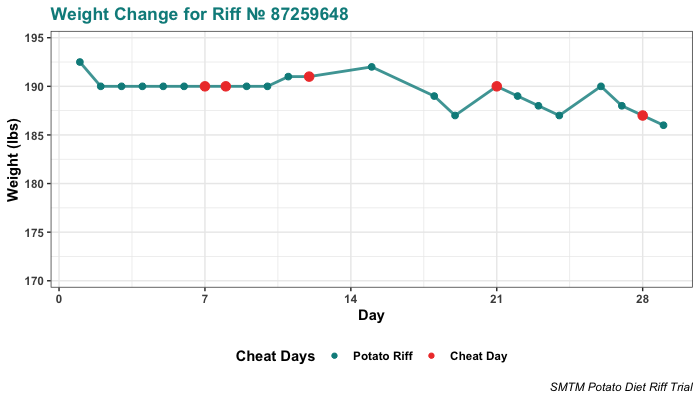
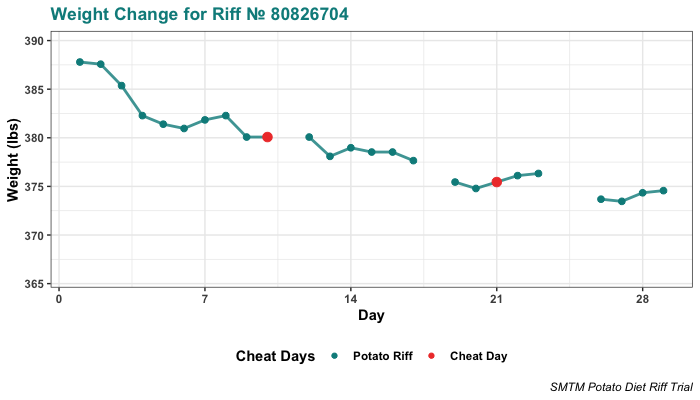
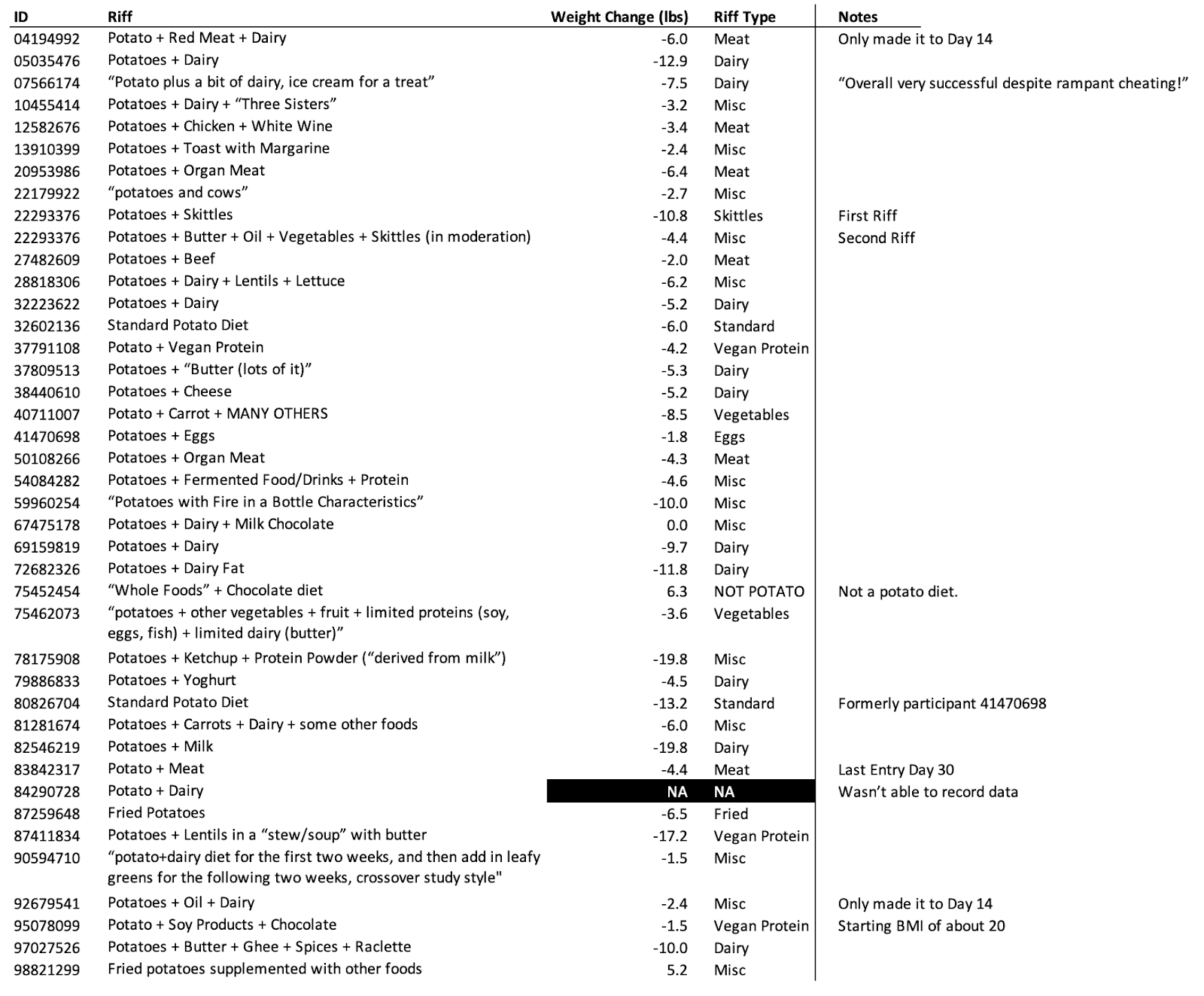
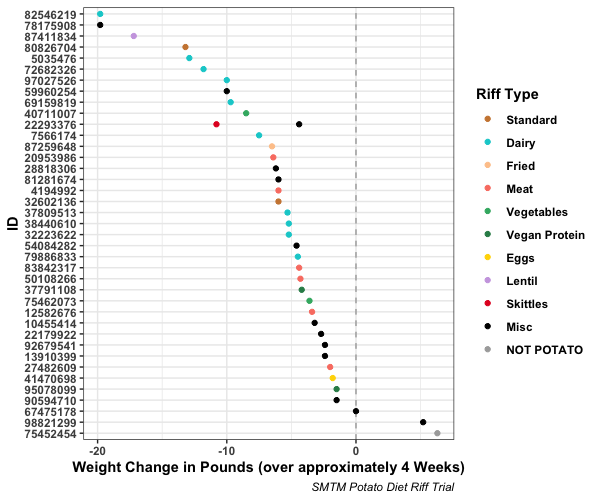

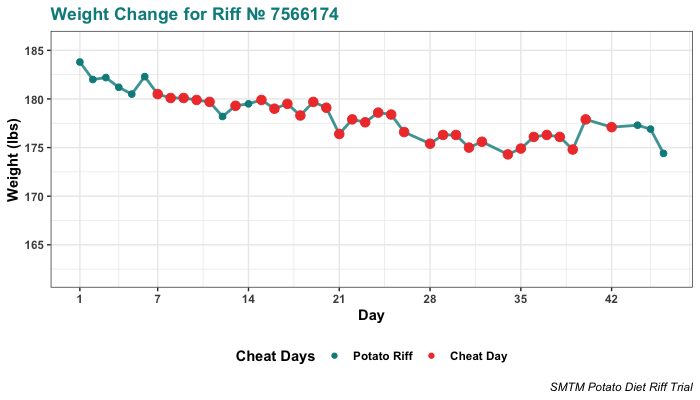
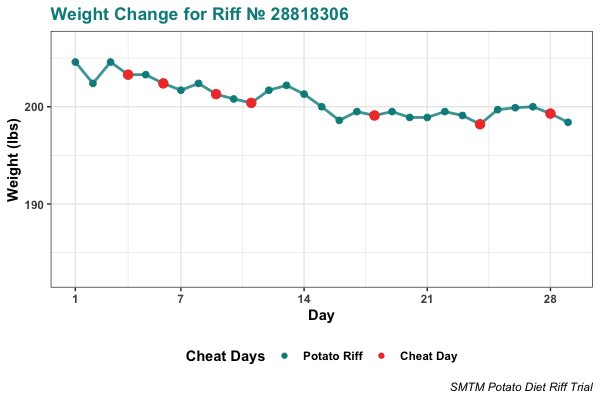

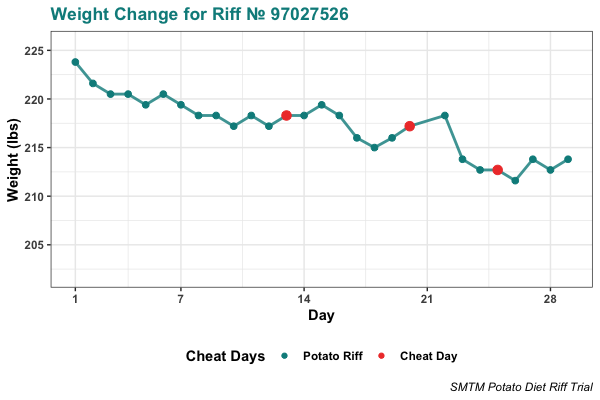


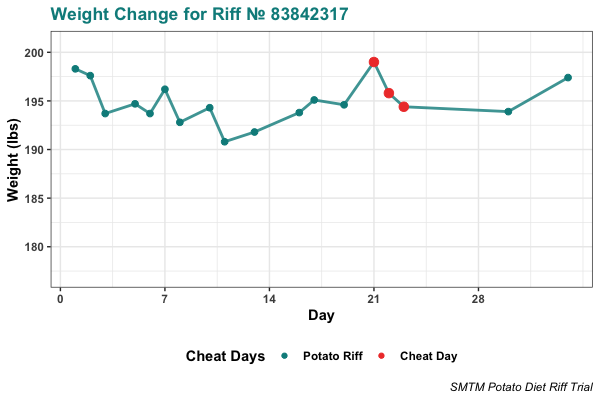

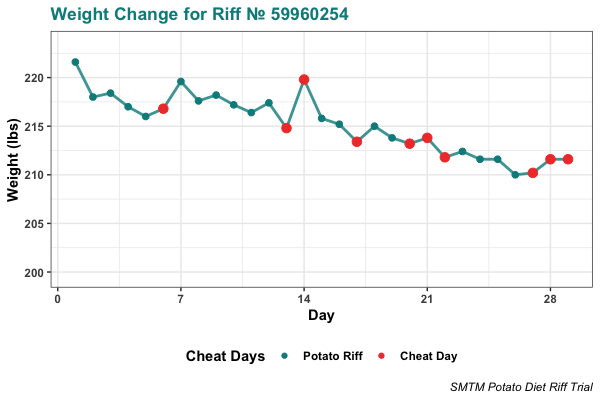
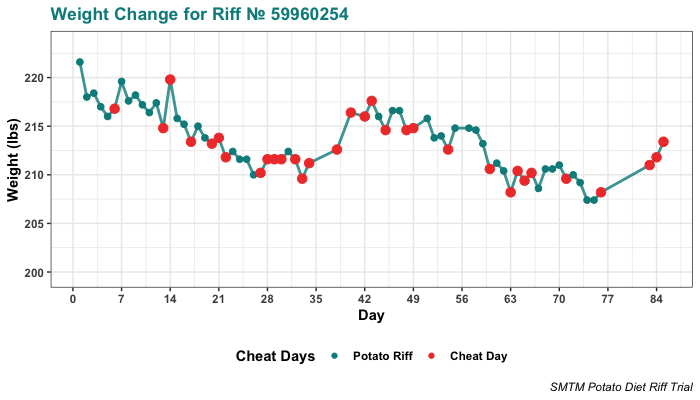
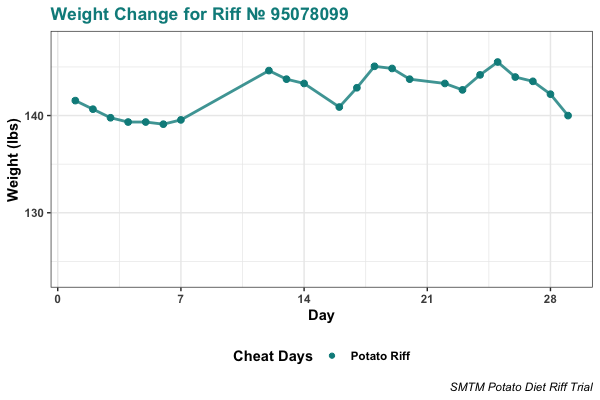


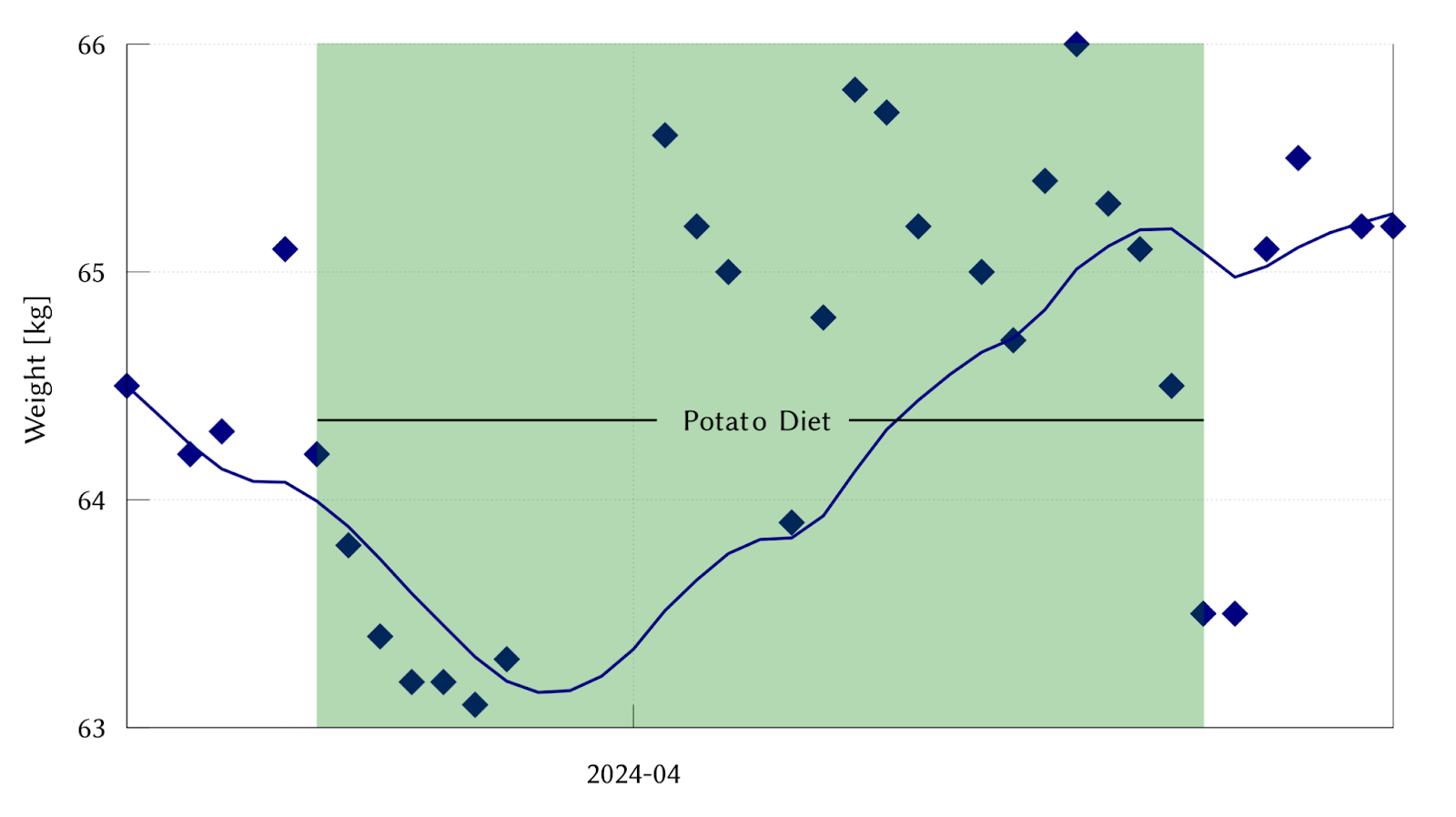


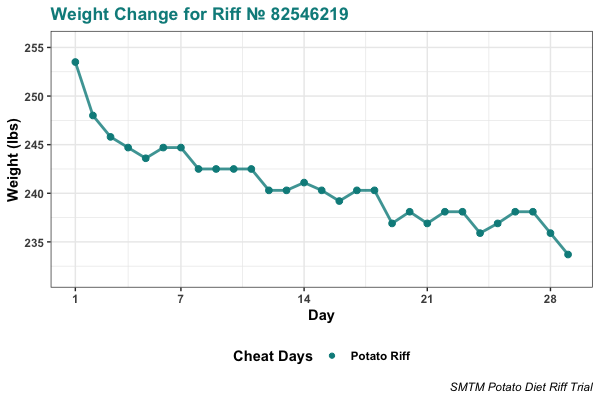


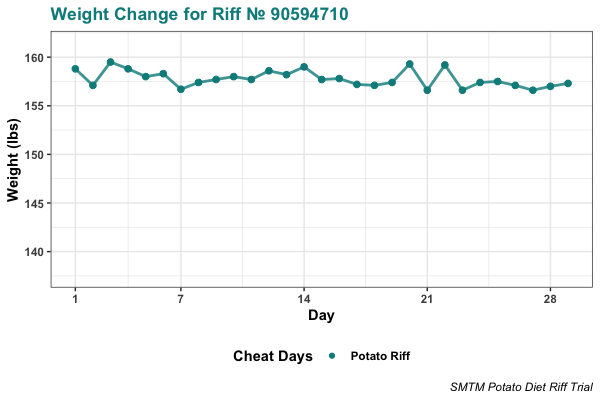


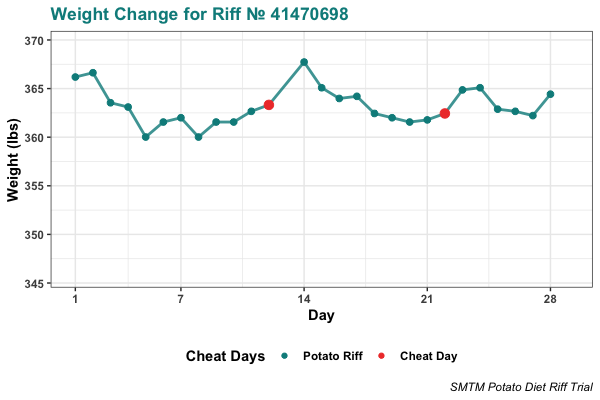

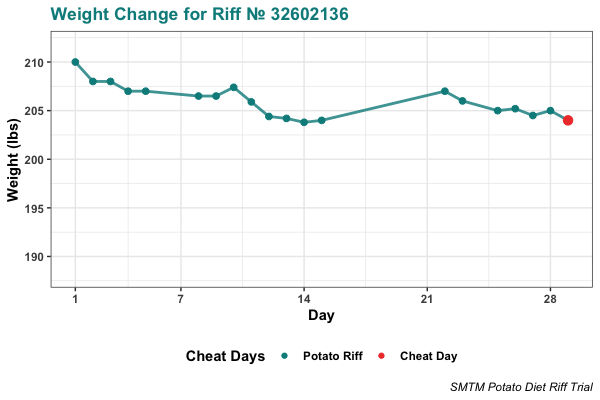
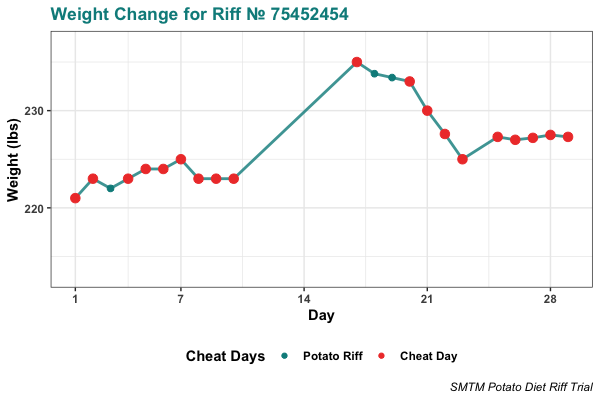

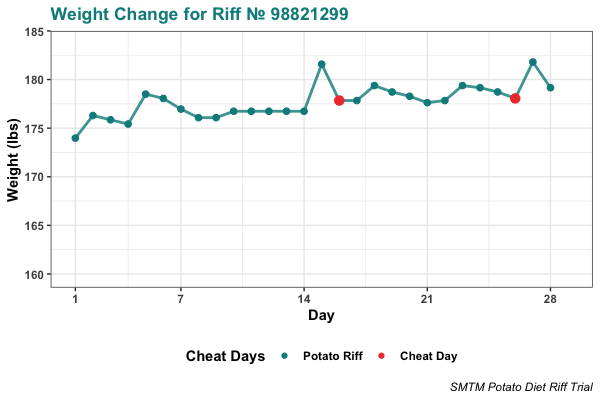
 .
.


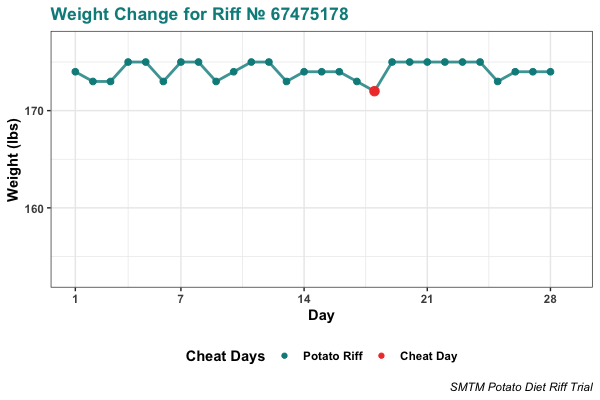


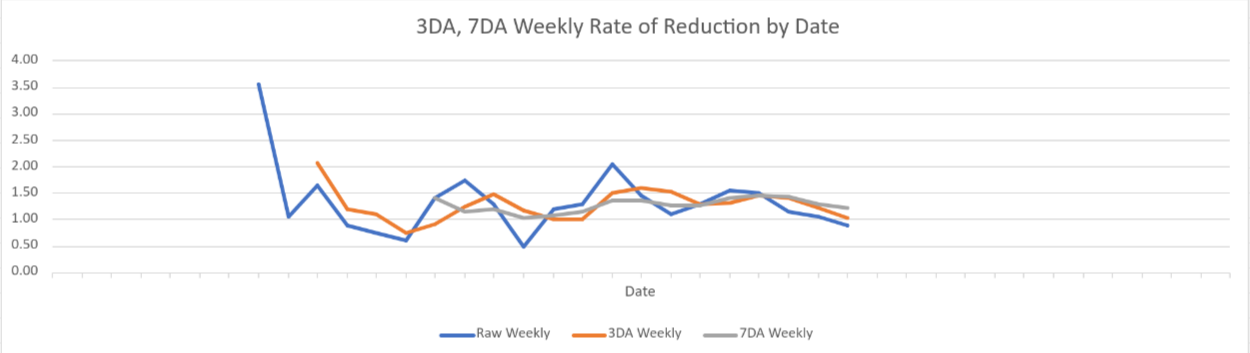

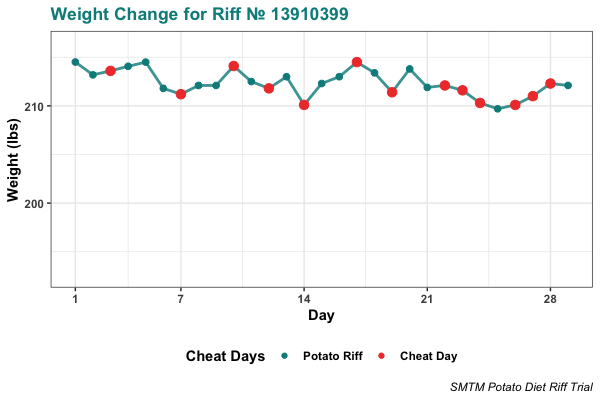







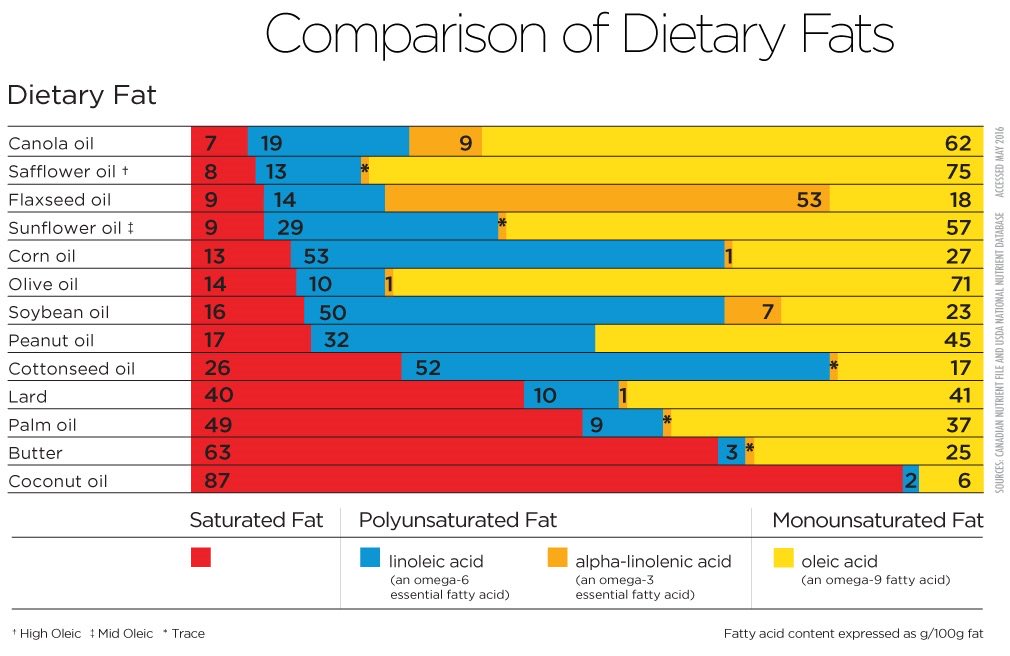


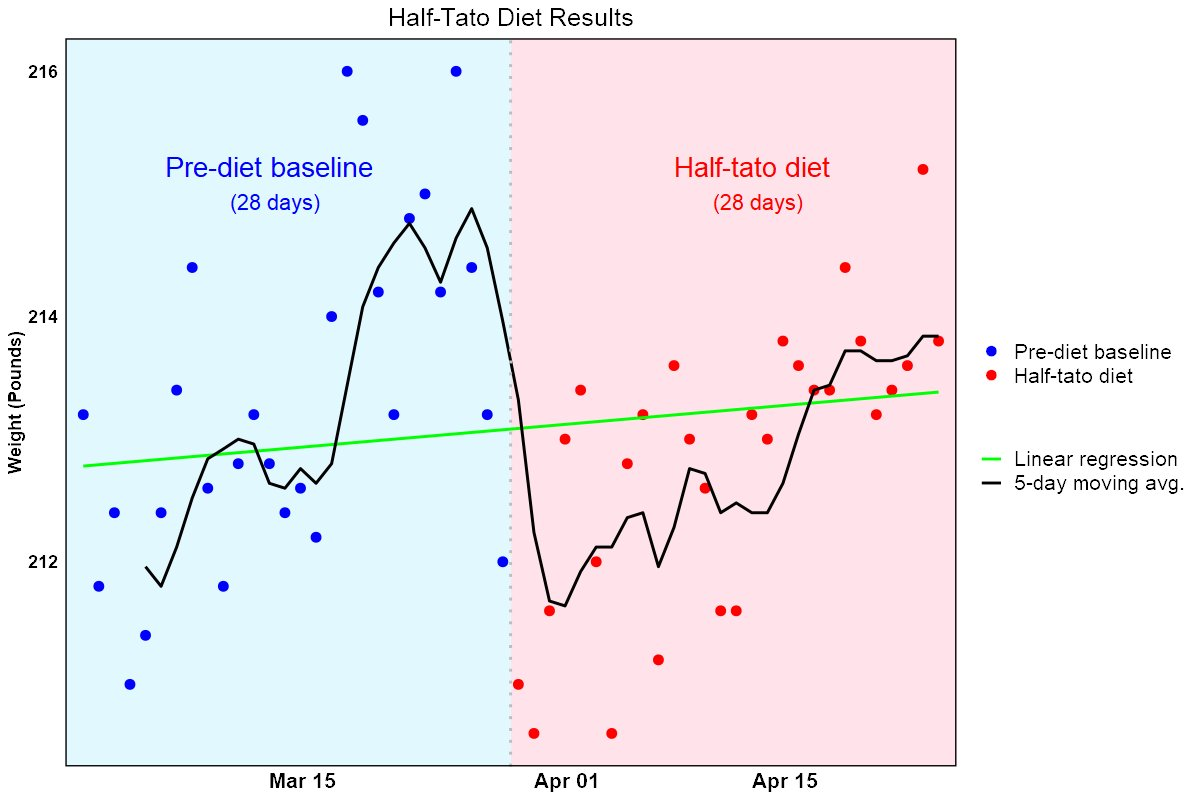
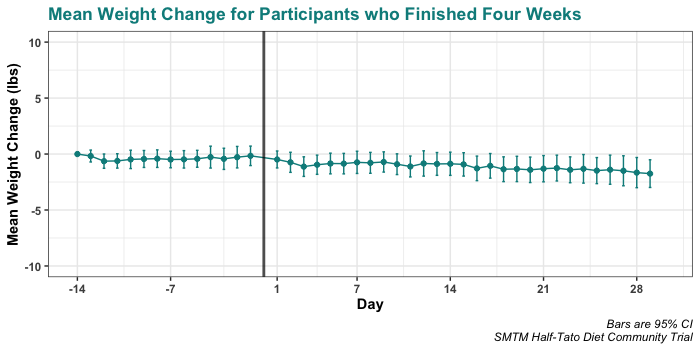
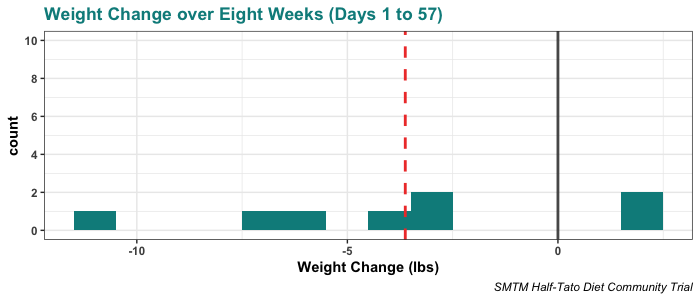
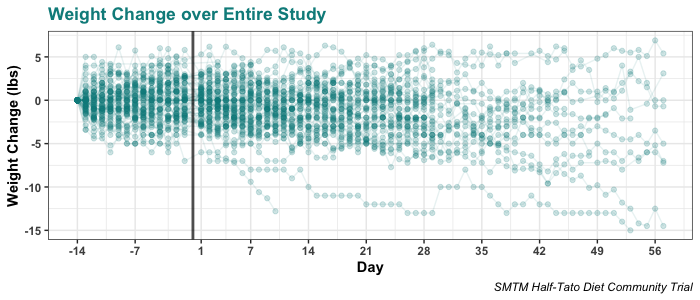



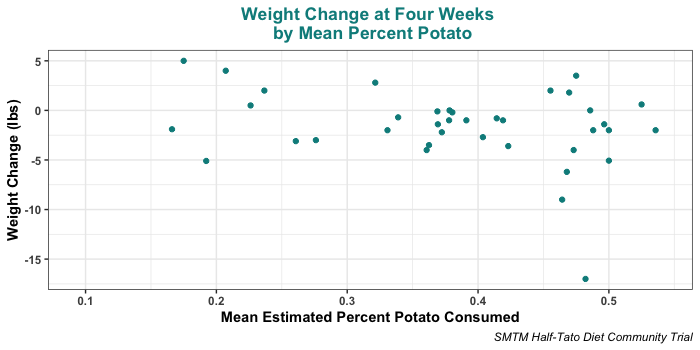
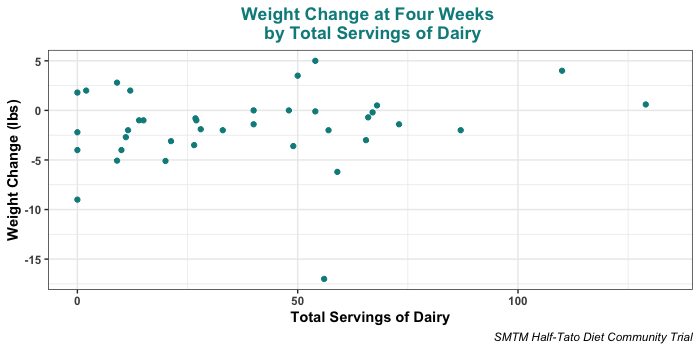


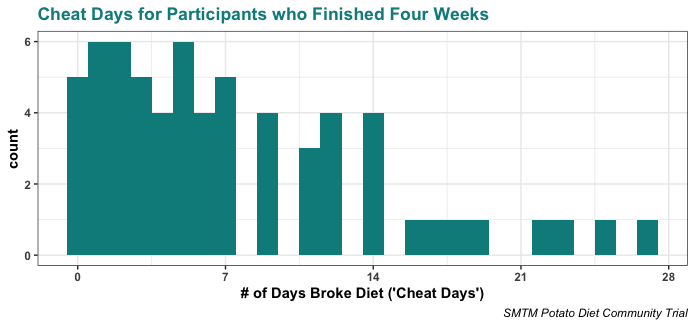
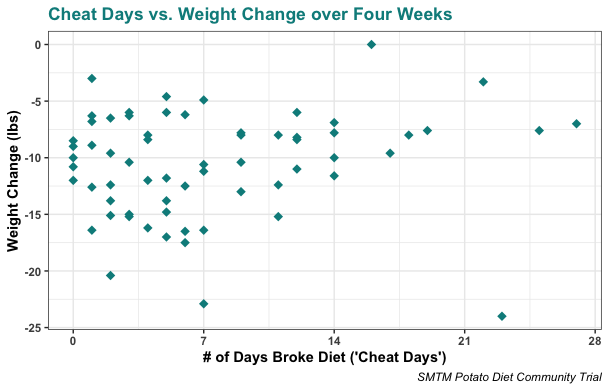

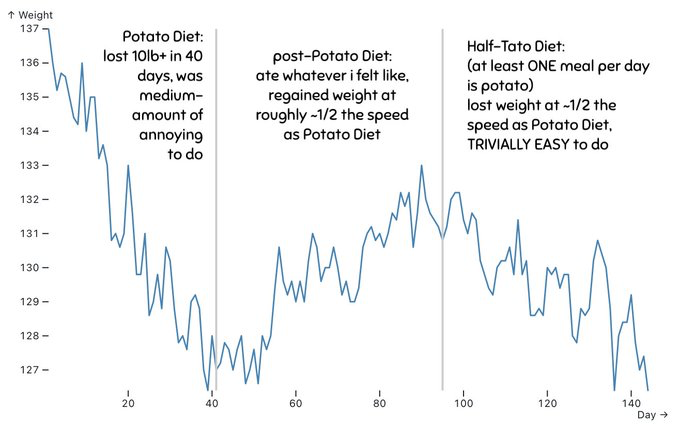
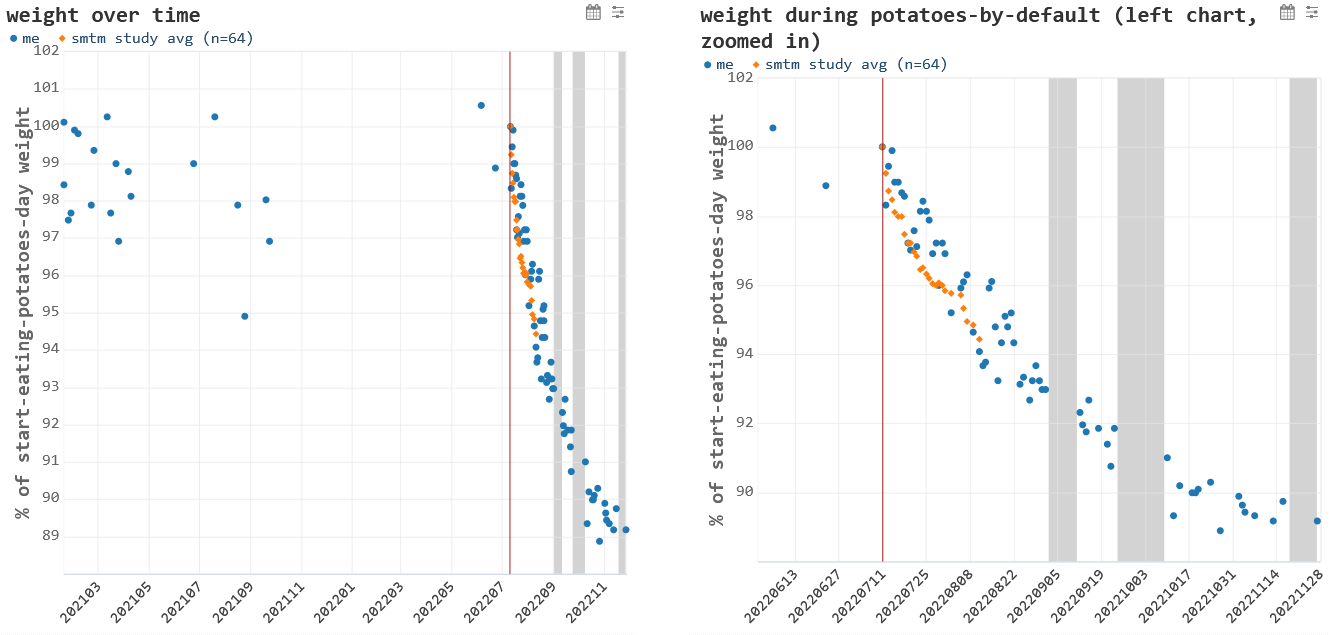

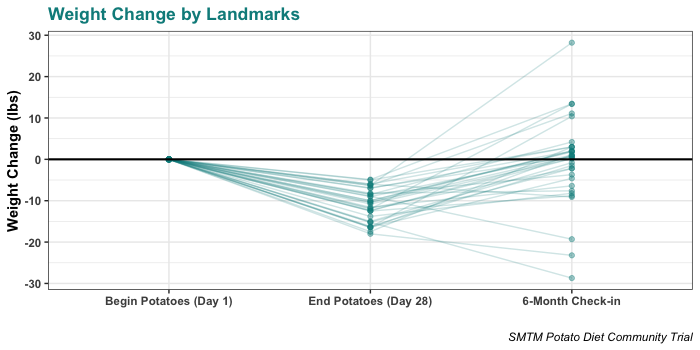
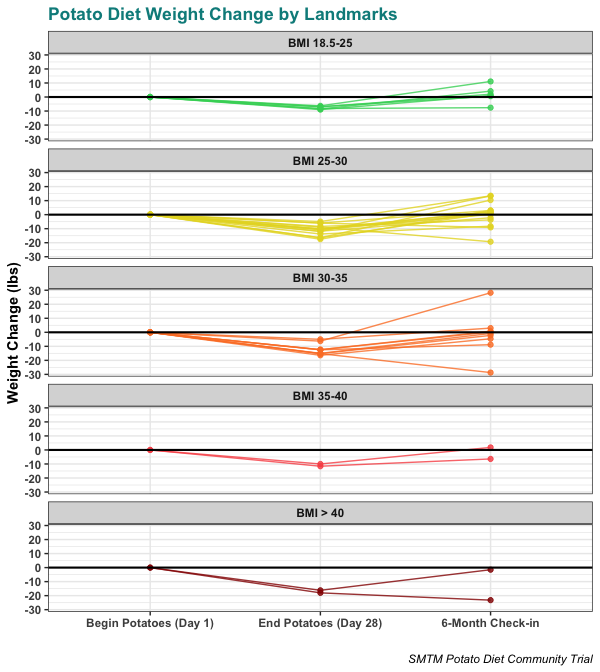
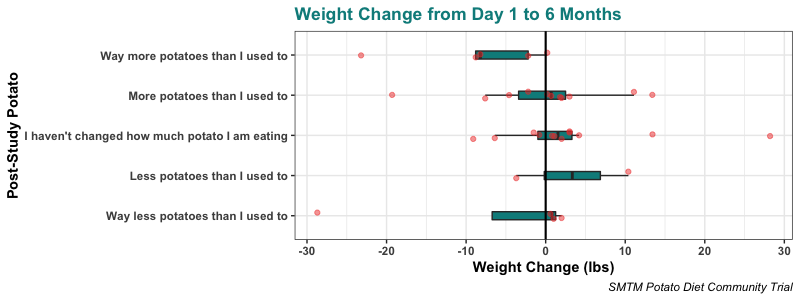
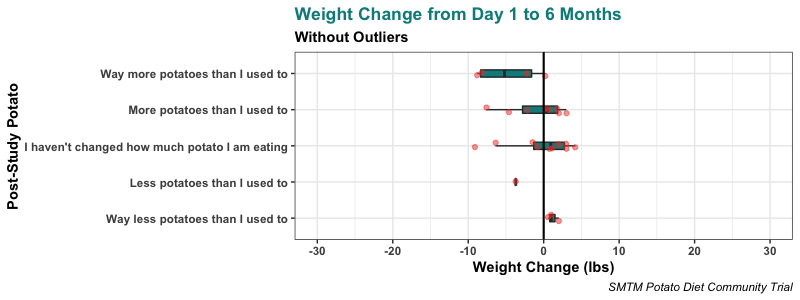
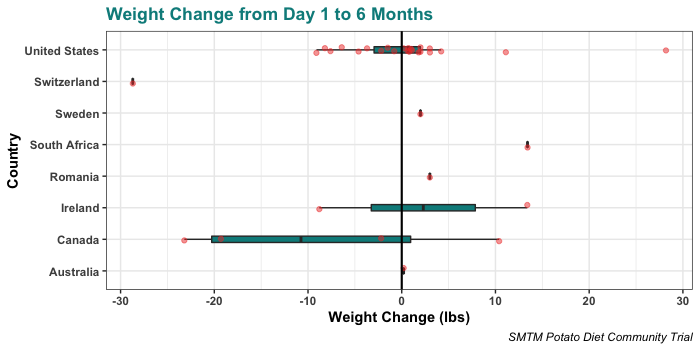
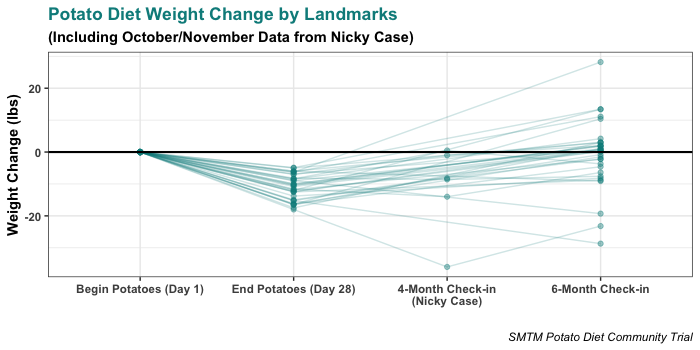
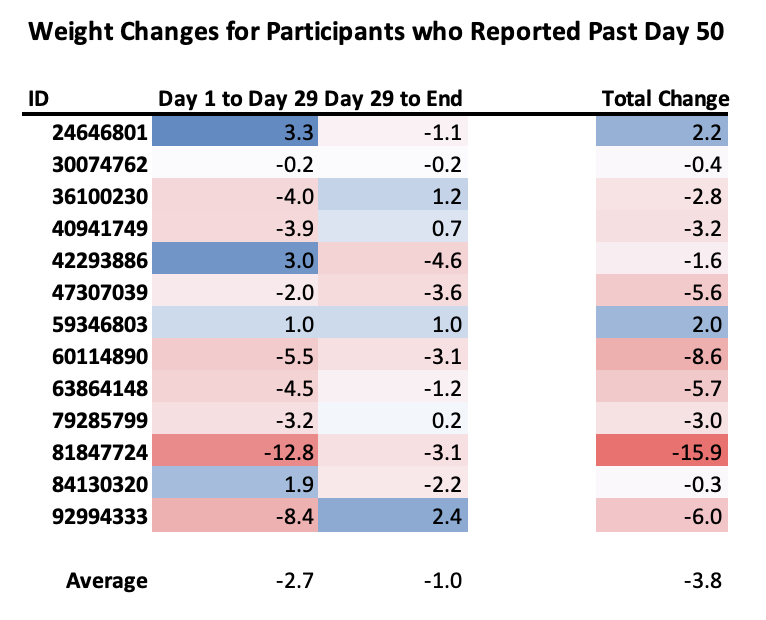
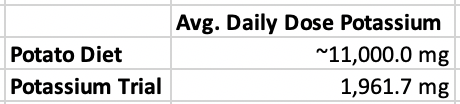
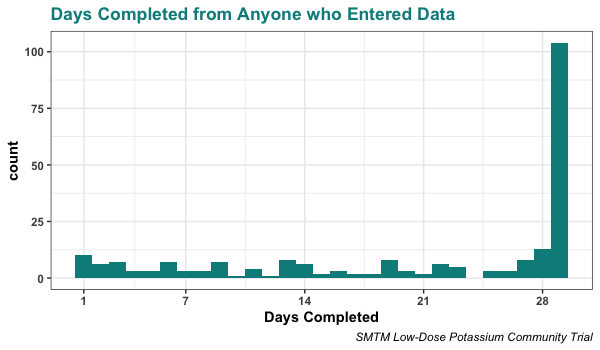



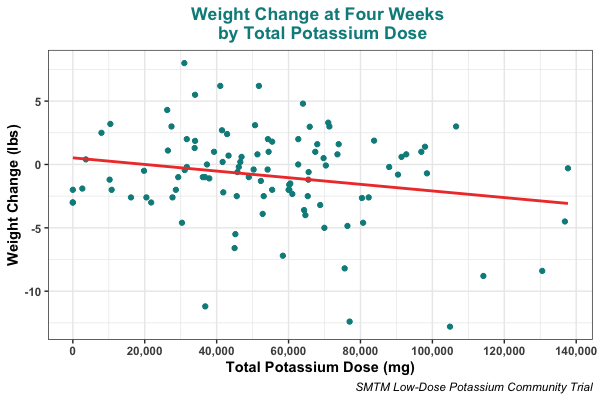

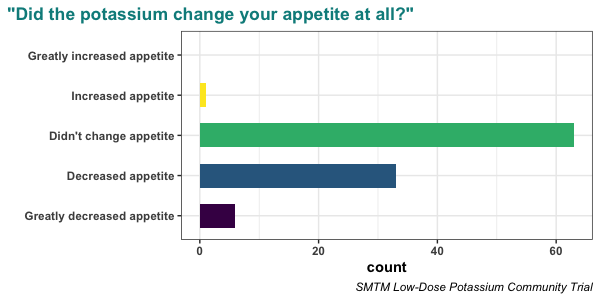



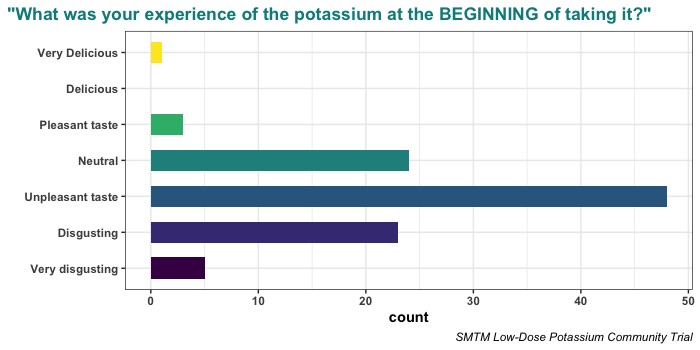

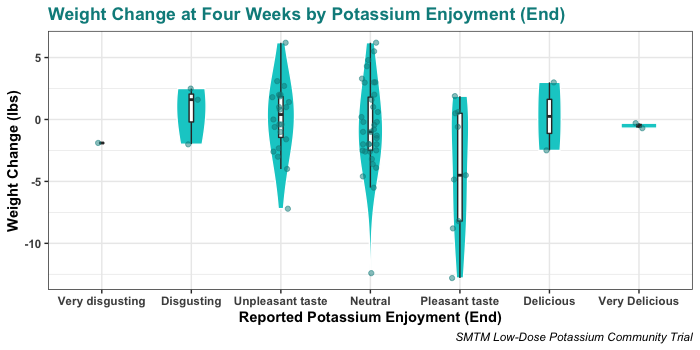

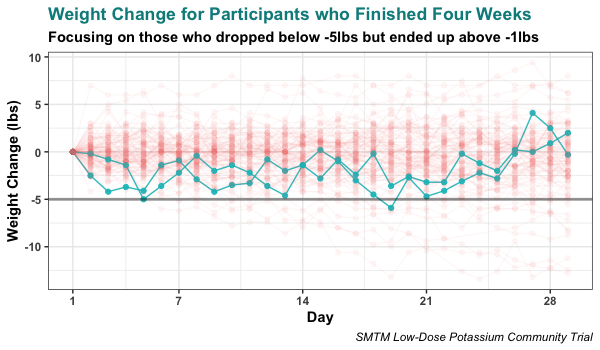

 SLIME MOLD TIME MOLD