The Cybernetics of Alternative Turkey

When the Tofurky research division is working on new alternative protein products, they tend to worry about taste. They tend to worry about appearance. And they tend to worry about texture. 

If they’re making an alternative (i.e. no-animals-were-harmed) turk’y slice, they want to make it look, smell, and taste like the real thing, and they care about proper distribution of fat globules within the alt-slice. 

But here’s a hot take, might even be true: people don’t mainly eat food for the appearance. After all, they would still eat most foods in the dark. They don’t mainly eat foods for the texture, the taste, or even for the distribution of fat globules. People eat food for the nutrition. 

Who’s hungry for a hot take?

This is why people don’t eat bowls of sawdust mixed with artificial strawberry flavoring, even though we have invented perfectly good artificial strawberry flavoring. You could eat flavors straight up if you wanted to, but people don’t do that. You want ice cream, not cold dairy flavor #14, and you can tell the difference. This is a revealed preference: people don’t show up for the flavors.

A food has the same taste, smell, texture, retronasal olfaction, and general mouthfeel when you start eating it as when you finish. If you were eating for these features, you would never stop. But people do stop eating — just see how far you can get into a jar of frosting. The first bite may be heavenly, but you won’t get very deep. The gustation features of the frosting — taste, smell, etc. — don’t change. You stop eating because you are satisfied.

Assuming you buy this argument, that the real motivation behind eating food is nutrition, then why do people care about flavor (and appearance, and texture, etc.) at all? We’re so glad you asked:

People can detect some nutrients as soon as they hit the mouth: the obvious one is salt. It’s easy to figure out if a food is high in sodium; you just taste it. As a result, it’s easy to get enough salt. You just eat foods that are obviously salty until you’ve gotten enough. 

But other nutrients can’t be detected immediately. If they’re bound up deep within the food and need to be both digested and absorbed, it might take minutes, maybe hours, maybe even longer, before the body registers their presence. To get enough of these nutrients, you need to be able to recognize foods that contain these nutrients, even when you can’t detect them from chewing alone. 

This is where food qualities come in. Taste and texture are signs you learn that help you predict what nutrients are coming down the pipeline. Just like how you learn that thud of a candy bar at the bottom of a vending machine predicts incoming sugar. The sight of a halal van predicts greasy food imminently going down your drunk gullet. How you learn that the sight of the Lays bag means that there is something salty inside, even though you can’t detect salt just from looking at it. You also learn that the taste of lentils means that you will have more iron in your system soon, even if you can’t detect the iron from merely putting the lentils in your mouth.

To give context, this is coming from the model of psychology we described in our book, The Mind in the Wheel. In this model, motivation is the result of many different drives, each trying to maintain some kind of homeostasis, and the systems creating the drives are called governors. In eating behavior, different governors track different nutrients and try to make sure you maintain your levels, hit your micros, get enough of each. 

There’s still a lot we don’t know about this, but to give one example we’re confident about, there’s probably one governor that makes sure you get enough sodium, which is why you add salt to your food. There’s also at least one governor that keeps track of your fat intake, at least one governor clamoring for sugar, probably a governor for potassium. Who knows. 

Governors only care about hitting their goals. Taste and texture are just the signs they use to navigate. And this is where the problem comes in. 

Consider that for all its flaws, turkey is really nutritious. Two slices or 84 grams of turkey contains 29% of the Daily Value (DV) for Vitamin B12, 46% of the DV for Selenium, 49% of the DV for Vitamin B6, and 61% of the DV for Niacin (vitamin B3).

Tofurkey is not. As far as we can tell, it doesn’t contain any selenium or B vitamins. Not clear if it contains zinc or phosphorus either. Maybe this is wrong, but at the very least, it doesn’t appear that Tofurkey are trying to nutrition-match. And that may be the key to why these products are still not very popular. If you try to compete with turkey on taste and texture, but people choose foods based on nutrition, you’re gonna have a problem.

This is just one anecdote, but: our favorite alternative protein is Morningstar Farms vegetarian sausage links. And guess what food product contains 25% DV of vitamin B6, 50% DV of niacin, and 130% DV of vitamin B12 per two links? Outstanding in its field.

In the Vegan War Room

We believe this has strategic implications. So please put on your five-star vegan general hat, as we lead you into your new imagined role as commander of the faithful.

General, as you may be aware, the main way our culture attempts to change behavior is by introducing conflict. We attempt to make people skinny by mocking them, which pits the shame governor against the hunger governors. We control children by keeping them inside at recess or making them stay after class, which pits the governors that make them act up in class against the governors that make them want to run around with their friends. Or we control them by saying, no dessert until you eat your brussel sprouts.

This is an unfortunate holdover from the behaviorists, who once dominated the study of psychology. In behaviorism, you get more of what you reward, and less of what you punish. Naturally when they asked themselves “how to get less of a behavior?” the answer they came up with was “punish!” But this is a fundamentally incomplete picture of psychology. Reward and punishment don’t really exist — motivation is all about governors learning what will increase or decrease their errors. While you can decide to pit governors against each other, this approach has serious limitations. It just doesn’t work all that well. 

First of all, conflict between governors is experienced as anxiety. So while you can change someone’s behaviour by causing conflict, you’ll also make them seriously anxious. This is fine, we guess, if you hate them and want them to feel terrible all the time. But it’s more than a little antisocial. 

Anyone who’s the target of punishment will see what is happening. They don’t want to feel anxious all the time, and they especially don’t want to feel anxious about doing what to them are normal, everyday things. If you try to change their behavior in this way, they will find you annoying and do their best to avoid you, so you can’t create so much conflict inside them. Imagine how much less effective this strategy is, compared to finding a method of convincing that people don’t avoid, or that they might even actively seek out.

On top of this, conflict dies out without constant maintenance. In the short term you can convince people that they will be judged if they have premarital sex, but this lesson will quickly fade, especially if they see people getting busy without consequence. The only way to keep this in check is to run a constant humiliation campaign, where people are reminded that they will be shamed if they ever step out of line. This is expensive, neverending, and, for the obvious reasons, unpopular. Scolding can work in limited ways, but nobody likes a scold.

Many attempts to convince people to become vegan, or even to simply eat less meat, follow this strategy — they try to make people eat less meat by taking the governors that normally vote for meat-eating (several nutritional governors, and perhaps some other governors, like the one for status) and opposing them with some other drive. 

You can tell people that they are bad people for eating meat, you can say that they will be judged, shamed, or ostracized. You can tell them that eating meat is bad for their health or bad for the environment. This might even be true. But just because it’s true doesn’t mean it’s motivating. This strategy won’t work all that well. It only causes conflict, because the drives that vote against eating meat will be strenuously opposed by the drives that have always been voting to eat meat to begin with.

But you don’t need to fight your drives. Better to provide a substitute.

No one takes a horse to their dentist appointments anymore. Cars are just vegan carriages; hence “horseless carriage”. We used to kill whales for oil. We don’t do that anymore, and it’s not because people became more compassionate. It’s because whale oil lamps got beat out by better alternatives, like electric lighting. People substitute one good for another when it is either strictly better at satisfying the same need(s), or better in some way — for example, not as good, but much cheaper, or much faster, or much more convenient. 

Whale oil lamps burned bright, but with a disagreeable fishy smell. Imagine if in the early days of alternative lighting, they had tried to give whale oil substitutes like kerosene or electric lights the same fishy smell, imagining that this would make it easier to compete with whale oil. No! They just tried to address the need the whale oil was addressing, namely light, without trying to capture any of the incidental features of whale oil. They offered a superior product, or sometimes one that was inferior but cheaper, and that was enough to do the job. We don’t run whale ships off Nantucket any more. 

So if you want people to eat less meat, if you want more people to become vegan, you shouldn’t roll out alternative turkey, salami, or anything else. You should provide substitutes, competing superior products, that satisfy the same drives without any reference to the original product. Ta-daaaa.

No one eats yogurt because they have an innate disposition for yogurt. Instead, they eat it because yogurt fulfills some of their needs. If they could get those needs met through a different product, they probably would, especially if the alternative is faster / easier / cheaper. 

For the sake of illustration, let’s say that turkey contains just three nutrients, vitamins X, Y, and Z. 

If you make an alternative turkey that matches the real thing in taste and texture, but provides none of the same nutrients, then despite the superficial similarity, you’re not even competing in the same product category. It’s like selling cardboard boxes that look like cars but that can’t actually get you to work — however impressive they might look, they don’t meet the need. People will not be inclined to replace their real turkey with your alternative one, at least not without considerable outside motivation. You will be working uphill.

Making a really close match can actually be counterproductive. If an alternative food looks/tastes/smells very similar to an original food, but it doesn’t contain the same nutrition, this is basically the same as gaslighting your governors. And the better the taste match, the more confusing this is.

Think about it from the perspective of the selenium governor. You’re trying to encourage behaviors that keep you in the green zone on your selenium levels, mostly by predicting which foods will lead to more selenium later. But things have recently become really confusing. About half the time you taste turkey flavor and texture, you get more selenium a few hours later. The other half of the time, you encounter turkey flavor and texture, but the selenium never arrives. 

By eating alternative proteins that taste like the “real thing”, you end up seriously confusing your governors, with basically no benefit.

We recently tried one of these new vegan boxed eggs. It did have the appearance of scrambled eggs, and it curdled much like scrambled eggs. It even tasted somewhat like scrambled eggs. But the experience of eating it was overall terrible. Not the flavor — the deep sense that this was not truly filling, not a food product. Despite simulating the experience of eggs quite closely, we did not want it. Maybe because it was not truly nutritious.

If you make an alternative turkey that contains vitamins X, Y, and Z, you will at least be providing a real substitute. People will have a natural motivation to eat your alternative turkey. But if you do this, you’re still in direct competition with the original turkey. You’re in its niche, it is an away game for you and a home game for turkey. You have to convince the consumer’s mind that your alt-turkey is worth switching to, and that takes a lot of convincing. People prefer the familiar. Unless the new product is much better in some way, they won’t switch. 

If you are trying to replicate turkey, you need to make a matching blob that matches real turkey on all the dimensions people might care about. A product exactly like that is hard to make at all, and forget about doing it while also being cheap, available, and satisfying. This is why it’s an uphill battle, you’re trying to meet turkey exactly.

Those of us who have never tasted tukrey are in ignorance still, our subconscious has no idea that turkey slices would be a great source of vitamin X. We’re not tempted. But people who have tried turkey before have tasted the deli meat of knowledge, and there’s no losing that information once you have it. Vitamin X governor gets what vitamin X governor wants, so these people will always feel called to the best source of vitamin X they’re aware of. You’ll never convince the vitamin X governor that turkey is a bad source of vitamin X; you’ll get more mileage out of giving it a better way to get what it wants!

So instead of shaming, or offering mock meats, the winning strategy might be to just come up with new, original vegan foods that are very good sources of vitamins X, Y, and/or Z. Just make vitamin X drinks, vitamin Y candies, and vitamin Z spread. If you don’t try to mimic turkey, then you’re not in competition with turkey in any way. You don’t need to convince people that it’s better than turkey — you just need to convince them that it’s nutritious and delicious. Why try to copy turkey when you can beat it at its own game? 

You don’t need alt-turkey to be all turkey things to all turkey people. As long as people get their needs covered in a way that satisfies, they’ll be happy. 

It seems like it would be easier to make a good source of phosphorus, than to make a good source of phosphorus PLUS make it resemble yogurt as much as possible. Alternative proteins that try to mimic existing foods will always be at a disadvantage in terms of quality, taste, and cost, simply because trying to do two things is harder than doing one thing really well. You’ll lose out on a lot of tradeoffs.

If we created new food products that contain all the nutrients that people currently get from meat, except tastier, cheaper, or even just more convenient, people would slowly add these foods to their diet. Over time, these foods would displace turkey and other meats as superior substitutes, just like electric lights replaced gas lamps, or like cell phones eclipsed the telegraph. Without even thinking about it, people will soon be eating much less meat than they did before. And if these new foods are good enough sources of the nutrients we need, then in a generation or two people may not be eating meat at all. After all, meat is a bit of a hassle to produce and to cook. Not like my darling selenium drink. 

We see this already in some natural examples. Tofu is much more popular in countries like China, Korea, Japan, where it is simply seen as a food, than it is in the US, where it is treated as a meat substitute. You don’t frame your substitute as being in the same category as your competitors unless you really have to. That’s just basic marketing.

We have a friend whose family is from Cuba. She tells a story about how her grandmother was bemused when avocado toast got really popular in the 2010s. When asked why she found this so strange, her grandmother explained that back in Cuba, the only reason you would put avocado on your toast was if you were so dirt poor you couldn’t afford butter. It was an extremely shameful thing to have to put avocado on your toast, avocados grew on trees in the back yard and were basically free. If you were so very poor as to end up in this situation, you would at least try to hide it.

In Cuba, where avocado was seen as a substitute for butter, it was automatically seen as inferior. But when it appeared in 2010s America in the context of a totally new dish, it was wildly popular. And in terms of food replacement, avocado is a stealth vegan smash hit, way more successful than nearly any other plant-based product. It wasn’t framed that way, but in a practical sense, what did avocado displace? Mostly dairy- and egg-based spreads like butter, cream cheese, and mayonnaise. There may be no other food that has led to such an intense increase in the effective amount of veganism, even if the people switching away from these spreads didn’t see it that way. They just wanted avocado on the merits.

This product space is usually thought of as “alternative proteins”. Which is fine, protein is one thing that everyone needs. But a better perspective might be, “vegan ways to get where you’re going”. And just because some of these targets happen to be bundled together in old-fashioned flesh-and-blood meat, doesn’t mean they need to be bundled together in the same ways in the foods of the future.
Philosophical Transactions: Potato Serendipity (and FODMAP testing)

In the beginning, scientific articles were just letters. Eventually Henry Oldenburg started pulling some of these letters together and printing them as the Philosophical Transactions of the Royal Society, the first scientific journal. In continuance of this hallowed tradition, here at SLIME MOLD TIME MOLD we occasionally publish our own correspondence as a new generation of philosophical transactions.

Today’s correspondence is from a husband and wife who wish to remain anonymous. This account has been lightly edited for clarity, but what appears below is otherwise the original report as we received it. 

The potato diet has mostly been used for weight loss, but it’s also notable for involving mostly one food and being close to nutritionally complete, which means you can use it as an elimination diet to study things like food triggers. We’ve been interested in this idea for a long time, and we find this case study particularly compelling because it’s a rare example of someone doing just that!


Since around 2018, K had been suffering from stomach pain, bloating, gas, and chronic constipation. Chronic constipation worsened after two pregnancies, so K sought medical intervention again in Feb 2025. K was prescribed medication (Linzess) to treat the constipation, which initially improved symptoms but was unreliable and had unpleasant side effects. She had been on that medication for 1 month before starting the potato diet.

Family and friends were bewildered to hear our plan, warning us of muscle loss and blood sugar problems since potatoes are ‘bad’.

Her initial goal was to lose 5-10 pounds from a starting BMI of 23.4 and test out the claims we read online about the diet. K actually joked, “wouldn’t it be funny if this diet fixes my stomach problems?”

We started the diet on 21MAR2025. The first two and a half days were 100% potato for both of us. Morale was suffering by the afternoon of day 3, so we caved and had a potato-heavy dinner with our kids. Afterwards, we agreed to eat only potatoes until dinner so we could still have a normal family meal time. We did make sure potatoes featured heavily in the weekly meal plan.

Within a week, K noticed improved symptoms and regularity without any medication. Initially, she thought she might have a lactose intolerance, so she switched to lactose-free milk and quit the potato diet once we reached the end of our planned testing window.

Back on a regular diet (but still avoiding lactose), K’s symptoms came back worse, with constant stomach aches and bloating. K realized that she had unintentionally been on a low-FODMAP diet while on the potato diet and decided to do intolerance testing. 

Her methodology for intolerance testing follows:

  1. Ate a high-potato, low FODMAP diet until minimal symptoms were present.
  2. Used NHS FODMAP rechallenging protocol to isolate FODMAP groups (lactose, fructans from wheat, fructans from onions, fructans from garlic, fructans from fruit, fructose, galactooligosaccharides, sorbitol, mannitol, fructose + sorbitol) and identify foods to use for testing each group
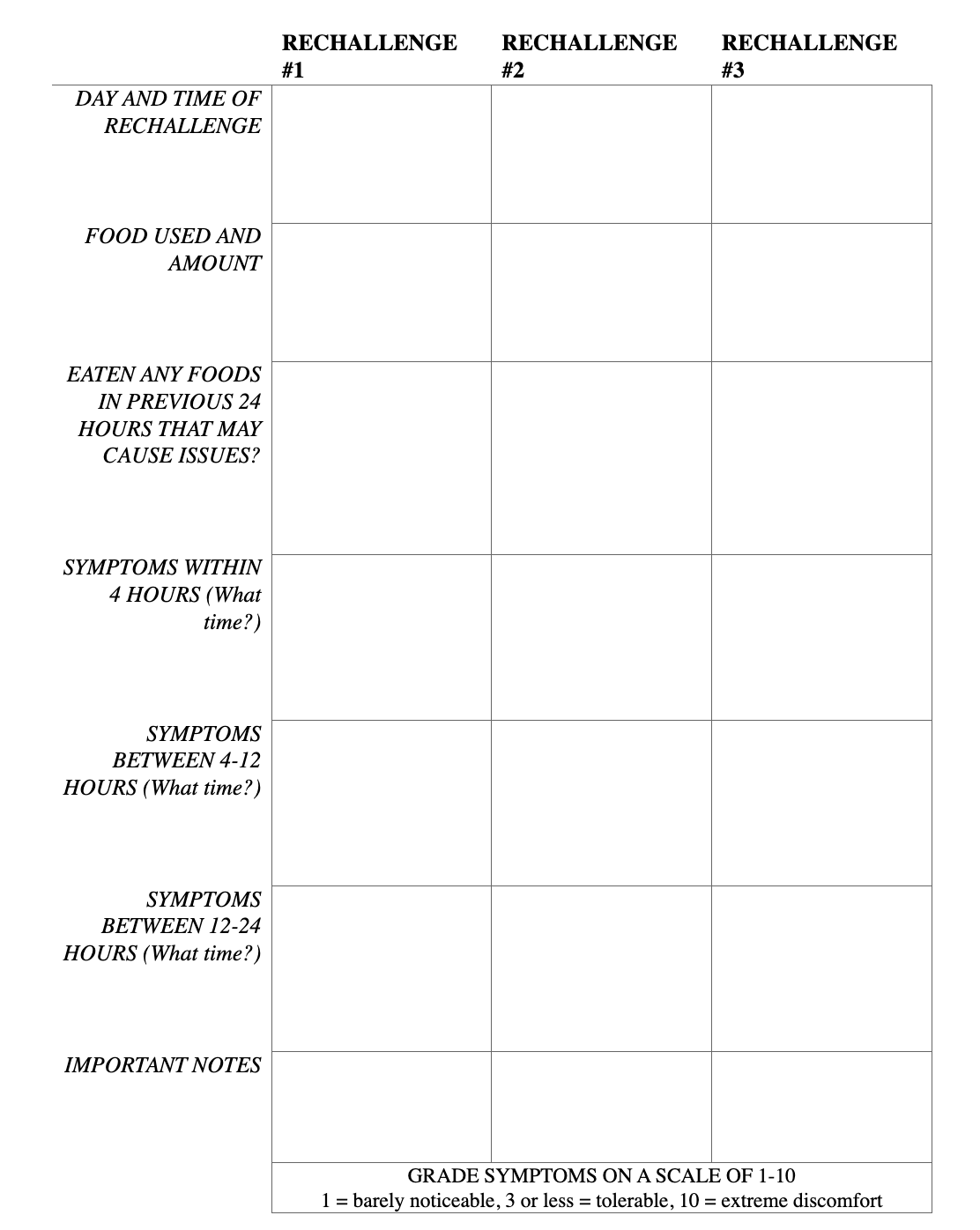
  3. Spent 3 days of rechallenging per group: day 1 – small portion, day 2 – med portion, day 3 – large portion of challenge food (ex: 1/4 cup milk, 1/2 cup milk, 1 cup milk)
  4. Kept daily log of symptoms and severity
  5. Allowed 3 days of ‘washout’ after rechallenging
  6. Rechallenged next food group, but did not incorporate challenged foods into diet to avoid multiple FODMAP effects
  7. If symptoms appeared after a food challenge, waited till symptoms subsided and repeated the rechallenge over another 3 days

Incorporating lots of potatoes allowed K to test out food groups while still eating a well-balanced diet. The culprit for K is fructans from wheat, which is why cutting out daily servings of wheat has made her symptoms disappear.

K is finishing FODMAP testing (still a couple more groups to go), but has had reliable relief from all symptoms without any meds. Potatoes are a regular addition to meals these days. 

Below is the blank version of the log she used.

Philosophical Transactions: DECADENT Reader Reports Losing 50 Pounds Eating Buttery, Cheesy Potatoes

Previous Philosophical Transactions:

This account has been lightly edited for clarity, but what appears below is otherwise the original report as we received it. 


Hi Slimes,

I’ve recently wrapped up a year-long weight loss self-experiment. During this time I lost 50 lbs, most of it on a Potatoes + Dairy version of the potato diet.

This corroborates your recent case studies where Potatoes + Dairy caused just about as much weight loss as the standard potato diet. It certainly worked well for me. I found the diet really enjoyable, my meals were always delicious. I didn’t get tired of the potatoes, they remain one of my favorite foods. And there were a few other interesting findings as well, all described below.

I’m a longtime reader of the blog so this is me sending you my report, which you can publish if you like. Please list me as “Cole” (not my real name). I hope you find it helpful.

Background

First, my demographics. I’m a white male American in my early-mid 30s. I’m about 5 feet 11 inches tall, but I have a large frame. While you should feel free to calculate my BMI at any point, I don’t think it’s a very accurate measure of adiposity in my case. 

My first baseline is in mid 2022, when I weighed about 220 lbs. I know this because I tried a version of the potato diet at the time and lost about 10 lbs over about 40 days. I wasn’t seriously concerned with my weight at the time, I was mostly just curious about the potato diet and what it feels like “from the inside”. But this turned out to be relevant later on because it let me know that I’m a potato diet responder. 

In mid 2022 I was about to start a new job, one that involved a lot of hard work, stress, and late nights, and also a longer commute / a lot more driving than I am used to (I mention this because I’m sympathetic to the hypothesis that obesity is linked to motor vehicle exposure in some way).

I didn’t notice at first, but after starting this new job, I started to gain weight. Around April 2024, I realized that I weighed almost 250 lbs. This was heavier than I had ever been before, and also quite uncomfortable. For anyone who’s never gained 10+ lbs before, let me tell you, it makes everything in your life just a little more difficult, including things like sleeping, and that sucks.

But this crisis turned into an opportunity: I was about to change jobs again, this time to a job with much more reasonable hours and that required almost no driving. I wanted to lose the weight anyways, so I decided to take this opportunity to run a series of diet experiments and investigate some of the findings you’ve presented on the blog. 

The Experiment

I began the study on May 12, 2024, with a starting weight of 247.6 lbs. Per previous potato diet experiments, I weighed myself in my underwear every morning for consistency. 

To track my weight and my progress, I used a google sheet based on the one you shared from Krinn’s self-experiment with drinking high doses of potassium. I found her columns tracking 7-day average, personal best, and “ratchet” to be pretty helpful. Would recommend for anyone else trying a weight loss self-experiment. 

I didn’t start any new exercise habit, though as I mentioned, I did start a new job and was driving less, I no longer had a weekly commute. So it’s possible that some of the weight loss is from “lifestyle changes” but I don’t think it could be much. According to my phone I’ve averaged about 7,000 steps per day the entire time, while gaining the weight and then while losing it. 

The self-experiment can be broken into three main phases: the high-potassium brine phase, the Potatoes + Dairy phase, and a short run-out phase at the end.

Potassium

I had already lost some weight on the potato diet in the past, so from the perspective of pure science, starting with the potato diet didn’t seem very interesting. Instead, I figured I would investigate the hypothesis that high doses of potassium are part of the reason the potato diet causes weight loss.

For the first 147 days of the experiment, I tried different high-potassium brines, and lost about 12 lbs. 

All brines started with a base of two 591 ml blue Gatorades, mixed in a liter bottle with whatever dry electrolytes or other ingredients I was trying. Potassium was always added as KCl in the form of Nu-Salt.

I tried a wide variety of different brine mixtures, using different amounts of KCl as well as NaCl, sodium bicarbonate (baking soda), magnesium malate, iodine (as Lugol’s 2% solution), and glycine powder. But I don’t think these mixtures are worth reporting individually, because I wasn’t able to seriously distinguish between them. Regardless of the mix, I mostly kept losing weight at a very slow pace.

My impression is that magnesium is important, and that brines with added sodium work better than brines without, but I’m the first to admit that the data isn’t strong enough to back this intuition up. The most I can say is that I seemed to lose weight in kind of a sine-wave pattern, which you can see on the graph. These ups and downs roughly lined up with the 14-day cycles where I tried different brine recipes (i.e. I tried most recipes for 2 weeks), but I might have imagined a pattern where in reality there were just natural fluctuations.

While I originally hoped to get around 10,000 mg a day of potassium from my brine, like Krinn did, this wasn’t possible. I found doses above 6,600 mg/day K hard to drink, so I settled at that dosage, reasoning that Krinn lost weight even at lower doses. 

In general, the brines made me feel weird. I sometimes became anxious, sometimes fatigued, sometimes got headaches, and sometimes it did weird things to my sense of smell. I did sometimes feel very energetic, and sometimes it seriously reduced my appetite. Some days I ate almost nothing and had almost no appetite. But even with a clear reduction in my appetite, even when I was eating very little, I didn’t lose much weight. (This itself was kind of striking.) 

In terms of results, 12 lbs isn’t nothing. But over 147 days, it’s only about 0.08 lbs lost per day. That’s not very much. 

I take this as evidence in favor of the hypothesis that high doses of potassium are part of why the potato diet causes weight loss. Even on only 6,600 mg/day K, I experienced many of the effects of the potato diet (reduced appetite, weird anxiety) and I did lose some weight, though not much. 

But I also think my results suggest that potassium may not be enough, and that the “potato weight loss effect” really comes from something like high doses of potassium plus something else in potatoes / with potatoes—maybe high doses of magnesium, maybe sufficient sodium to balance the potassium, etc. 

Potatoes & Dairy

The brine seemed to work, but my rate of weight loss was really slow. It seemed like it was time to try the potato diet. In addition to hopefully losing more weight, I saw two benefits. 

First, I could compare the effect of the brine directly to the effect of the potato diet, to see if I was already losing weight as fast as I could, or if there was something missing from the formula.

Second, I could test out the success of Potatoes + Dairy. The original potato diet was very strict, but by this point you had already reported a few case studies where people had lost a lot of weight on versions of the potato diet where they also ate various kinds of dairy. 

My version of Potatoes + Dairy was decadent. Every meal was potatoes, but I always added as much butter, cheese, and sour cream as I wanted, which was usually a lot. For a while I made a lot of scalloped potatoes, but eventually I got lazy and from that point on I mostly ate baked potatoes or turned old baked potatoes into homefries. I didn’t get tired of this because butter is great. 

When I didn’t have time to prepare potatoes, I would have cheese, milk, or ice cream as a snack. Yes, I ate as much ice cream as I wanted, and still lost weight (which is in line with the literature).

In case anyone wants to replicate my approach, my mainstays were:

  • Kerrygold salted butter, or occasionally Cabot salted butter
  • Cabot sour cream
  • Cabot cheeses, especially Cabot Seriously Sharp Cheddar Cheese 
  • Ben & Jerry’s Ice Cream, most often Peanut Butter Cup

Despite this decadence, I lost about 40 lbs more over 187 days.

Looking closer, the weight loss really happened over two spans, one before the 2024 December holidays, and one after. I first lost about 16 lbs over 75 days, gained about 8 of that back during late December and January, then lost about 28 lbs over the next 86 days. At the point of greatest descent (early March 2025), I lost 10 lbs in two weeks. 

I wasn’t very strict and I did cheat pretty often. My notes mention times and places that I had pizza, candy, or sometimes burritos. Sometimes I had cheat meals where I would go out to lunch or get hot pot with friends. Sometimes I went on dates, where I ate normal food. This mostly didn’t make a difference as long as I also kept up with the potatoes. 

You might think that potatoes are a neutral food, and they just help you survive while your body returns to normal, or something. But my sense is that potatoes actively cause the weight loss. On days where I didn’t prepare potatoes, and mostly just snacked on ice cream and cheese, I didn’t seem to gain much weight back, but I didn’t lose it, either. 

This leads to another counterintuitive recommendation: the potato diet can really reduce your appetite, sometimes to the point where you don’t want to eat. But I think that you actually lose more weight on days where you eat potatoes than on days where you don’t eat at all. So if your goal is to lose weight, don’t assume that not eating is a good strategy—eat your taters.

I’m pretty confident that the potato diet was causing the weight loss, in part because I started losing weight right when I switched from brine to potatoes. Also, when I cheated for more than just a meal or two, it was obvious on the graph. Halloween, Thanksgiving week, and the December Holidays stand out in particular. Here’s version of the graph with those days singled out:

My holiday weight re-gain continued well into January because I was travelling and helping to organize some professional conferences, and I wasn’t able to keep up with the potatoes very well. As soon as I got back on potatoes around Jan 20, my weight started dropping again, this time faster than before. 

I was pretty surprised when I blew past not only 220 lbs, but 210 lbs. I had thought that 220-210 might be the healthy range for me, and expected the diet to stall out there. But instead I blew past those milestones. Turns out that 220 lbs is at least 20 lbs overweight for me. I had no idea, because I felt pretty healthy at 220, but I guess I had forgotten what it was like to be a normal weight.

Run-Out

I first dropped below 200 lbs on March 20, 2025. Soon after that, my weight started to plateau, never falling much below 200 lbs but showing no signs of increasing. 

I also noticed that I suddently started craving foods that weren’t potatoes, something that I hadn’t experienced on the previous 170 days. First I started craving fruit, and the next day, I started seriously craving Mexican food. Soon I was craving broccoli and chocolate.

This made me think that I might have reached a plateau, possibly my “natural” weight. According to BMI I am still “overweight” at < 200 lbs, and I am definitely not “lean”. But I do feel trim, and the girl I’ve been dating keeps putting her hands on my chest and talking about how good I look, so I’ll take this as some evidence that “just under 200 lbs” is a reasonable weight for me. 

Because I already seemed to have hit a plateau, I decided to spend the last 31 days on a run-out period to see what would happen as I eased off the diet. During this time I still ate potatoes pretty often, but I started bringing in other foods, and I went whole days without eating any potatoes at all. Somewhat surprisingly, I didn’t gain back the weight as I relaxed the diet. 

I do kind of wonder if my weight would have fallen even further if I had remained on Potatoes + Dairy, but the fact that I was developing cravings for other food suggests to me that I had encountered a real state change. It might have been possible to force my weight lower, but the magic of the potato diet is that the weight loss happens without any force. If you start forcing things, you’re back in the territory of restriction diets. 

I officially ended the experiment on May 12, 2025, 365 days after I started, weighing 198.8 lbs. This was down from an original high of 247.6 lbs, and my all-time low was 194.4 lbs on April 22nd. 

I’ll probably keep eating a diet high in potatoes, since even after several months, I still love them very much (and you wouldn’t believe how much I’ve saved in groceries). But I seem to have reached a plateau and a healthy weight, and also, while potatoes are powerful, they come at a terrible cost (mostly joking but read on).

A Few Things People Should Know

Hair Loss

When you lose a lot of weight very quickly, you often lose some hair. I’d never heard of this before but apparently it’s common knowledge among women. Who knew? It’s called “telogen effluvium” and it definitely happened to me. In early January, after my first period of intense Potato + Dairy weight loss, I noticed my hair was seriously thinning on top and in the back. 

The good news is that hair lost in this way usually grows back on its own, though it can take a couple of months. That seems to be happening for me too. My hair is clearly thicker now than it was in January. And it’s pretty weird: looking at my scalp, I can see short hairs and even some very short hairs mixed in among the long ones. While my head hasn’t returned to normal yet, the hair is clearly growing back.

So in the end this doesn’t seem to be a serious concern. And it’s not specific to the potato diet, this just happens when you lose weight really fast. Even so, anyone who wants to copy my results should be aware that this might happen, but also that it’s usually temporary. 

Emotional Effects

Some people get really intense negative feelings of fear or anxiety while on the potato diet. This also happened to me. 

I’m glad I read Birb’s account of her experience with the potato diet before trying it for myself, because it really prepared me for my own experience. Here’s what she said: 

To anyone who wants to do this diet, or is considering it after the benefits I described above: I encourage you to do it, but please be extra cautious that your mental state might be altered and that you are not necessarily in your right mind. The feelings you experience during this diet may not be how you actually feel.

Like I said above, potato diet is fucking weird. I mention this and the above because towards the end of the third week, I found myself crying every day. I was having actual meltdowns… five days in a row. 

I am not talking “oh I am so sad, let a single tear roll down my cheek while I stare out of a window on a rainy day” levels of gloom and general depression. I am talking “at one point I couldn’t fold some of my laundry in a way that was acceptable to me, and this made me think I should kill myself, so I started crying”. 

Is this a really dark to drop in the middle of a sort of lighthearted post about potato diet? Yes. I am sorry if you are uncomfortable reading it. Personally, I think I have a responsibility to talk about it, because the mentally weird aspect of this diet cannot be stressed enough.

My experience was somewhat different from Birb’s, manifesting more as a sense of overwhelming dread or doom than as a feeling of depression. And unlike Birb, I didn’t start to seriously feel this way until several months into the diet. But I definitely recognize her description.

As far as I could tell, these feelings were somewhat related to how quickly I was losing weight, though maybe not in the way you expect. The faster I was losing weight, the more of an overwhelming sense of doom I felt. Hooray. That said, it wasn’t a very strong relationship. I still felt the doom during times when I was cheating on the diet, and even when I was losing a lot of weight, I sometimes felt ok. 

I suspect that these feelings may have something to do with how the body uses epinephrine and norepinephrine to release energy from adipose tissue, which would explain why you feel so crazy anxious and such intense dread when actively losing the most weight, but I’m not a doctor™.

The feelings might also be the result of a vitamin or mineral deficiency. We know that the potato diet is deficient in Vitamin A, and while I wasn’t rigorous about testing this, I found that eating some sweet potatoes (high in vitamin A) often made me feel better. I also found during the run-out period that eating mushrooms (selenium?), broccoli, and spinach (iron?) maybe helped as well. So if you’re having a bad emotional time on the potato diet, think about trying sweet potatoes or one of these other foods.

It’s interesting to me that these feelings of doom got stronger the further along I got in my weight loss. Maybe this is just because I was losing weight faster over time. But another (kind of crazy) possibility is that something is stored in our fat reserves and as I dug deeper into them, I released more of it. Or in general that something is flushed out from somewhere? I don’t know if I believe this but I wanted to mention it. 

That’s just my speculation. It could also have been ordinary anxiety from other causes that happened to line up with the weight loss. I’ve got some personal things going on in my life right now, maybe the anxiety is coming from those. Plus, a few friends have recently had similar feelings of dread, and they’re not losing extreme amounts of weight on a highly unusual diet.

Conclusions

My results make me very confident that Potatoes + Dairy works. The potato diet makes you lose weight, and that still works even if you add dairy, including butter and ice cream, no matter if you’re eating as much of it as you want.

While my data can’t speak to how well Potatoes + Dairy will work for anyone else, I hope this ends the idea that the potato diet works because it’s unpalatable. I lost 50 lbs and every meal was delicious. I also hope this finishes the idea that the potato diet works because it’s a “mono diet”. You can’t reasonably call something a mono diet when it includes potatoes, sour cream, and ice cream with tiny peanut butter cups.

I also think this is some evidence for the potassium hypothesis. I lost weight when I was taking high doses of potassium, though not nearly as much as on the potato diet. Maybe this was because I was taking too small of a dose, and a higher dose would have caused a similar amount of weight loss as what I eventually saw on the potato diet.

But I suspect this is because the potato effect doesn’t come from potassium alone, but from an interaction between potassium and something else, possibly other electrolytes like sodium and magnesium. 

If you could find the right mixture, maybe you could reproduce the potato effect in a brine. But if so, I wasn’t able to find it. For now, the state of the art is Potatoes + Dairy.

Regulatory Capture the FDA

Libertarians love to complain about regulatory capture. Here’s how it happens: The government doesn’t like how some industry is going, and decides to regulate it. But the regulatory agencies have to hire from somewhere, and the companies under regulation aren’t fools. Over time they find ways to staff the regulatory agencies with their own people. Eventually the regulated industry ends up in charge of “regulating” itself, and the government provides a huge subsidy in the form of all the rubber-stamping sinecures at the captured regulatory agency. To some people, this process looks all but inevitable, and it offends libertarians because it creates huge amounts of bloat with no benefit to the public.

Libertarians also love to complain about the FDA. But as Scott Alexander points out in a recent post, actually abolishing the FDA would be a huge headache, much more trouble than it’s worth. “Full abolition of the FDA would have domino effects on every other part of healthcare,” he argues. “You would have to reform the insurance system, the War on Drugs, the medical evidence system, the malpractice system, and the entire role of doctors. All of these other things are terrible and should probably be reformed anyway. But you’d have to do it all at the same time, and get it all exactly right.”

In our opinion, these two problems go together like sodium and chlorine — volatile chemicals on their own, but forming a useful salt when combined. Federal agencies are hard to remove. But they are relatively easy to capture. 

Instead of trying to destroy the FDA, libertarians and other sympathetic movements, like effective altruism, should try to regulatory capture it. And when they do capture the FDA, Scott Alexander is the man to run it [1].

Scott checks all the boxes. He’s a practicing physician, and well-versed in medical research. He has an extreme skepticism of regulation, but understands that actually running the FDA into the ground would be a bad idea. He knows much more than you wanted to know about all kinds of medical situations. The current FDA Commissioner seems like a solid career guy, but he’s not J. Edgar Hoover. We’re sure that if Scott starts making overtures now, President Swift will be willing to appoint him when she takes office following her landslide victory in 2028.

Grimes can make the introductions

We understand that Scott might feel hesitant, but taking control of the FDA would be a much more effective and only slightly more painful act of charity than donating a kidney. Also, you will one-up Dylan Matthews forever, we’d like to see him beat this one. 

And we have to point out — if regulatory capturing the FDA is possible, then for an effective altruist, making it happen might actually be a moral imperative. 

If Scott were the head of the FDA, he could do things like…

Approve normal right-handed ketamine and let doctors prescribe it in a way that makes sense.

The FDA, in its approval for esketamine, specified that it could only be delivered at specialty clinics by doctors who are specially trained in ketamine administration, that patients will have to sit at the clinic for at least two hours, and realistically there will have to be a bunch of nurses on site. 

… 

They want to make sure no patient can ever bring ketamine home, because they might get addicted to it. Okay, I agree addiction is bad. But patients bring prescriptions of OxyContin and Xanax home every day. Come on, FDA. We already have a system for drugs you’re worried someone will get addicted to, it’s called the Controlled Substances Act. Ketamine is less addictive than lots of chemicals that are less stringently regulated than it is. This just seems stupid and mean-spirited. 

I wanted to finally be able to prescribe ketamine to my patients who needed it. Instead, I’m going to have to recommend they find a ketamine clinic near them (some of my patients live hours from civilization), drive to it several times a week (some of my patients don’t have cars) and pay through the nose, all so that some guy with a postgraduate degree in Watching People Dissociate can do crossword puzzles while they sit and feel kind of weird in a waiting room. And then those same patients will go home and use Ecstasy. Thanks a lot, FDA.

Set the standards for a study to approve a cavity-fighting bacterium lower than “impossible”.

Professor Hillman started a company “Oragenics” and applied for FDA approval. The FDA demanded a study of 100 subjects, all of whom had to be “age 18-30, with removable dentures, living alone and far from school zones”. Hillman wasn’t sure there even were 100 young people with dentures, but the FDA wouldn’t budge from requiring this impossible trial.

And approve nutritional fluids that save babies’ lives, or local equivalent, the next time something like this comes up.

My problem is: doing anything in medicine is illegal until you clear a giant hurdle. To clear the hurdle, you have to pay millions (sometimes billions) of dollars, fill in thousands of pages of forms, conduct a bunch of studies that can be sabotaged for reasons like “this drug is too good so it would be unethical to have a control group”, and wait approximately ten years. You have to clear this hurdle to do anything, even the most obviously correct actions. Everything starts out illegal, and then a tiny set of possible actions is exempted from the general illegality. The easiest name for this hurdle is “the FDA”, since they’re the agency charged with enforcing it.

These are just a selection, we’re sure Scott can come up with lots of other creative things to do with this position. He could get to the bottom of the modern IRB debacle. He could arrange it so that the names of new medications all turn out to be horrible stealth puns. You might even be able to get Adderall again!

Some of you may be concerned that his new responsibilities would cut into Scott’s available time for blogging. But we’re talking about a man who kept blogging straight through residency. We are confident that running the FDA would only make his blog posts more interesting. 


[1] : We promise to take down this post before your senate confirmation hearing, though it would be rather diverting to hear Senator Warren ask if you’re in the pocket of Big Slime. But until then, the challenge stands.