The Scientific Virtues

Science education usually starts with teaching students different tools and techniques, methods for conducting research. 

This is wrong. Science education should begin with the scientific virtues. 

Teaching someone painting techniques without teaching them composition will lead to lifeless paintings. Giving business advice to someone who lacks civic duty will lead to parasitic companies. Teaching generals strategy without teaching them honor gets you warlords. So teaching someone the methods of science without teaching them the virtues will lead to dull, pointless projects. Virtue is the key to happy, creative, important, meaningful research.

The scientific virtues are:

  • Stupidity
  • Arrogance
  • Laziness
  • Carefreeness
  • Beauty
  • Rebellion
  • Humor

These virtues are often the opposite of the popular image of what a scientist should look like. People think scientists should be intelligent. But while it’s helpful to be clever, it’s more important to be stupid. People think scientists are authority figures. Really, scientists have to defy authority — the best scientists are one step (or sometimes zero steps) away from being anarchists. People think scientists are arrogant, and this is true, but we worry that scientists are not arrogant enough

Anyone who practices these virtues is a scientist, even if they work night shifts at the 7-11 and learned everything they know about statistics from twitter. Anyone who betrays these virtues is no scientist at all, even if they’ve got tenure at Princeton and have a list of publications long enough to run from Cambridge to New Haven.

Cultivating virtue is the most important way to become a better scientist. Many people want to be scientists but are worried that they are not smart enough, or not talented enough. It’s true that there is not much you can do to become smarter, and you are mostly stuck with the talents you were born with. But virtues can be cultivated infinitely — there is no limit to how good you can get at practicing them. Anyone can become a better scientist by practicing these virtues — maybe even a great scientist.

Stupidity

The great obstacle to discovering the shape of the earth, the continents, and the oceans was not ignorance, but the illusion of knowledge.

Daniel Boorstin

To a large extent, your skill as a researcher comes down to how well you understand how dumb you are, which is always “very”. Once you realize how stupid you are, you can start to make progress.

A different writer might say “humility” here rather than stupidity. But calling this virtue humility might make you feel smug and self-satisfied, which is not the right feeling at all. Instead, you should feel dumb. The virtue of stupidity is all about feeling like a tiny mote in a vast universe that you don’t understand even a little bit, and calling it humility doesn’t strike that note. 

Great scientists are not especially humble, as we shall see in just a minute. But they are stupid — they are practiced in practicing ignorance. They have cultivated the virtue of saying and doing things that are just entirely boneheaded, because this is vital to the process of discovery, and more important, it is relaxing and fun. 

It seems necessary to me, then, that all people at a session be willing to sound foolish and listen to others sound foolish.

Isaac Asimov

Stupidity is all about preparing you to admit when you’re facing a problem where you don’t know what is going on, which is always. This allows you to ask incredibly dumb questions at any time. 

People who don’t have experience asking stupid questions don’t understand how important they can be. Try asking more and dumber questions — lean in on how stupid you are. You will find the world opening up to you. Ignorant questions are revealing! 

I took mechanical drawing when I was in school, but I am not good at reading blueprints. So they unroll the stack of blueprints and start to explain it to me, thinking I am a genius. …

I’m completely dazed. Worse, I don’t know what the symbols on the blueprint mean! There is some kind of a thing that at first I think is a window. It’s a square with a little cross in the middle, all over the damn place. I think it’s a window, but no, it can’t be a window, because it isn’t always at the edge. I want to ask them what it is.

You must have been in a situation like this when you didn’t ask them right away. Right away it would have been OK. But now they’ve been talking a little bit too long. You hesitated too long. If you ask them now they’ll say, “What are you wasting my time all this time for?”

What am I going to do? I get an idea. Maybe it’s a valve. I take my finger and I put it down on one of the mysterious little crosses in the middle of one of the blueprints on page three, and I say, “What happens if this valve gets stuck?” — figuring they’re going to say, “That’s not a valve, sir, that’s a window.”

So one looks at the other and says, “Well, if that valve gets stuck –” and he goes up and down on the blueprint, up and down, the other guy goes up and down, back and forth, back and forth, and they both look at each other. They turn around to me and they open their mouths like astonished fish and say, “You’re absolutely right, sir.”

So they rolled up the blueprints and away they went and we walked out. And Mr. Zumwalt, who had been following me all the way through, said, “You’re a genius. I got the idea you were a genius when you went through the plant once and you could tell them about evaporator C-21 in building 90-207 the next morning,” he says, “but what you have just done is so fantastic I want to know how, how do you do that?”

I told him you try to find out whether it’s a valve or not.

Richard Feynman

Asking dumb questions was a particular favorite of Richard Feynman, who really cannot recommend it strongly enough: 

That was for me: I can’t understand anything in general unless I’m carrying along in my mind a specific example and watching it go. Some people think in the beginning that I’m kind of slow and I don’t understand the problem, because I ask a lot of these “dumb” questions: “Is a cathode plus or minus? Is an anion this way, or that way?”

But later, when the guy’s in the middle of a bunch of equations, he’ll say something and I’ll say, “Wait a minute! There’s an error! That can’t be right!”

The guy looks at his equations, and sure enough, after a while, he finds the mistake and wonders, “How the hell did this guy, who hardly understood at the beginning, find that mistake in the mess of all these equations?”

Richard Feynman

Reading about the lives of talented researchers, ones who have been praised by their peers and made stunning discoveries, you pretty quickly notice that they are not afraid at all of seeming or being very dumb, or very ignorant. For example, we can consider Niels Bohr, who won the Nobel Prize in Physics in 1922 for his pioneering work in quantum mechanics:

It is practically impossible to describe Niels Bohr to a person who has never worked with him. Probably his most characteristic property was the slowness of his thinking and comprehension. … In the evening, when a handful of Bohr’s students were “working” in the Paa Blegdamsvejen Institute, discussing the latest problems of the quantum theory, or playing ping-pong on the library table with coffee cups placed on it to make the game more difficult, Bohr would appear, complaining that he was very tired, and would like to “do something.” To “do something” inevitably meant to go to the movies, and the only movies Bohr liked were those called The Gun Fight at the Lazy Gee Ranch or The Lone Ranger and a Sioux Girl. But it was hard to go with Bohr to the movies. He could not follow the plot, and was constantly asking us, to the great annoyance of the rest of the audience, questions like this: “Is that the sister of that cowboy who shot the Indian who tried to steal a herd of cattle belonging to her brother-in-law?” The same slowness of reaction was apparent at scientific meetings. Many a time, a visiting young physicist (most physicists visiting Copenhagen were young) would deliver a brilliant talk about his recent calculations on some intricate problem of the quantum theory. Everybody in the audience would understand the argument quite clearly, but Bohr wouldn’t. So everybody would start to explain to Bohr the simple point he had missed, and in the resulting turmoil everybody would stop understanding anything. Finally, after a considerable period of time, Bohr would begin to understand, and it would turn out that what he understood about the problem presented by the visitor was quite different from what the visitor meant, and was correct, while the visitor’s interpretation was wrong.

George Gamow on Niels Bohr 

Great scientists were generally quite stupid, though we admit that some of them may have been stupider than others. More notably, most of them seem to have known it! 

The first thing Bohr said to me was that it would only then be profitable to work with him if I understood that he was a dilettante. The only way I knew to react to this unexpected statement was with a polite smile of disbelief. But evidently Bohr was serious. He explained how he had to approach every new question from a starting point of total ignorance. It is perhaps better to say that Bohr’s strength lay in his formidable intuition and insight rather than erudition.

Abraham Pais

Some of this is about fear. If you accept your ignorance, you will be aware of how stupid you are. Being afraid of being stupid, or seeming stupid, will lead you to make lots of mistakes. You will be afraid to look for mistakes; you will not double-check your work with the same level of care; you will be afraid that if people find out about your mistakes, they will laugh and think you are an idiot. Once you have accepted in full confidence that you, along with all other scientists, are in fact idiots, you will no longer be worried about this. You will notice your own mistakes, or others will notice them for you, and you will laugh it off. “I’m so glad someone caught this!” you will say. 

You see, one thing is, I can live with doubt and uncertainty and not knowing. I think it’s much more interesting to live not knowing than to have answers which might be wrong. I have approximate answers and possible beliefs and different degrees of certainty about different things, but I’m not absolutely sure of anything and there are many things I don’t know anything about, such as whether it means anything to ask why we’re here, and what the question might mean. I might think about it a little bit and if I can’t figure it out, then I go on to something else, but I don’t have to know an answer, I don’t feel frightened by not knowing things, by being lost in a mysterious universe without having any purpose, which is the way it really is so far as I can tell, possibly. It doesn’t frighten me.

Richard Feynman

Mistakes are inevitable! You are a dummy; you will sometimes be wrong. It is ok to be wrong. If you’re not willing to accept that sometimes you’re wrong, you will have a hard time ever being right. Be wrong with confidence.

Don’t worry too much about your intellectual gifts. Despite popular misconceptions, a lack of IQ won’t hold you back. If you are really dumb and know it, you have a leg up on the smart people who, on a cosmic scale, are still stupid, but haven’t realized it yet. 

Brains are nice to have, but many people who seem not to have great IQs have done great things. At Bell Telephone Laboratories Bill Pfann walked into my office one day with a problem in zone melting. He did not seem to me, then, to know much mathematics, to be articulate, or to have a lot of clever brains, but I had already learned brains come in many forms and flavors, and to beware of ignoring any chance I got to work with a good man. I first did a little analytical work on his equations, and soon realized what he needed was computing. I checked up on him by asking around in his department, and I found they had a low opinion of him and his idea for zone melting. But that is not the first time a person has not been appreciated locally, and I was not about to lose my chance of working with a great idea—which is what zone melting seemed to me, though not to his own department!

Richard Hamming

Stupidity can also be part of the inspiration behind the virtue of rebellion, a scientist’s ability to defy authority figures. If you’re stupid, you don’t realize when you should keep your mouth shut, so you say what you really think. Feynman again:

The last time he was there, Bohr said to his son, “Remember the name of that little fellow in the back over there? He’s the only guy who’s not afraid of me, and will say when I’ve got a crazy idea. So next time when we want to discuss ideas, we’re not going to be able to do it with these guys who say everything is yes, yes, Dr. Bohr. Get that guy and we’ll talk with him first.” I was always dumb in that way. I never knew who I was talking to. 

Maybe more important is that accepting your stupidity helps you cultivate the virtue of being carefree. If you think you have a great mind, you will feel a lot of pressure to work on things that are “challenging” and “important”. But you will never get anything done if you stress out about this kind of thing, and more seriously, you will never have any fun.

Perhaps one of the most interesting things that I ever heard him say was when, after describing to me an experiment in which he had placed under a bell-jar some pollen from a male flower, together with an unfertilized female flower, in order to see whether, when kept at a distance but under the same jar, the one would act in any way on the other, he remarked: — “That’s a fool’s experiment. But I love fools’ experiments. I am always making them.”

E. Ray Lankester, recalling Charles Darwin

Arrogance

My goal is simple. It is a complete understanding of the universe, why it is as it is and why it exists at all.

Stephen Hawking

Arrogance is the complement of stupidity, the yang to stupidity’s yin. Being stupid is all about recognizing that you know nothing about everything, and in fact you have little chance of ever understanding much about anything. Having accepted such complete ignorance, you must then be extraordinarily arrogant to think that you could ever make an original discovery, let alone solve a problem that has baffled people for generations. But this is exactly what we aim to do. To complement their stupidity, a scientist must also be arrogant beyond all measure.

No one else knows anything either, so when it comes to figuring something out for the first time, you have as good a shot at it as anyone else does! Why not go for it, after all? 

The condition of matter I have dignified by the term Electronic, THE ELECTRONIC STATE. What do you think of that? Am I not a bold man, ignorant as I am, to coin words?

Michael Faraday

Most people have the good sense to know what is realistic and practical, and to laugh at people who think they can do the impossible. So you have to be very dumb indeed, to be arrogant enough to think that you can change the world! 

Who would not have been laughed at if he had said in 1800 that metals could be extracted from their ores by electricity or that portraits could be drawn by chemistry.

Michael Faraday

A great gap in research is between people who try things and people who sit around thinking about whether to try things. Truly, aiming low is a dead end. Aiming low is boring.

Confidence in yourself, then, is an essential property. Or, if you want to, you can call it “courage.” Shannon had courage. Who else but a man with almost infinite courage would ever think of averaging over all random codes and expect the average code would be good? He knew what he was doing was important and pursued it intensely. Courage, or confidence, is a property to develop in yourself. Look at your successes, and pay less attention to failures than you are usually advised to do in the expression, “Learn from your mistakes.” While playing chess Shannon would often advance his queen boldly into the fray and say, “I ain’t scared of nothing.”

Richard Hamming

You will not always be right. Often you will be wrong. This is why stupidity comes before arrogance, because you have to be prepared to make lots of dumb mistakes. If you are prepared to make dumb mistakes, you can act with confidence. You will put ideas out there that you think might be wrong. But sometimes you will surprise yourself.

Is it dangerous to claim that parents have no power at all (other than genetic) to shape their child’s personality, intelligence, or the way he or she behaves outside the family home? … A confession: When I first made this proposal ten years ago, I didn’t fully believe it myself. I took an extreme position, the null hypothesis of zero parental influence, for the sake of scientific clarity. Making myself an easy target, I invited the establishment — research psychologists in the academic world — to shoot me down. I didn’t think it would be all that difficult for them to do so. … The establishment’s failure to shoot me down has been nothing short of astonishing.

Judith Rich Harris for Edge

Like stupidity, arrogance is linked to the virtue of rebellion. If you think you are hot shit, you will not be afraid to go against the opinions of famous writers, ivy-league professors, public officials, or other great minds.

The idea that smashed the old orthodoxy got its start on Christmas 1910, as Wegener (the W is pronounced like a V) browsed through a friend’s new atlas. Others before him had noticed that the Atlantic coast of Brazil looked as if it might once have been tucked up against West Africa, like a couple spooning in bed. But no one had made much of it, and Wegener was hardly the logical choice to show what they had been missing. He was a lecturer at Marburg University, not merely untenured but unsalaried, and his specialties were meteorology and astronomy, not geology.

But Wegener was not timid about disciplinary boundaries, or much else. He was an Arctic explorer and a record-setting balloonist, and when his scientific mentor and future father-in-law advised him to be cautious in his theorizing, Wegener replied, “Why should we hesitate to toss the old views overboard?”

— Richard Conniff for Smithsonian Magazine

You shouldn’t cultivate arrogance in a way that makes you an asshole, though some scientists have made this mistake. This virtue is not about thinking that you are better than other people. Forget about other people. It is about thinking that you have the potential to be really good — to be damn good. It is about moving with extreme confidence. You cultivate arrogance so that if someone says, “that’s very arrogant of you!” you respond, “so what?”

Laziness

Study hard what interests you the most in the most undisciplined, irreverent and original manner possible. 

Richard Feynman

Everyone knows that research requires hard work. This is true, but your hard work has to be matched by a commitment to relaxation, slacking off, and fucking around when you “should” be working — that is, laziness.

Laziness is not optional — it is essential. Great work cannot be done without it. And it must be cultivated as a virtue, because a sinful world is always trying to push back against it.

Leonardo, knowing that the intellect of that Prince was acute and discerning, was pleased to discourse at large with the Duke on the subject… and he reasoned much with him about art, and made him understand that men of lofty genius sometimes accomplish the most when they work the least, seeking out inventions with the mind, and forming those perfect ideas which the hands afterwards express and reproduce from the images already conceived in the brain.

Giorgio Vasari

Hard work needs to happen to bring an idea to fruition, but you cannot work hard all the time any more than a piston can be firing all the time, or every piston in an engine can fire at once. Pistons are always moving up and down. A piston moves up; it fires; but that action is matched by the piston moving down, and spending some time not firing. It would be foolish to complain that the piston is not firing all the time, but this is what some people do in trying to work hard all the time. They are trying to keep the piston in the down position the whole time, not recognizing that this will stop the piston from firing again, and will damage the whole engine. 

They would do better to cultivate the virtue of laziness, and go take a nap or stare at the clouds or play fetch with their dog or something. Taking a nap is just turning your brain off and then on again, which solves 90% of my computer problems.

Albert Einstein once asked a friend of mine in Princeton, “Why is it I get my best ideas in the morning while I’m shaving?” My friend answered, as I have been trying to say here, that often the mind needs the relaxation of inner controls — needs to be freed in reveries or day dreaming — for the unaccustomed ideas to emerge.

Rollo May

Mathematicians are not exactly scientists, but they certainly have one of the best claims on pure idea work. So you might expect that for mathematicians, more time spent working would lead to more results. But apparently not. G.H. Hardy, one of the great British mathematicians of the 20th century, started his mornings by reading the cricket scores (or when cricket was not in season, the Australian cricket scores). He would work only from 9 to 1, after which he would eat lunch, play tennis, or (surprise) watch a game of cricket. His collaborator John Edensor Littlewood said:

You must also acquire the art of ‘thinking vaguely,’ an elusive idea I can’t elaborate in short form. After what I have said earlier, it is inevitable that I should stress the importance of giving the subconscious every chance. There should be relaxed periods during the working day, profitably, I say, spent in walking. … On days free from research, and apart from regular holidays, I recommend four hours [of work] a day or at most five, with breaks about every hour (for walks perhaps). If you don’t have breaks you unconsciously acquire the habit of slowing down. 

John Edensor Littlewood

Henri Poincaré is perhaps the best example. He was something of a mathematician but also worked in physics and engineering, and he worked around four hours a day. Poincaré happened to have several experiences where hard work failed to crack a problem, but laziness or relaxation did the trick; for example, drinking coffee too late and messing up his sleep schedule:

For fifteen days I strove to prove that there could not be any functions like those I have since called Fuchsian functions. I was then very ignorant; every day I seated myself at my work table, stayed an hour or two, tried a great number of combinations and reached no results. One evening, contrary to my custom, I drank black coffee and could not sleep. Ideas rose in crowds; I felt them collide until pairs interlocked, so to speak, making a stable combination. By the next morning I had established the existence of a class of Fuchsian functions, those which come from the hypergeometric series; I had only to write out the results, which took but a few hours.

Henri Poincaré

Or, even more effortless, getting onto a bus:

I left Caen, where I was living, to go on a geological excursion under the auspices of the School of Mines. The incidents of the travel made me forget my mathematical work. Having reached Coutances, we entered an omnibus to go some place or other. At the moment when I put my foot on the step the idea came to me, without anything in my former thoughts seeming to have paved the way for it, that the transformations I had used to define the Fuchsian functions were identical with those of non-Euclidean geometry. I did not verify the idea; I should not have had time, as, upon taking my seat in the omnibus, I went on with a conversation already commenced, but I felt a perfect certainty. On my return to Caen, for conscience’s sake I verified the result at my leisure.

Then I turned my attention to the study of some arithmetical questions apparently without much success and without a suspicion of any connection with my preceding researches. Disgusted with my failure, I went to spend a few days at the seaside and thought of something else. One morning, while walking on the bluff, the idea came to me, with just the same characteristics of brevity, suddenness and immediate certainty, that the arithmetic transformations of indefinite ternary quadratic forms were identical with those of non-Euclidean geometry.

Henri Poincaré

(In fact there seems to be something about buses. If you are working on a problem you just can’t crack, maybe take a bus ride?)

In 1865, Kekulé himself came up with the answer. He related some years later that the vision of the benzene molecule came to him while he was riding on a bus and sunk in a reverie, half asleep. In his dream, chains of carbon atoms seemed to come alive and dance before his eyes, and then suddenly one coiled on itself like a snake. Kekulé awoke from his reverie with a start.

Isaac Asimov

Poincaré and Kekulé aren’t the only ones. For Linus Pauling, a head cold and pulpy detective novels seems to have done the trick:

In Oxford, it was April, I believe, I caught cold. I went to bed, and read detective stories for a day, and got bored, and thought why don’t I have a crack at that problem of alpha keratin.

Linus Pauling

This was one of the one of the many achievements that led to his Nobel Prize in Chemistry in 1954. So next time you think, “I shouldn’t read detective stories until I get bored, I should be working,” please reconsider.

Insight comes suddenly and without warning, but rarely when you have your nose to the grindstone. So spend some time staring out your dormitory window. If you don’t learn to be lazy, you might miss it.

Carefreeness

I lie on the beach like a crocodile and let myself be roasted by the sun. I never see a newspaper and don’t give a damn for what is called the world.

Albert Einstein, letter to Max Born

The hardest of the scientific virtues to cultivate may be the virtue of carefreeness. This is the virtue of not taking your work too seriously. If you try too hard, you get serious, you get worried, you’re not carefree anymore — you see, it’s a problem.

So I got this new attitude. Now that I am burned out and I’ll never accomplish anything, I’ve got this nice position at the university teaching classes which I rather enjoy, and just like I read the Arabian Nights for pleasure, I’m going to play with physics, whenever I want to, without worrying about any importance whatsoever.

Within a week I was in the cafeteria and some guy, fooling around, throws a plate in the air. As the plate went up in the air I saw it wobble, and I noticed the red medallion of Cornell on the plate going around. It was pretty obvious to me that the medallion went around faster than the wobbling.

I had nothing to do, so I start to figure out the motion of the rotating plate. I discover that when the angle is very slight, the medallion rotates twice as fast as the wobble rate — two to one. It came out of a complicated equation! Then I thought, “Is there some way I can see in a more fundamental way, by looking at the forces or the dynamics, why it’s two to one?”

I don’t remember how I did it, but I ultimately worked out what the motion of the mass particles is, and how all the accelerations balance to make it come out two to one.

I still remember going to Hans Bethe and saying, “Hey, Hans! I noticed something interesting. Here the plate goes around so, and the reason it’s two to one is…” and I showed him the accelerations.

He says, “Feynman, that’s pretty interesting, but what’s the importance of it? Why are you doing it?”

“Hah!” I say. “There’s no importance whatsoever. I’m just doing it for the fun of it.” His reaction didn’t discourage me; I had made up my mind I was going to enjoy physics and do whatever I liked.

I went on to work out equations of wobbles. Then I thought about how electron orbits start to move in relativity. Then there’s the Dirac Equation in electrodynamics. And then quantum electrodynamics. And before I knew it (it was a very short time) I was “playing” — working, really — with the same old problem that I loved so much, that I had stopped working on when I went to Los Alamos: my thesis-type problems; all those old-fashioned, wonderful things.

It was effortless. It was easy to play with these things. It was like uncorking a bottle: Everything flowed out effortlessly. I almost tried to resist it! There was no importance to what I was doing, but ultimately there was. The diagrams and the whole business that I got the Nobel Prize for came from that piddling around with the wobbling plate.

Richard Feynman

This is related to the scientific virtue of laziness — a carefree person will find it easier to take time off from their work, to relax, go sailing, play ping-pong, etc. But carefreeness is a higher virtue than even laziness is. Being carefree means not worrying and relaxing even when you are working very hard.

If you do not cultivate the sense of carefreeness, you will get all tangled up about not working on “important” problems. You will get all tangled up about working on the things you think you “should be” working on, instead of the things you want to be working on, the things you find fun and interesting.

If research starts to be a drag, it won’t matter how talented you are. Nothing will kill your spark faster than finding research dull. Nothing will wring you out more than working on things you hate but you think are “important”. 
This is tricky because there are many different ways you can lose your sense of carefreeness. There are a lot of things that can throw off your groove. The first is becoming attached to worldly rewards — cash, titles, fancy hats, etc.

I am happy because I want nothing from anyone. I do not care about money. Decorations, titles or distinctions mean nothing to me. I do not crave praise. The only thing that gives me pleasure, apart from my work, my violin, and my sailboat, is the appreciation of my fellow workers.

Albert Einstein

When you start seeking these rewards, or even thinking about them too much, the whole research enterprise falls apart. Sometimes this can happen overnight. 

You might say, “well surely someone has to think about these practical problems.” It’s true that some people should think about worldly things, but we don’t exactly see a shortage of that. What cannot be forced, and can only be cultivated, are free minds pursuing things that no one else thinks are interesting problems, for no good reason at all.

We must not forget that when radium was discovered no one knew that it would prove useful in hospitals. The work was one of pure science. And this is a proof that scientific work must not be considered from the point of view of the direct usefulness of it. It must be done for itself, for the beauty of science, and then there is always the chance that a scientific discovery may become like the radium a benefit for humanity.

Marie Curie

The best ideas are almost certainly going to be ones that seem insane or stupid — if they seemed like good ideas, someone would have tried them already. How can there possibly be a market for such ideas? They are left to people who are carefree enough in their spirit to pursue these dumb ideas anyways. Most great advances are preceded by announcements that they are impossible, and you need to be ready and willing to ignore that stuff:

The whole procedure [of shooting rockets into space]… presents difficulties of so fundamental a nature, that we are forced to dismiss the notion as essentially impracticable, in spite of the author’s insistent appeal to put aside prejudice and to recollect the supposed impossibility of heavier-than-air flight before it was actually accomplished.

Sir Richard van der Riet Woolley, British astronomer, reviewing P.E. Cleator’s “Rockets in Space”, Nature, March 14, 1936

Some people are ok at resisting money and fame. But people find it harder to avoid being swayed by praise. It is easy to want to impress people, and want them to like you. But if you start worrying about praise, two things will happen. First of all, you will be worrying, which will cloud your head. Second, if you are trying to get praise, you will work on problems that are popular. Popular problems are fine, but you have to know that they will be seductive. You should pay more attention to topics you like that aren’t popular. 

Focusing on unpopular problems you find fascinating is a good sign that you’re making use of your particular talents. Following praise is a sign you are being led away from your gifts! Taste is really important — follow what you find interesting.

…my work, which I’ve done for a long time, was not pursued in order to gain the praise I now enjoy, but chiefly from a craving after knowledge, which I notice resides in me more than in most other men. And therewithal, whenever I found out anything remarkable, I have thought it my duty to put down my discovery on paper, so that all ingenious people might be informed thereof.

Antonie van Leeuwenhoek, Letter of June 12, 1716

Another is worrying about being an “expert”, keeping up with the field, staying aware of the latest publications, et cetera. Staying carefree means being happy to ignore these things (if you feel like it). 

You can tell really good science because it stays carefree even when the stakes are very high:

I remember a friend of mine who worked with me, Paul Olum, a mathematician, came up to me afterwards and said, “When they make a moving picture about this, they’ll have the guy coming back from Chicago to make his report to the Princeton men about the bomb. He’ll be wearing a suit and carrying a briefcase and so on — and here you’re in dirty shirtsleeves and just telling us all about it, in spite of its being such a serious and dramatic thing.”

Richard Feynman

Staying carefree is how you keep in touch with what really interests you. It is how you practice going with your gut. It is how you make sure you are still having fun. 

No one is doing great work when they are bent over their lab bench thinking, “gee I wish I were doing something else!” Great work doesn’t come from banging your head against your keyboard a little harder. 

Alan Turing’s celebrated paper of 1935, which was to provide the foundation of modern computer theory, was originally written as a speculative exploration for mathematical logicians. The war gave him and others the occasion to translate theory into the beginnings of practice for the purpose of code-breaking, but when it appeared nobody except a handful of mathematicians even read, let alone took notice of Turing’s paper.

— Eric Hobsbawm on Alan Turing

We cannot emphasize enough that great work almost always comes from things that at the time seemed like pointless nonsense. Those scientists did it anyway, because it interested them. But to do that you will have to be ready to stand against the world, people telling you that you should be using your gifts on something more productive, that you are wasting your talents! Cultivating this carefreeness will help you ignore them.

A large part of mathematics which becomes useful developed with absolutely no desire to be useful, and in a situation where nobody could possibly know in what area it would become useful; and there were no general indications that it ever would be so. By and large it is uniformly true in mathematics that there is a time lapse between a mathematical discovery and the moment when it is useful; and that this lapse of time can be anything from 30 to 100 years, in some cases even more; and that the whole system seems to function without any direction, without any reference to usefulness, and without any desire to do things which are useful.

John von Neumann

Not every pointless idea ends up being a great discovery — most of them do not. But a feature you will see over and over again in great scientists is a complete lack of fear when it comes to pursuing ideas that seem like (or truly are) nonsense. You might have to look into 100 dumb ideas before you find one that is any good — in fact, maybe you should start right now.

I’ve noticed that my dog can correctly tell which way I’ve gone in the house, especially if I’m barefoot, by smelling my footprints. So I tried to do that: I crawled around the rug on my hands and knees, sniffing, to see if I could tell the difference between where I walked and where I didn’t, and I found it impossible. So the dog is much better than I am.

Richard Feynman

Most people find it hard to stay carefree all the time. When you choke, and start worrying about things — are you working on the right stuff, are you wasting your life, etc. — cultivating the virtue of carefreeness is the way to get back on top.

Beauty

I am among those who think that science has great beauty. A scientist in his laboratory is not only a technician: he is also a child placed before natural phenomena which impress him like a fairy tale. We should not allow it to be believed that all scientific progress can be reduced to mechanisms, machines, gearings, even though such machinery also has its beauty.

Neither do I believe that the spirit of adventure runs any risk of disappearing in our world. If I see anything vital around me, it is precisely that spirit of adventure, which seems indestructible and is akin to curiosity.

Marie Curie

The fifth virtue that a scientist must cultivate is an appreciation for beauty. There are practical reasons to do science, but in the moment, great research is done just to do something because it’s beautiful and exemplifies enjoying that beauty.  

This eye for beauty is not optional! It is, like all the scientific virtues, essential for doing any kind of original research.

The scientist does not study nature because it is useful; he studies it because it pleases him, and it pleases him because it is beautiful. Were nature not beautiful, it would not be worth knowing, life would not be worth living.

Henri Poincaré

Every scientist is limited by their appreciation for beauty. If you have developed an eye for it, your work will benefit. Without a sense for it, your work will suffer. It does not matter if your taste is for poetry, pinwheels, or cricket plays. You can have an obsession with video game soundtracks, or be an ameteur baker. You must be able to see the beauty in something — it is practice for seeing the beauty and the harmony of nature. The more kinds of beauty you learn to appreciate, the better your work will become.

The mathematician’s patterns, like the painter’s or the poet’s must be beautiful; the ideas, like the colours or the words must fit together in a harmonious way. Beauty is the first test: there is no permanent place in this world for ugly mathematics. 

G. H. Hardy

To many people, a scientist will seem obsessive. This is true, but obsession is not by itself a virtue. The obsession you see in many researchers comes from their sense of beauty — they know what it should look like. They have an intense need to get it right. They cannot let it alone when they know it is wrong — it keeps calling them back. Only when it is right will it be beautiful.

Copernicus’ aesthetic objections to [equants] provided one essential motive for his rejection of the Ptolemaic system.

Thomas Kuhn, The Copernican Revolution

This is why we cultivate an appreciation for aesthetics, rather than cultivating obsession itself. Pure obsession will lead you to pursue any project anywhere, even if it leads you up a tree. Cultivating aesthetics, you will only follow projects if they lead you up the trunks of particularly beautiful trees.

This builds on itself. Building an aesthetic sense leads you to become a better researcher. Practicing this sense in your work becomes another way to develop this virtue. Having developed the virtue, you can now appreciate the beauty in more things. This develops your aesthetic sense further, your work improves, the virtue reaches a higher stage of refinement, etc.

I have a friend who’s an artist, and he sometimes takes a view which I don’t agree with. He’ll hold up a flower and say, “Look how beautiful it is,” and I’ll agree. But then he’ll say, “I, as an artist, can see how beautiful a flower is. But you, as a scientist, take it all apart and it becomes dull.” I think he’s kind of nutty. … There are all kinds of interesting questions that come from a knowledge of science, which only adds to the excitement and mystery and awe of a flower. It only adds. I don’t understand how it subtracts.

Richard Feynman

Part of what is called beauty could simply be called fun. If you don’t know how to have fun, you will not be able to appreciate the beauty around you — you will not have a good time.

McClintock was motivated by the intrinsic rewards that she experienced from the work itself. She was rewarded every day by the joy she felt in the endeavor. She loved posing questions, finding answers, solving problems. She loved working in her garden and in her laboratory. She recalled later, “I was doing what I wanted to do, and there was absolutely no thought of a career. I was just having a marvelous time.” 

Upon hearing that she had been named for the Nobel Prize, McClintock told reporters, “The prize is such an extraordinary honor. It might seem unfair, however, to reward a person for having so much pleasure, over the years, asking the maize to solve specific problems and then watching its response.” When asked if she was bitter about the lateness of the recognition, she said simply, “If you know you’re right, you don’t care. You know that sooner or later, it will come out in the wash.”

— Abigail Lipson on Barbara McClintock

Given all this, perhaps it’s not surprising that many scientists are also talented artists and musicians.

If I was not a physicist, I would probably be a musician. I often think in music. I live my daydreams in music. I see my life in terms of music. … I cannot tell if I would have done any creative work of importance in music, but I do know that I get most joy in life out of my violin.

Albert Einstein

Just how good a violinist was Einstein? One time, a confused music critic in Berlin thought Einstein was a famous violinist rather than a famous physicist, and said, “Einstein’s playing is excellent, but he does not deserve world fame; there are many others just as good.”

Leonardo da Vinci is famous for his painting and drawing, of course, but what you may not know is that he was also something like the 15th century equivalent of a heavy metal virtuoso:

In the year 1494, Leonardo was summoned to Milan in great repute to the Duke, who took much delight in the sound of the lyre, to the end that he might play it: and Leonardo took with him that instrument which he had made with his own hands, in great part of silver, in the form of a horse’s skull—a thing bizarre and new—in order that the harmony might be of greater volume and more sonorous in tone; with which he surpassed all the musicians who had come together there to play. Besides this, he was the best improviser in verse of his day.

Giorgio Vasari

Richard Feynman (Nobel Prize in Physics, 1965) was famous for playing bongos, and briefly played the frigideira in a Brazilian samba band. He also made some progress as a portrait artist, to the point where he sold several pieces and even had a small exhibit. 

Barbara McClintock (Nobel Prize in Physiology or Medicine, 1983) played tenor banjo in a jazz combo for years, but in the end she had to give it up because it kept her up too late at night. 

Santiago Ramón y Cajal (Nobel Prize in Physiology or Medicine, 1906) ranks up there almost with Da Vinci in terms of the incredible breadth of his artistic pursuits:

Santiago Ramón y Cajal (1852–1934) is one of the more fascinating personalities in science. Above all he was the most important neuroanatomist since Andreas Vesalius, the Renaissance founder of modern biology. However, Cajal was also a thoughtful and inspired teacher, he made several lasting contributions to Spanish literature (his autobiography, a popular book of aphorisms, and reflections on old age), and he wrote one of the early books on the theory and practice of color photography. Furthermore, he was an exceptional artist, perhaps the best ever to draw the circuits of the brain, which he could never photograph to his satisfaction.

Larry W. Swanson, foreword to Cajal’s book Advice for a Young Investigator

We can add to this list that Cajal also wrote a number of science-fiction stories that were considered too scandalous for publication. Five were eventually published under the pseudonym “Dr. Bacteria” (yes, really), but the rest were considered too offensive to be published even at this remove, and they have since been lost.

This was also true for many of the old masters. James Clerk Maxwell was fascinated by color, and helped invent color photography. Robert Hooke was apprenticed to a painter as a young man, and proved pretty good at it. He did all his own illustrations for his book Micrographia, which to this day remain impressive. Sir Isaac Newton also seemed to have quite the knack for illustration:

Mr. Clark, aforementioned now apothecary, & surgeon in Grantham, tells me, that he himself likewise lodg’d, whilst a youth, in that same garret in the old house where Sr. Isaac had done. he says, the walls, & ceelings were full of drawings, which he had made with charcole. there were birds, beasts, men, ships, plants, mathematical figures, circles, & triangles. that the drawings were very well done. & scarce a board in the partitions about the room, without Isaac Newton cut upon it. … Sr Isaac when a lad here at School, was not only expert at his mechanical tools, but equally so with his pen. for he busyed himself very much in drawing, which he took from his own inclination; & as in every thing else, improv’d it by a careful observation of nature.

— William Stukeley on Isaac Newton

This is only an incomplete list — not every talented scientist is also a musician or artist. But a scientist’s success depends on the cultivation of their aesthetic sense, and this sense of beauty is essential to every researcher.

I am no poet, but if you think for yourselves, as I proceed, the facts will form a poem in your minds. 

Michael Faraday

Rebellion

… a reaction I learned from my father: Have no respect whatsoever for authority; forget who said it and instead look what he starts with, where he ends up, and ask yourself, “Is it reasonable?” 

Richard Feynman

To do research you must be free. Free to question. Free to doubt. Free to come up with new perspectives and new approaches. Free to challenge the old ways of doing things, or worse, ignore them. Free to try to solve problems where everyone thinks they know the answer. Free to not spend all your time hunched over your workbench and let your mind wander. Free to tinker with pointless ideas. Free to turn over rocks and look at the bugs underneath. 

The world must be free and open as well. You need to be free to meet and discuss things with anyone you want. You must have free access to books, libraries, journals, the internet. You must be free to try things and build things for yourself. 

But not everyone shares these values. And, because we are social creatures and we were brought up in societies that are less than totally free, we carry around an inner authoritarian in our heads. We cultivate the virtue of rebellion to free us from inner and outer attempts to suppress our freedom of thought and expression. 

There must be no barriers to freedom of inquiry … There is no place for dogma in science. The scientist is free, and must be free to ask any question, to doubt any assertion, to seek for any evidence, to correct any errors. Our political life is also predicated on openness. We know that the only way to avoid error is to detect it and that the only way to detect it is to be free to inquire. And we know that as long as men are free to ask what they must, free to say what they think, free to think what they will, freedom can never be lost, and science can never regress.

J. Robert Oppenheimer

Spitting in the eye of authority isn’t easy — it doesn’t come naturally to most people. So rebellion must be cultivated in small ways every day. You may not have to actively rebel very often, but the material for raising hell should always be kept in readiness.

To do science you have to be ready to pick at the idea that something might be wrong. The most important new ideas are going to be most at odds with what we believe right now. Having a mind free enough to think thoughts that have never been thought before is absolutely necessary.

The vibe of rebellion is, “the prevailing order is wrong — but some other order might be right.” Things could be fundamentally different than they are now; everything you take for granted could be ungranted. 

It’s not that this is true 100% of the time — sometimes the usual way of thinking is right — just that it won’t be obvious unless you’re questioning what you “know”. To some degree, rebellion is basically just acknowledging that the status quo can lead you astray.

Not everyone likes the idea of turning the current order upside down, so you may have to fight for it, or even for the right to speculate about it. But it’s important because making the world a better place is worth it. 

Research depends on cultivating the skill of looking at something and thinking — gee, this could be better. This instrument could be better. This theory could be better. Our understanding of this question could be better. This leads to the cultivation of the virtue of rebellion, where you look at how things are today, and think, you know what, they could be better.

I won’t stop at being Robin Hood. I feel more like a revolutionary because the final goal is not only to download all the articles and books and give open access to them, but to change legislation in such a way that free distribution of research papers will not face any legal obstacles.

Alexandra Elbakyan

Rebellion is one of the highest scientific virtues. It is supported by stupidity — because you have to be pretty dumb to bet against the status quo and think you can win. It is supported by arrogance — in that you must be pretty arrogant to think you know better than the experts. It is supported by aesthetics — because seeing the possibility for a more beautiful experiment, a more beautiful theory, a more beautiful world is needed to inspire your rebellion. It is supported by carefreeness — not worrying about whether you win or lose makes the struggle against authority that much easier. Whenever possible, rebellion should be fun.

Rebellion is also egalitarian — it means focusing on people’s arguments, not their credentials. If their arguments are solid, then it doesn’t matter if they are, in fact, a soccer mom. If their arguments are so full of holes you can see them from a mile away, then it doesn’t matter where their PhD is from, or what university gave them tenure.

If it disagrees with experiment it is wrong. In that simple statement is the key to science. It does not make any difference how beautiful your guess is. It does not make any difference how smart you are, who made the guess, or what his name is – if it disagrees with experiment it is wrong. That is all there is to it.

Richard Feynman

The virtue of rebellion means cultivating in yourself the ability to stand up to anyone on the planet, to question them as an equal, and to not take anything they say on authority alone. But rebellion is not about getting in fights for no reason — be strategic.

John Tukey almost always dressed very casually. He would go into an important office and it would take a long time before the other fellow realized that this is a first-class man and he had better listen. For a long time John has had to overcome this kind of hostility. It’s wasted effort! I didn’t say you should conform; I said “The appearance of conforming gets you a long way.” If you choose to assert your ego in any number of ways, “I am going to do it my way,” you pay a small steady price throughout the whole of your professional career. And this, over a whole lifetime, adds up to an enormous amount of needless trouble.

Richard Hamming 

This virtue extends outside of the research world, because nature does not stop at the laboratory door! Practicing rebellion has to extend to every part of your life. 

It’s easy to parrot experts. Even just saying “I don’t understand” is an act of rebellion. If you want to be free to be confused, to doubt, to ask dumb questions, you need to be prepared to be a rebel.

Every valuable human being must be a radical and a rebel, for what he must aim at is to make things better than they are.

Niels Bohr

You need to cultivate rebellion because people won’t always understand the value of that weird thing you are doing. You have to be ready to do it anyways. One reviewer of Charles Darwin’s book On The Origin of Species suggested that “Mr. D” re-write the book to focus on his observations of pigeons. “Every body is interested in pigeons,” they said. “The book would be reviewed in every journal in the kingdom, & would soon be on every table. … The book on pigeons would be at any rate a delightful commencement.” Barbara McClintock’s parents were against her research because they didn’t think there was any value in genetics!

The world in general disapproves of creativity, and to be creative in public is particularly bad. Even to speculate in public is rather worrisome.

Isaac Asimov

Similarly, if you have cultivated this virtue, you will also be ok with other people doing research that you don’t understand. Anyone doing really first-rate work must be doing something you don’t get — because if you understood it, it couldn’t possibly be all that original. So when you see a project that makes you scratch your head, think — it might be nothing, but let’s see where it goes, it could be a big deal.

In addition, exercising your rebellious thinking on social issues is good practice for rebellious thinking on scientific issues.

Unthinking respect for authority is the greatest enemy of truth.

Albert Einstein

Many people are open-minded. But some people have a hard time imagining society changing in any way, even for the better. It makes some people uncomfortable. So you need to be ready to try anyways, even in the face of this discouragement. 

I used to cut vegetables in the kitchen. String beans had to be cut into one-inch pieces. The way you were supposed to do it was: You hold two beans in one hand, the knife in the other, and you press the knife against the beans and your thumb, almost cutting yourself. It was a slow process. So I put my mind to it, and I got a pretty good idea. I sat down at the wooden table outside the kitchen, put a bowl in my lap, and stuck a very sharp knife into the table at a forty-five-degree angle away from me. Then I put a pile of the string beans on each side, and I’d pick out a bean, one in each hand, and bring it towards me with enough speed that it would slice, and the pieces would slide into the bowl that was in my lap.

So I’m slicing beans one after the other — chig, chig, chig, chig, chig — and everybody’s giving me the beans, and I’m going like sixty when the boss comes by and says, “What are you doing?”

I say, “Look at the way I have of cutting beans!” — and just at that moment I put a finger through instead of a bean. Blood came out and went on the beans, and there was a big excitement: “Look at how many beans you spoiled! What a stupid way to do things!” and so on. So I was never able to make any improvement, which would have been easy — with a guard, or something — but no, there was no chance for improvement.

Richard Feynman

This puts you at odds with authority. Kings, princes, and network executives do not want revolutionary new ideas. They generally like the current system, because they are used to it, and this system has given them positions of respect and power. They are going to do what they can to encourage people to accept how things are, or at least accept that for any problems that do exist, qualified people are taking care of it.

The scientist has a lot of experience with ignorance and doubt and uncertainty, and this experience is of very great importance, I think. When a scientist doesn’t know the answer to a problem, he is ignorant. When he has a hunch as to what the result is, he is uncertain. And when he is pretty darn sure of what the result is going to be, he is still in some doubt. We have found it of paramount importance that in order to progress we must recognize our ignorance and leave room for doubt. Scientific knowledge is a body of statements of varying degrees of certainty – some most unsure, some nearly sure, but none absolutely certain. Now, we scientists are used to this, and we take it for granted that it is perfectly consistent to be unsure, that it is possible to live and not know. But I don’t know whether everyone realizes this is true. Our freedom to doubt was born out of a struggle against authority in the early days of science. It was a very deep and strong struggle: permit us to question – to doubt – to not be sure. I think that it is important that we do not forget this struggle and thus perhaps lose what we have gained.

Richard Feynman

It is not enough to simply question the wisdom of experts, or to not listen to authority yourself. You have to cultivate ACTIVE REBELLION. Authority will constantly be telling you that things are understood, that they cannot be improved, that you cannot run in the halls. You need to actively undermine this — by finding ways that the world is not understood, by trying to improve things, by organizing go-kart races during lunch period. 

Authority will tell you to wait until the time is right, or wait for other people who are more qualified to have a go at it. But if you wait you will never get anywhere. You need to try small things right away, to try and fail and learn, to experiment and have a go at it.

Science as subversion has a long history. … Davis and Sakharov belong to an old tradition in science that goes all the way back to the rebels Benjamin Franklin and Joseph Priestley in the eighteenth century, to Galileo and Giordano Bruno in the seventeenth and sixteenth. If science ceases to be a rebellion against authority, then it does not deserve the talents of our brightest children. … We should try to introduce our children to science today as a rebellion against poverty and ugliness and militarism and economic injustice.

Freeman Dyson

This even puts you at odds with other scientists. Like other entrenched authorities, any change to the status quo threatens the position of scientists who have come before you. In fact it’s somewhat worse with other scientists, because the more famous they are, the bigger a target there is on their back. A good way to do great work is to tear down famous work by the previous generation, and you can imagine why the previous generation has a hard time feeling excited about this idea.

When an old and distinguished person speaks to you, listen to him carefully and with respect — but do not believe him. Never put your trust into anything but your own intellect. Your elder, no matter whether he has gray hair or has lost his hair, no matter whether he is a Nobel laureate — may be wrong.

Linus Pauling

Ideas can also have authority. A good idea in science tends to stick around until you barely notice it anymore. It’s not just that you see them as necessary, it’s that they start to seem like part of the background, a totally reasonable assumption. You take them for granted. But questioning old ideas is even more important than questioning old people, and a high exercise of rebellion is trying to tear down old ways of thinking, ways of thinking so old that you didn’t even realize you thought that way.

Concepts that have proven useful in ordering things easily achieve such authority over us that we forget their earthly origins and accept them as unalterable givens. Thus they might come to be stamped as “necessities of thought,” “a priori givens,” etc. The path of scientific progress is often made impassable for a long time by such errors. Therefore it is by no means an idle game if we become practiced in analysing long-held commonplace concepts and showing the circumstances on which their justification and usefulness depend, and how they have grown up, individually, out of the givens of experience. Thus their excessive authority will be broken. They will be removed if they cannot be properly legitimated, corrected if their correlation with given things be far too superfluous, or replaced if a new system can be established that we prefer for whatever reason.

Albert Einstein, Obituary for physicist and philosopher Ernst Mach (Nachruf auf Ernst Mach)

This is the great curse of success in science — it turns you into an authority figure. All of a sudden you, the little fringe weirdo that you are, are regarded as an expert. People start taking you seriously. People stop questioning your work, and start defending it! What’s worse, they defend your work on its reputation, rather than on how good it is. 

To punish me for my contempt of authority, Fate has made me an authority myself.

Albert Einstein

If you are so unlucky as to live to see this tragedy, you should try to see your status as an authority figure as a big joke. When it comes to these things, you need to have a sense of…

Humor

Good design is often slightly funny. … Godel’s incompleteness theorem seems like a practical joke.

Paul Graham

The final and — perhaps most important — virtue is humor. We see over and over again that individual scientists had wonderful, strange senses of humor.

Einstein in real life was not only a great politician and a great philosopher. He was also a great observer of the human comedy, with a robust sense of humor. … Lindemann took him to the school to meet one of the boys who was a family friend. The boy was living in Second Chamber, in an ancient building where the walls are ornamented with marble memorials to boys who occupied the rooms in past centuries. Einstein and Lindemann wandered by mistake into the adjoining First Chamber, which had been converted from a living room to a bathroom. In First Chamber, the marble memorials were preserved, but underneath them on the walls were hooks where boys had hung their smelly football clothes. Einstein surveyed the scene for a while in silence, and then said: “Now I understand: the spirits of the departed pass over into the trousers of the living.”

Freeman Dyson, “Einstein as a Jew and a Philosopher”, The New York Review of Books

A good sense of humor comes in many forms — wordplay, slapstick, poking fun at annoying colleagues…

It is said that the Prior of that place kept pressing Leonardo, in a most importunate manner, to finish the work … he complained of it to the Duke, and that so warmly, that he was constrained to send for Leonardo … [Leonardo explained] that two heads were still wanting for him to paint; that of Christ, which he did not wish to seek on earth; … Next, there was wanting that of Judas, which was also troubling him, not thinking himself capable of imagining features that should represent the countenance of him who, after so many benefits received, had a mind so cruel as to resolve to betray his Lord, the Creator of the world. However, he would seek out a model for the latter; but if in the end he could not find a better, he should not want that of the importunate and tactless Prior. This thing moved the Duke wondrously to laughter.

Giorgio Vasari

In On the Origin of Species, Darwin wrote that bumblebees are the only species that pollinates red clover. He discovered in 1862 that honeybees also pollinate red clover. Prompted by this discovery, he wrote to his friend John Lubbock, saying, “I hate myself, I hate clover, and I hate bees.” In his correspondence to W. D. Fox in October of 1852, he writes of his work on Cirripedia, “of which creatures I am wonderfully tired: I hate a Barnacle as no man ever did before, not even a Sailor in a slow-sailing ship.” Another time he wrote, “I am very poorly today and very stupid and hate everybody and everything.”

Many things conspire to make humor so important. One aspect of humor is noticing a pattern that almost everyone has missed, but which is undeniable once it’s been pointed out. Really good research does the same thing — you notice something that has always been there, and which is apparent in retrospect, but that no one has ever noticed before.

Once the cross-connection is made, it becomes obvious. Thomas H. Huxley is supposed to have exclaimed after reading On the Origin of Species, “How stupid of me not to have thought of this.”

Isaac Asimov

Making these little connections is an essential part of humor. If you train yourself to see and appreciate these little jokes in your everyday life, with friends, at the movies, etc., you will get better at seeing them in your work.

In spite of twenty-five years in Southern California, [Aldous Huxley] remains an English gentleman. The scientist’s habit of examining everything from every side and of turning everything upside down and inside out is also characteristic of Aldous. I remember him leafing through a copy of Transition, reading a poem in it, looking again at the title of the magazine, reflecting for a moment, then saying, “Backwards it spells NO IT ISN(T) ART.”

Igor Stravinsky, Dialogues

David Ogilvy wasn’t a scientist, but he was right when he said, “The best ideas come as jokes. Make your thinking as funny as possible.”

One of economist Tyler Cowen’s favorite questions to bug people with is, “‘What is it you do to train that is comparable to a pianist practicing scales?’ If you don’t know the answer to that one, maybe you are doing something wrong or not doing enough.” For scientists, the perfect practice is telling jokes. 

László Polgár believed that geniuses are made, not born, and set out to prove it. He kept his daughters on a strict educational schedule that included studying chess for up to six hours a day. There was also a twenty-minute period dedicated to telling jokes.

— Louisa Thomas on László Polgár

Having a sense of humor also helps keep things in perspective.

When I gave a lecture in Japan, I was asked not to mention the possible re-collapse of the universe, because it might affect the stock market. However, I can re-assure anyone who is nervous about their investments that it is a bit early to sell: even if the universe does come to an end, it won’t be for at least twenty billion years. By that time, maybe the GATT trade agreement will have come into effect.

Stephen Hawking

Humor keeps you from taking yourself too seriously.

The downside of my celebrity is that I cannot go anywhere in the world without being recognized. It is not enough for me to wear dark sunglasses and a wig. The wheelchair gives me away.

Stephen Hawking

Life is hard — sometimes the world is very dark. Research can be challenging. Pursuing an interest that few people understand, that sets you up against the authorities of your day, is often isolating. Scientists may discover things they would rather not have known. A sense of humor lessens the burden.

Schopenhauer’s saying, that “a man can do as he will, but not will as he will,” has been an inspiration to me since my youth up, and a continual consolation and unfailing well-spring of patience in the face of the hardships of life, my own and others’. This feeling mercifully mitigates the sense of responsibility which so easily becomes paralyzing, and it prevents us from taking ourselves and other people too seriously; it conduces to a view of life in which humor, above all, has its due place.

Albert Einstein

Another reason to cultivate humor is that nature is really weird. It will always be stranger and more amusing than you expect. The only way to keep up is to try to think in jokes. If you have a good sense of humor, you will end up closer to the truth. “Wouldn’t it be absurd if X were true?” you think, only to discover the next day that X is indeed true. 

The most exciting phrase to hear in science, the one that heralds new discoveries, is not “Eureka” but “That’s funny…”

Isaac Asimov

Finally, science is very social. If you have a good sense of humor, people will like you. You will get along with them better; you will have more fun; probably you will do better work together! Humor is worth cultivating for this reason too. 

Humor is generative. It attracts unusual people and ideas, the sort that wouldn’t otherwise end up in the same place together.

A deep sense of humor and an unusual ability for telling stories and jokes endeared Johnny even to casual acquaintances.

— Eugene Wigner, in “John von Neumann (1903 – 1957)”

Science is too important to be taken seriously. In the end, if you cannot have some fun out of your research, if you cannot see in some way how ridiculous the whole thing is — then what’s the point? 

When I was younger I was anti-culture, but my father had some good books around. One was a book with the old Greek play The Frogs in it, and I glanced at it one time and I saw in there that a frog talks. It was written as “brek, kek, kek.” I thought, “No frog ever made a sound like that; that’s a crazy way to describe it!” so I tried it, and after practicing it awhile, I realized that it’s very accurately what a frog says.

So my chance glance into a book by Aristophanes turned out to be useful, later on: I could make a good frog noise at the students’ ceremony for the Nobel-Prize-winners! And jumping backwards fit right in, too. So I liked that part of it; that ceremony went well.

Richard Feynman

A Chemical Hunger – Part X: What to Do About It

[PART I – MYSTERIES]
[PART II – CURRENT THEORIES OF OBESITY ARE INADEQUATE]
[PART III – ENVIRONMENTAL CONTAMINANTS]
[INTERLUDE A – CICO KILLER, QU’EST-CE QUE C’EST?]
[PART IV – CRITERIA]
[PART V – LIVESTOCK ANTIBIOTICS]
[INTERLUDE B – THE NUTRIENT SLUDGE DIET]
[PART VI – PFAS]
[PART VII – LITHIUM]
[INTERLUDE C – HIGHLIGHTS FROM THE REDDIT COMMENTS]
[INTERLUDE D – GLYPHOSATE (AKA THE ACTIVE INGREDIENT IN ROUNDUP)]
[INTERLUDE E – BAD SEEDS]
[PART VIII – PARADOXICAL REACTIONS]
[PART IX – ANOREXIA IN ANIMALS]
[INTERLUDE F – DEMOGRAPHICS]
[INTERLUDE G – Li+]
[INTERLUDE H – WELL WELL WELL]

[INTERLUDE I – THE FATTEST CITIES IN THE LAND]

Assuming you take our main thesis seriously — that obesity is the result of environmental contaminants — what should you do about it?

Our suggestions are very prosaic: Be nice to yourself. Eat mostly what you want. Trust your instincts. 

Diet and exercise won’t cure obesity, but this is actually good news for diet and exercise. You don’t need to put the dream of losing weight on their shoulders, and you can focus on their actual benefits instead. You should focus on your diet — not to get thin, but to make sure that you have enough energy to do everything you want to do in life. This means eating enough and making sure you get what you need. You should exercise — not to slim down, but to gain strength and energy, and you shouldn’t get discouraged when you don’t drop 50 lbs fast.

Don’t be mean to fat people. If you’re fat, don’t be mean to yourself about it. Don’t be a dick.

Pancakes Good

And this doesn’t apply to most of our readers, of course, but just in general — we gotta stop spending money on circular nutrition research. It’s clearly not going anywhere. Other theories of obesity don’t engage with the observations that are out there about the obesity epidemic, and try to explain the wrong thing.

Most theories focus on the dynamics of individual weight loss, under the assumption that obesity is the result of the normal mechanics of eating, exercise, weight loss, and weight gain. But we think that the dynamics of individual weight loss have almost nothing to do with the real question, which is why obesity rates are so much higher now than they were in the 1970s, and the rest of human history. Individuals can gain or lose 15-20 lbs from their set point, but this is messing around within the range of control — we only care about the set point.

Let’s say it’s 50 °F outside. If your thermostat is set to 72 °F and you open the door, your house’s temperature will drop at first and then will go back up to the set point of 72 °F. If your thermostat is set to 110 °F and you open the door, your house’s temperature will drop at first and then will go back up to the set point of 110 °F (assuming your furnace is strong enough).

This is a standard feature of how homeostatic systems respond to major disturbances — the controlled value swings around for a bit until the system can get it back under control, and send it back to the set point. So all the diet and exercise studies we’ve done over the last 50 years have just been an exercise in who can create the biggest, most jarring disturbance — but the lipostat always finds a way to bring your weight back where it wants it.

So all these “punch the control system as hard as we can” studies don’t tell us anything about why the thermostat is set to 110 °F in the first place, which is what we’re really interested in.

Get It Outta Me

Bestselling nutrition books usually have this part where they tell you what you should do differently to lose weight and stay lean. Many of you are probably looking forward to us making a recommendation like this. We hate to buck the trend, but we don’t think there’s much you can do to keep from becoming obese, and not much you can do to drop pounds if you’re already overweight. 

We gotta emphasize just how pervasive the obesity epidemic really is. Some people do lose lots of weight on occasion, it’s true, but in pretty much every group of people everywhere in the world, obesity rates just go up, up, up. We’ll return to our favorite quote from The Lancet:

“Unlike other major causes of preventable death and disability, such as tobacco use, injuries, and infectious diseases, there are no exemplar populations in which the obesity epidemic has been reversed by public health measures.”

The nonprofit ourworldindata.org has data from the WHO covering obesity rates in almost every country in the world from 1975 to 2016. In every country in this dataset, the obesity rate either stayed the same or increased every single year from 1975 to 2016. There is not one example of obesity rates declining for even a single country in a single year. Countries like Japan and Vietnam are some of the leanest countries in the world (about 4% and 2% obese, respectively), but in this dataset at least, even these super-lean countries don’t see even a single year where their obesity rates decline.

We see the same trend even for smaller-scale data. The Institute for Health Metrics and Evaluation (IHME) has a dataset of county-level obesity data from 2001 to 2011, which is publicly available on their website. Using this we can look at obesity rates across the United States, and we can see how much obesity rates have changed in each county between 2001 and 2011. We see that between 2001 and 2011, obesity rates decreased in zero counties, stayed the same in zero counties, and increased in 3,143 out of 3,143 counties and county equivalents in the United States.

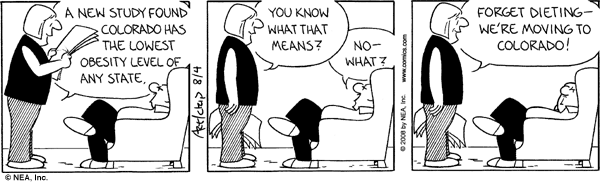
The smallest increase between 2001 and 2011 was in Eagle County, Colorado, where obesity rates went from 20.0% in 2001 to 21.5% in 2011, an increase of 1.5%. You’ll notice that this is Colorado once again, and it turns out that the five counties with the smallest increase from 2001 to 2011 are all in Colorado. Of the 25 counties with the smallest increase, 13 are in Colorado. The take-home here is that Colorado really is special. 

If we zoom in a little further on these data, we can find ONE case of obesity rates declining — they went from 22.7% in 2009 to 22.4% in 2011 in Fairfax City, Virginia, a drop of 0.3%. There were also two counties where rates stayed the same 2009-2011. But this is one county with rates going down, two staying the same, and 3,140 going up. If population-level reversals are this tiny and this rare, it’s hard to imagine that there is much an individual can do to change their own weight. 

But that said, here are a few ideas, approximately in order from least extreme to most extreme.

First off, there are a few things that won’t change how many contaminants you’re exposed to, but that may have an impact on your weight anyways.

1. The first is that you can put on more muscle mass. This won’t affect your weight as it appears on the scale, but it does often seem to affect people’s body composition. The lipostat pays attention to how much fat you have, but it also seems to pay some attention to how much you literally weigh (see these studies in mice, and this recent extension in humans). So if you gain muscle mass, you may lose fat mass. For advice on how to gain muscle mass, please see the internet.

2. — The second is that you could consider getting gastric bypass or a similar, related surgery. Our understanding is that these procedures are very effective at causing weight loss in many cases. However, they are pretty dangerous — this is still a surgical procedure, and so inherently comes with a risk of death and other serious complications. If you consider this option please take it very seriously, consult with your doctor, etc.

Many of you, however, are not just interested in weight loss, or are interested in weight loss along with reducing how many mystery chemicals you’re exposed to — “You stupid kids I don’t want to lose weight I want to get these contaminants out of my body!!!” So here’s a list of steps you could take to reduce your exposure and possibly lose weight, again approximately in order from least extreme to most extreme.

1. — The first thing you should consider is eating more whole foods and/or avoiding highly processed foods. This is pretty standard health advice — we think it’s relevant because it seems pretty clear that food products tend to pick up more contaminants with every step of transportation, packaging, and processing, so eating local, unpackaged, and unprocessed foods should reduce your exposure to most contaminants. 

2. — The second thing you can do is try to eat fewer animal products. Vegetarians and vegans do seem to be slightly leaner than average, but the real reason we recommend this is that we expect many contaminants will bioaccumulate, and so it’s likely that whatever the contaminant, animal products will generally contain more than plants will. So this may not help, but it’s a good bet. 

3. — The third thing is you can think about changing careers and switching to a leaner job. Career is a big source of variance in obesity rates, so if you have a job in a high-obesity profession like truck driver or mechanic, consider switching to a job in a low-obesity profession like teacher or surveyor. For a sense of what careers are high- and low-obesity, check out this paper about obesity by occupation in Washington State and this paper about obesity by occupation in US workers. If you are already in a pretty lean career, then ignore this one.

We think this goes double if you’re in a profession where you’re working with lithium grease directly, or even around lithium grease. Do what you can to stay away from the stuff.

4. — The fourth thing you can consider is changing where you live. The simplest is to change where you live locally — stay in the same area, but move to a different house or apartment. This one is tricky, and sort of a shot in the dark. How will you know if you are moving to a more or less-contaminated house? But if you suspect your house is high in contaminants, it might be worth moving. If you find specific contaminants especially concerning, you can try having your local water tested for them.

5. — A better option is to move to a leaner place altogether. If you’re in the United States, we recommend Colorado. Colorado is the leanest state, has exceptionally pure water sources, individual cities and counties in Colorado are extreme lean outliers, etc. Unbelievably, this comic exists: 

By Brian Crain for The Washington Post

If Colorado doesn’t suit you, you can move to some other state — Hawaii and Massachusetts are not far behind. To find your dream location, look at the CDC’s list of states, or one of the datasets of county-level data like this one or this one, and find a location with a lower rate of obesity than where you currently live. Or pick one of the places from the list of leanest communities in the US

6. — This may not be extreme enough. After all, even Colorado is more than 20% obese. So a more radical version of the same idea is moving to a leaner country altogether. 

If you live in the United States, the good news is that most countries are less obese than where you live now, even if you live in Colorado. Especially good choices seem to be Japan, South Korea, and Thailand, but there are many options — for the whole picture, check out the summary from Our World in Data

But don’t just take our word for it, listen to these happy customers. Like this person who lost weight over five months in Vietnam, this person who moved to Vietnam and lost 112 pounds in ten months, this person who lost about 4kg (9lbs) after about two months in Japan (and similar stories in the comments), this person who lost 5lbs on a two-week trip to Japan, or this person who lost 10lbs during a two-week trip to Japan, despite not keeping up with their exercise regimen. Most of these people attribute their weight loss to eating less and walking more, but you’ll also notice that most of them say it was easy to eat less and walk more, and that many of them report being surprised at how much weight they lost and how easily they lost it. 

We’ve also gotten a number of similar stories from commenters on the blog. First up is Julius, who said:

I currently live in Seattle but have moved around a lot. I’ve made 6 separate moves between places where I drank the tap water (mostly USA/UK/Hungary) and places I haven’t (South East Asia, India, Middle East). Whenever I’ve spent significant time in bottled water countries I lost weight (up to 50 lbs), and each time, save one 3 month stretch in Western Europe, I gained it back in tap water countries. I also lost weight for the first time in the States (20 lbs) this year around the time I switched to filtered water.

There’s also a similar story from Ross:

Very thought provoking and well researched piece. How about Japan? Very low rates of obesity. Similar issues with chemical residue. Anecdotally when I moved to Japan from the West I began to lose weight involuntarily, down to a BMI of 22. When I moved back to the West I regained weight. It’s a big rich country with plenty of processed, packaged food.

And a story from Tuck about their daughter:

Yes, my daughter is going to college in Japan. They have the “Freshmen 15 lbs” over there as well, except it’s the 15 lbs the foreigners lose when they go on a Japanese diet. Got a few panicked messages about “not having anything to wear”… LOL

So before you sign up for the gastric bypass, try spending a couple months in a lean country and see how it goes.

Studies

The question “what do we do about it” also includes the question “what research comes next?” Here’s what we’re thinking.

Correlational Studies

A lot of people’s first instincts when reading this work is to propose correlational studies. (We don’t necessarily mean a literal correlation, we just mean something that’s not a controlled experiment.) But we think that correlational studies are the wrong way to go at this point.

The first reason is statistical. We covered this in Part IV but it bears repeating. Because most of the modern variation in obesity is genetic, the apparent effect of any contaminant will be quite small, probably no larger than r = 0.50 and maybe a lot smaller. In any study we could run, the range of the variable would probably be restricted, and when the range of a variable is restricted, the correlation always ends up looking smaller than it really is. Some people have proposed we do animal studies for more control — but this is also a bad choice statistically, since the obesity effects in animals seem to be smaller than the effects for humans.

The combination of these problems means that any correlational study would be searching for a pretty small effect, and that means you would need a huge sample size to even have a good chance of finding a potential relationship. So “run a quick correlational study” starts looking like “find a way to fund and organize a study with 1,000 mice”. While we love mice, this seems like an awful lot of them. And even if we have enough statistical power that we have a 90% chance to detect a relationship, that still means we have a 10% chance of missing the relationship altogether. We don’t love those odds. 

Second, A Chemical Hunger already documents a lot of correlational evidence for contaminants in general, and for a few contaminants in particular, especially lithium. If you already find this evidence compelling, it’s hard to imagine that one more piece of correlational evidence will do anything for you. And if you don’t find our review convincing, it’s hard to imagine that another piece of correlational evidence will change your mind.

The contamination theory of obesity has to be possible, in the sense that we know chemicals can cause weight gain and we know various chemicals are in the environment. We hope we’ve also convinced you that it’s plausible. Now we want to figure out, is it true? More correlational evidence isn’t going to get us there.

So overall we recommend going right for the jugular. If this theory is correct, then we have a good shot at doing what we really want to do — actually curing obesity — and no result could be more convincing than that. 

Experiments

So in general, we approve of the idea of doing experiments to just cure obesity straight up.

Normally in public health it’s hard to do this kind of experiment, because it’s unethical to expose people to dangerous chemicals. Back when they were trying to figure out if cigarettes cause cancer, they didn’t do any studies where they assigned people to smoke 3 packs a day. But there’s nothing unethical about removing a contaminant from the environment, so we like that approach. 

We call these experiments, and they are, but in many cases we can actually cheat a little by not bothering to include a control group. People almost never spontaneously stop being obese, so we can just use the general obesity rate in the population as our control group. 

Generally speaking, there are two approaches. “Broad-spectrum” experiments take the overall contaminant theory seriously, and just try to reduce contaminant exposure generally, without committing to any specific contaminant. “Targeted” experiments go after one contaminant in particular, and see if controlling levels of that contaminant alone can lead to weight loss.

These have clear trade-offs. The broad-spectrum experiments are more likely to work and require less experimental control, but if they cure obesity, they don’t tell us what contaminant is responsible (curing obesity would still be pretty cool tho). The targeted experiments are less likely to work because we might go after the wrong contaminant, or we might fuck up our experimental control and let some contamination through — but if they DO work, then we have strong evidence that we’ve found the contaminant that’s responsible.

For all of these studies, the big hurdle is that we don’t know how quickly obesity can be reversed, even under the best circumstances. It might also vary a lot for different people — we have no idea. So if we try any of these experiments, we need to run them for several months at the very least, just to get a good idea of whether or not it’s working. Maybe if we’re lucky we’ll find out you can cure obesity in 2 weeks; but 3 months, 6 months, or even 1 year seems more plausible. 

Below, we propose a few basic ideas for experiments. These aren’t exhaustive — as we do more research, we may come up with new and better ways to try to cure obesity. But they seem like an ok place to start.

Broad-Spectrum Experiments

Slime Mold Time Mold’s Excellent Adventure

The idea is simple. Some places, like Colorado, are pretty lean relative to everywhere else. We think that’s because those places are less contaminated. So we find some people who are obese, and pay for them all to take a year-long vacation to Boulder, Colorado, and see if they lose any weight. 

For better effect, go a step further and send them to one of the leanest countries in the world instead. Vietnam seems to be the leanest country in the world right now, at only about 2% obese, and rent is pretty cheap there, so that would be a good option. If you want to stay in heavily industrialized nations, Japan is a good alternative; if you want to stay in the English-speaking world, maybe the Philippines. There are lots of good places to choose from.

For full effect, you would want your participants to eat the local food and drink the local water as much as possible. If they’re eating American food and drinking American beer, then you’re right back where you started.

(If you know of any study abroad or similar programs that we could piggyback on, please let us know!)

Throw Water Filters at the Problem and See What Happens

This is a broad-spectrum version of a targeted idea, below. The basic idea is simple. Contaminants might be in the water supply; filters get lots of stuff out of water; people drink water. So in this study, we find a bunch of people who are overweight or obese, send them the strongest/best water filters we can afford, and see if they lose any weight over the next several months. 

For even more effect, send the filters to people who live in the most obese states, or even target some of the most obese communities directly.

This really is not a precision instrument — filters don’t get everything out of water, and water might not even be your main source of contaminants. Maybe your food or your carpets are the bigger problem. But if losing weight were as simple as throwing a water filter at the problem, that would be pretty exciting, and we would want to know.

Targeted Experiments

Right now lithium is our top suspect, so we’re using lithium as our go-to example in all of these experiments. But if it turns out that lithium isn’t a good match, any of these experiments could be retrofitted to target some other contaminant instead. 

To use a targeted approach, we need to be able to figure out how much exposure people are getting, and we need to know what we can do to reduce that exposure. So there are a few pre-experiment projects we need to do first.

To begin with, we need to figure out which water filters (if any!) remove lithium from drinking water. If we can find a filter that works, this will let us make sure any water source is lithium-free.

In addition, we’re worried that lithium might accumulate in food, so we need to do another study where we look at as many different types of food as we can and try to figure out if there are high levels of lithium in any of the stuff we’re all eating. Without this, any study will be hopelessly complicated because we won’t be able to control for the lithium in your food. But if we figure out what crops (if any) are concentrating lithium, maybe we can figure out a way to feed people a low-lithium diet.

Targeted Water Filters

Assuming we can find a water filter that does the job, we could do a pretty straightforward study where we send people a water filter that takes lithium out of their water, and see if they lose weight over a couple months.

For maximum effect, we would also want to make sure they weren’t getting any lithium from their food, which is why we want to do a study on how much lithium is in the food supply. It’s not clear how easy this would be — we might have to curate food sources and provide people with all their meals as well, which would make this study a hundred times more complicated.

There are a couple other things we could do to improve this study. We could focus on sending water filters to people in the most obese parts of the country, or to places where we already know the water is contaminated with lithium.

We could test the amount of lithium in people’s blood, urine, and/or saliva as they use the filter, see if it goes down, and see if the decrease in lithium in their body tracks on to weight loss. Assuming people did lose weight, this would be important because it might help us figure out more about the mechanism of lithium leaving the body. Some people will probably clear lithium faster than others, and if lithium causes obesity, we would want to be able to figure out how to help people clear it from their body as fast as possible. 

We could also do a slightly bigger study, where we go to one of the fattest places in the US and install a bunch of whole-home water filtration systems for a couple randomly selected families who are overweight or obese. This would be more expensive but it would have some perks. If it turns out that showering in lithium-tainted water is really the active ingredient, and not just drinking it, then a whole-home water filtration system would take care of that. 

There’s also a small chance that there’s just no filter on the market that can get lithium out of drinking water. Or maybe distillation works, but the cost is prohibitive for a whole-home system. In that case, we could rent a few water tanker trucks, fill them with water we know is low in lithium (we’ll import it from Colorado if we have to!), and take them to a cul-de-sac in one of the most obese communities in the US. If we can find a neighborhood who’d sign up for this, we could switch their houses’ water supplies over to our tanker trucks for a few months, bringing in new water as needed, and see if that did anything for their health. 

Amish Obesity

This piece from the LA Times is pretty bad, but it tells an interesting story. In part of Ontario, Canada, a group of Old Order Amish have “stunningly low obesity levels, despite a diet high in fat, calories and refined sugar.” The figure they quote is an obesity rate of only 4%. But about 200 miles south, the Amish in Holmes County, Ohio have obesity rates similar to the rest of the population, closer to 30% obese.

These two groups should be genetically similar. Both groups grow most of their own food. Both of them have pretty similar lifestyles — despite what the LA Times piece and this related article say, even if “only” 40% of the Amish in Ohio do hard farm labor, their lives are still more like the Amish in Ontario than the non-Amish in Holmes Country. 

This makes them almost a perfect comparison. Why are the Amish in Ohio so much more obese than the Amish in Ontario? If the contamination hypothesis is correct, then we should be able to look at the local environments of these two communities and find more contamination (of one sort or another) in Ohio than in Ontario. 

Because both groups grow most of their own food (we think?), we don’t need to worry about the influence of food imported from elsewhere — whatever contaminants are in their water will also be in their plants, and they won’t be bringing in contaminated food from outside. This makes this situation a much more controlled environment to study our hypothesis.

If lithium is the contaminant that causes obesity, we might expect to see deeper wells in Ohio than in Ontario. Information about the Amish is hard to find on the internet, for obvious reasons, but we have found some information that suggests that the Amish in America do use drilled wells, some of which may be relatively recent. We can’t find anything about the wells used by the Amish in Ontario — but it would be interesting if they were still using older, shallower wells for their water.

Another thing we might expect to see, if lithium is to blame, is evidence of some kind of fossil fuel activity in Ohio and not in Ontario. Well, in our last post we did review evidence for fossil fuel contamination in a number of places in Ohio. And when we were looking for documentation on water wells in Amish Ohio, we came across articles like Fracking on Amish Land (in Ohio), Energy Companies Take Advantage of the Amish Prohibition on Lawsuits (in Ohio), this excerpt about natural gas wells (in Pennsylvania), and Tradition, temptation as Amish debate fracking (in Pennsylvania, but mostly in Ohio). 

Ontario has its own problems, including thousands of abandoned gas wells, but very few of them appear to be on Amish land. Zoom in on the towns of Milverton, Millbank, Newton, Linwood, and Atwood on that map, and you’ll see that there are almost no petroleum wells around these Amish communities. And unlike in Ohio, we haven’t found any news stories about recent drilling or fracking on Amish land in Ontario. 

Or we could just go test the water. It’s a simple question, how much lithium is in the water in each place, and testing for other contaminants might not be a bad idea either. If we find similar levels of lithium in both places, and there are no complicating factors like imported food, that would be a strike against lithium as an explanation. But if there’s more lithium in the food and water in Ohio than in Ontario, that would be quite a mark in favor of the lithium hypothesis. Assuming they were interested, we could then work with the Amish in Ohio to try to get the lithium (or whatever) out of their water, and see if that reduced their rates of obesity. 

We don’t expect that we have many Amish readers, but if you know of a good way to get in contact with the Amish in either of these locations, we’d be interested in talking to them!  

Research Advising

There are also a few ideas we have that we won’t be pursuing ourselves, but if someone else (or a small team) wants to go after them, we would be happy to advise.

Taking lithium out of the water supply as a whole would be pretty hard, so it’s not usually an option. But it might be an option for countries that get most of their drinking water from desalination. You could run this as an experiment — one desalination plant uses lithium-free brine while another continues with the normal procedure — but you wouldn’t have to. In this case, there’s no need for a control group. If Saudi Arabia or Kuwait changed their desalination process so that no lithium ended up in their water, and saw their obesity rate fall 10% over the next five years, that would be evidence enough. Or you could do a version of this study with some other relevant group, e.g. seafarers drinking desalinated water as suggested by commenter ugoglen. So if anyone is able to do something like this, we would be interested in being involved.

In our post on PFAS, we did a small amount of regression modeling using data from The National Health and Nutrition Examination Survey (NHANES) and found evidence of a relationship between BMI and certain PFAS in the data for 1999-200, 2003-2004, and 2005-2006. This finding is very suggestive, but we only tested some very simple models, and we only looked at three of the datasets that are available. We think that a bigger analysis could be very illuminating, but model fitting isn’t our specialty. We would love to work with a data scientist or statistician with more model fitting experience, however, to conduct a more complete analysis. So if you have those skills and you’re interested, please let us know

We’re still pretty interested in the all-potato diet. So far all we have are anecdotes, but the anecdotes are pretty compelling. Chris Voigt famously vowed to eat nothing but 20 plain potatoes (and a small amount of cooking oil) and lost 21 pounds over 60 days, without feeling very hungry. There’s also Andrew Taylor of Australia, who lost 114 lbs over a year of eating nothing but potatoes and reports feeling “totally amazing”. Last we heard he’s still doing pretty well. Magician Penn Jillette lost over 100 lbs using a strategy that started with two weeks of a potato-only diet (h/t reader pie_flavor), and seems to be keeping it off. This also inspired at least one copycat attempt from a couple who have jointly lost over 220 lbs starting with two weeks of an all-potato diet.

There’s also this comment from u/DovesOfWar on reddit:

To complement the potatoes anecdote, at some point to save money and time I ate almost nothing but potatoes, onions and butter and I lost like 60 pounds. I stopped because everyone thought I was starving (despite not being hungry) and I chugged it off to extreme lazyness/depression (despite not being sad) so I stopped doing that and never connected it to my diet, but what I should have done is write a fad book on the diet and solve the money problem that way. I’m back to a normal healthy 29 BMI now and still relatively poor, so I see I interpreted the experiment completely wrong and now my life sucks.

Based on those examples, you can see why we’re interested. It seems pretty low-cost (potatoes are cheap) and low-risk (if you feel bad, you can stop eating potatoes). If someone wants to organize a potato-centered weight-loss study, or if people just want to get together and try it for themselves, we’d be happy to advise. You can coordinate on the subreddit u/pondgrass set up over at r/spudbud if you like, though so far there doesn’t seem to be much activity.

We’re also interested in the effect of alkali metal ions, especially potassium. Lithium, currently our prime suspect, is an alkali metal ion that appears to affect the brain. Other alkali metal ions like sodium and potassium also play an important role in the brain, and there’s evidence that these ions may compete with each other, or at least interact, in interesting ways (see also here, here, and here). If lithium causes obesity, it may do so by messing with sodium or potassium signaling (or maybe calcium) in the brain, so changing the amount of these ions you consume, or their ratios, might help stop it. 

This is supported by some hints that potassium consumption is related to successful weight loss. Potatoes are high in potassium, so if the all-potato diet really does work, that might be part of the mechanism.

You can easily get sodium from table salt, and you can get potassium from potassium salts like this one or this one. We’ve tried them, and we find them a little gross, but to some people they taste just like regular salt. If that’s no good, there are always dietary sources like potatoes.

So trying various forms of alkali-metal diets — high-K+, high-K+/low-Na+, high-K+/high-Na+, high-K+/low-Ca2+, etc. — seems pretty easy and might prove interesting. As before, if someone wants to organize a community study around this angle, or if people want to try it for themselves, we’d be happy to advise. These salts are pretty safe, and not prescription medications, but they’re not quite as basic as potatoes — before you try seriously changing your sodium or potassium intake, please talk with your doctor.

Also, how about lithium grease? These greases are basically the perfect slow-release form of lithium, which make them kind of concerning. Mechanics work with lithium grease and are relatively obese. But there are alternative kinds of greases that don’t use lithium, and sometimes companies intentionally switch what kind of grease they use. If a company switched out lithium grease for some other grease in one of their factories, we could compare the weights of workers at that factory to workers at other factories, and see if there was any weight loss over the next few years. And what happens when mechanics who use lithium grease every day switch to a new job? What happens if they get promoted to a desk job? What happens when they retire? If you know a group of mechanics or some other group that works with lithium grease and might be interested, please let us know!

We’re also interested in advising original ideas. We love it when you send us ideas we never would have come up with ourselves. So if you have some great idea — a review of a contaminant we didn’t cover, another idea for a related study, relevant anecdotes that might inspire something, etc. — let us know. If we like it, we’ll do what we can to help — advise you, promote it, try to help you get funding, whatever.


This is the end of A Chemical Hunger. We will still write more about obesity, and probably more about contamination, but this is the end of the series. Thank you for reading, commenting, sharing, contributing, questioning, challenging, and yes, even disputing! We’ve learned a lot from your comments and questions — and we hope you’ve learned something from reading!

Even if you still don’t find our hypothesis convincing, thank you for reading the series all the way to the end! We think it’s great that you were willing to give our wacky idea the time of day. This kind of exploration is essential, even if some of the theories turn out to be a little silly. And even if our theory is totally wrong, someday someone will figure out the answer to this thing, and we’ll send the global obesity rate back down to 2%.

As we mentioned, we want to conduct some research to follow up on the book-length literature review you just finished reading. Our near-term goal is to better understand how people get exposed to contaminants, especially lithium, so we can give advice on how to avoid exposure. Our medium-term goal is to figure out what causes obesity, probably by trying to cure it in a sample population. Our long-term goal is to try to cure it everywhere. That would be pretty cool.

If you’re interested in supporting this research, you can become a patron on patreon, or contact us if you want to help fund a larger project.

In conclusion: Be excellent to each other. Party on, dudes.


I Want to Believe the Sexy van Leeuwenhoek is Out There

Old friends and doctoral students in the sciences, MENO and SALVIATI, are discussing the state of science funding. 


Meno: There are lots of ways to have a good life. Research isn’t even an easy way.

Salviati: No, it’s a pretty shit way, and would be even if you were divinely gifted. There are interesting side-effects, but it’s not exactly the good life. Antonie van Leeuwenhoek had the right idea — first he became a rich merchant in the sale of cloth, then while fiddling with lenses in his spare time, was the first to discover microorganisms, and more or less invented the field of microbiology.

Meno: Yeah, what’s the modern day version of that?

Salviati: We know that Dr. H [a scholar of their mutual acquaintance, who became very wealthy from oil investments before pursuing graduate school — Ed.] could have done it, and you wouldn’t need to be nearly as wealthy as he was. I do wonder if the option used by Leibniz and Leonardo is still open, of finding a rich patron. It would be easier today than it was for them — you wouldn’t need to find a king or a duke, there are plenty of people today rich enough to support a scientist.

Meno: A science sugar daddy.

Salviati: Yes, but you can’t say that. Hm – Actually, I think you could probably do very well by finding the smartest and most capable camgirls, and doing some kind of OnlyFans science accelerator setup.

Meno: Once you’re doing sex work to fund your research, maybe just teach instead?

Salviati: Camgirls can make like $100,000 a month.

Meno: Really??

Salviati: It’s true, though only the most successful. More usual is around $40/hour, but even that’s quite a good wage. And camgirls, or successful sex workers more generally, might be expected to be especially gifted scientists.  Camgirls are not the only profession that this would work for, of course. Any job with good pay and flexibility could do the same. But camgirls are notable for the flexibility of their profession, and their abilities are especially likely to be underestimated by society at large. You’re selecting heavily for people who are open to doing something rather unorthodox, and this kind of free-thinking is essential to the scientist. Further, by going to the most successful camgirls, you’d be selecting people who have already demonstrated ability to set up what is essentially a very successful small business.

Meno: I gotta get into that.

Salviati: If you try, I wouldn’t hold it against you.

Meno: You first.

Salviati: Most of them, of course, do not make that much. But also most people do not win major international scholarships, as you have, my friend.

Meno: And only I shall do both.

Salviati: The noted camgirl / philosopher / hetaira known as Aella, a sort of latter-day Phryne or Aspasia, has collected much data that may be relevant. Here she finds that on OnlyFans, those with a college degree make more money than those without — and those with a master’s degree or higher do even better. Note that the bars are by percent ranking — as in, who is in the top 5% of people on the site? — and so a shorter bar means more success, and more money.

Salviati: Here she finds that while most people on OnlyFans do not make much money, the most successful take in several thousand dollars per month. She herself has made $100,000 in a month on at least one occasion. 

Salviati: She says “the big change is around 0.7-0.8%”, and with around a million people on OnlyFans, that is about seven or eight thousand camgirls making a small fortune every month. If only one in a thousand of these women also have the ability to be great scholars, then there are several of them; and I would wager, it is more than one in a thousand. 

 van Leeuwenhoek and Aella in exactly the same pose, and very nearly the same outfit. Ok, has anyone seen both of them at the same party?

Meno: I suppose the first step is to get hot, is it not?

Salviati: If you want to become a successful cammer, Meno, I can hardly stand in your way, but this is not what I had in mind. I was thinking you could recruit talented camgirls, bring them together, and offer them scientific training. They’re fully-funded, having no need of patronage — they have patronage already. 

Meno: In exchange for them funding your research?

Salviati: No, sort of as a science accelerator.

Meno: What do you mean?

Salviati: Well, would you say that society overvalues or undervalues the scientific ability of camgirls?

Meno: Society undervalues their scientific ability, certainly.

Salviati: I could hardly agree more. Society clearly undervalues their ability. When society misses ability in this way, it means there is unappreciated value waiting to be created. There’s value just lying around. The greatest amount of untapped value belongs to the camgirls, of course, and it would be their place to gain from it. But when something is undervalued, it also means that there is a space for those who, unlike the rest of society, recognize skill and virtue when they see it, and invest in it when no one else will. You and I have little money, but we do have the benefit of our skills, experience, and scientific training that is unavailable to many. We could — for example — go to top camgirls who also seem gifted and capable, especially those with science backgrounds. We could offer to connect them to camgirls of similar interest and abilities, and for a modest fee, offer them whatever scientific training we can give, and begin collaborations with them. The camgirls could do it themselves, naturally, but someone would need to coordinate this and it could equally well be us, since we could also offer them some training (especially statistics training). Together you could get a house or two in a remote area with good internet. They can keep camming to make money — van Leeuwenhoek didn’t quit his job as a cloth merchant! — and then you all collaborate to cure cancer or something.

Meno: This sounds like more work and less payoff than getting an academic job.

Salviati: Look, you’re the one who called patrons “science sugar daddies.” I’m just agreeing with you.

Meno: Hahaha – I appreciate the idea. It’s important to ideate on ways to reach the goal, which is sufficient money and freedom to pursue science.

Salviati: Yes

Meno: There’s no guarantee that an academic job provides the best tradeoffs, but it does seem to provide a reasonable standard to beat.

Salviati: I just wonder if the kind of guy who would pay a woman $20/month to look at her nudes wouldn’t pay her $100/month to look at her nudes AND support her research. There will be some people who will pay to see nudes, and some people will pay to support their favorite scientist or artist. There will also be people who do both, and I wonder if they won’t put up even more money than they would in either case alone. To put in stupid stats terms, I look at Patreon and OnlyFans and wonder if there might be a significant interaction.

Meno: I think you may be optimistic about the scientific skill of camgirls. I’m sure they’re better scientists than people might expect, but good scientists are rare.

Salviati: All that needs to happen is for it to be undervalued, I think, and for there to be a lot of them, which there are. I guess I’m a big believer in the effect of what can be called “scenes”. If there are many untapped geniuses, and we bring them together, what they produce together will be much greater than what they could ever produce apart. Paul Graham at one point wrote about what he calls the case of the Milanese Leonardo. He says, “Practically every fifteenth century Italian painter you’ve heard of was from Florence, even though Milan was just as big. People in Florence weren’t genetically different, so you have to assume there was someone born in Milan with as much natural ability as Leonardo. What happened to him?” Or we can consider “The Martians”, the nickname for a group of scientists from Hungary. They all grew up in the same parts of Budapest, went to the same high schools, and eventually went to America where among other things they led the Manhattan Project.

Meno: I’m not sure I see why they only have to be undervalued in science, rather than good at science.

Salviati: That might be the weak link. It depends on how seriously we take the “Milanese Leonardo” argument. Now, you and I agree that the two of us have at least some chance to make a great discovery. Where does that promise come from in us? Are you and I in the top .01% in terms of natural ability? Or in the top 5% plus our connections, the scenes we are a part of?

Meno: Regardless, being near the top is what matters, right? If I think someone’s IQ is 70 but it’s actually 80, I’ve undervalued them but they’re not going to produce good science.

Salviati: You’re right that it’s not strictly about undervaluation. But there are thousands of sex workers, in fact hundreds of thousands. Not everyone has it in them to be a great scientist, but a great scientist can come from anywhere. If we believe that camgirls are undervalued for their scientific skills — a safe assumption — then there are likely camgirls with the potential to be great scientists, and who society has missed. Another PhD student I know recently told me (though I omit their name in case they are hesitant), “sex workers know more about the human condition than any psychologist, change my mind” … Oh yeah that was after I said “Time to start my own journal, with blackjack and hookers”

Meno: I think I’m going to do the postdoc I was recently offered, rather than try to turn thousands of sex workers into scientists, but I see the appeal.

[Crowd boos]

Salviati: This seems more like a good opportunity for sex workers who want to be van Leeuwenhoek than it does for us. But I would be happy to consult for sexy van Leeuwenhoek, so maybe there is some profit to be made on our side.

Meno: The real key… is to become the sexy van Leeuwenhoek.

Salviati: Sadly I am not sexy enough. But I want to believe the sexy van Leeuwenhoek is out there.

FIN

Higher than the Shoulders of Giants; Or, a Scientist’s History of Drugs


I. 

The United States used to introduce new constitutional amendments all the time. But after the 26th Amendment in 1971, we stopped coming up with new amendments and haven’t added any since. (The 27th Amendment doesn’t really count — while it was ratified in 1992, it was proposed all the way back in 1789. It’s also only one sentence long and really boring.)

Global GDP used to grow faster and faster all the time — the time it took the global economy to double in size showed a pretty clear linear trend. This was the rule until about 1960-1980, when economic growth suddenly stagnated. Global GDP is still going up, but it’s now growing at a more or less constant rate, instead of accelerating. 

Productivity and hourly wages used to be tightly linked — if you’re creating more value for your employer, they will be willing to pay you more. However, around 1970, these two trends suddenly decoupled. You may have seen graphs like this: 

There used to be less than 1 lawyer per 1000 Americans, though that number was slowly increasing. That is, until about 1971, when it suddenly shot up. Now there are about 4 lawyers for every 1000 Americans. In some parts of the country, the ratio can be as high as 10 per 1000. This is (unsurprisingly) true in New York but also unexpectedly true in our home state of Vermont, which has 5.8 lawyers per 1000 people. It’s ok though, I hear they can’t enter your home unless you invite them in. 

It used to be that about 100 out of every 100,000 people in the population were in prison. That is, until about 1971, when that rate started climbing. Now about 700 out of every 100,000 Americans are incarcerated.

There are even signs that scientific progress has been slowing down since — you guessed it! — about 1970 (see also this paper). 

This is only a small selection of the many things that seem to have gone terribly wrong since about 1970. For a more complete picture, check out the excellent Wake Up, You’ve Been Asleep for 50 Years and WTF Happened In 1971?, which are our sources for most of the trends described above. 

So yeah, what the F did happen in the early 1970s? When dozens of unexplained trends all seem to start in the same year, it seems like more than coincidence — you start wondering if there might be a monocausal event

“The break point in America is exactly 1973,” says economist Tyler Cowen, “and we don’t know why this is the case.” One possible culprit is the 1973 oil embargo, because many of these trends have to do with energy. But Cowen doesn’t think this holds water. “Since that time, the price of oil in real terms has fallen a great deal,” he says, “and productivity has not bounded back.” 

Another possible culprit is the US going off the gold standard in 1971, part of the set of measures known as the Nixon shock (also the name of our new Heavy Metal band). This makes some sense because many of these trends have to do with the economy. But it’s not clear if this is a good explanation either, as many of these trends seem to be global, and most of the world is not on the US dollar. The US is admittedly a pretty big deal, but we’re not the only economy in the world.

But it’s also possible that all this comes from a different policy that Nixon signed into law the year before: the 1970 Controlled Substances Act.

II. 

The early history of coffee is shrouded in mystery. Legends of its discovery date as far back as the 9th century CE, but whenever it was discovered, it’s clear that it came from Africa and had reached the Middle East by 1400. The first coffeehouse in Istanbul opened around 1554, and word of coffee began reaching Europe in the middle 1500s. Even so, it took Europeans about a hundred more years to really take note — the first coffeehouse in Christendom didn’t open until 1645, when one popped up in Venice.

Only five years later, in 1650, the first coffeehouse in England opened in Oxford. There is nothing new under the sun, so unsurprisingly it was very popular with students and intellectuals. Early patrons included Christopher Wren and John Evelyn, and later additions included Hans Sloane, Edmund Halley, and Isaac Newton, who according to some stories, “are said to have dissected a dolphin on a table in the coffeehouse before an amazed audience.” Coffee is a hell of a drug. 

The first coffeehouse in London opened in 1652 in St. Michael’s Alley in Cornhill, operated by a Greek or Armenian (“a Ragusan youth”) man named Pasqua Rosée. The coffee house seems to have been named after Roseé as well, and used him as its logo — one friend who wrote him a poem addressed the verses, “To Pasqua Rosée, at the Sign of his own Head and half his Body in St. Michael’s Alley, next the first Coffee-Tent in London.”

The Royal Society, the oldest national scientific institution in the world, was founded in London on 28 November 1660. The founding took place at the original site of Gresham College, which as far as we can tell from Google Maps, was a mere three blocks from Rosée’s coffeehouse. Some accounts say that their preferred coffeehouse was in Devereux Court, though, which is strange as that is quite a bit further away. But this may be because Rosée’s coffeehouse was destroyed in the Great Fire of 1666.

In 1661, Robert Boyle published The Sceptical Chymist, which argues that matter is made up of tiny corpuscules, providing the foundations of modern chemistry. In 1665, Robert Hooke published Micrographia, full of spectacularly detailed illustrations of insects and plants as viewed through a microscope, which was the first scientific best-seller and invented the biological term cell. By 1675, there were more than 3,000 coffeehouses in England. In 1687, Newton published his Principia

As the popular 1667 broadside News from the Coffe House put it: 

So great a Universitie

I think there ne’re was any;

In which you may a Schoolar be

For spending of a Penny.

This trend continued into the following centuries. As just one example, Voltaire (1694-1778) reportedly consumed a huge amount of coffee per day. No, REALLY huge. Most sources seem to suggest 40 to 50 cups, but The New York Times has it as “more than 50 cups a day.” Perhaps the cups were very small. Wikipedia says “50-72 times per day”, but we can’t tell where they got these numbers. I ask you, what kind of drugs would this man be on, if he were alive today?

Do we really think this mild stimulant could be responsible for the Scientific Revolution? Well to be entirely clear, we aren’t the first ones to make this argument. Here’s a Huffington Post article reviewing several books and essays on the same idea, including one by Malcolm Gladwell. And in Weinberg and Bealer’s The World of Caffeine, the authors tell us that the members of the Royal Society, “had something in common with Timothy Leary, the Harvard professor who experimented with LSD, in that they were dabbling in the use of a new and powerful drug unlike anything their countrymen had ever seen. Surviving recorded accounts confirm that the heavily reboiled sediment-ridden coffee of the day was not enjoyed for its taste, but was consumed exclusively for its pharmacological benefits.”

Today we tend to take coffee in stride, but this stimulant didn’t seem so mild at the time. In 1675, King Charles II briefly banned coffeehouses in London, claiming they had “very evil and dangerous effects.” We don’t know the exact details of the public response, but it was so negative that the king changed his mind after only eleven days! Ten years later, coffee houses were yielding so much tax revenue to the crown that banning them became totally out of the question. 

Merchants panicked over an imagined danger to the economy, one writing, “The growth of coffee-houses has greatly hindered the sale of oats, malt, wheat, and other home products. Our farmers are being ruined because they cannot sell their grain; and with them the landowners, because they can no longer collect their rents.” The owner of the second coffeehouse in London, James Farr, was prosecuted by his neighbors in 1657, “for making and selling a sort of liquor called coffe, as a great nuisance and prejudice to the neighborhood, etc.”

On the less official side of things, the 1674 anonymous WOMEN’S PETITION AGAINST COFFEE REPRESENTING TO PUBLICK CONSIDERATION THE Grand INCONVENIENCIES accruing to their SEX from the Excessive Use of that Drying, Enfeebling LIQUOR (which possibly deserves to be read in full, if only for the 1674 use of “cuckol’d” and “dildo’s”) declared, among other things:

Never did Men wear greater Breeches, or carry less in them of any Mettle whatsoever. There was a glorious Dispensation (’twas surely in the Golden Age) when Lusty Ladds of seven or eight hundred years old, Got Sons and Daughters; and we have read, how a Prince of Spain was forced to make a Law, that Men should not Repeat the Grand Kindness to their Wives, above NINE times in a night … the Excessive Use of that Newfangled, Abominable, Heathenish Liquor called COFFEE …has…Eunucht our Husbands, and Crippled our more kind Gallants, that they are become as Impotent, as Age, and as unfruitful as those Desarts [sic] whence that unhappy Berry is said to be brought.

It’s not like these concerns disappeared as people got used to it. As late as the early 1900s, physicians were still raving about the dangers of this terrible drug. As the wonderful (and sadly defunct) site History House reports:

In the spectacularly titled Morphinism and Narcomanias from Other Drugs (1902), one T. D. Crothers, M.D. tells a few tales of delirium induced by coffee consumption. He also remarks, not unlike analogies to marijuana made by current drug crusaders, that, “Often coffee drinkers, finding the drug to be unpleasant, turn to other narcotics, of which opium and alcohol are the most common.” Similarly, in A System of Medicine (1909), edited by the comically degreed Sir T. Clifford Allbutt (K.C.B., M.A., M.D., LL.D., D. Se., F.R.C.P., F.R.S., F.L.S., F.S.A., Regius Professor of Physic [Internal medicine] in the University of Cambridge), some contributors announce their distaste for caffeine: “We have seen several well-marked cases of coffee excess… the sufferer is tremulous, and loses his self-command… the speech may become vague and weak. By miseries such as these, the best years of life may be Spoilt.”

High doses of caffeine cause odd behavior in test animals. Rats will bite themselves enough to die from blood loss, prompting Consumers Union to observe, “Some readers may here be moved to protest that the bizarre behavior of rats fed massive doses of caffeine is irrelevant to the problems of human coffee drinkers, who are not very likely to bite themselves to death.”

Neither did the science-coffee connection disappear with Newton and Hooke. Researchers still consume more coffee than any other profession. The mathematician Alfréd Rényi quipped, “A mathematician is a machine for turning coffee into theorems,” and he and his colleagues, including Paul Erdős, drank copious amounts. At one point, when trying to explain why Hungary produces so many mathematicians, one of the reasons Erdős gave was, “in Hungary, many mathematicians drink strong coffee … At the mathematical institute they make particularly good coffee.” 

The first webcam, great ancestor to all those Zoom calls you’ve been having, was developed by University of Cambridge computer scientists so they could watch the coffee pot without having to leave their desks.  

And while it’s very popular, coffee isn’t the only way to get your sweet, sweet caffeine fix. Consider the connection between Tea and the British Empire. [cue Rule, Britannia!

Hey Jared we have a piping hot tip for you

Caffeine in one form or another continued to be the stimulant of choice until the middle of the 19th century, when the Germans made an even more exciting discovery.

III. 

When the Spanish arrived in South America, they noticed that some of the natives had the refreshing habit of chewing on the leaves of a local plant, “which make them go as they were out of their wittes.” At first the Spaniards were concerned but then they realized it was pretty great, and started using it themselves — for medicinal purposes, of course. 

Even so, chemistry was not fully developed in the 1600s (they needed to wait for the coffee to hit), so despite many attempts it took until 1855 for the active ingredient to be purified from coca leaves. This feat was accomplished by a German named Friedrich Georg Carl Gaedcke. With this success, another German chemist (Friedrich Wöhler) asked a German doctor who happened to be going on a round-the-world trip (Carl Scherzer) to bring him back more of these wonderful leaves. The doctor came back a few years later with a trunk full of them, which the second chemist passed on to yet a third German chemist, Albert Niemann, who developed a better way of purifying the new substance, which he published as his dissertation. (Sadly he never got to enjoy the substance himself, as he discovered mustard gas the same year and died the year after that, probably from working too closely with mustard gas.)

And with this series of developments, pure cocaine was injected directly into the German nervous system.

A typical example of the effects of cocaine on the German scientific body can be found in a man you might have heard of — Sigmund Freud, who has the same birthday as one of the authors. Having recently moved on from his earlier interest in trying to find the testicles and/or ovaries of eels (don’t laugh, it was a major scientific question of the day!), he found himself VERY EXCITED by the possibilities of this new treatment, which had just become available to physicians.

“Woe to you, my Princess, when I come,” wrote Sigmund Freud to his future wife, Martha Bernays, on June 2, 1884. “I will kiss you quite red and feed you till you are plump. And if you are forward, you shall see who is the stronger, a gentle little girl who doesn’t eat enough, or a big wild man who has cocaine in his body. In my last serious depression I took cocaine again and a small dose lifted me to the heights in a wonderful fashion. I am just now collecting the literature for a song of praise to this magical substance.”

He didn’t just use cocaine to intimidate (???) his fiancée, though. Freud also found that it had professional applications. “So I gave my lecture yesterday,” he wrote in a letter a few months earlier, “Despite lack of preparation, I spoke quite well and without hesitation, which I ascribe to the cocaine I had taken beforehand. I told about my discoveries in brain anatomy, all very difficult things that the audience certainly didn’t understand, but all that matters is that they get the impression that I understand it.” We see that not much has changed since the 1880s. 

Freud wasn’t the only one who was excited by this new discovery, of course. Only two years later, a bedridden Robert Louis Stevenson wrote The Strange Case of Dr Jekyll and Mr Hyde, a 30,000-word novella that he completed in about three days. Many accounts suggest that Stevenson was high on cocaine during this brief, incredibly productive period, possibly recreationally, or possibly because it was simply part of the medicine he was taking. This claim is somewhat contested, but we’re inclined to believe it — you try writing 30,000 words in three days, by hand, while bedridden, without the help of a rather good stimulant.

One Italian, Paolo Mantegazza, was so enthusiastic about the new substance that he actually developed a purification process of his own in 1859. Over the next several decades, he founded the first Museum of Anthropology in Italy, served in the Italian parliament, published a 1,200-page volume of his philosophical and social views, at least three novels, and several scientific books and papers (this paper from 2008 claims that he founded the field of sexual medicine), including one in which he wrote:

“I sneered at the poor mortals condemned to live in this valley of tears while I, carried on the wings of two leaves of coca, went flying through the spaces of 77,438 words, each one more splendid than the one before. An hour later, I was sufficiently calm to write these words in a steady hand: God is unjust because he made man incapable of sustaining the effect of coca all lifelong. I would rather have a life span of ten years with coca than one of 10,000,000,000,000,000,000,000 centuries without coca.”

We should note that while Mantegazza was very productive in these decades, he was also a vivisectionist and a racist. Clearly not everyone should have access to cocaine of this quality.

A different Italian looked at cocaine and saw not poor mortals condemned to live in the valley of tears, but economic opportunity. He happened to read a paper by Mantegazza on the substance, and was inspired. This man was Angelo Mariani, and in 1863 he “invented” cocawine, by which we mean he put cocaine in wine and then sold it. 

Apparently this was more than just a good idea. Cocaine.org, a reputable source if ever we’ve seen one, tells us, “If cocaine is consumed on its own, it yields two principal metabolites, ecgonine methyl ester and benzoyleconine. Neither compound has any discernible psychoactive effect. Cocaine co-administered with alcohol, however, yields a potent psychoactive metabolite, cocaethylene. Cocaethylene is very rewarding agent in its own right. Cocaethylene is formed in the liver by the replacement of the methyl ester of cocaine by the ethyl ester. It blocks the dopamine transporter and induces euphoria. Hence coca wine drinkers are effectively consuming three reinforcing drugs rather than one.”

Mariani is notable less for taking cocaine himself, and more for being possibly the most influential drug pusher of all time. His enticing product, called Vin Mariani, soon became a favorite of the rich, powerful, and highly productive, unleashing the creative potential of cocaine on the world.

YOU CAN TELL SHE’S VERY EXCITED ABOUT THIS WINE FOR SOME REASON

A good catalogue of its influence can be found in the literally thousands of celebrity endorsements it received, and which were proudly displayed in its ads. “Testimonials from eminent personages were so numerous that Mariani, as great a public relations man as he was a chemist, published them in handsome leather-bound volumes—replete with portraits and biographical sketches of the endorsers.” Many of these names and endorsements seem to have been lost to time, but here are a few you might recognize. 

Presumably you have heard of the Pope. Pope Leo XIII and Pope Pius X both enjoyed Vin Mariani, and Pope Leo XIII liked it so much that he often carried a hip flask of the wine. He even awarded Mariani a Vatican Gold Medal, “to testify again in a special manner his gratitude.” He also appeared on a poster advertisement endorsing the wine, and later called Mariani a “benefactor of humanity”. AP news reports that the chief rabbi of France liked it too. 

Sarah Bernhardt, famous actress and subject of the most entertaining Wikipedia entry of all time, said, “My health and vitality I owe to Vin Mariani. When at times unable to proceed, a few drops give me new life.” Jules Verne, one of the fathers of science fiction, wrote, “Vin Mariani, the wonderful tonic wine, has the effect of prolonging life.” Frédéric Auguste Bartholdi, who you will know as the sculptor of the Statue of Liberty, wrote, “this precious wine will give me the strength to carry out certain other projects already formed.” Alexander Dumas is said to have enjoyed it as well, but we can’t find a quote. 

In 1892, Thomas Edison contributed the almost maddeningly vague note, “Monsieur Mariani, I take pleasure in sending you one of my photographs for publication in your album.” Edison was already quite famous by this point, and it’s not clear how long he had been enjoying the effects of Vin Mariani, but we can make an educated guess. 

Vin Mariani was invented in 1863, and we know that by 1868, Edison had a reputation for working “at all hours, night or day”. His famous Menlo Park lab was built in 1876, and soon began producing inventions at a steady rate — the phonograph in 1877, his work on electric lights about 1880, motion picture devices in 1891, and so on. 

In 1887, one writer noted, “he scarcely sleeps at all, and is equally as irregular concerning his eating”. The same account quotes a “co-laborer” of Edison’s as saying, “he averaged eighteen hours [of work] a day. … I have worked with him for three consecutive months, all day and all night, except catching a little sleep between six and nine o’clock in the morning.” In 1889, when he was 42, he told Scientific American that he slept no more than four hours a night. Given that we know he enjoyed Vin Mariani, we think this is good evidence of just how much he must have been drinking. 

Mariani claimed to have collected over four thousand such endorsements from various celebrities. It’s only natural that he also collected endorsements from physicians. In one of his ads, he trots out the following: “In cases of morphinomania, Dr. Dujardin-Beaumetz has pointed out the advantage to be obtained with the Vin Mariani, and following him, Dr. Palmer, of Louisville, and Dr. Sigmaux Treaux [sic] of Vienna, have obtained excellent results with this therapeutic agent.” Yes, you saw that right — that last name there is a botched attempt to spell “Dr. Sigmund Freud”. Maybe Mariani was high on his own supply after all.

While Mariani deserves credit as the man who got cocaine to the masses, the Germans were the ones who first purified the cocaine, and the ones who undoubtedly put it to the best scientific and medical use.

[content warning for the next several paragraphs: descriptions of 19th-century medical experimentation]

It’s easy for a modern person to miss the fact that aside from alcohol and getting held down by surgical assistants, there were few anaesthetics at this point in history. Laughing gas (nitrous oxide) was discovered in 1776, but the Americans took a long time to figure out that it could be used for anything other than killing animals and getting high, and were still struggling with the idea that it might have medical applications. 

Furthermore, laughing gas is a general anaesthetic, not a local anaesthetic, and a weak one at that. It was totally unsuitable for delicate operations like eye surgery. 

People had already noticed that a dose of cocaine will numb your nose, lips, or tongue. Even so, it took the combined powers of Sigmaux Treaux Sigmund Freud and his friend Karl Koller, an ophthalmology intern, to make this breakthrough. Koller was interested in finding a local anaesthetic for eye surgery, and he had already tried putting various chemicals, including morphine, into the eyes of laboratory animals, with no success. Separately, Freud was convinced that cocaine had many undiscovered uses. So in 1884, when Freud left to go pay a visit to Martha, he left Koller some cocaine and encouraged him to experiment with it. 

While Freud was away, Koller made his discovery. Amazingly, in his papers Koller describes the exact moment when he made the connection:

Upon one occasion another colleague of mine, Dr. Engel, partook of some (cocaine) with me from the point of his penknife and remarked, “How that numbs the tongue.” I said, “Yes, that has been noticed by everyone that has eaten it.” And in the moment it flashed upon me that I was carrying in my pocket the local anesthetic for which I had searched some years earlier.

Dr. Gaertner, an assistant in the lab where Koller worked, continues the story in more detail:

One summer day in 1884, Dr. Koller, at that time a very young man … stepped into Professor Strickers laboratory, drew a small flask in which there was a trace of white powder from his pocket, and addressed me … in approximately the following words: “I hope, indeed I expect that this powder will anesthetize the eye.” 

“We’ll find out that right away”, I replied. A few grains of the substance were thereupon dissolved in a small quantity of distilled water, a large, lively frog was selected from the aquarium and held immobile in a cloth, and now a drop of the solution was trickled into one of the protruding eyes. At intervals of a few seconds the reflex of the cornea was tested by touching the eye with a needle… After about a minute came the great historic moment, I do not hesitate to designate it as such. The frog permitted his cornea to be touched and even injured without a trace of reflex action or attempt to protect himself, whereas the other eye responded with the usual reflex action to the slightest touch. The same tests were performed on a rabbit and a dog with equally good results. … 

Now it was necessary to go one step further and to repeat the experiment upon a human being. We trickled the solution under the upraised lids of each other’s eyes. Then we put a mirror before us, took a pin in hand, and tried to touch the cornea with its head. Almost simultaneously we could joyously assure ourselves, “I can’t feel a thing.” We could make a dent in the cornea without the slightest awareness of the touch, let alone any unpleasant sensation or reaction. With that the discovery of local anesthesia was completed. I rejoice that I was the first to congratulate Dr. Koller as a benefactor of mankind.

The final proof came on August 11, 1884, when Koller performed the first successful cocaine-aided cataract surgery. Koller was only 25 when he made this discovery, a Jewish medical student so poor that he had to ask a friend to present the findings for him, since he could not afford the train fare to go to the ophthalmology conference in Heidelberg that year. 

The finding was received with worldwide amazement and enthusiasm. “Within three months of this date,” says one paper, “every conceivable eye operation had been attempted using cocaine, in every part of the world.” The idea spread “not just into ophthalmology, but wherever mucous membranes required surgery—in gynecology, proctology, urology, and otolaryngology.”  Encyclopedia Britannica says that this finding “inaugurated the modern era of local anesthesia.”

In fact, cocaine got such an amazing reputation as a local anaesthetic that the suffix -”caine” was back-formed from the name, and was used form names of new local anaesthetics as they were discovered, like amylocaine, lidocaine, bupivacaine, prilocaine, and procaine (aka novocaine).

[content warning: more descriptions of 19th-century medical experimentation]

As the technique developed further, people started using cocaine as an anaesthetic in spinal operations. The first was an American named James Leonard Corning, who also happened to be a big fan of Vin Mariani. In 1885, he performed a spinal injection of cocaine on a dog (why?), and found that this left the dog temporarily unable to use its legs. 

Encouraged by this finding, he soon decided to give a similar injection to a patient who had recently been referred to him for “addiction to masturbation”. Corning gave the man cocaine as a spinal injection of some sort (there is scholarly debate over what sort!). After 20 minutes, he noticed that “application of [a wire brush] to the penis and scrotum caused neither pain nor reflex contraction.” Whether this was a successful treatment for the unfortunate patient is not recorded.

A German surgeon named August Bier independently came up with the idea in 1898. He and his assistant August Hildebrandt performed the procedure on several patients as part of routine surgeries, until one day in August 1898, when for reasons that remain unclear, they decided to experiment on each other.

“Hildebrandt was not a surgeon and his ham-fisted attempts to push the large needle through Bier’s dura proved very painful,” begins one account, not at all what you would expect from the rather dry-sounding volume Regional Anaesthesia, Stimulation, and Ultrasound Techniques. It continues, “The syringe of cocaine and needle did not fit well together and a large volume of Bier’s cerebrospinal fluid leaked out and he started to suffer a headache shortly after the procedure.” Probably because of the flawed injection, Bier was not anaesthetized at all.

Bier of course was a surgeon, and so when it was his turn to give Hildebrandt the injection, he performed it flawlessly. Soon Hildebrandt was very anaesthetized. To test it, reports Regional Anaesthesia, “Bier pinched Hildebrandt with his fingernails, hit his legs with a hammer, stubbed out a burning cigar on him, pulled out his pubic hair, and then firmly squeezed his testicles,” all to no effect. In a different account, this last step was described as “strong pressure and traction to the testicles”. They also pushed a large needle “in down to the thighbone without causing the slightest pain”, and tried “strong pinching of the nipples”, which could hardly be felt. They were thrilled. With apparently no bad blood over this series of trials, the two gentlemen celebrated that evening with wine and cigars, and woke up the next morning with the world’s biggest pair of headaches, which confined them to bed for 4 and 9 days, respectively. You can read the account in its thrilling original German here.

(Why genital flagellation has such a central role in the climax of both of these stories is anyone’s guess.)

Despite the wild tale of the discovery, this represented a major medical advancement, which made many new techniques and treatments a possibility. Spinal anaesthesia is now a common technique, used in everything from hip surgery to Caesarean sections. Soon Bier and others had developed various forms of regional anaesthesia, which made it safe to perform new and more delicate operations on the arms and legs.

A more prosaic discovery, but no less important, was made by Richard Willstätter in 1898. At the time there was some academic debate about the chemical structure of cocaine, and there were a couple competing theories. Willstätter proved that they were both wrong, came up with the correct structure, and demonstrated that he was correct by synthesizing cocaine in the lab. This was not only the first artificial synthesis of cocaine, but the first synthesis of an organic structure that we’re aware of.  

We’re tempted to wink and ask why he was so motivated to develop a synthetic cocaine, but we’ve looked through Willstätter’s autobiography, and he very clearly states at one point, “although I always possessed cocaine from my youth on, I never knew the temptation to experience its peculiar effects myself.” Maybe this was because by 1894 they had discovered that cocaine had some side effects (even the diehard Freud was off it by 1904), or maybe because he was a nice Jewish boy who wouldn’t mess around with that sort of thing (though Dr. Karl “pins-in-the-eyes” Koller was also Jewish). In any case, his early fame was closely related to the rise of cocaine, and he went on to win the 1915 Nobel Prize for Chemistry.

Just like England was the center of learning in the enlightenment, Germany was the center of scientific advancement in the second half of the 19th century, especially in the natural sciences. Anyone who wanted to study biology, chemistry, or physics had to learn German, because that’s the language all the best volumes and journals were printed in. 

Around 1897, the great Spanish neuroscientist Santiago Ramón y Cajal wrote, “it must be admitted that Germany alone produces more new data than all the other nations combined when it comes to biology. … A knowledge of German is so essential that today there is probably not a single Italian, English, French, Russian, or Swedish investigator who is unable to read monographs published in it. And because the German work comes from a nation that may be viewed as the center of scientific production, it has the priceless advantage of containing extensive and timely historical and bibliographic information.”

“We can only speculate as to how twentieth century history would be different if the Germans had discovered marijuana instead of cocaine,” writes History House (they wrote about the history of drugs a lot, ok?).

This persisted until the two World Wars, when German scientific dominance ended. In a footnote to the 1923 edition of his book, Ramón y Cajal notes that other countries had begun, “competing with, and in many cases surpassing, the work of German universities, which for decades was incomparable.” 

One explanation is the obvious one: that the wars destroyed Germany’s ability to do good science. (Also they kicked out all the scientists who were Jewish, gay, communists, etc.) But another explanation is that America began to discover new drugs of her own. 

IV.

There were other drugs of course, to fill the gap between German scientific dominance and the third drug revolution of the 1950s and ’60s. Cocaine had already become illegal in the United States in 1914, so people were on the lookout for alternative highs.

In contrast to his rival Edison, Nikola Tesla doesn’t drink cocaine wine. Tesla didn’t smoke — he didn’t even take tea or coffee. “I myself eschew all stimulants,” he once told Liberty magazine in 1935. “I am convinced that within a century coffee, tea, and tobacco will be no longer in vogue.” Perhaps this was because of his amazing, and apparently substance-unaided, ability to visualize designs in his mind’s eye. Tesla said elsewhere that when he first designed a device, he would let it run in his head for a few weeks to see which parts would begin to wear out first.

Tesla did, however, LOVE to drink. “Alcohol … will still be used,” he said. “It is not a stimulant but a veritable elixir of life.” When Prohibition came around in the United States, Tesla did break the habit, but he wrote that the law would, “subject a citizen to suffering, danger and possible loss of life,” and suggested that damages from the resulting lawsuits against the government would soon exhaust the treasury. 

(And what was the worst of these vices according to Tesla, the one more dangerous than rum, tobacco, or coffee? Nothing less than chewing gum, “which, by exhaustion of the salivary glands, puts many a foolish victim into an early grave.”)

Obviously Tesla was wrong about the cost of reparations from Prohibition. But is it a coincidence that Prohibition was the law of the land for the decade running up to the Great Depression? Was it a coincidence that the Great Depression began to turn around in March 1933, the same month that President Roosevelt signed the first law beginning the reversal of Prohibition? Probably it is, but you have to admit, it fits our case surprisingly well. 

While Alcohol is a depressant, perhaps it stimulates the curious spirit in some number of our fellow creatures, as it seems to have done for Tesla. Again from History House:

Washington’s taste for Madeira wine shows up [in his accounts] with mindnumbing regularity: from September 1775 to March 1776, Washington spent over six thousand dollars on booze. … Revolutionary War-era persons drank a phenomenal amount. We have here an account of a gentleman’s average consumption: “Given cider and punch for lunch; rum and brandy before dinner; punch, Madeira, port and sherry at dinner; punch and liqueurs with the ladies; and wine, spirit and punch till bedtime, all in punchbowls big enough for a goose to swim in.”

The other drug as old as time has also been associated with scientific productivity. One contributor to the 1971 book Marihuana Reconsidered, who wrote under the pseudonym “Mr. X”, said that he often enjoyed cannabis, found that it improved his appreciation for art, and even made him a better scientist. In the late ‘90s, after his death, Mr. X was revealed to be Carl Sagan. On the topic of his professional skills, he said: 

What about my own scientific work? While I find a curious disinclination to think of my professional concerns when high – the attractive intellectual adventures always seem to be in every other area – I have made a conscious effort to think of a few particularly difficult current problems in my field when high. It works, at least to a degree. I find I can bring to bear, for example, a range of relevant experimental facts which appear to be mutually inconsistent. So far, so good. At least the recall works. Then in trying to conceive of a way of reconciling the disparate facts, I was able to come up with a very bizarre possibility, one that I’m sure I would never have thought of down. I’ve written a paper which mentions this idea in passing. I think it’s very unlikely to be true, but it has consequences which are experimentally testable, which is the hallmark of an acceptable theory.

Marijuana doesn’t help everyone be a better scientist — some people just get paranoid, or just fall asleep. But it’s especially interesting that Sagan found it hallucinogenic, because the third drug revolution was all about hallucinogens. 

The history of hallucinogens is pretty weird, even by the standards of how weird drug history normally is. Hallucinogens are relatively common, and in theory we could have discovered them at any point in the past several thousand years. But aside from occasional mishaps involving ergot poisoning, hallucinogens didn’t play much of a role in human history until the middle of the 20th century. 

Like the coca plant, Psilocybin mushrooms (“shrooms”) grow in the dirt and have been around forever. Unlike the coca plant, they grow all over the world, and have always been readily available. Indigenous groups around the world have used them in ceremonies and rituals, but they weren’t used as a recreational drug until 1955

Europeans certainly had access to these shrooms for thousands of years, but the first well-documented report of psilocybin consumption in Europe was a case described in the London Medical and Physical Journal in 1799, of a man who picked Psilocybe semilanceata (“liberty cap”) mushrooms in London’s Green Park and had them for breakfast with his four children. First the youngest child, “was attacked with fits of immoderate laughter, nor could the threats of his father or mother refrain him.” Then the father, “was attacked with vertigo, and complained that every thing appeared black, then wholly disappeared.” Soon all of them were affected. The doctor who made the report didn’t see this as a potential good time, or a way to expand the mind — he refers to the effect as “deleterious”.

While it has been enjoyed by many people, we can’t find much evidence of mercantile, economic, or scientific discoveries associated with the use of shrooms. This may not be the drug’s fault, since it was banned so soon after being brought to popular attention. 

But there is one major cultural development linked to psilocybin. In his book Mycelium Running: How Mushrooms Can Help Save the World, Paul Stamets describes a discussion he had with Frank Herbert, author of Dune, in the 1980s. Herbert showed him a new method he had developed for growing mushrooms on newly-planted trees, which at the time everyone thought was impossible. They kept talking, and:

Frank went on to tell me that much of the premise of Dune — the magic spice (spores) that allowed the bending of space (tripping), the giant worms (maggots digesting mushrooms), the eyes of the Freman (the cerulean blue of Psilocybe mushrooms), the mysticism of the female spiritual warriors, the Bene Gesserits (influenced by tales of Maria Sabina and the sacred mushroom cults of Mexico) — came from his perception of the fungal life cycle, and his imagination was stimulated through his experiences with the use of magic mushrooms.

Dune is the best-selling science fiction novel of all time, winner of the Hugo and the very first Nebula award, and one of my personal favorites. Even if this were the only thing shrooms had inspired, it would be a pretty big deal.

The other major naturally-occurring hallucinogen seems to have had a wider impact, and has a laundry list of famous users and associated creations. This drug is mescaline, the active ingredient in peyote cactus. As with cocaine, the Germans were the first to discover mescaline, but unlike cocaine, they didn’t seem to do anything with it. Possibly this was because they thought of it as a poison. The chemist who first isolated it wrote, “mescaline is exclusively responsible for the major symptoms of peyote (mescal) poisoning.” Well, he was almost right.

The first recreational use of the drug we found was from Jean-Paul Sartre, who took mescaline in 1929 while attending the École Normale Supérieure. He had a bad trip, during which he hallucinated various sea creatures. When he came down, he found that the hallucinations persisted, though he didn’t seem to be very worried by this:

Yeah, after I took mescaline, I started seeing crabs around me all the time. They followed me in the streets, into class. I got used to them. I would wake up in the morning and say, “Good morning, my little ones, how did you sleep?” I would talk to them all the time. I would say, “O.K., guys, we’re going into class now, so we have to be still and quiet,” and they would be there, around my desk, absolutely still, until the bell rang.

[Interviewer asks: A lot of them?]

Actually, no, just three or four.

He eventually ended up getting treated for this by Jacques Lacan, who suggested the crabs represented loneliness. When he was feeling depressed, Sartre would instead get the “recurrent feeling, the delusion, that he was being pursued by a giant lobster, always just out of sight… perpetually about to arrive.”

This experience seems to have influenced Sartre’s work — for example, in his play “The Condemned of Altona,” one of the characters claims to communicate with people from the thirtieth century, who have become a race of crabs that sit in judgment of humanity. Is this a precursor to the Carcinization Meme?

are you feeling it now mr krabs

Other authors have had similar experiences, except more positive, and without the crustaceans. Aldous Huxley took mescaline in 1953, and wrote his book The Doors of Perception about the experience. From then on he was a proponent of psychedelics, and they came to influence his final book, Island, published in 1962. Sadly the mescaline cannot be responsible for his most famous novel, Brave New World, because it was published decades earlier, in 1932. It also can’t be held responsible for his 1940 screenplay adaptation of Pride and Prejudice.

But mescaline clearly deserves some credit for Ken Kesey’s 1962 book, One Flew Over the Cuckoo’s Nest, and for Ken Kesey in general. Kesey was working as an orderly at a psych hospital and decided to make some money on the side by testing drugs for the CIA as part of project MKUltra, who gave him both mescaline and LSD (we’ll get to this drug in a second, don’t you worry). The combination of these drugs and his job as an orderly led him to write One Flew Over the Cuckoo’s Nest, which was an instant smash hit — there was a play the next year, with Gene Wilder in a major role, and the film adaptation in 1975 won five Oscars. 

Ken Kesey went on to basically invent modern drug culture, hippie culture, and Bay Area California. Ken Kesey and his drugs were also largely responsible for Jerry Garcia and the Grateful Dead, and thus indirectly responsible for the Ben & Jerry’s flavor Cherry Garcia, “the first ice cream named for a rock legend”.

Mescaline was also a force behind Philip K. Dick’s 1974 Hugo- and Nebula-nominated novel, Flow My Tears, The Policeman Said. In a letter that is more than a little reminiscent of the cocaine-driven Robert Louis Stevenson, he says:

At one point in the writing I wrote 140 pages in 48 hours. I have high hopes for this. It is the first really new thing I’ve done since EYE IN THE SKY. The change is due to a change that overtook me from having taken mescalin [sic], a very large dose that completely unhinged me. I had enormous insights behind the drug, all having to do with those whom I loved. Love. Will love.

If you want to REALLY understand this story, you probably have to read Dick’s undelivered speech, How to Build a Universe That Doesn’t Fall Apart Two Days Later. It doesn’t mention the mescaline but it certainly captures… something. 

Most of his other famous works — The Man in the High Castle, Do Androids Dream of Electric Sheep? (aka Blade Runner), We Can Remember It for You Wholesale (aka Total Recall), Minority Report, etc. — were written before this, and so probably were not affected by mescaline. That’s ok though, because we know that up to 1970 Dick was on amphetamines nearly full-time.

And finally of course there is the great king of the psychedelics, LSD, which started to become prominent around the same time. LSD was actually invented some decades earlier. It was first synthesized in 1938 by Swiss (but notably, German-speaking) chemist Albert Hofmann. He was looking for a new respiratory and circulatory stimulant, but when he tested the new chemical in lab animals, it showed none of the desired effect — though the animals did become “restless” — and was abandoned for five years. 

But Hofmann had a “peculiar presentiment” that there might be more to LSD than met the eye, and so in 1943 he synthesized some more. On April 19th, he arranged to take what he thought would be a tiny dose, in case the substance was poisonous, a mere 250 micrograms. Instead, he went on the mother of all trips, and had his famous bicycle ride home. Subsequent tests showed that a fifth of that original dose was sufficient to produce strong trips in lab assistants — LSD had arrived.

The inventor had no question about what his discovery meant, or what it was for. In a speech on his 100th (!!!) birthday, Hofmann said, “I think that in human evolution it has never been as necessary to have this substance LSD. It is just a tool to turn us into what we are supposed to be.” Okie dokie.

For a drug that got only a couple decades in the sun, LSD has a pretty impressive track record. Francis Crick, one of the people who discovered the structure of DNA, probably took LSD and may have been tripping when he was doing some of his DNA work, though this isn’t well-attested. Douglas Englebart, inventor of the mouse and the guy who did The Mother of All Demos, took LSD some time in the early 60’s. Time magazine wrote approvingly of LSD’s ability to treat mental illnesses as early as 1955.

The Beatles were already extremely popular before they first took acid in 1965, but it clearly influenced their music from then on. This in turn influenced much of the music made in the second half of the 20th century. You may be surprised to learn that they took it for the first time by accident; to be more precise, someone dosed them without their consent. You see…

In the spring of 1965, John Lennon and George Harrison, along with their wives Cynthia Lennon and Patti Boyd, were having dinner over their dentist’s house when they were first “dosed” with LSD.

Dentist John Riley and his girlfriend, Cyndy Bury, had just served the group a great meal, and urged their distinguished guests to stay for coffee, which they reluctantly did…

Riley wanted to be the first person to turn on the Beatles to acid, so the couples finished their coffee, and then Riley told Lennon that the sugar cubes they used contained LSD, a powerful new drug with incredible hallucinogenic effects.

Lennon said, “How dare you fucking do this to us!”

As George remembered, “The dentist said something to John, and John turned to me and said, ‘We’ve had LSD.’ I just thought, ‘Well, what’s that? So what? Let’s go!'”

Eventually they escaped their dentist and ended up at George’s house. John “was beginning to reconsider his attitude toward acid,” in part because he was excited that “George’s house seemed to be just like a big submarine.”

Once they came down, John and George decided the other two Beatles needed to try LSD as well. “John and I had decided that Paul and Ringo had to have acid,” said George Harrison, “because we couldn’t relate to them any more. Not just on the one level, we couldn’t relate to them on any level, because acid had changed us so much.” 

This was easier said than done — Paul didn’t want to try it — but they threw a big house party with Peter Fonda, David Crosby, and various others where they all (except Paul) dropped acid, George fell in the swimming pool, they watched Cat Ballou (with a laugh track), they all got in the shower and passed around a guitar, normal party stuff. Paul didn’t take LSD that night but he took it shortly after, at which point he said it “explained the mystery of life.” The resulting insights helped form their next albums: Revolver, and of course, Sgt. Pepper’s Lonely Hearts Club Band.

The Beatles are just one example, of course. Pink Floyd, the Doors, Jefferson Airplane, and many other bands were all trying out LSD at around the same time. Bob Dylan took LSD (“Who smokes pot any more?” he asked in 1965) and he went on to win a Nobel Prize. The new drug influenced culture in many ways. The real question here is, who has dinner at their dentist’s house?

Another question is, why didn’t we discover how to use psychedelics earlier? Shrooms, at least, have been available for a long time. Why weren’t Leibniz, Galileo, and Shakespeare all tripping out of their minds?

We think there might be two reasons. Unlike stimulants, which have a pretty reliable effect, hallucinogens often have different effects on different people. And also unlike stimulants, it seems you often have to use hallucinogens in just the right way in order to unlock their creative potential. Coffee or cocaine make you more focused and more productive, even more creative, in the moment. But it’s very rare to be able to produce anything while high on psychedelics. 

In an interview in 1960, Aldous Huxley said:

But you see (and this is the most significant thing about the experience), during the experience you’re really not interested in doing anything practical — even writing lyric poetry. If you were having a love affair with a woman, would you be interested in writing about it? Of course not. And during the experience you’re not particularly in words, because the experience transcends words and is quite inexpressible in terms of words. So the whole notion of conceptualizing what is happening seems very silly. After the event, it seems to me quite possible that it might be of great assistance: people would see the universe around them in a very different way and would be inspired, possibly, to write about it.

The same insight was discovered by the Beatles. “We found out very early,” said Ringo Starr, “that if you play it stoned or derelict in any way, it was really shitty music, so we would have the experiences and then bring that into the music later.”

LSD helped Doug Englebart come up with the idea of the computer mouse, but he had the idea when he was down — the only thing he invented while actively tripping seems to have been a potty training tool.

Even CNN Business, the most unlikely of sources, says: “The last thing [a programmer should do] is take LSD and then code. It’s more subtle: ‘if you have issues in your life or anything, you’re going to think about them [while high], and think about them in a different perspective.’”

So much, so usual, right? “Drugs help you be creative” — you’ve heard this one before. By itself, it’s not very original as a thesis.

THEN CAME 1970

… and what can we say, but that science and the economy never recovered? 

The 1970 Controlled Substances Act invented five “schedules” or categories for regulating drugs. The most extreme level of regulation was Schedule I, for drugs that the feds decided had high potential for abuse, no accepted medical uses, and that were “not safe to use, even under medical supervision”. Into Schedule I went LSD, marijuana, mescaline, psilocybin, and many others. 

The next level of regulation was Schedule II, for drugs that the feds felt also had high potential for abuse, limited medical uses, and high risk of addiction. Into Schedule II went cocaine and amphetamines. 

Less exciting (for the most part) drugs went into Schedules III, IV, and V. 

Leaving out caffeine and alcohol was the only thing that spared us from total economic collapse. Small amounts of progress still trickle through; drugs continue to inspire humanity. This mostly happens with LSD, it seems, probably because the potential of that drug has not been as exhausted as the potential of cocaine and coffee. 

Steve Jobs famously took LSD in the early 70’s, just after the crackdown was revving up. “Taking LSD was a profound experience, one of the most important things in my life,” he said. “LSD shows you that there’s another side to the coin, and you can’t remember it when it wears off, but you know it. It reinforced my sense of what was important — creating great things instead of making money, putting things back into the stream of history and of human consciousness as much as I could.” 

Bill Gates has been more coy about his relationship with acid, but when an interviewer for Playboy asked him, “ever take LSD?” he pretty much admitted it. “My errant youth ended a long time ago,” he said in response to the question. “There were things I did under the age of 25 that I ended up not doing subsequently.”

So it seems like LSD had a small role in the lead-up to both Apple and Microsoft. These aren’t just two large companies — these are the two largest publicly-traded companies in the world. Apple is so big it accounts for almost 10% of the GDP of the United States (!!!), and about 7% of the value of the S&P 500. That is very big.

Economic growth is not objectively good by itself. But part of the question here is, “what happened to economic growth around 1970?” When the companies in the global #1 and #2 positions were both founded by people who used LSD, it makes you want to pay attention. It makes you wonder what Jeff Bezos, Larry Page, and Sergey Brin might have tried (though it might not be LSD).

It isn’t just the guys at the top, of course. In 2006, Cisco engineer Kevin Herbert told WIRED magazine that he “solved his toughest technical problems while tripping to drum solos by the Grateful Dead.” According to WIRED, Herbert had enough influence at Cisco that he was able to keep them from drug testing their employees. “When I’m on LSD and hearing something that’s pure rhythm,” says Herbert, “it takes me to another world and into another brain state where I’ve stopped thinking and started knowing.” We’re not sure where he is now, but he was still giving interviews advocating for LSD in 2008.

This is all business, but the impacts are not strictly economic. The big scientific breakthrough made on LSD after the drugs shutdown of 1970 is perhaps the most important one of all, Kary Mullis’s invention of polymerase chain reaction (PCR) in 1983.

PCR is basically the foundational method of all modern biochemistry/biomedicine. The New York Times called it, “highly original and significant, virtually dividing biology into the two epochs of before PCR and after PCR.” The scientific community agrees, and Mullis was awarded the Nobel Prize in Chemistry in 1993 for his invention, only seven years after he originally demonstrated the procedure.

Everyone knew that Mullis was big into psychedelics. “I knew he was a good chemist because he’d been synthesizing hallucinogenic drugs at Berkeley,” said one of his colleagues. And Mullis himself makes it pretty clear that LSD deserves a lot of the credit for his discovery. “Would I have invented PCR if I hadn’t taken LSD? I seriously doubt it,” said Mullis. “I could sit on a DNA molecule and watch the polymers go by. I learnt that partly on psychedelic drugs.” If this is even partially true, most progress in bioscience in the past 40 years was made possible by LSD. It may also have inspired Jurassic Park

(We also want to mention that Mullis was really weird. In addition to being a psychology and sociology denialist, HIV/AIDS denialist, and global warming denialist, he also claims he was visited by a fluorescent “standard extraterrestrial raccoon”, which spoke to him and called him “doctor”. Maybe this is because the first time he took acid, he took a dose of 1,000 micrograms, four times Hofmann’s original monster dose of 250 micrograms and about 10-20 times a normal dose. It really is possible to take too much LSD.)

Drugs continue to influence culture as well, of course, but none of those impacts seem to be as big as the Beatles. Michael Cera is a good actor, but we don’t know if his taking mescaline on-camera for the film Crystal Fairy & the Magical Cactus counts as a major discovery. We do appreciate that they included a crab, however. 

V.

Some accounts of scientific progress suggest that it happens based on foundational technologies, sometimes called “General Purpose Technologies”. For example, Tyler Cowen and Ben Southwood say: 

A General Purpose Technology (GPT), quite simply, is a technological breakthrough that many other subsequent breakthroughs can build upon. So for instance one perspective sees “fossil fuels,” or perhaps “fossil fuels plus powerful machines,” as the core breakthroughs behind the Industrial Revolution. Earlier GPTs may have been language, fire, mathematics, and the printing press. Following the introduction of a GPT, there may be a period of radical growth and further additional innovations, as for instance fossil fuels lead to electrification, the automobile, radio and television, and so on. After some point, however, the potential novel applications of the new GPT may decline, and growth rates may decline too. After America electrified virtually all of the nation, for instance, the next advance in heating and lighting probably won’t be as significant. Airplanes were a big advance, but over the last several decades commercial airliners have not been improving very much.

… [An] alternate perspective sees general technological improvement, even in such minor ways as ‘tinkering’, as more fundamental to the Industrial Revolution – and progress since then – as more important than any individual ‘general purpose’ breakthroughs. Or, if you like, the General Purpose Technology was not coal, but innovation itself.

So the foundational technologies driving innovation can be either literal technologies, new techniques and discoveries, or even perspectives like “innovation.”

When we cut off the supply and discovery of new drugs, it’s like outlawing the electric motor or the idea of a randomized controlled trial. Without drugs, modern people have stopped making scientific and economic progress. It’s not a dead stop, more like an awful crawl. You can get partway there by mixing redbull, alcohol, and sleep deprivation, but that only gets you so far.

There have been a few discoveries since 1970. But when we do develop new drugs, they get memory-holed. MDMA was originally discovered in 1912, but it didn’t start being used recreationally until about the mid-1970s. Because of this, it originally escaped the attention of the DEA, and for a while it was still legal. By 1985, the DEA made sure it was criminalized. 

Of course, people do still do drugs. But the question is who can do drugs, and who has access to them. When coffee was introduced, any student or lowlife in London could get a cup. Cocaine was more expensive, but doctors seem to have had relatively easy access, and Vin Mariani made the substance available to the masses. LSD has always been pretty cheap, and otherwise broke grad students seem to have had no trouble getting their hands on literally mindbending amounts. For a while, the CIA was paying people to take it!

Now that drugs are illegal, only a small percentage of the population really has reliable access to them — the rich and powerful. This is a problem because drugs only seem to unlock a great creative potential in a small number of people. “I don’t think there is any generalization one can make on this,” said Aldous Huxley. “Experience has shown that there’s an enormous variation in the way people respond to lysergic acid. Some people probably could get direct aesthetic inspiration for painting or poetry out of it. Others I don’t think could.” If we want drugs to help drive our economy and our scientific discovery, we need to make them widely available to everyone, so anyone who wants to can give them a try.

Not everyone needs drugs to have great breakthroughs. “I do not do drugs,” said Salvador Dalí, “I am drugs.” (Though Freud was one of his major influences, so drugs were in his lineage nonetheless.) Einstein doesn’t seem to have done drugs either, but like Dalí, he probably was drugs. 

But right now, we are losing the talent of people in whom drugs would unlock genius. A small number are still rich enough and privileged enough to both take drugs and get away with it. Anyone who has that potential, but who is currently too poor or too marginalized, will never get access to the drugs they need to change the world. Even the rich and well-connected may not be able to get the amount of drugs they need, or get them often enough, to finish their great works. Not everyone is Kary Mullis, able to synthesize their own LSD. Who knows what discoveries we have missed over the last 50 years.

We’ve heard a lot of moral and social arguments for legalizing drugs. Where are the scientific and economic arguments? Drugs are linked with great scientific productivity. Genome sequencing is the last big thing to happen in science, and it happened courtesy of LSD.

Drugs are also an enormous market. Commodity trading in drugs was so important to the origin of modern investing that today the ceiling of the New York Stock Exchange is decorated with gold tobacco leaves. Right now the markets for illegal drugs are not only unregulated, they’re untaxed. They’re probably immensely inefficient as well. We can more or less guarantee that your new cocawine startup will have a hard time getting VC backing. 

“It’s very hard for a small person to go into the drug importing business because our interdiction efforts essentially make it enormously costly,” said conservative economist Milton Friedman in 1991. “So, the only people who can survive in that business are these large Medellin cartel kind of people who have enough money so they can have fleets of airplanes, so they can have sophisticated methods, and so on. In addition to which, by keeping goods out and by arresting, let’s say, local marijuana growers, the government keeps the price of these products high. What more could a monopolist want? He’s got a government who makes it very hard for all his competitors and who keeps the price of his products high. It’s absolutely heaven.”

We’ll also note that America’s legal system is infamously slow and backed up. It’s easy to imagine that this is because the legal system is choking itself, trying to swallow all these drug cases, leaving no room to deal with anything else. In 1965, annual marijuana arrest rates were about 18,000. By 1970 they had increased tenfold, to 180,000. By 2000 the number was about 730,000 annually. As a result, we no longer have a functioning legal system. 

So maybe things began to crawl in 1970, when we began to take the steam out of our engine of progress. The first big shock was the Controlled Substances Act, but it wasn’t the last. 

VI.

Above, we quoted economist Tyler Cowen on foundational technologies. “The break point in America is exactly 1973,” he says elsewhere, “and we don’t know why this is the case.” Well, we may not know for sure, but we have a pretty good guess: The Drug Enforcement Administration, or DEA, was founded on July 1, 1973.

Before the DEA, enforcement of drug laws was sort of jumbled. According to the DEA’s own history of the period, “Previous efforts had been fragmented by competing priorities, lack of communication, multiple authority, and limited resources.” Nixon called for “a more coordinated effort,” and a few years later the DEA was born. Now there was a central authority enforcing the new laws, so perhaps it is not surprising that 1973, rather than 1970, was the break point. 

What about other countries? The trends since 1970 are global, not limited to the US. It’s not like the DEA is running around the rest of the world enforcing our drug laws on other countries, right? Well, first of all, the DEA is running around the rest of the world enforcing our drug laws on other countries.

Perfectly normal US law enforcement agents in… Afghanistan

Second, the rest of the world has largely followed the United States in criminalizing recreational drug use. This is regulated by a number of United Nations treaties. As a result of these treaties, most of the drugs that are illegal in the US are also illegal in most members of the United Nations.

Cocaine is illegal in most countries, including Canada, New Zealand, China, India, Japan, and Thailand. In Saudi Arabia, you can be executed for it. In Singapore, importing or exporting many drugs carries a mandatory death sentence.  

Friendly Singapore warning card about the death penalty for drug traffickers!

LSD was made illegal by the 1971 UN Convention on Psychotropic Substances, and it remains illegal in all 184 states that are party to the convention. 

The Netherlands has a reputation for being very drug-friendly, but this is largely undeserved. While they do tolerate some drugs (a policy known as gedoogbeleid), most drugs technically remain illegal. “Soft drugs” like marijuana, hash, and “magic truffles” (NOT shrooms — apparently these are different) are tolerated. Note the exact wording from this government website, though: “Although the sale of soft drugs is a criminal offence, coffee shops selling small quantities of soft drugs will not be prosecuted.” 

“Hard drugs”, including cocaine, magic mushrooms, and LSD are still very much illegal. Even for soft drugs like marijuana, however, you can’t possess more than a small amount for personal use. Producing any amount of any drug — including marijuana! — remains illegal. So even in this notorious drug haven, most drugs are still illegal and heavily restricted.

Any country that broke from this pact and really legalized drugs would see an explosion in their economy, and soon we expect, breakthroughs in their arts and sciences. But the UN wouldn’t like that, and you might wake up to find the DEA burning product in your backyard. So for now, with a small number of exceptions, these substances remain illegal. 

VII.

We hear a lot of talk these days about decriminalizing marijuana. This is the right thing to do, but it won’t be enough. Legalizing marijuana is not going to cut it.

Legalizing other drugs is more like it. When asked how he thought America would change if drugs were legalized, Milton Friedman said:

I see America with half the number of prisons, half the number of prisoners, ten thousand fewer homicides a year, inner cities in which there’s a chance for these poor people to live without being afraid for their lives, citizens who might be respectable who are now addicts not being subject to becoming criminals in order to get their drug, being able to get drugs for which they’re sure of the quality. …

I have estimated statistically that the prohibition of drugs produces, on the average, ten thousand homicides a year. It’s a moral problem that the government is going around killing ten thousand people. It’s a moral problem that the government is making into criminals people, who may be doing something you and I don’t approve of, but who are doing something that hurts nobody else. 

Friedman was a conservative’s conservative. He was an advisor to Reagan and to Thatcher. You can hardly get more impeccable conservative credentials than that! But when he looks at drug prohibition, he literally calls it socialism.

Everyone knows that hippies love drugs and want to legalize them. That much is not surprising. What is surprising is that conservatives are so firmly against drugs. It just doesn’t make any sense. Judge Juan Torruella of the First Circuit U.S. Court of Appeals was appointed by Ronald Reagan in 1984. In 1996, he said:

Prohibition’s enforcement has had a devastating impact on the rights of the individual citizen. The control costs are seriously threatening the preservation of values that are central to our form of government. The war on drugs has contributed to the distortion of the Fourth Amendment wholly inconsistent with its basic purposes. …

I detect considerable public apathy regarding the upholding of rights which have been cherished since this land became a constitutional Republic, when it comes to those accused of drug violations. Now I will grant you that people that sell drugs to children and the like are not very nice people, and I do not stand here or anywhere in defense of such heinous conduct. However, we must remember that we do not, and cannot, have one constitution for the good guys and another for the bad ones.

Paul Craig Roberts, an economist who served as Assistant Secretary of the Treasury for Economic Policy under Reagan, said in The Washington Times in 2001:

The conservatives’ war on drugs is an example of good intentions that have had unfortunate consequences. As often happens with noble causes, the end justifies the means, and the means of the drug war are inconsistent with the U.S. Constitution and our civil liberties.

Think about it. In the name of what other cause would conservatives support unconstitutional property confiscations, unconstitutional searches, and Orwellian Big Brother invasions of privacy? …

It is a personal tragedy for a person to ruin his life with alcohol, drugs, gambling or any other vice. But it is a public tragedy when government ruins the lives of millions of its citizens simply because it disapproves of a product they consume.

The “war on drugs” is, in truth, a war on the Constitution, civil liberties, privacy, property, freedom and common sense. It must be stopped.

Legalizing drugs is the right thing to do — from a moral point of view, from an economic point of view, from a scientific point of view. But legalizing drugs won’t be enough. We need new drugs. We need to taste drugs that no one has ever heard of, mysterious new combinations of drugs that no one’s ever tried before. Scientific and economic progress — great discoveries and major companies — comes on the heels of drug discovery. 

Is the Controlled Substances Act really responsible for the general decline since 1970? We’re not sure, but what is clear is that drugs are foundational technologies, like the motor, combustion engine, semiconductor, or the concept of an experiment. New drugs lead to scientific revolutions. Some of those drugs, like coffee, continue to fuel fields like mathematics and computer science, even some hundreds of years later. With apologies to Newton, “If I seem higher than other men, it is because I am standing on the shoulders of giants.”

Mulch Ado About Nothing

See part one here

Well, it’s been more than a month, and still the fabled glories of slime mold cultivation evade me. The first serious snow of the season fell this week. Despite daily drenchings of the prescribed amount, nothing has grown. None has been spotted casually growing on rotting wood around the forest either. It may just be a bad year for slime molds, due to the exceptionally dry summer. 

Either we will try again next year or we will cave and buy a culture kit.

Slime Mold Part I

It’s late September, which for me means seasonal hankerings for autumnal coffee beverages and questionable slime mold studies. I finally got a Pumpkin Cream Cold Brew at Starbucks yesterday. Unfortunately, no plasmodiums have presented themselves as willing partners to help me solve mazes or design efficient transit systems

I emailed a local expert (someone who wrote an article about slime molds and has a doctorate in a relevant field) a few weeks ago. They advised me to wait until cooler temps and rain naturally induce the spores that lay dormant through the summer. We’ve now had several nights below freezing, but very little fall rain, and I worry my ideal cultivation window is rapidly closing. 

It’s time to take fate into my own hands. 

I’ve located six locations near to my house with slightly different elevations, exposures, and soil types to serve as cultivation grounds. At each I have placed two piles of brown mulch. I am using this type of mulch because it is what I had at the house. One pile will serve as the site control, while the second will be watered daily. I used a 32 oz. can to scoop the mulch to ensure approximately similar amounts in each condition.

Figure 1: Freshly strewn mulch piles at sites 1-6.

Watered piles will get two scoops of water from a little red plastic scoop that was originally used for protein powder. I chose this because its vibrant hue will make it easier to find when I inevitably misplace it. Also, it was the first thing I found.

Figure 2: A 32 oz. can for creating mulch piles and carrying water and red scoop for dosage. 

I’m using tap water because I really don’t think using distilled water will make a difference — the water at our house comes from a well and is probably more similar to rainwater than treated water would be. The budget for this project is also $0. 

A seventh location with 4 mulch piles will examine a wider range of watering conditions–1 scoop, 2 scoops, 4 scoops, and 6+ scoops are the treatment conditions.

Figure 3: Mulch piles at site 7.

The 1 scoop pile isn’t a real control, but there are already a bunch of no-water piles around at the other sites, so having another one here seemed boring. I was going to have the highest value be 8 scoops but I’m saying 6+ because the can I use only really holds a total of 14 scoops so to do all of them in one go it would end up being 7 scoops for the final pile, which just doesn’t follow as nicely from the previous numbers as 6 or 8 does. Still, I want to have this one to be pretty wet so on some days I might go and fill up the can a second time so I can give it 8 (or more) scoops. I fully expect this to degenerate into a “just drench it” scenario within the week.