Previous Philosophical Transactions:
This account has been lightly edited for clarity, but what appears below is otherwise the original report as we received it.
Hi Slimes,
I’ve recently wrapped up a year-long weight loss self-experiment. During this time I lost 50 lbs, most of it on a Potatoes + Dairy version of the potato diet.
This corroborates your recent case studies where Potatoes + Dairy caused just about as much weight loss as the standard potato diet. It certainly worked well for me. I found the diet really enjoyable, my meals were always delicious. I didn’t get tired of the potatoes, they remain one of my favorite foods. And there were a few other interesting findings as well, all described below.
I’m a longtime reader of the blog so this is me sending you my report, which you can publish if you like. Please list me as “Cole” (not my real name). I hope you find it helpful.
Background
First, my demographics. I’m a white male American in my early-mid 30s. I’m about 5 feet 11 inches tall, but I have a large frame. While you should feel free to calculate my BMI at any point, I don’t think it’s a very accurate measure of adiposity in my case.
My first baseline is in mid 2022, when I weighed about 220 lbs. I know this because I tried a version of the potato diet at the time and lost about 10 lbs over about 40 days. I wasn’t seriously concerned with my weight at the time, I was mostly just curious about the potato diet and what it feels like “from the inside”. But this turned out to be relevant later on because it let me know that I’m a potato diet responder.
In mid 2022 I was about to start a new job, one that involved a lot of hard work, stress, and late nights, and also a longer commute / a lot more driving than I am used to (I mention this because I’m sympathetic to the hypothesis that obesity is linked to motor vehicle exposure in some way).
I didn’t notice at first, but after starting this new job, I started to gain weight. Around April 2024, I realized that I weighed almost 250 lbs. This was heavier than I had ever been before, and also quite uncomfortable. For anyone who’s never gained 10+ lbs before, let me tell you, it makes everything in your life just a little more difficult, including things like sleeping, and that sucks.
But this crisis turned into an opportunity: I was about to change jobs again, this time to a job with much more reasonable hours and that required almost no driving. I wanted to lose the weight anyways, so I decided to take this opportunity to run a series of diet experiments and investigate some of the findings you’ve presented on the blog.
The Experiment
I began the study on May 12, 2024, with a starting weight of 247.6 lbs. Per previous potato diet experiments, I weighed myself in my underwear every morning for consistency.
To track my weight and my progress, I used a google sheet based on the one you shared from Krinn’s self-experiment with drinking high doses of potassium. I found her columns tracking 7-day average, personal best, and “ratchet” to be pretty helpful. Would recommend for anyone else trying a weight loss self-experiment.
I didn’t start any new exercise habit, though as I mentioned, I did start a new job and was driving less, I no longer had a weekly commute. So it’s possible that some of the weight loss is from “lifestyle changes” but I don’t think it could be much. According to my phone I’ve averaged about 7,000 steps per day the entire time, while gaining the weight and then while losing it.
The self-experiment can be broken into three main phases: the high-potassium brine phase, the Potatoes + Dairy phase, and a short run-out phase at the end.
Potassium
I had already lost some weight on the potato diet in the past, so from the perspective of pure science, starting with the potato diet didn’t seem very interesting. Instead, I figured I would investigate the hypothesis that high doses of potassium are part of the reason the potato diet causes weight loss.
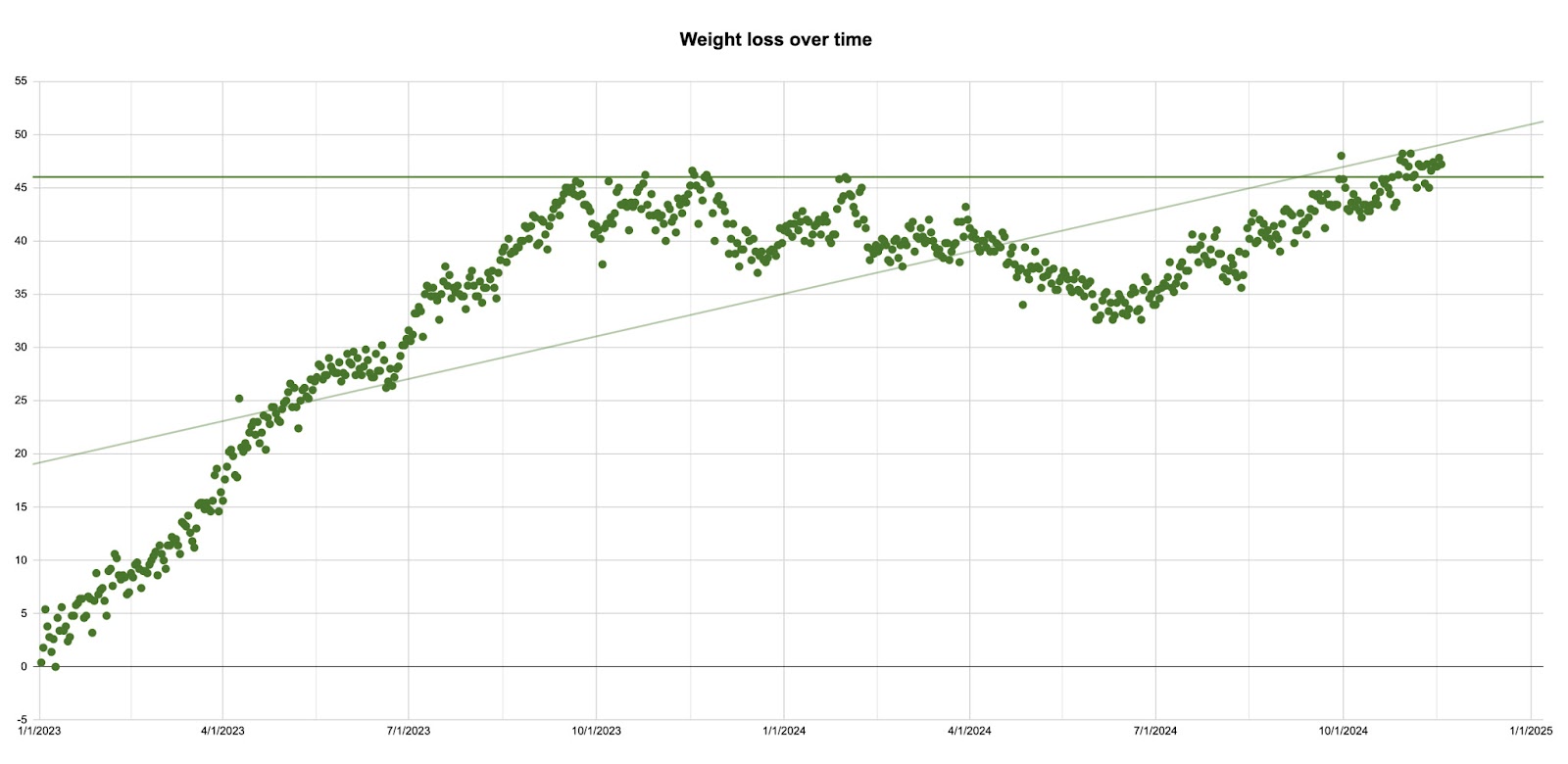
For the first 147 days of the experiment, I tried different high-potassium brines, and lost about 12 lbs.
All brines started with a base of two 591 ml blue Gatorades, mixed in a liter bottle with whatever dry electrolytes or other ingredients I was trying. Potassium was always added as KCl in the form of Nu-Salt.
I tried a wide variety of different brine mixtures, using different amounts of KCl as well as NaCl, sodium bicarbonate (baking soda), magnesium malate, iodine (as Lugol’s 2% solution), and glycine powder. But I don’t think these mixtures are worth reporting individually, because I wasn’t able to seriously distinguish between them. Regardless of the mix, I mostly kept losing weight at a very slow pace.
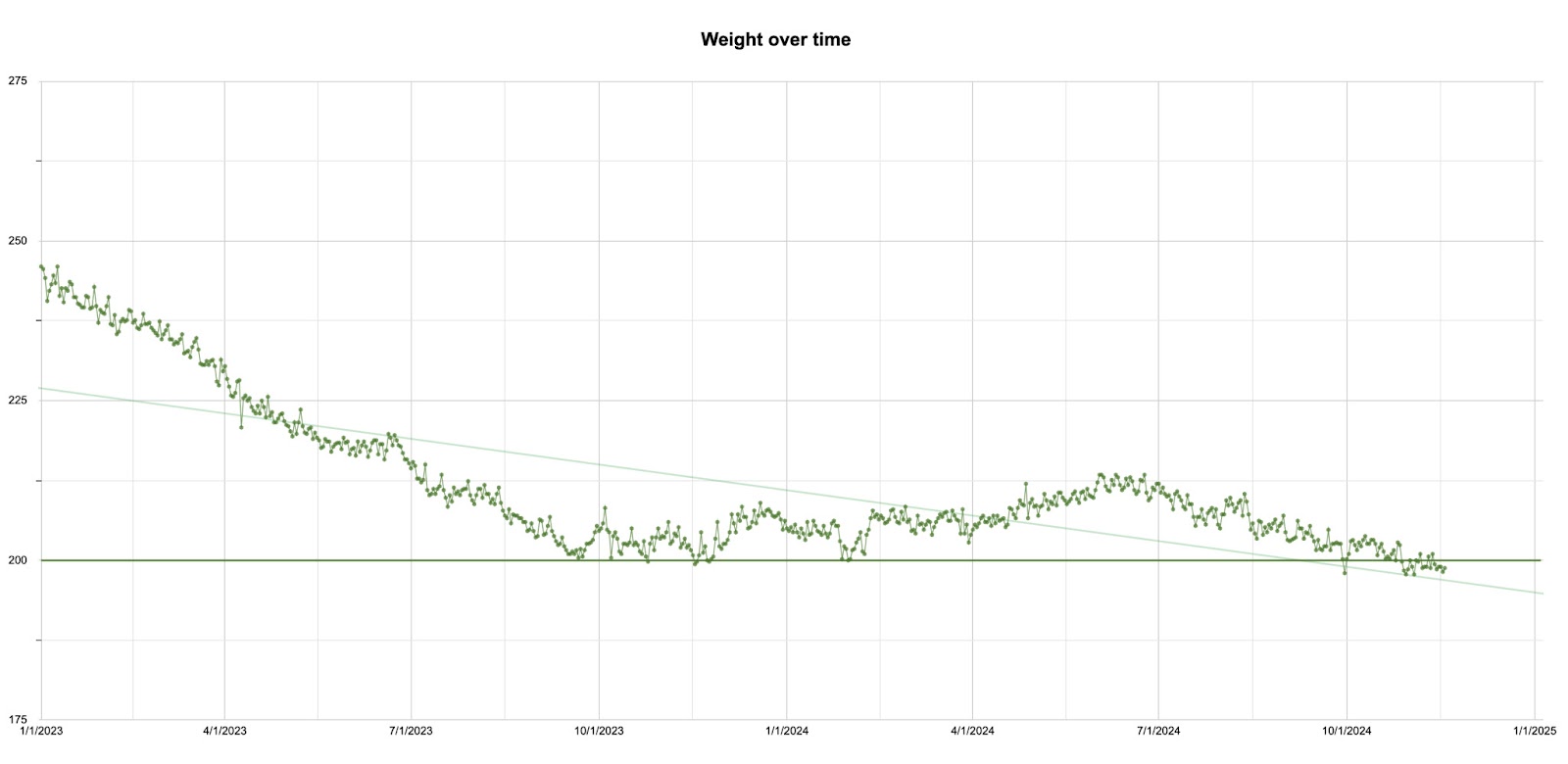
My impression is that magnesium is important, and that brines with added sodium work better than brines without, but I’m the first to admit that the data isn’t strong enough to back this intuition up. The most I can say is that I seemed to lose weight in kind of a sine-wave pattern, which you can see on the graph. These ups and downs roughly lined up with the 14-day cycles where I tried different brine recipes (i.e. I tried most recipes for 2 weeks), but I might have imagined a pattern where in reality there were just natural fluctuations.
While I originally hoped to get around 10,000 mg a day of potassium from my brine, like Krinn did, this wasn’t possible. I found doses above 6,600 mg/day K hard to drink, so I settled at that dosage, reasoning that Krinn lost weight even at lower doses.
In general, the brines made me feel weird. I sometimes became anxious, sometimes fatigued, sometimes got headaches, and sometimes it did weird things to my sense of smell. I did sometimes feel very energetic, and sometimes it seriously reduced my appetite. Some days I ate almost nothing and had almost no appetite. But even with a clear reduction in my appetite, even when I was eating very little, I didn’t lose much weight. (This itself was kind of striking.)
In terms of results, 12 lbs isn’t nothing. But over 147 days, it’s only about 0.08 lbs lost per day. That’s not very much.
I take this as evidence in favor of the hypothesis that high doses of potassium are part of why the potato diet causes weight loss. Even on only 6,600 mg/day K, I experienced many of the effects of the potato diet (reduced appetite, weird anxiety) and I did lose some weight, though not much.
But I also think my results suggest that potassium may not be enough, and that the “potato weight loss effect” really comes from something like high doses of potassium plus something else in potatoes / with potatoes—maybe high doses of magnesium, maybe sufficient sodium to balance the potassium, etc.
Potatoes & Dairy
The brine seemed to work, but my rate of weight loss was really slow. It seemed like it was time to try the potato diet. In addition to hopefully losing more weight, I saw two benefits.
First, I could compare the effect of the brine directly to the effect of the potato diet, to see if I was already losing weight as fast as I could, or if there was something missing from the formula.
Second, I could test out the success of Potatoes + Dairy. The original potato diet was very strict, but by this point you had already reported a few case studies where people had lost a lot of weight on versions of the potato diet where they also ate various kinds of dairy.
My version of Potatoes + Dairy was decadent. Every meal was potatoes, but I always added as much butter, cheese, and sour cream as I wanted, which was usually a lot. For a while I made a lot of scalloped potatoes, but eventually I got lazy and from that point on I mostly ate baked potatoes or turned old baked potatoes into homefries. I didn’t get tired of this because butter is great.
When I didn’t have time to prepare potatoes, I would have cheese, milk, or ice cream as a snack. Yes, I ate as much ice cream as I wanted, and still lost weight (which is in line with the literature).
In case anyone wants to replicate my approach, my mainstays were:
- Kerrygold salted butter, or occasionally Cabot salted butter
- Cabot sour cream
- Cabot cheeses, especially Cabot Seriously Sharp Cheddar Cheese
- Ben & Jerry’s Ice Cream, most often Peanut Butter Cup
Despite this decadence, I lost about 40 lbs more over 187 days.
Looking closer, the weight loss really happened over two spans, one before the 2024 December holidays, and one after. I first lost about 16 lbs over 75 days, gained about 8 of that back during late December and January, then lost about 28 lbs over the next 86 days. At the point of greatest descent (early March 2025), I lost 10 lbs in two weeks.
I wasn’t very strict and I did cheat pretty often. My notes mention times and places that I had pizza, candy, or sometimes burritos. Sometimes I had cheat meals where I would go out to lunch or get hot pot with friends. Sometimes I went on dates, where I ate normal food. This mostly didn’t make a difference as long as I also kept up with the potatoes.
You might think that potatoes are a neutral food, and they just help you survive while your body returns to normal, or something. But my sense is that potatoes actively cause the weight loss. On days where I didn’t prepare potatoes, and mostly just snacked on ice cream and cheese, I didn’t seem to gain much weight back, but I didn’t lose it, either.
This leads to another counterintuitive recommendation: the potato diet can really reduce your appetite, sometimes to the point where you don’t want to eat. But I think that you actually lose more weight on days where you eat potatoes than on days where you don’t eat at all. So if your goal is to lose weight, don’t assume that not eating is a good strategy—eat your taters.
I’m pretty confident that the potato diet was causing the weight loss, in part because I started losing weight right when I switched from brine to potatoes. Also, when I cheated for more than just a meal or two, it was obvious on the graph. Halloween, Thanksgiving week, and the December Holidays stand out in particular. Here’s version of the graph with those days singled out:
My holiday weight re-gain continued well into January because I was travelling and helping to organize some professional conferences, and I wasn’t able to keep up with the potatoes very well. As soon as I got back on potatoes around Jan 20, my weight started dropping again, this time faster than before.
I was pretty surprised when I blew past not only 220 lbs, but 210 lbs. I had thought that 220-210 might be the healthy range for me, and expected the diet to stall out there. But instead I blew past those milestones. Turns out that 220 lbs is at least 20 lbs overweight for me. I had no idea, because I felt pretty healthy at 220, but I guess I had forgotten what it was like to be a normal weight.
Run-Out
I first dropped below 200 lbs on March 20, 2025. Soon after that, my weight started to plateau, never falling much below 200 lbs but showing no signs of increasing.
I also noticed that I suddently started craving foods that weren’t potatoes, something that I hadn’t experienced on the previous 170 days. First I started craving fruit, and the next day, I started seriously craving Mexican food. Soon I was craving broccoli and chocolate.
This made me think that I might have reached a plateau, possibly my “natural” weight. According to BMI I am still “overweight” at < 200 lbs, and I am definitely not “lean”. But I do feel trim, and the girl I’ve been dating keeps putting her hands on my chest and talking about how good I look, so I’ll take this as some evidence that “just under 200 lbs” is a reasonable weight for me.
Because I already seemed to have hit a plateau, I decided to spend the last 31 days on a run-out period to see what would happen as I eased off the diet. During this time I still ate potatoes pretty often, but I started bringing in other foods, and I went whole days without eating any potatoes at all. Somewhat surprisingly, I didn’t gain back the weight as I relaxed the diet.
I do kind of wonder if my weight would have fallen even further if I had remained on Potatoes + Dairy, but the fact that I was developing cravings for other food suggests to me that I had encountered a real state change. It might have been possible to force my weight lower, but the magic of the potato diet is that the weight loss happens without any force. If you start forcing things, you’re back in the territory of restriction diets.
I officially ended the experiment on May 12, 2025, 365 days after I started, weighing 198.8 lbs. This was down from an original high of 247.6 lbs, and my all-time low was 194.4 lbs on April 22nd.
I’ll probably keep eating a diet high in potatoes, since even after several months, I still love them very much (and you wouldn’t believe how much I’ve saved in groceries). But I seem to have reached a plateau and a healthy weight, and also, while potatoes are powerful, they come at a terrible cost (mostly joking but read on).
A Few Things People Should Know
Hair Loss
When you lose a lot of weight very quickly, you often lose some hair. I’d never heard of this before but apparently it’s common knowledge among women. Who knew? It’s called “telogen effluvium” and it definitely happened to me. In early January, after my first period of intense Potato + Dairy weight loss, I noticed my hair was seriously thinning on top and in the back.
The good news is that hair lost in this way usually grows back on its own, though it can take a couple of months. That seems to be happening for me too. My hair is clearly thicker now than it was in January. And it’s pretty weird: looking at my scalp, I can see short hairs and even some very short hairs mixed in among the long ones. While my head hasn’t returned to normal yet, the hair is clearly growing back.
So in the end this doesn’t seem to be a serious concern. And it’s not specific to the potato diet, this just happens when you lose weight really fast. Even so, anyone who wants to copy my results should be aware that this might happen, but also that it’s usually temporary.
Emotional Effects
Some people get really intense negative feelings of fear or anxiety while on the potato diet. This also happened to me.
I’m glad I read Birb’s account of her experience with the potato diet before trying it for myself, because it really prepared me for my own experience. Here’s what she said:
To anyone who wants to do this diet, or is considering it after the benefits I described above: I encourage you to do it, but please be extra cautious that your mental state might be altered and that you are not necessarily in your right mind. The feelings you experience during this diet may not be how you actually feel.
Like I said above, potato diet is fucking weird. I mention this and the above because towards the end of the third week, I found myself crying every day. I was having actual meltdowns… five days in a row.
I am not talking “oh I am so sad, let a single tear roll down my cheek while I stare out of a window on a rainy day” levels of gloom and general depression. I am talking “at one point I couldn’t fold some of my laundry in a way that was acceptable to me, and this made me think I should kill myself, so I started crying”.
Is this a really dark to drop in the middle of a sort of lighthearted post about potato diet? Yes. I am sorry if you are uncomfortable reading it. Personally, I think I have a responsibility to talk about it, because the mentally weird aspect of this diet cannot be stressed enough.
My experience was somewhat different from Birb’s, manifesting more as a sense of overwhelming dread or doom than as a feeling of depression. And unlike Birb, I didn’t start to seriously feel this way until several months into the diet. But I definitely recognize her description.
As far as I could tell, these feelings were somewhat related to how quickly I was losing weight, though maybe not in the way you expect. The faster I was losing weight, the more of an overwhelming sense of doom I felt. Hooray. That said, it wasn’t a very strong relationship. I still felt the doom during times when I was cheating on the diet, and even when I was losing a lot of weight, I sometimes felt ok.
I suspect that these feelings may have something to do with how the body uses epinephrine and norepinephrine to release energy from adipose tissue, which would explain why you feel so crazy anxious and such intense dread when actively losing the most weight, but I’m not a doctor™.
The feelings might also be the result of a vitamin or mineral deficiency. We know that the potato diet is deficient in Vitamin A, and while I wasn’t rigorous about testing this, I found that eating some sweet potatoes (high in vitamin A) often made me feel better. I also found during the run-out period that eating mushrooms (selenium?), broccoli, and spinach (iron?) maybe helped as well. So if you’re having a bad emotional time on the potato diet, think about trying sweet potatoes or one of these other foods.
It’s interesting to me that these feelings of doom got stronger the further along I got in my weight loss. Maybe this is just because I was losing weight faster over time. But another (kind of crazy) possibility is that something is stored in our fat reserves and as I dug deeper into them, I released more of it. Or in general that something is flushed out from somewhere? I don’t know if I believe this but I wanted to mention it.
That’s just my speculation. It could also have been ordinary anxiety from other causes that happened to line up with the weight loss. I’ve got some personal things going on in my life right now, maybe the anxiety is coming from those. Plus, a few friends have recently had similar feelings of dread, and they’re not losing extreme amounts of weight on a highly unusual diet.
Conclusions
My results make me very confident that Potatoes + Dairy works. The potato diet makes you lose weight, and that still works even if you add dairy, including butter and ice cream, no matter if you’re eating as much of it as you want.
While my data can’t speak to how well Potatoes + Dairy will work for anyone else, I hope this ends the idea that the potato diet works because it’s unpalatable. I lost 50 lbs and every meal was delicious. I also hope this finishes the idea that the potato diet works because it’s a “mono diet”. You can’t reasonably call something a mono diet when it includes potatoes, sour cream, and ice cream with tiny peanut butter cups.
I also think this is some evidence for the potassium hypothesis. I lost weight when I was taking high doses of potassium, though not nearly as much as on the potato diet. Maybe this was because I was taking too small of a dose, and a higher dose would have caused a similar amount of weight loss as what I eventually saw on the potato diet.
But I suspect this is because the potato effect doesn’t come from potassium alone, but from an interaction between potassium and something else, possibly other electrolytes like sodium and magnesium.
If you could find the right mixture, maybe you could reproduce the potato effect in a brine. But if so, I wasn’t able to find it. For now, the state of the art is Potatoes + Dairy.




 SLIME MOLD TIME MOLD