Peer Review: Obesity II – Establishing Causal Links Between Chemical Exposures and Obesity

A new paper, called Obesity II: Establishing Causal Links Between Chemical Exposures and Obesity, was just published in the journal Biochemical Pharmacology (available online as of 5 April 2022). Authors include some obesity bigwigs like Robert H. Lustig, and it’s really long, so we figured it might be important. 

The title isn’t some weird Walden II reference — there’s a Part I and Part III as well. Part I reviews the obesity epidemic (in case you’re not already familiar?) and argues that obesity “likely has origins in utero.”

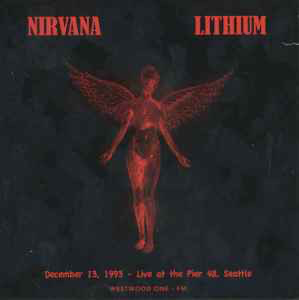
“The obesity epidemic is Kurt Cobain’s fault” is an unexpected but refreshing hypothesis

Part III basically argues that we should move away from doing obesity research with cells isolated in test tubes (probably a good idea TBH) and move towards “model organisms such as Drosophila, C. elegans, zebrafish, and medaka.” Sounds fishy to us but whatever, you’re the doctor.

This paper, Part II, makes the case that environmental contaminants “play a vital role in” the obesity epidemic, and presents the evidence in favor of a long list of candidate contaminants. We’re going to stick with Part II today because that’s what we’re really interested in.

For some reason the editors of this journal have hidden away the peer reviews instead of publishing them alongside the paper, like any reasonable person would. After all, who could possibly evaluate a piece of research without knowing what three anonymous faculty members said about it? The editors must have just forgotten to add them. But that’s ok — WE are these people’s peers as well, so we would be happy to fill the gap. Consider this our peer review:

This is an ok paper. They cite some good references. And they do cite a lot of references (740 to be exact), which definitely took some poor grad students a long time and should probably count for something. But the only way to express how we really feel is:
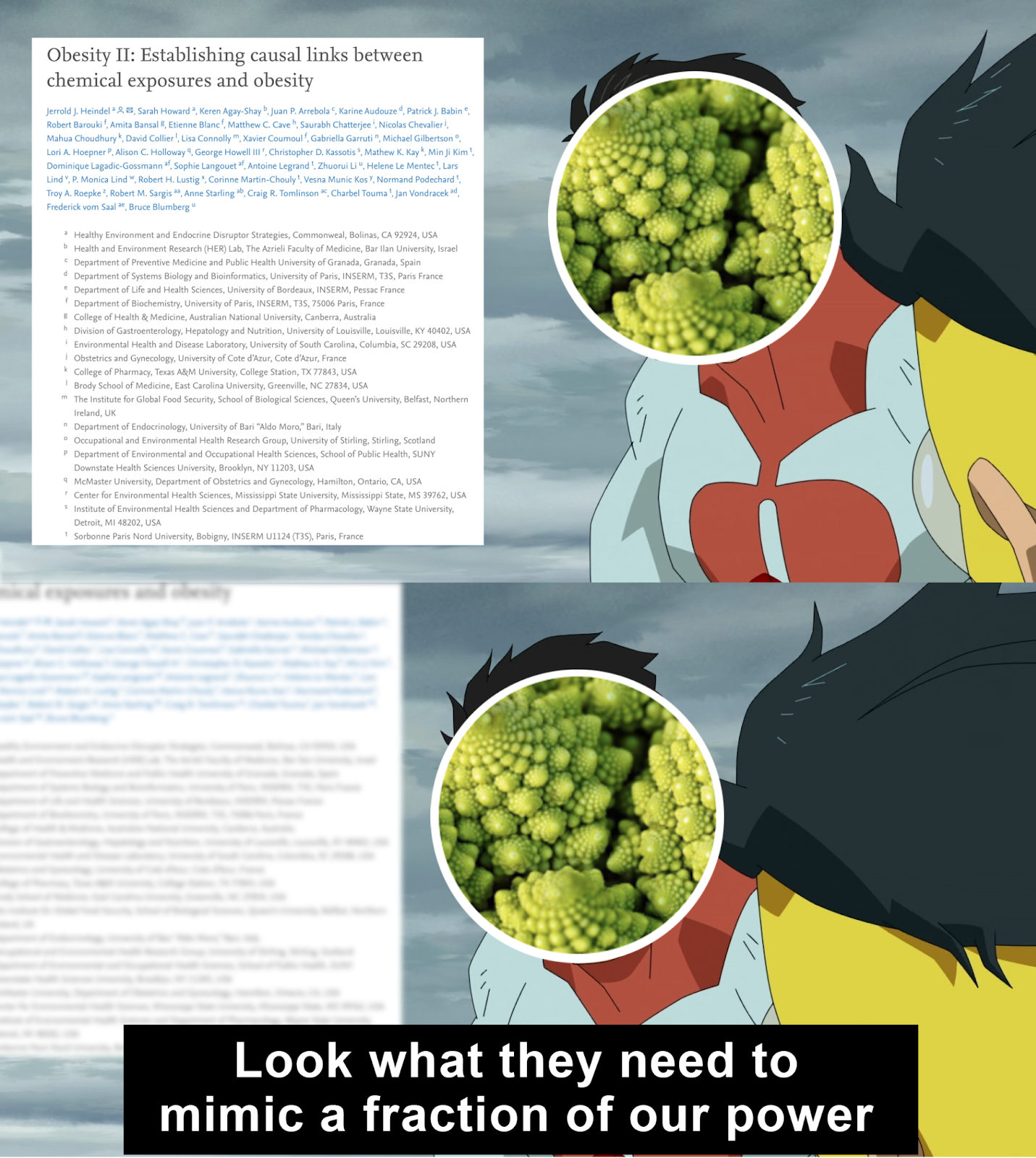
Seriously, 43 authors from 33 different institutions coming together to tell you that “ubiquitous environmental chemicals called obesogens play a vital role in the obesity pandemic”? We could have told you that a year ago, on a budget of $0. 

This wasted months, maybe years of their lives, and millions of taxpayer dollars making this paper that is just like, really boring and not very good. Meanwhile we wrote the first draft of A Chemical Hunger in a month (pretty much straight through in October 2020) and the only reason you didn’t see it sooner was because we were sending drafts around to specialists to make sure there wasn’t anything major that we overlooked (there wasn’t).

We don’t want to pick on the actual authors because, frankly, we’re sure this paper must have been a nightmare to work on. Most of the authors are passengers of this trainwreck — involved, but not responsible. We blame the system they work under.

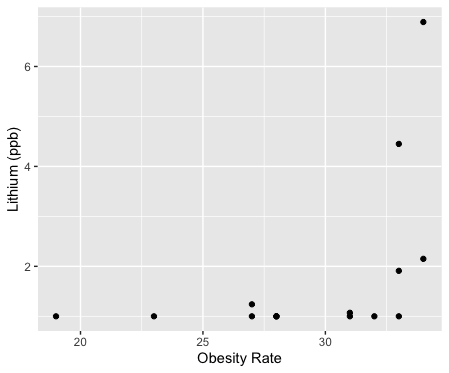
We hope this doesn’t seem like a priority dispute. We don’t claim priority for the contamination hypothesis — here are four papers from 2008, 2009, 2010, and 2014, way before our work on the subject, all arguing in favor of the idea that contaminants cause obesity. If the contamination hypothesis turns out to be right, give David B. Allison the credit, or maybe someone even earlier. We just think we did an exceptionally good job making the case for the hypothesis. Our only original contributions (so far) are arguing that the obesity epidemic is 100% (ok, >90%) caused by contaminants, and suggesting lithium as a likely candidate. 

So we’re not trying to say that these authors are a bunch of johnny-come-latelies (though they kind of are, you see the papers up there from e.g. 2008?). The authors are victims here of a vicious system that has put them in such a bad spot that, for all their gifts, they can now only produce rubbish papers, and we think they know this in their hearts. It’s no wonder grad students are so depressed! 

So to us, this paper looks like a serious condemnation of the current academic system, and of the medical research system in particular. And while we don’t want to criticize the researchers, we do want to criticize the paper for being an indecisive snoozefest.

Long Paper is Long

The best part of this paper is that comes out so strongly against “traditional wisdom” about the obesity epidemic:  

The prevailing view is that obesity results from an imbalance between energy intake and expenditure caused by overeating and insufficient exercise. We describe another environmental element that can alter the balance between energy intake and energy expenditure: obesogens. … Obesogens can determine how much food is needed to maintain homeostasis and thereby increase the susceptibility to obesity. 

In particular we like how they point out how, from the contaminant perspective, measures of how much people eat are just not that interesting. If chemicals in your carpet raise your set point, you may need to eat more just to maintain homeostasis, and you might get fat. This means that more consumption, of calories or anything else you want to measure, is consistent with contaminants causing obesity. We made the same point in Interlude A. Anyways, don’t come at us about CICO unless you’ve done your homework. 

We also think the paper’s heart is in the right place in terms of treatment: 

The focus in the obesity field has been to reduce obesity via medicines, surgery, or diets. These interventions have not been efficacious as most people fail to lose weight, and even those who successfully lose substantial amounts of weight regain it. A better approach would be to prevent obesity from occurring in the first place. … A significant advantage of the obesogen hypothesis is that obesity results from an endocrine disorder and is thus amenable to a focus on prevention. 

So for this we say: preach, brothers and sisters.

The rest of the paper is boring to read and inconclusive. If you think we’re being unfair about how boring it is, we encourage you to go try to read it yourself.

Specific Contaminants

The paper doesn’t even do a good job assessing the evidence for the contaminants it lists. For example, glyphosate. Here is their entire review:

Glyphosate is the most used herbicide globally, focusing on corn, soy and canola [649]. Glyphosate was negative in 3T3-L1 adipogenic assays [650], [651]. Interestingly, three different formulations of commercial glyphosate, in addition to glyphosate itself, inhibited adipocyte proliferation and differentiation from 3T3-L1 cells [651]. There are also no animal studies focusing on developmental exposure and weight gain in the offspring. An intriguing study exposed pregnant rats to 25mg/kg/day during days 8-14 of gestation [652]. The offspring were then bred within the lineage to generate F2 offspring and bread to generate the F3 progeny. About 40% of the males and females of the F2 and F3 had abdominal obesity and increased adipocyte size revealing transgenerational inheritance. Interestingly, the F1 offspring did not show these effects. These results need verification before glyphosate can be designated as an obesogen.

For comparison, here’s our review of glyphosate. We try to, you know, come to a conclusion. We spend more than a paragraph on it. We cite more than four sources.

We cite their [652] as well, but we like, ya know, evaluate it critically and in the context of other exposure to the same compound. We take a close look at our sources, and we tell the reader we don’t think glyphosate is a major contributor to the obesity epidemic because the evidence doesn’t look very strong to us. This is bare-bones due diligence stuff. Take a look: 

The best evidence for glyphosate causing weight gain that we could find was from a 2019 study in rats. In this study, they exposed female rats (the original generation, F0) to 25 mg/kg body weight glyphosate daily, during days 8 to 14 of gestation. There was essentially no effect of glyphosate exposure on these rats, or in their children (F1), but there was a significant increase in the rates of obesity in their grandchildren (F2) and great-grandchildren (F3). There are some multiple comparison issues, but the differences are relatively robust, and are present in both male and female descendants, so we’re inclined to think that there’s something here. 

There are a few problems with extending these results to humans, however, and we don’t just mean that the study subjects are all rats. The dose they give is pretty high, 25 mg/kg/day, in comparison to (again) farmers working directly with the stuff getting a dose closer to 0.004 mg/kg.

The timeline also doesn’t seem to line up. If we take this finding and apply it to humans at face value, glyphosate would only make you obese if your grandmother or great-grandmother was exposed during gestation. But glyphosate wasn’t brought to market until 1974 and didn’t see much use until the 1990s. There are some grandparents today who could have been exposed when they were pregnant, but obesity began rising in the 1980s. If glyphosate had been invented in the 1920s, this would be much more concerning, but it wasn’t.

Frankly, if they aren’t going to put in the work to engage with studies at this level, they shouldn’t have put them in this review. 

If this were a team of three people or something, that would be one thing. But this is 43 specialists working on this problem for what we assume was several months. We wrote our glyphosate post in maybe a week?

Some of the reviews are better than this — their review of BPA goes into more detail and cites a lot more studies. But the average review is pretty cruddy. For example, here’s the whole review for MSG:

Monosodium glutamate (MSG) is a flavor enhancer used worldwide. Multiple animal studies provided causal and mechanistic evidence that parenteral MSG intake caused increased abdominal fat, dyslipidemia, total body weight gain, hyperphagia and T2D by affecting the hypothalamic feeding center [622], [623], [624]. MSG increased glucagon-like peptide-1 (GLP-1) secretion from the pGIP/neo: STC-1 cell line indicating a possible action on the gastrointestinal (GI) tract in addition to its effects on the brain [625]. It is challenging to show similar results in humans because there is no control population due to the ubiquitous presence of MSG in foods. MSG is an obesogen.

Seems kind of extreme to unequivocally declare “MSG is an obesogen” on the basis of just four papers. On the basis of results that seem to be in mice, rats, mice, and cells in a test tube, as far as we can tell (two of the citations are review articles, which makes it hard for us to know what studies they specifically had in mind). Somehow this is enough to declare MSG a “Class I Obesogen” — Animal evidence: Strong. In vitro evidence: Strong. Regulatory action: to be banned. Really? 

Instead, we support the idea of — thinking about it for five minutes. For example, MSG occurs naturally in many foods. If MSG were a serious obesogen, tomatoes and dashi broth would both make you obese. Why are Italy and Japan not more obese? The Japanese first purified MSG and they love it so much, they have a factory tour for the stuff that is practically a theme park — “there is a 360-degree immersive movie experience, a diorama and museum of factory history, a peek inside the fermentation tanks (yum!), and finally, an opportunity to make and taste your own MSG seasoning.” Yet Japan is one of the leanest countries in the world.

As far as we can tell, Asia in general consumes way more MSG than any other part of the world. “Mainland China, Indonesia, Vietnam, Thailand, and Taiwan are the major producing countries in Asia.” Why are these countries not more obese? MSG first went on the market in 1909. Why didn’t the obesity epidemic start then? We just don’t think it adds up. 

(Also kind of weird to put this seasoning invented in Asia, and most popular in Asia, under your section on “Western diet.”)
Adapted from Fig. 3

Let’s also look at their section on DDT. This one, at least, is several paragraphs long, so we won’t quote it in full. But here’s the summary: 

A 2017 systematic review of in vitro, animal and epidemiological data on DDT exposures and obesity concluded the evidence indicated that DDT was “presumed” to be obesogenic for humans [461]. The in vitro and animal data strongly support DDT as an obesogen. Based on the number of positive prospective human studies, DDT is highly likely to be a human obesogen. Animal and human studies showed obesogenic transmission across generations. Thus, a POP banned almost 50 years ago is still playing a role in the current obesity pandemic, which indicates the need for caution with other chemical exposures that can cause multigenerational effects.

We’re open to being convinced otherwise, but again, this doesn’t really seem to add up. DDT was gradually banned across different countries and was eventually banned worldwide. Why do we not see reversals or lags in the growth of obesity in those countries those years? They mention that DDT is still used in India and Africa, sometimes in defiance of the ban. So why are obesity rates in India and Africa so low? We’d love to know what they think of this and see it contextualized more in terms of things like occupation and human exposure timeline.

Review Paper

With a long list of chemicals given only the briefest examination, it’s hard not to see this paper as overly inclusive to the point of being useless. It makes the paper feel like a cheap land grab to stake a claim to being correct in the future if any of the chemicals on the list pan out.

Maybe their goal is just to list and categorize every study that has ever been conducted that might be relevant. We can sort of understand this but — why no critical approach to the material? Which of these studies are ruined by obvious confounders? How many of them have been p-hacked to hell? Seems like the kind of thing you would want to know! 

You can’t just list papers and assume that it will get you closer to understanding. In medicine, the reference for this problem is Ioannidis’s Why Most Published Research Findings Are False. WMPRFAF was published in 2005, you don’t have an excuse for not thinking critically about your sources.

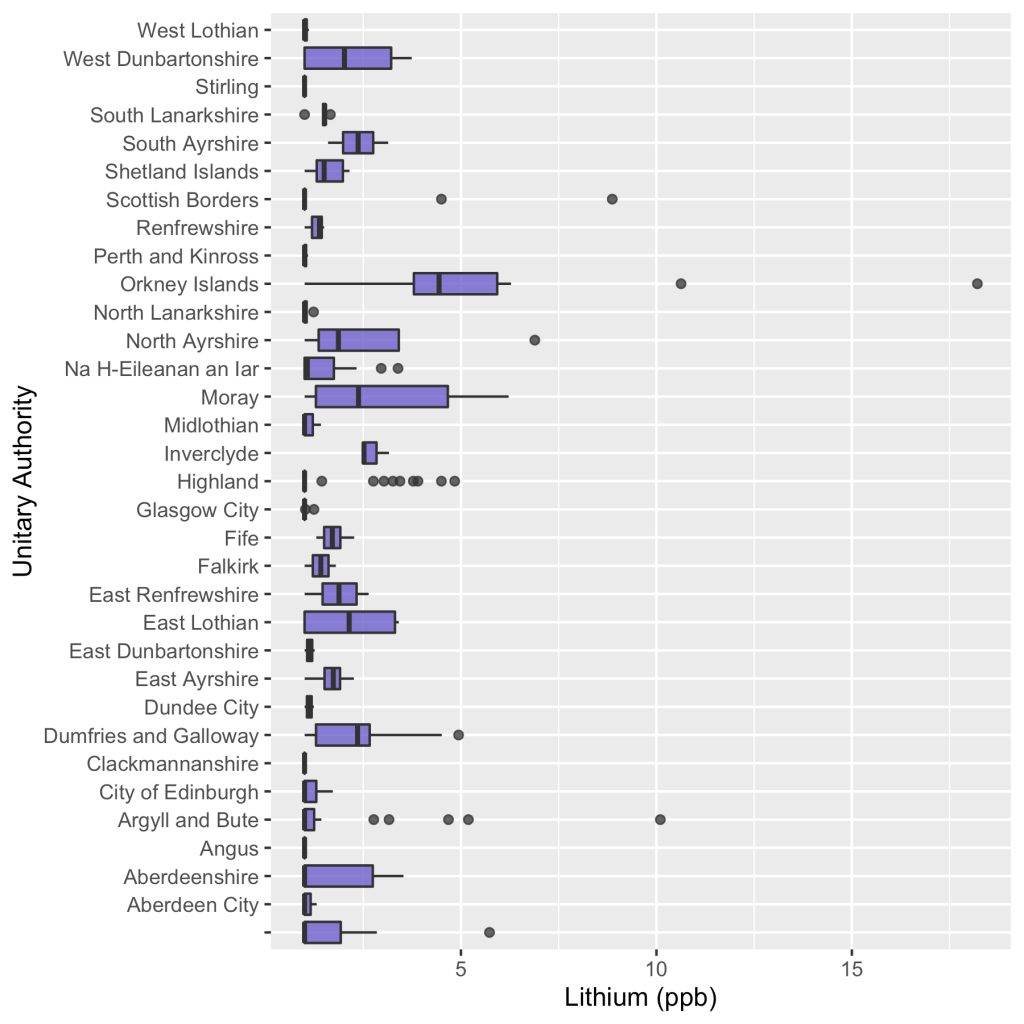
Despite this, they don’t even mention lithium, which seems like an oversight. 
Oh right, Kurt Cobain IS responsible for the obesity epidemic

We wish the paper tried to provide a useful conclusion. It would have been great to read them making their best case for pretty much anything. Contaminants are responsible for 50% of the epidemic. Contaminants are responsible for no more than 10% of the epidemic. Contaminants are responsible for more than 90% of the epidemic. We think phthalates are the biggest cause. We think DDT is the biggest cause. We think it’s air pollution and atrazine. Make a case for something. That would be cool.

What is not cool is showing up being like: Hey we have a big paper! The obesity epidemic is caused by chemicals, perhaps, in what might possibly be your food and water, or at work, though if it’s not, they aren’t. This is a huge deal if this is what caused the epidemic, possibly, unless it didn’t. The epidemic is caused by any of these several dozen compounds, unless it’s just one, or maybe none of them. What percentage of the epidemic is caused by these compounds? It’s impossible to say. But if we had to guess, somewhere between zero and one hundred percent. Unless it isn’t. 

Effect Size

The paper spends almost no time talking about effect size, which we think is 1) a weird choice and 2) the wrong approach for this question. 

We don’t just care about which contaminants make you gain weight. We care about which contaminants make you gain a concerning amount of weight. We want to know which contaminants have led to the ~40 lbs gain in average body weight since 1970, not which of them can cause 0.1 lbs of weight gain if you’re inhaling them every day at work. These differences are more than just important, they’re the question we’re actually interested in!

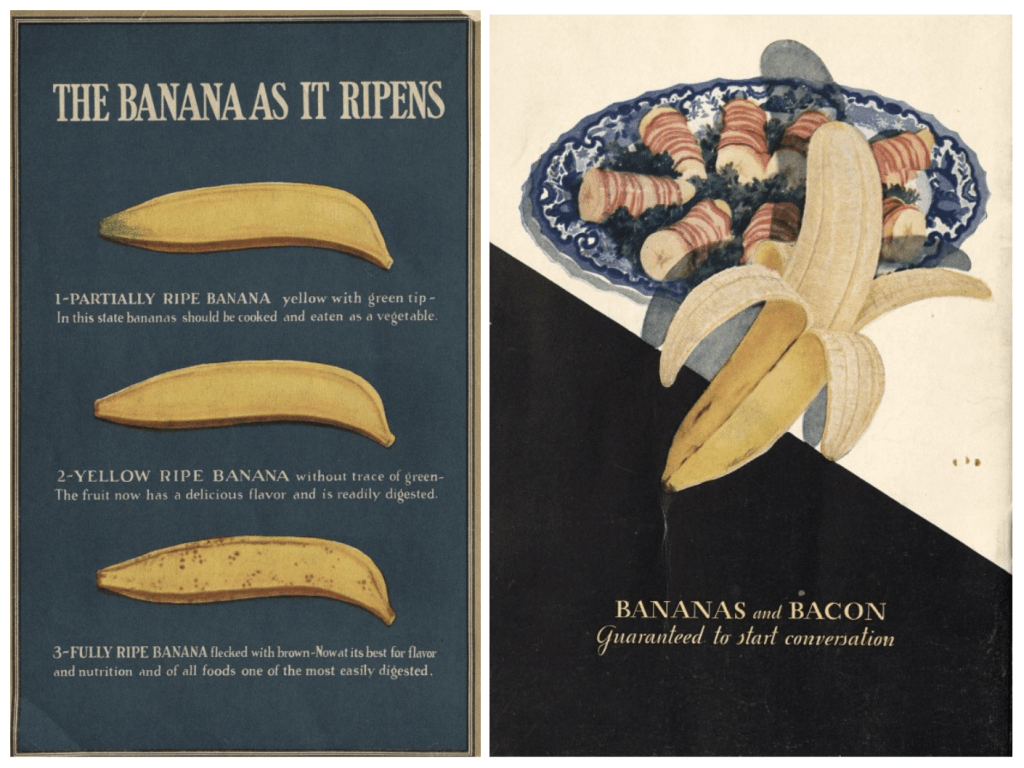
For comparison: coffee and airplane travel are both carcinogens, but they increase your risk of cancer by such a small degree that it’s not even worth thinking about, unless you’re a pilot with an espresso addiction. When the paper says “Chemical ABC is an obesogen”, it would be great to see some analysis of whether it’s an obesogen like how getting 10 minutes of sunshine is a carcinogen, or whether it’s an obesogen like how spending a day at the Chernobyl plant is a carcinogen. Otherwise we’re on to “bananas are radioactive” levels of science reporting — technically true, but useless and kind of misleading.

The huge number of contaminants they list does seem like a mark in favor of a “the obesity epidemic is massively multi-causal” hypothesis (which we discussed a bit in this interview), but again it’s hard to tell without seeing a better attempt to estimate effect sizes. The closest thing to an estimate that we saw was this line: “Population attributable risk of obesity from maternal smoking was estimated at 5.5% in the US and up to 10% in areas with higher smoking rates”.

Stress Testing

Their conclusion is especially lacking. It’s one thing to point out that what we’re studying is hard, but it’s another thing to deny the possibility of victory. Let’s look at a few quotes:

“A persistent key question is what percent of obesity is due to genetics, stress, overnutrition, lack of exercise, viruses, drugs or obesogens? It is virtually impossible to answer that question for any contributing factors… it is difficult to determine the exact effects of obesogens on obesity because each chemical is different, people are different, and exposures vary regionally and globally.”

Imagine going to an oncology conference and the keynote speaker gets up and says, “it is difficult to determine the exact effects of radiation on cancer because each radiation source is different, people are different, and exposures vary regionally and globally”. While much of this is true, oncologists don’t say this sort of thing (we hope?) because they understand that while the problem is indeed hard, it’s important, and hold out hope that solving that problem is not “virtually impossible”. Indeed, we’re pretty sure it’s not. 

They’re pretty pessimistic about future research options:

“We cannot run actual ‘clinical trials’ where exposure to obesogens and their effects are monitored over time. Thus, we focus on assessing the strength of the data for each obesogen.”

Assessing the strength of the data is a good idea, but this is leaving a lot on the table. Natural experiments are happening all the time, and you don’t need clinical trials to infer causality. We’d like to chastise this paper with the following words:

[Before] we set about instructing our colleagues in other fields, it will be proper to consider a problem fundamental to our own. How in the first place do we detect these relationships between sickness, injury and conditions of work? How do we determine what are physical, chemical and psychological hazards of occupation, and in particular those that are rare and not easily recognized?

There are, of course, instances in which we can reasonably answer these questions from the general body of medical knowledge. A particular, and perhaps extreme, physical environment cannot fail to be harmful; a particular chemical is known to be toxic to man and therefore suspect on the factory floor. Sometimes, alternatively, we may be able to consider what might a particular environment do to man, and then see whether such consequences are indeed to be found. But more often than not we have no such guidance, no such means of proceeding; more often than not we are dependent upon our observation and enumeration of defined events for which we then seek antecedents.

… However, before deducing ‘causation’ and taking action we shall not invariably have to sit around awaiting the results of the research. The whole chain may have to be unraveled or a few links may suffice. It will depend upon circumstances.

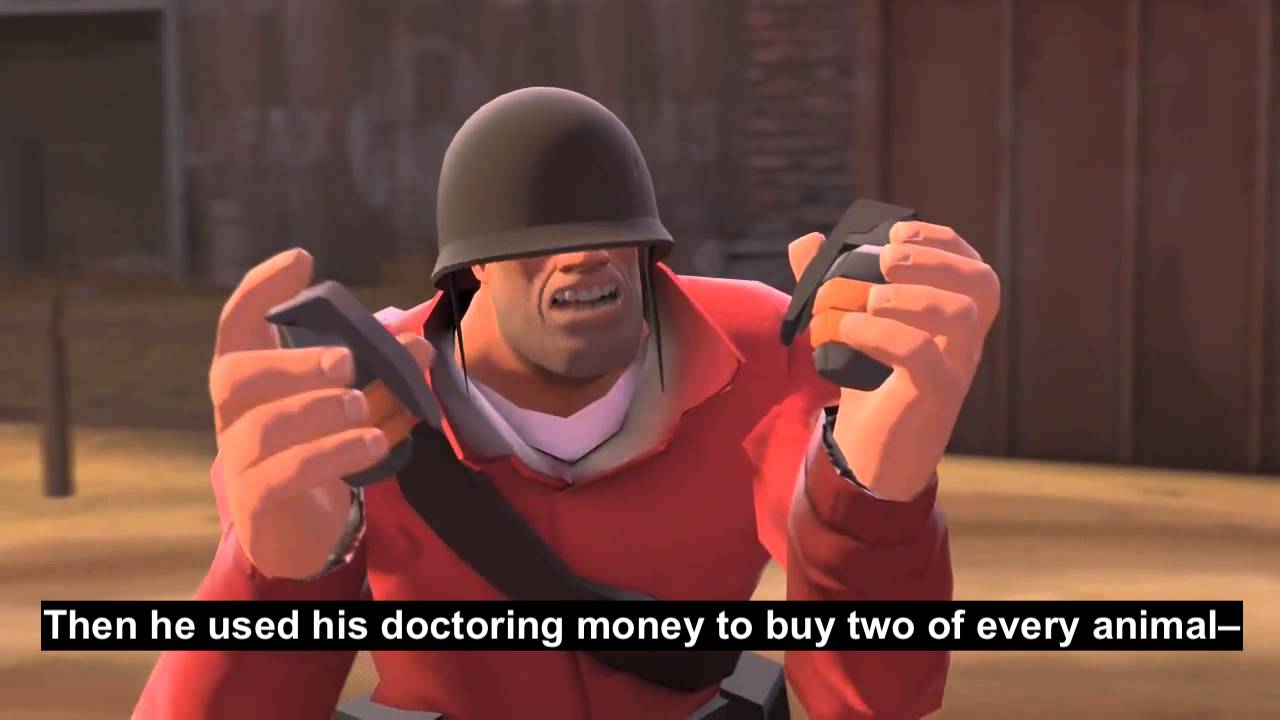
Sir Austin Bradford Hill said that, and we’d say he knows a little more about clinical trials than you do, pal, because HE INVENTED THEM. And then he perfected them so that no living physician could best him in the Ring of Honor– 
So we think the “no clinical trials” thing is a non-issue. Sir Austin Bradford Hill and colleagues were able to discover the connection between cigarette smoking and lung cancer without forcing people to smoke more than they were already smoking. You really can do medical research without clinical trials.

They did not do this

But even so, the paper is just wrong. We can run clinical trials. People do occasionally lose weight, sometimes huge amounts of weight. So we can try removing potential obesogens from the environment and seeing if that leads to weight loss. If we do it in a controlled manner, we can get some pretty strong evidence about whether or not specific contaminants are causing obesity.

Defeatism

Our final and biggest problem with this paper is that it is so tragically defeatist. It leaves you totally unsure as to what would be informative additional research. It doesn’t show a clear path forward. It’s pessimistic. And it’s tedious as hell. All of this is bad for morale. 

The paper’s suggestions seem like a list of good ways to spend forever on this problem and win as many grants as possible. This seems “good” for the scientists in the narrow sense that it will help them keep their tedious desk jobs, jobs which we think they all secretly hate. It’s “good” in that it lets you keep playing what Erik Hoel describes as “the Science Game” for as long as possible:

When you have a lab, you need grant money. Not just for yourself, but for the postdoctoral researchers and PhDs who depend on you for their livelihoods. … much of what goes on in academia is really the Science Game™. … varying some variable with infinite degrees of freedom and then throwing statistics at it until you get that reportable p-value and write up a narrative short story around it.

Think of it like grasping a dial, and each time you turn it slightly you produce a unique scientific publication. Such repeatable mechanisms for scientific papers are the dials everyone wants. Playing the Science Game™ means asking a question with a slightly different methodology each time, maybe throwing in a slightly different statistical analysis. When you’re done with all those variations, just go back and vary the original question a little bit. Publications galore.

If this is your MO, then “more research is needed” is the happiest sound in the world. Actually solving a problem, on the other hand, is kind of terrifying. You would need to find a new thing to investigate! It’s much safer to do inconclusive work on the same problem for decades.

This is part of why we find the suggestion to move towards research with “model organisms such as Drosophila, C. elegans, zebrafish, and medaka” so suspicious. Will this solve the obesity epidemic? Probably not, and certainly not any time this decade. Will it allow you to generate a lot of different papers on exposing Drosophila, C. elegans, zebrafish, and medaka to slightly different amounts of every chemical imaginable? Absolutely.

(As Paul Graham describes, “research must be substantial– and awkward systems yield meatier papers, because you can write about the obstacles you have to overcome in order to get things done. Nothing yields meaty problems like starting with the wrong assumptions.’”)

With all due respect to this approach, we do NOT want to work on obesity for the rest of our lives. We want to solve obesity in the next few years and move on to something else. We think that this is what you want to happen too! Wouldn’t it be nice to at least consider that we might make immediate progress on serious problems? What ever happened to that? 

Political Scientist Adolph Reed Jr. once wrote that modern liberalism has no particular place it wants to go. “Its métier,” he said, “is bearing witness, demonstrating solidarity, and the event or the gesture. Its reflex is to ‘send messages’ to those in power, to make statements, and to stand with or for the oppressed. This dilettantish politics is partly the heritage of a generation of defeat and marginalization, of decades without any possibility of challenging power or influencing policy.“

In this paper, we encounter a scientific tradition that no longer has any place it wants to go (“curing obesity? what’s that?”), that makes stands but has a hard time imagining taking action, that is the heir to a generation of defeat and marginalization. All that remains is a reflex of bearing witness to suffering. 

We think research can be better than this. That it can be active and optimistic. That it can dare to dream. That it can make an effort to be interesting. 

Why do we keep complaining about this paper being boring? Why does it matter? It matters because when the paper is boring, it suggests that the idea that obesity is caused by contaminants isn’t important enough to bother spending time on the writing. It suggests people won’t be interested to read the paper, that no one cares, that no care should be taken in the discussion. That nothing can be gained by thinking clearly about these ideas. It suggests that the prospect of curing obesity isn’t exciting. But we think that the prospect of curing obesity is very exciting, and we hope you do too!
DISCO ELYSIUM BREAKS THE LOOMS OF RPGs

[This essay contains several major spoilers for the game Disco Elysium. Also, if you haven’t played Disco Elysium, this essay will make almost no sense, so probably just skip it. Special thanks to Erik Hoel for reading a draft of this post.]

BREAKING THE LOOMS OF RPGs

Computer Role Playing Games have a strange inheritance.

CRPGs are descended from pen & paper RPGs. The promise of a pen & paper RPG is simple: absolute freedom. Be anyone you want to be! Do anything you want to do!

The rules guide you, but you are constrained only by your imagination. You can always fail; but anything may be attempted.

“That’s why people like role-playing games. You can be whoever you want to be. You can try again. Still, there’s something inherently violent even about dice-rolls.”

This kind of freedom isn’t possible in a CRPG. We just don’t have the technology to offer the kinds of infinite choices made possible by a pen & paper format. In a CRPG, every dialogue tree must be planned, scripted out entirely in advance. No amount of preparation can make a CRPG unlimited. Ten dialogue choices is always several fewer than infinite choices.

“‘Fortress Accident SCA produces revolutionary interactive call-in radio games’ — that’s what the catalogue says.”

This is the paradox that kills most CRPGs. If you promise infinite choice, and don’t deliver, the game feels comically restrained. Why can’t I bribe this guard? Why can’t I climb through this huge, open window? Why can’t I just attack these thieves instead of playing along with their stupid riddle game? These questions quickly pile up, and lots of games drown in them.

While Disco Elysium does offer more dialogue choices than the average CRPG, it is still bounded. Most dialogue trees have only 4 or 5 options.

UNPRECEDENTED FREEDOM OF CHOICE

In the promotional materials, Disco Elysium promises unprecedented freedom of choice. Somehow, they deliver. How did they manage to do this?

IT’S A ROLE PLAYING GAME

A thing that people often seem to forget about RPGs is that they are ROLE PLAYING GAMES; they are games where you get to play a role. Where you get to have the experience of being someone else.

Different types of games have different strengths. Pen & paper RPGs do allow infinite choice, and good designs will take advantage of that strength. But you shouldn’t play to strengths that you don’t have.

CRPGs can’t offer you infinite choices. But CRPGs have strengths all their own.

After you wake up in the Whirling-in-Rags, you immediately start making choices about what sort of person you want to be. What’s important to you. How you want to interact with others. How you behave towards yourself. Are you the kind of cop who talks to his necktie?

You encounter different political philosophies. You consider them. You hear stories about what sort of a cop you are, what sort of person you are. You defend, reject, or apologize for your behavior. You balk, or you double down. Maybe you should get a drink. Some speed? Think about it.

And yet… there is something strange, lurking behind all these choices.

“YOUR BODY BETRAYS YOUR DEGENERACY.”

You can be a sorry mess. You can be a naïve optimist. A fascist or a communist. You can be a drug-addled superstar. You can reject your own name. You can be kind or you can be cruel to those around you.

But you can never not be the kind of guy who wakes up from a three-day bender, naked, lying on the floor of a trashed hostel room.

You are that kind of guy from the first moments of the game. It is inevitable.

Here it is. Hard facts from the man you are. You once jerked off in the locker room and were caught. You held a young woman by the arm and kept her in your apartment for 20 minutes against her will. That’s right, these are not flights of fancy. These are *real deeds*, Harry, emerging from the darkness of your past. You tried shooting a fleeing suspect in the foot but hit him in the pelvis, crippling him for life. And above all, you let life defeat you.

Be as violent and unhinged as you want, but you can never take your gun and start threatening civilians for money. The game doesn’t give you that option. Harry has it in him to be a beggar, sure, and to be a woman-hating fascist, but threatening civilians for money is something he will never, ever do. It’s just not in him.

Not trying to defend Harry here; he’s pretty lousy. Maybe you think it would be reasonable to help clean up the hostel room that you trashed? Turns out this is another thing that you can’t do. It’s not clear if this is something that Harry would refuse, or if it’s just the sort of thing that would never occur to him on his own. But either way, the game never offers the option. These simple acts of decency are also beyond you, one way or another.

(Although somehow Harry does have it in him to shoot a child — if only barely.)

Abstain from alcohol and drugs; be pure and above it all; try to live the life of the mind. You can only change so much. Whatever you do, you will still be the kind of cop who notices a bit of congealed rum in a cafeteria bar and considers licking it off the counter.

There are things that Harry will never consider, and there are voices that will always be speaking in the back of his head. There is no truce with the Furies.

There is no way to open the supply depot door. Accept it. You cannot open all the doors. You have to integrate this into your character. Some doors will forever remain closed. Even if every single other door will open at one time or another, maybe to a key, or maybe to some sort of tool meant for opening doors… But this one will never accede to such commands. A realization crucial to personal growth. Crucial.

This is how Disco Elysium makes choice work. You can’t choose to be just anyone. You are stuck with yourself. Not only the circumstances of your birth; you are stuck with the consequences of every bad decision you have ever made. All you can do is choose what to do with the situation you’re in.

This is much more meaningful. Making these limited choices is all the power any of us have. The game gives you the chance to become someone else, experience his confusion, carry his weight. You can’t choose just anything, but you can feel what it is like for Harry to make these choices.

The promise was unprecedented choice, not unlimited choice.

“I think this racist is better than the last — but the next racist will be the really good one.”

Race is, strangely enough, a mainstay of traditional RPGs. Making a new character involves a couple big choices, and along with class, race is usually one of them. Do you want to be an elf? A dwarf? A bird-person?

Race is also a mainstay in Disco Elysium, but here, it is very different. You have no control over the race of your character — you will always be a ham sandwich, just like you’ll probably always be in thrall to *AL GUL*. You are given no choice in the matter.

This may be why racism is such a central theme, and it may be why Kim Kitsuragi, your constant companion, is Seolite.

Disco Elysium turns the normal logic of RPGs on its head. You can choose how to deal with racists as you encounter them around Martinaise. You can choose how to respond to how they treat Kim. But you will never actually be in Kim’s position. You will never actually know what it is like for him.

You make choices, and the choices you make are important. How you act will affect how Kim feels, and how he feels about you. But in the big ways, your hands are bound.


“She said she’s heard of you from Jamrock. That you’re a human can-opener. That you play suspects against each other. Open them up, like cans.”

There is something pathological about you, detective—as if you weren’t aware.

“He can talk human beings into telling him anything. And he doesn’t stop. In all the time I’ve spent with him, he has not once stopped working on the case. He is tireless. Madly driven.”

The final lesson of choice is about something that Harrier Du Bois cannot control. You are an addict, and not just in the obvious ways. You can never stop solving crimes. You have no choice in the matter.

“*He* is the infernal engine. He never stops. He only gets worse.”

The logic of the game enforces this. As far as I can tell, if you keep going around trying dialogue options, and you don’t die, sooner or later you will solve the case. It is inevitable.

I’m not even sure you can be fired. No matter what I tried, the 41st ended up taking Harry back in the end. Drugs, racism, fascism, nothing would dissuade them. HDB will keep detecting until he dies.

“I don’t know why I do the things I do, lieutenant Kitsuragi.”

GASPINGLY YOU PARTAKE OF A SHIFTING IDENTITY NEVER YOUR OWN

Decades ago on the D&D forums, a common topic of discussion among DMs was: How do you play a character who is smarter than you are?

A smart DM might have a real-world intelligence of 14 or so, maybe 16 if they’re very gifted. But characters in D&D can easily have an intelligence of 18, and some monsters have intelligence scores that are even higher. It’s easy to act within your own abilities, pretending to be less intelligent than you really are. But how can you pretend to be someone smarter?

Infinite choice is one of the great strengths of pen & paper RPGs. This problem is one of their great weaknesses. You’re given the promise of being anything you can imagine. But how can you choose to experience being something that is beyond your abilities?

Disco Elysium makes full use of the CRPG medium to offer an UNPRECIDENTED ANSWER to this question.

The key is passive skill checks. Rolling passive checks in a pen & paper RPG quickly becomes tedious. Often, you forget to make the check at all. And how could the DM manage have an appropriate insight ready at every possible juncture?

Letting the computer keep track of all the checks, and having all the insights be pre-scripted, solves these problems neatly. The result is that you get the experience of having skills that you may not have in real life.

Want to play a character who’s smarter than you are? Max out those intellect skills. Watch as Logic and Encyclopedia breezily analyze the world, while Rhetoric and Drama feed you lines to run circles around your inferiors.

Rhetoric urges you to debate, make intellectual discourse, nitpick – and win. It enables you to break down arguments and hear what people are really saying. You’ll spot fallacies as soon as they’re used – what exactly did the waiter leave out of their testimony? What was the dancer trying to divert you from? Was that double entendre intended, or did you just get an accidental lead?

Smart enough, but social skills never that strong? Pour your heart into Empathy, Esprit de Corps, and Drama. Pick up on the thoughts and feelings of friends and strangers in a way you never imagined. Experience the thrill, the pain, the regret of your actions. Learn what you can carelessly do to people. It’s like seeing a new color.

Empathy breaks into the soul of others and forces you to feel what’s inside. It enables you to notice social cues other may miss: perhaps a hidden sadness you could coax out a little more, a strange joy from someone who should be bereaved, or a hidden resentment that could return to harm you later.

This cuts both ways. Never had much trouble with self-control? Don’t know what it’s like to live in fear of what you might do? Dump Volition and Composure, to constantly lose your cool. Overinvest in Authority, Hand-Eye Coordination, and Reaction Speed. Be appalled at the things they make you say and do.

At high levels, Hand/Eye Coordination makes you deadly – supposing you’ve a weapon in your hand. But once you do, Hand/Eye Coordination will compel you to take the shot – even if it’s not the best approach.

A few times in my first playthrough, I figured out part of the mystery before Detective Du Bois did. That was ok. I realized that I was smarter than he was in that playthrough, and it didn’t break the story. I wasn’t mad that the developers had kept me from acting on my flash of understanding, because I understood that Harry wasn’t there yet. He had to work it out on his own, and eventually, he did.

I have decent enough social skills, but in my first playthrough, Empathy would still occasionally surprise me with cutting insights about characters, obvious in hindsight, but which I had entirely missed. Even though they were only small mistakes, it was humbling. Now I see that there are levels of empathy I can still aspire to.

Empathy. This is the power of a good RPG, to experience a life totally unlike your own. It’s a rare thing, and never before has simple technology been so skillfully leveraged to make it happen.

A GOD DAMNED TRAGEDY

Time for some Coppo Del’Arte. What genre is Disco Elysium?

Most RPGs are adventures. Go on a quest. Slay the monster. Get the treasure. Confront an ancient evil.

Clearly this game is different; the best treasure often ends up being a piece of clothing you found in a barrel. Quests are things like, “find your other shoe.”

Sure, Disco Elysium is billed as “A Detective RPG”. And sure, there are some detectives involved. But the story isn’t exactly about the crime, or even about solving the crime. Crypotzoology takes up almost as much of the plot. In fact, if the game’s attitude towards Dick Mullen is anything to judge by, this game hates detective fiction.

Dick Mullen is stupid — and not even real. You’re real. Your brain is real. Your real real brain is inside the hat.

There’s only one thing it can possibly be:

Disco Elysium is a Greek Tragedy. The game is practically dripping with it—the original title was No Truce With the Furies, and Disco Elysium isn’t all that subtle either. The Furies are essential to Greek tragedy; it is their address.

Today we tend to be more familiar with Shakespearian tragedies. In Shakespearian tragedies, the main characters die. Macbeth dies in Macbeth. Romeo and Juliet both die in Romeo and Juliet. Julius Caesar barely makes it to Act 3 of his own play. In Hamlet, there are almost no surviors period. Being the title character in a Shakespearian tragedy is pretty much a death sentence.

Greek tragedies aren’t like that. Other characters die, but Oedipus survives to the end of Oedipus Rex. Orestes survives the Oresteia, pursued by the Furies. Antigone dies in Antigone, but Creon is the one who has made all the mistakes in that play, and he’s the one who survives to deal with the consequences.

Curses to the man whoever it was, that man who had saved me from the wild hooks on my feet, who had saved me from the wilderness, from those grazing lands, from death, only to give me this detestable end. Had I died then, I would be no burden of melancholy, now, neither to me nor to my friends.

Some of these plays are even more hardcore. In Medea, Medea not only lives, she kills most of the other characters in the play, including both of her sons. Then she goes to start a new life in Athens.

It’s not that the hero or the main character never dies in these plays; sometimes they do. It’s that death isn’t the worst thing that can happen to a person. In Greek tragedies, you have to keep on living. That’s usually the worst part. At the end of Oedipus Rex, the chorus says, “Call no man happy until he is dead.”

This is Disco Elysium. Other people die. Terrible things happen. Harry Du Bois has to go on living.

“He can’t go. Not before the case is solved.”

The game is even structured like a Greek tragedy. A Greek tragedy happens in just one place; Disco Elysium is confined to the narrow streets of Martinaise, hardly big enough to fit on a single postcard.

A Greek tragedy always involves a chorus, critical for interpreting and commenting on the plot for the benefit of the audience. Fifteen was a usual number. There are twenty-four voices in your head in Disco Elysium, but not all of them are active at the same time, and sometimes the chorus in a tragedy could number up to fifty men…

Most of the action in a Greek tragedy happens offstage, the actors commenting upon it later, as they learn of it. Often the worst of the tragedy happens before the play begins, and is recounted on stage by the actors or the chorus. Oedipus Rex opens years after Oedipus has killed his father and married his mother. That isn’t the plot. The action of the play is all about what happens as Oedipus and everyone else learn of these horrible crimes, and how they react to it.

“God, I don’t know…” He thinks. “Six years ago? She was way before my time.”

Disco Elysium opens six years after Harry’s ex-something left him, and the action of the game concerns what happens as he learns of the things he has done, and how he chooses to handle it.

SIX years?”

A reasonable assumption would be that Harry’s total amnesia is there to help out with exposition. The player doesn’t know anything about the world of Revachol either, so making Harry a total amnesiac lets the player get exposition in a way that doesn’t confuse the narrative. Harry can ask the stupid questions that the player is thinking, and given his circumstances, it makes sense for him to do so.

But another perspective is that he is an amnesiac to allow for anagnorisis.

What if you didn’t lose your memory? What if something in Martinaise came and stored it all away. For you to slowly open one box at a time. So you can choose which parts to keep. Keep almost none of it. Only the flowers on the windowsill. Only the distant sound of a radio. Lose all the actors, the dark shadows, leave only the still lifes, the blissful distant wash of waves. If everybody knew — you never did. She’ll be coming soon. That is all.

Anagnorisis is the moment of recognition in a play, when a character sees their own true nature, or another character’s true nature, for the first time. In Oedipus Rex, it occurs when Oedipus learns for the first time of his true parentage. Most of us don’t have these kinds of secrets lurking in our past. But if you forget who you are…

Harrier Du Bois is the ideal tragic hero. He knows nothing of himself. Everything he learns, everything he does, all the voices in his head, yield terrible recognition of his past. And yet he just keeps going. He has to.

“I could’ve eaten it for all I know. I don’t remember anything. This world, this city. Nothing.”

WHAT KIND OF LITERATURE IS A VIDEO GAMES?

Why model a video game on Greek tragedy?

“Does it have anything to do with disco?”

No.

“‘Officer’ is my stage name, right? I can see myself as a middling disco artist called ‘The Officer.'”

Did you know that the original term for “actor” in English was “player”?

All the world’s a stage,

And all the men and women merely players;

Book Review: A Square Meal – Part II: Politics

The book is still A Square Meal: A Culinary History of the Great Depression, recommended to us by reader Phil Wagner, and Part I of the review is here.

Condescension, Means Testing, and Infinite Busybodies

The other big thing we learned from A Square Meal, besides the fact that food in the 1920s was bonkers, is that the Great Depression brought out the absolute worst in the American political machine: the tendency for condescension to the unfortunate, constant means testing to make sure the needy are really as needy as they say, and infinite busybodies of every stripe.

Some of this was just standard government condescension. In WWI, the United States Food Administration tried to convince Americans that dried peas were a fine substitute for beefcake, and that “Wheatless, Eggless, Butterless, Milkless, Sugarless Cake” was a food substance at all. Sure.

When the Great Depression hit, things got steadily worse. Homemakers were encouraged to turn anything and everything into casseroles, which had the benefit of making their contents indistinguishable under a layer of white sauce and bread crumbs. The housewife could serve unappetizing food or leftovers over and over again without her family catching on, or at least that was the idea. Among other things this gives us this unusual early example of the overuse of the term “epic”:

Whatever the answer, [the casserole] is bound to be an epic if mother is up to the minute on the art of turning homely foods into culinary triumphs

Some people in government seemed to be confused — they seemed to think that the food issues facing the nation were a matter of presentation, that food just didn’t look appetizing enough. It’s hard to interpret some of these suggestions in any other light, like the idea that good advice for Americans in the Depression could be, “to impart a touch of elegance to a bowl of split pea soup, why not float a thin slice of lemon on top and sprinkle it with some bright red paprika and finely chopped parsley.” Or the suggestion that beans could be fried in croquettes to make them more appealing. Authorities trotted out “reassuring” announcements like: 

The fact that a really good cook can serve better meals on a small budget than a poor cook can serve on the fat of the land suggests that the fault may be not in the food material itself but in the manner in which the food is prepared and served, and therein lays a tale!
But what really grinds our gears isn’t the condescension, it’s the means testing. The second half of the book is mostly depressing stories about the government refusing to provide basic aid to starving families, or screwing up one relief program after another with means testing, or other things along these lines.

American society at the time was firmly anti-charity. People thought that everyone on the breadline could be divided into the “deserving poor” and the “undeserving poor”, and it was their job to search out which was which. They seemed to believe that even one whiff of assistance would immediately turn any hardworking, self-respecting American into a total layabout. 

People in the 1930s are always saying things like, “if a man keeps beating a path to the welfare office to get a grocery order he will gradually learn the way and it will be pretty hard to get him off that path.” They really seemed to believe in the corrupting power of government support, to the point where they were often afraid to even use the word “charity”.

Before the Great Depression, there was very little history of big-picture welfare. The support that society did provide was administered locally, and not very well administered at all:

The poor laws combined guarded concern for needy Americans with suspicions that they were complicit in their own misfortune. Under the poor laws, the chronically jobless were removed from society and dispatched to county poorhouses, catchall institutions that were also home to the old, infirm, and mentally ill. Those who could ordinarily shift for themselves but were temporarily jobless applied to public officials, men with no special welfare training, for what was known as outdoor or home relief, assistance generally given in the form of food and coal. To discourage idlers, the welfare experience was made as unpleasant as possible. Before applying for help, the poor were made to wait until utterly penniless, and then declare it publicly. When granting relief, officers followed the old rule of thumb that families living “on the town” must never reach the comfort level of the poorest independent family. The weekly food allowance was a meager four dollars a week—and less in some areas—regardless of how many people it was supposed to feed. Finally, it was customary to give food and coal on alternate weeks, providing minimal nourishment and warmth, but never both at the same time.

Journalists called people who received government assistance “tax eaters”. When support from the town was forthcoming, it looked like this: 

…the board made all relief applicants fill out a detailed form with questions like: Do you own a radio? Do you own a car? Do you spend any money for movies and entertainment? Did you plant a garden? How many bushels of potatoes do you have? The board gave aid in the form of scrip, which now could only be used to purchase the “necessities of life” at local stores: “flour, potatoes, navy beans, corn meal, oatmeal, coffee, tea, sugar, rice, yeast cakes, baking soda, pepper, matches, butter, lard, canned milk, laundry soap, prunes, syrup, tomatoes, canned peas, salmon, salt, vinegar, eggs, kerosene.”

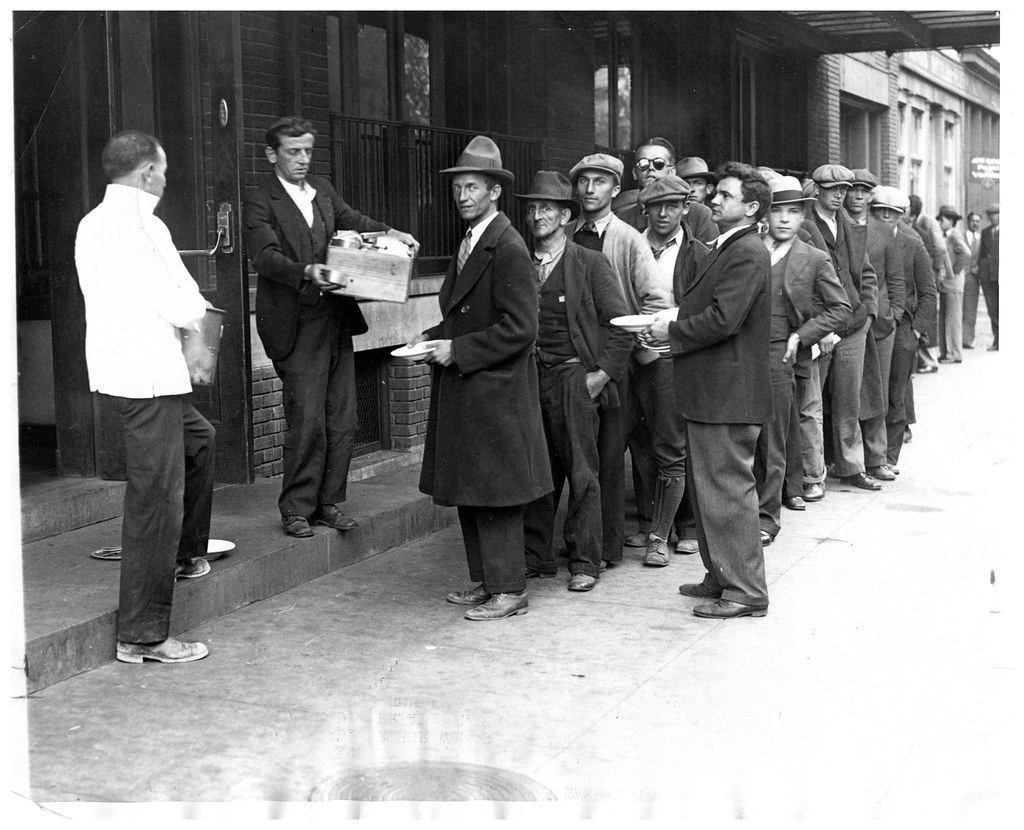
The Manhattan breadline is emblematic of the Great Depression, so we were sort of surprised at just how much people at the time hated them, even very mainstream sources. You’d think that giving out bread to the starving would be one of the more defensible forms of charity, but people loathed it. And none more than the city’s social workers, described as the breadlines’ “harshest critics”:

Welfare professionals with a long-standing aversion to food charity, social workers condemned the breadlines as relief of the most haphazard and temporary variety, not much different from standing on a street corner and handing out nickels. The people who ran the breadlines, moreover, made no attempt to learn the first thing about the men they were trying to help, or to offer any form of “service” or counseling. The cause of more harm than good, the breadlines were humiliating and demoralizing and encouraged dependence, depriving able-bodied men of the impulse to fend for themselves. Social workers were adamant. Breadlines were the work of fumbling amateurs and “should be abolished entirely; if necessary by legal enactment.”

As the Depression dragged on and things became worse, more relief did come. But when it came, the relief was invasive. Housewives were told not only what to cook, but where to shop. Some women had to venture far outside their own neighborhoods to use food tickets. Social workers dropped in on schools to criticize the work of teachers, in particular the tendency of teachers to be overly “sentimental” or “solicitous”. They feared that schoolteachers lacked the “well-honed detective skills” required to distinguish between whining and genuine tales of woe. 

To ascertain that applicants were truly destitute, officials subjected them to a round of interviews. Candor was not assumed. Rather, all claims were verified through interviews with relatives and former employers, which was not only embarrassing but could hurt a man’s chances for employment in the future. More demeaning, however, were the home visits by TERA investigators to make sure the family’s situation was sufficiently desperate. Investigators came once a month, unannounced, anxious to catch welfare abusers. Any sign that the family’s finances had improved—a suspiciously new-looking dress or fresh set of window curtains—was grounds for cross-examination. If the man of the house was not at home—a suggestion that he might be out earning money—investigators asked for his whereabouts, collecting names and addresses for later verification. Finally, though instructed otherwise, investigators were known to reprimand women for becoming pregnant while on relief, the ultimate intrusion.

Families lived in dread of these monthly visits, terrified they would be cut off if it was discovered that one of the kids had a paper route or some similar infraction.

In some areas, including New York City, “pantry snoopers” accompanied women to the market to confirm that all parties (both shopper and shopkeeper) were complying with TERA’s marketing guidelines. More prying took place in the kitchen itself, where investigators lifted pot covers and peered into iceboxes on the lookout for dietary violations.

Relief was often inadequate. Public officials were sometimes able to set relief levels at whatever amount they saw fit, regardless of state or federal guidance. Some of them assumed that poor families would be able to provide their own farm goods, but often this was not the case. In some places officials reasoned that poor workers would be easier to push around, and kept food allowances low to keep them in line. There was also just straight-up racism: 

Six Eyetalians will live like kings for two weeks if you send in twenty pounds of spaghetti, six cans of tomato paste and a dozen loaves of three-foot-long bread. But give them a food order like this [$13.50, state minimum for six persons for half a month], and they will still live like kings and put five bucks in the bank. Now you ought to give a colored boy more. He likes his pork chops and half a fried chicken. Needs them, too, to keep up his strength. Let him have a chicken now and then and maybe he’ll go out and find himself a job. But a good meal of meat would kill an Eyetalian on account of he ain’t used to it.

Families on relief who asked for seasonings on their food, like vinegar or mustard, were refused on the grounds that they might “begin to feel too much like other families”. Officials who were afraid that cash handouts to the poor might encourage dependence instead used that money to hire a resident home economist to help the poor make better use of what little they had.

As with modern means testing, this seems heart-breakingly callous. All these “supervisory” jobs intended to keep poor people from getting too much relief look suspiciously like a method for taking money that’s meant to help starving families and using it to pay the middle class to snoop on their less fortunate neighbors. Everyone loves giving middle-class busybodies jobs in “charity” work, no one seems to worry all that much about getting food to malnourished children. 

To be fair, no one expected that the relief would have to go on for years. Everyone thought that the panic was temporary, that it would all be over in a couple of months. This doesn’t make it much better, but it does explain some of the reluctance.

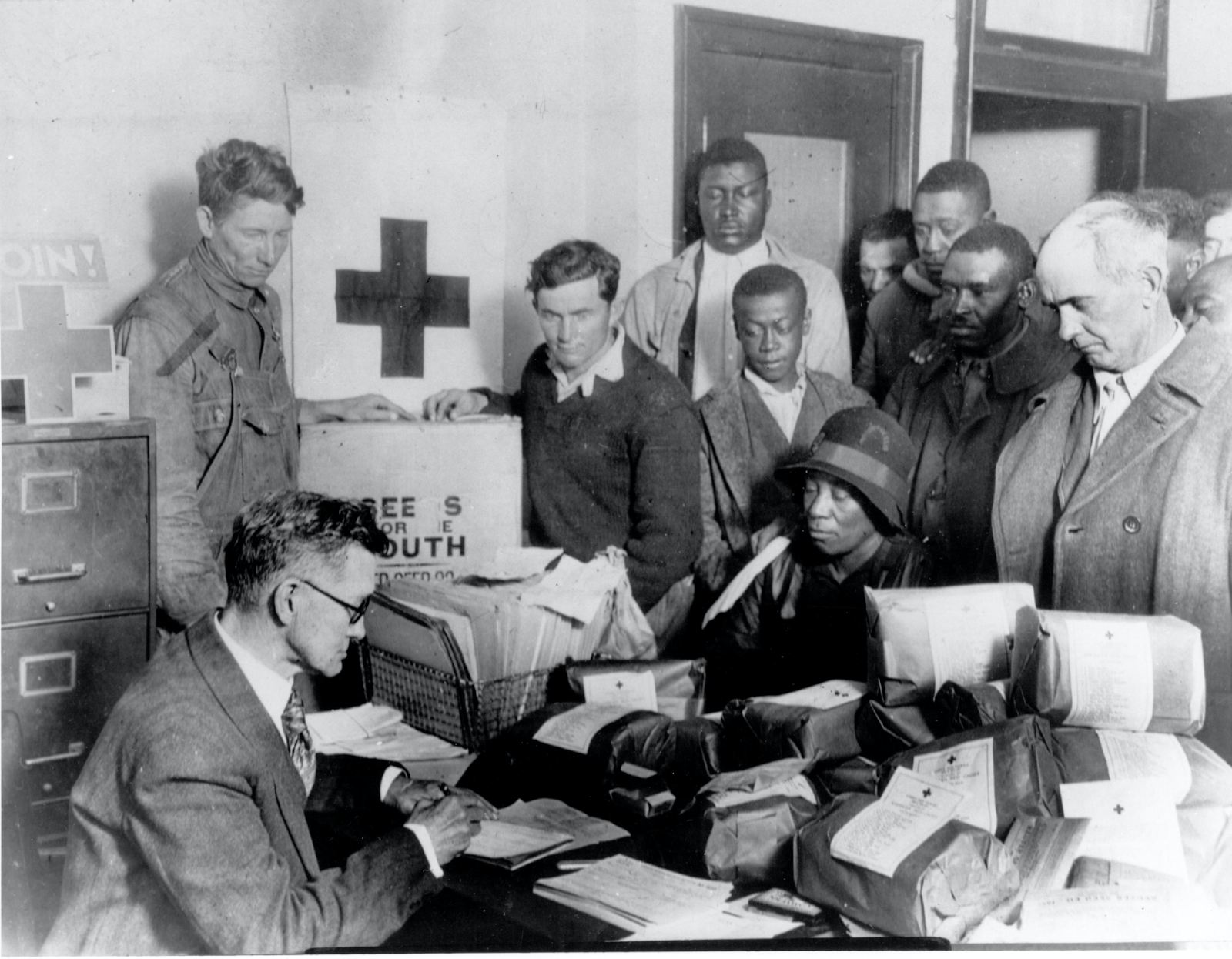
Another surprising villain in all this is, of all things, the American Red Cross. Over and over again, the Red Cross either refused to provide aid or gave only the smallest amounts, even when people were literally starving to death. They sent officials to areas stricken by drought and flood, who reported back that there was not “evidence of malnutrition more than exists in normal times” or brought back stories about an old man complaining that the Red Cross was feeding him too well. Meanwhile, actual Red Cross workers were reporting circumstances like this, from Kentucky: 

We have filled up the poor farm. We have carted our children to orphanages for the sake of feeding them. There is no more room. Our people in the country are starving and freezing.

The Red Cross’s reasoning was the same as everyone else in government: “If people get it into their heads that when they have made a little cotton crop and tried to make a corn crop and failed and then expected charity to feed them for five months, then the Red Cross had defeated the very thing that it should have promoted, self-reliance and initiative.” Actually this statement is on the friendlier side of things; another Red Cross official, after touring Kentucky, wrote: “There is a feeling among the better farmers in Boyd County that the drought is providential; that God intended the dumb ones should be wiped out; and that it is a mistake to feed them.”

Was Hoover the Villain? 

This brings us to a major question — namely, was Herbert Hoover the real villain of the Great Depression? 

At first glance it certainly looks that way. Hoover consistently blocked relief bills in Congress. He had a clear no-relief policy, and he stuck to it throughout his time as president. And he did send the US Army to drive a bunch of poor veterans out of DC

(He also lived in incredible opulence during his time in the White House. Always black tie dinners, always a table awash in gold, always fancy gourmet foreign food, always a row of butlers all exactly the same height. As they say, “not a good look”.)

But when you start looking at things in more detail, it becomes more complicated. It may seem naïve, but Hoover really thought that Americans would come together and take care of each other without the need for government assistance. He seemed to oppose relief because he thought that the federal government stepping in would make things worse. In one speech, he promised that “no man, woman or child shall go hungry or unsheltered through the coming winter” and emphasized that voluntary relief organizations would make sure that everyone was taken care of. He might have been wrong, but this doesn’t look villainous. (He also said, “This is, I trust, the last winter of this great calamity.” It was 1932.)

In a pretty bizarre state of affairs, he also seems to have been thwarted by the Red Cross at every turn, especially its chairman John Barton Payne. It makes sense that Hoover approved of the Red Cross, since it was one of the voluntary generous organizations he liked so much. What’s strange is how frequently the Red Cross just didn’t do jack, even when asked.

For example: In 1930, Hoover pressured the Red Cross to help out with drought relief in the Mississippi delta. The Red Cross agreed to give out $5 million in aid, but by the end of the year they had spent less than $500,000, mostly on handing out seed to farmers. 

Another time, Hoover went to the Red Cross to help provide relief to striking miners. This time the Red Cross refused, though again they offered seed to the miners (it’s unclear if there was even arable land near the mine). So Hoover went to a Quaker relief organization instead, and the Quakers agreed to help feed hungry children in the mining areas. Hoover struck a deal where the Red Cross would provide $200,000 to help the Quakers out. The Quakers waited two months before the Red Cross refused again. So the Quakers went ahead without them.

Somehow Hoover never turned his back on the Red Cross. Maybe he just liked the idea of aid organizations too much to realize that this one kept undermining him in times of crisis. 

But the other thing to understand about Hoover is that, despite his gruff no-handouts exterior, inside he was a bit of a softie. He stuck to his guns on the subject of cash relief, but he usually found a way to help without breaking his own rules. When the Red Cross refused to help the Quakers, Hoover rooted around and found $225,000 in an idle account belonging to a World War I relief organization, and sent that instead. In the flood of 1927 (when he was secretary of commerce), he refused to allocate federal funds directly, but he did have the U.S. Army distribute rations, tents, and blankets, organized local governments to rebuild roads and bridges, and got the Red Cross to distribute seeds and farm implements (the only thing they seem comfortable with). This was a huge success, and a big part of what won him the 1928 presidential election!  

The reason Hoover believed in the no-relief approach was simple — he had used it many times before, and it had always worked. He had a long track record of dealing with this kind of crisis. Before he was president, his nickname was “The Great Humanitarian” for the relief work he had done in Europe during World War I. People saw him as an omnicompetent engineering genius, and the reputation is at least partially deserved. It’s hard to overstate just how popular he was before the Depression: He won the election of 1928 with 444 electoral votes to 87, a total landslide.

Hoover thinks that attitude is the key to fighting financial panics, because this is exactly what he saw in 1921. There was a big stock market panic, which Hoover recognized was at least partially psychological. So he put out a bunch of reassuring press releases, told everyone that the panic was over, and sure enough, the market recovered.

So when the same thing happens in 1929, he figures the same approach will work. He does everything he can to project confidence and a sense of business as usual, and tries not to do anything that will start a bigger panic. This includes no federal relief — because if the federal government starts handing out money, that must mean things are REALLY bad. It makes a certain amount of sense, it did work for him in the past, but for some reason, it doesn’t work this time around. Maybe blame the Red Cross. 

FDR definitely jumped in to take advantage of the confusion. As then-governor of New York, he started implementing the kind of relief plans that Hoover refused to consider. He gave direct food relief. He used the word “charity”. And when he ran for president, he made it very clear that he thought the federal government should cover what the states could not, and make sure that no one would starve.

This did win him the election. But afterwards, he started looking a lot more like Hoover and some of his cronies. In his 1935 state of the union address, he said, “continued dependence upon relief induces a spiritual and moral disintegration fundamentally destructive to the national fiber. To dole out relief in this way is to administer a narcotic, a subtle destroyer of the human spirit. It is inimical to the dictates of sound policy. It is in violation of the traditions of America.” We’re right back to where we started. 

FDR rolls out the Works Progress Administration, another program that ties relief to a person’s work. But this isn’t administered much better than the Red Cross. Many workers couldn’t live on the low wages they offered. Even when they could, the jobs lasted only as long as the projects did, so workers often went months without jobs between different programs. 

The Civilian Conservation Corps was for a long time the most popular of these programs, but in 1936, Roosevelt decided to focus on balancing the budget instead. He slashed the program from 300,000 people to about 1,400. Over time, most of the relief burden fell back on state and city governments, many of which descended back into cronyism.

Some of the programs, for migrants and “transients”, were worse, nearly Orwellian:

Before the New Deal, transients were the last group to receive relief under the old poor laws. Now the FTP funded a separate system of transient centers guided by federal regulations meant to guard against local governments’ ingrained cultural biases against drifters and migrant job seekers. In rural areas, transients would be gathered into federal “concentration camps” (a term that had not yet gained its ominous connotations) designed for long-term stays.

As waves of agricultural migrants spread across the United States, by 1940 the FSA had opened 56 camps around the country, 18 of them in California, each accommodating up to 350 families. Administrators nevertheless continued to keep costs as low as possible, following the “rehabilitation rather than relief” rule handed down by President Roosevelt. Rather than give migrants food, the camps taught home economics–style classes on nutrition and food budgeting.

By 1937 everything seems to have fallen apart again, and the authors suggest that the second half of the 1930s was as bad or worse than the first half. In 1938, Roosevelt refused to give any further direct food relief from the WPA coffers. The stories from 1939 are kind of harrowing. 

By 1939, the problems of unemployment and what to do with millions of jobless Americans seemed intractable. The economy continued to sputter along; real prosperity remained an elusive goal; and Americans were losing compassion for the destitute and hungry.  

A Houston, Texas, reporter lived for a week on the city’s $1.20 weekly food handout, eating mostly oatmeal, potatoes, stewed tomatoes, and cabbage, and lost nearly ten pounds. In Chicago, a family of four received $36.50 a month, meant to cover food, clothing, fuel, rent, and everything else. But fuel in the cold Chicago winters was expensive; families had no choice but to cut back on food. In Ohio, the governor again refused to give aid to Cleveland, which ran out of money for nearly a month—called the “Hunger Weeks”—at the end of 1939. The city was reduced to feeding its poor with flour and apples as desperate families combed garbage bins for anything edible. Adults lost as much as fifteen pounds, while children had to stay home, too weak from hunger to attend school. Doctors saw a jump in cases of pneumonia, influenza, pleurisy, tuberculosis, heart disease, suicide attempts, and mental breakdowns.

So whatever Hoover did wrong, he doesn’t deserve all the blame, and the WPA certainly did not end the Great Depression.

Book Review: A Square Meal – Part I: Foods of the ‘20s and ‘30s

[Content warning: Food, culture shock, milk]

They say that the past is a foreign country, and nowhere is this more true than with food. 

The book is A Square Meal: A Culinary History of the Great Depression by Jane Ziegelman and Andrew Coe, recommended to us by reader Phil Wagner. This book is, no pun intended, just what it says on the tin, a history of food during the 1920s and 1930s. Both decades are covered because you need to understand what food was like in the 1920s to understand what changed when the Great Depression battered the world in the ‘30s. 

Home is where the lard-based diet is

We read this book and were like, “what are you eating? I would never eat this.” 

The book picks up at end of World War I, and the weird food anecdotes begin immediately:  

Their greeting back in American waters—even before they landed—was rapturous. Local governments, newspapers, and anybody else who could chartered boats to race out to meet the arriving ships. When the Mauretania, carrying 3,999 troops, steamed into New York Harbor late in 1918, a police boat carrying the mayor’s welcoming committee pulled alongside. After city dignitaries shouted greetings to them through megaphones, the troops who crowded the deck and hung from every porthole bellowed en masse: “When do we eat?!” It became a custom for greeting parties to hire professional baseball pitchers to hurl California oranges at the troops—some soldiers sustained concussions from the barrage—to give them their first taste of fresh American produce in more than a year.

Not that the soldiers weren’t also well-fed at the front lines: 

Despite the privations they had undergone, the Americans held one great advantage over both the German enemy and the soldiers of their French and British allies. They were by far the best-fed troops of World War I.

The U.S. Army field ration in France varied according to circumstances, but the core of the soldiers’ daily diet was twenty ounces of fresh beef (or sixteen ounces of canned meat or twelve ounces of bacon), twenty ounces of potatoes, and eighteen ounces of bread, hard or soft. American troops were always proud that they enjoyed white bread, while all the other armies had to subsist on dark breads of various sorts. This ration was supplemented with coffee, sugar, salt, pepper, dried fruit, and jam. If supply lines were running, a soldier could eat almost four pounds of food, or 5,000 calories, a day. American generals believed that this was the best diet for building bone, muscle, tissue, and endurance. British and French troops consumed closer to 4,000 calories, while in the last months of the war the Germans were barely receiving enough rations to sustain themselves.

The overall food landscape of the 1920s is almost unrecognizable. The term “salad” at the time referred to “assemblages made from canned fruit, cream cheese, gelatin, and mayonnaise,” which the authors note FDR especially hated [1]. Any dish that contained tomatoes was called “Spanish” (a tradition that today survives only in the dish Spanish rice). And whatever the circumstances, there was ALWAYS dessert — even in the quasi-military CCC camps, even in the government-issued guides to balanced meals, even in school lunch programs that were barely scraping by. 

This book also has some interesting reminders that constipation used to be the disease of civilization. In fact, they mention constipation being called “civilization’s curse”. This is why we have the stereotype of old people being obsessed with fiber and regularity, even though that stereotype is about a generation old now, and refers to a generation that has largely passed.

In the countryside, farm diets were enormous and overwhelmingly delicious: 

In midwestern kitchens, the lard-based diet achieved its apotheosis in a dish called salt pork with milk gravy, here served with a typical side of boiled potatoes:

On a great platter lay two dozen or more pieces of fried salt pork, crisp in their shells of browned flour, and fit for a king. On one side of the platter was a heaping dish of steaming potatoes. A knife had been drawn once around each, just to give it a chance to expand and show mealy white between the gaping circles that covered its bulk. At the other side was a boat of milk gravy, which had followed the pork into the frying-pan and had come forth fit company for the boiled potatoes.

The first volume of their oral history, Feeding Our Families, describes the Indiana farmhouse diet from season to season and meal to meal. In the early decades of the century, the Hoosier breakfast was a proper sit-down feast featuring fried eggs and fried “meat,” which throughout much of rural American meant bacon, ham, or some other form of pork. In the nineteenth century, large tracts of Indiana had been settled by Germans, who left their mark on the local food culture. A common breakfast item among their descendants was pon haus, a relative of scrapple, made from pork scraps and cornmeal cooked into mush, molded into loaf pans and left to solidify. For breakfast, it was cut and fried. Toward fall, as the pork barrel emptied, the women replaced meat with slices of fried apples or potatoes. The required accompaniment was biscuits dressed with butter, jam, jelly, sorghum syrup, or fruit butter made from apples, peaches, or plums. A final possibility—country biscuits were never served naked—was milk gravy thickened with a flour roux.

Where farmhouse breakfasts were ample, lunch was more so, especially in summer when workdays were long and appetites pushed to their highest register. With the kitchen garden at full production, the midday meal often included stewed beets, stewed tomatoes, long-simmered green beans, boiled corn, and potatoes fried in salt pork, all cooked to maximum tenderness. At the center of the table often stood a pot of chicken and dumplings, with cushiony slices of white bread to sop up the cooking broth. The gaps between the plates were filled with jars of chow-chow; onion relish; and pickled peaches, cauliflower, and watermelon rinds. The midday meal concluded with a solid wedge of pie. Like bread, pies were baked in bulk, up to a dozen at a time, and could be consumed at breakfast, lunch, and dinner.

Ingredients were prepared in ways that sound pretty strange to a modern ear. Whole onions were baked in tomato sauce and then eaten for lunch. Whole tomatoes were scalloped on their own. 

Organ meats were considered perfectly normal, if somewhat tricky to cook. The book mentions how food columnists had to teach urban housewives about how to remove the “transparent casing” that brains naturally come in, the membrane from kidneys, and the arteries and veins from hearts — not the sort of thing you would expect from a modern food columnist. On hog-killing day, an annual event all over the rural United States: 

The most perishable parts of the animal were consumed by the assembled crowd, the brains scrambled with eggs, the heart and liver fried up and eaten with biscuits and gravy. Even bladders were put to good use—though it wasn’t culinary. Rather, they were given to the children, who inflated them, filled them with beans, and used them as rattles.

There are a lot of fascinating recipes in this book, but perhaps our favorite is this recipe that appears in a section on the many uses of pork lard: 

Appalachian farm women prepared a springtime specialty called “killed lettuce,” made from pokeweed, dandelion, and other wild greens drizzled with hot bacon grease that “killed,” or wilted, the tender, new leaves. The final touch to this fat-slicked salad was a welcome dose of vinegar.

You might expect the urban food situation to be more modern, seeing as it involves less hog-killing. But if anything, it’s stranger. 

To start with, ice cream delicacies were considered normal lunch fare: 

The most typical soda fountain concoction was the ice cream soda, which was defined as “a measured quantity of ice cream added to the mixture of syrup and carbonated water. From there, the imaginations of soda jerks were given free range. Trade manuals such as The Dispenser’s Formulary or Soda Water Guide contained more than three thousand soda fountain recipes for concoctions like the Garden Sass Sundae (made with rhubarb) and the Cherry Suey (topped with chopped fruit, nuts, and cherry syrup). … From relatively austere malted milks to the most elaborate sundaes, all of these sweet confections were considered perfectly acceptable as a main course for lunch, particularly by women. In fact, American sugar consumption spiked during the 1920s. This was in part thanks to Prohibition—deprived of alcohol, Americans turned to anything sweet for a quick, satisfying rush.

Delicatessens and cafeterias, which we take for granted today, were strange new forms of dining. The reaction to these new eateries can only be described as apocalyptic. Delicatessens were described as “emblems of a declining civilization, the source of all our ills, the promoter of equal suffrage, the permitter of business and professional women, the destroyer of the home.” The world of the 1920s demanded an entirely new vocabulary for many new social ills springing up — “cafeteria brides” and “delicatessen husbands” facing down the possibility of that new phenomenon, the “delicatessen divorce.” The fear was that your flapper wife, unable to make a meal in her tiny city kitchenette, or out all day with a self-supporting career, would feed you food that she got from the delicatessen, instead of a home-cooked and hearty meal. 

In all of these cases, the idea was that new ways of eating would destroy the kitchen-centric American way of life — which, to be fair, it did. Calling a deli “the destroyer of the home” seems comical to us, but they were concerned that these new conveniences would destroy the social structures that they knew and loved, and they were right. We think our way of life is an improvement, of course, but you can hardly fault the accuracy of their forecasting.

Really, people found these new eateries equal parts wonderful and terrifying — like any major change, they had their songs of praise as well as their fiery condemnations (hot take: delicatessens were the TikTok of the 1920s). For a stirring example from the praise section, take a look at this lyrical excerpt from the June 18, 1922 edition of the New York Tribune:

Spices of the Orient render delectable the fruits of the Occident. Peach perches on peach and pineapple, slice on slice, within graceful glass jars. Candies are there and exhibits of the manifold things that can be pickled in one way or another. Chickens, hams and sausages are ready to slice, having already been taken through the preliminaries on the range. There are cheeses, fearful and wonderful, and all the pretty bottles are seen, as enticing looking as ever, although they are but the fraction of their former selves [i.e., under Prohibition].”

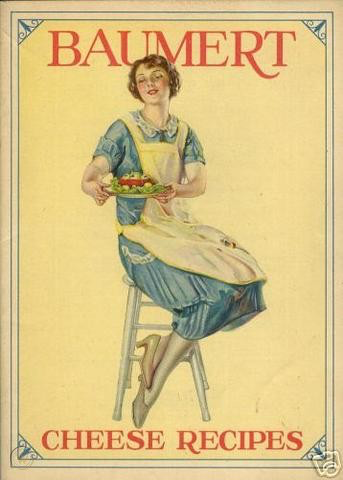
CHEESES FEARFUL AND WONDERFUL

Sandwiches were not only strange and new, but practically futuristic. “Before the 1920s, sandwiches were largely confined to picnics and free lunches in saloons,” they tell us, “and, with their crusts cut off, delicate accompaniments to afternoon tea.” The writer George Jean Nathan claimed that before the 1920s, there existed only eight basic sandwich types: Swiss cheese, ham, sardine, liverwurst, egg, corned beef, roast beef, and tongue (yes). But by 1926, he “claimed that he had counted 946 different sandwich varieties stuffed with fillings such as watermelon and pimento, peanut butter, fried oyster, Bermuda onion and parsley, fruit salad, aspic of foie gras, spaghetti, red snapper roe, salmi of duck, bacon and fried egg, lettuce and tomato, spiced beef, chow-chow, pickled herring, asparagus tips, deep sea scallops, and so on ad infinitum.”

Like the delicatessen, Americans were not going to take this sandwich thing lying down. Nor would they take it at all calmly! Boston writer Joseph Dinneen described sandwiches as “a natural by-product of modern machine civilization.”

Make your own “biggest thing since sliced bread” joke here, but actually this sandwich craze led directly to first the invention of special sandwich-shaped loaves with flattened tops, and then to sliced bread, which hit the market in 1928.

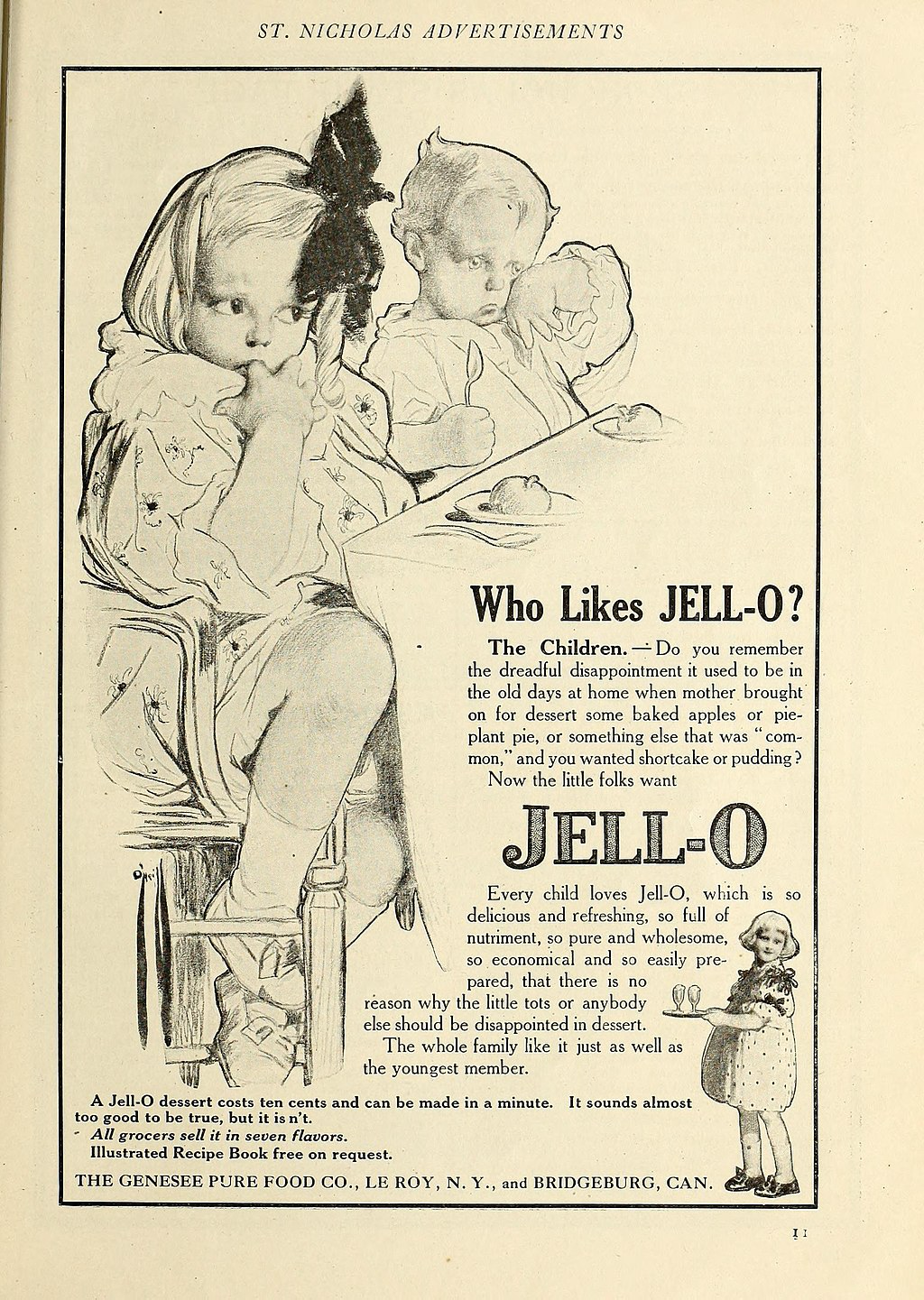
Frozen foods had also just been invented (frozen foods are soggy and tasteless unless you freeze them really fast; Clarence Birdseye figured out how to do quick freezing by seeing fish freeze solid during an ice fishing trip in Labrador) and were considered a novelty. Yet somehow the brand name Jell-O dates all the way back to 1897.

Many new foods didn’t fit squarely within existing categories. This is sort of like how squid ice cream seems normal in Japan. We have rules about what you can put in an ice cream — mint ice cream makes sense, but onion ice cream is right out — but the Japanese don’t care what we think the ice cream rules are. In the 1920s and 1930s many foods were unfamiliar or actually brand new, so no one had any expectations of what to do with them. For example, the banana, which you know as a fruit, was new enough to Americans that they were still figuring out how the thing should be served

Does seem guaranteed to start conversation! 

We’re sure bananas would be fine served as a vegetable, or with bacon, but this is certainly not the role we would assign to them today.

When the Depression hit, grapefruit somehow found its way into food relief boxes in huge quantities; “so much grapefruit that people didn’t know what to do with it.” Soon the newspapers were coming up with imaginative serving suggestions, like in this piece from the Atlanta Constitution:

It may open the meal, served as a fruit cocktail, in halves with a spoonful of mint jelly in the center or sprinkled with a snow of powdered sugar. It bobs up in a fruit cup, or in a delicious ice. It may be served broiled with meat, appear in a fruit salad or in a grapefruit soufflé pie. Broiled grapefruit slices, seasoned with chili sauce, make an unusual and delightful accompaniment for broiled fish, baked fish or chops.

Some of these sound pretty good; but still, unusual.

Vitamins

The other really strange and exciting thing about this period is that they had just discovered vitamins.

As we’ve covered previously, this was not as easy as you might think. It’s simple to think in terms of vitamins when you’re raised with the idea, but it took literally centuries for people to come up with the concept of a disease of deficiency, even with the totally obvious problem of scurvy staring everyone right in the face. 

Scurvy isn’t just a problem for polar explorers and sailors in the Royal Navy. Farm families living through the winter on preserved foods from their cellar tended to develop “spring fever” just before the frost broke, which the authors of this book think was probably scurvy. Farmwives treated it with “blood tonics” like sassafras tea or sulfured molasses, or the first-sprouted dandelions and onions of spring.

But just around the turn of the century, and with the help of cosmic accidents involving guinea pigs, people finally started to get this vitamin thing right. So the 1920s and 30s paint an interesting picture of what cutting-edge nutrition research looks like when it’s so new that it’s still totally bumbling and incompetent. 

In 1894, Wilbur Olin Atwater established America’s first dietary standards. Unfortunately, Atwater’s recommendations didn’t make much sense. For example, in this system men with more strenuous jobs were assigned more food than men with less strenuous jobs — a carpenter would get more calories than a clerk. This makes some sense, but Atwater then used each man’s food levels to calculate the amount of food required for his wife and kids. The children of men with desk jobs sometimes got half as much food as the children of manual laborers! The idea of treating each member of the family as their own person, nutritionally speaking, was radical in the early 1900s, but the observation that some children were “kept alive in a state of semi-starvation” had begun to attract attention.

People knew they could do better, so following Atwater’s death in 1907, the next generation got to work on coming up with a better system. Atwater had assumed that basically all fats were the same, as were all carbohydrates, all protein, etc. But Dr. Elmer V. McCollum, “a Kansas farm boy turned biochemist”, was on the case investigating fats. 

We really want to emphasize that they had no system at this point, no idea what they were doing. Medical science was young, and nutritional science was barely a decade old. Back then they were still just making things up. These days “guinea pig” and “lab rat” are clichés, but these clichés hadn’t been invented back in 1907. Just like how Holst and Frolich seem to have picked guinea pigs more or less at random to study scurvy, and how ​Karl Koller’s lab used big frogs to test new anesthetics, McCollum was one of the first researchers to use rats as test subjects.

Anyways, McCollum tried feeding his rats different kinds of fats to see if, as Atwater claimed, all fats had the same nutritional value. He found that rats that ate lots of butterfat “grew strong and reproduced, while those that ate the olive oil did not”. He teamed up with a volunteer, Marguerite Davis, and they discovered a factor that was needed for growth and present not only in milk, but eggs, organ meat, and alfalfa leaves. This factor was later renamed vitamin A (as the first to be discovered), and the age of the vitamins had begun. Soon McCollum and Davis were on the trail of a second vitamin, which they naturally called vitamin B.

The public went absolutely bananas for vitamins. It’s not clear if this was a totally natural public reaction, or if it was in response to fears drummed up by… home economists. Yes, home economics, the most lackluster class of all of middle school, represents that last lingering influence of what was once a terrible force in American politics: 

More than anything else, women were afraid of the “hidden hunger” caused by undetectable vitamin deficiencies that could well be injuring their children. … Home economists leveraged those fears. To ensure compliance, bureau food guides came with stark admonitions, warning mothers that poor nutrition in childhood could handicap a person for life. Women were left with the impression that one false move on their part meant their children would grow up with night blindness and bowed knees.

Whatever the cause, vitamins took America by storm. Any food found to be high in one vitamin or another quickly turned that finding to advertising purposes. Quaker oats, found to be high in vitamin B, advertised to kids with a campaign that “teamed up with Little Orphan Annie and her new pal, a soldier named Captain Sparks, who could perform his daring rescues because he had eaten his vitamins.” For adults, they implied that vitamin B would help make you vigorous in bed: 

…a snappy new advertising campaign: “I eat Quaker Oats for that wonderful extra energy ‘spark-plug.’ Jim thinks I have ‘Oomph!’ but I know it’s just that I have plenty of vitality and the kind of disposition a man likes to live with.” What she did with her extra “oomph” was unspecified, but the graphic showed a young couple nose to nose, smiling into each other’s eyes.

Vitamins continued to have this weird grip over the imagination for a long time. As late as the 1940s, American food experts worried that the Nazis had developed some kind of super-nutritional supplement, a “magical Buck Rogers pill,” to keep their army tireless and efficient (there probably was such a pill, but that pill was methamphetamine). In response, Roosevelt convened a 900–person National Nutrition Conference for Defense, a full quarter of them home economists, to tackle malnutrition as part of the war effort.

Maybe it’s not surprising that vitamins had such a hold on the popular imagination. It’s hard for us to imagine growing up in a world where scurvy, beriberi, and rickets were a real and even terrifying danger, not just funny-sounding words you might encounter in a Dickens novel. But for people living in the 1920s, they were no joke. Look at your local five-year-old and think how they will never understand the real importance of the internet, and what life was like before. You’re the same way about vitamins.

Milk

The final thing we learned is that people from the 1920s and 1930s had an intense, almost deranged love for milk.

Milk was always mentioned first and usually mentioned often. It was on every menu. Good Housekeeping’s 1926 article, Guide Posts to Balanced Meals, included “One pint of milk a day as either a beverage or partly in soups, sauces or desserts” as guidepost #1. Pamphlets from the USDA’s Bureau of Home Economics suggested that one fifth of a family’s food budget should be spent on milk. Milk was served at every meal in the schoolhouse, with milk and crackers at recess, the target being a quart of milk for every child, every day.

Milk was on every relief list. Food relief in NYC in 1930, a very strict beans-and-potatoes affair, still made sure to include a pound of evaporated milk for every family. Even for those on microscopic fifty-cent-a-day menus, milk was recommended at every meal, “one pint for breakfast, some for lunch, and then another pint for supper.” One father struggling to adjust to the Depression said, “We had trouble learning to live within the food allowance allotted us. We learned it meant oleomargarine instead of butter. It meant one quart of milk a day for the children instead of three.” Even the tightest-fisted relief lists included a pint of milk a day for adults, and a quart a day for children. The most restrictive diets of all were bread and — you guessed it — milk.

Milk was the measure of destitution. Descriptions of people eating “whatever they could get” sound like this: “inferior qualities of food and less of it; less milk; loose milk instead of bottled milk, coffee for children who previously drank milk.” When describing the plight of West Virginia mining families, a state union leader said, “Their diet is potatoes, bread, beans, oleomargarine, but not meat, except sow-belly two or three times a week. The company won’t let the miners keep cows or pigs and the children almost never have fresh milk. Only a few get even canned milk.”

There’s no question — milk was the best food. The government sent McCollum, the guy who discovered vitamins, around the country, where in his lectures he said:

Who are the peoples who have achieved, who have become large, strong, vigorous people, who have reduced their infant mortality, who have the best trades in the world, who have an appreciation for art and literature and music, who are progressive in science and every activity of the human intellect? They are the people who have patronized the dairy industry.

Normal milk wasn’t enough for these people, so in 1933 they developed a line of “wonder foods” around the idea of combining milk with different kinds of cereals. They called them: Milkorno, Milkwheato, and Milkoat. These products are about what you would expect, but the reception was feverish:  

With great fanfare, Rose introduced Milkorno, the first of the cereals, at Cornell’s February 1933 Farm & Home Week, where the assembled dignitaries—including Eleanor Roosevelt, wife of the president-elect—were fed a budget meal that included a Milkorno polenta with tomato sauce. The price tag per person was 6½ cents. FERA chose Milkwheato (manufactured under the Cornell Research Foundation’s patent) to add to its shipments of surplus foods, contracting with the Grange League Federation and the Ralston Purina Company to manufacture it. … Milkwheato and its sister cereals represented the pinnacle of scientifically enlightened eating. Forerunners to our own protein bars and nutritional shakes, they were high in nutrients, inexpensive, and nonperishable. White in color and with no pronounced flavor of their own, they were versatile too. Easily adapted to a variety of culinary applications, they boosted the nutritional value of whatever dish they touched. They could be baked into muffins, cookies, biscuits, and breads; stirred into chowders and chili con carne; mixed into meat loaf; and even used in place of noodles in Chinese chop suey.

We had always assumed that the American obsession with milk was the result of the dairy lobby trying to push more calcium on us than we really need. And maybe this is partially true. But public opinion of dairy has fallen so far from the rabid heights of the 1930s that now we wonder if milk might actually be underestimated. Is the dairy lobby asleep at the wheel? Still resting on their laurels? Anyways, if you want to eat the way your ancestors ate back in the 1920s, the authentic way to start your day off right is by drinking a nice tall pint of milk.

[1] : There might be a class element here? The authors say, “FDR recoiled from the plebeian food foisted on him as president; perhaps no dish was more off-putting to him than what home economists referred to as ‘salads,’ assemblages made from canned fruit, cream cheese, gelatin, and mayonnaise.”


PART II HERE

Links for March 2022

THIS BUG hAAS A CUTE FACE

It’s been a good month for Georgism. Vox comes out in favor of a Land Value Tax; cameo by friend of the blog Lars Doucet. Also, a great essay on why Georgism is so attractive in our current situation (Basically, it cuts against ideologies and encourages pragmatic harmony. Havel would be proud.). 

Interesting take on how to get “the news” in our modern ecosystem. Briefly, the proposed solution is “use twitter not at all in the way it was intended to be used”. 

“These biosensors function as permanent colorimetric pigments. Instead of tattoo ink, researchers injected the pigments into the thin dermis layer of tissue that hosts nerves, blood vessels, and interstitial fluid (ISF). Sensors vary in color as they come into contact with biomolecules. Placed appropriately, a diagnostic tattoo can reveal biomarker changes faster than conventional testing and the appearance of symptoms.” (But why did they call it Dermal Abyss???) If tattoos are too much of a commitment, they’re also working on diagnostic stickers that work more or less the same way.

Ben Kuhn on lognormal distributions and outliers. In our experience, understanding lognormal distributions is pretty easy and opens up all kinds of low-hanging fruit. This is a good intro to the concept and why it comes in handy.

Slate: Russians are racing to download Wikipedia before it gets banned. Takeaways: Wikipedia is smaller than you might expect, small enough to fit on a flash drive. The Russian-language Wikipedia is only 29 GB, and: “The entirety of English Wikipedia, from ‘List of Informally Named Dinosaurs’ to ‘Floor’ to ‘Skunks as Pets’ and everything in between, is 87 GB with pictures or 47 GB without.”

When a high voltage is applied to pure water filling 2 beakers kept close to each other, a connection forms spontaneously, giving the impression of a floating water bridge.

If you’re familiar with Dr. Bronner’s Magic Soaps, then you know about “the label”. (If not, a sample: “In all we do, let us be fair, generous, and loving to Spaceship Earth and all its inhabitants. For we’re All-One or None! All-One!”) It turns out that the story of how the label was born is even more interesting than you might think.

Sumerian dog joke good; scholarly discussion of what it means great

Article from 2007. On a phone call, the author offhandedly mentions that his wife is good at Game Boy Tetris — “She can get 500 or 600 lines, no problem.” — and learns that the current world record for Game Boy Tetris is 327 lines. They go to New Hampshire and she becomes the new world record holder with a total of 841 lines.

In Japan, crows have learned to attack solar power plants with stones. No one knows why: “It is unknown why crows bombard solar panels, possibly it is a game. The stones seldom directly crack panels, but the crows are experts at placing stones or other garbage just so that they stay on top of the panel, soon causing overheating and destruction or permanent damage.” The only way to keep crows away is to use falcons. “One trained falcon making 60 attack sorties a day can protect 100,000 solar panels from vengeful crows.”

Yet another example of a potato-only diet, complete with a book. Amazon reviews are anecdotal, of course, but they’re very positive. Not affiliated with us, in fact predates our work by a couple of years, looks like this got started in 2015 or 2016.

uhhhh wat

Philosophical Transactions: Lithium in Scottish Drinking Water with Al Hatfield

Previous Philosophical Transactions:

Al Hatfield is a wannabe rationalist (his words) from the UK who sent us some data about water sources in Scotland. We had an interesting exchange with him about these data and, with Al’s permission, wanted to share it with all of you! Here it is:


Hi,

I know you’re not that keen on correlations and I actually stopped working on this a few months ago when you mentioned that in the last A Chemical Hunger post, but after reading your post today I wanted to share it anyway, just in case it does help you at all. 

It’s a while since I read all of A Chemical Hunger but I think this data about Scottish water may support a few things you said:

– The amount of Lithium in Scottish water is in the top 4 correlations I found with obesity (out of about 40 substances measured in the water)

– I recall you predicted the top correlation would be about 0.5, the data I have implies it’s 0.55, so about right.

– I recall you said more than one substance in the water may contribute to obesity, my data suggested 4 substances/factors had correlations of more than 0.46 with obesity levels and 6 were more than 0.41.

Method

– Scottish Water test and record how much of up to 43 substances is in each reservoir/water source in Scotland https://www.scottishwater.co.uk/your-home/your-water/water-quality/water-quality

– their data is in pdf format but I converted it to Excel

– Scottish Water don’t publish Lithium levels online but I did a Freedom of Information request and they emailed it to me and I added it to the spreadsheet.

– I used the website to get the water quality data for a reservoir for every city/big town in Scotland and lined it up in the spreadsheet.

– I used Scottish Health Survey – Local Area Level data to find out what percentage of people are obese in each area of Scotland and then matched it as well as I could to a reservoir/water source.

– I then used the Data Analytics add-on in Excel to work out the correlations between the substances in the water and obesity.

Correlations with obesity (also in attachment)

Conductivity 0.55

Chloride 0.52

Boron 0.47

Lithium 0.47

Total Trihalomethanes 0.42

Sodium 0.42

Sulphate 0.38

Fluoride 0.37

Colony Counts After 3 Days At 22øc 0.34

Antimony 0.33

Gross Beta Activity 0.33

Total organic carbon 0.31

Gross Alpha Activity 0.30

Cyanide 0.26

Iron 0.26

Residual Disinfectant – Free 0.23

Arsenic 0.23

Pesticides – Total Substances 0.23

Coliform Bacteria (Total coliforms) 0.23

Copper 0.19

PAH – Sum Of 4 Substances 0.19

Nitrite 0.17

Colony Counts After 48 Hours At 37øc 0.16

Nickel 0.13

Nitrite/Nitrat e formula 0.13

Nitrate 0.12

Cadmium 0.11

Turbidity 0.08

Bromate 0.08

Colour 0.06

Lead -0.10

Manganese -0.12

Hydrogen ion (pH) -0.12

Aluminium -0.15

Chromium -0.15

Ammonium (total) -0.22

2_4-Db -0.25

Residual Disinfectant – Total -0.36

2_4-D -0.42

Dicamba -0.42

MCPB -0.42

MCPP(Mecoprop) -0.42

Scottish Water definition of Conductivity

Conductivity is proportional to the dissolved solids content of the water and is often used as an indication of the presence of dissolved minerals, such as calcium, magnesium and sodium.

Anyway, not sure if that’s any help to you at all but I enjoy your blog and thought I would send it in. Let me know if you have any questions.

Thanks 

Al


Hi Al,

Wow, thanks for this! We’ll take a look and do a little more analysis if that’s all right, and get back to you shortly. 

Do you know the units for the different measurements here, especially for the lithium? We’d be interested in seeing the original PDFs as well if that’s not too much hassle.

Thanks! 

SMTM


Hi,

You’re welcome! That’s great if you can analyse it as I am very much an amateur. 

The units for the Lithium measurements are µgLi/l. I’ve attached the Lithium levels Scottish Water sent me. I think they cover every water source they test in Scotland (though my analysis only covered about 15 water sources).

Sorry I don’t have access to the original pdfs as they’re on my other computer and I’m away at the moment. But I have downloaded a couple of pdfs online. Unfortunately the online versions have been updated since I did my analysis in late November, but hopefully you can get the idea from them and see what measurements Scottish Water use.

Let me know if you’d like anything else.

Thanks,

Al


Hey Al,

So we’ve taken a closer look at the data and while everything is encouraging, we don’t feel that we’re able to draw any strong conclusions.

We also get a correlation of 0.47 between obesity and lithium levels in the water. The problem is, this relationship isn’t significant, p = 0.078. Basically this means that the data are consistent with a correlation anywhere between -0.06 and 0.79, and since that includes zero (no relationship), we say that it’s not significant.

This still looks relatively good for the hypothesis — most of the confidence interval is positive, and these data are in theory consistent with a correlation as high as 0.79. But on the whole it’s weak evidence, and doesn’t meet the accepted standards.

The main reason this isn’t significant is that there are only 15 towns in the dataset. As far as sample sizes go, this is very small. That’s just not much information to work with, which is why the correlation isn’t significant. For similar reasons, we haven’t done any more complicated analyses, because we won’t be able to find much with such a small sample to work with. 

Another problem is that correlation is designed to work with bivariate normal distributions — two variables, both of them approximately normally distributed, like so: 

Usually this doesn’t matter a ton. Even if you’re looking at a correlation where the two variables aren’t really normally distributed, it’s usually ok. And sometimes you can use transformations to make the data more normal before doing your analysis. But in this case, the distribution doesn’t look like a bivariate normal at all:  

Only four towns in the dataset have seriously elevated lithium levels, and those are the four fattest towns in the dataset. So this is definitely consistent with the hypothesis.

But the distribution is very strange and very extreme. In our opinion, you can’t really interpret a correlation you get from data that looks like this, because while you can calculate a correlation coefficient, correlation was never intended to describe data that are distributed like this.

On the other hand, we asked a friend about this and he said that he thinks a correlation is fine as long as the residuals are normal (we won’t get into that here), and they pretty much are normal, so maybe a correlation is fine in this case? 

A possible way around this problem is nonparametric correlation tests, which don’t assume a bivariate normal distribution in the first place. Theoretically these should be kosher to use in this scenario because none of their assumptions are violated, though we admit we don’t use nonparametric methods very often. 

Anyways, both of the nonparametric correlation tests we tried were statistically significant — Kendall rank correlation was significant (tau = 0.53, p = .015), and so was the Spearman rank correlation (rho = 0.64, p = .011). Per these tests, obesity and lithium levels are positively correlated in this dataset. The friend we talked to said that in his opinion, nonparametric tests are the more conservative option, so the fact that these are significant does seem suggestive. 

We’re still hesitant to draw any strong conclusions here. Even if the correlations are significant, we’re working with only 15 observations. The lithium levels only go up to 7 ppb in these data, which is still pretty low, at least compared to lithium levels in many other areas. So overall, our conclusion is that this is certainly in line with the lithium hypothesis, but not terribly strong evidence either way.

A larger dataset of more than 15 towns would give us a bit more flexibility in terms of analysis. But we’re not sure it would be worth your time to put it together. It would be interesting if the correlation were still significant with 30 or 40 towns, and we could account for some of the other variables like Boron and Chloride. But, as we’ve mentioned before, in this case there are several reasons that a correlation might appear to be much smaller than it actually is. And in general, we think it can sometimes be misleading to use correlation outside the limited set of problems it was designed for (for example, in homeostatic systems).

That said, if you do decide to expand the dataset to more towns, we’d be happy to do more analysis. And above all else, thank you for sharing this with us!

SMTM

[Addendum: In case anyone is interested in the distribution in the full lithium dataset, here’s a quick plot of lithium levels by Scottish Unitary Authority: 

]


Thanks so much for looking at it. Sounds like I need to brush up on my statistics! Depending how bored I get I may extend it to 40 towns some time, but for now I’ll stick with experimenting with a water filter.

All the best,

Al

The Only True Wisdom is Knowing that You Can’t Draw a Bicycle

I. 

Early on in science there would never even could be a replication crisis or anything because everyone was just trying all the stuff. They were writing letters to each other with directions, trying each others’ studies, and seeing what they could confirm for themselves.  

Today, scientists would tell you that replicating someone else’s work takes decades of specialized training, because most findings are too subtle and finicky to be reproduced by just anyone. For example, consider this story from Harvard psychology professor Jason Mitchell, about how directions depend on implicit knowledge, and it’s impossible to fully explain your procedure to anyone:

I have a particular cookbook that I love, and even though I follow the recipes as closely as I can, the food somehow never quite looks as good as it does in the photos. Does this mean that the recipes are deficient, perhaps even that the authors have misrepresented the quality of their food? Or could it be that there is more to great cooking than just following what’s printed in a recipe? I do wish the authors would specify how many millimeters constitutes a “thinly” sliced onion, or the maximum torque allowed when “fluffing” rice, or even just the acceptable range in degrees Fahrenheit for “medium” heat. They don’t, because they assume that I share tacit knowledge of certain culinary conventions and techniques; they also do not tell me that the onion needs to be peeled and that the chicken should be plucked free of feathers before browning. … Likewise, there is more to being a successful experimenter than merely following what’s printed in a method section. Experimenters develop a sense, honed over many years, of how to use a method successfully. Much of this knowledge is implicit.

Mitchell believes in a world where findings are so fragile that only extreme insiders, close collaborators of the original team, could possibly hope to reproduce their findings. The implicit message here is something like, “don’t bother replicating ever; please take my word for my findings.” 

The general understanding of replication is slightly less extreme. To most researchers, replication is when one group of scientists at a major university reproduce the work of another group of scientists at a different major university. There’s also a minority position that replications should be done by many labs, that replication is an internal process of double-checking: “take the community’s word”. 

But this doesn’t seem quite right to us either. If a finding can’t be confirmed by outsiders like you — if you can’t see it for yourself — it doesn’t really “count” as replication. This used to be the standard of evidence (confirm it for yourself or don’t feel bound to take it seriously) and we think this is a better standard to hold ourselves to.

It’s not that Mitchell is wrong — he’s right, there is a lot of implicit knowledge involved in doing anything worth doing. Sometimes science is really subtle and hard to replicate at home; other times, it isn’t. But whether or not a particular study is easy or hard to replicate is a dodge. This argument is a load of crap because the whole reason to do research in the first place is a fight against received wisdom.

The motto of the Royal Society, one of the first scientific societies, was and still is nullius in verba. Roughly translated, this means, “take no one’s word” or “don’t take anyone’s word for it”. We think this is a great motto. It’s a good summary of the kind of spirit you need to investigate the world. You have the right to see for yourself and make up your own mind; you shouldn’t have to take someone’s word. If you can take someone else’s word for it — a king, maybe — then why bother? 

In the early 1670s, Antonie van Leeuwenhoek started writing to the Royal Society, talking about all the “little animals” he was seeing in drops of pond water when he examined them under his new microscopes. Long particles with green streaks, wound about like serpents, or the copper tubing in a distillery. Animals fashioned like tiny bells with long tails. Animals spinning like tops, or shooting through the water like pikes. “Little creatures,” he said, “above a thousand times smaller than the smallest ones I have ever yet seen upon the rind of cheese.”

Wee beasties

Naturally, the Royal Society found these reports a little hard to believe. They had published some of van Leewenhoek’s letters before, so they had some sense of who the guy was, but this was almost too much:

Christiaan Huygens (son of Constanijn), then in Paris, who at that time remained sceptical, as was his wont: ‘I should greatly like to know how much credence our Mr Leeuwenhoek’s observations obtain among you. He resolves everything into little globules; but for my part, after vainly trying to see some of the things which he sees, I much misdoubt me whether they be not illusions of his sight’. The Royal Society tasked Nehemiah Grew, the botanist, to reproduce Leeuwenhoek’s work, but Grew failed; so in 1677, on succeeding Grew as Secretary, Hooke himself turned his mind back to microscopy. Hooke too initially failed, but on his third attempt to reproduce Leeuwenhoek’s findings with pepper-water (and other infusions), Hooke did succeed in seeing the animalcules—‘some of these so exceeding small that millions of millions might be contained in one drop of water’ 

People were skeptical and didn’t take van Leewenhoek at his word alone. They tried to get the same results, to see these little animals for themselves, and for a number of years they failed. They got no further help from van Leewenhoek, who refused to share his methods, or the secrets of how he made his superior microscopes. Yet even without a precise recipe, Hooke was eventually able to see the tiny, wonderful creatures for himself. And when he did, van Leewenhoek became a scientific celebrity almost overnight. 

If something is the truth about how the world works, the truth will come out, even if it takes Robert Hooke a few years to confirm your crazy stories about the little animals you saw in your spit. Yes, research is very exacting, and can demand great care and precision. Yes, there is a lot of implicit knowledge involved. The people who want to see for themselves might have to work for it. But if you think what you found is the real McCoy, then you should expect that other people should be able to go out and see it for themselves. And assuming you are more helpful than van Leewenhoek, you should be happy to help them do it. If you don’t think people will be able to replicate it at their own bench, are you sure you think you’ve discovered something?

Fast forward to the early 1900s. Famous French Physicist Prosper-René Blondlot is studying the X-Rays, which had been first described by Wilhelm Röntgen in 1895. This was an exciting time for rays of all stripes — several forms of invisible radiation had just been discovered, not only X-Rays but ultraviolet light, gamma rays, and cathode rays. 

Also he looked like a wizard

So Blondlot was excited, but not all that surprised, when he discovered yet another new form of radiation. He was firing X-rays through a quartz prism and noticed that a detector was glowing when it shouldn’t be. He performed more experiments and in 1903 he announced the discovery of: N-rays!  

Blondlot was a famous physicist at a big university in France, so everyone took this seriously and they were all very excited. Soon other scientists had replicated his work in their own labs and were publishing scores of papers on the subject. They began documenting the many strange properties of N-rays. The new radiation would pass right through many substances that blocked light, like wood and aluminum, but were obstructed by water, clouds, and salt. They were emitted by the sun and by human bodies (especially flexed muscles and certain areas of the brain), as well as rocks that had been left in the sun and been allowed to “soak up” the N-rays from sunlight. 

The procedure for detecting these rays wasn’t easy. You had to do everything just right — you had to use phosphorescent screens as detectors, you had to stay in perfect darkness for a half hour so your eyes could acclimate, etc. Fortunately Blondlot was extremely forthcoming and always went out of his way to help provide these implicit details he might not have been able to fit in his reports. And he was vindicated, because with his help, labs all over the place were able to reproduce and extend his findings.

Well, all over France. Some physicists outside France, including some very famous ones, weren’t able to reproduce Blondlot’s findings at all. But as before, Blondlot was very forthcoming and did his best to answer everyone’s questions. 

Even so, over time some of the foreigners began to get a little suspicious. Eventually some of them convinced an American physicist, Robert W. Wood, to go visit Blondlot in France to see if he could figure out what was going on. 

What a dude. Classic American

Blondlot took Wood in and gave him several demonstrations. To make a long story short (you can read Wood’s full account here; it’s pretty interesting), Wood found a number of problems with Blondlot’s experiments. The game was really up when Wood secretly removed a critical prism from one of the experiments, and Blondlot continued reporting the same results as if nothing had happened. Wood concluded that N-rays and all the reports had been the work of self-deception, calling them “purely imaginary”. Within a couple of years, no one believed in N-rays anymore, and today they’re seen as a cautionary tale. 

So much for the subtlety and implicit knowledge needed to do cutting-edge work. Maybe your results are hard to get right, but maybe if other people can’t reproduce your findings, they shouldn’t take your word for it.

This is the point of all those chemistry sets your parents (or cool uncle) gave you when you were a kid. This is the point of all those tedious lab classes in high school. They were poorly executed and all but this was the idea. If whatever Röntgen or Pasteur or Millikan or whoever found is for real, you should be able to reproduce the same thing for yourself in your high school with only the stoner kid for a lab assistant (joke’s on you, stoners make great chemists — they’re highly motivated).

Some people will scoff. After all, what kind of teenager can replicate the projects reported in a major scientific journal? Well, as just one example, take Dennis Gabor: “during his childhood in Budapest, Gabor showed an advanced aptitude for science; in their home laboratory, he and his brother would often duplicate the experiments they read about in scientific journals.”

Clearly some studies will be so complicated that Hungarian teenagers won’t be able to replicate them, or may require equipment they don’t have access to. And of course the Gabor brothers were not your average teenagers. But it used to be possible, and it should be made possible whenever possible. Because otherwise you are asking the majority of people to take your claims on faith. If a scientist is choosing between two lines of work of equal importance, one that requires a nuclear reactor and the other that her neighbor’s kids can do in their basement, she should go with the basement.

It’s good if one big lab can recreate what another big lab claims to have found. But YOU are under no obligation to believe it unless you can replicate it for yourself.

You can of course CHOOSE to trust the big lab, look at their report and decide for yourself. But that’s not really replication. It’s taking someone’s word for something. 

There’s nothing wrong with taking someone’s word; you do it all the time. Some things you can’t look into for yourself; and even if you could, you don’t have enough time to look into everything. So we are all practical people and take the word of people we trust for lots of things. But that’s not replication.

Something that you personally can replicate is replication. Watching someone else do it is also pretty close, since you still get to see it for yourself. Something that a big lab would be able to replicate is not really replication. It’s nice to have confirmation from a second lab, but now you’re just taking two people’s word for it instead of one person’s. Something that can in principle be replicated, but isn’t practical for anyone to actually attempt, is not replication at all.

If it cannot be replicated even in principle, then what exactly do you think you’re doing? What exactly do you think you’ve discovered here? 

What ever happened to all the public science demonstrations

We find it kind of concerning that “does replicate” or “doesn’t replicate” have come to be used as synonyms of “true” and “untrue”. It’s not enough to say that things replicate or not. Blondlot’s N-ray experiments were replicated hundreds of times around France, until all of a sudden they weren’t; van Leeuwenhoek’s observations of tiny critters in pond water weren’t replicated for years, until they were. The modern take on replication (lots of replications from big labs = good) would have gotten both of these wrong. 

II.

If knowing the truth about some result is important to you, don’t just take someone’s word for it. Don’t leave it up to the rest of the world to do this work; we’re all bunglers, you should know that. If you can, you should try it for yourself.

So let’s look at some examples of REAL replication. We’ll take our examples from psychology, since as we saw earlier, they’re in the thick of the modern fight over replication.

We also want to take a minute to defend the psychologists, at least on the topic of replication (psychology has other sins, but that’s a subject for another time). Psychology has gotten a lot of heat for being the epicenter of the replication crisis. Lots of psychology studies haven’t replicated under scrutiny. There have been many high-profile disputes and attacks. Lots of famous findings seem to be made out of straw

Some people have taken this as a sign that psychology is all bunkum. They couldn’t be more wrong — it’s more like this. One family in town gets worried and hires someone to take a look at their house. The specialist shows up and sure enough, their house has termites. Some of the walls are unsafe; parts of the structure are compromised. The family is very worried but they start fumigating and replacing boards that the termites have damaged to keep their house standing. All the other families in town laugh at them and assume that their house is the most likely to fall down. But the opposite is true. No other family has even checked their home for termites; but if termites are in one house in town, they are in other houses for sure. The first family to check is embarrassed, yes, but they’re also the only family who is working to repair the damage.

The same thing is going on in psychology. It’s very embarrassing for the field to have their big mistakes aired in public; but psychology is also distinct for being the first field willing to take a long hard look at themselves and make a serious effort to change for the better. They haven’t done a great job, but they’re one of the only fields that is even trying. We won’t name names but you can bet that other fields have just as many problems with p-hacking — the only difference is that those fields are doing a worse job rooting it out. 

The worst thing you can say about psychology is that it is still a very young field. But try looking at physics or chemistry when they were only 100 years old, and see how well they were doing. From this perspective, psychology is doing pretty ok. 

Despite setbacks, there has been some real progress in psychology. So here are a few examples of psychological findings that can actually be replicated, by any independent researcher in an afternoon. You don’t have to take our word or anyone else’s word for these findings if you don’t want to. Try it for yourself! Please do try this at home, that’s the point.

Are these the most important psychology findings? Probably not — we picked them because they’re easy to replicate, and you should be able to confirm their results from your sofa (disclaimer: for some of them, you may have to leave your sofa). But all of them are things we didn’t know about 150 years ago, so they represent a real advance in what we know about the mind.

For most of these you will need a small group of people, because most of these are statistically true results, not guaranteed to work in every case. But as long as you have a dozen people or so, they should be pretty reliable.

Draw a Bicycle — Here’s a tricky one you can do all on your own. You’ve seen a bicycle before, right? You know what they look like? Ok, draw one. 

Unless you’re a bicycle mechanic, chances are you’ll be really rubbish at this — most people are. While you can recognize a bicycle no problem, you don’t actually know what one looks like. Most people produce drawings that look something like this:

Needless to say, that’s not a good representation of the average bicycle.

Seriously, try this one yourself right now. Don’t look up what a bicycle looks like; draw it as best you can from memory and see what you get. We’ll put a picture of what a bicycle actually looks like at the end of this post. 

Then, tweet your bicycle drawings at us at @mold_time on twitter

(A similar example: which of the images below shows what a penny looks like?)

Wisdom of the CrowdWisdom of the crowd refers to the fact that people tend to make pretty good guesses on average even when their individual guesses aren’t that good. 

You can do this by having a group of people guess how many jellybeans are in a jar of jellybeans, or how much an ox weighs. If you average all the guesses together, most of the time it will be pretty close to the right answer. But we’ve found it’s more fun to stand up there and ask everyone to guess your age.

We’ve had some fun doing this one ourselves, it’s a nice trick, though you need a group of people who don’t know you all that well. It works pretty well in a classroom. 

This only works if everyone makes their judgments independently. To make sure they don’t influence each other’s guesses, have them all write down their guesses on a piece of paper before blurting it out. 

Individual answers are often comically wrong — sometimes off by up to a decade in both directions — but we’ve been very impressed. In our experience the average of all the guesses is very accurate, often to within a couple of months. But give it a try for yourself.

Emotion in the Face — You look at someone’s face to see how they’re feeling, right? Well, maybe. There’s a neat paper from a few years ago that has an interesting demonstration of how this isn’t always true. 

They took photos of tennis players who had just won a point or who had just lost a point, and cut apart their faces and bodies (in the photos; no tennis pros were harmed, etc.). Then they showed people just the bodies or just the faces and asked them to rate how positively or negatively the person was feeling:

They found that people could usually tell that a winning body was someone who was feeling good, and a losing body was someone feeling bad. But with just the faces, they couldn’t tell at all. Just look above – for just the bodies, which guy just won a point? How about for the faces, who won there?

Then they pushed it a step further by putting winning faces on losing bodies, and losing faces on winning bodies, like so:

Again, the faces didn’t seem to matter. People thought chimeras with winning bodies felt better than chimeras with losing bodies, and seemed to ignore the faces.

This one should be pretty easy to test for yourself. Go find some tennis videos on the internet, and take screenshots of the players when they win or lose a point. Cut out the faces and bodies and show them to a couple friends, and ask them to rate how happy/sad each of the bodies and faces seems, or to guess which have just won a point and which have just lost. You could do this one in an afternoon. 

Anchoring — This one is a little dicey, and you’ll need a decent-sized group to have a good chance of seeing it. 

Ask a room of people to write down some number that will be different for each of them — like the last four digits of their cell phone number, or the last two digits of their student ID or something. Don’t ask for part of their social security number or something that should be kept private. 

Let’s assume it’s a classroom. Everyone takes out their student ID and writes down the last two digits of their ID number. If your student ID number is 28568734, you write down “34”.

Now ask everyone to guess how old Mahatma Gandhi was when he died, and write that down too. If this question bores you, you can ask them something else — the average temperature in Antarctica, the average number of floors in buildings in Manhattan, whatever you like.

Then ask everyone to share their answers with you, and write them on the board. You should see that people who have higher numbers as the last two digits of their student ID number (e.g. 78 rather than 22) will guess higher numbers for the second question, even though the two numbers are unrelated. They call this anchoring. You can plot the student ID digits and the estimates of Gandhi’s age on a scatterplot if you like, or even calculate the correlation. It should come out positive.

Inattentional Blindness — If you’ve taken an intro psych class, then you’re familiar with the “Invisible Gorilla” (for everyone else, sorry for spoiling). In the biz they call this “inattentional blindness” — when you aren’t paying attention, or your attention is focused on one task, you miss a lot of stuff.

Turns out this is super easy to replicate, especially a variant called “change blindness”, where you change something but people don’t notice. You can swap out whole people and about half the time, no one picks up on it.

Because it’s so easy, people love to replicate this effect. Like this replication from NOVA, or this British replication, or this replication from National Geographic. You can probably find a couple more on YouTube if you dig around a bit. 

This one isn’t all that easy to do at home, but if you can find a couple accomplices and you’re willing to play a prank on some strangers, you should be able to pull it off. 

(Or you can replicate it in yourself by playing I’m on Observation Duty.)

False Memory — For this task you need a small group of people. Have them put away their phones and writing tools; no notes. Tell them you’re doing a memory task — you’ll show them a list of words for 30 seconds, and you want them to remember as many words as possible. 

Then, show them the following list of words for 30 seconds or so: 

After 30 seconds, hide or take down the list. 

Then, wait a while for the second half of the task. If you’re doing this in a classroom, do the first step at the beginning of class, and the second half near the end.

Anyways, after waiting at least 10 minutes, show them these words and ask them, which of the words was on the original list? 

Most people will incorrectly remember “sleep” as being on the original list, even though, if you go back and check, it’s not. What’s going on here? Well, all of the words on the original list are related to sleep — sleep adjectives, sleep sounds, sleep paraphernalia — and this leads to a false memory that “sleep” was on the list as well. 

You can do the same thing for other words if you want — showing people a list of words like “sour”, “candy”, and “sugar” should lead to false memories of the word “sweet”. You can also read the list of words aloud instead of showing it on a screen for 30 seconds, you should get the same result either way. 

Draw your own conclusions about what this tells us about memory, but the effect should be pretty easy to reproduce for yourself.

We don’t think all false memory findings in psychology bear out. We think some of them aren’t true, like the famous Loftus & Palmer (1974) study, which we think is probably bullshit. But we do think it’s clear that it’s easy to create false memories under the right circumstances, and you can do it in the classroom using the approach we describe above.

You can even use something like the inattentional blindness paradigms above to give people false memories about their political opinions. A little on the tricky side but you should also be able to replicate this one if you can get the magic trick right. And if this seems incredible, ridiculous, unbelievable — try it for yourself! 

Oh yeah, and here’s that bicycle: 

Three Angles on Erik Hoel’s Aristocratic Tutoring

Erik Hoel, concerned that we’re not getting our fair share of geniuses, suggests that aristocratic tutoring is what’s missing:

Let us call this past form aristocratic tutoring, to distinguish it from a tutor you meet in a coffeeshop to go over SAT math problems while the clock ticks down. It’s also different than “tiger parenting,” which is specifically focused around the resume padding that’s needed for kids to meet the impossible requirements for high-tier colleges. Aristocratic tutoring was not focused on measurables. Historically, it usually involved a paid adult tutor, who was an expert in the field, spending significant time with a young child or teenager, instructing them but also engaging them in discussions, often in a live-in capacity, fostering both knowledge but also engagement with intellectual subjects and fields.

“Aristocratic tutoring” is not how we would describe it, but otherwise this sounds about right. We think Erik is right that historical tutoring was better than education today. But we don’t think being aristocratic is what made it better. So here are three other angles on the same idea:

I.

It’s no secret that school sux. It’s not that tutoring is good, it’s that mechanized schooling is really bad. If we got rid of formal 20th century K-12 education, and did homeschooling / unschooling / let kids work at the costco, we would get most of the benefits of tutoring without all the overhead and inequality.

Our personal educational philosophy is that, for the most part, the most important thing you can do for your students is expose them to things they wouldn’t have encountered otherwise. Sort of in the spirit of, you can lead a horse to water, but you can’t make him drink. So K-12 education gums up the works by making bad recommendations, having students spend a lot of time on mediocre stuff, and keeping them so busy they can’t follow up on the better recommendations from friends and family. 

From this perspective, mechanized schooling is actually a net negative — it is worse than nothing, and if we just let kids run around hitting each other with sticks or whatever, we would get more geniuses. 

Future Geniuses

But another possibility is that mechanized schooling is net neutral, and the problem is that we’ve lost some active ingredient that makes tutoring effective.

II.

Education no longer includes moral instruction. Back in the day, a proper education taught you more than “the mitochondria is the powerhouse of the cell” — it taught you to take your character as seriously as your scholarship, to lead and to serve, and to understand your moral responsibilities. Tutoring worked because tutors inspired their pupils. Modern education is a lot of things, but “inspiring” ain’t one of them.

Back when formal education could still be inspiring, it still produced brilliant individuals. People have pointed out that the Manhattan Project was led by a group of strangely brilliant Hungarian scientists. Not only did most of them come from Budapest, many of them went to the same high school, and some of them had the same math teacher, László Rátz. Eugene Wigner, a Nobel Laureate in physics and one of Rátz’s pupils, had this to say:

… there were many superb teachers at the Lutheran gymnasium. But the greatest was my mathematics teacher László Rátz. Rátz was known not only throughout our gymnasium but also by the church and government hierarchy and among many of the teachers in the country schools. I still keep a photograph of Rátz in my workroom because he had every quality of a miraculous teacher: He loved teaching. He knew the subject and how to kindle interest in it. He imparted the very deepest understanding. Many gymnasium teachers had great skill, but no one could evoke the beauty of the subject like Rátz.

Rátz may or may not have been responsible for Wigner’s success, and he didn’t teach everyone involved in the Manhattan Project; our point is just that these Hungarians lived in a time when high school math teachers could still inspire former students to describe them as “miraculous”. This seems to be an aspect of the educational system that we have lost.

If this is right, then we don’t need to worry about tutoring being aristocratic. You shouldn’t need tutors or even miraculous Hungarian math teachers. Other things that are also inspiring / socially encouraging would work just as well — see for example the amazing progress of the speedrunning community, a bunch of teenage nerds bootstrapping a scene by inspiring each another to insane degrees of precision.

Erik hints at this by mentioning the social element. “For humans,” he says, “engagement is a social phenomenon; particularly for children, this requires interactions with adults who can not just give them individual attention, but also model for them what serious intellectual engagement looks like.” Individual attention is good, but we also think kids are good at teaching themselves. The active ingredient to us is showing kids “what serious intellectual engagement looks like”, and most kids today don’t see that until college (if ever).

III.

The real problem is segregating children. Tutoring worked because you exposed children to people practicing a real skill (even if it’s only speaking their native language), or working in an actual profession. Modern education exposes them only to teachers.

At the end of your German tutelage you can speak to people you wouldn’t have been able to speak to before, read books and poems you wouldn’t have been able to read. At the end of your taxidermy tutelage you can take samples and stuff birds, and could theoretically make a living at it. Meanwhile at the end of high school you can write a five-point essay, a “skill” that you will never use again as long as you live.

So the problem is not the lack of tutoring per se, as much as the lack of giving children any sense of the real world at all. Today, children have to be sent to guidance counselors to be advised on what is out there. Teenagers dream of being youtubers and influencers. This isn’t their fault — these are some of the only professions where they actually understand what is involved. It’s the fault of adults, for not letting children see any of the many ways they could actually go out and exercise their powers in the world.

But tutoring isn’t the only way to expose children to real skills. So did working in the family business, and so did apprenticeships. Writing about why nerds are unpopular, Paul Graham says: 

I’m suspicious of this theory that thirteen-year-old kids are intrinsically messed up. If it’s physiological, it should be universal. Are Mongol nomads all nihilists at thirteen? I’ve read a lot of history, and I have not seen a single reference to this supposedly universal fact before the twentieth century. Teenage apprentices in the Renaissance seem to have been cheerful and eager. They got in fights and played tricks on one another of course (Michelangelo had his nose broken by a bully), but they weren’t crazy.

As far as I can tell, the concept of the hormone-crazed teenager is coeval with suburbia. I don’t think this is a coincidence. I think teenagers are driven crazy by the life they’re made to lead. Teenage apprentices in the Renaissance were working dogs. Teenagers now are neurotic lapdogs. Their craziness is the craziness of the idle everywhere.

Paul is right; in many parts of the world, useful apprenticeship was the historical norm. As anthropologist David Graeber writes:  

Feudal society was a vast system of service… the form of service that had the most important and pervasive influence on most people’s lives was not feudal service but what historical sociologists have called “life-cycle” service. Essentially, almost everyone was expected to spend roughly the first seven to fifteen years of his or her working life as a servant in someone else’s household. Most of us are familiar with how this worked itself out within craft guilds, where teenagers would first be assigned to master craftsmen as apprentices, and then become journeymen… In fact, the system was in no sense limited to artisans. Even peasants normally expected to spend their teenage years onward as “servants in husbandry” in another farm household, typically, that of someone just slightly better off. Service was expected equally of girls and boys (that’s what milkmaids were: daughters of peasants during their years of service), and was usually expected even of the elite. The most familiar example here would be pages, who were apprentice knights, but even noblewomen, unless they were at the very top of the hierarchy, were expected to spend their adolescence as ladies-in-waiting—that is, servants who would “wait upon” a married noblewoman of slightly higher rank, attending to her privy chamber, toilette, meals, and so forth, even as they were also “waiting” for such time as they, too, were in a position to marry and become the lady of an aristocratic household themselves.

Service was especially pervasive in England. “Few are born who are exempted from this fate,” wrote a Venetian visitor around 1500, “for everyone, however rich he may be, sends away his children into the houses of others, whilst he, in return, receives those of strangers into his own.”

Even just having your children around adults and being a part of adult conversations will go a long way. For what it’s worth, this is how we were raised, i.e. mostly around adults.

This may be another element common to the cases Erik mentions — most of the geniuses he names seem to have had very little contact with children outside their immediate family. Whether or not this is good for children psychologically is a separate question, but it does seem to lead to very skilled adults.

In fact, the number of children in a family might also be a factor. There was a time when most families were pretty large, so a lot of children had several older siblings. If you have five older brothers, you get both benefits — other children to play with, and a more direct line to adulthood through your older siblings. Erik mentions the example of Bertrand Russell, and we wonder if this might be more representative than he realizes:

When Bertrand Russell’s older brother introduced him to geometry at the age of 11, Russell later wrote in his autobiography that it was: “… one of the great events of my life, as dazzling as first love.” Is that really solely his innate genetic facility, or was mathematics colored by the love of his older brother?

It’s easy to come up with other examples (though of course this is not universal). Charles Darwin was the fifth of six children. The Polgár sisters are all chess prodigies, and were intentionally raised to be geniuses, but the youngest daughter Judit is the best of the three. Jane Austen had five older brothers and an older sister. Her eldest brother James wrote prologues and epilogues for plays the family staged and it seems as though this moved Jane to try her hand at something similar.

So part of the success of tutoring might simply be exposing a child to subjects “before they are ready”, and one way to reliably do that is to have them overhear the lessons of their older siblings, who they are ready to imitate.

This ties neatly into the social/moral element we mention above. Children may be moved by a passionate tutor, or a beloved uncle, or a cousin, or a medical student who lives in the spare room. But they will always be influenced by older siblings, and the more older siblings there are, the more gates to adult influence will be opened. Maybe if we want more geniuses, people need to start having larger families.

Control and Correlation

I.

A thermostat is a simple example of a control system. A basic model has only a few parts: some kind of sensor for detecting the temperature within the house, and some way of changing the temperature. Usually this means it has the ability to turn the furnace off and on, but it might also be able to control the air conditioning. 

The thermostat uses these abilities to keep the house at whatever temperature a human sets it to — maybe 72 degrees. Assuming no major disturbances, the control system can keep a house at this temperature indefinitely.

In the real world, control systems are all over the place.

Imagine that a car is being driven across a hilly landscape.

A man is operating this car. Let’s call him Frank. Now, Frank is a real stickler about being a law-abiding citizen, and he always makes sure to go exactly the speed limit. 

On this road, the speed limit is 35 mph. So Frank uses the gas pedal and the brake pedal to keep the car going the speed limit. He uses the gas to keep from slowing down when the road slopes up, and to keep the car going a constant speed on straightaways. He uses the brake to keep from speeding up when the road slopes down.

The road is hilly enough that frequent use of the gas and brake are necessary. But it’s well within Frank’s ability, and he successfully keeps the needle on 35 mph the whole time. 

Together, Frank and the car form a control system, just like a thermostat, that keeps the car at a constant speed. You could also replace Frank’s brain with the car’s built-in cruise control function, if it has one, and that might provide an even more precise form of control. But whatever is doing the calculations, the entire system functions more or less the same way. 

Surprisingly, if you graph all the variables at play here — the angle of the road, the gas, the brake, and the speed of the car at each time point — speed will not be correlated with any of the other variables. Despite the fact that the speed is almost entirely the result of the combination of gas, brake, and slope (plus small factors like wind and friction), there will be no apparent correlation, because the control system keeps the car at a constant 35 mph. 

High precision technical diagram

Similarly, if you took snapshots of many different Franks, driving on many different roads at different times, there would be no correlation between gas and speed in this dataset either.

We understand something about the causal system that is Frank and his car, and how this system responds to local traffic regulations, so we understand that gas and brake and angle of the road ARE causally responsible for that speed of 35 mph. But if an alien were looking at a readout of the data from a bunch of cars, their different speeds, and the use of various drivers’ implements as they rattle along, it would be hard pressed to figure out that the gas makes the car speed up and the brake makes it slow down. 

II. 

We see that despite being causally related, gas and brake aren’t correlated with speed at all.

This is a well-understood, if somewhat understated, problem in causal inference. We’ve all heard that correlation does not imply causation, but most of us assume that when one thing causes another thing, those two things will be correlated. Hotter temperatures cause ice cream sales; and they’re correlated. Fertilizer use causes bigger plants; correlated. Parental height causes child height; you’d better believe it, they’re correlated. 

But things that are causally related are not always correlated. Here’s another example from a textbook on causal inference

Weirdly enough, sometimes there are causal relationships between two things and yet no observable correlation. Now that is definitely strange. How can one thing cause another thing without any discernible correlation between the two things? Consider this example, which is illustrated in Figure 1.1. A sailor is sailing her boat across the lake on a windy day. As the wind blows, she counters by turning the rudder in such a way so as to exactly offset the force of the wind. Back and forth she moves the rudder, yet the boat follows a straight line across the lake. A kindhearted yet naive person with no knowledge of wind or boats might look at this woman and say, “Someone get this sailor a new rudder! Hers is broken!” He thinks this because he cannot see any relationship between the movement of the rudder and the direction of the boat.

Let’s look at one more example, from the same textbook: 

[The boat] sounds like a silly example, but in fact there are more serious versions of it. Consider a central bank reading tea leaves to discern when a recessionary wave is forming. Seeing evidence that a recession is emerging, the bank enters into open-market operations, buying bonds and pumping liquidity into the economy. Insofar as these actions are done optimally, these open-market operations will show no relationship whatsoever with actual output. In fact, in the ideal, banks may engage in aggressive trading in order to stop a recession, and we would be unable to see any evidence that it was working even though it was!

III.

There’s something interesting that all of these examples — Frank driving the car, the sailor steering her boat, the central bank preventing a recession — have in common. They’re all examples of control systems.

Like we emphasized at the start, Frank and his car form a system for controlling the car’s speed. He goes up and down hills, but his speed stays at a constant 35 mph. If his control is good enough, there will be no detectable variation in the speed at all. 

The sailor and her rudder are acting as a control system in the face of disturbances introduced by the wind. Just like Frank and his car, this control system is so good that to an external observer, there appears to be no change at all in the variable being controlled.

The central bank is doing something a little more complicated, but it is also acting as a control system. Trying to prevent a recession is controlling something like the growth of the economy. In this example, the growth of the economy continues increasing at about the same rate because of the central bank’s canny use of open-market operations, bonds, liquidity, etc. in response to some kind of external shock that would otherwise cause economic growth to stall or plummet — that would cause a recession. And “insofar as these actions are done optimally, these open-market operations will show no relationship whatsoever with actual output.”

The same thing will happen with a good enough thermostat, especially if it has access to both heating and cooling / air conditioning. The thermostat will operate its different interventions in response to external disturbances in temperature (from the sun, wind, doors being left open, etc.), and the internal temperature of the house will remain at 72 degrees, or whatever you set it at.

If you looked at the data, there would be no correlation between the house’s temperature and the methods used to control that temperature (furnace, A/C, etc.), and if you didn’t know what was going on, it would be hard to tell what was causing what.

In fact, we think this is the case for any control system. If a control system is working right, the target — the speed of Frank’s car, the direction of the boat, the rate of growth in the economy, the temperature of the house — will remain about the same no matter what. Depending on how sensitive your instruments are, you may not be able to detect any change at all. 

If control is perfect — if Frank’s car stays at exactly 35 mph — then the system is leaking literally no information to the outside world. You can’t learn anything about how the system works because any other variable plotted against MPH, even one like gas or brake, will look something like this: 

This is true even though gas and brake have a direct causal influence on speed. In any control system that is functioning properly, the methods used to control a signal won’t be correlated with the signal they’re controlling. 

Worse, there will be several variables that DO show relationships, and may give the wrong impression. You’re looking at variables A, B, C, and D. You see that when A goes up, so does B. When A goes down, C goes up. D never changes and isn’t related to anything else — must not be important, certainly not related to the rest of the system. But of course, A is the angle of the road, B is the gas pedal, C is the brake pedal, and D is the speed of the car. 

If control isn’t perfect, or your instruments are sensitive enough to detect when Frank speeds up or slows down by fractions of an mph, then some information will be let through. But this doesn’t mean that you’ll be able to get a correlation. You may be able to notice that the car speeds up a little on the approach to inclines and slows down when it goes downhill, and you may even be able to tie this to the gas and brake. But it shouldn’t show up as a correlation — you would have to use some other analysis technique, but we’re not sure if such a technique exists.

And if you don’t understand the rest of the environment, you’ll be hard pressed to tell which variation in speed is leaked from the control system and which is just noise from other sources — from differences in friction across the surface of the road, from going around curves, from imperfections in the engine, from Frank being distracted by birds, etc.

IV.

This seems like it might be a big problem, because control systems are found all over biology, medicine, and psychology.

Biology is all about homeostasis — maintaining stability against constant outside disturbances. Lots of the systems inside living things are designed to maintain homeostatic control over some important variable, because if you don’t have enough salt or oxygen or whatever, you die. But figuring out what controls what can be kind of complicated. 

(If you’re getting ready to lecture us on the difference between allostasis and homeostasis, go jump in a pond instead.)

Medicine is the applied study of one area of biology (i.e. human biology, for the most part), so it faces all the same problems biology does. The human body works to control all sorts of variables important to our survival, which is good. But if you look at a signal relevant to human health, and want to figure out what controls that signal, chances are it won’t be correlated with its causes. That’s… confusing. 

Lots of people forget that psychology is biological, but it obviously is. The brain is an organ too; it is made up of cells; it works by homeostatic principles. This is an under-appreciated perspective within psychology itself but some people are coming around; see for example this recent paper.

If you were to ask us what field our book A Chemical Hunger falls under, we would say cognitive science. Hunger is pretty clearly regulated in the brain as a cognitive-computational process and it’s pretty clearly part of a number of complicated homeostatic systems, systems that are controlling things like body weight and energy. So in a way, this is psychology too.

It’s important to remember that statistics was largely developed in fields like astronomy, demography, population genetics, and agriculture, which almost never deal with control systems. Correlation as you know it was introduced by Karl Pearson (incidentally, also a big racist; and worse, a Sorrows of Young Werther fan), whose work was wide-ranging but largely focused on genetic inheritance. While correlation was developed to understand things like barley yields, and can do that pretty well, it just wasn’t designed with control systems in mind. It may be unhelpful, or even misleading, if you point it at the wrong problem.

For a mathematical concept, correlation is not even that old, barely 140 years. So while correlation has captured the modern imagination, it’s not surprising that it isn’t always suited to scientific problems outside the ones it was invented to tackle.

Links for February 2022

all aboard

Lady Wonder “was a mare some claimed to have psychic abilities and be able to perform intellectually demanding tasks such as arithmetic and spelling. … Lady was said to have predicted the outcome of boxing fights and political elections, and was consulted by the police in criminal investigations.“

Did you ever spend time in… middle school? If so, you may recognize some of these urban legends about drugs. Who can forget such classics as “Bananadine” or “Man permanently thinks he is an orange and is terrified of being turned into a glass of orange juice.” We love that Wikipedia has an article on this. 

Monte Testaccio is an artificial hill in Rome over 100 feet high, and 1 km in circumference, composed of fragments of broken ancient Roman pottery dating from the time of the Roman Empire. Gotta go back to Rome so I can look at this friggin’ bing.

Also per Wikipedia: Albert Einstein loved the children’s puppet show Time for Beany. “On one occasion, the physicist interrupted a high-level conference by announcing, ‘You will have to excuse me, gentlemen. It’s Time for Beany.’”

Possible good news about PFAS

Beautiful houses in Oman.

Our predictions for 2050 are already coming to pass in small ways. Delivery robots are so common in some cities (e.g. Milton Keynes in the UK) that there are already delivery robot traffic jams. (Also reminded of the time a delivery robot caught fire on Berkeley campus and students made a memorial for it.) This furry did the Moderna vaccine we told you science was gonna get weirder and cooler.

Alex Wellerstein writes a retrospective on 10 years of NUKEMAP. “Historians should not be surprised by the passing of time, but people are, and historians are people, so, well, here I am, continually surprised.” Relatedly, if you ever think nuclear war is about to occur, consider taking a 90-day trip to New Zealand.

Other explosions: According to Fire in the sky — a history of meteoritics, there are a lot more documented cases of asteroid impacts than we realized! It’s only a matter of time before an asteroid wipes out a town — and THIS time, we’ll capture it on video

Or maybe Russia will crash-land the International Space Station in our backyard, who knows.

In animation, Worthikids is the guy to watch. Here’s a good interview with him about his process.

Breastfeeding by humans of animals — much more common than you might think! “The reasons for this are varied: to feed young animals, to drain a woman’s breasts, to promote lactation, to harden the nipples before a baby is born, to prevent conception, and so on. … In far northern Japan, the Ainu people are noted for holding an annual bear festival at which a captured bear, raised and suckled by the women, is sacrificed.”

Best in Blogging this month: 

  • Adam at Experimental History describes bureaucratic psychosis. “The best way I’ve found to keep it at bay is to simply excuse myself from other people’s Renaissance Fair realities and go play somewhere else. Let the obtuse administrators, sadistic gatekeepers, and conmen consultants rule their blob-land; I am happy sharing a little corner of the world with people who see me as a person.”
  • Applied Divinity Studies put out a two-part series on the purported shoplifting wave in San Francisco (Part 1, Part 2). We recommend reading it in full, but to summarize, ADS thinks that this supposed crime spree is a complete fantasy, driven by selective reporting and “an abject failure to do even the bare minimum of background research”. Seriously chilling implications about how much you can trust reporting and for our political landscape. “If you stick though this series, you’ll get to hear… how we ended up in this weird and wacky world where libertarian VCs somehow end up agreeing with liberals like Nancy Pelosi and London Breed, and where the stance they all agree on is that we should be tough on a crime, a stance historically antithetical to both parties’ platforms.”
  • If you’re still concerned about the downfall of civilization, consider this series (Part I, Part II, Part III) from A Collection of Unmitigated Pedantry on the question, “how bad was the fall of Rome (in the West)?” Choice quote from the ending: 

The collapse of the Roman Empire in the West is a complex sequence of events and one that often resists easy answers, but it is a useful one to think about, particularly as we now sit atop our own fragile clockwork economic mechanism, suspended not a few feet but many miles above the grinding poverty of pre-industrial life and often with our own arsonists, who are convinced that the system is durable and stable because they cannot imagine it ever vanishing.

Until it does.

Independent hacker P4x fucks up North Korea.

Check out this “glitch art object”! We want one. Actually, here’s a build log.

Edward Snowden: “it’s not VR if i can’t get into a fistfight with kermit the frog”