Reward and punishment is the lowest form of education.
— Zhuangzi
What is the value of a glass of water? Well, it has great value if you’re in the middle of the desert, but not much value at all on the shores of Lake Champlain.
What’s the value of the action, “put on a heavy down coat”? It has positive value if you find yourself in Saskatchewan on January 3rd, but negative value in the Arizona summer.
And what’s the value of taking an outdoor shower in cool water? This one has negative value in Saskatchewan and positive value in Phoenix.
Building a mind around notions of “value” quickly leads you into contradictions.
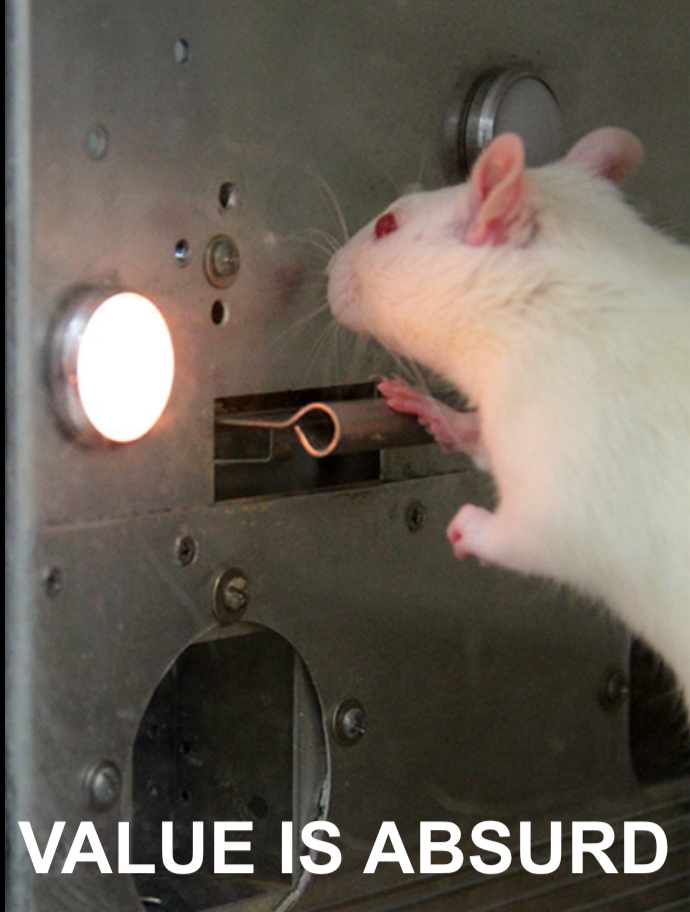
Let’s say we have a mouse in a cage. We’ve designed the cage to vary wildly in temperature, so by default, the mouse is uncomfortable.
But we’re not monsters. We’ve given the mouse some control over the temperature: two levers, a red one that raises the temperature a bit, and a blue one that lowers it. If the mouse can learn to operate this system, it will be able to maintain a reasonable temperature with little trouble.
How would a mouse do on this task, if God saw fit to grace it with a brain that runs on reward and punishment?
Well, let’s say that first the temperature got too high. The mouse tries the red lever. This makes things even hotter. Clearly the red lever is a punishment! The mouse assigns the red lever a value like [-1] or something. Next the mouse tries the blue lever. This makes the cage less hot. A reward! The blue lever gets a value like [+1].
Because it is rewarding, the mouse presses the blue lever until the cage is a comfortable temperature. Then what happens? That’s right, the mouse keeps pressing the lever! After all, the mouse is trying to seek rewards and avoid punishments, and the blue lever has always been rewarding in the past.
Soon the cage is too cold. Pressing the blue lever becomes a punishment [-1], since it only makes things colder. The mouse slowly updates the value of the blue lever until it reaches [0], at which point it stops pressing the lever.
Then what happens? Well, it doesn’t press the blue lever, because it has an expected value of [0]. And it doesn’t press the red lever either! After all, the red lever still has an expected value of [-1]. In all past experience, pressing the red lever always makes things “worse”.
This system of reward and punishment has left the mouse entirely confused. Its conclusion is that the blue lever has no value, and that the red lever is always a negative experience.
You can try to solve this with awkward kludges, but most of them don’t work. For example, you might have it so that the mouse learns separate values for the levers in separate environments, the idea being that it will learn that the blue lever is rewarding when it’s too warm, and punishing when it’s too cold. But then the mouse will have to learn thousands of different values for each action in thousands of different environments — a separate value for the blue lever when it is sunny, overcast, breezy, when the mouse is bored, when the lab techs are talking too loud, etc.
Worse, the mouse will have no ability to generalize. If it learns that the blue lever is “punishing” when the cage is cold, it won’t be able to apply this knowledge outside that immediate situation. It will not learn to press the blue lever when the cage is too hot, because it has reduced the experience to an abstract number.
Much easier for the mouse to learn what the blue lever does: it lowers the temperature of the cage, which the mouse experiences as a decline in body temperature.
Is this a reward or a punishment? Neither. What is the value of this action? It has none. Value is absurd. Pushing the blue lever has specific rather than general consequences. It is simply a thing the mouse can do, and the mouse learns how the things it can do affect the things that interest it.
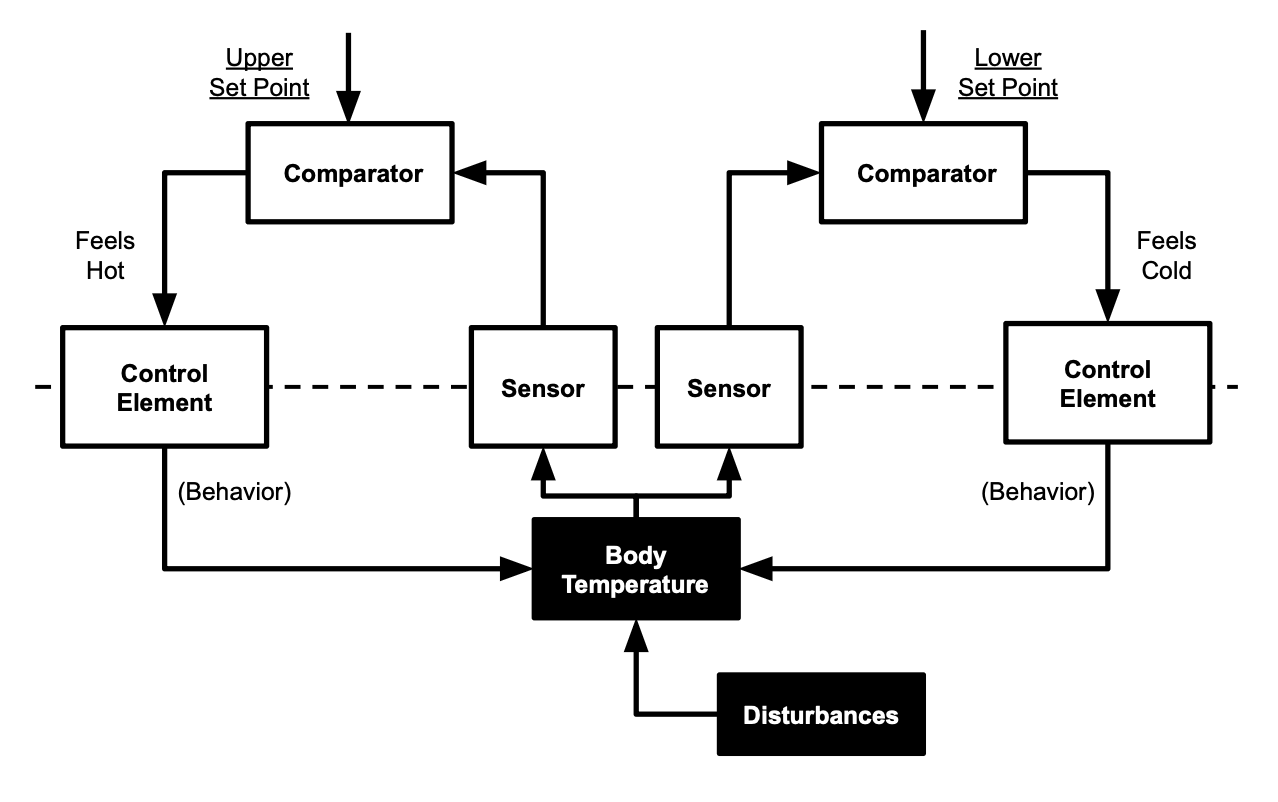
The mouse is naturally endowed with systems interested in its body temperature: at least two governors, one dedicated to keeping it from being too hot, the other keeping it from being too cold. The governors pay attention to things that might knock the mouse’s body temperature away from its set points, and actions that can set the body temperature right again. So the governors are very interested in these levers, and quickly learn their uses.
Both the (keep-mouse-from-getting-too) cold governor and the (keep-mouse-from-getting-too) hot governor track the mouse’s body temperature, though they defend different set points. When the mouse pulls the blue lever, there is a change in the mouse’s body temperature. Since both governors control that variable, both of them learn that the action of pulling the blue lever reduces the mouse’s body temperature. When the mouse pulls the red lever, both governors learn that the action of pulling the red lever increases the mouse’s body temperature.
The governors gain the same information, but they use it in different ways. The cold governor knows to vote for pulling the red lever when the mouse is below its target temperature, and to vote against pulling the blue lever when that would drive the mouse below its target temperature. This is implicit in its design. The hot governor knows to vote for pulling the blue lever when the mouse is above its target temperature, and to vote against pulling the red lever when that would drive the mouse above its target temperature.
Each governor learns on its own, and keeps some kind of record of what actions increase or decrease the variables it cares about, and by how much. This is itself a complicated process, and we don’t mean to discount it. But governors clearly learn how actions change the world, not whether or not they are “valuable”. There is no reward and no punishment.
Some experiences are consistently “punishing”, like getting hit in the face by a 2×4. But this is incidental, it’s only because the pain governor has strong opinions about damage to the face — the opinion that this value should always be kept very close to zero. So the pain governor will always oppose such hardware-related incidents.
And in fact, even this is not always punishing. If you are born without a pain governor, or your pain governor is temporarily turned off (by drugs, for example), then getting hit in the face by a 2×4 is no longer “punishing”. More like a gentle romp.
And there is nothing at all that is always “rewarding”. Your first donut after a long day at work will be rewarding, but by the 10th donut you will start to find donuts “punishing”. By the 100th donut, anyone would find additional donuts excruciating (ok, almost anyone).
Even with that said, there are still a lot of open questions. It may be, for example, that governors learn more quickly when an action actually corrects their error, compared to when they observe it in a neutral situation.
Imagine it’s 20 °F outside and you go and stand near a campfire. Up to that point you were pretty cold, so your cold governor had a pretty big error. When you walk over to the campfire, your cold governor will be very interested — it will notice that standing near a campfire is a good way to warm up.
But what will your hot governor learn? Hopefully it will learn something. After all, standing near a campfire affects the variable it cares about, body temperature. It would be good for the hot governor to remember this, so it can avoid standing near campfires in the future when it’s hot out. But in this moment, the hot governor’s error is zero. So it’s possible that the hot governor doesn’t learn such a strong lesson about the effect of campfires as the cold governor did.
If some day it is 98 °F outside, and there’s a campfire, will the hot governor remember what it learned? At 98 °F, you are too hot, the hot governor has an error. Will it remember that standing near the campfire will increase your body temperature, and so will increase its error? Or will it have to learn that lesson all over again, because last time you encountered a campfire, it was sleeping, because it had no error.
Similarly, we don’t know if a governor will learn more when its error is bigger. But it seems plausible. If it is 78 °F and you go stand near a campfire, that will increase your hot governor’s error from small to medium, and it will remember that. But if it is 98 °F and you go stand near a campfire, that will increase your hot governor’s error from large to extra large! It seems possible that the hot governor will remember that even more, that increasing an error will be remembered more seriously when the error is already somewhat large.
The Part of the Book with Some Math
We probably won’t have to invent the exact rules that run inside a mouse’s head when it’s learning to manage all those levers. Our guess is that many of these algorithms have already been discovered, in past research on reinforcement learning.
A complete recap of reinforcement learning is beyond the scope of this book, but we can give you a rough sense, and suggest the few tweaks it might need to fit into our new paradigm.
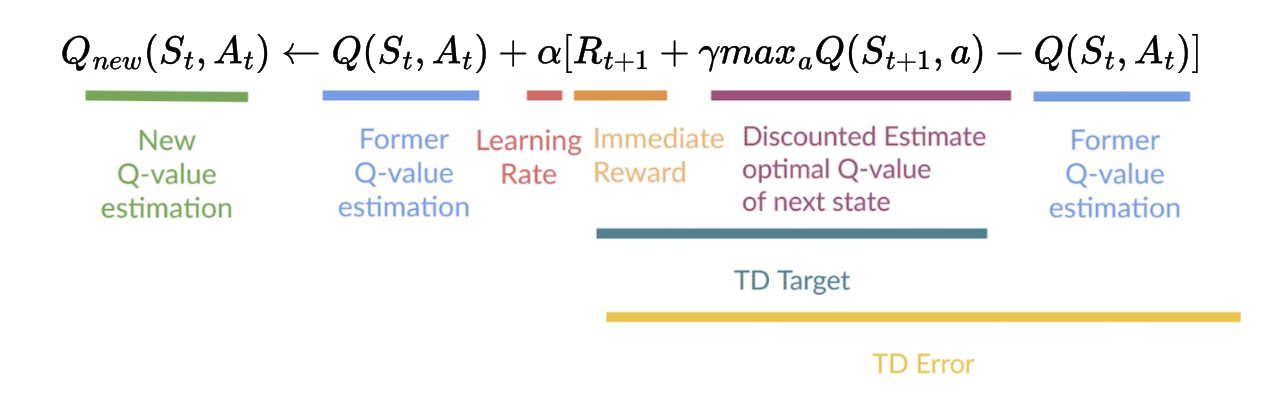
There are many kinds of reinforcement learning algorithms, but the difference between them isn’t our current focus. For today we’ll use Q-learning as our example, a model-free algorithm that uses this update function:
Q-learning works by keeping track of the value of different actions A the agent can take in states S. The function Q(S, A) gives us the value of taking action A in state S.
This update function describes how the value representation of Q(S, A), the current estimate of the value of choosing action A in state S, changes in the light of new evidence.
The core of the equation is very simple. The new Q(S, A) is equal to the old Q(S, A) plus some change (for now ERROR) times a learning rate:
Q_new(S, A) = Q(S, A) + α [ERROR]
The learning rate α is a parameter between 0 and 1 that controls how much the Q-value is updated in each step. If the learning rate is higher, then more weight is given to new information and the mouse learns faster. But it might learn too much from the most recent example, and ignore past experience. If the learning rate is lower, then less weight is given to new information, the mouse learns slower, and updates are more conservative.
Hopefully that makes sense so far. You update the new value based on the old value, adjusting it by some amount, tuned by a parameter that controls whether the update is fast or slow. But what about this error? Let’s break it down.
R_t+1 is the immediate value the animal just experienced after taking action A in state S.
Next we see γ, which is the discount function. This is another parameter between 0 and 1, and this one controls how much future rewards are valued compared to immediate rewards. If γ is close to 1, the agent considers long-term rewards heavily; if close to 0, it focuses mainly on immediate rewards.
The next term, max_aQ(S_t+1,a), is a little trickier but not actually that bad. This looks ahead to the next step (t+1, where t stands for time), so the state we’ll be in next. Then it estimates the maximum value of the possible actions available at that state S_t+1. So this represents the agent’s best estimate of the value of future actions from the next state onward. This is important because if an action puts us in situations that lead to future rewards, we should learn that action is rewarding even if it doesn’t lead to a reward directly; it sets us up for success, which is nearly as good.
Finally, this is subtracted from the current estimate, Q(S, A), because what we want here is to know how far off is the current reward plus expected future rewards from the existing estimate of the value of this action.
Let’s take a few perverse examples that will make this equation transparent. To keep things simple, we’ll assume that the discount function is exactly 1.
Let’s start by considering a situation where we have already learned the correct value. The expected value of action A is 10, and we’ll see that that is perfectly correct. When we take action A in state S, we get a reward of 8, and that puts us in a new state S_t+1 with a maximum expected value of 2. This was all anticipated, so the existing value of Q(S, A) is 10:
NEW = 10 + α(8 + 2 – 10)
This gives:
NEW = 10 + α(0)
So we see that the weight of α doesn’t matter, because the error was zero, and anything multiplied by zero is zero. The organism was entirely correct in its expectations, so there will be no update at all. The reward from this action in this state (including anticipated future rewards) was 10, the old estimate was 10. The new value will be 10, the same as the old value.
But let’s say the estimate is off, and the mouse expected a value of 7 from the action A in state S. Then the function is:
NEW = 7 + α(8 + 2 – 7)
Now the learning rate matters. If the learning rate is 1, then the new estimate of this action in this state will be changed to the exact value of the most recent experience:
NEW = 7 + 1(8 + 2 – 7)
10 = 7 + 1(3)
But this is probably a mistake. It erases all the past experience. Maybe this was an unusually good time in state S to take action A, and we shouldn’t take this good outcome as representative. So instead we can use a more modest learning rate like 0.2:
NEW = 7 + 0.2(8 + 2 – 7)
7.6 = 7 + 0.2(3)
The only change by adding back in the discount rate is that the mouse doesn’t count the full value of the best possible future rewards. They’re only possible — a cheese in the hand and all that. Here’s the same situation with a discount rate of 0.9:
NEW = 7 + 0.2(8 + 0.9(2) – 7)
NEW = 7 + 0.2(8 + 1.8 – 7)
7.56 = 7 + 0.2(2.8)
In summary, Q-learning works by adjusting the Q-value of each action based on immediate rewards and estimated future rewards, gradually refining an estimate for the likely value of each action in each state.
It takes only a simple tweak to adapt this style of algorithm for cybernetics.
Reinforcement learning assumes that each agent has a single value function that it tries to maximize, and that all kinds of value are the same. In this perspective, 2 points from hot chocolate is the same as 2 points worth of high fives.
The cybernetic paradigm rejects that — abstract “rewards” don’t exist. Instead, governors track specific changes. So in this case, an algorithm like Q-learning is running inside each of the governors. The keep-mouse-from-getting-too cold governor is keeping track of what different actions in different states do to its error signal. The keep-mouse-from-getting-too hot governor is keeping track of what different actions in different states do to its error signal.
Each of the governors has its own ledger of the effect of different possible actions, and is keeping track of how each of these actions influences the signal(s) it cares about. Then all the governors get together and vote for their favorite action(s).
Recap
Building a mind around notions of “value” quickly leads you into contradictions.
Value is absurd. Behaviors have specific rather than general consequences.
We think the mind doesn’t represent “value” at all. Instead, governors track how actions affect their error signals. Governors clearly learn how actions change the world, not whether or not they are “valuable”. There is no reward and no punishment.
Human nature is not a machine to be built after a model, and set to do exactly the work prescribed for it, but a tree, which requires to grow and develop itself on all sides, according to the tendency of the inward forces which make it a living thing.
—John Stuart Mill
The cybernetic paradigm gives you a theory of personality for free.
There are lots of governors in your mind, and some governors are stronger than others. Other things being equal, a stronger governor has more influence over your actions than a weaker governor. It gets more votes and has more of a say when it comes time for your governors to decide what to do.
Someone with an unusually strong hunger governor will seek out food sooner and will spend more effort to get it than someone with an especially weak hunger governor.
Someone with an especially strong status governor will be especially sensitive to changes in their status, and will invest lots of time and effort into status games. Someone with an especially weak status governor will appear almost blind to status, and it will hardly ever influence their behavior.
This provides the cybernetic paradigm’s theory of personality. People differ in many ways, but a particularly important way they can differ is in the strength of each of their different governors/emotions. In the cybernetic paradigm, differences between people are differences between parameters like the setpoints, strength, and sensitivity of their different governors.
To say that one person is more extraverted than another is to say either that their setpoint for social interaction is higher, that they defend the setpoint more aggressively, or that they’re more sensitive to disturbances away from that setpoint. To say that someone is brazen is to suggest that their shame governor is weaker than normal. To say that they are humble says something about the governor that pays attention to status.
Let’s break this down a little further.
First: People can have different setpoints for the same governor. We don’t know what units danger is measured in, but if one person has a danger set point of 5 units and another person has a danger set point of 10 units, the first person will keep themselves much safer than the second person. They will avoid situations where they feel that danger is above 5 units, while the other person won’t be sensitive, won’t feel any fear, until the danger is much higher.
That said, we actually don’t think that most personality differences are differences in setpoints, because the setpoints we know about are pretty similar across different people. Most people defend very similar setpoints for body temperature (about 98.6 °F), very similar setpoints for plasma osmolality (about 280 mOsm/L), very similar setpoints for serum potassium (about 4 mmol/L).
But there are certainly some exceptions. People can defend very different body weights, making some people extremely lean and others extremely obese. And set points can change, so they’re sometimes different even within one person. A fever is a short-term change in the body temperature set point(s). Obesity is a long-term change in the body weight set point(s).
Finally, even if people do defend very similar setpoints across the board, there will always be small differences between their setpoints, which will lead to some differences in personality.
Second: People’s governors can be stronger or weaker when it comes time to negotiate with other governors. When two governors disagree, which one wins?
Mark’s anger governor is especially strong, and gets many more votes than the other governors. So when anger goes up against anything else, it almost always wins. Mark has anger-control issues.
Julie’s fatigue governor is especially weak, and gets many fewer votes than the other governors. So when fatigue goes up against anything else, it almost always loses. Julie often stays up until she is very tired, doing all sorts of activities until she practically collapses. She barely seems aware that she’s tired. Even when she lies down, she often has a very hard time falling asleep. If there’s anything else she has in mind, her fatigue is not strong enough to keep her from thinking of it, then getting up and doing it.
You can describe this in terms of each governor having a different weight, with a weight of 1 meaning average strength. If one of your governors has a weight of 1, then that drive is as strong for you as it is for the average person. Weights above 1 mean the governor is stronger than normal; weights below 1 mean it’s weaker.
If you are born with the weight on your fear governor set to 2, your experience of fear is twice as powerful as normal, it has something like twice the influence over your actions. This makes you very cowardly, since your fear becomes overpowering in situations that other people would find mildly concerning. After all, it has twice as many votes as usual!
If you are born with the weight on your fear governor set to 0.5, your experience of fear is half as powerful as normal, it gets half as many votes as it would normally. This makes you very brave. In situations that other people would find terrifying, your fear barely has enough votes to call a motion.
Third: People’s governors can be more or less sensitive to disturbances. By analogy, a thermostat might have a narrow or a wide acceptable range around the target temperature. Strict sensitivity would mean frequent corrections as soon as the temperature drifted even 0.1 °F away from the set point, while a looser control system would allow more drift before it reacts, with control not kicking in until it was 2-3 °F off target.
This is a natural tradeoff. Strict/aggressive control means you spend more energy, reacting even to small changes and adjusting constantly, but it also means you stay very close to the set point. Loose/sluggish control means you spend more time out of alignment but you also save a lot of energy on not making all these neurotic adjustments. Some things really do need to be kept right at the set point, but other things can be allowed to wander a bit.
We think these three kinds of differences are probably important. But just to show that this isn’t an exhaustive list, here are two more ways that people’s governors might be different.
For example, an important parameter in control systems is gain. A sluggish system applies weak corrections (low gain), meaning it takes longer to reach the target. An aggressive system cranks up corrections harder (high gain), leading to faster changes, but possibly overshooting.
So some governors respond to an error with a big correction all at once, while other governors respond to an error of the same size with many small, incremental corrections. This might look like a personality difference of overreacting or underreacting.
This isn’t the same as sensitivity to disturbances. For example, Julie has a cleanliness governor with low sensitivity and high gain. She lets her apartment get pretty dirty (because of the low sensitivity), but once it’s a certain level of mess, she cleans it all at once, back to a high level of cleanliness (high gain).
Mark also has a cleanliness governor with low sensitivity, but his has low gain. He also lets his apartment get pretty dirty (because of the low sensitivity), but once it’s a certain level of mess, he slowly cleans it bit by bit until it doesn’t bother him anymore (low gain).
A related idea is damping. Some thermostats have a built-in “wait time” after making a correction, which helps prevent the temperature from swinging wildly. If our governors have some kind of damping, this might also vary between people.
With a fear governor set to low damping, you would respond very quickly to danger, but might sometimes freak out over nothing. It might even look like an extreme flinch response. With a fear governor set to high damping, you would respond very slowly and deliberately to new threats — good in some situations, but very bad in others!
All these parameters can combine in some interesting ways. Consider two people who have unusual sugar-governors, but unusual in different ways. Alice has a normal sugar setpoint, but her sugar-governor is unusually strong. Bob has a normal weight on his sugar-governor, but an unusually high sugar setpoint.
Alice’s sugar-governor gets more votes than other people’s. Since it tends to have the votes it needs, from the outside this looks like making sweet foods a priority. She always eats her sweets first. But if you kept a close measure of how much sugar she’s eating, you’d see that it’s actually the same amount as the average person, because her set point is the same.
Bob’s sugar-governor gets the normal amount of votes, but aims for a higher setpoint. For a given level of desire, Bob doesn’t prioritize sugar more than other people. But if you keep track over the long term, he does consume more sugar to reach that higher set point.
The upshot is that there are at least as many personality dimensions as there are emotions, and each of these personality dimensions are linked to the “settings” of a particular emotion.
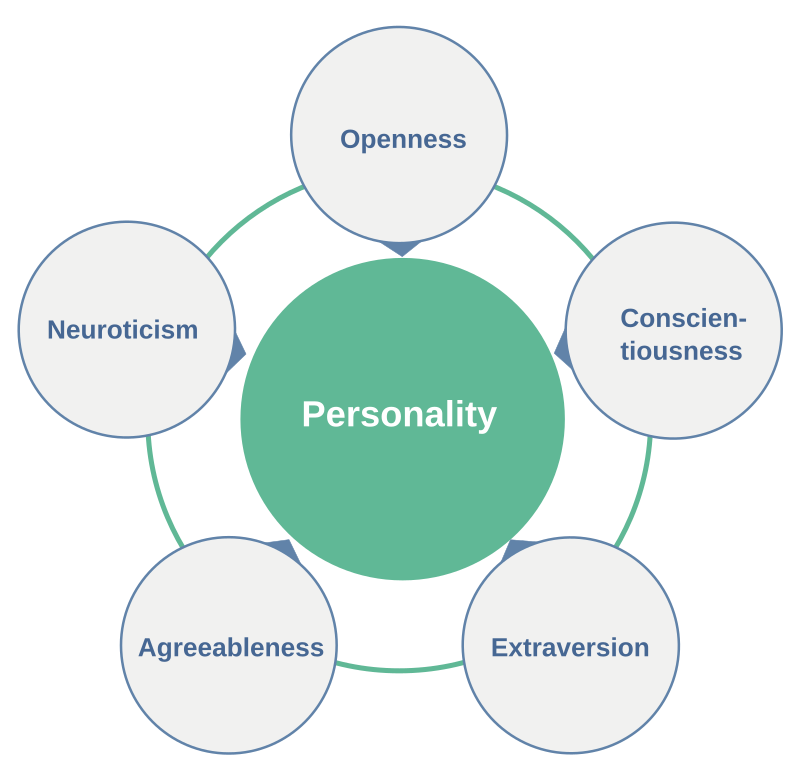
This theory comes from statistical analysis. When you have people rate themselves and others on a wide variety of adjectives, and then apply various statistical techniques, you usually end up with five clusters of adjectives. Over time people settled on a set of labels for those clusters: openness, conscientiousness, extraversion, agreeableness, and neuroticism.
It’s not hard to see how these might map on to various emotions. For example, extraversion is probably a rough measure of the strength of various social emotions.
But the Big Five has some problems as a theory. The first one is fundamental — the Big Five are an abstraction, not a model. We all have a casual sense of what it means to be neurotic, we know what kind of superficial behavior to expect from someone described with this word, but the theory doesn’t say anything about the mechanisms that cause someone to behave in a neurotic way. It caps out at being able to record that one measure is correlated with another measure. It can neither explain, nor in any meaningful way can it predict. (For more about these problems, see The Prologue.)
Rather short of a wiring diagram
In addition, the method psychologists used to come up with these five factors is limited.
The Big Five were discovered through a method called factor analysis, a statistical approach that searches for clusters of correlated variables and hypothesizes factors that might account for the patterns it finds. Psychologists collected large sets of descriptive adjectives like “friendly” and “bashful” and had people rate how well the adjectives applied to themselves or others. Then they used factor analysis to estimate how these ratings co-occurred. This usually gave a solution of five factors — five clusters of adjectives that tended to be highly correlated within the clusters.
But language doesn’t capture all of the true personality differences, or at least doesn’t capture all of them to the same degree.
There are some terms, like “salt tooth” and “sweet tooth”, which hint at recognition of the fact that in some people the salt-hunger governor is unusually strong, and in other people the sugar-hunger governor is unusually strong. But these terms aren’t as much a part of our language as dimensions like “does this person spend lots of time around other people” or “is this person reliable”, which come out into the factors of “extraversion” and “conscientiousness”.
This is for social-historical reasons — at the moment, our culture cares a lot about communicating whether or not a person is sociable and/or reliable, and cares very little about their preferences for sweet or salty foods. Compare this to how Ancient Greek and Latin both had lots of different words for different kinds of shields. In their culture, the kind of shield you used said a lot about where you fit in society, so they had terms to make these distinctions. But in our culture no one cares what kind of shield you use, so modern English does not.
Different times and cultures will have different priorities, and will want sets of words that help them describe variation in the drives they care about the most. There’s still variation in the drives they don’t care about as much, but since they don’t care about that variation, they won’t talk about it, so they won’t need any words for it.
The fear governor is real, and martial cultures of the past had many ways to talk about differences in how someone responds to fear. How you responded to fear was very relevant in these cultures, it came up a lot. But today we are safe most of the time and these differences rarely matter, so the words we’ve inherited from such times, like brave and cowardly, are too few to pull their own group in a factor analysis. (You could get more by adding archaic terms like dauntless, plucky, valiant, doughty, aweless, and orped, but these probably don’t go in the surveys.)
The Icelandic language, on the other hand, which has changed much less than English over the centuries, still retains several words for these concepts — huglaus, óframur, ragur, blauður, deigur, all these mean something like “fearful” or “cowardly”. And on the opposite side, Icelandic has about a dozen words for “brave”.
But even though English doesn’t give them dozens of adjectives apiece, emotions like cold, tiredness, needing to pee, etc. all have personality dimensions just the same. Some people are driven more by the need to keep warm, and some barely notice the cold. Some people are driven by their bed. For some people, when nature calls, you must answer.
The seven deadly sins are a bit judgy as a personality measure, but they had it a little better. Gluttony and sloth are clearly ways to talk about individual differences in things like hunger and tiredness. And lust is, if anything, one of the most notable personality dimensions. How could you possibly explain Aella’s personality without mentioning that she is much, much hornier than average? On the opposite side, having a weight on this governor near zero would lead to asexuality, so being asexual should also be understood as part of personality.
Individual Differences
There are also some differences that are not linked to the emotions and drives, that don’t reflect the settings on different governors.
For example, people can also be different in the parameters of motivation we described in Part II; like the gate threshold, i.e. the minimum number of votes to make an action happen. If you have a higher gate threshold, you are more likely to just sit there and less likely to do anything, every action needs a larger number of votes just to activate. If you have a lower gate threshold, you are constantly jumping around, every time an action gets any votes, you do it. Similarly, to say that someone is decisive is to imply something about the parameters of their selector, not their governors.
One underrated individual difference is being a night owl versus being a morning lark (sometimes called your chronotype). The dimension is related to sleep, but doesn’t seem like a parameter of the drive for sleep (probably?). Instead it’s a tendency or preference for when sleep will occur.
Some people are certainly more curious than others. But curiosity may not be an emotion, because it doesn’t seem to be satisfying a drive to send a signal to some specific target.
Another difference is taste preference. Certainly some tastes, like those for salt or fat, are nutritive, necessary for survival, and therefore probably controlled by a governor. But some taste preferences may not come from the drives, they may just be variation. Chunky and creamy peanut butter have almost exactly the same nutritional profile, but some people prefer one to the other. The same goes for preferences for smells — there is probably not a lavender-smell governor, but some people still like the smell of lavender more than others.
If these preferences really are preferences, and aren’t attached to drives, we’ll be able to tell because they will not be exhausted like drives are. Even someone who likes salt very much will eventually eat enough salty food and will stop eating it for a while. Their salt drive will send its error signal to zero and then be satisfied. But someone who likes the smell of lavender shouldn’t get satisfied by it in the same way, their preference should be mostly constant.
The reason for these differences is the same as for any kind of differences: diversity. It’s not just random chance; it is by design, because: bees.
How do the bees decide how many of them should be fanning? … There’s no communication, but as the ventilation gets worse in the hive, more and more bees start fanning their wings. How would you design bees to solve this problem? You don’t want every bee fanning their wings 24/7 or they’re wasting time, but a nice ratio of ‘bees fanning’ to ‘bees not fanning’ that adapts in order to hit your ventilation criteria.
When Huber examined the fanning problem, he came up with an elegant theory. He suggested that bees are differentially sensitive to noxious smells. So as the noxious smells get worse, the sensitivity threshold of more and more bees is reached, and more of them begin fanning until ultimately the entire hive is fanning.
If everyone in your village has the same set point for danger, then as danger increases, for a long time no one takes any precautions, and then at some point everyone flips over and starts fortifying the town all at once. This is kind of a nuts way to do things.
It’s better to have some diversity. If there’s only a little danger, a small number of villagers are stockpiling food and reinforcing the town walls. As the danger increases, more and more villagers attend to the safety of the town. This is actually its own form of control system.
The same thing goes for preferences. If everyone in your band of hunter-gatherers falls asleep exactly at dusk and rises at dawn, then you are all defenseless at the same time. But if some of you are morning larks and some of you are night owls, then someone is always awake to tend the fire and watch for saber-toothed tigers.
Now apply the same reasoning to taste and smell. If everyone in your town has identical tastes, then they will all eat pretty much the same food; if that food becomes rotten, everyone gets sick at once. Better to have variation in food preferences so you’re eating different things. Then if some food goes bad, only some of you get sick. Avoid a single point of failure.
To sum up, differences in the strength of different governors are a major part of personality, though not the only part. There are also various other individual differences, including simple preferences.
Sex Differences
Academic psychologists claim they can’t find any clear mental differences between the sexes (mostly; for the nuanced version of things, see here). But here’s one: the huge and obvious differences in the desire to play certain kinds of video games.
About half of gamers are women. But a few genres are overwhelmingly played by men. In particular, men are much more interested in tactical shooters like ARMA 3, and in grand strategy paint-the-map games like Europa Universalis. These games are about violent competition and domination, so this pattern may point to the existence of something like a “need to dominate” emotion.
Looking closer, the experience of shooters and strategy games are quite different, suggesting that there might actually be two separate dominance-related emotions that tend to be much stronger in men than in women. Let’s consider these drives one at a time.
The experience of a tactical shooter is shooting people in the head; it’s about as close as you can get these days to crushing your enemies, seeing them driven before you, and hearing the lamentations of their women. You may be wondering whether people really have a drive for such a thing, especially if you don’t play tactical shooters. But there’s good evidence that many people do. As one example, the subreddit r/CombatFootage (TAKE CARE IN CLICKING, CONTAINS DISTURBING COMBAT FOOTAGE) has 1.7 million members. Top videos on the subreddit get thousands of likes and hundreds of comments. For comparison, r/vegan also has 1.7 million members. Some people really want to see this stuff.
In contrast, grand strategy games are abstract and bloodless, lovingly referred to as spreadsheet simulators. These don’t seem like they could be about personal, physical domination, since they don’t even simulate that. But they’re not pacifistic — they do a very good job simulating the experience of forcing other societies to make concessions, become your vassals, and so on.
Between the two genres, there’s plausibly one dominance emotion about personally thrashing your enemies, and another dominance emotion about being in charge of organizing the logistics of thrashing — something like social domination, or having your group dominate other groups.
Paradox games!
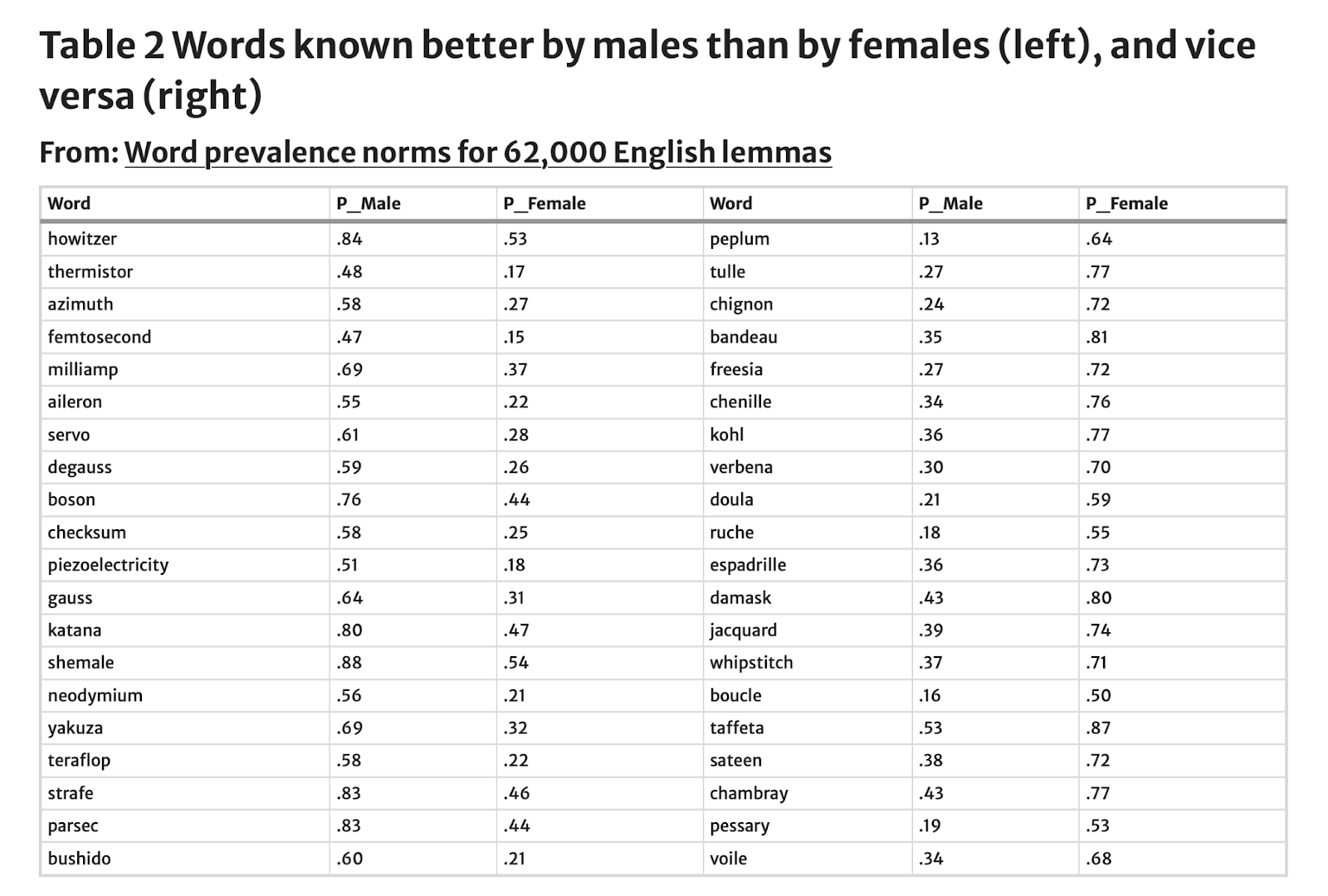
We see something similar in the list of words known better by males than by females, and vice versa. Men are much more likely to know words like howitzer, katana, and bushido (not just military terms, but historical military terms) while women are much more likely to know words like peplum, chignon, and damask (fabric and hairdressing terms). The authors of this paper characterize the result as, “gender differences in interests (games, weapons, and technical matters for males; food, clothing, and flowers for females)”.
even more spreadsheets
The list suggests that on average men tend to have stronger dominance emotions and women tend to have stronger decorative emotions, or perhaps hygienic emotions (in the sense that being properly dressed is hygiene).
We are of course talking about average differences. There are plenty of women with strong dominance emotions, and plenty of men with strong decorative emotions. (And women may in fact have higher tuning on a different set of dominance emotions.) But on average there seems to be some difference.
We don’t care about the cause — differences could be the result of socialization, of nature, or both. Or something else. But there do seem to be average personality differences between the sexes, which make perfect sense when you think of personality as differences in the strength of different governors.
It’s also worth considering if sex differences we think of as physiological might actually be psychological. Women typically feel colder than men — this might be biological, something to do with their body size or metabolic rate. But it could also be psychological, something to do with the set point or strength of their cold governor.
Psychiatry
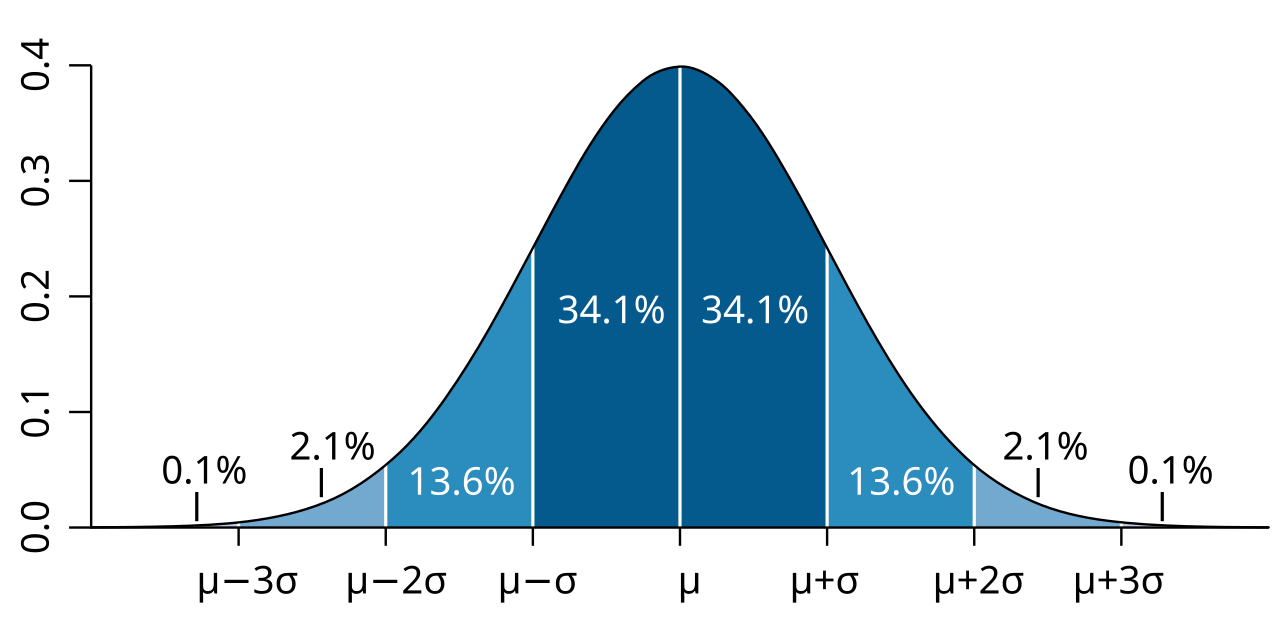
Like most biological attributes, the strength of our governors probably falls on a normal distribution. The majority of people will have a fairly usual weight on each governor. But in rare cases, weights will be set incredibly high or incredibly low.
Since we have no idea what the units are for “strength of a governor”, as before we will just say that 1 is the population average. Having a weight of 0.5 on a drive means it is half the strength of the population average, and having a weight of 2 on a drive means it is twice the strength of the population average.
If you set the weight on a governor to 0, we call this a “knockout”. It’s functionally equivalent to not having that drive at all, because when the weight on a governor is 0, the governor gets no votes.
For example, take Alex Honnold, sometimes called “the World’s Greatest Solo Climber”. Alex enjoys climbing sheer cliffs without a rope, an experience so terrifying that many people can’t even stand to watch the videos. When neuroscientists put Honnold through an fMRI and showed him terrifying and gruesome pictures, they found that his brain is intact — he does have an amygdala — but he has almost no fear response.
Whatever the exact biological issue might be — whether he was born that way, or if he’s somehow turned down the fear governor through training and exposure — Honnold appears to be someone with a fear knockout. The weight on his fear governor is set very close to zero.
In cybernetic psychology, a lot of psychiatric conditions look, in a literal sense, like personality disorders. Personality is largely made up of differences in the weights on a person’s various governors. Personality disorders occur when some of those weights are not merely different, but set extremely low or extremely high.
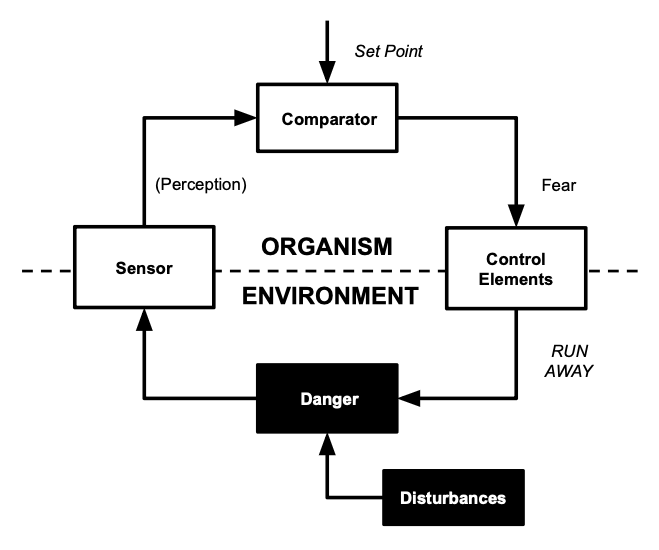
Consider fear. Most people are somewhat concerned about things some of the time. They have a weight on their fear governor around 1. If you set the weight on “fear” to 10, they will instead be very concerned about things lots of the time. That looks a lot like paranoia.
This is a good spot to point out that a cybernetic system has multiple parts and can be broken in many ways. Let’s take the fear governor as an example.
You can break the input function, so it perceives danger as being higher than it otherwise would. This will cause paranoia. You can change the fear governor’s set point to a very low level of danger, so it reacts to even very small amounts of danger. This will cause paranoia. You can damage the output function, so that it thinks that large interventions are appropriate for small amounts of danger. This will cause paranoia. Or you can change how many votes the fear governor gets in the parliament of the mind. Again, this will cause paranoia.
These changes may present slightly differently, but notice how even though these are four different problems with the fear governor, you end up seeing basically the same behavior in every case. Among other things, this makes diagnosis and treatment quite tricky. You have at least four disorders, with categorically different causes, yet nearly identical presentation.
This also offers a plausible model for conditions like autism and psychopathy. Both appear to be congenital abnormalities in various emotions — conditions that happen when you are born with a couple of your emotions unusually strong or weak.
“Autism” seems to be a label that we apply to people who have very low weights, or complete knockouts, on some of their social emotions.
“Psychopathy” seems to be a label that we apply to people who have very low weights or knockouts on a different set of social emotions, especially when combined with high weights on emotions like anger or need for dominance.
As you can tell from our hedging, we suspect these categories are poorly-formed. There probably isn’t “a disorder” that can be identified with autism. It’s just a word, an abstraction that we use to refer to various personality types that are similar in the sense that they have low weights on certain social emotions. (See the Prologue for more on this.)
Autism and psychopathy are often framed as deficiencies, but you can also see them as deficiencies in some things combined with superabundances in other things.
We tend to call people “psychopaths” not when they merely lack in fear or compassion, but when a lack of fear or compassion are combined with unusually strong drives for status and dominance.
People tend to be considered autistic not when they merely lack a drive for status, but when this is combined with unusually strong interest in social rules and an unusually strong drive for compassion. People get confused about this. You often hear things like, “people who are autistic don’t understand social conventions”. But actual people who are autistic seem to believe things like, “if you eat a non-prime number of chicken nuggets you’re breaking the rules”.
It’s not clear if these are specific “disorders”, or just the extremes of normal personality variation. Some people have stronger social emotions than others. When the weights on your social emotions are 0.7, nobody cares, you just seem kind of introverted. But when some of your weights are 0.5 or lower, maybe they start calling you autistic.
Same thing for psychopathy. The lower your social weights are, and the higher your aggression and dominance weights, the more likely people are to call you a psychopath. But there’s not a bright line. It’s more like height than blood type. Type O and type AB blood are categorically different, but there’s no objective point at which you become “tall” or “short”, those are relative.
Recap
People differ in many ways, but a particularly important way they can differ is in the strength of each of their different governors/emotions. In the cybernetic paradigm, personality is the result of differences between parameters like the setpoints, strength, and sensitivity of different governors.
People can have different setpoints for the same governor.
People’s governors can be stronger or weaker when it comes time to negotiate with other governors. When two governors disagree, which one wins?
People’s governors can be more or less sensitive to disturbances.
People’s governors can have different amounts of gain, applying weak corrections or strong corrections.
People’s governors can have different amounts of damping.
The Big Five are an abstraction, not a model.
The Big Five were discovered through a method called factor analysis, a statistical approach that searches for clusters of correlated variables and hypothesizes factors that might account for the patterns it finds.
Psychologists collected large sets of descriptive adjectives like “friendly” and “bashful” and had people rate how well the adjectives applied to themselves or others. Then they used factor analysis to estimate how these ratings co-occurred. This usually gave a solution of five factors.
But language doesn’t capture all personality differences, or at least doesn’t capture all of them to the same degree.
There are also some individual differences that are not linked to the emotions and drives, like your chronotype or your taste preferences.
The reason to have personality differences is the same as for any kind of differences: diversity.
It’s better to have diversity. If there’s only a little danger, a small number of villagers are stockpiling food and reinforcing the town walls. As the danger increases, more and more villagers attend to the safety of the town.
Remember: bees!
There appear to be large sex differences in the strength of some of the governors.
Many psychiatric conditions are probably personality disorders, the result of the weights on a person’s various governors being set extremely low or extremely high.
Inland Empire: What if *you* only appear as a large singular body, but are actually a congregation of tiny organisms working in unison?
Physical Instrument: Get out of here, dreamer! Don’t you think we’d know about it?
— Disco Elysium
When you’re hungry, you eat a sandwich. When you feel kind of gross, you take a shower. When you’re lonely, you hang out with friends.
But what about when you want to do all these things and more? Well, you have to pick. You have many different drives, but only one body. If you try to eat a hamburger, kiss a pretty girl, and sing a comic opera at the same time, there will be a traffic jam in the mouth. You will suffocate, or at least you will greatly embarrass yourself. Only a true libertine can eat a sandwich in the shower while hanging out with friends.
To handle this, you need some kind of system for motivation.
For starters, consider this passage from Stephan Guyenet’s The Hungry Brain:
How does the lamprey decide what to do? Within the lamprey basal ganglia lies a key structure called the striatum, which is the portion of the basal ganglia that receives most of the incoming signals from other parts of the brain. The striatum receives “bids” from other brain regions, each of which represents a specific action. A little piece of the lamprey’s brain is whispering “mate” to the striatum, while another piece is shouting “flee the predator” and so on. It would be a very bad idea for these movements to occur simultaneously – because a lamprey can’t do all of them at the same time – so to prevent simultaneous activation of many different movements, all these regions are held in check by powerful inhibitory connections from the basal ganglia. This means that the basal ganglia keep all behaviors in “off” mode by default. Only once a specific action’s bid has been selected do the basal ganglia turn off this inhibitory control, allowing the behavior to occur. You can think of the basal ganglia as a bouncer that chooses which behavior gets access to the muscles and turns away the rest. This fulfills the first key property of a selector: it must be able to pick one option and allow it access to the muscles.
The human mind, and the minds of most vertebrates, operates in essentially the same way.
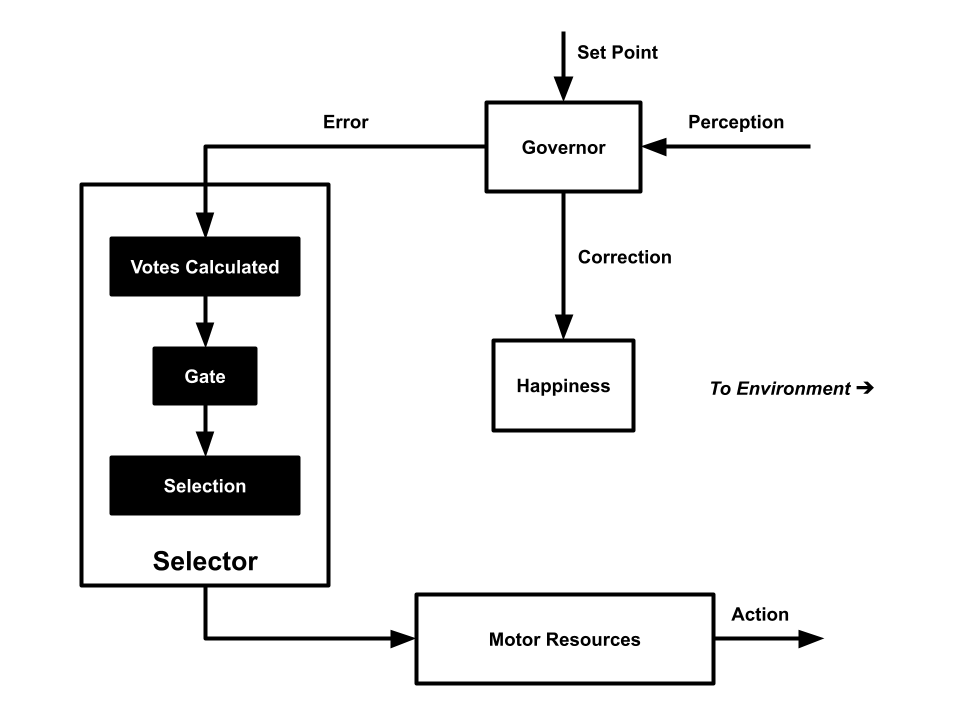
Motivation and action are determined by the collective deliberation of multiple governors. Each governor is one of the control systems described in Part I — some governors for thirst, some for pain, some for fear, and so on. They come together and submit bids for different actions and vote on which action to take next.
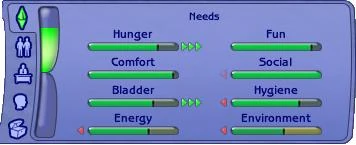
Inside Out, Disco Elysium, Internal Family Systems, The Sims, etc. — we have a deep intuition that behavior is the result of a negotiation between inner forces that want different things. This keeps manifesting in pop culture, but academic psychology has mostly missed it.
The technical term for this problem is selection, so we’ll refer to this system as the selector. In a physical sense this process probably happens in the basal ganglia, but we’ll let someone else worry about the neuroscience. For now we just want to talk about the psychology.
We can’t say exactly how the selector works, there are too many mysteries, lots more work to be done, a lot of possible lines of research. But here’s some speculation about how we think it might work, which will sketch out some of the open questions.
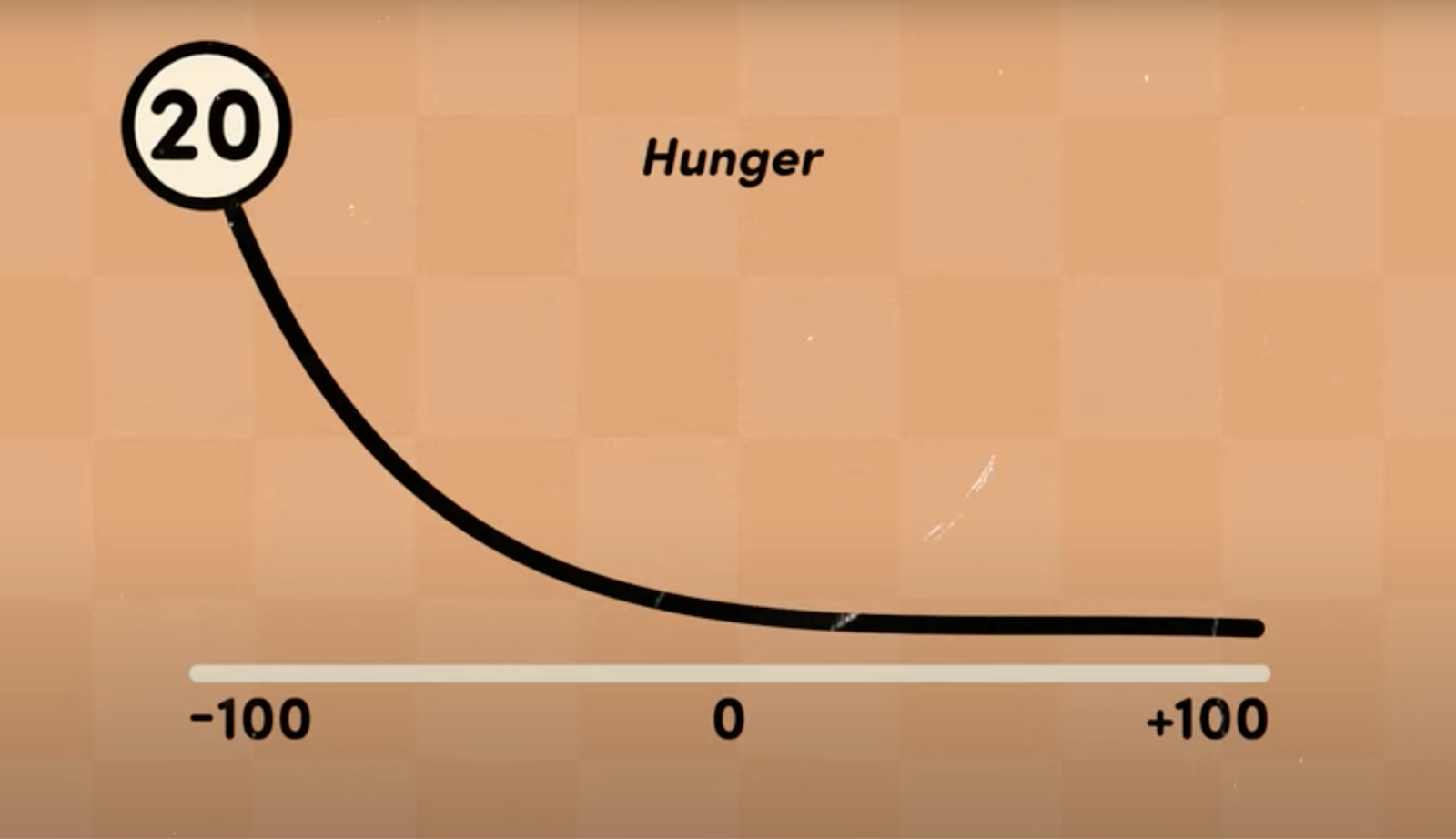
Governors cast votes based on the strength of their error signal. The stronger the error, the more votes it gets. When you’re not at all thirsty, the thirst governor gets basically no votes, because it doesn’t need them. Other priorities are more important. But if you are very thirsty, the thirst governor gets lots of votes (or if you prefer, one very strong vote). If you are starving, your hunger governor gets plenty of votes so it can drive you to eat and become less hungry.
Governors vote for behaviors that they expect will decrease their errors. The thirst governor votes for actions like “find water” and “drink water”. Later, the have-to-pee governor votes for actions like, “find a bathroom”. The pain governor votes for things like “stop picking a fight with the lions, get the hell out of the lion enclosure.”
Governors can also vote against behaviors that would increase their errors. It’s clear that the pain governor can vote against touching a hot stove, even if pain is currently at zero. You don’t have to wait until you burn your hand for your pain governor to realize this will be a bad idea.
This is because governors are predictive. If something is hurting you, the pain governor will vote for you to stop doing that, to avoid the thing that is causing you pain, to withdraw. But you don’t have to be in pain for the pain governor to influence your actions. As behaviors come up for a vote, the pain governor looks at each of them and tries to predict if they will increase its error, that is, if they will cause you pain. If it thinks some behavior will increase its error, the pain governor votes against that behavior.
So we see that governors don’t only get votes based on their current error signals — they also have the power to vote against behaviors they anticipate will increase their error. Maybe governors cast votes not based on the current strength of their error signal, but based on the predicted change in their error if the action were to be carried out. In this way when hunger is high, the hunger governor gets votes for “eat ham sandwich” because this is predicted to correct the error. And even when pain is zero, the pain governor still gets votes against “touch the electric fence” because touching the fence is predicted to increase its error. This would also fit most observed behavior.
Wherever votes come from, the governors need to allocate their votes, so there’s some procedure for this as well. One simple way to do things is for governors to propose behaviors and submit bids on those behaviors to the selector, and the strongest bid wins. If this is how it works, then each governor is supporting only one behavior at a given time.
This seems unlikely. We think it’s more likely that governors support many possible behaviors at once — just like how legislators in a real congress support many possible policies at once.
Actions that happen all the time are so common because they are popular with lots of governors. For example, the “eat a hamburger” action captures the votes of basically the whole hunger voting bloc — salt-hunger, fat-hunger, calorie-hunger, et cetera. Many different hungers will vote for this hamburger. No one dares to vote against the hamburger policy, except maybe the shame governor, if you’ve been taught that hamburgers are sinful or something.
It’s also not clear whether votes are conserved. If the hunger governor has 100 votes and you give it 50 options, can it only give each option 2 votes? Is this why no one can agree what they want for dinner? Or can it put all 100 votes towards every option that it likes?
Functions
Some governors may get more votes than others. You can imagine why the governor in charge of keeping you breathing might get extra votes — it has a very important job and it can’t wait to build a coalition. The same thing goes for governors like fear and pain. When you’re in serious danger, they always have the votes they need.
Our assumption so far is that the relationship between error signal and votes is linear. But certain governors, controlling things that are critical to your survival, may get more votes for the same amount of error signal — there may be different curves. This is how The Sims did it. If this is the case, it should be possible to discover the formula for votes as a function of error for each governor.
On the other hand, maybe the more critical governors just have stronger error signals than less-important governors. In any case, we should notice that things like suffocation and pain tend to get the votes they need, however that works out under the hood.
However votes are determined, the outcome is simple. Whatever action gets the most votes is the action you take next, assuming the action wins by a large enough margin.
This is not exactly a winner-take-all system. You can sometimes do more than one thing at once, the selector does try to account for multitasking — you can chew and drive at the same time, since your mouth and hands are not deadlocked. But you cannot e.g. both pee and stay in your clean, dry bed. Someone is going to have to win that vote.
Threshold
An organism that can’t sit still and keeps doing stuff, even when it doesn’t need to, is wasting resources for no reason and putting itself in danger. Sometimes organisms do nothing at all, so our model of the selector needs to account for that.
We think it does that through a mechanism that recognizes votes below a certain threshold and reduces them to zero. In audio engineering, this is called a gate. An audio gate stops sounds below a certain volume from passing through, which is good for cutting out background noise and static. For more information, watch this Vox explainer or listen to some Phil Collins.
You Know What I Mean
In the mental selector, the gate stops votes that are below some minimum threshold. If you are a tiny bit hungry, you shouldn’t bother leaving the house to get a meal, even if there is nothing better to do. Don’t go out and see people if you are only a tiny bit lonely.
An organism without a gate, or with a broken gate, will eat as soon as it is a tiny bit hungry, leave the house as soon as it is even a tiny bit lonely. It will constantly put on and take off its sweater to try to maintain a precise target temperature. But this is clearly not a good use of time or energy. Better to wait until you’re actually some minimum amount of hungry or lonely, before taking steps to correct things.
The gate may act on governors directly, preventing governors with very small error signals from voting at all. When you’re not in any danger, who cares what the fear governor thinks?
Or it could be that the gate acts on behaviors, and behaviors that get below some fixed number of votes are treated like they got zero votes instead. If no action gets a number of votes above the threshold, then no behavior occurs.
Also, it seems like an action only happens as long as it beats the next-highest action by a certain number of votes. It’s not clear whether it needs to win by a certain number of votes (“action with the most votes happens as long as it has more than 20 more votes than the action with the second-most votes”) or by some kind of fraction (“action with the most votes happens as long as the action with the second-most votes has no more than 90% its count”), or if this is even a meaningful question given how our motivation system is designed. The important thing is that if “drink coffee” gets 151 votes and “run to catch the bus” gets 152 votes, you will stand there looking like an idiot and miss your bus. (cf. Buridan’s ass)
So far we’ve been assuming that governors are the only things that drive behavior, the only things that ever get votes in the selector. But there may be exceptions.
Curiosity is an unusual case, kind of an enigma. It might be an emotion, but it’s a bit strange. It might be something else, some other kind of signal.
Like an emotion, curiosity seems to be able to drive behavior. We’ve all done things simply because we were curious. This suggests it might, like the other emotions, be the error signal of some kind of governor. And it seems to be able to compete with the other governors, because curiosity often wins out over concerns like sleep or even sex.
But in other ways, curiosity does not look like the other emotions. Unlike hunger or fear, it’s not obviously an error signal from a drive that keeps us alive. It’s not obviously connected to immediate survival in the way the other emotions are. A person who doesn’t sleep or breathe dies. A person who doesn’t feel shame is ostracized, and (in nature) soon dies. But a person who doesn’t act on their curiosity is just frustrated.
And unlike the other emotions, curiosity doesn’t seem to be easily satisfied. Acting on your fear should make you less afraid, acting on your thirst should make you less thirsty, but acting on your curiosity often seems to make you more curious.
We do have one suggestion of how curiosity might work. Let’s return to the idea that emotions are predictive. The fear governor not only knows that escaping the basement will reduce its error, it can also predict beforehand that entering the basement will increase its error. In general, governors have a model of the world which they use to predict how different behaviors will influence their errors.
Unlike the governors, which vote for behaviors that they predict will correct their errors, curiosity is a special drive that votes for behaviors the emotions have a hard time predicting. Actions can be ranked by how certain the governors are about their consequences. Curiosity, the most perverse, votes for actions that the other governors rate as having the greatest uncertainty.
This helps us learn about actions that the governors might otherwise ignore. It’s another way to encourage exploration. If you only act in response to emotions, then you lose the opportunity to learn about things that might be really important later. It’s a better long-term strategy to use your extra energy to try things that are probably safe, but where you aren’t sure what will happen. (See this paper for more on this kind of model.)
You know who loves doing this? Toddlers. Toddlers love doing this. It may not be that children are more curious than adults, but simply that adults have learned more about the consequences of their actions and have fewer of these very uncertain behaviors to explore.
Self-Control
One of the mysteries of motivation is that sometimes, you want to do something and it’s super easy to do. Why is it sometimes easy to do things?
The answer is simple. When a behavior gets votes from a governor, it’s easy to do. Outside of clinical depression, you don’t have to drag yourself to a delicious meal, or to hear the new hot gossip. Popular emotions are throwing all their votes behind these actions, they are going to become policy.
Behaviors that don’t have a governor behind them are hard to do. Evolution didn’t include a governor for “write your term paper”, so this project tends to go pretty slowly, especially if it’s in competition with behaviors that do have governors voting for them, like “hang out with your friends”. Sometimes the term paper never happens.
The same thing goes for the big-picture aspirations people so often struggle with. Intellectually you might want to become a famous author, or learn Japanese, or memorize pi to 100 digits. But the sad truth is that no governor is willing to support these ideas. You just don’t have the votes.
Things that can’t get votes from a governor only get votes from your executive function. Executive function must not have many votes to spend, because these actions tend to be very difficult.
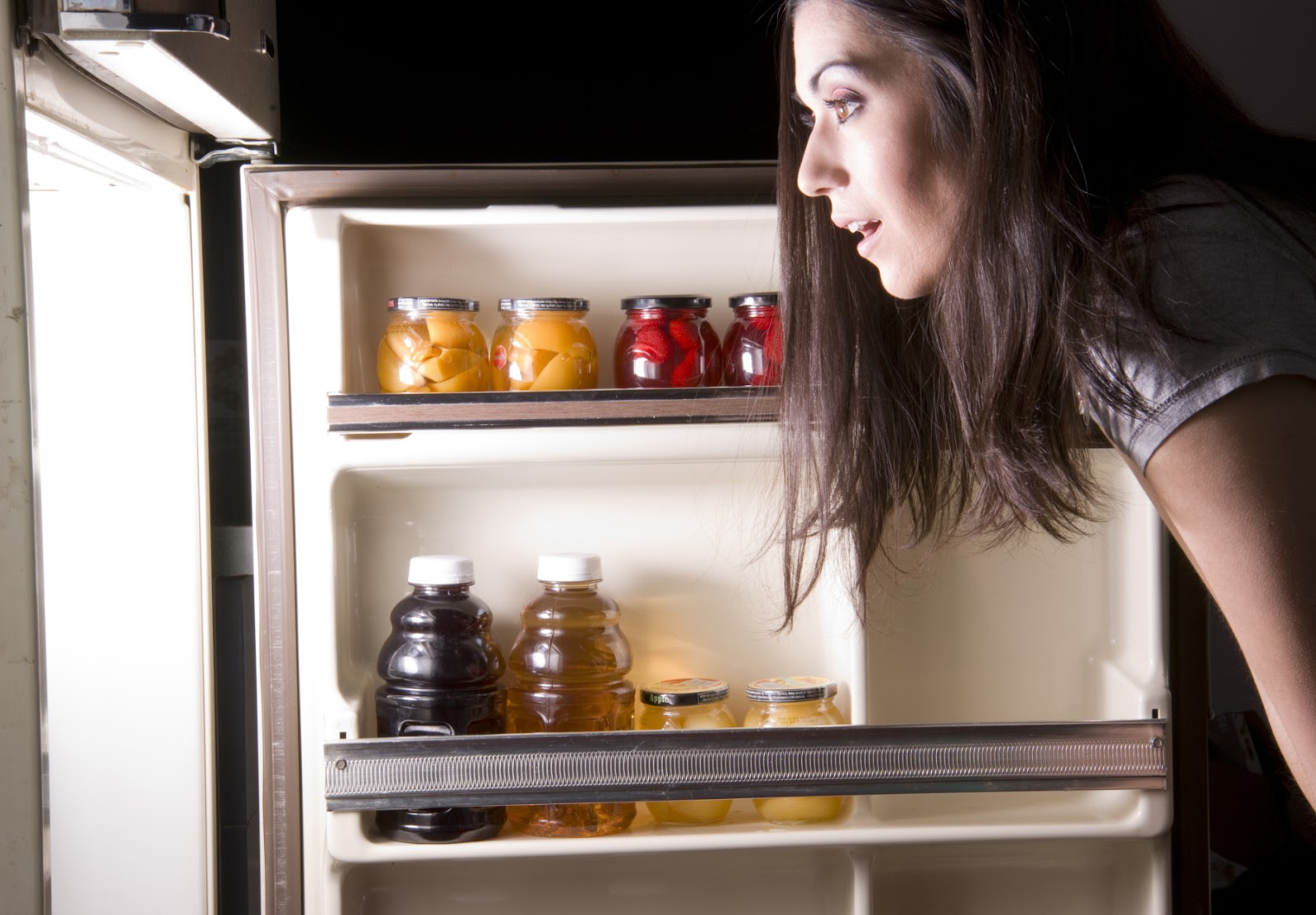
Even if you can temporarily scrape together the votes for one of these actions, you have to hold your coalition together. This usually fails. You will inevitably get distracted once any of the other governors gets a large enough error signal to vote for something else, like getting a snack. This is why you are always looking in the fridge instead of studying.
Wait, how did I get here?
One workaround is to convince a governor to vote for these actions. If you get a lot of praise and status at school for doing well on your math test, social governors that are concerned with status will be willing to vote for math-related activities in the future, because they realize that it’s good for their bottom line. Or if there’s a pretty girl in your Japanese class, you may find that it becomes easier for you to work on your presentation, in an effort to impress her. No points for guessing which governor is voting for this!
This is probably why people seem to find over and over again that money is not very motivating.
Money is motivating when it can directly address your needs. If you are starving, the connection between $5 and a block of cheese is pretty clear. As a result, the hunger governor will vote for things that get you $5.
But in a modern economy, most people’s remaining needs cannot be easily met by more money. They already have enough money to get all the food, warmth, sleep, and so on that they need. The only drives they have problems satisfying are the drives where, for one reason, there isn’t or can’t be a normal market.
Social factors like friendship or a feeling of importance are often left unsatisfied, but these are hard to trade directly for money. You can’t buy these things for any amount, or at least, there are no effective markets in these “goods”. So money is no longer very motivating for people who need these things. Their active governors, the ones with big errors, the ones that get the votes, understand that more money won’t solve their problems, so they don’t vote for actions that would get you more money.
As we hinted at above, we might assume that there is also an executive function that gets some votes. Executive function is why you can make yourself do dumb things that are in no way related to your survival, why you can plan for the very-long-term, and also why you have self-control in the face of things like cold and pain.
Eventually we may discover that what appears to be “self-control” is actually just the combined action of social emotions like shame. It may be that there is no such thing as an executive function, and what feels like self-control is really the result of different social emotions, the drives to do things like maintain our status or avoid shame, voting for things that are in their interest. But for now let’s keep the assumption that there is someone driving this thing.
Even so, executive function doesn’t have very many votes, which is why most people cannot starve themselves to death or hold their breath until they suffocate. At some point, the suffocation governor ends up with so many votes that it can make you do whatever it wants, and it always votes for the same thing: breathe.
Happiness
Here’s another thing people find surprising: why don’t we maximize happiness?
People often complain about not being as happy as they would like. But their revealed preferences are clear: they don’t always do things that make them happy, even when they know what those things are, even when it’s easy. People often choose to do things that are painful, difficult, even pointless.
This is because there is no governor voting for happiness. Happiness is more like a side-effect, something that happens whenever you successfully correct any governor’s error signal. People who live challenging lives end up happy, assuming they are able to meet those challenges, but there is no force inside you that is voting for you to go and become more happy per se.
Remember that happiness isn’t an emotion. All emotions are error signals generated by a governor dedicated to controlling some signal related to survival. Governors have a simple relationship with the error signals they generate: they vote for behaviors that will drive their error signal towards zero. So if happiness were some kind of emotion, the governor that generated it would vote, whenever possible, to drive happiness towards zero!
Clearly people don’t behave in a way that tries to drive happiness to zero. While we aren’t happiness-maximizers either, many of our actions do make us happier, and when we take an action that makes us less happy, we’re less likely to take that action in the future. This is clear evidence that happiness isn’t an emotion.
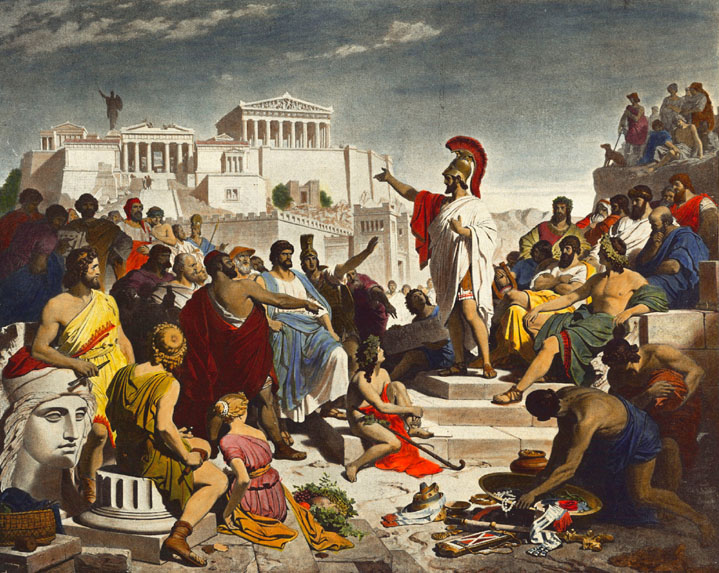
The paradoxes of motivation are a lot like the paradoxes of democracy. A democracy does not institute the policies that are the best for its citizens. It doesn’t even institute the policies that are most popular. Democracies institute the policies that get enough votes.
Similarly, a person does not take the actions that make them happiest. They do not take the actions that are best for them, or even the actions that are most likely to lead to their survival. No, people take the actions that get the most votes.
Direct video feed from inside your head
Like with democracy, the system still mostly works, because “what gets the most votes” is close enough to “what’s good for you”, enough of the time. But there are all kinds of situations that lead to behavior that can appear mystifying, until you learn to see things through the lens of parliamentary procedure.
There’s nothing wrong with not being happy. You can not be happy and still be doing perfectly fine. So why do people find this startling, and ruminate about their lack of happiness? Isn’t it strange that people obsess so much over happiness, but don’t actually change their actions to become more happy?
The explanation may be purely social. In modern American culture, we are expected to be happy. Not being happy is seen as a sign of failure and weakness. Being unhappy, or even just feeling neutral, is enough to make us lose status in the eyes of others, it can be the source of ridicule and shame. Being anything less than perfectly happy can be enough to make you a subject of pity. So even though happiness is not directly controlled, if you exist in a culture with these norms, some of your social governors (associated with emotions like shame and drives for status) will vote for you to do things that will make you happy, just so you can get one over on the Joneses.
But our social emotions are not voting to make us happy per se — they are actually concerned with making sure we avoid the social consequences that would come from appearing unhappy. They want to make sure that we don’t lose status for being seen as gloomy, and keep us from feeling shame for our melancholy. One way to do this is to vote for actions that will make you happier. But equally good, better even, is to vote for actions that make you seem happy!
So other things being equal, the social emotions tend to drive us towards the appearance of happiness, rather than actual happiness. Actual happiness may or may not make us appear happy in a way that will increase our status or reduce our shame. But the appearance of happiness always appears happy. So that’s what gets the votes.
This is what makes people neurotic about not being as happy as they should be. When they’re feeling reflective, it makes some people worry that they are fake, since they feel consistently driven towards the appearance of happiness, even at the expense of what would actually make them happy.
This is a well-known problem in contemporary American culture, and for cultures that have borrowed American standards for happiness. But most other cultures don’t expect people to be happy all the time. Without this expectation, people from these cultures don’t have the problem of feeling like they must both seek happiness and perform it, and don’t run into this weird vicious cycle. (Though of course, other cultures have problems of their own.)
For a similar example, consider the problem of self-sabotage. In some cultures and contexts it’s not appropriate to perform better than your peers, or to get too much better too quickly (cf. tall poppy syndrome). In this case, some of the social governors will vote against performing your best, to avoid the social disapproval that might come from performing better than you “should”.
This suggests that the treatment for self-sabotage is to surround yourself with people who think that failure is shameful and success is impressive, rather than the other way around. And it suggests that something you can do for the people around you is to express polite disappointment when they accomplish less than they hope for and genuine enthusiasm when they accomplish more. Even an expression of envy can be a supportive thing to do for your friends, as long as it’s clear that it comes from a place of admiration rather than competition.
Of course, if you go too far in this direction, you can end up with a culture that is neurotic about success rather than about conformity. Decide your own point on the tradeoff, but we’d argue that self-sabotage is worse than pushing yourself too hard.
Suffering
Why do people sometimes seek out extreme experiences? Why do we subject ourselves to things like roller coasters, saunas, horror movies, extreme sports, and even outright suffering?
Psychologist Paul Bloom explains these decisions in terms of chosen suffering versus unchosen suffering. For example, in this interview he says, “You should avoid being assaulted… there’s no bright side to the death of a loved one… there’s no happiness in watching your house burn down… nor is there happiness to be found in getting a horrible disease. Unchosen suffering is awful.”
In contrast he says, “chosen suffering, the sort of suffering we seek-out can be a source of pleasure … You choose to have kids, you choose to run a marathon, you choose to eat spicy food. You choose these things because there’s a payoff later in future pleasure.”
We think this is close. He’s picked the right examples, but getting assaulted, losing a loved one, or getting a horrible disease, are just bad. Choosing them wouldn’t make them any better. So it can’t be the chosen versus unchosen nature of these examples that makes the difference.
A better way to think about this is whether the suffering is under your control. If suffering is under your control, it can be corrected at any time. Since happiness is generated when errors are corrected, then controlled suffering is a neat hack — it’s a free way to generate happiness at no risk to actual life and limb.
Controlled suffering is like a sauna or a horror movie. You’re sweating or you’re scared, but you can stop at any time, and stopping feels pretty great, it’s a relief. The uncontrolled version would be more like being trapped in a sauna, or locked inside a haunted house — not so pleasurable, and not the sort of thing people go looking for. A really uncontrolled version would be the experience of being trapped inside a burning building, or being chased by an actual serial killer, where the stakes are not only real, they have permanent consequences.
When given a choice, people only tend to choose controlled suffering, and tend to suffer uncontrolled suffering only against their choosing. So almost all chosen suffering is controlled, and all uncontrolled suffering is unchosen. This should come as no surprise. But this has led Bloom to mistake the choosing for the active ingredient, rather than the controlled nature of the suffering.
Choosing uncontrolled suffering doesn’t make it good for you. Choosing to get assaulted is about as bad as getting assaulted by accident. Unchosen but controlled suffering isn’t usually that bad. Taking a wrong turn and ending up in the sauna by mistake is not that much of a bummer.
If you do want to become happier, the solution is simple — make yourself hungry, thirsty, cold, hot, tired, lonely, scared, etc. And then correct these errors promptly. It will feel amazing. If it doesn’t feel amazing, you are probably depressed in some more serious way. (See upcoming sections for more speculation about what this means for you.)
Governors vote for behaviors that they expect will decrease their errors.
Governors are predictive, they will also vote against actions that they anticipate will increase their error.
The number of votes each governor gets is a function of the size of their error and/or the predicted change in error of the actions available.
Behavior is determined by the collective negotiation of all governors.
The technical term for this problem is selection, so this set of systems is called the selector.
There is a mechanism called a gate that takes votes below a certain threshold and reduces them to zero. In the mental selector, the gate stops votes that are below some minimum threshold. This ensures that actions must get at least some minimum number of votes to be performed.
Behaviors like “eat cake” that have a governor behind them are easy to do. Behaviors like “study for your math test” that don’t have a governor behind them are hard to do. This resolves most mysteries of self-control.
Discussion Questions
What behaviors do you find it really easy to do? What behaviors do you find it really challenging to do?
When was a time you chose to do something that was painful, difficult, or pointless?
What kinds of extreme experiences do you seek out? Why do you do that?
Is each governor’s influence conserved? If the hunger governor has 100 votes and you give it 50 options, can it only give each option 2 votes? Or can it put all 100 votes towards every option? Is this why no one can agree what they want for dinner?
To avoid biting the dust, lots of things need to be juuuust right. If you get too hot or too cold, you die. If you don’t eat enough food, you die. But if you eat too much food, you also die. If you produce too much blood, or too little blood, if you [other thing], if you [third thing], dead dead dead.
It’s a miracle that organisms pull this off. How do they do it? Easy: they make thermostats.
Go to Zero
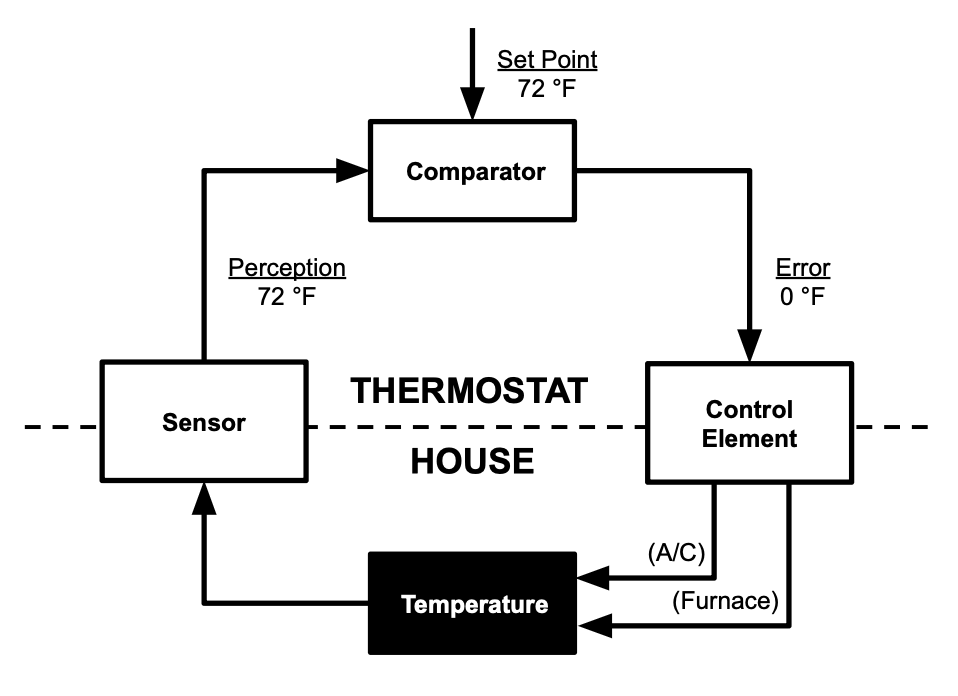
A thermostat is a simple control system.
Thermostats are designed to keep your house at a certain temperature. You don’t want the house to get much hotter than the target temperature, and you don’t want it to get much colder.
To make this happen, the thermostat is designed to drive the temperature of the house towards the target. If you’re not too allergic to anthropomorphism, we can say that the goal of the thermostat is to keep the house at that temperature. Or we can describe it as a control system, and say that the thermostat is designed to control the temperature of the house, keeping it as close to the target as possible.
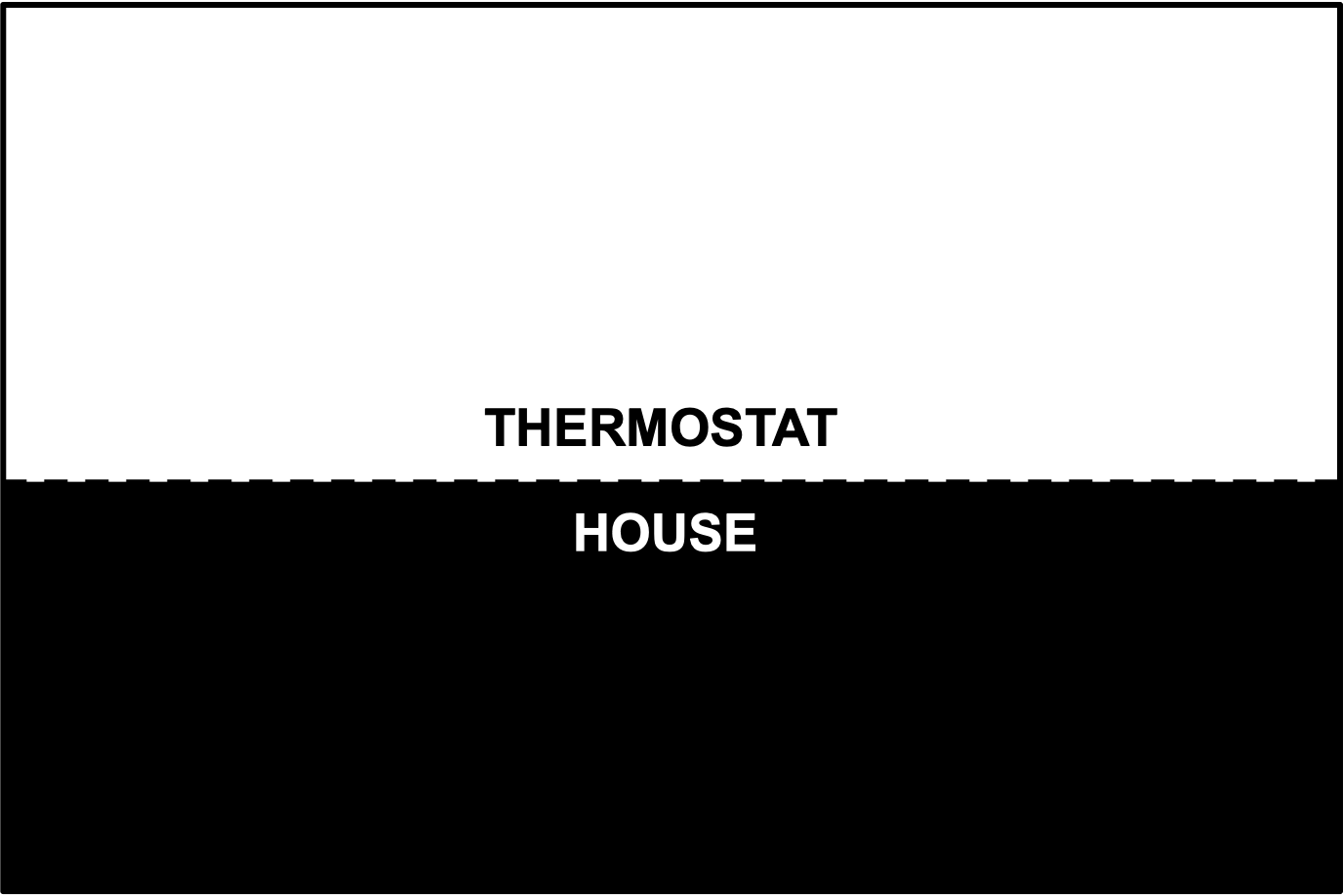
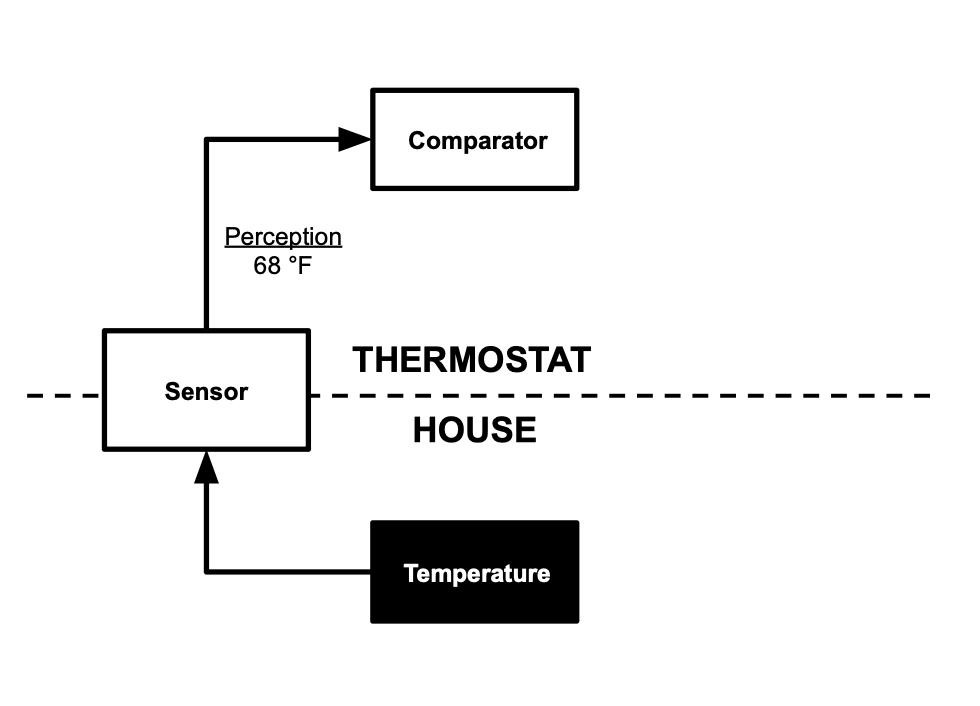
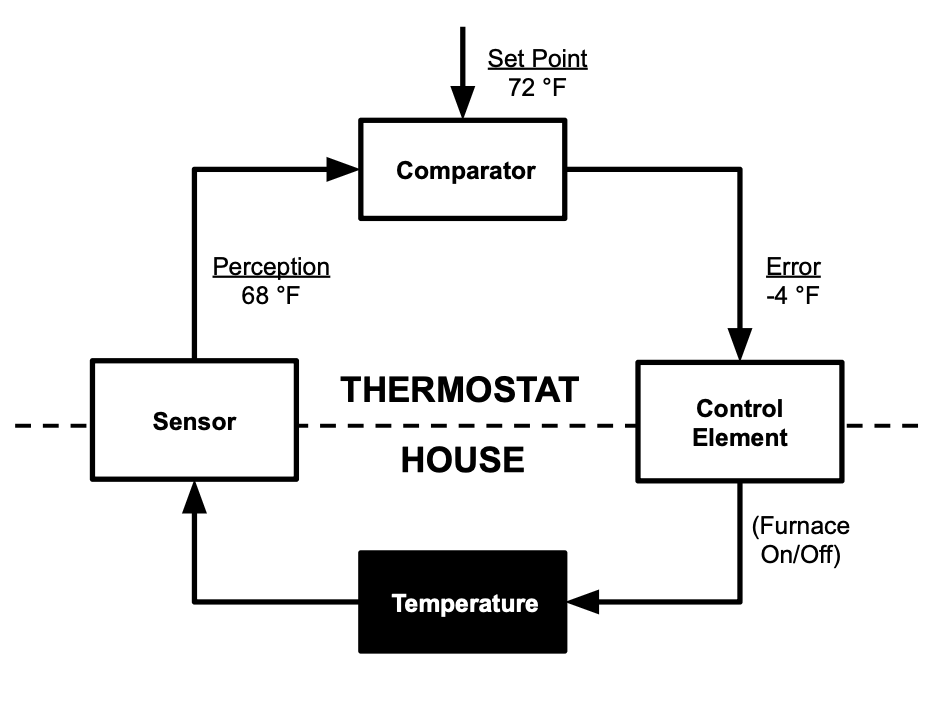
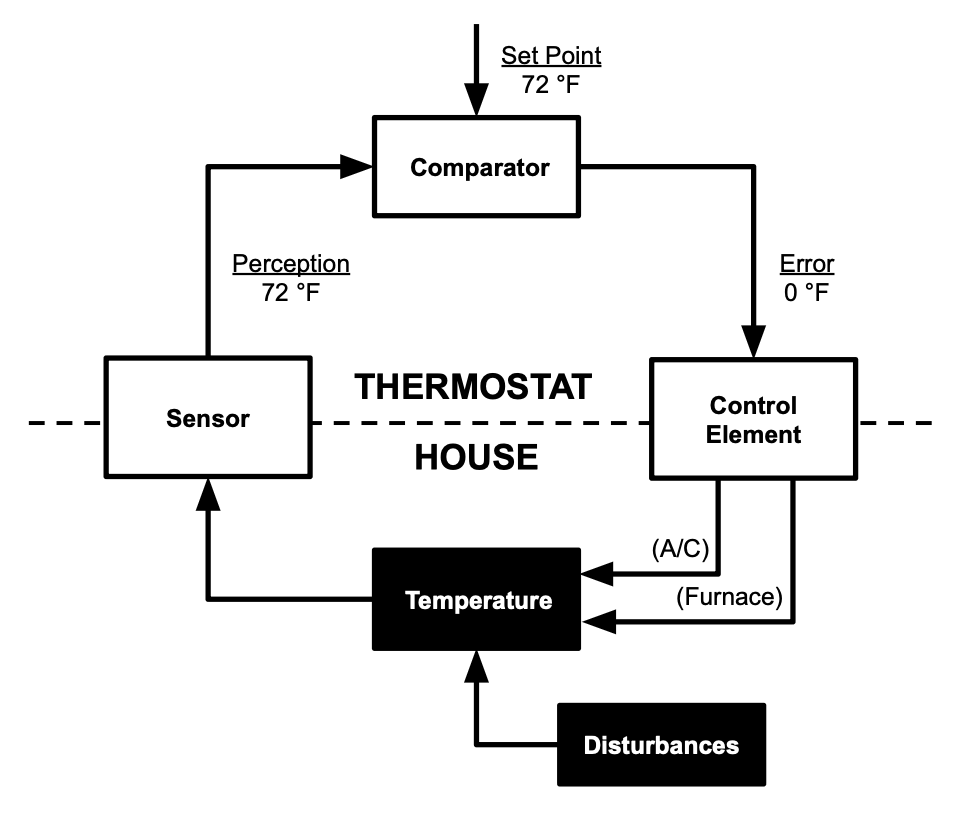
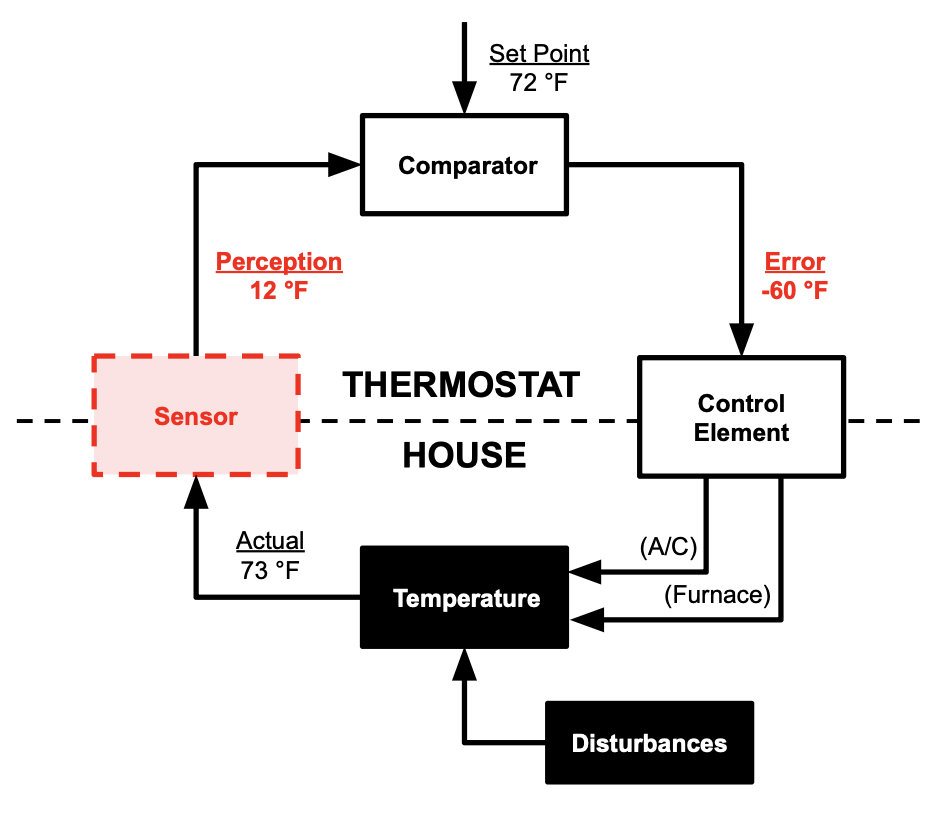
The basic idea is simple. We divide the world into the inside of the thermostat and the outside of the thermostat, like so:
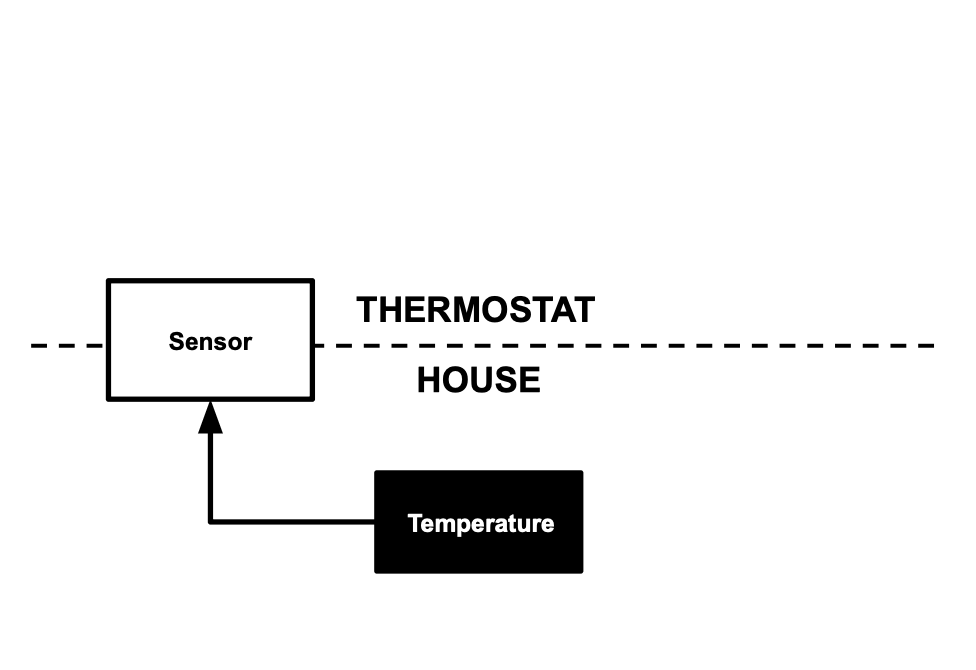
To begin with, we need some kind of sensor (sometimes called an input function) that can read the temperature of the house and communicate that information to the inside of the thermostat.
Some sensors are better than others, but it doesn’t really matter. As long as the sensor can get a rough sense of the temperature of the house and transport that information to the guts of the device, the thermostat should be able to do its job.
The sensor is a part of the thermostat, so we color-code it white, but it interacts with the outside world, so the box sticks a little bit out into the house.
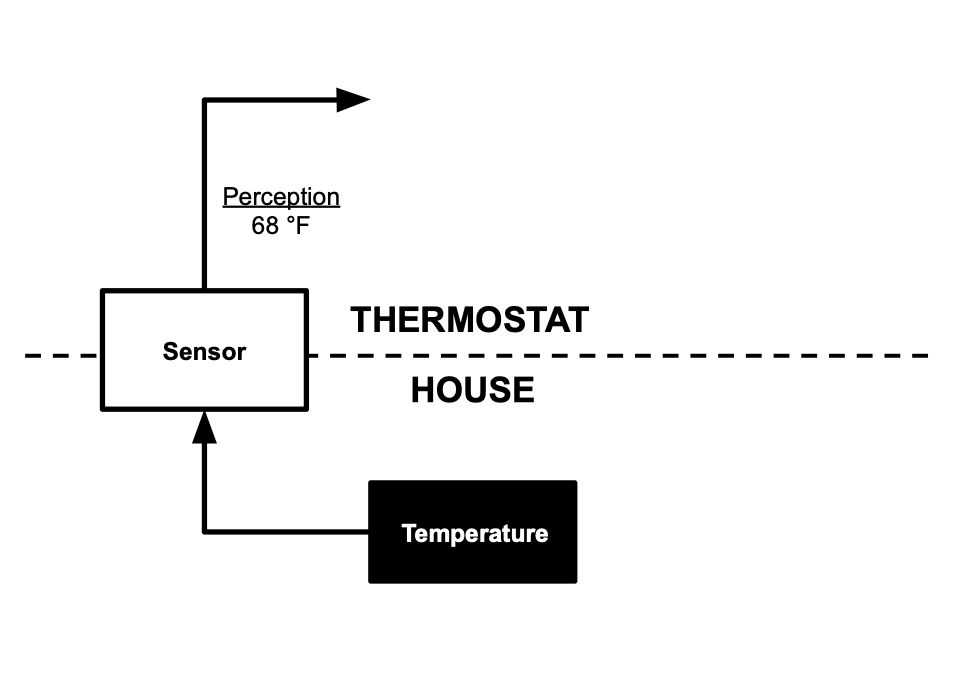
The sensor creates a signal that we call a perception. In this case, the sensor perceives that the house is 68 degrees Fahrenheit.
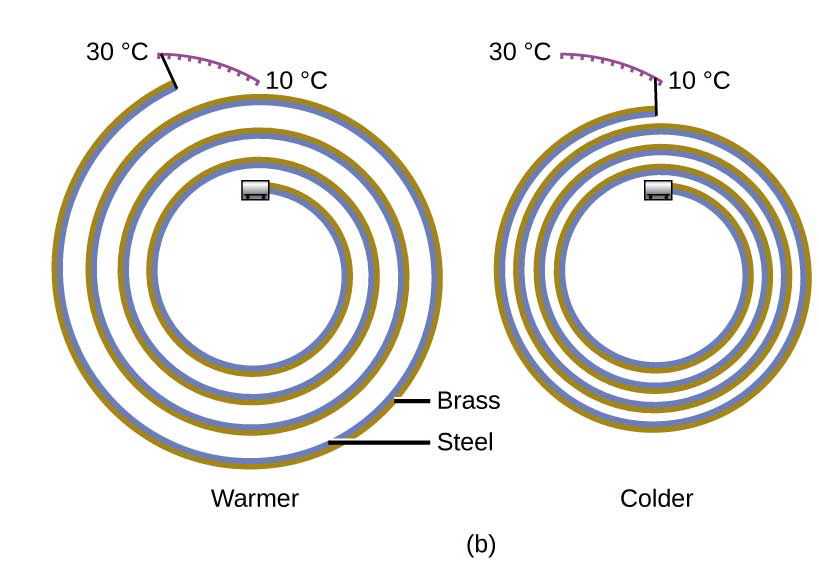
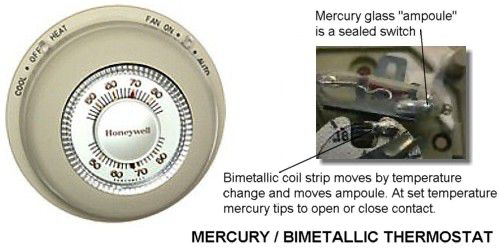
The sensor can be very simple, like a thermometer that measures the temperature at one spot in the house. Or it can be very complicated — for example, a network of different kinds of sensors all throughout the house, feeding into a complex algorithm that references and weighs each one, providing some kind of statistical average.
The important thing is that the sensor generates a perception of the thing it’s trying to measure, the signal the control system is aiming to control. In this case, the sensor is trying to get an estimate of the temperature in the house, and it has sensed that the temperature is about 68 ºF.
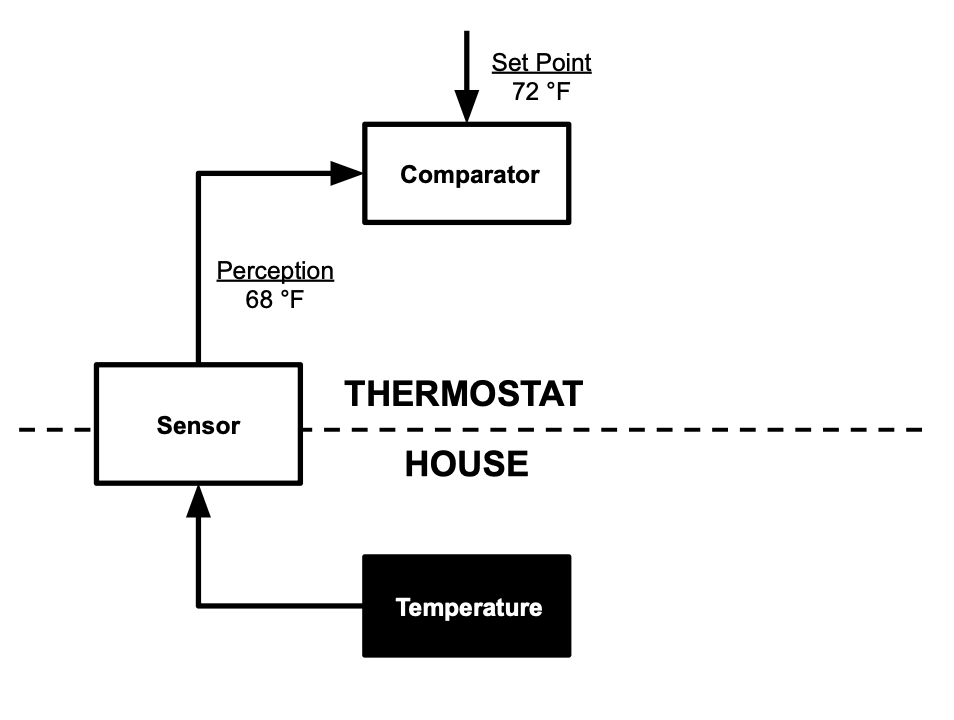
The thermostat also needs a part that can interpret the signal coming in from the sensor. This part of the thermostat is usually called the comparator.
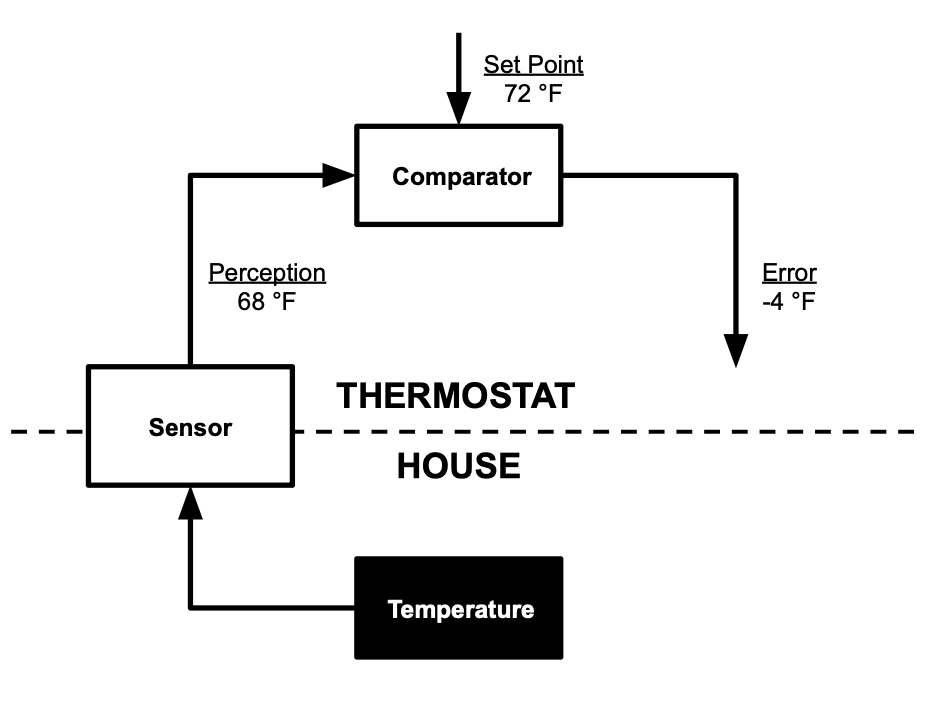
We call this part the comparator because its main job is to compare the temperature perception coming from the sensor to the target temperature for the house. To compare these two things, the thermostat needs to know the target temperature. So let’s add a set point.
The target is set by a human, and in this case we can see that they set it to 72 °F. So the set point for the thermostat is 72 °F.
If the set point is 72 °F and the sensor detects a temperature of 72 °F, the thermostat doesn’t need to do anything. Everything is all good. When the perception from the sensor is the same as the set point, then assuming the sensor is working correctly, the house is the correct temperature. There is a difference of 0 °F.
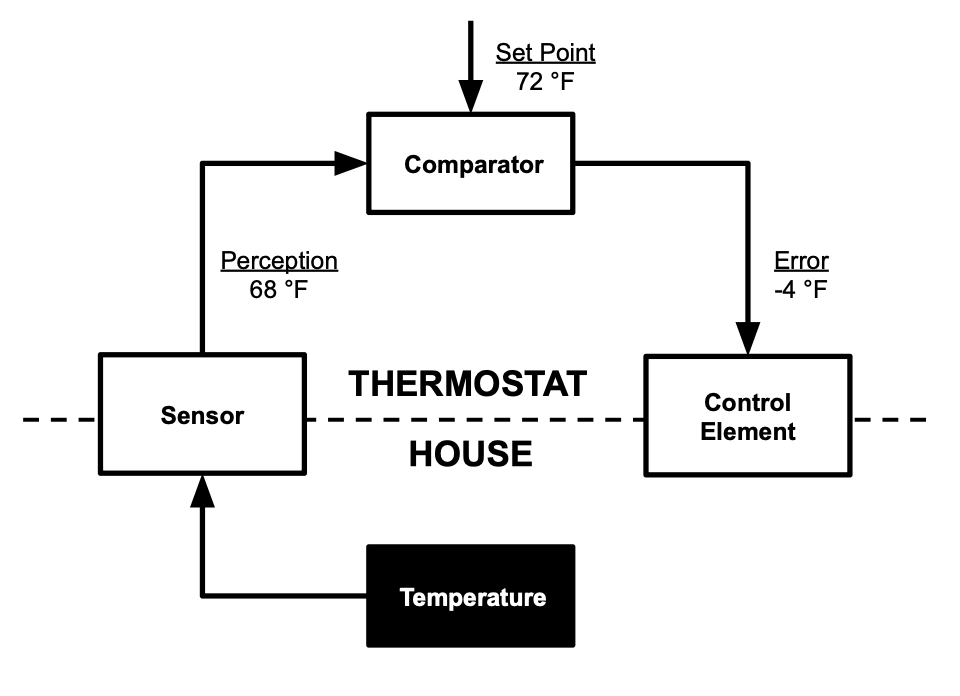
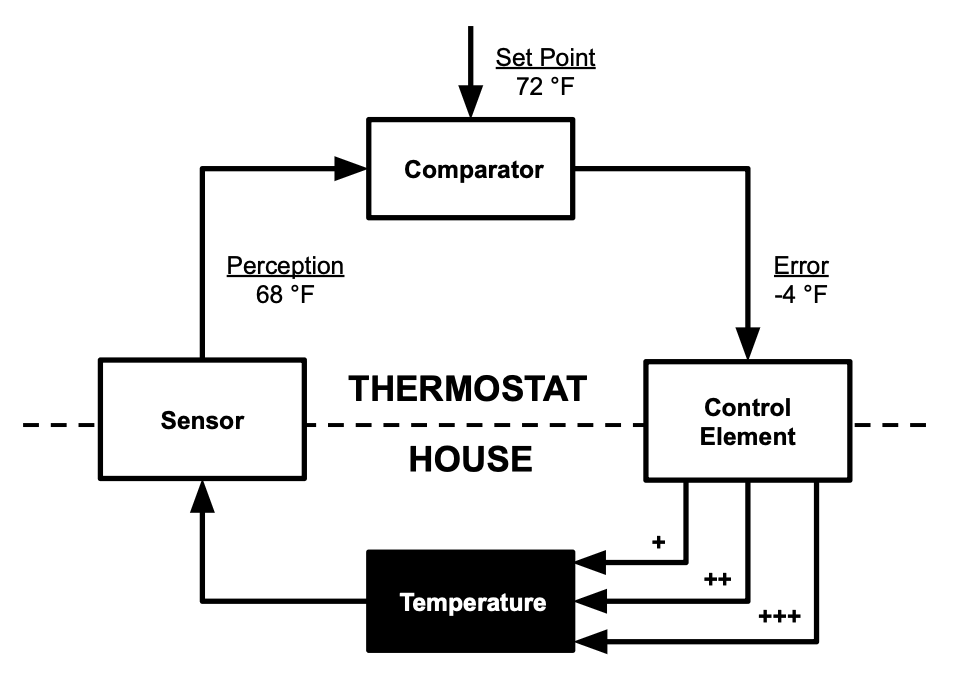
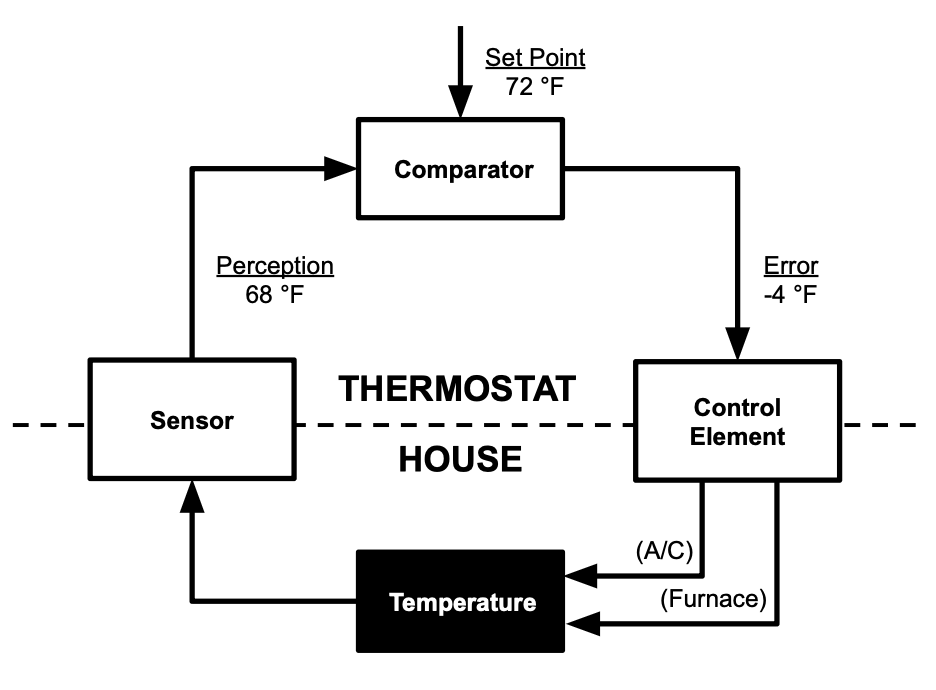
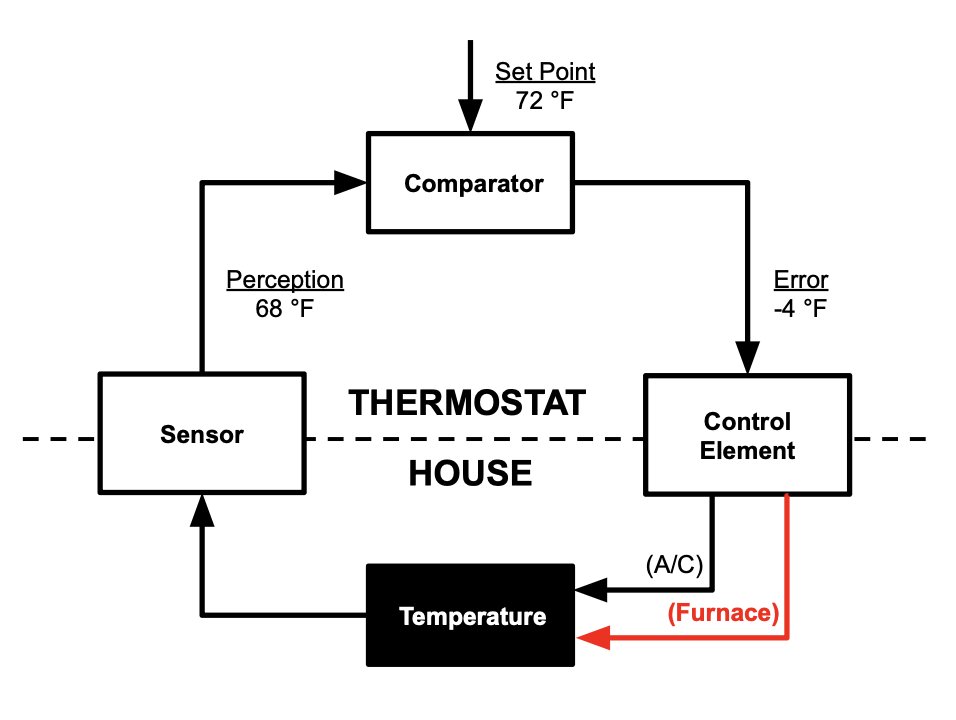
But sometimes everything is not all good. Sometimes the set point is 72 °F but the sensor is only reading 68 °F, like it is here.
In this case, the comparator compares the set point (72 °F) to the perception (68 °F) and finds that there is a difference of -4 °F. The perception of the house’s temperature is four degrees colder than the target, so the house itself is about four degrees colder than we want it to be.
Having done this math, the comparator creates an error signal, which is simply the difference between the perception and the set point. If there’s no difference between the perception and the set point, then the error signal will be zero, i.e. no difference at all. If the error is zero, the thermostat doesn’t need to do anything. But in this case, the difference between the perception and the set point is -4 °F, so the error signal is -4 °F too.
For the thermostat to do its job, we need to close the loop. The final thing the thermostat needs is some way of influencing the outside world. This is often called the output function or the control element, which is the name we will use here:
Like the sensor, the control element sticks out into the exterior world, to indicate that it can interact with things outside the thermostat.
But you’ll notice that the loop is still not closed. The control element needs ways to influence the outside world.
A really simple thermostat might have only one way to influence things — it might only be able to turn on the furnace, which will raise the temperature:
But this is a pretty basic thermostat. It can’t control how hot the furnace is running, it can only turn it on or off.
It will do better if we give it more options. We can improve this thermostat by installing three settings for the furnace, like so:
This is much better. If the house is just a little cold, the control element can turn on the lowest furnace setting. This will keep the thermostat from overshooting the set point and sending the temperature above 72 °F. But if the house is freezing, it can turn on the turbo setting, and drive it to the set point much more quickly.
But there’s still a problem: our poor thermostat still has no way to lower the temperature. If the house goes above 72 °F, it can’t do a thing. The temperature will go above the set point and stay there until it comes down on its own; the thermostat is powerless.
This is unacceptable. But we can fix this problem by giving the thermostat access to air conditioning:
The control element can have many different possible outputs. Its job is to measure the error signal and decide what to do about it, and its goal is to drive the error signal to zero, or as close to zero as it can manage.
Similar to the sensor, the control element can be very simple or very complex. A simple control element might just turn on the heat any time the error signal is negative, or when the error signal is below some threshold. A more complicated control element might look at the derivative of the change in temperature over time and try to control the temperature predictively.
A very smart control element might use machine learning, or might have access to information about the weather, time of day, or day of the week, and might learn to use different strategies in different situations. You could give it a bunch of output options and just let it mess around with them, learning how different outputs influence the error signal in different ways.
More sophisticated techniques will give you a more effective control system. But as long as the control element has some way to influence the temperature, the thermostat should work ok.
Back in our example thermostat, the temperature in this house is too low, so the control element turns on the furnace. This raises the temperature, driving the error signal towards zero:
Once the error signal is zero, the control element turns off the furnace:
But even with this success, it’s important for the loop to remain closed. Even when the thermostat has driven the house’s temperature to the set point, and driven the error signal to zero, the house is still subject to disturbances. People open the door, they turn on the oven, they spill ice cream on the floor. Some heat escapes through the windows, the sun beats down on the roof. Let’s add disturbances to the diagram:
Because of these outside disturbances, the temperature of the house is always changing. To control the house’s temperature, to keep it near the set point in the face of all these disturbances, the control system needs to remain active.
This makes it easy to tell whether or not the thermostat is working like it should. Successful behavior drives the temperature (or at least the perception of that temperature) to the set point, and drives the error signal to zero. In the face of disturbances, it keeps the error signal close to zero, or quickly corrects it there.
In many older thermostats, the sensor is a bimetallic coil of brass and steel. Because of differences in the two metals, this coil expands when it gets warmer and contracts when it gets cooler. If this is all set up properly, the coil gives a decent measure of the temperature and helps the rest of the mechanism drive the house’s temperature to a given target.
But if you were to hold this coil closed, or tie a string around it and pull it tight enough to give a reading of 60 °F, the system will behave as though the temperature is always 60 °F. If the set point is 72 °F, the system will experience a large error signal, just as though the real temperature of the house was 60 °F, and will make a futile attempt to raise the house temperature, pushing as hard as it can, forever, until the thermostat breaks or the coil is released.
The thing to hold on to here is that every control system produces multiple signals.
There will always be some kind of sensory signal as input.
There will always be some kind of reference or target signal serving as the set point.
And there will always be an error signal, which under normal conditions will be the difference between the other two signals.
Dividing a control system into individual parts helps us understand what happens when a control system breaks in different ways:
If something goes wrong with the sensor in a thermostat (like the coil example above), the control system will try to reduce the error between the set point and the perceived temperature, not the actual temperature.
If something goes wrong with the comparator, producing an incorrect error, then the control system will try to drive that error signal to zero.
If something goes wrong with the output function, any number of strange things can happen.
Hello Governor
The thermostat is just an example; control systems are everywhere. The technical term used to describe control systems like these is “cybernetic”, and the study of these systems is called cybernetics.
Both words come from the Ancient Greek κυβερνήτης (kubernḗtēs, “steersman”), from κυβερνάω (kubernáō, “I steer, drive, guide, act as a pilot”). Norbert Wiener and Arturo Rosenblueth, who invented the word, chose this term because control systems steer or guide their targets, and because a steersman or pilot acts as a control system by keeping the ship pointed in the right direction.
Most famous of these is the centrifugal governor used to regulate the speed of steam engines. Look closely at any steam engine, and you should see one of these:
The engine’s output is connected to the governor by a belt or chain, so the governor spins along with the engine. As the engine starts to speed up, the governor spins faster, and its spinning balls gain kinetic energy and move outward, like they’re trying to escape.
This outward movement isn’t just for show; if the motion goes far enough, it causes the lever arms to pull down on a thrust bearing, which moves a beam linkage, which reduces the aperture of a throttle valve, which controls how much steam is getting into the engine. So, the faster the engine goes, the more the governor closes the valve. This keeps the engine from going too fast — it controls the engine’s speed.
Control systems maintain homeostasis, driving a system to some kind of equilibrium. A thermostat controls the temperature of a house, a centrifugal governor controls the speed of a steam engine, but you can control just about anything if you put your mind to it. As long as you can measure a variable in some way, influence it in some way, and you can put a comparator between these two components to create an error signal, you can make a control system to drive that variable towards whatever set point you like.
Control in the Organism
Every organism needs to make sure it doesn’t get too dry, too hot, too cold, etc. If it gets any of these wrong, it dies.
As a result, a lot of biology is made up of control systems. Every organ is devoted to maintaining homeostasis in one way or another. Your kidneys control electrolyte concentrations in your blood, the pancreas controls blood sugar, and the thyroid controls all kinds of crap.
The brain is a homeostatic organ too. But the brain does homeostasis with a twist. Unlike the other organs, which mostly drive homeostasis by changing things inside the body, the brain controls things with external behavior.
Thirst
One of the first behavioral control systems to evolve must have been thirst. All animals need water; without water, they die. So the brain has a control system that aims to keep the body hydrated.
This is a control system, just like a thermostat. Hydration is the goal, but that goal needs to be measured in some way. In this case the input function seems to be a measure of plasma osmolality, as detected by the brain. This perception is then compared to a reference value (in humans this is around 280-295 mOsm/kg), which generates an error signal that can drive behaviors like finding and consuming water.
As we see in the diagram, in this control system the error signal is thirst. We can tell this must be the case because successful behavior drives thirst to zero. The perception of osmolality can’t be the error signal, because osmolality is driven to 280-295 mOsm/kg, which is how we know that number is the target or set point. Whatever value is driven towards zero must be the error signal.
Just like with a thermostat, the output function can be very simple or very complex. Organisms with simple nervous systems may have only one output; they drink water when it happens to be right in front of them. Animals that live in freshwater streams and ponds may execute a program as simple as “open your mouth”, since they are always immersed in water that is perfectly good for them to drink.
Organisms with complex nervous systems, or that are adapted to environments where water is more scarce, will have more complex responses. A cat can go to its water bowl. In the dry season, elephants search out good locations and actively dig wells. Humans get in the car and drive to the store and make small talk while exchanging currency to purchase Vitamin Water®, a very complex response. But it’s all to control plasma osmolality by reducing the error signal of thirst to zero.
Hot and Cold
Organisms need to maintain a constant temperature, so the brain also includes systems for controlling heat and cold.
This adaptation actually consists of two different control systems — one that keeps the body from getting too warm, and another that keeps the body from getting too cold. We have two separate systems, rather than one system that handles both, because of the limits of how neurons can be wired up. “Neural comparators work only for one sense of error, so two comparators, one working with inverted signals, would be required to detect both too much and too little of the sensor output level.” (Powers, 1973)
We can also appeal to intuition — it feels entirely different to be hot or to be cold, they are totally different sensations. And when you are sick, sometimes you feel both too hot and too cold, something that would be impossible if this were a single system.
As usual, the output function can be simple or complex. Some responses are relatively automatic, like sweating, and might not usually be considered “behavior”. But other responses, like putting on a cardigan, are definitely behavior.
This is a chance to notice something interesting. A human can shiver, sweat, put on a coat, or open a window to control their temperature. But they can also… adjust the set point on the thermostat for their house! One way a control system can act on the world is by changing the set point of a different control system, and letting that “lower” system carry out the control for it.
Pain
Organisms need to keep from getting injured, so they have ways to measure damage to their bodies, and a system to control that damage.
Again, we see that pain is the error signal that’s generated in response to some kind of measure of damage or physical harm.
A very simple control system will respond to pain, and nothing else. This might be good enough for a shellfish. But a more complex approach (not pictured in this diagram) is for the control system to predict how much pain might be coming, and drive behavior to avoid that pain, instead of merely responding. Compare this to a thermostat which can tell a blizzard is incoming, and turns on the furnace in anticipation, before the cold snap actually hits.
Hunger
Most organisms need to eat in order to live. Once the food is inside your body there are other control systems that put it to the right use, but you need to express some behavior to get it there. So there’s another control system in charge of locating nutritious objects and putting them inside your gob.
Obviously in this case, the error signal is hunger — successful eating behavior tends to drive hunger to zero.
More realistically, there is not one eating control system, and not one kind of hunger, but several. There might even be dozens.
One control system probably controls something like your blood sugar level, and drives behavior that makes you put things with calories inside your mouth.
But man cannot live on calories alone, and neither can any other organism. For one thing, you definitely need salt. So there must be another control system that drives behavior to make you put salty things (hopefully salty foods, though perhaps not always) inside your mouth. This is confirmed by the fact that people sometimes crave salty foods. If you’ve ever had a moose lick the salt off your car, you’ll know that we’re right.
It’s hard to tell exactly how many kinds of hunger there are, but humans need several different nutrients to survive, and we clearly can have cravings for many different kinds of foods, so there must be several kinds of hunger. The same goes for other animals.
Fear
Organisms also need to avoid getting eaten themselves. This is somewhat more tricky than controlling things like heat and fluid levels, but evolution has found a way.
To accomplish this, organisms have been given a very complicated input function that estimates the threats in our immediate area, by weighing information like “is there anything nearby that looks or sounds like a tiger?” This input function creates a complicated perception that we might call “danger”.
This danger estimate is then compared to some reference level of acceptable danger, creating the error signal of fear. If you are in more danger than is considered acceptable, you RUN AWAY (or local equivalent).
Disgust
Getting eaten is not the only danger we face. Organisms also need to avoid eating poisonous things that will kill them, and avoid contact with things that will expose them to disease.
Like fear, the input function here is very complicated. It’s not as simple as checking the organism’s blood osmolality or some other internal signal. Trying to figure out what things out there in the world might be poisonous or diseased is a difficult problem.
But smelling spoiled milk or looking at a rotting carcass clearly creates some kind of signal, which is compared with some reference level, and creates an error signal that drives behavior. That’s why, if you drink too much Southern Comfort and later puke it up, you’ll never want Southern Comfort again.
In this case, the error signal is disgust.
Shame
Every organism needs to maintain internal homeostasis in order to survive. Organisms that can perceive the world and flop around a bit also tend to develop the ability to control things about the outside world, things like how close they get to predators. This improves their ability to survive even further.
Social organisms like humans also control social variables. It’s hard to know exactly what variables are being controlled, since they are not as simple as body temperature. They are at least as complicated as an abstract concept like “danger” — something we certainly perceive and can control, but that must be very complicated.
However, we can make reasonable guesses. For one, humans control things like status. You want to make sure that your status in your social group is reasonably high, that it doesn’t go down, that it maybe sometimes even goes up.
In this case, the error signal when status is too low is probably something like what we call shame. Sadness, loneliness, anger, and guilt all seem to be error signals for similar control systems that attempt to control other social variables.
Cybernetic Paradigm
Every sense you possess is an instrument for reacting to change. Does that tell you nothing?
― Frank Herbert, God Emperor of Dune
Control of blood osmolality leads to an error signal we call thirst. This drives behavior to keep you hydrated.
Control of body temperature leads to error signals we know as the experiences “hot” and “cold”. These drive behavior to keep you comfortable, even cozy.
Control of various nutritional values leads to error signals that we collectively call hunger. These drive behavior that involves “chowing down”.
While they can be harder to characterize, control of social values like status and face lead to error signals we identify with words like “shame” and “guilt”. These drive social behavior like trying to impress people and prove our value to our group.
All of these things are of the same type. They’re all error signals coming from the same kinds of biological control systems, error signals that drive external behavior which, when successful, pushes that error signal towards zero.
All of these things are of the same type, and the word for this type is “emotion”. An emotion is the error signal in a behavioral biological control system.
We say “behavioral” because your body also regulates things like the amount of copper in your blood, but there’s no emotion associated with serum copper regulation. It’s regulated internally, by processes you are unaware of, processes that may not even involve the brain. In contrast, emotions are the biological control errors that drive external behavior.
Thirst, hot, cold, shame, disgust, fear, and all the different kinds of hunger are all emotions. Other emotions include anger, pain, sleepy, need to pee, suffocation, and horny. There are probably some emotions we don’t have words for. All biological error signals that are in conscious awareness and that drive behavior are emotions.
See!? Emotions!
Some emotions come in pairs that control two ends of one variable. The emotions of hot and cold are a good example. You try to keep your body temperature in a certain range, so it needs one control system (and one emotion) to keep you from getting too cold, and another control system (and another emotion) to keep you from getting too hot.
Feeling hot and feeling cold are clearly opposites, two emotions that keep your body temperature in the right range. There’s also an opposite of hunger — the emotion you feel when you have eaten too much and shouldn’t eat any more. We don’t have a common word for it in English, but “fullness” or “satiety” are close.
But for many goals, there’s only a limit in one direction. You just want to make sure some variable doesn’t get too high or too low. You’ll notice that “need to pee” is an emotion, but it doesn’t have an opposite. While your bladder can be too full, it can’t be too empty, so there’s no emotion for that.
This is counterintuitive to modern psychology because academic psychologists act as though nothing of interest happens below the neck. They couldn’t possibly imagine that “hungry” or “needs to pee” could be important to the study of psychology — even though most human time and energy is spent on eating, sleeping, peeing, fuckin’, etc.
In contrast, when the goal is to model believable human behavior, and not just to produce longwinded journal articles, these basic drives and emotions come about naturally. Even The Sims knew that “bladder” is one of the eight basic human motivations.
This is a joke; there are more than eight motivations. But frankly, the list they came up with for The Sims is pretty good. It’s clear that there are drives to keep your body and your living space clean, and it seems plausible that these might be different emotions. We don’t have words for the associated emotions in English, but The Sims calls these motivations “Hygiene” and “Environment” (originally called “Room”).
Happiness and Other Signals
Emotions are easy to identify because they are errors in a control system. Like any error in a control system, successful behavior drives the error to zero. This means that happiness is not an emotion.
After all, it’s clearly not an error signal. Behavior doesn’t try to drive happiness to zero. That means it’s not the same kind of thing as the rest of these signals, which are all clearly error signals. And that means happiness isn’t an emotion. Happiness is some kind of signal, but it’s not an emotion.
Now you may be thinking, “Hold on a minute there, SMTM. I was on board with you about the biological control systems. I understand how hunger and cold and whatnot are all the error signals of various control systems, that’s very interesting. But you can’t just go around saying that pain and thirst are emotions, and that happiness isn’t an emotion. You can’t just go around using accepted words in totally made-up new ways. That’s not what science is all about.”
We disagree; we think that this IS what science is all about. Adapting old words to new forms is like half of the project.
For starters, language always changes over time. The word “meteor” comes from the Greek metéōron, which literally meant “thing high up”. For a long time it referred to anything that happened high up, like rainbows, auroras, shooting stars, and unusual clouds. This sense is preserved in meteorology, the study of the weather, i.e. the study of things high up. But in common use, “meteor” is now restricted to space debris burning up as it enters the atmosphere. And there’s nothing wrong with that.
Second, changing the way we use words is a very normal part of any scientific revolution.
Take this passage from Thomas Kuhn’s essay, What Are Scientific Revolutions?:
Revolutionary changes are different and … problematic. They involve discoveries that cannot be accommodated within the concepts in use before they were made. In order to make or to assimilate such a discovery one must alter the way one thinks about and describes some range of natural phenomena. … [Consider] the transition from Ptolemaic to Copernican astronomy. Before it occurred, the sun and moon were planets, the earth was not. After it, the earth was a planet, like Mars and Jupiter; the sun was a star; and the moon was a new sort of body, a satellite. Changes of that sort were not simply corrections of individual mistakes embedded in the Ptolemaic system. Like the transition to Newton’s laws of motion, they involved not only changes in laws of nature but also changes in the criteria by which some terms in those laws attached to nature.
The same is true of this revolution. Before this transition, happiness and fear were emotions, while hunger was not. After it, hunger is an emotion, like shame and loneliness; happiness is some other kind of signal; and other signals like stress may be new sorts of signals as well.
As in any revolution, we happen to be using the same word, but the meaning has changed. This kind of change has been a part of science from the beginning.
Ontologically, where “planet” had meant “lights that wander in the sky,” it now meant “things that go around the sun.” Empirically, the claim was that all the old planets go around the sun, except the moon and the sun itself, so those are not really planets after all. Most troublingly, the earth too goes around the sun, so it is a planet.
The earth does not wander in the sky; it does not glow like the planets; it is extremely large, whereas most planets are mere pinpoints. Why call the earth a planet? This made absolutely no sense in Copernicus’ time. The claim appeared not false, but absurd: a category error. But for Copernicus, the earth was a planet exactly in that it does wander around the universe, instead of sitting still at the center.
Maybe heliocentrism would have succeeded sooner if Copernicus used a different word for his remodeled category! This is a common pattern, though: an existing word is repurposed during remodeling. There is no fact-of-the-matter about whether “planet” denoted a new, different category, or if the category itself changed and kept its same name.
So just like Copernicus, our claims aren’t false, they’re absurd. In any case, it’s too cute to hold so closely onto the current boundaries for the word “emotion”, given that the term is not even that old. Before the 1830s, English-speakers would have said “passions” or “sentiments” instead of “emotions”. So to slightly change the meaning of “emotion” is not that big a deal.
In any case, we can use words however we want. So back to the question at hand: If happiness isn’t an emotion, or at least isn’t a cybernetic error signal, then what is it?
The answer is quite simple. People and animals have many different governors that try to maintain a signal at homeostasis, near some target or on one side of some threshold. When one of these signals is out of alignment, the governor creates an error signal, an emotion like fear or thirst. The governor then does its best to correct that error.
When a governor sends its signal back into alignment, correcting an error signal, this causes happiness. Happiness is what happens when a thirsty person drinks, when a tired person rests, when a frightened person reaches safety.
Consider the experiences that cause the greatest happiness. A quintessential happy experience might be finishing a long solitary hike in the February cold, arriving at the lodge freezing and battered, and throwing open the door to the sight of a roaring fire, soft couches, dry socks, good company, and an enormous feast.
The reason this kind of experience is so joyous is because a person who has just finished a long winter’s hike has driven many of their basic control systems far out of alignment, creating many large error signals. They are cold, thirsty, hungry, tired, perhaps they are in a bit of discomfort, or even pain. The opportunity to correct these error signals by stepping into a warm ski lodge leads to 1) many errors being corrected at once, and 2) the corrections being quite fast and quite large.
When errors are corrected by a large amount, or they are corrected very quickly, that creates more happiness than when they are corrected slowly and incrementally. A man who was lost in the desert will feel nothing short of bliss at his first sip of cool water — he is incredibly thirsty, and correcting that very large error creates a lot of happiness.
Imagine yourself on a hot summer day. To quaff a tall glass of ice water and eliminate your thirst all at once is immensely pleasurable. To sip the same amount over the course of an hour is not nearly so good. More happiness is created when a correction is fast than when it is slow.
Here we see some confirmation that “need to pee” is an emotion. We also see evidence of the laws of how error correction causes happiness. Since the error signal was so big, and since it was resolved all at once in that dirty little gas station bathroom, the correction was both large and sudden, which is why peeing made the author so happy. “Moans”, or happiness in general, “are connected with not getting what you want right away, with putting things off.” Or take Friedrich Nietzsche, who asked: “What is happiness? The feeling that power is growing, that resistance is overcome.”
Correcting any error signal creates happiness, and the happiness it creates persists for a while. But over time, happiness does fade. We don’t know the exact rate of decay, but if you create 100 points of happiness today, you might have only 50 points of happiness tomorrow. The next day you will have only 25, and eventually you will have no happiness at all.
But in practice, your drives are constantly getting pushed out of alignment and you are constantly correcting them, and in most cases this leads to a steady stream of happiness. You get hungry, thirsty, tired, and you correct these errors, generating more happiness each time. As long as you generate happiness faster than the happiness decays, you will be generally happy on net.
You can think of this as a personal happiness economy. Just like a business must have more money coming in than going out to stay in the black, you’ll feel happy on net as long as errors are being corrected faster than happiness decays.
In this model, there are as many ways to feel bad as there are things that are being controlled. But there’s only one way to feel good. Which would mean that all of our words for positive emotion — joy, excitement, pride — are really referring to the same thing, just in different contexts.
Happiness is also related to the concept of “agency”, the general ability to affect your world in ways of your choosing. A greater ability to affect your world means more ability to cause large changes in any context. If you have a lot of ability to make things change, you can make big corrections in your error signals — you can take the situation of being very hungry and correct that error decisively, leading to a burst of happiness.
(It may also be the case that even an arbitrary exercise of agency can make you somewhat happy, since people do seem to gain happiness from meeting some very arbitrary goals. But this is hard to distinguish from social drives — maybe you are just excited at how impressed you think everyone will be when they see how many digits of pi you have memorized.)
People are consistently surprised to find that living in posh comfort and having all your needs immediately met isn’t all that pleasurable. But with this model of happiness, it makes perfect sense. Pleasure and happiness are only generated when you are out of alignment in a profound way, a way that could legitimately threaten your very survival, and then you are brought back into alignment in a way that is literally life-affirming.
This is why people who are well-off, the idle rich in particular, often feel like their lives are pointless and empty. To have all your needs immediately met generates almost no happiness, so the persistently comfortable go through life in something of a gray fog.
Does this suggest that horrible experiences can, at least under the right circumstances, make you happy and functional? Yes.
See this section about the Blitz during World War Two, from the book Tribe (h/t @softminus):
On and on the horror went, people dying in their homes or neighborhoods while doing the most mundane things. Not only did these experiences fail to produce mass hysteria, they didn’t even trigger much individual psychosis. Before the war, projections for psychiatric breakdown in England ran as high as four million people, but as the Blitz progressed, psychiatric hospitals around the country saw admissions go down. Emergency services in London reported an average of only two cases of “bomb neuroses” a week. Psychiatrists watched in puzzlement as long-standing patients saw their symptoms subside during the period of intense air raids. Voluntary admissions to psychiatric wards noticeably declined, and even epileptics reported having fewer seizures. “Chronic neurotics of peacetime now drive ambulances,” one doctor remarked. Another ventured to suggest that some people actually did better during wartime.
The positive effects of war on mental health were first noticed by the great sociologist Emile Durkheim, who found that when European countries went to war, suicide rates dropped. Psychiatric wards in Paris were strangely empty during both world wars, and that remained true even as the German army rolled into the city in 1940. Researchers documented a similar phenomenon during civil wars in Spain, Algeria, Lebanon, and Northern Ireland. An Irish psychologist named H. A. Lyons found that suicide rates in Belfast dropped 50 percent during the riots of 1969 and 1970, and homicide and other violent crimes also went down. Depression rates for both men and women declined abruptly during that period, with men experiencing the most extreme drop in the most violent districts. County Derry, on the other hand—which suffered almost no violence at all —saw male depression rates rise rather than fall. Lyons hypothesized that men in the peaceful areas were depressed because they couldn’t help their society by participating in the struggle.
Horrible events can also traumatize people, of course. Being bombed by the Luftwaffe is dangerous to your health. But in other ways, being thrust into catastrophe can be very reassuring, even affirming. We were put together in an era of constant threat, it should be no surprise that we can be functional in that kind of environment.
Don’t Worry, Why Happy
So happiness isn’t an emotion, and doesn’t drive behavior. The natural question has to be, why does happiness exist at all? What function does it serve if it is not, like an emotion, helping to drive some important signal to homeostasis.
We think happiness is a signal used to calibrate explore versus exploit.
The exploration-exploitation dilemma is a fancy way of talking about a basic problem. Should you mostly stick to the options you know pretty well, and “exploit” them to the fullest extent, or should you go out and “explore” new options that might be even better?
For example, if you live in a city and have tried 10 out of the 100 restaurants in the area, when you decide where to go to lunch, should you go to the best restaurant you’ve found so far, for an experience that is guaranteed to be pretty good, or should you try a new restaurant and maybe discover a new favorite? And how much time should you spend with your best friend, versus making new friends?
It’s a tradeoff. If you spend all your time exploring, you never get the opportunity to enjoy the best options you’ve found. But if you exploit the first good thing you find and never leave, you’re likely to miss out on better opportunities somewhere else. You have to find a balance.
This dilemma makes explore versus exploit one of the core issues of decision-making, and finding the right balance is a fundamental problem in machine learning approaches like reinforcement learning. So it’s not at all surprising that psychology would have a signal that helps to tune this tradeoff.
Remember that in this model of happiness, behavior is successful when it corrects some error, and creates some amount of happiness. This makes happiness a rough measure of how consistently you are correcting your errors.
If you are reliably generating happiness, that means you’re correcting your errors all the time, so your overall strategies for survival must be working pretty well. Keep doing what you’re doing. On the other hand, if you are not frequently generating happiness, that means you are almost never correcting your errors, and you must be doing rather poorly. Your strategies are not serving you well — in nature, you would probably be on the fast track to a painful death. In this situation, you should switch up your strategies and try something new. In a word, you should explore.
When you’re generating plenty of happiness, you are surviving, your strategies are working, and you should stick with them. When you’re not generating much happiness, your strategies are not working, you may not be surviving long, and you should change it up and try new things in an attempt to find new strategies that are better.
All this makes sense in a state of nature, where sometimes you have to change or die. But note that in the modern world, you can survive for a long time without generating much happiness at all. This is why modern people sometimes explore their way into very strange strategies.
(Tuning explore vs. exploit is just one theory. Another possibility is that your happiness is a signal for other people to control. For example, a parent might have a governor that tries to make sure their child has at least a certain level of happiness. There are reasons to suspect this might be the case — we are much more visibly happy and unhappy than we are visibly hungry or tired. If this is true, then our happiness might be more important for other people than for ourselves.)
Psychologists don’t usually think of happiness in these terms, but this perspective isn’t entirely original. See this Smithsonian Magazine interview with psychologist Dan Gilbert from 2007. The interviewer asks, “Why does it seem we’re hard-wired to want to feel happy, over all the other emotions?” Dan responds with the following:
That’s a $64 million question. But I think the answer is something like: Happiness is the gauge the mind uses to know if it’s doing what’s right. When I say what’s right, I mean in the evolutionary sense, not in the moral sense. Nature could have wired you up with knowing 10,000 rules about how to mate, when to eat, where to seek shelter and safety. Or it could simply have wired you with one prime directive: Be happy. You’ve got a needle that can go from happy to unhappy, and your job in life is to get it as close to H as possible. As you’re walking through woods, when that needle starts going towards U, for unhappy, turn around, do something else, see if you can get it to go toward H. As it turns out, all the things that push the needle toward H—salt, fat, sugar, sex, warmth, security—are just the things you need to survive. I think of happiness as a kind of fitness-o-meter. It’s the way the organism is constantly updated about whether its behavior is in support of, or opposition to, its own evolutionary fitness.
As for terms like “unhappiness”, we think they should be defined out of existence. When people use the word “unhappy”, we think they mean one of two things. Either their happiness levels are low, in which case they are not-happy rather than un-happy; or some error, like fear or shame, has just increased by a large amount. This is unpleasant, and there is a sense of being more out of alignment than before, but it’s always linked to specific emotions. It’s not some generic deficit of happiness, and happiness cannot go negative; there is no anti-happiness.
Recap
Control systems maintain homeostasis, driving a system to some kind of equilibrium.
Every control system produces multiple signals.
There will always be some kind of sensory signal as input.
There will always be some kind of reference or target signal serving as the set point.
And there will always be an error signal, which under normal conditions will be the difference between the other two signals.
Dividing a control system into individual parts helps us understand what happens when a control system breaks in different ways:
If something goes wrong with the sensor in a thermostat, the control system will try to reduce the error between the set point and the perceived temperature, not the actual temperature.
If something goes wrong with the comparator, producing an incorrect error, then the control system will try to drive that error signal to zero.
If something goes wrong with the output function, any number of strange things can happen.
A lot of biology is made up of control systems. Every organ is devoted to maintaining homeostasis in one way or another. Your kidneys control electrolyte concentrations in your blood, the pancreas controls blood sugar, and the thyroid controls all kinds of crap.
The brain is a homeostatic organ too. Unlike the other organs, which mostly drive homeostasis by changing things inside the body, the brain controls things with external behavior.
This is the main unit of psychology: biological control systems that help maintain homeostasis by driving behavior.
The error signals generated by these control systems, signals like fear, shame, and thirst, are known as emotions. An emotion is the error signal in a behavioral biological control system.
In the face of disturbances, a governor keeps its error signal close to zero, or quickly corrects it there. Successful behavior drives the error signal to zero. Whatever value is driven towards zero must be the error signal.
Because happiness isn’t driven towards zero, happiness isn’t an error signal, which means that happiness is not an emotion.
When a governor sends its signal back into alignment, correcting an error signal, this causes happiness. Happiness is what happens when a thirsty person drinks, when a tired person rests, when a frightened person reaches safety.
Happiness probably exists to tune the balance between explore and exploit.
The technical term used to describe control systems like these is “cybernetic”, and the study of these systems is called cybernetics.
We who have nothing to “wind string around” are lost in the wilderness. But those who deny this need are “burning our playhouse down.” If you put quotes around certain words it sounds more like a metaphor.
Take almost anything, heat it up, and it gets bigger. Heat it up enough, it melts and becomes a liquid. Heat it up even more, it becomes a gas, and takes up even more space. Or, cool it down, it contracts and becomes smaller again.
The year is 1789. Antoine Lavoisier has just published his Traité Élémentaire de Chimie. Robert Kerr will soon translate it into English under the title Elements of Chemistry in a New Systematic Order containing All the Modern Discoveries, usually known as just Elements of Chemistry.
The very first thing Lavoisier talks about in his book is this mystery about heat. “[It] was long ago fully established as a physical axiom, or universal proposition,” he begins, “that every body, whether solid or fluid, is augmented in all its dimensions by any increase of its sensible heat”. When things get hotter, they almost always get bigger. And when things get colder, they almost always shrink. “It is easy to perceive,” he says, “that the separation of particles by heat is a constant and general law of nature.”
Lavoisier is riding a wave. About two hundred years earlier, Descartes had suggested that we throw out Aristotle’s way of thinking, where each kind of thing is imbued with its own special purpose, and instead bring back a very old idea from Epicurus, that everything is made out of tiny particles.
The plan is to see if “let’s start by assuming it’s all particles” might be a better angle for learning about the world. So Lavoisier’s goal here is to try to describe heat in terms of some kind of interaction between different particles.
He makes the argument in two steps. First, Lavoisier says that there must be two forces: one force that pushes the particles of the object apart (which we see when the object heats up), and another force that pulls them together (which we see when the object cools down). “The particles of all bodies,” he says, “may be considered as subjected to the action of two opposite powers, the one repulsive, the other attractive, between which they remain in equilibrio.”
The force pushing the particles apart obviously has something to do with heat, but there must also be a force pushing the particles together. Otherwise, the separating power of heat would make the object fly entirely apart, and objects wouldn’t get smaller when heat was removed, things wouldn’t condense or freeze as they got cold.
“Since the particles of bodies are thus continually impelled by heat to separate from each other,” he says, “they would have no connection between themselves; … there could be no solidity in nature, unless they were held together by some other power which tends to unite them, and, so to speak, to chain them together; which power, whatever be its cause, or manner of operation, we name Attraction.” Therefore, there is also a force pulling them together.
Ok, that was step one. In step two, Lavoisier takes those observations and proposes a model:
It is difficult to comprehend these phenomena, without admitting them as the effects of a real and material substance, or very subtle fluid, which, insinuating itself between the particles of bodies, separates them from each other; and, even allowing the existence of this fluid to be hypothetical, we shall see in the sequel, that it explains the phenomena of nature in a very satisfactory manner.
Let’s step back and notice a few things about what he’s doing.
First: While he’s happy to speculate about an attractive force, Lavoisier is very careful. He doesn’t claim anything about the attractive force, does not even speculate about “its cause, or manner of operation”. He just notes that there appears to be some kind of force causing the “solidity in nature”, and discusses what we might call it.
He does the same thing with the force that separates. Since it seems to be closely related to heat, he says we can call this hypothetical fluid “caloric” — “but there remains a more difficult attempt, which is, to give a just conception of the manner in which caloric acts upon other bodies.”
We don’t know these fluids exist from seeing or touching them — we hypothesize them from making normal observations, and asking, what kind of thing could there be, invisible but out there in the world, that could cause these observations? “Since this subtle matter penetrates through the pores of all known substances,” he says, “since there are no vessels through which it cannot escape, and consequently, as there are none which are capable of retaining it, we can only come at the knowledge of its properties by effects which are fleeting, and difficultly ascertainable.”
And Lavoisier warns us against thinking we are doing anything more than speculating. “It is in these things which we neither see nor feel,” he says, “that it is especially necessary to guard against the extravagance of our imagination, which forever inclines to step beyond the bounds of truth, and is very difficulty restrained within the narrow line of facts.”
Second: In addition to speculating, Lavosier proposes a model.
But not just any model. Lavosier’s theory of heat is a physical model. He proposes that heat is a fluid with particles so small they can get in between the particles of any other body. And he proposes that these particles create a force that separates other particles from each other. The heat particles naturally seep inside the particles of other objects, because they are so small. And this leads to the expansion and contraction that was the observation we started with.
Lavoisier is proposing a model of entities and rules. In this case, the entities are particles. There are rules governing how the particles can interact: Heat particles emit a force that pushes apart other particles. Particles of the same body mutually attract. There may be more entities, and there will certainly be more rules, but that’s a start.
Third: Instead of something obscure, he starts by trying to explain existing, commonplace observations.
People often think that a theory should make new, testable predictions. This thought seems to come from falsificationism: if a theory gives us a prediction that has never been seen before, we can go out and try to falsify the theory. If the prediction stands, then the theory has some legs.
But this is putting the cart before the horse. The first thing you actually want is for a theory to make “testable” predictions about existing observations. If a new proposal cannot even account for the things we already know about, if the entities and rules don’t duplicate a single thing we see from the natural world, it is a poor theory indeed.
It’s good if your model can do the fancy stuff, but first it should do the basic shit. A theory of weather doesn’t need to do much at first, but it should at least anticipate that water vapor makes clouds and that clouds make rain. It’s nice if your theory of gravity can account for the precession of the perihelion of Mercury, but it should first anticipate that the moon won’t fall into the earth, and that the earth attracts apples rather than repels them.
Fourth: His proposal is wrong! This model is not much like our modern understanding of heat at all. However, Lavoisier is entirely unconcerned. He makes it very clear that he doesn’t care whether or not this model is at all accurate in the entities:
…strictly speaking, we are not obliged to suppose [caloric] to be a real substance; it being sufficient … that it be considered as the repulsive cause, whatever that may be, which separates the particles of matter from each other; so that we are still at liberty to investigate its effects in an abstract and mathematical manner.
People are sometimes very anxious about whether their models are right. But this anxiety is pointless. A scientific model doesn’t need to be right. It doesn’t even need to describe a real entity.
Lavoisier doesn’t care about whether the entities he describes are real; he cares about the fact that the entities he proposes 1) would create the phenomenon he’s trying to understand (things generally expand when they get hotter, and contract when they get colder) and 2) are specific enough that they can be investigated.
Lavoisier’s proposal involves entities that operate by simple rules. The rules give rise to phenomena about heat that match existing observations. That is all that is necessary, and Lavoisier is quite aware of this. “Even allowing the existence of this fluid to be hypothetical,” he says, “we shall see … that it explains the phenomena of nature in a very satisfactory manner.”
Lavoisier (wearing goggles) operates his solar furnace
This is how scientific progress has always worked: Propose some entities and simple rules that govern them. See if they give rise to the things we see all the time. It’s hard to explain all of the things, so it’s unlikely that you’ll get this right on the first try. But does it explain any of the things?
If so, congratulations! You are on the right track. From here, you can tweak the rules and entities until they fit more and more of the commonly known phenomena. If you can do this, you are making progress. If at some point you can match most of the phenomena you see out in the world, you are golden.
If you can then go on to use the entities as a model to predict phenomena in an unknown set of circumstances, double congratulations. This is the hardest step of all, to make a called shot, to prove your model of rules and entities in unknown circumstances.
But first, you should prove it in known circumstances. If your theory of heat doesn’t even account for why things melt and evaporate, there’s no use in trying to make more exotic predictions. You need to start over.
Superficial
Much of what passes for knowledge is superficial.
We mean “superficial” in the literal sense. When we call something superficial, we mean that it deals only with the surface appearances of a phenomenon, without making appeal or even speculating about what might be going on beneath the surface.
There are two kinds of superficial knowledge: predictions and abstractions.
1. Predictions
Predictions are superficial because they only involve anticipating what will happen, and not why.
If you ask an astronomer, “What is the sun?” and he replies, “I can tell you exactly when the sun will rise and set every day”… that’s cool, but this astronomer does not know what the sun is. That will still be true even if he can name all the stars, even if he can predict eclipses, even if he can prove his calculations are accurate to the sixth decimal point.
Most forms of statistics suffer from this kind of superficiality. Any time anyone talks about correlations, they are being superficial in this way. “The closer we get to winter, the less time the sun spends in the sky.” Uh huh. And what is the sun, again?
Sometimes it is ok to talk about things just in terms of their surface appearances. We didn’t say “don’t talk about correlations”. We said, “correlations are superficial”. But often we want to go deeper. When you want to go deeper, accept no substitutes!
Sometimes all you want to do is predict what will happen. If you’re an insurance company, you only care about getting your bets right — you need to have a good idea which homes will be destroyed by the flood, but you don’t need to understand why. You know that your business involves uncertainty, and these predictions are only estimates. If all you want to do is predict, that’s fine.
But in most cases, we want more than just prediction. If you’re a doctor choosing between two surgeries, you certainly would rather conduct the surgery with the 90% survival rate than the surgery with the 70% survival rate. But you’d ideally like to understand what’s actually going on. Even having chosen the surgery with better odds, what can you do to make sure your patient is in the 90% that survive, rather than the 10% that do not? What are the differences between these two groups? We aspire to do more than just rolling the dice.
Consider this for any other prediction. In the Asch conformity experiments, most participants conformed to the group. From this, we can predict that in similar situations, most people will also conform. But some people don’t conform. Why not? Prediction by itself can’t go any deeper.
Or education. Perhaps we can predict which students will do well in school. We predict that certain students will succeed. But some of these students don’t succeed, and some of the students we thought would be failures do succeed. Why? Prediction by itself can’t go any deeper.
I’m able to recall hundreds of important details at the drop of a hat
There’s something a little easy to miss here, which is that having a really good model is one way to make really good predictions. However good your predictions are when you predict the future by benchmarking off the past, having a good model will make them even better. And, you will have some idea of what is actually going on.
But people often take this lesson in reverse — they think that good predictions are a sign of a good understanding of the processes behind the thing being predicted. It can be easy to just look for good predictions, and think that’s the final measure of a theory. But in reality, you can often make very good predictions despite having no idea of what is actually happening under the hood.
This is why you can operate a car or dishwasher, despite having no idea how they work. You know what will happen when you turn on your dishwasher, or shift your car into reverse. Your predictions are very good, nearly 100%. But you don’t know in a mechanical sense why your car moves backwards when you shift into reverse, or how your dishwasher knows how to shut off when it’s done.
If you want to fix a dishwasher that’s broken, or god forbid design a better one, you need to understand the inner guts of the beast, the mechanical nature of the machine that creates those superficial features that you know how to operate. You “know” how to operate the superficial nature of a TV, but how much do you understand of this:
Let’s take another different example. This Bosch dishwasher has only 6 buttons. Look how simple it is for any consumer to operate:
But look how many parts there are inside. Why are some of the parts such weird shapes? How much of this do you understand? How much of it does the average operator understand:
2. Abstractions
Successful models will always be expressed in terms of entities and rules. That might seem obvious — if you’re going to describe the world, of course you need to propose the units that populate it, and the rules that govern their behavior!
But in fact, people almost never do this. Instead, they come up with descriptions that involve neither entities nor rules. These are called abstractions.
Abstractions group similar observations together into the same category. But this is superficial, because the classification is based on the surface-level attributes of the observations, not their nature. All crabs look similar, but as we’ve learned more about their inner nature, what we call DNA, we learned that some of these crabs are only superficially similar, that they came to their crab-like design from entirely different places. The same thing is true of trees.
We certainly cannot do without abstractions like “heat”, “depression”, “democracy”, “airplane”, and so on. Sometimes you do want to group together things based on their outward appearance. But these groups are superficial at best. Airplanes have some things in common abstractly, but open them up, and under the hood you will find that each of them functions in its own way. Democracies have things in common, but each has its own specific and mechanical system of votes, representation, offices, checks and balances, and so on.
Imagine that your car breaks down and you bring it to a mechanic and he tells you, “Oh, your car has a case of broken-downness.” You’d know right away: this guy has no idea what he’s talking about. “Broken-downness” is an abstraction; it doesn’t refer to anything, and it’s not going to help you fix a car.
Instead, a good mechanic will describe your car’s problem in terms of entities and rules. “Your spark plugs are shot [ENTITIES], so they can’t make the pistons [ENTITIES] go up and down anymore [RULES].”
It’s easy to see how ridiculous abstractions are when we’re talking about cars, but it can be surprisingly hard to notice them when we’re talking about science.
For instance, if you feel sad all the time, a psychologist will probably tell you that you have “depression.” But depression is an abstraction — it involves no theory of the entities or rules that cause you to feel sad. It’s exactly like saying that your car has “broken-downness.” Abstractions like this are basically useless for solving problems, so it’s not surprising that we aren’t very good at treating “depression.”
Abstractions are often so disassociated from reality that over time they stop existing entirely. We still use words like “heat”, “water”, and “air”, but we mean very different things by these words than the alchemists did. Medieval physicians thought of medicine in terms of four fluids mixing inside your body: blood, phlegm, yellow bile, and black bile. We still use many of those words today, but the “blood” you look at is not the blood of the humorists.
It’s possible that one day we’ll stop using the word “depression” at all. Some people find that idea crazy — depression is so common, so baked into our culture, that surely it’s going to stick around. But stuff like this happens all the time. In the 19th and 20th centuries, “neurasthenia” was a common diagnosis for people who felt sad, tired, and anxious. It used to be included in the big books of mental disorders, the Diagnostic and Statistical Manual (DSM)and the International Statistical Classification of Diseases and Related Health Problems (ICD).
Now it isn’t. But that’s not because people stopped feeling sad, tired, and anxious — it’s because we stopped using “neurasthenia” as an abstraction to describe those experiences. Whatever people learned or wrote about neurasthenia is now useless except for historical study. That’s the thing about abstractions: they can hang around for a hundred years and then disappear, and we can be just as clueless about the true nature of the world as when we began. Don’t even get us started on Brain fag syndrome.
The DSM will never fully succeed because it’s stuck dealing with abstractions. One clue we’re still dealing with geocentric psychology here is that the DSM groups disorders by their symptoms rather than their causes, even though causes can vary widely for the same symptoms (e.g. insomnia can be biological, psychological, or your cat at 3 am).
Imagine doing this for physical diseases instead — if you get really good at measuring coughing, sneezing, aching, wheezing, etc. you may ultimately get pretty good at distinguishing between, say, colds and flus. But you’d have a pretty hard time distinguishing between flu and covid, and you’d have no chance of ever developing vaccines for them, because you have no concept of the systems that produce the symptoms.
Approaches like this, where you administer questionnaires and then try to squeeze statistics out of the responses, will always top out at that level. At best, you successfully group together certain clusters of people or behaviors on the basis of their superficial similarities. This can make us better at treating mental disorders, but not much better.
If you don’t understand problems, it’s very unlikely you will solve them.
Abstractions are dangerous because they seduce you into thinking you know something. Medicine is especially bad at this. Take an abstraction, give it a Latin name, then say “because”, and it sounds like an explanation. You’ve got bad breath? That’s because you have halitosis, which means “bad breath”. This isn’t an explanation; it’s a tautology.
Will the treatment for one case of halitosis work on another case? Impossible to say. It certainly could. One reason things sometimes have the same surface appearance is because they were caused in the same way. But some people have halitosis because they never brush their teeth, some people have it because they have cancer, and other people have it because they have a rotting piece of fish stuck in their nose. Those causes will require different treatments.
— Molière, The Hypochondriac
Abstractions are certainly useful. But by themselves, abstractions are a dead end, because they don’t make specific claims. This is exemplified by flowchart thinking. You can draw boxes “A” and “B” and draw an arrow between them, but what is the specific claim made by this diagram? At most it seems to be that measures of A will be correlated with measures of B, and if the arrow is in one direction only, that changing measures of A will also change measures of B.
That’s fine if this is the level of result you’re satisfied with, but it bears very little resemblance to the successes of the mature sciences. Chemistry’s successes don’t come from little flow charts going PROTON –> GOLD <—> MERCURY. If anything, that flowchart looks a lot more like alchemy.
What you should think of when you see scientific claims using only abstraction
Abstractions can be useful starting points, but they’re bad ending points. For example, people noticed that snow melts in the sunlight and gold melts in a furnace. They noticed that hot water boils and that hot skin burns. It seemed like the same force was at work in all of these cases, so they called it “heat”.
The sensation of warmth, the force of sunlight, the similarities between melting and evaporation, are abstracted: “these go together so well that maybe they are one thing”.
That’s only a starting point. Next you have to take the hypothesis seriously and try to build a model of the thing. What are the entities and rules behind all this warming, melting, and burning?
That’s what Lavoisier did: he came up with a model to try to account for these superficial similarities. Subsequent chemists proposed updates to the entities and the rules that did an even better job, and now we have a model that accounts for heat very well. We still call it “heat”, but because the model is a proposal about the underlying structure, it’s not superficial, so it’s not an abstraction.
The universe of this game is an infinite two-dimensional grid of square cells. This means each cell has eight neighbors, i.e. the cells that are horizontally, vertically, and diagonally adjacent.
The cells have only two properties — each cell is either alive or dead (indicated as black and white); and each cell has a location in the infinite two-dimensional grid. Time occurs in discrete steps and is also infinite. This is the full list of the entities in this world.
At each step in time, the following rules are applied:
Any live cell with fewer than two live neighbors becomes dead.
Any live cell with two or three live neighbors stays alive.
Any live cell with more than three live neighbors becomes dead.
Any dead cell with exactly three live neighbors becomes a live cell.
This is the full list of the rules in this world.
(Remember, black is alive)
All those parts, and no others, come together to create this world. You can try it for yourself here.
Despite being inspired by things like the growth of crystals, Conway’s Game of Life isn’t a model for any particular part of the natural world. However, it is an example of a set of simple entities, and simple rules about how those entities can interact, that gives rise to complex outcomes.
This is the kind of model that has served as the foundation for our most successful sciences: a proposal for a set of entities, their features, and the rules by which they interact, that gives rise to the phenomena we observe.
Instead of being a chain of abstractions, a flowchart that operates under vaguely implied rules, Conway’s Game of Life is a set of entities that interact in specific ways. And because it is so precise, it makes specific claims.
In principle, we can give you any starting state in the Game of Life, and you should be able to apply the rules to figure out what comes next. You can do that for as big of a starting state as you want, or for as many timesteps as you want. The only limit is the resources you are willing to invest. For example, see if you can figure out what happens to this figure in the next timestep:
Or if you want a more challenging example, try this one:
There are, of course, an infinite number of these exercises. Feel free to try it at home. Draw a grid, color in some cells at random, and churn through these rules. Specific claims get made.
In comparison, take a look at this diagram. Wikipedia assures us that the diagram depicts “mental state in terms of challenge level and skill level, according to Csikszentmihalyi’s flow model”:
You might wonder what exactly is being claimed here. Yes, if you are medium challenged and low skilled, you are “worried”. But it’s not clear what that means outside of the context of these words.
This diagram is just mapping abstractions to abstractions. There is no proposal about the entities underlying those abstractions. What, specifically, might be going on when a person is medium skilled, or low challenged? LOW SKILL + HIGH CHALLENGE —> ANXIETY sounds like a scientific statement, but it isn’t. It’s like saying LOW CAR ACTIVITY + HIGH AMOUNTS OF WEIRD NOISES —> CAR BROKEN-DOWNNESS. Forget about such questions, what matters is that HIGH SKILL + HIGH CHALLENGE —> FLOW.
The Big Five is considered one of the best theories in psychology, and provides five dimensions for describing personality, dimensions like extraversion and openness. But the dimensions are only abstractions. The theory doesn’t make any claim about what constitutes being “high openness”, literally constitutes in the sense of what that factor is made up of. The claims are totally superficial. At most, the big five is justified by showing that its measures are predictive. This so-called theory is not scientific.
Modern scientists often claim that they are building models. However, these are usually statistical models. They are based on historical data and can be used to guess what the future will look like, assuming the future looks like the past. Statistical models predict relationships between abstract variables, but don’t attempt to model the processes that created the data. A linear regression is a “model” of the data, but no one really thinks that the data entered the world through a linear model like the one being used to estimate it.
This is made even more confusing because there is another totally different kind of “statistical model” found in fields like statistical physics. These are models in the sense that we mean. Despite involving the word “statistical”, they are nothing like a linear regression. Instead of looking backwards at historical data of abstract variables, models in statistical physics take hypothetical particles and step them forward, in an attempt to describe the collective behavior of complex systems from microscopic principles about how each particle behaves. These models are “statistical” only in the sense that they use probability to attempt to describe collective behavior in systems with many particles.
We want a model that is a proposal for simple entities, their properties, and the rules that govern them, that can potentially give rise to the natural phenomena we’re interested in. The difference between the Game of Life and a genuine scientific model is simply that while the Game of Life is an artificial set of entities and rules that are true by fiat, answering to nothing at all about the real world, a scientific model is a proposal for a set of entities and rules that could be behind some natural phenomenon. All we have to do is see if they are a good match.
Particle Man
Physics first got its legs with a model that goes something like this. The world is made up of bodies that exist in three-dimensional space and one-dimensional time. The most important properties of bodies are their mass, velocity, and position. They interact according to Newton’s laws. There are also some forces, like gravity, though the idea of forces was very controversial at first.
If you read Newton’s laws, you’ll see that these are the only entities he mentions. Bodies that have mass, speed/velocity, and a location in time according to space. Also there is a brief mention of forces.
Since this model was invented, things have gotten much more complicated. We now have electrical forces, Einstein changed the nature of the entities for space/time/mass, and there is all sorts of additional nonsense going on at the subatomic level.
We were able to get to this complicated model by starting with a simpler model that was partially right, a model that made specific claims about the entities and rules underlying the physical world, and therefore made at least somewhat specific predictions. These predictions were wrong enough to be useful, because they could be tested. Claims about the rules and entities could be challenged, and the models could be refined. They did more than simply daisy-chain together a series of abstractions.
Time for a motivational poster
Coming up with the correct model on the first go is probably impossible. But coming up with a model that is specific enough to be wrong is our responsibility. Specific enough to be wrong means proposals about entities and rules, rather than superficial generalizations and claims about statistical relationships.
Like Lavoisier, we should be largely unconcerned as to whether these models are real or purely hypothetical. We should be more concerned about whether it “explains the phenomena of nature in a very satisfactory manner.” Remember that “we are not obliged to suppose this to be a real substance”!
As another example, consider different models of the atom.
Dalton was raised in a system where elements had been discovered by finding substances that could not be broken down into anything else. Hydrogen and oxygen were considered elements because water could be separated into both gases, but the gases themselves couldn’t be divided. So Dalton thought of atoms as indivisible.
When electrons were discovered, we got a plum pudding model. When Rutherford found that atoms were mostly empty space, we got a model with a small nucleus and electrons in orbit. Emission spectra and other observations led to electron shells rather than orbits. None of these models were right, but they were mechanical and accounted for many observations.
The Nature of Science
Anyways, what is science?
Most people these days claim that the legitimacy of science comes from the fact that it’s empirical, that you’re going out and collecting data. You see this in phrases like, “ideas are tested by experiment”. As a result, people who do any kind of empirical work often insist they are doing science.
Testing ideas by experiment is essential — what else are you going to rely on, authority figures? But what kind of ideas are tested by experiment? Science can’t answer normative ideas, like “how should I raise my child?” or “what kind of hat is best?” It also can’t answer semantic ideas like “is a hot dog a sandwich?”
Some things are empirical but don’t seem very much like science at all. For example, imagine a study where we ask the question, “are red cars faster than blue cars?” You can definitely go out and get a set of red cars and a set of blue cars, race them under controlled conditions, and get an empirical answer to this question. But something about this seems very wrong — it isn’t the kind of thing we imagine when we think about science, and doesn’t seem likely to be very useful.
Similarly, you could try to get an empirical answer to the question, “who is the most popular musician?” There are many different ways you could try to measure this — record sales, awards, name recognition, etc. — and any approach you chose would be perfectly empirical. But again, this doesn’t really feel like the same thing that Maxwell and Newton and Curie were doing.
You could object to these studies on the grounds that the questions are moving targets. Certain musicians are very popular today, but someday a different musician will be more popular. Even if right now, across all cars, red cars are faster than blue cars, that may not be true in the future, may not always be true in the past. If you go far enough back in time, there weren’t any cars at all.
You could also object that the results aren’t very stable, they can be easily altered. If we paint some of our red cars blue, if we spend some marketing dollars on one musician over another, the empirical answer to these questions could change.
Both of these complaints are correct. But they identify symptoms, not causes. They reflect why the questions are nonsensical, but they’re not the source of the nonsense.
Better to say, these studies are unscientific because they make no claim about the underlying entities.
We say that science is when metaphysical proposals about the nature of the entities that give rise to the world around us are tested empirically. In short, you propose entities and rules that can be tested, and then you test your proposal. Science does have to be empirical. But being empirical is not enough to make something science.
A good way to think of this is that we’re looking for a science that is not merely empirical, but mechanical, in the sense of getting at a mechanism. The ideal study tries to get a handle on proposals about the mechanics of some part of the natural world. And you can only get at the mechanics by making a proposal for entities and rules that might produce parts of the natural world that we observe.
This isn’t always possible at first. When you hear there’s some hot new mold that cures infections, your first question should be plain and empirical — does it actually cure infections or not? The practical reason to firmly establish empirical results is to avoid dying of infections. But the scientific reason is so that you can come around and say, “now that we have established that this happens, let’s try to figure out why it happens.” Now you are back to mechanism.
But you still have to be careful, because many things that people think are mechanisms are actually more abstractions. Psychology gets this wrong all the time. Let’s pick on the following diagram, which is theoretically a claim about mechanism, i.e. the mechanism by which your death/life IAT is correlated with some measure of depression. But “zest for life” isn’t a proposal for a mechanism, it’s just another abstraction. You need a specific proposal of what is happening mechanically for something to be a mechanism.
Incidentally, this suggests that having a background in game design may give you a serious leg up as a theoretical scientist.
Game designers can’t be satisfied with abstractions. Their job is to invent mechanisms, to fill a world with entities and laws that make the gameplay they want to make possible, possible; the gameplay they don’t want impossible; and that help players have the intended experience.
Compare this story from Richard Feynman:
[My Father] was happy with me, I believe. Once, though, when I came back from MIT (I’d been there a few years), he said to me, “Now that you’ve become educated about these things, there’s one question I’ve always had that I’ve never understood very well.”
I asked him what it was.
He said, “I understand that when an atom makes a transition from one state to another, it emits a particle of light called a photon.”
“That’s right,” I said.
He says, “Is the photon in the atom ahead of time?”
“No, there’s no photon beforehand.”
“Well,” he says, “where does it come from, then? How does it come out?”
I tried to explain it to him—that photon numbers aren’t conserved; they’re just created by the motion of the electron—but I couldn’t explain it very well. I said, “It’s like the sound that I’m making now: it wasn’t in me before.” (It’s not like my little boy, who suddenly announced one day, when he was very young, that he could no longer say a certain word—the word turned out to be “cat”—because his “word bag” had run out of the word. There’s no word bag that makes you use up words as they come out; in the same sense, there’s no “photon bag” in an atom.)
He was not satisfied with me in that respect. I was never able to explain any of the things that he didn’t understand. So he was unsuccessful: he sent me to all these universities in order to find out those things, and he never did find out.
You can see why Feynman’s father found this frustrating. But to a game designer, nothing could be more trivial than to think that God designed things so that atoms spawn photons whenever the rules call for it. Where were the photons before? The question isn’t meaningful: “photons” is just a number in the video game engine, and when the rules say there should be new photons, that number goes up.
This is also why abstractions don’t work for science. Listening to someone explain a new board game is already one of the most frustrating experiences of all time. But imagine someone explaining the rules to you in abstractions rather than in mechanics.
In Settlers of Catan, the universe is an island consisting of 19 hexagonal tiles. Settlements can be built at the intersections of tiles, and tiles generate resources depending on their type. The game could be described abstractly. But this is not as useful as describing it mechanically:
MR. ABSTRACTIO: You can make a new settlement with resources. Maritime trade creates value. The player with the best economy wins. Okay, let’s play!
MR. MECHANICO: Building a new settlement requires a Brick, Lumber, Wool, and Grain card. A settlement or a city on a harbor can trade the resource type shown at 3:1 or 2:1 as indicated. You win by being the first to reach 10 victory points, and you earn victory points from settlements (1 point each), cities (2 points each), certain development cards (1 point each), having the longest road (2 points), and having the largest army (2 points).
Another source of unappreciated mechanical thinking is video game speedrunners. Game designers have a god’s-eye view of science, as they make the rules of a world from scratch; speedrunners are more like scientists and engineers, using experiments to infer the underlying rules of the world, and then exploiting the hell out of them.
With a deep enough understanding of Super Mario World, you can use Mario’s actions to add your own code to the game, and reprogram the world to play Flappy Bird
Many sciences like neuroscience and nutrition pretend to be model-building, but are actually just playing with abstractions. They appear to make claims about specific entities, but on closer inspection, the claims are just abstractions in a flowchart.
This can be hard to spot because many of these entities, like neurotransmitters or vitamins, really are specific entities in the chemical sense. But in neuroscience and nutrition these entities are often invoked only as abstractions, where they interact abstractly (e.g. more of X leads to more of Y) rather than mechanically. They tell you, “X upregulates Y.” How fascinating, what are the rules that lead to this as a consequence?
If you ask me how a car works, and I say “well right here is the engine, and there are the wheels, and the steering wheel, that’s inside,” and so on, you’d quickly come to the conclusion that I have no idea how a car actually works.
Explanations are often given in terms of abstractions. “Please doc, why am I depressed?” “Easy, son: Not enough dopamine.” If you’re like us, you’ve always found these “explanations” unsatisfying. This is because abstractions can’t make sense of things. They just push the explanatory burden on an abstract noun, and hope that you don’t look any deeper.
Explanations need to be in terms of something, and scientific explanations need to be in terms of a set of entities and their relationships. Why do sodium and chlorine form a salt? Because one of them has one extra electron in its outer shell, leading to a negative charge, while one has one missing electron in its outer shell, leading to a positive charge, and they form an ionic bond. This is why chlorine also readily forms a salt with potassium, etc. etc. The observed behavior is explainable in terms of the entities and their properties we’ve inferred over several hundred years of chemistry, interacting according to the rules we’ve inferred from the same.
The fake version of this can be hard to spot. “Why am I depressed? Not enough dopamine” sounds a lot like “Why does my car not start? Not enough gasoline.” But the second one, at least implicitly, leads to a discussion of spark plugs, pistons, and fuel pumps acting according to simple rules, genuine mechanics’ mechanics. The first one promises such an implied mechanism but, in our understanding at least, does not deliver.
This also dissolves one of our least-favorite discussions about psychology, whether or not there are “real truths in the social sciences”. There may or may not be real truths in the social sciences. But human behavior, and psychology more generally, is definitely the result of some entities under the hood behaving in some way, and we can definitely do more to characterize those entities and how they interact.
Would you live longer if you ate less salt? How much longer? We can guess, but we don’t really know. To really be sure, we’d need to take two groups of people, get them to eat different amounts of salt, and then see how long they live.
This way of thinking follows a particular strict standard, namely “randomized controlled experiments are the only way to infer causality”. But this isn’t really how things have ever worked. This is pure extrapolation, not model-building. In contrast to the impressionistic research of inventing abstractions, you might call this brute-force empiricism.
Experiments are useful, but we can’t let them distract from the real goal of science, which is building models that work towards a mechanistic understanding of the natural world.
To get to the moon, we didn’t build two groups of rockets and see which group made it to orbit. Instead, over centuries we painstakingly developed a mechanical understanding of physics, or at least a decent model of physics, that allowed us to make reasonable guesses about what kind(s) of rockets might work. There was a lot of testing involved, sure, but it didn’t look like a series of trials where we did head-to-head comparisons of hundreds of pairs of rocket designs, one pair at a time.
So to “get to the live longer”, we probably won’t build a low-salt and high-salt diet and fire them both at the moon. Instead we will, slowly, eventually, hopefully, develop a mechanical understanding of what salt does in the body, where things are likely to go well, and where they’re likely to go wrong. Then we will compare these models to observations over time, to confirm that the models are roughly correct and that things are going as anticipated, and we’ll correct the models as we learn more.
It won’t look like two groups of people eating broadly different diets in large groups. That is science done with mittens. There is a better way than losing all articulation and mashing together different conditions.
Astronomy may have forced us to do science the right way because it enforces a “look but don’t touch” approach. Newton didn’t run experiments where he tried the solar system one way and then tried it the other way. Instead he (and everyone else) looked, speculated, came up with models, and saw which models would naturally cause the action they had already seen in the heavens. None of the models were entirely right, but some of them were close, and some of them made interesting predictions. And in time, some of them got us to the moon.
Philosophy Time
These are the insights you need to make sense of the famously confusing but deeply insightful philosopher of science Thomas Kuhn.
One-paragraph background on Kuhn: Thomas Kuhn was a philosopher of science who introduced the concept of “paradigms”. According to Kuhn, each science (biology, chemistry, etc.) is built on a paradigm, and scientific progress is more than the slow accumulation of facts, it involves revolutions, where an old paradigm is tossed out and a new one installed as the new foundation.
But even though it’s his biggest concept, Kuhn can be kind of vague about what a “paradigm” involves, and this has led to a lot of confusion. So let’s try to pin it down.
A paradigm is not just a shared set of assumptions or tools and techniques. If it were, any tennis club would have a paradigm.
A paradigm is specifically a proposal (or rather, class of proposals) about the entities, properties, and relationships that give rise to some natural phenomenon.
Kuhn says:
Effective research scarcely begins before a scientific community thinks it has acquired firm answers to questions like the following: What are the fundamental entities of which the universe is composed? How do these interact with each other and with the senses? What questions may legitimately be asked about such entities and what techniques employed in seeking solutions? At least in the mature sciences, answers (or full substitutes for answers) to questions like these are firmly embedded in the educational initiation that prepares and licenses the student for professional practice.
(The Structure of Scientific Revolutions, Chapter 1)
Why “a class of proposals” and not “a proposal”? Well, because the specifics are always very much up for debate, or at least subject to empirical scrutiny. Any particular proposal, with exact values and all questions pinned down, cannot be a paradigm. A paradigm is a general direction that includes some flexibility.
For example, we may not know if the mass of a specific particle is 2 or 1 or 156 or 30,532 — but we do agree that things are made up of particles and that one of the things you can say about a particle is that it has some mass.
There may even be disagreement about the limits of the proposal itself — can the mass of a particle be any real number, say 1.56, or is mass limited to the positive integers, like 2, 4, and 10? Can the mass of a particle be negative? But in general we have a basic agreement on what kind of thing we are looking for, i.e. the types of entities, their features, and their interactions.
Kuhn gives an example based on Descartes’s corpuscularism. Descartes didn’t give a specific proposal about exactly what kinds of corpuscules there are, or exactly the rules by which they can interact. Instead, it was more of an open-ended suggestion: “hey guys, seems like a good model for physics would be something in the class of proposals where all things are made up of tiny particles”:
After the appearance of Descartes’s immensely influential scientific writings, most physical scientists assumed that the universe was composed of microscopic corpuscles and that all natural phenomena could be explained in terms of corpuscular shape, size, motion, and interaction. That nest of commitments proved to be both metaphysical and methodological. As metaphysical, it told scientists what sorts of entities the universe did and did not contain: there was only shaped matter in motion. As methodological, it told them what ultimate laws and fundamental explanations must be like: laws must specify corpuscular motion and interaction, and explanation must reduce any given natural phenomenon to corpuscular action under these laws. More important still, the corpuscular conception of the universe told scientists what many of their research problems should be. For example, a chemist who, like Boyle, embraced the new philosophy gave particular attention to reactions that could be viewed as transmutations.
(The Structure of Scientific Revolutions, Chapter 4)
Kuhn’s arguments definitely line up with one proposal: a book by the cyberneticist William Powers, called Behavior: The Control Of Perception. And the two men must have recognized at least some of this in each other, judging from the blurb that Kuhn wrote for Powers’s book:
Powers’ manuscript, Behavior: The Control of Perception, is among the most exciting I have read in some time. The problems are of vast importance, and not only to psychologists; the achieved synthesis is thoroughly original; and the presentation is often convincing and almost invariably suggestive. I shall be watching with interest what happens to research in the directions to which Powers points.
And it’s worth considering what Powers says about models:
In physics both extrapolation and abstract generalization are used and misused, but the power of physical theories did not finally develop until physical models became central. A model in the sense I intend is a description of subsystems within the system being studied, each having its own properties and all—interacting together according to their individual properties—being responsible for observed appearances.
As you can see, this is another description of a model based on rules and entities.
The final concept to take away here is that these models are mechanistic. There’s a reason that Descartes was celebrated for his mechanical philosophy. When you assume the universe is akin to a gigantic clock, a real machine where the hands and numbers on the face are driven by the interaction of gears and levers below, your theories will be mechanical too. They will appeal to the interaction of gears and wires, rather than to abstract notions of what is happening on the clock face. (“The minute-hand has minute-force, and that’s why it moves faster than the hour-hand, which only has hour-force.”)
If a model is not mechanical in this way, if it does not speculate about the action of mechanisms beneath what is seen, it will be superficial. And it is not enough to speculate about things beneath. You can layer abstractions on abstractions (e.g. your anxiety is caused by low self-esteem). But you can’t design a watch without talking about individual pieces and how they will interact according to fixed rules.
A Third Direction for the Mind
Psychology is pre-paradigmatic. It’s not simply that we can’t agree on what entities make up the mind — it’s that there have been almost no proposals for these entities in the first place. There are almost no models, or even proposals for models, that could actually give rise to even a small fraction of the behavior we observe. A couple hundred years of psychology, and almost all we have to show for it are abstractions.
But there are a few exceptions, proposals that really did try to build a model.
The first major exception is Behaviorism. This was an attempt to explain all human and animal behavior in the terms of reward, punishment, stimulus, and muscle tension, according to the laws of association. If, after some stimulus, some muscle tension was followed by reward, there would be more of that muscle tension in the future following that stimulus; if followed by punishment, there would be less.
This ended up being a terrible way to do psychology, but it was admirable for being an attempt at describing the whole business in terms of a few simple entities and rules. It was precise enough to be wrong, rather than vague to the point of being unassailable, which has been the rule in most of psychology.
A more popular proposal is the idea of neural networks. While models based on this proposal can get pretty elaborate, at the most basic level the proposal is about a very small set of entities (neurons and connections) that function according to simple rules (e.g. backpropagation). And it’s hard to look at modern deep learning and large language models and not see that they create some behavior that resembles behaviors from humans and animals.
That said, it’s not clear how seriously to take neural networks as a model for the mind. Despite the claim of being “neural”, these models don’t resemble actual neurons all that much. And there’s a thornier problem, which is that neural networks are extremely good function approximators. You can train a neural network to approximate any function; which means that seeing a neural network approximate some function (even a human behavior like language) is not great evidence that the thing it is approximating is also the result of a neural network.
Finally, there is a proposal that the main entities of the mind are negative feedback loops, and that much or even all of psychology can be explained in terms of the action of these feedback loops when organized hierarchically. This proposal is known as cybernetics.
The riff trial is a new type of study design. In most studies, all participants sign up for the same protocol, or for a small number of similar conditions. But in a riff trial, you start with a base protocol, and every participant follows their own variation. Everyone tests a different version of the original protocol, and you see what happens.
As the first test of this new design, we decided to riff on one of our previous studies: the potato diet. For many people, eating a diet of nothing but potatoes (or almost nothing but potatoes) causes quick, effortless weight loss, 10.6 lbs on average. It’s not a matter of white-knuckling through a boring diet — people eat as much (potato) as they want, and at the end of a month of spuds, they say things like, “I was quite surprised that I didn’t get tired of potatoes. I still love them, maybe even more so than usual?!”
Why the hell does this happen? Well, there are many theories. The hope was that running a riff trial would help get a sense of which theories are plausible, try to find some boundary conditions, or just more randomly explore the diet-space. We thought it might also help us figure out if there are factors that slow, stop, or perhaps even accelerate the rate of weight loss we saw on the full potato diet.
In the first two months after launching the riff trial, we heard back from ten riffs. Those results are described in the First Potato Riffs Report. Generally speaking, we learned that Potatoes + Dairy seems to work just fine, at least for some people, and we saw more evidence against the idea that the potato diet works because you are eating only one thing (people still lost weight eating more than one thing), or because the diet is very bland (it isn’t).
Between January 5th and March 18th, 2024, we heard back from an additional seventeen riffs. Those results are described in the Second Potato Riffs Report. Generally speaking, we learned that Potatoes + Dairy still seems to work just fine. Adding other vegetables may have slowed progress, and the protein results were mixed. However, the Potatoes + Skittles riff was an enormous success.
Between March 18th and October 9th, 2024, we heard back from an additional eleven riffs. Those results are described in the Third Potato Riffs Report. Generally speaking, we saw continued support for Potatoes + Dairy.
The trial is closed, but since the last report, we’ve heard back from an additional two riffs, which we will report in a moment. This gives us a total of 40 riffs in this riff trial. Note that this is not the same as 40 participants, since some people reported multiple riffs, and a few riffs were pairs of participants.
Participant 87259648 did a Fried Potatoes riff, specifically, “mostly fried in a mix of coconut oil and tallow or lard” and continuing her “normal daily coffees with raw whole milk, heavy cream, honey and white sugar.”
Despite consuming only “around 30 percent potato on average”, she lost a small amount of weight and “found [the] diet to be easy and enjoyable, I never felt sick of potato although I did have a hard time getting myself to eat MORE potato each day.”
Participant 80826704 was formerly participant 41470698, but asked for a new number to do a new kind of riff. In Riff Trial Report Two, he had done Potatoes + Eggs as participant 41470698 and lost almost no weight. This time, he did a full potato diet and lost a lot of weight, more than 13 lbs:
Mean weight change was 6.4 lbs lost, with the most gained being 5.2 lbs and the most lost being two people who both lost 19.8 lbs. One person gained weight, one person saw no change, one person reported no data, and the rest lost weight. One person also gained 6.3 lbs on “Whole Foods” + Chocolate, but this was not a potato diet (only about 10% of her diet was potatoes).
Here are all the completed riffs, plotted by the amount of weight change and sorted into very rough riff categories:
There are also a large number of people who signed up, but never reported closing their riff. We’re not going to analyze them at this point, but all signup data is available on the OSF if you want to take a look at the demographics.
Things we Learned about the Potato Diet
The potato diet continues to be really robust. You can eat potatoes and ketchup, protein powder, or even skittles, and still lose more than 10 lbs in four weeks.
The main thing we learned is that Potatoes + Dairy works almost as well as the normal potato diet. There were many variations, but looking at the 10 cases that did exclusively potatoes and dairy, the average weight lost on these riffs was 9.2 lbs. This is pretty comparable to the 10.6 lbs lost on the standard potato diet, suggesting that Potatoes + Dairy is almost as good as potatoes by themselves (though probably not better).
We didn’t see much evidence that there might be a protocol more effective than the potato diet. This is sad, because it would have been really funny if Potatoes + Skittles turned out to be super effective.
That said, three riffs did do unusually well, and it’s still possible that there is some super-potato-diet that causes more weight loss than potatoes on their own, or that’s better in some other way.
There’s some evidence that meat, oil, vegetables, and especially eggs make the potato diet less effective. But with such a small sample, it’s hard to know for sure. This could be a productive direction for future research. You could organize it as an RCT, and compare a Just-Potato condition to a Potato + Other Thing condition. Or an individual could test this by first doing a potato diet with one of these extra ingredients for a few weeks, then removing the extra ingredient and doing a standard potato diet for a few weeks as comparison.
The strongest evidence is against eggs, because participant 41470698 / 80826704 did exactly that. First he did a Potatoes + Eggs riff and lost only 1.8 lbs. Then he did a standard potato diet and lost 13.2 lbs. That’s not proof positive, but it’s a pretty stark comparison. If that happens in general, it would be hard not to conclude that eggs stop potatoes from working their weight-loss wonders.
Current Potato Recommendation
If you want to try the potato diet for weight loss, our current recommendation is this funnel:
Start by getting about 50% of your diet from potatoes and see how well that works.
If you want to be more aggressive, switch to Potatoes + Dairy. Try to get at least 95% of your diet each day from potatoes and dairy products, but don’t worry about small amounts of cheating.
If you want to be more aggressive, switch to the original potato diet. Try to get at least 95% of your diet each day from potatoes, but don’t worry about small amounts of cheating.
If you want to be more aggressive, switch to a strict potato diet. Try to get almost 100% of your calories each day from potatoes, allowing for a small amount of cooking oil or butter, salt, hot sauce, spices, and no-calorie foods like coffee.
If dairy doesn’t work for you for some reason (like you’re a vegan, or you just hate milk), consider replacing Step 2 with a different riff that showed good results, like Potatoes + Lentils or Potatoes + Skittles.
Remember to get vitamin A. Mixing in some sweet potatoes is a good idea for this reason.
Remember to get plenty of water. Thirst can feel different on the potato diet, you will need to drink more water than you expect.
Remember to eat! In potato mode, hunger signals often feel different. But if you don’t eat you will start to feel terrible, even if you don’t feel hungry. If anything, eating a good amount of potatoes each day may make you lose weight faster than you would skipping meals.
If the potato diet makes you miserable, try the three steps above. If you try those three steps and you’re still miserable, stop the diet.
Things we Learned about Doing Riff Trials
This is the first-ever riff trial. But it won’t be the last. So for the next time someone does one of these, here’s what we’ve learned about how to do them right.
#1: It Works
We hoped that riff trials would use the power of parallel search to quickly explore the boundary conditions of the base protocol, and discover what might make it work better or worse.
This works. We had suspected that dairy might stop the potato effect, but we quickly learned that we were wrong. We saw that the potato effect is also sometimes robust to lots of other foods, like skittles. And we saw that other foods, like eggs and meat, seem like they might interfere with the weight-loss effect.
#2: You May Have to Encourage Diversity
That said, there was not as much diversity in the riffs as we might have hoped.
Most people signed up for some version of Potatoes + Dairy. This was great because it provided a lot of evidence that Potatoes + Dairy works, and works pretty damn well. But it was not great for the riff trial’s ability to explore the greater space of possible riffs.
In future riff trials, the organizers should think about what they can do to encourage people to sign up for different kinds of riffs. If you don’t, there’s a good chance you’ll find that most of your scouting parties went off in the same direction, and that’s not ideal if you want to really explore the landscape.
One way to do this would be to run a riff trial with multiple rounds. First, you have a small number of people sign up and complete their riffs. Then, you take some of the most interesting riffs from the first round and encourage people to sign up to riff off of those. You could even do three or four rounds.
In fact, this is kind of what we did. Since we reported the results in waves, and had rolling signups, some people were definitely inspired to try things like Potatoes + Dairy or Potatoes + Lentils because of what they saw from completed riffs. But we could have done this even more explicitly, and that might be a good idea in the future.
#3: Riff Trials Harness Cultural Evolution
There’s no formal skincare riff trial. But it does kind of exist anyway. People get interested in skincare, and go look at other people’s routines. They copy the routines they like, but usually with some modifications. This is all it takes for skincare protocols to mutate, combine, and spread through the population, getting better and better over time.
The same is true of any protocol floating out there in the culture, including the potato diet itself. Even if we hadn’t run the riff trial, people would have experimented with potato diets for the next 10 or 20 years, trying new variations and learning new things about the diet-space. But this process would have been slow, and it would have been hard to tell what we were learning, because the results would have been spread out over time and space.
The fact that we planted our flag and ran this as a riff trial didn’t change the nature of this exploration. But making it one study, clearly marking out its existence, definitely sped things up, and helps make all the riffs easier to compare and interpret.
87259648 – Fried Potatoes
Riff
Potatoes, mostly fried in a mix of coconut oil and tallow or lard. I will continue with my normal daily coffees with raw whole milk, heavy cream, honey and white sugar. Maybe occasional fruit on cheat days but mostly just potatoes, dairy, coconut oil, tallow, coffee and honey/sugar. 28 days. My reasoning for choosing this is that fried potatoes are delicious, i really don’t want to give up my coffee routine, or waste the raw milk that i get through a cow share, and anecdotally, coconut oil and stearic acid have both been reported to help with weight loss.
Report
So I didn’t lose a lot of weight, but I definitely lost somewhere between 3 – 6.5 lbs (hard to tell due to fluctuations in water weight) and an inch off my waist despite doing a pretty relaxed version of the diet.
What I ended up doing was a diet of around 30 percent potato on average (even though I only ate potatoes for dinner and “grazed” on smallish things throughout the rest of the day, it was hard for me to get past around 30 percent potato calorie-wise). The rest of my diet was mostly dairy (raw milk, heavy cream, sour cream, butter, cheese and occasional ice cream), fruit, sugar (and sugary drinks), honey, chocolate and saturated fats (coconut oil and beef tallow).
I rarely boiled the potatoes so the potato portion of the diet was mainly peeled yellow or red potatoes pan-fried in a mixture of tallow and coconut oil, baked russet potatoes with the skins, or roasted red and yellow baby potatoes with the skins.
I occasionally supplemented extra potassium, as well as other supplements. Around day 5 I started drinking coconut water in order to get extra potassium.
I found this diet to be easy and enjoyable, I never felt sick of potato although I did have a hard time getting myself to eat MORE potato each day. The skins didn’t seem to bother me. Something about the diet definitely seemed to have an appetite lowering effect, although my appetite did fluctuate from day to day. I never intentionally cut calories or deprived myself of anything I really wanted. So even on the very low calorie days I ate as much as I felt like eating that day. (i am used to doing extended fasts so this is not super unusual for me, but I DO think that the extra potassium or something DID result in more days than usual where I didn’t feel like eating as much).
I didn’t exercise any more or less than I usually do.
My husband and another male family member did even less strict versions of the diet along with me (potatoes for dinner, whatever else they wanted the rest of the day) and they both seemed to lose more weight than I did, but they didn’t keep track of any data. I’m a 49 year old female, the other two men are 49 and 66. In the last couple years it has gotten much harder for me to lose weight, and I have been pretty fatigued in general. I didn’t notice any extra energy on this diet, but appetite did often seem suppressed.
I didn’t observe any noteworthy reduction in pulse or body temperature over the course of the diet. Three weeks after finishing the diet I have not been able to keep the weight off and am back up to 190.
I kept track of everything in the Cronometer app, so if you have any questions I can access some data that’s even more specific from there, let me know!
80826704 – Only Potatoes
Riff
Formerly participant 41470698, who asked for a new number: “I would like to try the full potato diet at some point during 2024. Could you prepare a new Google Sheet for me for this purpose?”
Report
I completed the potato only version in August, but neglected to send you a report. Happy to report that I’ve completed it and filled the 4 week sheet.
In terms of feeling it was very similar to my riff experiment. In terms of results this has been completely different. One thing I am now throughly convinced about is the “ad libitum” part. I am hungry, I eat. It’s so simple it’s scandalous, but it’s been buried under years of well meant status quo advice.
From that point it simply matters which food types I eat. Even if the lithium hypothesis turns out wrong, this part I am thoroughly convinced about now.
Difficulty
In a way this was easier than potatoes + eggs. One reason I remember for this was the forced pre-planning. Because I knew I was going to eat only potatoes I generally tried to peel way more potatoes than I was hungry for. Because of this, for the next meal I would have potatoes already lying around. I could then eat those as-is, or more tasty, (re-)baking them in a frying pan.
Somehow I had less inclination to cheat.
I’ve also gone to McDonalds like 6 times, ordering only fries without sauce. And a lot of fries from a Snackbar (https://nl.wikipedia.org/wiki/Snackbar). It’s super convenient when going by train to just order a big portion of fries without sauce.
Fun stuff
Potatoes are fucking delicious by the way. I’ve taken to eating them without sauce, because now it just feels like potatoes with sauce taste like sauce. And then I’m missing the potato flavor. Maillard reaction for the win.
With a group of friends I did a “potato tasting”. I bought 8 breeds of potatoes and cooked them with the oven or boiled. So we tasted 16 different kinds. People were truly surprised by the amount of variation.
My surprise was mostly about how difficult the different breeds were to peel. Some potatoes are truly monsters.
Krinn also added an exercise habit that she described as a “naïve just-hit-the-treadmill exercise regimen”. Even with this in mind, her results still seem remarkable, because most people do not lose 50 lbs from starting a moderate treadmill habit:
We published a short review of that original post on this here blog of ours. That was in July 2023. Now, Krinn is back, and more powerful than ever, with an untitled post we’ll call A Year And Change After The Long Post About The Potassium Experiment (AYACATLPATPE).
The long and short of it is that Krinn kept taking high doses of potassium and kept losing weight, eventually reaching her goal of 200 lbs. There was a long plateau in the middle after she first brushed up against her goal, but she maintained the original weight loss and eventually lost the remaining weight:
In personal communication (see very bottom of this post), Krinn noted that:
One of the few things the graphs say really, really, really loudly is “Krinn lost 30+ pounds _and stayed that way for at least a year._” … one of the overwhelmingly common failure modes of existing interventions: people lose some weight and then gain some weight and end up fairly close to where they started. Whatever else happened in my experiment, it sure wasn’t that: I lost a significant amount of weight and then _stabilized._ That seems important.
This time we don’t have much to add, but as before we wanted to reproduce her post for posterity. And we do have a few thoughts, mainly:
This seems like more evidence that high doses of potassium cause weight loss. It suggests that potassium is probably one of the active ingredients, maybe the only active ingredient, in the weight loss caused by the potato diet. Krinn was taking about as much potassium as you would get if you were eating 2000 calories of potatoes per day, and experienced similar weight loss.
It’s good to be skeptical of single case studies, however rigorous and careful they may be, but here are a few things to keep in mind:
Remember that participants in the Low-Dose Potassium Community Trial lost a small but statistically significant amount of weight (p = .014) on a dose much lower than what Krinn was taking — only about 2,000 mg of potassium a day on average, compared to Krinn’s ~10,000 mg per day. This can’t confirm the effects of the higher dose, but it is consistent with Krinn’s results, and the final sample size was 104 people.
There’s also at least one successful replication. Inspired by Krinn’s first report, Alex Chernavsky did a shorter potassium self-experiment and lost about 4 pounds over a two-month period, otherwise keeping his diet and exercise constant. He also provided this handy table:
Finally, we know of two other people who are losing weight on high-potassium brines, at least one of them without any additional exercise. They’re both interested in publishing their results, probably in early 2025. So watch this space. :)
As before, we want to conclude by saying that Krinn is a hero and a pioneer. She is worth a hundred of the book-swallowers who can only comment and couldn’t collect a data point to save their life. If you want to do anything remotely like what Krinn did, please feel free to reach out, we’d be happy to help.
Here’s a reproduction of Krinn’s full report as it appears in her tumblr post:
A Year And Change After The Long Post About The Potassium Experiment
A year and change after the long post about the potassium experiment, I reached my weight-loss goal. This is a quick, minimally-structured thought-dump about it. As before, this is part of a wider conversation that starts with A Chemical Hunger.
Methodology: I mostly kept doing what I’d been doing. Turned up the exercise dial a bit, turned down the potassium dial a bit. Both still, AIUI, quite high compared to American baseline. Some bad news — in addition to whatever confounding factors were present last time, there’s a few extra ones now from my life in general going very poorly. As before, here’s the data, Creative Commons Zero, good luck with whatever you try on it. After making it to one year of being fairly diligent, I decided to let things vary and see what happened — on the one hand, I’d gotten far enough towards my personal goal that I wasn’t too fussed about the last 10%, and on the other hand, if this works in general and even work when you’re kinda half-assing it, that too is great news.
Interpretations: There’s multiple ways this could go. Here are a few that were easy to think of.
Potassium or potassium-plus-exercise caused me to lose weight
Exercise caused me to lose weight and potassium was irrelevant
Something else caused me to lose weight
I would prefer to believe that potassium-plus-exercise caused me to lose weight. The data I have and my experience of gathering/being that data, to some extent support that conclusion. Flipping that around, if I ask “does that data rule out this conclusion?” no it absolutely does not. But it’s important to note that the exercise-only conclusion is only slightly less-well-supported and the none-of-the-above explanation is much-less-well-supported but certainly not ruled out. I have a preferred explanation, but all three of these explanations are live.
My subjective experience of the thing was that there was an easy part and a hard part. In the easy part I lost weight at a pretty rapid and consistent pace. In the hard part, my weight changed less and went back and forth more than it went down. If you buy into SMTM’s “something is screwing up people’s lipostats” theory, this is very consistent with that theory: potassium reduced or removed the something, my weight briskly dropped back to a healthy range (the first 9 months of the graphs) and then stabilized. However, the competing theory of “Krinn was super out of shape and then she started exercising” is also supported by the graphs (not shown on the graphs: my fairly poor 2022 exercise habits — my long-term exercise habits have had some good stretches, but the plague years did not do good things for me there!). I’m not sure whether it matters that I shifted from mostly treadmill time to having a couple of walks around the neighborhood that I can do pretty much on autopilot (shout-out to Mike Duncan’s Revolutions, this show is the first time podcast as a medium has clicked for me and it’s a great show). I do think, though, that exercise is a bit more complicated than I was really grasping. That, in turn, makes me glad that I’m tracking three exercise metrics rather than just one — if I was going to track only one, it’d be exertion, but exertion, exercise minutes, and step count, together make it possible to at least take a guess at what qualities a day’s exercise had.
Regarding my own questions from the first post:
• How safe is this? When I made the first post I was antsy about “adding this much potassium to your diet is probably safe for people in generally good health” but now I’m pretty sure it’s true. Some health problems can take a long time to present themselves, but adding this much of something to your diet for two years and having it be fine, is pretty persuasive evidence that the thing is probably fine. It could still easily turn out to have negative health impacts that are important, but a huge swath of the things you’d be worried about, are vanishingly unlikely once you’ve hit the point of “I’ve been taking this for two years and I’m fine.”
• Does this replicate? Well, it’s self-consistent for me, and I don’t want to gain 50 pounds and try again. I did not like the shape of my body at +50 pounds from where I am now! So this is a question for others.
• How much do other nutrients matter? I don’t know. Mostly not equipped to rigorously check.
• Does HRT matter? I’ll let you know if I can get back on HRT. I would definitely like to investigate this.
• Does dieting matter? Probably: my diet changed involuntarily over the course of two years and that certainly matters to some extent, but one of my ground rules is that I’m focusing on controlling exercise and potassium, the things I can control. Diet is far more complex and also in my life particularly, more susceptible to unplanned, involuntary change, so I’m writing it off as a factor.
• Does this help with cannabis-induced hunger? I think I was off-base/over-optimistic with this one and it either doesn’t matter or matters a small amount.
• Is there a point where I get really hungry/tired or start accidentally starving? I did not reach such a point. I felt basically fine the whole time.
I was cooking with this though:
If you tell someone you want to lose weight and would like their advice, it is overwhelmingly likely that the advice will involve exercising more. Everyone has heard this advice. And yet, as Michael Hobbes observes in a searing piece for Highline, “many ‘failed’ obesity interventions are successful eat-healthier-and-exercise-more interventions” that simply didn’t result in weight loss. Even if we as a society choose to believe “more exercise always leads to weight loss, most people just fuck up at it,” that immediately confronts us with the important question, why do they fuck up at it? and its equally urgent sibling, what can we learn from those who succeed at it to give a hand up to those who have not yet succeeded?
Conclusion: I’m gonna keep writing things down in my spreadsheet for the same reasons as last time. I’m not sure what exactly I’m going to do as far as twiddling the factors, because now my main goal is somewhere between “don’t gain weight again” and “see what happens,” but I do know that writing down what happens is Good Actually, so I’m going to keep doing that.
Slightly after publication, Krinn sent us these comments, which she agreed we could publish:
Personal Communication
Dangit now I’m having the first draft effect: writing the first draft and sleeping on it tells me things I should have written. In this case, I think there’s a plausible reading that my experience supports the “potassium does something good at a high enough effect size to care about” line of argument because while the peaks of how much effort I put in were fairly high — the periods of combined high exercise and high potassium intake — the most noticeable effect was when I was ramping up on both of those in the first 9 months, and when I was in just-bumbling-through-like-an-average-human mode, the effect didn’t reverse itself. There were plateau periods and there were slow-reversion periods, but there was definitely no “you slacked off and now there’s rapid weight gain mirroring the rapid weight loss” effect. I think that’s positive? I think it’s plausible to read it as “once I got the majority of the weight loss effect, locking in that benefit was easy.”
In any case one of the questions I was interested in was “if this works, does it work well enough that an average person can successfully implement it?” and I am now convinced that that’s a clear “Yes”.
I wouldn’t say there’s any part of this experiment that I’m actively unhappy about, but I do find it a little frustrating that this is basically just another piece of evidence on the pile of “here’s something that is consistent with the lithium/potassium hypothesis, but that is also consistent with some other stuff, and my main observation is that Something Happened” — intellectually I feel sure that much solid science is built by assembling big enough piles of such evidence and then distilling it into “now we know Why Something Happened,” but putting one single bit of evidence on the pile is still something where I need to make my own satisfaction about it rather than having a well-established cultural narrative rushing to bring me “yes! you did the thing! Woohoo!”
Also thinking more about the potassium experiment I’m having one of those “hold on a minute, this should have been obvious to me” moments — one of the few things the graphs say really, really, really loudly is “Krinn lost 30+ pounds and stayed that way for at least a year.” That’s one of the crucial parts of the whole obesity thing, that second half, right? That’s one of the overwhelmingly common failure modes of existing intervention: people lose some weight and then gain some weight and end up fairly close to where they started. Whatever else happened in my experiment, it sure wasn’t that: I lost a significant amount of weight and then stabilized. That seems important.
Yessssss I get the smug clever-kitty feeling, this is exactly why I have that “ratchet” column in the spreadsheet: the last ratchet-tick day from more than a year ago (i.e. it’s locked in) was July 10th 2023, on which day my week-average weight was 212.4lbs, down 33.6lbs from the start of the year.
So that early period of dramatic weight loss is noteworthy because we can be confident that whatever the cause was — potassium, exercise, or something else — it caused durable weight loss, which is exactly the thing we are looking for.
This is a conclusion we couldn’t have reached in July 2023, with the major writeup I did, because at that point “something else happens and Krinn gains the weight back” was very possible, was one of the likely answers to “what comes next?”
For many people, eating a diet of nothing but potatoes (or almost nothing but potatoes) causes quick, effortless weight loss. It’s not a matter of white-knuckling through a boring diet — people eat as much (potato) as they want, and at the end of a month of spuds they say things like, “I was quite surprised that I didn’t get tired of potatoes. I still love them, maybe even more so than usual?!” And some people lose a similar amount even when eating only 50% potato.
Why the hell does this happen? Well, there are many theories. To help get a sense of which theories are plausible, try to find some boundary conditions, or just more randomly explore the diet-space, we decided to run a Potato Diet Riff Trial.
In this study, people volunteer to try different variations on the potato diet for at least one month and let us know how it goes. For example, they might eat nothing but potatoes and always cook their potatoes in olive oil. Or they might eat nothing but potatoes and leafy greens. Or they might eat nothing but potatoes but always eat their potatoes with ketchup.
The hope is that this will help us figure out if there are other factors that slow, stop, or perhaps even accelerate the rate of weight loss we saw on the full potato diet. This will get us closer to figuring out why potatoes cause weight loss in the first place, and might get us closer to curing obesity. We might also discover a new version of the diet that is easier to stick to, or causes more weight loss, or both.
In the first two months after launching the riff trial, we heard back from ten riffs. Those results are described in the First Potato Riffs Report. Generally speaking, we learned that Potatoes + Dairy seems to work just fine, at least for some people, and we saw more evidence against the mono-diet and palatability hypotheses.
Between January 5th and March 18th, 2024, we heard back from an additional seventeen riffs. Those results are described in the Second Potato Riffs Report. Generally speaking, we learned that Potatoes + Dairy still seems to work just fine. Adding other vegetables may have slowed progress, and the protein results were mixed. However, the Potatoes + Skittles riff was an enormous success.
Since then, we’ve heard back from 11 new riffs. (Specifically, these are the riffs we heard back from between March 18th and October 9th, 2024.)
A few riffs are ongoing, but signups have slowed to a crawl. So while there may be a few more riff trial results in your future, signups are now closed. We may do more potato diet studies in the future, perhaps even another riff trial, but we are going to wrap this one up for now. Expect a final riffs retrospective around January 2025.
But let’s see what we’ve learned so far. First we’ll review the overall results, and talk about our interpretation. Then, at the end we’ve included the actual riff proposals and reports from all 11 participants in an appendix, if you want to read about them in more detail.
Unless otherwise indicated, weight loss numbers are over a period of about 28 days, comparable to the original Potato Diet Community Trial.
Potatoes + Dairy
Participant 07566174 ate “Potato plus a bit of dairy, ice cream for a treat”. At the end they said, “overall very successful despite rampant cheating!” and you know what, that’s entirely right:
In this case, cheating wasn’t “take a day-long break from eating potatoes”, instead it meant more like “ate less than 100% potato”. For example, one cheat day entry said: “Had some cake, and a couple chocolates. Otherwise, potato. Plus a beer instead of ice cream.”
This participant actually gave us six weeks of data, here is the longer chart:
Participant 28818306 took to the true spirit of the riffs trials, “trying to combine what looks like working riffs (potatoes + dairy + lentils)” along with adding “some lettuce to the mix to see if it keeps working”.
This worked ok. “It went well in the first 2 weeks,” 28818306 reported, “the other 2 were kind of slow, and harder to follow.”
Participant 92679541 did a riff of potatoes + oil + dairy (mainly cream and butter), with a more casual protocol and cheating most days, but had to stop the diet early. Despite all this, he lost a couple of pounds:
Participant 97027526 did a riff starting with potatoes plus butter, ghee and spices, and added raclette cheese after a few days.
Chalk another one up for the potato diet making people fall even deeper in love with potatoes: “I discovered I LOVE baked potatoes (first cooked in the microwave then finished off in the oven to crispen them up) and over 70% of my potatoes were cooked like that. … I am surprised that after four weeks I still really like potatoes! I’m going to continue with the potatoes for a while”.
She lost exactly 10 pounds over 28 days:
We then later received an update, where she said, “I am almost at the end of 8 weeks and still going strong. … My diet now exclusively consists of baked potatoes, butter, salt (a few pinches once a day), pepper and sometimes garam masala. … I’m not nearly as hungry as I used to be.”
Between Day 1 and Day 53, she lost a total of 15.9 pounds:
Potatoes + Meats
Several people tried riffs that aimed for the most classic meat & potatoes.
50108266 and 20953986 are a husband and wife team who started with the plain potato diet then added organ-based meat. Their full protocol was a bit complicated, see the appendix for more detail.
The results: Two weeks of just potatoes, “lost weight, but hated it”. Two weeks of potatoes + organ meat, “lost less weight, enjoyed much more. We will keep going.” It’s interesting that such a small change could so strongly affect their perceived enjoyment of the diet, especially while not strongly affecting how quickly they lost weight.
54084282 said, “I feel a diet that I could stick to for 30 days would be potato, bacon, black coffee, and Guinness. The bacon would help supplement fat and protein missing from the potatoes and reduce the need for extra seasonings. The coffee and Guinness are mostly for personal preference.”
Thirty days later, we got this update: “I have modified from my original riff! I’d characterize my current plan as fermented food/drinks + potatoes, along with a serving or two of protein daily. It is resulting in steady weight loss while alleviating the bloating and unpleasant constipation feeling that I experienced initially. I have lost about 5 pounds this month while feeling generally satisfied and still surprisingly not tired of potatoes. Only real remaining issue is eating out. I just cannot bring myself to order only French fries for a meal (especially around the kids). I just cheat in those situations but still manage to steadily drop weight, lol.”
Checking the data now, we see that 54084282 kept recording data up to day 58, and continued the trend of losing weight:
83842317 says, “potato + meat (chicken, beef, pork, fish)”. Then after the diet, “The convenience of eating tater tots, hash browns, chips, fries, and meat has been very easy and I’ll be sticking to it”.
There was no weight entry for Day 29, so here’s 83842317’s data up to the last weight entry on Day 34:
Participant 22179922 did a riff she came to call “potatoes and cows”, starting with potatoes and ramping up to first include dairy and then include other animal products (see appendix for full details).
Chocolate-Style Riffs
Two people did riffs that sort of involved chocolate.
59960254 did something like “Potatoes with Fire in a Bottle Characteristics”, meaning potatoes and a small amount of fat from sources like butter, tallow, coconut, cacao, etc. and also including fruit, honey, dates, and dark chocolate. This lead to a weight loss of exactly 10 lbs by Day 29:
We actually have 12 weeks of data from this participant, here is the longer version. The fluctuations in the middle are a sad story that have little to do with the diet itself; his cat got sick around the three week mark.
95078099 followed a riff of “potato + soy products + chocolate”. Note that he started off quite lean, with a BMI of around 20, but that “this is the result of a long, hard calorie restriction. My personal aim is not to lose weight, but to keep the weight down. If I stay at the same weight, and not drift up by a few pounds, I’d consider that a success!” So in this case the question is not really whether 95078099 can lose weight on the potato diet, but whether he can maintain weight on the potato diet without calorie restriction.
Ultimately, 95078099 lost 1.5 lbs between the first and the last measurement over four weeks. But based on the moving average, he concludes, “for myself, and for the purpose of keeping my weight down, I’d consider my potato riff ineffective.” See the appendix for a lot more detail, including additional charts with several years of data.
Skittles Update
Previously, participant 22293376 tried a Potatoes + Skittles riff, and was “astonished at just how well it went.” Here are those original results:
This was in January 2024. By July, he had started gaining weight and decided to do a second run of the riff, with some minor changes. This time it was potatoes plus: butter, oil, sweet potatoes, “low-calorie vegetables (onions, peppers, broccoli, green chile, etc.)”, and “skittles (in moderation)”. And for this second round, the results look like this:
The y-axis is fixed to match 22293376’s previous graph.
22293376 says, “I generally didn’t eat more than 20-30 skittles a day, and sometimes none. I don’t really recommend eating skittles-only meals but you do you!” Also check out the appendix for more detail on this riff.
Interpretation
As before, Potatoes + Dairy seems to work for many people, and it seems quite resistant to cheating. Every Potatoes + Dairy riff in this roundup lost some weight, and some lost as much as 10 lbs.
People lost some weight on different versions of Potatoes + Meats, but this seems to be inconsistent. It’s possible that the kind of meat, or its origin, could make a difference.
“Potatoes with Fire in a Bottle Characteristics” worked quite well. While the sample size is only one, it’s a nice proof of concept. These various fats and sweets don’t seem to interfere at all with the potato effect, at least not for this participant.
It’s also wonderful to have a skittles replication. The results are still from the same person, which means we can’t be sure if it will work equally well for other people, but it’s nice to see that this can happen twice. And it’s certainly more evidence against the idea that the potato effect is purely the result of cutting out processed foods and sweets. If sweets were always a potato-effect-killer, they would have stopped the effect here. They didn’t, so they aren’t.
Of course, we’d love to see replications from other people too. So if you’ve been on the fence, consider trying potatoes + skittles.
If so, please let us know how it goes! But it will have to be your own self-experiment, because as mentioned above, signups for the riff trial are closed. Expect a final report and a retrospective some time around January 2025.
07566174 – Potato + Dairy (ice cream)
Riff
Potato plus a bit of dairy, ice cream for a treat
Report
Hello,
I’m emailing to share results after 6 ish weeks of potato diet. Overall very successful despite rampant cheating! I’ll be continuing for a few weeks more.
28818306 – Potatoes + Dairy + Lentils + Lettuce
Riff
I’m trying to combine what looks like working riffs (potatoes + dairy + lentils) and add some lettuce to the mix to see if it keeps working and makes it “healthier” (at least according to my wife :-))
Report
Hi just wanted to let you know that I ended the 4 week of the potato riff trial.
It went well in the first 2 weeks, the other 2 were kind of slow, and harder to follow.
My diet consisted of a lentils burrito for breakfast (lentils flat bread + cooked lentils as filling + cheese). A mix of baked potatoes + cheese during the rest of the day. I tried to keep it mostly potatoes and use cheese for variety or as a snack.
I usually cooked 2 big batches of potatoes every week and I reheated them on a pan with a bit of olive oil.
I happened to take a blood test at the end of the diet and notice a drop in a few markers.
I’ve attached 2 pdfs. One is the most recent and another was 6 months before for comparison.
You can use them in your posts if you anonymize them.
They were translated by AI but look ok
Cheers
92679541 – Potatoes + Oil + Dairy
Riff
My plan is potatoes + oil + dairy (mainly cream and butter)
Report
I’m stopping the diet early (after two weeks). I ended up doing a *very* loose protocol – basically potatoes + anything that would be fine on Keto (i.e. potatoes intended to be basically my only carb). As you can see from my entries, I cheated most days, typically with sweets, for which I experienced really wild cravings. I am down ~ a couple of pounds from my first weigh in.
97027526 – Potatoes plus butter, ghee, cheese, and spices
Riff
Not 100% decided yet! Perhaps potato + butter/ghee + spices or potato + butter/ghee + cheese + spices. Planning to do this with another person in my household. We intend to do this just for 4 weeks but if it is going really well and I don’t find it difficult I may continue for another few weeks
Report
Dear Slimemold Timemold team,
August:
I’ve just found the below updates in my drafts from months ago. Not sure if it’s still interesting, but I did eat the potatoes! I ended up going back to my normal diet and I am almost back to my starting weight now. Thinking of giving it another go in September.
February:
I saw your latest potato riffs article today and when I didn’t see my own results there I realised I forgot to send you the following email almost a month ago when I completed the four weeks… So here it is:
Note from the end of the first four weeks
I have completed the four weeks!
I initially planned to do potatoes plus butter, ghee and spices but ended up adding cheese after a few days. This added a bit of interest and I think made me more likely to comply with the diet. I am exclusively eating raclette cheese (a Swiss cheese normally eaten with potatoes). The first two or three days were a bit tough, but after that I had no problems. I discovered I LOVE baked potatoes (first cooked in the microwave then finished off in the oven to crispen them up) and over 70% of my potatoes were cooked like that. After reading about the increased resistant starch in cooled potatoes I decided to cook potatoes the day before. I only managed this sometimes so about 40%-50% of potatoes were pre-cooled. At the start of the diet I ate lots of spices on my potatoes (home ground garam masala and chili flakes) but as time goes on I find myself satisfied with butter and sometimes salt as flavourings.
I am surprised that after four weeks I still really like potatoes! I’m going to continue with the potatoes for a while (probably another 2 weeks maybe another 4) and will keep using the spreadsheet in case that’s useful.
Update from 21/03/2024
I am almost at the end of 8 weeks and still going strong. I have removed the cheese because I suspected it was behind some bowl complaints. No complaints since I stopped the cheese. My diet now exclusively consists of baked potatoes, butter, salt (a few pinches once a day), pepper and sometimes garam masala. Potatoes are about 60% pre-cooled 40% freshly cooked. I’m not nearly as hungry as I used to be.
Thanks for organising!
50108266 and 20953986 (Potatoes + Organ meat)
Riff
Hi!
We are planning to participate in a trial with my husband / wife. So, there will be two very similar applications. [SMTM’s note: as indeed there were!]
We want to start with the plain potato diet and then add organ-based meat to it.
Reasoning includes personal preferences and curiosity about BCAA and PUFA theories.
Our current diet is 70% “Steak and Salad,” “Fish and Salad,” or “Plain Yogurt, Steak and Salad.” Some days, we binge on processed sugary sweets, then do steak and salad again. Our main dietary sacrifice is starch. And despite most of the time having a “colorful and diverse plate,” straight from the dietary recommendations brochure cover, we both consistently gain weight. So now we want to try to revert our diet.
We both search for dopamine in food and have difficulties fighting cravings, so as a second ingredient, we need something we will be very interested in. We had two main candidates – something sweet or something meaty.
The results of the Potatoes + Beef riff were not good, and we already know that eating lots of beef doesn’t work for us either. So we had to find meat we like, but don’t eat often. In our case, it’s the organ-based meat. It is common in our home cultures but is absolutely not popular in the country where we live now. So, we did not eat organs and bones for a long time, but we used to eat them when we were thinner. And we really miss it, so it makes us excited.
Regarding the PUFA theory: to be consistent, we had to decide which type of fat to use for frying the potatoes. We decided to go with butter and leave seed oils aside.
The plan is the following:
1. We start with the 2 weeks plain potato diet
– We eat potatoes of all available types and in all forms, ad libitum
– We season the potatoes to make them tasty. It includes adding salt, garlic, different peppers, fresh dill. If the potatoes stop being tasty, we try to add something else in controlled amounts – parsley, soy sauce etc.
– We fry with butter, preferably ghee. We don’t cook with seed oils during the diet.
– We may eat restaurant fries, which probably will be cooked with seed oils, but we don’t make it the main part of our diet
– We may eat store-bought chips, but we don’t make it the main part of our diet
2. We drink our usual amounts of water, tea, Coke Zero, and coffee, but we don’t add milk to our coffee anymore.
3. We do our cheat meals on weekend breakfasts. Usually, it’s some kind of “balanced European breakfast” – avocado, egg, toast with butter and cheese, smoked salmon, croissant, orange juice
4. We keep taking the supplements we are used to take, which are
Wife’s case
Lion’s mane – 2500 mg
Vitamin B complex (includes 50 mcg B12)
CoQ10 – 200 mg
Liposomal vitamin C – 500 mg
Saw Palmetto – 500 mg
Myo-inositol – 1000 mg
Husband’s case
Lion’s mane – 2500 mg
Vitamin B complex (includes 50 mcg B12)
CoQ10 – 200 mg
Liposomal vitamin C – 500 mg
5. We stop taking
Omega 369 – 500 mg – Because it’s seed-oil based
Kalium-Magnesium Citraat – 270 mg – Because we increase potassium intake with the potatoes
6. We keep taking prescribed medications
Wife: I don’t have any
Husband: Fluoxetine
7. We follow the second 2 weeks by adding the protein but trying to keep it on the low-BCAA side. It will be beef and chicken:
– Bone broth
– Tongue
– Liver
– Heart
– Stomach
– Intestine
– Kidney
– Other organs we may find in the shop
– But not the muscle meat
8. We also intend to try to add the third component to the diet or change the component after 4 weeks, depending on the results of the first weeks.
Report
We, 50108266 and 20953986, did it. Here is our report!
TLDR
2 weeks potatoes – lost weight, but hated it
2 weeks potatoes + organs meat – lost less weight, enjoyed much more. We will keep going.
Report
We live in the Netherlands, another country of lean people (16% obesity rate) whose diet contains a significant share of bread and potatoes. The potato part of the diet was easy to organize, as there are tons of potato options in the supermarket, and french fries are available in any restaurant. For the first week, we bought as many options as possible – different brands of potatoes sliced for fries, more starchy and less starchy potatoes for baking and boiling, and potatoes sliced and mixed with various spices.
We ended up with a pretty stable diet. For breakfast, we ate air-fried fries. For lunch, we baked potatoes in the oven with their shells and seasoned them with salt, garlic, dill, and butter. For dinner, we baked potatoes again or boiled potatoes with the same seasoning. Usually, after dinner, we had one more snack with store-bought chips.
The first week was especially difficult, as we were constantly bloated, constipated, dehydrated, and hungry. We were eating smaller volumes than we were used to, feeling satiated by the meal’s end but also hungry shortly after. Because of our diet mood, on the first days, we were hesitant to eat more; also, despite our hunger, potatoes were not attractive enough to get up and cook some. Some nights, I was struggling to fall asleep because of growling hunger mixed with a heavy feeling of being bloated. Some nights, we were binge-eating a big pack of chips per person.
We both felt we were not losing enough weight for such a struggle. We both have experienced losing significant amounts of weight with calorie-restricted low-carb diets, and we both felt that “at that time we were losing more weight and faster.” However, I have weight records for myself for those times, and actually, weight-loss speed in absolute amounts was the same.
The second week was easier as we found preferred options and ate more boiled potatoes. In the middle of the second week, 20953986 started to add a little bit of mayonnaise “for the taste.” It’s an interesting choice, as he usually is a hot sauce person. Maybe mayonnaise was easier to reach, or perhaps he was attracted to protein in it. For me, 50108266, the smell of eggs in mayonnaise was extremely tempting, and I spent the whole 12th evening thinking about eggs obsessively. On the 13th day, I also accidentally felt sick at night, like I had food poisoning or a stomach bug; both are not common to me.
On the morning of the 15th day, 20953986 almost cried over his morning potatoes because he was hungry and disgusted at the same time.
I learned that I could not predict how much weight I was losing. I could not explain my weight fluctuations with bowel movements, water loss, water intake, or menstrual period. I also could not correlate how swollen I was with my weight. However, 20953986 sees the correlation between his bowel movements and weight. I also tried to find a correlation between weight loss and hunger and weight loss and eating processed foods. I was expecting to lose more weight after sleeping hungry, and less weight after eating a full pack of chips, but neither I nor 20953986 found such correlations for ourselves.
In the third week, we started with organs. Organ meat is not typical in Dutch culture but quite common in Turkish and Russian, so we love it and know how to cook it. We added pork liver sausage to our air-fried fries breakfast. For lunch, we usually had boiled beef tongue with boiled or baked potatoes. For dinner, we had either soup with chicken hearts, potatoes, and bone broth or fried beef liver with fries. The grilled liver was also relatively easy to find in Greek and Turkish restaurants, so we had quite a lot of it. We also tried kidneys and thymus, but we did not like them.
In the third week, our weight fluctuated in an unusual way. On the 15th day, the first day of the organ diet, I developed symptoms of an ear infection (even more unusual to me than a stomach bug) that lasted until the 17th day. On the 16th morning, I got +1 kg (2.2 lbs); on the 17th morning, my weight was the same, and after the infection symptoms were gone, my weight rapidly dropped. But the resulting weight loss in the third week was still a pitiful 0,7 kg (1.43 lbs). I assume the reason for the weight gain was an infection, but it could also be a change in the diet or a change in our cheating routine. On that day, we had our planned cheat moment, but because of how depressed 20953986 was, instead of cheat breakfast, we had cheat lunch, which, in my case, contained grilled chicken breast, bread, and yogurt mixed with spices.
20953986 also did not lose much weight that week, but he gained weight not at the beginning of the week, like me, but on the weekend. He also had a sick moment, but it was a chronic muscular pain problem that most possibly had nothing to do with the diet and weight.
On his rolling average graph, we see that there is no actual change in the weight loss velocity.
The fourth week was easy and enjoyable. We never felt too hungry, did not suffer from digestion problems, and got our second-best weight loss results in the four weeks.
The only thing that we noticed was a craving for vegetables and greens.
At the end of the report, I want to mention the cheat days. We were cheating on weekend breakfasts, as it is an important ritual for both of us. We went (except for one time that I mentioned) to the regular places where we go for breakfast; we always had several latte macchiatos and some kind of an assorted breakfast platter with greens, eggs, savory sandwiches, and pastry (you can imagine continental breakfast or Turkish breakfast). I noticed several things for myself that, however, did not work for 20953986:
I was less attracted to bread and pastry. Last time, I did not touch my bread at all. This also means that I ate less for breakfast than usual.
We had two breakfasts in a row, and every Sunday, despite the cheating, I had a weight decrease, but after the second breakfast on Monday or one time on Tuesday, I had a weight increase. This pattern included even the first Monday of a diet. We started our diet on Sunday; we ate a cheat breakfast, then ate only potatoes, and my weight increased the next day. I wonder whether it is a coincidence, whether something I eat stimulates some weight increase, or whether it is about waking up later on the weekend. When we had a holiday during the third week, I also had a weight decrease followed by an increase, although we did not cheat that day. But the third week was a mess anyway.
Because of this observation, we want to try some experiments around it. Considering that we are limited with our habits and working week, we can’t change much, but our current intention is to keep the same diet and try different times of the day on weekends for the cheat meals, which will also lead to different cheat foods. I am open to suggestions.
54084282 – Potato, Bacon, Black Coffee, and Guinness
Riff
I’ve recently been experimenting with potato dishes in anticipation of trying a potato diet to lose some weight I’ve gained in the past few years. I feel a diet that I could stick to for 30 days would be potato, bacon, black coffee, and Guinness. The bacon would help supplement fat and protein missing from the potatoes and reduce the need for extra seasonings. The coffee and Guinness are mostly for personal preference but also helps supplement nutrition. I plan to also use a variety of potatoes, including sweet and red with peel on.
Report
It’s now 30 days, just checking in but I plan to continue on my potato riff. I still hope to make it down to 135 lbs 🙂
I have modified from my original riff! I’d characterize my current plan as fermented food/drinks + potatoes, along with a serving or two of protein daily. It is resulting in steady weight loss while alleviating the bloating and unpleasant constipation feeling that I experienced initially.
I have lost about 5 pounds this month while feeling generally satisfied and still surprisingly not tired of potatoes. Only real remaining issue is eating out. I just cannot bring myself to order only French fries for a meal (especially around the kids). I just cheat in those situations but still manage to steadily drop weight, lol. Thanks for bringing this diet to my attention, it’s been good to me!
83842317 – Potato + Meat
Riff
potato + meat (chicken, beef, pork, fish). I had energy on the last round, but lacked the energy to continue heavy strength training and had to give up lifting the last two weeks. I’d like to see if having meat occasionally can help with recovery and keep my strength and training regimen up while losing weight.
Report
Done.
This was much easier. Strength and endurance workouts were fine and I never lacked for energy. I was lifting for maintenance and ramping up endurance for a marathon in October and never had to quit a workout for lack of energy.
There was a tracked 38h:32m:25s, 72.53 mi, 18856 kcal of workouts across hiking, walking, running, swimming, and various cardio machines during this period.
I had several trips throughout the period, so sticking to it was a challenge. I made do with bags of potato chips and cans of fish from grocery stores, but not always having access to an air fryer was tricky.
I took cream or half-and-half when available in my 1-3 coffees per weekday when in an office (maybe maybe 12 of the total days)
I caught a nasty cold on the 13th that kept me bedridden and alternating between eating and sleeping for days
Between all the travel, it was difficult to get access to a scale, so I wound up weighing myself on five different scales when I could find one.
The convenience of eating tater tots, hash browns, chips, fries, and meat has been very easy and I’ll be sticking to it out of mostly convenience. I’ll add in vegetables for other nutrients, but psychologically I haven’t craved variety in my diet for several years, and the convenience is unbeatable. All I need is a reliable option when traveling.
22179922 – Potatoes and Cows
Riff
I am primarily interested in learning more about how keto interacts with potatoes.
History: About a decade ago I lost weight, and kept it off, with keto (note: a sort of meat and veg keto, elements of paleo and Mediterranean, more butter and animal fats than vegetable oils, and lots of intermittent fasting). I felt great, and it removed the constant hunger that I didn’t even know I had (a commenter on your blog called it the Hunger). I then gained quite a bit of weight due to a high stress situation in 2020, and for various reasons (pregnancy, breast-feeding, loss of gall-bladder) have been unwilling to go back to that diet until now. Also my ancestors would have eaten a lot of potatoes and dairy, and it seemed to work for them.
Current situation: I need to lose 10-20 kg. I am still breastfeeding, and thus need more nutrients (particularly protein) than average. I also am often low on iron. There may be another pregnancy in my future, so I would like to lose this weight fast.
Riff: I will start with potatoes, dairy, salt, and spices at libitum for two weeks (to see whether potatoes works for me, and to put the diet most likely to work up front). I will then add in some animal products (especially fat, stock, and liver from beef, pork, lamb) for another two weeks.
After the four weeks are up, I would like to try alternating two weeks keto (as described above) with two weeks potato (potatoes + dairy + animal products) for as long as I need to (possibly two months).
If I become pregnant again, I would like to try keto + potatoes (at the same time, rather than alternating). I’m wary of doing any extreme diet during pregnancy in case hormones/epigenetics/etc affect the baby. However putting these two extreme diets together makes a diet that doesn’t seem extreme at all.
Reports
First Interim Email
Hello SMTM,
Participant number: 22179922
Riff: potatoes and cows (I think I called it something else when I first
pitched it, but this name is better).
I have finished the first four weeks of my riff. I intend to keep
going, but I’m sending you my interim report now. I’m not sure whether
you want to publish it now, or when I finish for good, or both, or
neither, but I’m at least sending you the interim report now since I
intend to keep going for the foreseeable future. It’s in txt format so
it’s easier for you to turn into whatever format you need, with whatever
formatting is required.
I’ve included some information in the report about my dieting history,
for context. I’ve also included my conclusions about obesity and weight
loss in general to get a better idea of how I felt over the course of
this diet and how it shaped my opinions. Should you prefer, you may
publish my report without those sections, but I’ve included them for
context; and as a reader I’d like to read similar things from others.
First Interim Report
Participant number: 22179922
Riff: Potatoes and cows
*The Riff*
I like dairy, so wanted to do potatoes + dairy. Aiming for potatoes garnished with dairy, rather than 50-50. But I am currently breastfeed and thus may need more protein than usual, as well as other micronutrients, so I decided to add in animal products too. I’ve heard rumours about too much protein, so I decided to focus on things like stock, fat, liver, and only eat flesh if I felt a craving for it. I’ve also been reading about seed oils recently, so I decided to focus on beef and lamb (yes, I know lamb is not from a cow) rather than chicken and pork (I rarely eat pork anyway). Since I’m allowed both butter and animal fat, there’s no point using any other sort of cooking oil.
But I also wanted to see whether potatoes would work for me at all, so I decided to start with two weeks of just potatoes and dairy, followed by two weeks of potatoes and cows. I did not end up following this to the letter, but I decided to split this diet up into multiple levels and record each day which level I did.
0 – Potatoes only (salt and butter allowed begrudgingly)
1 – Potatoes and dairy
2 – Potatoes and non-flesh animal products (i.e. fat, stock, organ meat)
3 – Potatoes and animal products
4 – Potatoes, animal products, and fruit and vegetables.
I never reached level 4 in the first month (unless you count cheat days), but I put it in because for the next few months I want to experiment with alternating between potatoes, keto, and keto+potatoes in two week blocks.
Some Q&A about this riff:
Why now? Baby is getting most calories from food rather than breastmilk, and I just came across the potato thing a few days ago, and I want to have another baby soon, so now’s my chance.
Why potatoes? Preliminary results seem pretty promising. Also I love potatoes. Also my ancestors ate lots of potatoes so they might work well with my genome.
Why dairy? Preliminary results seem pretty promising. Also I love dairy. Also my ancestors. But also, I’ve heard good things about butter in particular as a source of fat, and I love eating potatoes with cheese and/or butter.
Why add animal products? I need iron. Also frying potatoes in tallow. Also other animal nutrients.
Why not meat? I might add meat if I feel particularly protein hungry, but preliminary results for meat seemed not great, and I mainly wanted to test potatoes, rather than “meat and potatoes”. But someone (possibly me) should test “meat and potatoes” in the future. Or even “meat and potatoes and veg”/”meat and 3 veg”.
Why not chicken? Preliminary results for eggs seem bad, and also their high in lithium. I’ve heard rumours that chicken fat inherits its omega3/6 etc from its diet, and chicken diets are probably bad, so I think chicken might be a confounder that is worth testing separately. I’d like to test free-range vs feed lot chicken though.
Doesn’t pork have the same problems as chicken? Yes, but I rarely eat pork as I don’t particularly like it, and I especially avoid pork fat, so I’m not particularly fussed about it.
What about fish? I might add some fish as “meat” if I feel particularly protein hungry. But I don’t really eat fish stock, or want to fry potatoes in fish fat, etc.
*About me*
– I am female. Ever since puberty I’ve needed both red meat and iron supplements to stay ahead of deficiency.
– I’ve always been a bit on the chubby side, with my BMI hovering at the overweight border of normal all throughout childhood. I love food. Food makes me feel better and I stress eat and emotional eat and eat for enjoyment and very rarely forget a meal. (I suspect genetics makes some people feel this way about food more than others, and therefore people like me will overeat more than undereat, and thus will tend towards the overweight side of the spectrum, and will be more likely to be overweight/obese when there is an environmental issue. Whereas my husband often forgets to eat, so that probably counteracts whatever is in our environment)
– I need strict rules. I don’t do well with moderation.
– I need extrinsic motivation. I love food and don’t particularly care about appearance, and don’t really play sport. Being part of a study is particularly good for this.
– Related to the above, I am Catholic and find that I am able to “diet” during Lent in ways that I don’t have the willpower for during the rest of the year. I’ve recently been experimenting with trying to use this to help with both moderation and motivation, e.g. only having sugar on “Feast days”.
*My weight and dieting history*
Childhood: My normal/starting adult weight is 75kg. Both my parents have always been overweight. We would often flip flop between lots of take-away, and a strict wholefoods/mediterranean diet. My mother tried to be mostly low-carb, and used olive oil rather than canola/vegetable oil. We rarely ate wheat or junk food due to a coelic in the family. I never felt true satiety, but could feel physically full, and would also use social cues to determine when to eat or stop. I noticed a commenter on SMTM refered to “the Hunger”, and that’s exactly what I have. Eating Chinese take-away was an occasion for bingeing.
Anecdote about “the Hunger”: As and adult, I went to the USA with my family. I felt the Hunger stronger than ever before. At one point we’d just finished eating lunch and my (stick-thin) sister saw an interesting restaurant and decided to get a second lunch. I thought “Of course we could all eat a second lunch, but it’s not socially acceptable to admit that, and even less so to actually do it”. I now understand that not everyone feels this Hunger.
First weight gain: in my third year of uni I looked in the mirror and realised I’d gained a lot of weight. I was now 85kg. At the time, I attributed it to following my now-husband’s diet patterns (lots of carbs, we’d often share some hot chips together for lunch, very little meat or protein) rather than my mother’s (too many carbs are bad, eat some protein with every meal). However, having read “A Chemical Hunger”, I now see it could be due to moving house, moving daytime environment (from school to uni), the preponderance of on campus food options (pfas, seed oils), or even the increase in my wheat (glyphosate) or non-freerange chicken (antibiotics?) intake.
First weight loss (keto): I did a combination of keto and intermittent fasting. My keto diet was basically meat+veggies, with some dairy, as opposed to what I’ve heard called “Standard American Keto”. I never measured my ketone levels, but I determined ketosis based on how I felt, and in my opinion this was reasonably accurate. I would generally eat one meal a day, occasionally with one snack, occasional fast for the whole day, and every two weeks I would reintroduce carbs for two weeks. I rarely ate take-away, at mostly animal fats. I lost 20kg in 6 months and got down to my lowest adult weight (65kg). I very quickly gained those last 10kg back (within two weeks), and was stable at my old set point of 75kg for the next 5 years. For the first time in my life I no longer felt the Hunger. And even when I reintroduced carbs, I found the Hunger was still gone for the next week or so. I felt true satiety! And when the Hunger returned in force, I was able to kill it off with a week of keto, or stave it off with one day of keto/fasting every one to two weeks.
But this weight loss also co-incided with another change in environment, both moving house and moving workplace/school/uni.
Second weight gain (2020): I had a combination of a long term stressor, plus some acute stress, plus some physical influences, plus the covid lockdowns, all coalesce at once, and I gained about 15kg that year. But, having read “A Chemical Hunger”, I notice this weight gain also coincided with moving house, and a change in living arrangements (I got married), and a change in eating behaviour (I was now a short walk away from a supermarket that liked to mark down their products, so I would often go for a morning walk through the supermarket to grab a bargain, and ended up eating a lot of packaged and processed food (pfas? seed oils? glyphosate in wheat? etc).
Pregnancy etc: I was now 93kg and creeping up and up, and I became pregnant. Suddenly I couldn’t do keto (this is debatable, but I decided to be safe in case of hormones or epigenetics) or fast any more, so I could neither arrest this upward trend nor reverse it. Also I needed a lot of extra protein and extra nutrients (from what I understand, this is mostly for the mother’s sake, as the baby will generally steal her nutrients regardless). Morning sickness meant I could eat only carbs, fruit, and some dairy. I had strong cravings the whole pregnancy for carbs+dairy, and this continued into breastfeeding.
Gall bladder: a few months after giving birth, I went to hospital and needed my gall bladder removed. I did some research and realised that I needed the following diet for the rest of my life:
– high fibre (to slow down digestion and soak up gall that is produced)
– steady fat intake, so lots of small meals is better than one
– relatively stable diet.
– at first I thought I had to eat breakfast, but with some experimentation it seems that I can skip it as long as I’m consistent.
– I’ve heard rumours that different fats react differently (in particular, that coconut oil isn’t digested by gall, and that olive oil feels better the next day than fish and chips grease)
These rules are at odds with my previous success at keto and one meal a day. I was pretty scared to try anything slightly away from general medical establishment food recommendations, hesitant to try keto again, and scared to go too long without a meal, even when not hungry. I then gained another 10kgs, and ended up just over 100kg.
Second weight loss: I knew something had to be done, so I decided to try keto again. I kept starting and then cheating a day or two later, so I never made it to ketosis, but it did help me to feel comfortable with keto again, even without a gall bladder. I finally managed to reasonably consistently do keto during Lent (cheating every Sunday though), and I lost around 5kgs (from 102kg to 97kg). Then I discovered SMTM and the potato study a few months later. And if I can make keto+potatoes work, I can continue that through pregnancy and breastfeeding in the future. I lost about 2kg in a month with this riff.
*The month of potatoes*
I started off with just potatoes and dairy. I very quickly found myself eating a lot more dairy than envisioned, as a piece of cheese or a glass of milk made a good snack. I found myself always running out of potatoes at the beginning. Very excited, as potatoes and dairy are both delicious. At the beginning I would often find myself too hot, and fidgety, but as time went on I felt it a little less.
I started adding animal products earlier than envisioned, at day 5. Surprisingly, I didn’t yet have any cravings for them, but my husband wanted to feel included so I made us some sweet potatoes fried in animal fat. I also added meat earlier than expected, on day 8, due to wanting a bit more variety in my diet rather than a craving.
My typical meals were baked potato (usually microwaved, served with cheese and sour cream), soup (potato boiled in stock with cheese, often with lemon juice and pepper added, and usually with a potassium salt mix added too), fried potatoes (either fried in animal fat or ghee, sometimes steamed or microwaved before), and cepalinai (a lithuanian dish involving grated potato, wrapped around mince, boiled, then served with sour cream, onion, and bacon). I’d never made cepalinai before, and never did succeed perfectly, but I had a lot of fun this month trying very slight variations in the mixture to try to get them to work. Note that steaming, rather than boiling, is a great cheat’s way of cooking cepalinai without them falling apart.
I often had a bite of my child’s food when she wanted to share with me, but I didn’t count this as cheating. On Fridays I would eat a few bites of salmon with my potatoes. I would generally cheat when going out, which was mainly Saturday evening and Sunday brunch. Some days I would have a square of dark chocolate after dinner.
Early on, I tried two meals that I knew would have lots of leftovers (roast potatoes – potatoes that had been previously boiled with butter, garlic, lemon juice (I had been given lemons the day before I started this diet), herbs; and scalloped potatoes with a cream and garlic sauce). I gained 1.3kg, which is technically within uncertainty given how much my weight can vary day to day, but it was quite disheartening and I tried to troubleshoot. Here’s my diary entry from that day:
> Why am I gaining weight? Eating too much? Do I need less variety? Am I eating too much cheese? Does boiling reduce potassium too much? … I can gain/lose by up to 3kg just because (e.g. bloating, mensturation, etc), so idk.
From this point onwards I never boiled my potatoes unless I was going to eat the boiling water too. And I never made large oven tray meals either, or meals with garlic, because I noticed I overate those two meals.
From my fasting days, I had a jar containing a mix of potassium salt, sodium salt, and lemon-flavoured magnesium. The label has rubbed off and I no longer remember the quantities. I decided to try adding this to my food in case potassium made a difference. But I also hate the metallic taste of potassium and the weird fake lemon flavour of the magnesium, so I could only add this in small quantities, and only if I was also adding lemon juice, and practically this meant I only added it to soup.
On some days, especially day 8, I felt extremely hot and fidgety, and it was an internal heat, as though my metabolism was on fire. I started recording my daily morning temperature after that, but there was nothing out of the ordinary there. And on some days I was extremely cold, as though I was eating at a calorie deficit, but it was hard to say how much of that was due to the cold winter weather on those days.
Got sick around halfway through, but kept eating potatoes. Got very little sleep towards the end and probably overate.
While the Hunger never quite went away on this diet like it did during keto, I did get very attuned to noticing a certain variation on the Hunger, which I’ll call the Addiction. As far as I could tell, the Addiction cropped up whenever I ate seed oil (usually take-away foods like hot chips and Chinese, or packaged foods), but this could easily be confounded by pfas or some other problem. And when it cropped up, I felt a compulsion to eat that particular food, and never felt satiated by that food, and furthermore the Addiction seemed to hang around for about 12-24hrs.
I’ve realised that the Hunger seems to come in at least two parts, and on days when the Addiction wasn’t there I found myself occasionally feeling semi-satiated and happy to put my half-finished food away for later. If the seed oil blogs are right, I wonder if the Addiction is direct vegetable oil metabolic harm and the non-Addiction part of the Hunger is some sort of indirect metabolic harm from vegetable oil. Or they could be from at least two different sources of contamination etc.
I never got sick of potatoes, and in fact found a new appreciation for them. I particularly enjoyed feeling a connection with my european ancestors. However, towards the end I did feel a strong yearning to include other foods like onions, eggs, or a touch of flour. This was not a craving, but because I wanted to better emulate some of these ancestral recipes. In future I may decide to be a little more lax with things like that. On the other hand, I never managed to eat only potatoes (and salt). I tried eating only potatoes twice: the first time I caved and added butter at dinner, the second time I had butter with every meal and caved and added cheese and milk at dinner. I don’t think I could do a straight potatoes diet.
*My current theory*
I read “A Chemical Hunger”, and I generally agree that there is some sort of contamination in the modern world. Probably multiple. But I also think some things like seed oils and HFCS may be a problem too. It seems like certain diets (e.g. keto) may be a bit of a work-around for a broken metabolism, but I love carbs so I’d like to get to the bottom of this so I can eat carbs freely some day.
Mainly, I think that each of these issues probably causes obesity in some people, but none of them will be the cause of obesity in everyone. And if we remove one thing (e.g. pfas), some people will get completely better, and others will get a little bit better, and still others (hopefully very few) will have been permanently broken. For me personally, I think seed oils are one culprit, but I think there’s at least one other that I haven’t identified yet.
The fact that semaglutide has been found to work against addiction makes me wonder if one of it’s main pathways is preventing “the Addiction”, and thus that vegetable oil (or whatever similar thing in processed food (both ultra-processed packaged food and commercial restaurant/fast food)) is a culprit for many people.
*The future*
I’m going to have a few cheat days, maybe up to a week, and then try alternating between keto and potatoes+cow every two weeks. I may allow a few extra things like onions and eggs during the potatoes+cow phase. Next time I pregnant, I’d like to try some version of keto+potatoes, i.e. a sort of wholefoods diet that includes milk and excludes rice and wheat, so as to be sufficiently mainstream. I’d like to avoid vegetable oil, but that’s extremely difficult at the best of times. I’d also like to avoid packaged and ultra-processed food, and wheat.
Things I’d like to experiment with in the future (or see someone else try):
– Rice (I love rice and could eat it all day)
– Better bread (many variations, e.g. made without soy, without vegetable oil, from european wheat, etc)
– Free range vs. cage eggs (and chickens)
– Chicken (esp free range) vs. red meat
– Animal products vs. animal flesh
– Meat+veg+potato(+dairy)
– Alternating keto and potato, or keto and potato+keto
– Modern Catholic diet: preplan what fast (i.e. some sort of food restriction) and feast days mean, and preplan which days of the year are which (mix of long and short periods), and then follow that
– Medieval Catholic (or Orthodox) diet: as above, using medieval rules.
– Medieval peasant diet: as above, but with very little meat except on Sundays and feasts.
Second Report
Hello SMTM,
Here’s my next (probably final) report. This time there is less to say, so I’ll just say it here instead of attaching it:
————————————
Participant number: 22179922
After I completed 4 weeks of potato+cows, I decided to start alternating between 2 weeks “keto” and two weeks “potato”.
During my two weeks of keto, I tried to do something similar to ex150 from ExFatLoss. That is, one meal containing veggies + a limited amount of protein, and as much cream as I like the rest of the time. But because I don’t have a gall bladder, I require more fibre with my fat so I decided to add veggies or berries to the ad-lib cream. Overall, I don’t think this worked very well. When I exclude the initial water loss, I think I even gained weight here. And it took about a week for my gall-bladder to adjust, so I should have chosen a longer period. And towards the end I was craving carbs and protein and I had to switch to potatoes early.
I then intended to do a further two weeks of potato+cows, but it turned out I was pregnant. That probably caused the protein cravings, but I don’t think it caused the weight gain. Because I was pregnant, I decided to follow potato+cows very loosely, indulging in any cravings that came up ad lib. However, it turned out that most of my cravings were for meat, potatoes, and dairy anyway, so I actually followed my potato riff reasonably closely. Three common additions during this time were onions, eggs (free range), and flour (Italian to avoid glyphosate), mostly so I could follow certain potato recipes.
Overall, I didn’t seem to lose much weight in the initial 4 weeks, and to the extent that I did lose it I seemed to gain it all back in the following 4 weeks. I also felt very tired and hungry towards the end, but it’s unclear how much of that was due to a calorie deficit and how much was due to pregnancy. I would not attribute the weight gain to pregnancy though. It felt a lot closer to “weight loss by calorie deficit” rather than “weight loss by not feeling hungry”, both of which I have previous experience with.
I don’t think I’d try potatoes for weight loss in the future, but I did feel pretty good on them, discovered a few new satiety-related feelings, and I now have a new-found appreciation for potatoes. I’ve also made a big effort to avoid fast food, take-away, and packaged food, along with Australian and American wheat, and obvious sources of PFAS. And when I do buy pre-prepared food, I do my best to avoid fried food. I’m sure it’s healthier, but I’m yet to see an effect on my weight yet.
I will continue eating this way for the foreseeable future, but I don’t think I’ll fill in the spreadsheet – I’ve already noticed I’m putting in a lot less information than in the first month.
And I still haven’t managed to properly make cepelinai.
59960254 – Potatoes with Fire in a Bottle Characteristics
Riff
4 weeks. I am planning on incorporating the general idea/outlook of work like Fire in a bottle. So potatoes and a small amount of fat from sources that are not seed oils. Butter, tallow, coconut, cacao, etc.
Report
So my protocol was potato diet, low fat, low protein in the spirit of Brad Marshall’s “Fire in a Bottle” blog. So that meant the fat was generally saturated, and sources high in stearic acid. Fruit and honey were permissible, as well as dates for an evening sweet treat, or high cacao % dark chocolate. The one corner I cut on this was to frequently use this chili oil ( https://xiankits.com/products/xff-chili-oil-crisps-jar?Size=8oz ) to make the meals more palatable. In the spirit of FiaB this should be off limits because I’m sure the oil they’re using is some sort of seed oil but… can’t win them all.
For potatoes I tried a range of different styles, at first doing separate batches of regular and sweet, so that I had options. Eventually found I really enjoyed the yellow potatoes from Lidl and just make that. For prep/cooking I peel, boil, and mash all of them. At first I was weighing and tracking calories and titrating the amount of fat added to keep it below 10% of calories. After a week or 2 of this I got lazy and just eyeballed it. I experimented with all manner of combinations when eating. I found sweet potatoes often didn’t require the addition of anything beyond salt and pepper. Regular potatoes were eaten with various combinations of: butter, stearic enhanced butter (as Brad describes on his blog), chili oil, beef tallow, cacao butter, beef bone broth, honey, powdered glycine, and maybe something else I’m forgetting.
I found the diet reasonably easy to stick to, since I wasn’t eating strictly potatoes and could vary what I put in them. One concept that Brad has talked about is the idea that saturated fat causes a feeling of satiety much quicker than PUFA and why, down to a mitochondrial level, that might be. I really buy that argument now after the last several months. The speed and intensity of satiety I get when using tallow or cacao butter is a lot. I found my perception of hunger changed whenver I had a good stretch of following the diet strictly. I wouldn’t really feel actaul hunger, I would just at some point realize I was daydreaming about how good an entire pizza would be, or a steak, or piece of cake, whatever, and know that meant I was hungry.
Any time I’ve restarted the diet after a cheat day I find it takes at least a day to feel the effects kick in. Between potato diet and not drinking (which is still kinda a new thing for me) I find I wake up early and have good energy throughout the day. I’ve experimented with eating early in the morning to kickstart metabolism, another thing I believe I’ve heard Brad talk about, and at the other end of the spectrum waiting till at least noon or later to actually eat a substantial meal. The second option is more fun mentally because the morning fast allows me to log a lower weight for the day, and I’ll take any psychological trick that works. I found blood pressure improved pretty quickly with some weight loss and a few days into potato diet. Blood glucose was less quick to make changes, but perhaps I need to lose more weight.
I often cheated when going out to dinner with the wife, since in my mind eating fries in a restaurant is also a bad option due to the frying oil, so in those situations I just went with the flow and ordered what I wanted. I found between weight and waistline I could see some sort of progress near daily, however that progress would be quickly and temporarily undone by a cheat day or meal. Every cheat was reversed by getting back on the diet, but conversely, you could say as soon as I stopped the restrictive diet I immediately started reverting to the mean, which for me seems to be over 220.
I only ended up losing 10# during the month in part because of cheat meals, with a few days of travel, and my favorite cat getting sick at the 3 week mark, which threw everything out of whack for the 2 weeks that he was ill before we had to put him down. Since completing the month I’ve tried to stay on the diet however it’s summer time and there’s tons of plans and it’s hard not to cheat when out and about.
My interpretation of Brad and others work is that the increased PUFA in diet throws off a variety of mechanisms that disable or alter the lipostat and cause weight gain. If Brad is right then this is in part because the body normally sees PUFA as a sign of scarcity and depresses metabolism as part of a survival mechanism. My understanding of all that is that in theory if I could purge the excess PUFA from body fat, which would likely also mean losing quite a bit more weight, that maybe then I wouldn’t so immediately start putting weight back on when I stop eating potato diet.
At time of writing I’m at 213, up from a low of 207 after a week and a few days of being off diet. Will be interesting to see how long it takes to get back to 207 and make a new low. I am having a hard time of breaking and staying under 210, and I have not weighed less than 200 in over a decade. My goal weight is still < 180, and I plan to evaluate how much further to go when I get to that point. And while this has not been as immediate a change as I’d like, I am still 20# lighter than my heaviest weight.
Also today I shared a different version of the potato diet chart/vitals with you. I don’t love the horizontal scroll to fill in the info. Will be continuing on with the V2 I shared. This was a kinda free form rambling recollection of the experience. I should have done it sooner after the completion of 1 month but ya know, was dealing with the cat and life in general. Please hit me up with any followups as needed.
95078099 – Potatoes + Soy + Plain Vegan Chocolate
Riff
My riff is potato + soy products + chocolate! Sounds delicious, and will give me plenty of protein.
My main hypothesis for why the potato diet works is that it’s relatively bland, leading to less calorie intake. My chosen riff will hopefully not be very bland, though, and if it works, would make my hypothesis seem less likely to me.
Note that my starting weight is quite low, with a BMI of ~20. This is the result of a long, hard calorie restriction. My personal aim is not to lose weight, but to keep the weight down. If I stay at the same weight, and not drift up by a few pounds, I’d consider that a success!
I participated in the half-tato trial last year (participant ID 81471891), with a highly calorie-controlled approach, and I didn’t see a significant difference in weight loss speed between the baseline weeks and the potato weeks. This time, I plan to not count calories or track what I eat, but just to eat what I feel like, within the constraints of my riff.
Report
Hey SNTM 🙂
I finished my “potatos + soy products + plain vegan chocolate” riff!
Found it pretty enjoyable! I stuck to my riff very consistently, and didn’t break the diet.
– Potatos: Most of the time, I microwaved them, which I found extremely convenient! But I also ate them baked, fried, mashed, and as soup. I also occasionally ate french fries, potato dumplings, and store-bought hash browns. Once, I tried making “potato cookies” from potato starch.
– Soy products: This included soy milk, soy yoghurt, soy-based cream, lots of tofu, fermented tofu, tempeh, some soy-based meat substitutes, soy flakes, and soy flour. I was really happy with the variety here!
– Chocolate: I restricted myself to plain, dark, vegan chocolate, so I wouldn’t over-indulge. But I didn’t hold back here, and ate as much chocolate as I wanted. In the end, I was a bit bored by plain supermarket chocolate. I also put cocoa powder into my soy milk sometimes.
– Oil: This was allowed per the base protocol. I mostly had canola oil, olive oil, coconut oil, and — of course — soybean oil.
– Spices: A per protocol I also added spices to my food: Salt and pepper, herbs, garlic and onion powder, chili and paprika powder.
– Sugar: On two days, I made caramelized potatos, and some of the soy milk and soy yoghurt I ate had sugar in it.
So, what were the outcomes? It is important to mention that, because of my already low starting weight, my goal was not weight loss, bug weight maintenance. Between the first and the last measurement over the course of the four weeks, I lost 0.7 kg (1.5 lbs). However, as weight measurements have a high degree of noise to them, looking at a moving average of the data seems more meaningful.
This becomes especially clear when zooming out. I have *a lot* of data on my weight, and attached some graphs: Of the last two months, of the last 1.5 years, and of all data I have (12 years). As you can see, I did a calorie restriction diet for most of 2023, where I ate 1200-1800 kcal per day. Now, I’m trying to stay inside the 64-67 kg range by resuming that restriction once I hit the upper boundary of that range, until I hit the lower boundary again.
I started the potato diet immediately after such a calorie restriction phase. This way, I could compare how effective it would be in keeping my weight down. Overall, in the moving average, it looks like I gained about 1 kg of weight during the month. This seems typical for a phase where I’m not counting calories. So, for myself, and for the purpose of keeping my weight down, I’d consider my potato riff ineffective.
Finally, here are some suggestions for how I think you could improve your approach:
– Ask people to track their weight for one additional week before and after the potato period, to be able to build better moving averages, and to see how starting/stopping eating potatoes affects the weight.
– Have participants fill out a survey at the end of the four weeks, asking for more data. Questions like “How many meals were deep-fried potatoes?”, “What total volume of oil did you consume?” or “What food did you miss most?”
– Do yearly follow-up surveys with all participants (of all previous trials)! Ask for current weight, their current potato consumption, and other dieting experiences. This would allow you to see the long-term effects of the potato intervention.
I have a followup with results from a second round to share – feel free to post it if you want to.
It’s me, Skittles guy* again. I’m back to report on my second round of the potato diet. After my successful first attempt in January, I decided to give it another go this summer.
Quick Recap of Round One (January):
– Duration: 4 weeks
– Weight loss: 12 pounds (187 to 175 lbs)
– Protocol: Potatoes, fats, and Skittles (consumed in moderation)
The Interim Period:
After the initial success, I maintained my weight without much effort. However, by June-July, I noticed the scale creeping above 175 lbs, accompanied by some compulsive eating behaviors. So, I broke out the potato peeler once again…
Round Two (July 22nd – August 17th):
– Starting weight: 176 lbs
– Ending weight: 166.4 lbs
Modified Protocol:
This time, I allowed myself the following foods ad libitum:
– Butter and oil
– Sweet Potatoes
– Low-calorie vegetables (onions, peppers, broccoli, green chile, etc.)
– Skittles (in moderation)
Additional Factors:
– I’m in the midst of training for an Ultramarathon and averaged ~30 miles of running per week
– Allowed fresh fruit as a treat after runs of 2 hours or longer (4-5 times during the diet period)
– One cheat meal after a particularly long run
The Experience:
While not quite as enjoyable as the winter edition (hot potatoes are probably just less appealing in the summer?), the diet was still effective and compliance was relatively easy. Hash browns and mashed potatoes were my go-to meals, often with generous helpings of green chile. I had no particular difficulty running, and my estimated VO2Max (per Apple Watch) improved from 43.5 to 45.
Key Takeaways:
1. The potato diet once again proved effective, even at a lower starting weight.
2. Adding other vegetables was not incompatible with weight loss.
2. The diet is compatible with endurance training, supporting both weight loss and performance improvement.
The potato diet has been a game changer for me. It’s a real psychological comfort to know that I can drop weight (or even just reset my eating behaviors) with a simple protocol that doesn’t require a great deal of mental effort.
* I generally didn’t eat more than 20-30 skittles a day, and sometimes none. I don’t really recommend eating skittles-only meals but you do you!
This account has been lightly edited for clarity, but what appears below is otherwise the original report as we received it.
From April 21 of this year until today (August 5), I’ve been on a potatoes-by-default diet. This was inspired by the email by M (Philosophical Transactions: M’s Experience with Potatoes-by-Default). In that time, I went from a weight of 173.0 pounds to a weight of 155.4. I’m giving myself a slight handicap, because I actually started the diet about two weeks earlier and my weight was ~180, but I didn’t track my meals or get a digital scale until the 21st and my analog scale was unreliable. Depending on how robust you want to be about it, I’ve lost 17 or 24 pounds in 107 or 121 days. About half of that weight loss was concentrated in the first few weeks, but I kept it off and continued losing over the rest of the diet period.
The most interesting thing I have to say about this is that I have nothing interesting to say. My experience matches what I expected from reading this blog and other sources. I’ve lost weight, and noticed no adverse health effects. That made me almost not want to share here, but it’s important to share replications!
The Details
Here are the eccentricities of my particular case:
1. The diet variation I chose.
I chose “potatoes by default” because I was interested in testing it, and because my social life puts me in group meal settings regularly. And then I added sauce because I had some sauce in the fridge I was hoping to use up. Initially I was going to discontinue the sauce after finishing it up, but I realized it wasn’t adding very many calories and I was curious whether it would affect the diet. My usual meal was a bowl of potatoes with roughly 2 tablespoons of sauce for dipping.
My favorite sauces after four months include the Zesty Secret Sauce by Marie’s, the Creamy Buffalo Sauce by Sweet Baby Ray’s, and the Gold BBQ Sauce by Kinder’s. Sometimes I would add some everything bagel seasoning and melted butter to the buffalo sauce – absolutely amazing!
One question discussed on the blog has been whether some ingredient serves as a blocker, and these sauces contained a whole lot of supposed blockers, which I think is interesting data. The percent of my meals with/without potatoes was inconsistent over the course of the diet, but sauce with potatoes was a constant, so if there’s a complete potato-diet-effect blocker, it wasn’t in the sauces.
I cooked the potatoes by cutting off the skin, cutting them in half or thirds depending on the size, and baking them in the oven on parchment paper at 425 for around 70 minutes. Potato varieties used were mostly russet and gold, sometimes red, and “baby” varieties if they were on sale.
The rest of my diet was very standard – all the normal-American-diet ingredients that might be blockers were involved, and there was no particular portion control beyond not eating when I was full.
2. Exercise.
I don’t believe exercise played a substantial role in the weight loss, but I had two exercise habits going on during this experiment and I did lose weight, so it’s worth reporting on them.
First, I walked a minimum of 10,000 steps each day, although that actually undersells the average (15,313).
Second, roughly 10 times during the experiment period, I played dance video games (DDR or Just Dance) for a minimum of 2 hours at a relatively intense difficulty mode. These mostly happened in the first two months, and were discontinued for personal reasons and not for diet or health-related reasons.
“I Could Never Do That,” Said The Person Who Never Tried
Some friends I discussed this diet with said they were interested, but could never do it, because they get cravings for specific foods when they’re hungry. I find this absolutely unpersuasive. The rules I followed let me have snacks when I got cravings; I still lost weight, and the cravings were less common than before the potato diet.
Some people in previous experiments writing on this blog noted that their desire to have junk food largely subsided while in “potato mode”. It was pretty easy for me to control what I ate at home. But sometimes I would be outside the house, and I would be a little bit hungry and get a small meal at a restaurant, and then I was in trouble! Because if I ate something small, I suddenly found myself hungry for dessert too. But if I didn’t eat out, and I went about my day, I would be perfectly happy not following that impulse.
At any rate, if you’re going to follow any diet, potato dieting is about as close as a diet can be to Pareto optimal: (e.g. it’s better in every possible way than any diet you compare it to)
It’s easy to do. The rules are simpler than any other diet; the shopping is simpler; the meal prep is simpler.
It’s easy to stick to; it’s the only diet I’ve ever kept for more than a week. My experience with other diets is that you are constantly thinking about the food and fighting cravings for other food. For some reason, a potato diet doesn’t create that for me, especially with the leniency of “-by-default.”
It’s less expensive than any other diet. I spent roughly $500 a month less on groceries over the period, despite eating the same proportion of my meals at home.
No Grand Conclusion
Ultimately, this is an N=1 replication. There were times when I ate better and times when I ate worse. I didn’t always lose weight when I was having non-potato meals, but if I gained weight (e.g. on travel) I would quickly lose it again when going back to potatoes. This feels like the “lipostat” hypothesis to me; eating a lot of potatoes did something to make my set point weight lower than it otherwise would be.
I’m happy to have lost weight and even happier to be able to provide a tiny bit more data in support of the potato diet.
You happen to be aware of a long-running literature that finds correlations between trace levels of lithium in groundwater and public health outcomes, things like lower rates of crime, suicide, and dementia, and decreased mental hospital admissions (meta-analysis, meta-analysis, meta-analysis).
You also know that when lithium is prescribed as a treatment for conditions like bipolar disorder, people often gain weight as a side effect. Based on these two facts alone — lithium causes weight gain at clinical doses, and some clinical effects seem to appear with long-term trace exposure — lithium already seems like the kind of thing that might cause obesity. You add it to the list.
You find that many of the professions that are unusually obese — like firefighters, truck drivers, and vehicle mechanics — work closely with heavy machinery, including trucks and cars, that are lubricated with lithium grease. And you notice that the Middle East is one of the most obese regions in the world. This potentially fits because they get a lot of their drinking water from desalinated seawater, which may contain relatively high levels of lithium. And because (as you will later learn) fossil fuel prospecting, especially from arid regions, tends to cause a lot of lithium contamination.
The famous Pima Indians of Arizona had a tenfold increase in diabetes from 1937 to the 1950s, and then became the most obese population of the world at that time, long before 1980s. Mexican Pimas followed the trend when they modernized too.
This is an excellent point. Sure enough, the Pima in the Gila River Valley of Arizona were unusually obese and had “the highest prevalence of diabetes ever recorded”, way back before the general obesity rate had even broken 10%.
This seems like a real blow to the lithium hypothesis — unless, of course, the Pima were exposed to unusually high levels of lithium way before everyone else.
Turns out, the Pima were exposed to unusually high levels of lithium way before everyone else. For starters, you find this report which says, “In the Gila River Valley, deep petroleum exploration boreholes were drilled during the early 1900’s through the thick layers of gypsum and salty clay found throughout the valley. Although oil was not found, salt brines are now discharging to the land surface through improperly sealed abandoned boreholes, and the local water quality has been degraded.” The report also notes that “lithium is found in the groundwater of the Gila Valley near Safford.” You also find this USGS report, which says a Wolfberry plant “was sampled on lands inhabited by the Pima Indians in Arizona; it contained 1,120 ppm lithium in the dry weight of the plant.” This is an extremely high concentration compared to other plants.
Another USGS report says, “Sievers and Cannon (1974) expressed concern for the health problem of Pima Indians living on the Gila River Indian Reservation in central Arizona because of the anomalously high lithium content in water and in certain of their homegrown foods.”
You track down Sievers & Cannon for more detail. Sure enough, you find that the average concentration of lithium in American municipal waters in 1970 was about 2 ng/mL, while the average concentration of lithium in the water of the Gila River Indian Reservation was about 100 ng/mL, around 50 times higher. Sievers & Cannon also say:
It is tempting to postulate that the lithium intake of Pimas may relate 1) to apparent tranquility and rarity of duodenal ulcer and 2) to relative physical inactivity and high rates of obesity and diabetes mellitus.
This couldn’t possibly have been said with the goal of explaining the obesity epidemic, because the obesity epidemic didn’t exist in the early 1970s when the quote was written. Sievers & Cannon had no idea the obesity epidemic was coming. It was a neutral observation.
If you had to point to some moment as the one we started to believe in the lithium hypothesis, this would be it.
It’s easy enough to come up with a theory that fits all the evidence you’re working with. It’s hard to make a theory that will fit the evidence you’re unaware of. The real test of a theory happens when it comes in contact with something new and relevant. The hypothesis that lithium is responsible for the obesity epidemic makes two predictions (with some allowance for reality being very weird): If some group was exposed to high levels of lithium earlier than everyone else, that group should become especially obese before everyone else did. And conversely, if there’s a group that became unusually obese before everyone else did, that group was probably exposed to unusually high levels of lithium early on. The Pima fulfill these predictions.
As you discover more about the lithium hypothesis, you add more interludes to the series. In the first interlude, you talk more about the possible sources of lithium contamination, like lithium grease, desalinated seawater, and the enormous spills that are a byproduct of fossil fuel prospecting. You also provide a close read of the paper by Sievers & Cannon.
In the second interlude, you take a look at the idea that modern people might be getting exposed to more lithium as a result of drinking from deeper wells made possible by better drilling techniques, and you start making some international comparisons.
Then you decide to try something a little silly. You happened to find a list of the most and least obese cities and communities in America, based on data from Gallup. You think it would be kind of funny to go through each of the cities and communities on the list, and see if you can find out how much lithium is in their drinking water.
This really seems like a long shot. Most cities don’t track the lithium levels in their drinking water, and even if the lithium hypothesis is entirely correct, even if you were able to find some measurements, it’s not clear that the data would show a clear relationship. After all, communities can have more than one source of drinking water, and drinking water isn’t people’s only source of exposure.
But the project unexpectedly turns out to be a huge success. You discover that the leanest communities tend to get their water from isolated reservoirs or pristine mountain snowmelt. Sometimes you can even find official measurements that confirm low concentrations of lithium. The most obese communities, meanwhile, tend to be drawing from aquifers with high levels of lithium, or directly downstream of coal ash ponds that are confirmed to be leaching lithium into the groundwater, or downstream of a lithium grease plant that recently exploded.
The scene of this morning’s explosion at the Chemtool plant in Rockton, seen by neighbors off Fischer Road in South Beloit. Evacuation orders in place for anyone within a mile of the building. @cbschicago
All this seems like pretty strong evidence in favor of the lithium hypothesis. A critic would have to argue that unusually obese cities just happen to be downstream from lithium grease plants that experience catastrophic failures. This happened not once, but twice. What are the odds of that, exactly?
A few months later, you get an email from JP Callaghan, an MD/PhD student at a large Northeast research university and specialist in protein statistical mechanics, modeling, and lithium pharmacokinetics. It’s hard to briefly sum up this wide-ranging conversation, but JP agrees that the lithium hypothesis is plausible and discusses some perspectives like bolus-dose exposure and multiple-compartment models that, taken together, suggest that if you’re exposed to small doses over a long enough span, it might even be possible to end up with internal lithium levels as high as those achieved with clinical treatment.
This still assumes that to gain weight, you need to end up with a clinical-level dose in your brain. But the trace exposure literature makes you think that even small doses have some effects. To test this, you survey people who take much smaller doses of lithium as a nootropic, and find that people who take doses as small as 1 mg/day report feeling all kinds of different effects, some of them quite negative. This suggests you may not need big, clinical doses of 50+ mg/day to gain weight, especially if you are exposed to low doses for a very long time.
Of course, 1 mg/day is still more lithium than most people are getting from their water. But you know that people get at least some lithium from their food. Remember how the Pima were eating wolfberries that contained 1,120 ppm lithium, which works out to like 15 mg per tablespoon of wolfberry jam?
You wonder how modern food compares, so you do a literature review. You find good evidence that there’s lithium in modern food, and especially high concentrations in certain foods like meat and eggs. You do another literature review looking at the fact that different sources report very different concentrations of lithium in modern foods. You find that the different papers use different analytical techniques, which may explain why they get such different results.
You test this idea by running an actual study to compare the different analytical techniques. Lo and behold, you find that exactly as you predicted, some techniques almost never detect any lithium in food, while other techniques detect it easily. The second set of techniques are almost certainly the more accurate ones, since they give consistently different readings for different foods, while the other techniques indiscriminately return almost nothing but zeroes.
Looking at the results themselves, you see that some of the foods you tested contain markedly high levels of lithium. In this sample, the highest levels were detected in ground beef (up to 5.8 mg/kg lithium), corn syrup (up to 8.1 mg/kg lithium), goji berries (up to 14.8 mg/kg lithium), and eggs (up to 15.8 mg/kg lithium).
You decide to do a followup study to take a closer look at those eggs. The results confirm your original findings — nearly all the samples contain detectable levels of lithium, and around 60% of samples contain more than 1 mg/kg lithium (fresh weight). As before, the egg samples with the highest concentrations of lithium contain just over 15 mg/kg in the fresh weight.
This also seems like some evidence for the lithium hypothesis. Potassium and lithium are both alkali metals, and it’s already well-established that sodium interferes with lithium kinetics in the body, so much so that going on a low-sodium diet while taking clinical doses of lithium can be very dangerous. It’s plausible that potassium has similar interactions.
Correlational Analysis
People often ask us, what’s the correlation between obesity and lithium in drinking water? Honestly, we find this question a little confusing.
First of all, everyone knows that correlation doesn’t imply causation. If you discovered a correlation between lithium in town drinking water and obesity in those towns, that would be slightly more evidence that lithium causes obesity, but by itself a correlation isn’t very strong evidence of a causal relationship.
Second, as we described in Section IV of A Chemical Hunger, a small correlation, or even no correlation at all, isn’t evidence of no relationship. Even when there’s a real relationship between two things, there are lots of things that can make it look like there’s no correlation; one example is that looking at a truncated range almost always makes a correlation look smaller than it really is. If you were to look at correlations in lithium exposure, you should expect to be looking at a somewhat truncated range, so the correlation in the data would be smaller than the real relationship, which could be misleading.
This is why we don’t really care about the correlation, because it couldn’t clear things up one way or another. A strong correlation between lithium in water and obesity rates wouldn’t be particularly convincing evidence in favor of the hypothesis. And a weak correlation, or even no correlation, wouldn’t be particularly convincing evidence against. Since it doesn’t clarify either way, you can see why we think that going after these data would be a waste of time.
What would be convincing is experimental evidence, if we could get it. (Though this isn’t always possible; for example, the smoking-lung cancer relationship was established without any human experiments.) We don’t understand why correlation comes up so often. People should remember their hierarchy of evidence.
In general we think this question reveals a misunderstanding about what correlation really is. A correlation is just a mathematical way of describing a relationship, and not even a very sophisticated one. The relationship is what we’re really interested in, and we already have good reason to believe that this relationship is pretty strong — all the evidence we laid out above. In our first post on lithium, in our second post on lithium, in our post on groundwater contamination and historical/international levels, and in our post looking at the fattest and leanest communities in America, we very reliably found that places exposed to high levels of lithium had high rates of obesity, and places exposed to low levels of lithium had low rates of obesity. This is strong evidence for a relationship, even if that relationship can’t immediately be expressed as a correlation.
All this to say, we can give you a correlation coefficient, but we don’t want you to take it very seriously. It does (spoiler) come out in favor of the hypothesis that lithium exposure causes obesity. However, for all the reasons we outlined above, it is not actually strong additional evidence, just one more small item to add to the pile.
Yes, it is a strong positive correlation. No, that is not conclusive, you need to weigh it in the balance with all the other evidence. Do not turn off your brain when you see the scatterplots.
To calculate a correlation coefficient, you need cases where you can find a number for both the obesity rate, and for lithium exposure. In many cases we can’t get one of these numbers (how obese was Texas in 1970? no one knows) or can’t get a specific number, even though observations are in line with the theory (drinking water in Chilean towns can contain up to 700 ng/mL lithium, but how much is it on average?).
But when we look at the 15 cases where we can give specific values to both variables (the American cities of Denver, San Jose, Barnstable, Miami, DC, McAllen, and San Antonio circa 2010-2020; plus measurements from Greece, Italy, Denmark, Austria, Kyushu Japan, 1964 America, 2021 America, and the Pima in 1973), the scatterplot looks like this:
That correlation is r(13) = 0.744, p = 0.002, with a 95 percent confidence interval of [0.374, 0.910].
The shape is pretty reminiscent of a standard dose-response curve, but it could also indicate a logarithmic relationship; if you log-transform the lithium dosage, it looks very linear:
That correlation is r(13) = 0.732, p = 0.002, 95 percent confidence interval [0.351, 0.905].
This can’t be cherrypicked because those are all 15 cases we are aware of where we have a measurement for both the obesity rate and the level of lithium in local drinking water. If you are aware of other cases, let us know and we will add them to the scatterplot.
There are only 15 datapoints. But at the same time, the correlation is clearly significant, p = .002, even with different models.
Pace Deniers
Some people seem to think we have an axe to grind about lithium, but we’re not sure where this perception came from. At the start we took lithium no more seriously than any other candidate. Over time, we found the evidence compelling, and now we think the case in favor of lithium is quite strong. This is all very carefully documented in A Chemical Hunger and our posts ever since. You can see every step of the process.
Clinical doses of lithium cause weight gain. Not for everyone, but it’s a known side effect. Many effects of lithium probably kick in at trace doses, especially when exposure is long-term. This is probably because lithium accumulates in the body, in the thyroid and/or brain (though possibly somewhere else, like the bones).
Lithium levels in US drinking water have been increasing for at least 60 years. We know where it’s coming from: increasing use of lithium grease, from industrial applications, and from contamination from fossil fuel prospecting, which produces brines known to be enormously rich in lithium.
Populations that were exposed to modern levels of lithium in their drinking water decades before everyone else had modern levels of obesity decades before everyone else. Many of the professions that are especially obese are professions that are regularly exposed to lithium grease.
Most of the leanest communities in America are places where lithium levels in the drinking water are either plausibly low given circumstances (e.g. they get their water directly from pristine snowmelt) or confirmed low by measurement. Most of the heaviest communities in America are places where lithium levels in the drinking water are either confirmed high by measurement or plausibly high given circumstances (e.g. they are directly downstream from a lithium grease plant that recently exploded).
It would be hard for this argument to be any simpler. Honestly, we keep feeling like we’re in the mental gymnastics meme:
We couldn’t fill out the other half of the meme because we honestly can’t tell what deniers are thinking? If you are a lithium denier, please fill out the other half and @ us on twitter.
Lithium Hypothesis for Dummies
To help make this discussion easier, in the following sections we break down the argument in favor of the lithium hypothesis piece by piece.
We invite people to dispute this case. It would be great to hear counterarguments!
We want to make it REALLY EASY for people to engage with the hypothesis, which is why we went to the trouble of writing this post.
However, we have conditions.
If you want to argue, we charge you to either: 1) make the case that these premises are wrong, or 2) make the case that the inferences don’t follow from the premises.
Anything else is pointless griping, and shows a serious lack of reading comprehension, to respond to a hallucinated version of the hypothesis rather than to what we have actually written. We won’t respond to such “arguments”. If we haven’t responded to you in the past, it’s because you displayed reading comprehension levels so low that we couldn’t find a productive way to engage.
As Zhuangzi (Kjellberg translation, p. 218) explains:
Making a point to show that a point is not a point is not as good as making a nonpoint to show that a point is not a point. Using a horse to show that a horse is not a horse is not as good as using a nonhorse to show that a horse is not a horse. Heaven and earth are one point, the ten thousand things are one horse.
Doses
For background, let’s talk about lithium doses.
In clinical settings, lithium is usually prescribed as lithium carbonate, and doses are given in milligrams (mg) lithium carbonate. However, lithium carbonate is 81.3% carbonate and only 18.7% elemental lithium, so the dose of lithium is much lower than the prescribed dose. For example, if you are prescribed 600 mg of lithium 2 times a day, that’s 1200 mg of lithium carbonate, which works out to about 224 mg of elemental lithium.
To keep things standard, and to focus on the actual effective dose, numbers from here on are always elemental lithium.
Clinical doses of lithium are usually between 336 mg/day and 56 mg/day. However, in rare cases lithium is prescribed at doses as low as 28 mg/day (e.g. here and here), suggesting there may be therapeutic effects at doses this low.
Doses between 50 mg/day and 1 mg/day we will refer to as subclinical doses, since they are smaller than the usual clinical dose, but still appreciable amounts.
Doses of less than 1 mg/day will be called trace doses, since you are unlikely to get more than this from your drinking water alone.
Premises
To the best of our knowledge, the following premises are all well-supported. However, some of these premises have more evidence behind them than others.
Premises about Effects and Doses of Lithium
D1:Clinical doses of lithium act as a mood stabilizer and sedative, and cause all kinds of nonspecific adverse effects, ranging from “confusion” and “dry mouth” to “vision problems” and “twisting movements of the body”.
D2: When people take clinical doses of lithium, many of them gain weight. As one point of reference, this review paper says, “lithium maintenance therapy stimulates weight gains of over 10 kg in 20% of patients.”
D4: A long-running epidemiological literature (meta-analysis, meta-analysis, meta-analysis) suggests that long-term exposure to trace levels of lithium in drinking water decreases crime, reduces suicide rates, reduces rates of dementia, and decreases mental hospital admissions.
D5:One randomized controlled trial found that a dose of only 0.4 mg/day improved the mood of a group of violent former drug users, compared to placebo. As far as we know, there are no other RCTs on lithium exposure below clinical levels.
Premises about Lithium Contamination and Exposure
C1: Between 1962 and 2021, median lithium levels in American drinking water increased by a factor of about 3-4, from a median of about 2 ng/mL to a median of about 6-8 ng/mL. Maximum recorded levels in drinking water increased by a factor of around 10, from a maximum recorded level of 170 ng/mL in 1962 to a maximum recorded level of 1,700 ng/mL in modern data.
C2: The EPA has expressed concern about trace doses of lithium in American drinking water. In 2021 they put out a report stating, “45% of public-supply wells and about 37% of U.S. domestic supply wells have concentrations of lithium that could present a potential human-health risk.” Specifically, they’re concerned that many water supplies contain more lithium than the relatively low trace benchmarks of 10 ng/mL and 60 ng/mL.
C4: Lithium grease was invented in the 1940s and was first patented in 1942. Since then it has become the most widely used type of grease, commonly applied to all kinds of machinery in automotive, industrial, and household applications.
O1: Some professions are much more obese than others. For example, the Washington State Department of Labor and Industries survey of more than 37,000 workers found that truck drivers were the most obese group of all, at 38.6%, and mechanics were #5 at 28.9% obese, while only 20.1% of food preparation workers were obese, and only 19.9% of construction workers. Another source, the National Health Interview Survey Data, (2004-2011) found that motor vehicle operators, health care support workers, transportation and material moving workers, protective service workers, and “other construction and related workers” had some of the highest rates of obesity.
O2: The Pima people, sometimes called Pima Indians, are a group of Native Americans from the area that is now southern Arizona and northwestern Mexico. In the United States, they are particularly associated with the Gila River Valley. The Pima seem to have had normal rates of diabetes and obesity in 1937, but by 1950 rates of both had increased enormously, and by 1965 the Arizona Pima Indians had “the highest prevalence of diabetes ever recorded.”
O4: In addition, Sievers & Cannon found an “extraordinary lithium content of 1120 ppm” in the local wolfberries, which the Pima “used occasionally for jelly”.
O5: Lithium contamination in the Gila River Valley likely came from fossil fuel prospecting. This report says, “In the Gila River Valley, deep petroleum exploration boreholes were drilled during the early 1900’s through the thick layers of gypsum and salty clay found throughout the valley. Although oil was not found, salt brines are now discharging to the land surface through improperly sealed abandoned boreholes, and the local water quality has been degraded.”
Premises about Lithium Concentration in Food
F1: Lab studies where plants are hydroponically grown under controlled conditions find that plants can concentrate the lithium in their water. For example, Antonkiewicz et al. (2017) finds that even when only exposed to 1 mg/L lithium in solution, corn ends up with an average of about 11 mg/kg in dry material.
F2: We recently conducted a study of lithium in 10 American foods, and found that all ten foods contained detectable levels of lithium, with levels as high as 14.8 mg/kg lithium in goji berries and up to 15.8 mg/kg lithium in eggs (fresh weight).
F3: As a followup, we conducted a study where we measured the lithium content of a wider variety of eggs. Nearly all egg samples contained detectable levels of lithium. Around 60% of samples contained more than 1 mg/kg lithium, and the samples with the highest concentrations contained as much as 15 mg/kg lithium (fresh weight).
Primary Inferences
K1 – From D1, D3: Some of the known effects of lithium that appear when someone takes clinical doses also kick in at subclinical doses.
K2 – From D1, D4, D5, O3: Some of the known effects of lithium that appear when someone takes clinical doses also kick in at trace doses.
K3 – From C1, C2, C3, C4, C5, C6, C7, C8, C9, C10, C11, O3, O5: Lithium contamination in the United States has increased since 1962 as a result of human activity, especially fossil fuel prospecting.
K4 – From F1, F2, F3, C11, O3, O4: Lithium concentrates in certain foods.
K5 – From O1, O2, O3, O4, O5, C4: Specific populations who have been exposed to high levels of lithium have high levels of obesity.
Secondary Inferences
S1 – From D2, K1, K5: Exposure to subclinical doses of lithium causes weight gain.
S2 – From D2, D4, K2, K5: Long-term exposure to trace doses of lithium causes weight gain.
S3 – From C1, C2, O2, O3, O5, K3: People are regularly exposed to trace doses of lithium in their drinking water, especially people in areas with notable fossil fuel prospecting like the US and the Middle East.
S4 – From C11, O4, K4: People are regularly exposed to subclinical doses of lithium in their food, especially people who eat food grown in areas with notable fossil fuel prospecting like the US.
Tertiary Inferences
From S2, S3, C7: The US and Middle East are so unusually obese because they are both arid regions that produce a lot of fossil fuels, leading to relatively high levels of lithium in the local environment.
From S1, S4: The US is a net food exporter, this is why the world in general is becoming more obese.
Predictions
No prediction can be entirely decisive, but here are some predictions that are likely to be true if the arguments above are sound, and lithium is a major cause of modern obesity rates:
International variation in obesity rates can be predicted by how much fossil fuels the country produces (not counting sources of fossil fuel that are not concomitant with lithium or that are in locations where they won’t expose people to lithium, e.g. offshore) and how much food they import from the US. International variation is also partially genetic, so even if this is a good fit, it won’t explain anywhere near 100% of the variance between nations. We explore this idea a bit in this post.
If someone makes a dataset of US counties that includes a “height in watershed” variable, that variable will be more strongly related to obesity rates than a raw altitude variable. If someone can somehow make a “downstream of how much fossil fuel activity” estimate variable, that variable will match even better.
Remaining Questions
Assuming lithium causes obesity,
How big of a dose is needed to make most people obese? And where is that lithium exposure coming from? Here are three possible (but not exhaustive) scenarios:
Trace doses of lithium are sufficient to cause obesity. Lithium is cleared from the brain so slowly (see e.g. this paper, “lithium has an increased affinity to thyroid tissue … [investigations reveal] the lithium elimination from brain tissue to be slow”) that over a long enough timespan, even very small doses accumulate.
Many people become obese on subclinical doses alone, so the subclinical doses of lithium found in food are sufficient to cause obesity. Trace levels in water have a small impact because they provide a more constant dose that keep levels stable, but wouldn’t be able to cause obesity on their own.
Subclinical doses of lithium by themselves are not enough to cause obesity. However, some foods contain more lithium than others. Sometimes you get unlucky and eat foods with such a high concentration they give you a bolus containing a small clinical dose, which over time leads to serious accumulation. Eventually lithium in the brain reaches the same levels as you would see on clinical doses.
We know that some plants concentrate lithium in their soil and/or water. Of the crops we grow for food, which concentrate lithium? What’s the rate of concentration — 2x, 10x, 100x? For various levels of lithium in soil and/or water, how much lithium ends up in various parts of the plant? What other factors influence this concentration? Similarly, how much do animals concentrate lithium in their feed into the animal products we eat?
How do we treat obesity caused by lithium exposure? Is it enough for someone to eat a low-lithium diet? Or do you need to take measures to increase the clearance of lithium from your system? What measures can accomplish that?
What percent of the obesity epidemic is caused by lithium exposure? 100%? 20%? Something in between? What else, if anything, is causing such high rates of obesity?
In general, what are the best methods to remove lithium from soil and water supplies?
Alternatives
Some of you may still prefer alternative theories. That is ok.
However, we do want to emphasize that alternative theories should be able to explain the following:
The unusual relationship between altitude and obesity rates in the United States. We say “unusual” because while many people want to pin this on something immediately related to altitude (like the idea that lower oxygen levels at high altitudes cause lower weights), this doesn’t actually match the evidence. First of all, the paper that people generally point to in support of this idea, Lippl et al. (2010), is quite bad. Weight loss was minimal, the analysis looks p-hacked (or at least suffers from multiple comparisons issues), and the study isn’t even an experiment, there is no control group. On top of that, since they manipulate altitude rather than manipulating oxygen directly, so this is at best evidence that altitude causes weight loss, not evidence for any particular mechanism. No points for presenting a paper that finds evidence for the premise trying to be explained, rather than trying to explain it. As for other arguments, Scott Alexander looked at the case in 2016 and concluded that the atmosphere probably doesn’t cause obesity. Also, simple elevation theories don’t actually match the evidence. Low-altitude states like Massachusetts and Florida are relatively lean, and West Virginia is relatively obese. In our opinion, the pattern matches “length of watershed” better than altitude itself (Massachusetts is very low-altitude but also in a very short watershed), and “aggregate drinking water exposure to fossil fuels” even better (West Virginia is high-altitude and near the top of its watershed but also the site of lots of fossil fuel activity).
Why the Pima were so obese so early on.
Why some professions are so much more obese than other professions, and why those particular professions are so unusually lean or obese.
The lithium hypothesis does a pretty good job explaining all of these observations. As far as we know, no other hypotheses of the obesity epidemic can be squared with them. It’s not like they have seed oils in Charleston, WV and not in Charlottesville, VA. It’s not like food is more palatable when placed in front of auto mechanics than when served to other professions. These are rather strong relationships and they need to be explained.
To be completely fair, there are some similar questions that the lithium hypothesis has yet to explain. Here they are: